


Debbie Silver on Fall Down 7 Times Get Up 8
- Rashawn “Shawnee” Caruthers | Getting Smart
- Debbie Silver
- Fall Down 7 Times, Get Up 8: Raising and Teaching Self–Motivated Learners, K-12, by Debbie ThompsonSilver
- Brené Brown
- Carol Dweck
- “‘I Wish You Bad Luck.’ Read Supreme Court Justice John Roberts’ Unconventional Speech to His Son’sGraduating Class”
- Corwin
Transcript
This transcript has not been edited for spelling accuracy.
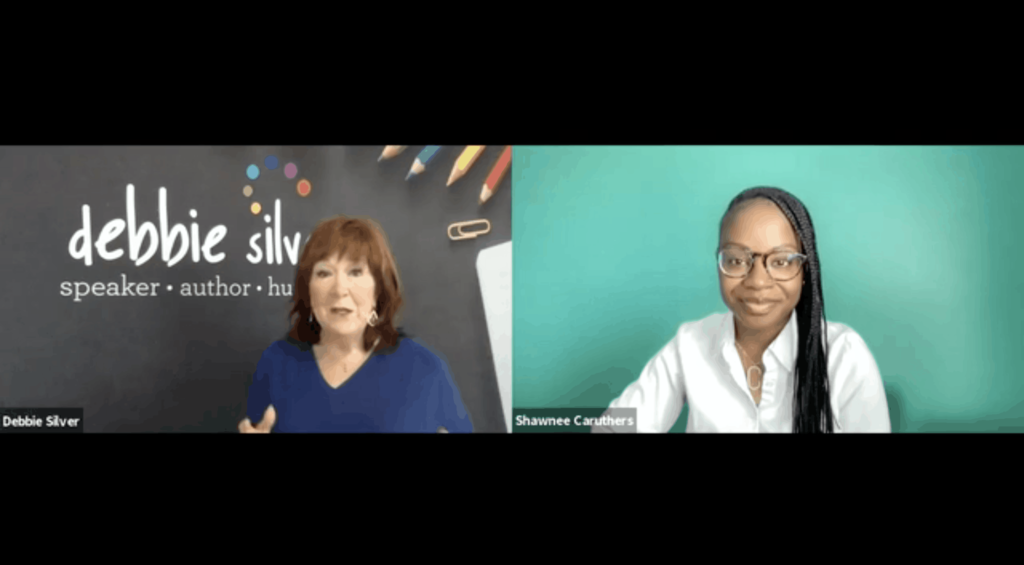
You’re listening to the Getting Smart podcast where we unpack what is new and innovative in education. I’m your host Jessica and today Shawnee Carruthers sits down with Debbie Silver to discuss the second edition of her book, Fall Down Seven Times, Get Up Eight. Dr. Debbie Silver is an award-winning educator with 30 years experience as a classroom teacher,
staff development instructor, and university professor. Aside from being recognized as Louisiana State Teacher of the Year, she is also a popular education keynoter and author. Lots of us are in as Debbie and Shawnee chat about agency, self-efficacy, what parents should be telling their kids, and more.
Debbie Silver, welcome to the Getting Smart podcast. It’s so great to have you. How are you? I’m great. It’s good to be here.
Thank you, Shawnee. Oh, you’re so welcome. You know, this is a great week for all of our educators. It’s Teacher Appreciation Week and, you know, here at Getting Smart. Yes, we love to honor and celebrate teachers.
And I know that you’re formerly a middle school science teacher, I believe. So why education? Well, it actually was an accident. That was never my plan. And I’ve actually taught every grade except for kindergarten, but I found my place in
middle school science. But I actually started out as a temporary substitute at Logan’s Sport, Roads and Walls Elementary in Logan’s Sport, Louisiana, and fell in love and went, oh my gosh, you know, this is what I want to do. And so I did for 30 years.
I’ve taught in various capacities. And as I said, I moved up to middle school after having taught almost every grade and then started teaching future teachers and now work with both future teachers and now teachers. But I had no idea about the rewards and the fulfillment. And I think it’s probably the greatest contribution that I can make to the world today as a teacher.
And I figured that I was lucky enough to figure that early on. And so that’s what I’ve always done. Oh, that’s great. I mean, teachers have a huge impact on, you know, who and what we become sometimes. So you’re absolutely right.
And you’ve been described as where education and humor and humor collide. How do you see those as related? Well, for one thing, I think every teacher has to be authentic. And I was lucky enough. I’ve got a long story we won’t go into.
But I started teaching with no degree. I only had two hours. I mean, I only had a half a degree at 60 hours, but none of those were in education. But they had a desperate need and I feel that need. And at first I tried to be what my teachers had been, you know, pretty rigid, pretty concrete,
pretty sequential, and I was miserable and so were the kids. So I finally just kind of started being myself and I’m more of a random, pretty much the humor and everything kind of a clown. And it worked and it worked for me. And that’s why I’m doing this, you know, decades later because I think every teacher needs
to find your authentic self. And my original dream was to be a stand-up comedian and a writer. And somebody was asking me about that the other day. I said, do you miss that? And my husband looked at me and he said, yeah, that’s what you do.
And I went, you know, you’re right. And I didn’t plan it. I didn’t even see it coming, but it just all turned out that way. So I’ll always say, do what you love and get really good at it. You can’t forget that part, but work hard and get good at it and the rest will follow.
Absolutely. It’s so great that you were able to combine your passion with just your knowledge, which is what we encourage students to do every day. In an interview that you did with Corwin, you mentioned that people just aren’t joyful anymore. How can we better teach joy and live joyfully?
And, you know, it’s interesting because because of COVID, I’m seeing a whole lot more emphasis on that, a lot more conversation about that. But prior to COVID, two of my colleagues, middle-level educators, also Jack Burtmeyer and Judith Thaynen, and I wrote a book called Deliberate Optimism, Reclaiming the Joy in Education.
Because in our work around the world, what we saw was teachers were losing their sense of autonomy. They were losing their sense of joy. There’s so much that’s top down directed, you know, very little input from teachers that was being required of us that what we saw teachers was just drawing in. And so we did some research and set out to find out how do you incorporate more joy,
be deliberately optimistic. And we looked at the work of Seligman and several others that talked about their choices you could make to be joyful. One of them is having you frame the circumstances, which is a big Martin Seligman piece. And he’s right, you know, you can’t control the circumstances, which I’m happy to hear everybody’s talking about now. But, you know, even Mandura talking about self-efficacy, if you want to feel like you have power,
you’ve got to get really good about figuring out what you can control and what you cannot control. And so we were telling teachers, you know, if you go into the lounge and you’re tilting at windmills, you know, oh, ain’t it awful? Look what the superintendent did. Look what the state board of education did.
Guess what the parents are doing? Most of those things are way outside your realm of influence. And so that’s kind of wasted time. It’s kind of negative. So you have to start focusing on the things that you directly control,
which would be your relationships with your students, you know, small steps. The other thing is self-care. And thankfully, everybody’s talking about that now. But it is important because I was that teacher that thought, you give and you give and you give until you drop.
And then it took me a while to realize, you know, there’s a point at which when you’re at school, you give kids your total, undivided, focused attention. So millennials, that means turn off your cell phone. That means shut off your social media. That means when you’re with kids, be with kids.
Focus. But what I had to learn was when you’re done with school and you get home, then you switch your focus back to those people are your puppies or kittens or whoever’s there to greet you, but you focus on them. And I get asked a lot, you know, how do you divide your attention and your energy?
And I said, I didn’t do it really well, but I can tell you how to do well. And the well part is when you get ready to walk in the house, you put the biggest smile on your face and you let those people at home know that you’ve been waiting all day to be with them. If you and Brene Brown talks about this, if you only do it for 30 seconds, you set the tone for the rest of the day.
And, you know, Del Carnegie used to say, act enthusiastic and you’ll be enthusiastic. And I was originally a drama major. You’re probably going, no way. OK, way. But one of the first things they taught us was if you want to emulate an emotion on stage,
physically do the things you do when you feel that emotion. In other words, if you just walk in the room and slam the door or just walk up and smack somebody, it breeds that assertiveness, that aggression, that hostility, that anger. But if you take a moment and breathe, which we’re all talking about mindfulness now, and get a hold of yourself, get back in that prefrontal cortex,
then then you make decisions that are better. But so much of it is the way you frame things. You know, you look at a situation and your limbic system is saying you need to react. You need to get even. You need to do whatever or protect yourself.
If you can take just that moment to breathe and get back up into that thinking part of your brain to choose a better reaction. And it was Victor Frankl, who wrote Man’s Search for Meaning, one of my favorite books. And he’s been a prisoner of war camp. He had been a prisoner in a prisoner of war camp from in Germany during World War Two.
And he’s Jewish and he was persecuted in every kind of degradation that can be put upon a person was put on Victor Frankl. And when he got out and was one of the few survivors and wanted to go right back to work as a psychotherapist, people said, how did you do that? How did you maintain your sense of optimism, your sense of survival?
And how did you come out not being angry and bitter? And he said, there’s there’s freedom in your response between every stimulus and response. There is a freedom of choice. And when you make your own choices, then that gives you freedom. It’s me, a lot of teacher joy has to do with freedom.
We want to be in charge of our rooms. We want to be in charge of our students. We want to be in charge of our own lives. So focusing on those things, that brings me joy. Oh, no, I love that you speak about perseverance and being fully present in the humility,
the vulnerability that you spoke about with Renee Brown. And I know you’re also very inspired by Carol DeWitt and those growth mindset components as well. And you’re right, that’s all that we need to to be whole and to also encourage or and get permission, I guess, to our students to be able to do the same. So thank you for hearing that.
And I also want to just offer a congratulations on your on your book. Oh, thank you. Seven times and and get up eight. What inspire you to write this book in the first place? Well, in the first place, I have five sons who have varying degrees of success in school,
even with, you know, two parents who are in education and step parents. And I just kept thinking, what is going on? And in the classroom, pretty much, you know, things went pretty smoothly. But about the time I wrote, fall down seven times, get up eight, I was doing guest appearances like I would go in and do a science show.
For kids. And that’s pretty exciting. You know, I bring snakes and rockets and, you know, just say, y’all come up here, we’re going to play. And occasionally, students would say, well, what do we get if we come up there? And I’m like, let me tell you what you’re going to get if you don’t get up here.
And I mean, what do you mean, what do you get? And that’s what I really started looking at the entitlement that was coming around. And it’s about the time I started having grandchildren. And I’m looking at how many times we tell kids how great they are. And, you know, I’m thinking, OK, I probably did that too.
But I started reading Dr. Dweck, who was telling us that you don’t want to praise for anything that a kid cannot control because you either lead them into entitlement or they can get the learned helplessness. Like I’ll never be that good. I’ll never have that. I wasn’t born with that, that fixed mindset.
So I was really curious about all of that. And started doing my research on, as you said, the persistency, the tenacity, the resilience and really what is it? Because how many of us have known that kid that was straight A, ballot Victorian, got to college and did a total face point.
And then all of us have taught that kid who had no reason to be successful. They had everything going against them. You knew their home life. You knew what was going on. You wanted to fix it, but we’re teachers and can’t fix everything.
And then that child just rose from the ashes like a Phoenix, which is why I teach. And you’re like, how did that happen? And my belief was this is something we can teach. This is something we can do something about.
And I looked at many of the faux pas that I made all in good faith, but really wrong, especially with gifted kids. And I learned a lot in my research and I wanted to share that. And I also wanted to give examples, because when I first started talking about Dweck’s work, people would say, oh, I love, you know, what you’re saying.
I love what Dweck found out. But how does that look in if you’re a parent in my home? Or how does that look if you’re in this situation or that situation? So I’m pretty good at taking research and making it very practical. I would say that is my gift is that I can read the research.
I like it, but I can also turn around and make it very practical and applicable for teachers and parents. So that’s what that book was about. And I have to tell you, I’ve written four books. That’s my favorite.
And so when I got the opportunity to do the update, the edit, I jumped on that because in between that release and the new book came all of the problems we’re having now with the finding a digital balance. You know, we’re now talking about addiction with kids, talking about digital addiction and social media and what is the influence.
I also really fleshed out the gifted part. Two of my stepson, one of my stepson’s and one of my son’s were labeled gifted. And I had done a lot of looking into that after the book was written. So there’s a whole half a chapter about how this particularly applies to those gifted kids. But I guess I’ve always been the advocate for the underdog.
Ever since I started teaching, that was always, you know, give me the low ability kids, give me the problem kids. They just filled my heart. So I put in more things about them because people have misinterpreted the work’s work to to say, oh, well, no matter what your horrible
circumstances are, you know, that are absolutely deplorable and no other human being would be alive. But if you’ll just work hard, you can be whatever you want to be. And no, that is true. And kids know that. So I really wanted to go in and be even more realistic about how do we give kids a reasonable
chance at success? And that means every single kid. And that means what do we need to do to make that playing field where everybody can be successful? And then we teach them the skills they need to do it. We don’t just say, well, if you had more grit, which I’m not really a fan of that word,
but if you had more tenacity, if you had more resilience and put it all on the learner, I think that’s wrong. I think it is an interaction between we advocates for the kids and the kids. But I think there’s a lot to be learned about the feedback that we give kids and the what we do to bring them to the next bar to keep raising the bar.
When I taught at Rose and Wild, one of the problems was because we were all black, all on free lunch, low socioeconomic. What I saw, even among my colleagues, were, well, these poor little kids. And I said, but sometimes I was mispaced them. I would be addressed, you know, mispaced, you’re asking too much.
These kids can’t do that. I said, but they are. And they went, but you’re asking too much. And I said, but they’re doing it. And I saw that also when I worked in Canada with First Nation, the people telling the kids
that they’re not as much as many times are the people in the village, the elders in the village are promoting this, this misconception. And so I think it’s really important that every teacher, you know, race, gender, don’t care, whoever you are, you take every kid individually and you look them right in the eye and you figure out where they are, not where they should be, not where they ought
to be, not where they’d be in a perfect world, not where the states as they are. Where are they? And then we gently raise the bar just beyond that. And we step aside and give them the reins all the time, maintaining the support that they need to keep moving forward.
Yeah. And when listening to you share those examples, it just makes me think of just that those notions of agency and equity. Yes. I’m interested in hearing how you feel like they connect and how do they differ? Um, well, agency, I think, has to be developed in anybody. It’s a combination of your self-efficacy, your belief in your power system.
And it’s also a combination of your resilience and persistence. But I’ve seen kids in the most dire circumstances that had agency. You know, they’re kind of like, don’t tell me, no, I’ll come back and I’m on this joint. And I’ve seen kids with every reason to be, you know, everything that just give up. Now, let’s be realistic.
In our world, when we’re talking about kids who achieve, kids who don’t achieve, we’re coming from very different circumstances. This belief that anybody can be anything they want to be is a lie. And we never should have told kids that in the first place, although I used to tell them that. But when I really looked at that, the research is really clear.
Anybody can be better at anything if they’re willing to make the effort, make the choices and stick with it. It doesn’t mean you’re going to win. It doesn’t mean you’re going to be on the top. It doesn’t mean you’re going to be a millionaire or a famous.
But it does mean if you have sincere desire to get better and you stick with that, you will get better. You can’t help but get better. But on the equity issue, you also have to look at, and this is what Malcolm Gladwell and others have pointed out, even when you’re looking at equal talent.
And I think talent is just jacks are better. You know, that’s what you open with. It’s what you do with it. That’s important. But we have to acknowledge that, you know, if you are affluent, you can move to a
place where there’s more opportunities for your kids. You can hire coaches. You if you’re not having to worry about where your next meal coming from or safety issues, you have more time to devote to your to your goals. And all people don’t have that luxury right now in the United States.
And that’s what we have to work for. And when I say give every kid a reasonable chance at success, that’s part of it. I mean, maybe at school, I can totally protect. But what if my kid goes home to a community where being smart is looked down on? And maybe he’s bullied, you know, in his neighborhood because, oh, look at you
trying to be the smart kid. And they have this dual identity. So they’re trying to maintain two identities and move forward. And it’s hard. And I really think it’s time that we start admitting that, you know, this is a hard
road, but at the same time, hold those kids to what they can do, which everybody can make one small step forward, an incremental success. And then where do I get my joy when they do it? When they reach those goals and we celebrate together and then they go, I did it. Look, I did it.
Yes. Yes. Yeah, absolutely. And I know that you speak about sometimes when you’re not continuing to hold them to those standards that there is this learned helplessness. It is, which is the opposite.
And this is I can’t. So I won’t. So I quit. So I fail. So I can’t.
So I won’t. So I quit. So I fail. It is a self-fulfilling prophecy. It is cyclical.
And it is sometimes like I mentioned, you know, with First Nations, it is sometimes taught by a community. It can be picked up from a family. We’ve all heard this, you know, where somebody goes, well, no wonder you didn’t get that.
Your last name is Jones and Jones’s don’t ever get anything. And I’m telling Pierce, why would you ever say that to a child? Because you’re killing everything they have that has to do with hope. And that’s basically who those kids are. They’ve lost hope.
They also believe I didn’t I didn’t get the smart gene. I didn’t get the artistic gene. I didn’t get the physical prowess gene. Therefore, I’m a loser. I’m never going to have it.
And that is all part of a fixed mindset. Now, gifted kids can have it too. You know, they can finally figure out they’re not the smartest person in the room. And it can absolutely devastate them. So if we come in and encourage kids about getting better, about really working hard
on the journey and admit that it’s hard to say, oh, yeah, this part is not easy. You’re probably not going to like it. But we can think of some things that might get not so bad because nobody ever got here that didn’t start here. But if kids genuinely believe that you can affect your future with your work
and your choices, then they have power and it won’t be learned helplessness. But, you know, it happens. We had my youngest stepson had the genius older brother, the gifted brother. And he was very literal and kind of slow to think about things. He just really needed to mull it over, totally introvert opposite of his brother,
the extrovert and got labeled in as an elementary kid. And what they told him was you’re not very smart. And he actually believed that and his parents believe that. And then he came to live with me and I’m like, wait a minute, because he would say these things.
And this is what I love about being in the classroom because you watch kids, you look at their eyes, even the kids that are not interacting. You can watch them and you’ll say something, their eyes light up and you’re like, wait a minute, what do you know about this? And they’re like, oh, no, anything.
Yeah, you do, you know, share it with me. But this kid who finally got it turned around, got out of the learned helplessness, finally found out he had dyslexia, which he did not know into the seventh grade and found out that he can do it. It just has to do a little different path and it takes him a little longer.
He now has two master’s degrees and he’s a certified counselor in the state of Texas. One of the biggest contributors to a good world that I know, one of the finest people that I know, Andy Silver, but it took somebody saying, you know, Andy, you’re not Scott, your older brother, you’re Andy, but you’re really cool who you are.
So you do it your way and let’s make that happen. No, I absolutely love that. In the book, you also talk about, you know, the examples where teachers are saying, like I’ve told my students that failure isn’t an option. I want to have failures in my class and I want you to talk about what’s wrong with that.
And, you know, and I relate it back to one of the things that you send out in all your graduation courses. I wish you bad luck and that commencement address by Chief Justice John Roberts. So I know you firmly believe in, you know, about that failure notion. So can you talk more about what’s wrong with teachers telling students
that failure isn’t an option? Yeah. And I want to be fair. I think what they’re saying is I’m not going to give up on you. And we do have kids that’ll say, I’m just going to take a nap and teachers are like, you know, that’s your choice.
And I’m like, no, I’m not doing that. But when you make that statement, failure is not an option. What you’re implying is that failure is bad and that if you fail, you know, that’s a misstep and that shouldn’t have happened. And you’ve got to really quick get back up and cover your tracks.
Whereas, you know, I learned from Dr. Dweck who articulated it so well that failure is and I don’t mean to be counterintuitive. You know, you know, go, yeah, I failed. That’s so great. I did a total face plan. I mean, nobody does that.
But how about we start looking at our missteps as, whoa, that was not good. But what did I learn from that? What if in class instead of walking in going, OK, who made 100? Raise your hand. OK, so good. Let’s give them a round of applause.
How about we walk in and go, all right, who totally blew that a sound and let them raise their hands and go. So tell me what happened and let them tell their story and go, huh, OK. So what did you learn from that? So kids start learning that, you know, and there’s different kinds of failure.
If you go to their website that brainology is the name of the website. They talk about, you know, there’s some failures that can be pretty catastrophic. And but a lot of failures inform us, you know, watch a baby learning to walk. They don’t just get off the couch one day and take off across the room.
They fall down, they get up, they fall down, they get up. So Chief Justice Roberts had written, I came across it in my research, had given the closing address for graduation of middle school. And it’s called I Wish You Bad Luck. And it’s in the book.
You can see it or you can Google it and find it. But what he tells kids is, you know, I wish you enough failure to give you the tenacity to go forward and to realize I wish you enough like people being rude to you for you to appreciate kindness. I wish you enough stumbling blocks for you to understand that for some people,
you know, their stumbling blocks are bigger than yours. And you need to be compassionate about that and you need to have empathy for that. But it’s just this beautiful speech. And so I wrote him and asked him, could I use it? And like you said, I send it in my graduation announcements
because what it is saying is the same thing that a lot of us are saying, that failure has to be treated as an event, as a circumstance. It’s not a person because I have kids that go, I am a failure. And I always say, but you can’t be because you’re not done yet. Get back up. We’re going to try it again.
And, you know, there’s a lot of posters and all of that. I think more meaningful for kids is having a teacher that models that in the classroom because we fail. I fail with technology all the time. But to say to kids, you know, oh, man, you know, really should have read the directions a little better, going to have to reach out for some healthier guys.
But when they see the adults around them doing and I have that in the book, a lot of examples, then they’re more likely to say, well, I didn’t want that to happen. You know, that wasn’t the plan. But here’s what I learned from that.
I love that you define that failure is not a person. It’s not a persecution. It’s a learning experience. Absolutely. So powerful. As you have gone through your educational journey,
what’s the thing you wish you knew earlier as a teacher? I wish I knew a lot more about the not giving feedback on things that kids can control. My kids were my perception was they were star for affirmation. That was really early in the 70s.
And a lot of their parents felt like if you bolstered a kid, they would be conceited. And so they really try to, you know, keep them in their place. And I didn’t feel that a lot of my kids got a lot of affirmation, which is fine, except I went over the top. You know, and if a kid’s saying like two notes on key, I’m like, there you go.
You know, there’s our next Grammy Award winner. Or if they wrote two lines of poetry, there we go. Our next, you know, Maya and I just went way over the top, which I explained in the book is leading kids into entitlement or learned helplessness. And I also think I didn’t push my gifted kids enough.
You know, I was so grateful for those kids that were very sequential and, you know, turn in their notebooks and everything. I don’t think I ever raised the bar for them. It was like, oh, who they’ve got it great. And I did raise the bar for my, my, my struggles,
but my high flyers kind of think I’ll let them down. So if I had it to do over again, I would make sure that all my feedback had to do with things they could control their effort, their choices, having a good heart, being brave, going first, being resilient, you know, trying it again, I would just really acknowledge that.
And I would stay away from, oh, you’re so smart. You’re so pretty. You have such athletic, you know, prowess. I’d lay off the labels because I think feedback that labels good or bad is detrimental. It’s just more like, OK, here we are.
So let’s look at what it is and let’s see where we go from here and leave off the personalization, leave off the prior, you know, experience. Just look at that kid with the expectation. I know you want to get better. So here’s what I’m going to do to help you with that.
Really nurturing the whole child. Yeah, baby. Absolutely. Well, I just love talking to you today and just learning more about your work and your definition of joy and what brings you joy. And just how you feel about failure and just what you’re trying to help
teachers and parents build up in students. And it’s just removing those labels and just really personalizing it for the kid right in front of you, looking them right in the eye and helping them to be what they can become and not anyone else. So thank you for chatting with us today on the game.
You’re so welcome. Yes, it was a joy. Thank you. Thank you. Thanks so much to Debbie for joining us today. We appreciate her lifelong commitment to personalized learning and helping learners achieve their highest dreams.
We’d also like to thank Corwin, the publishers of fall down seven times and get up eight for sponsoring this episode. We will have more episodes with Corwin authors in the coming weeks. All right, that’s it for today, listeners, for the Getting Smart podcast. This is Jessica signing off.





0 Comments
Leave a Comment
Your email address will not be published. All fields are required.