

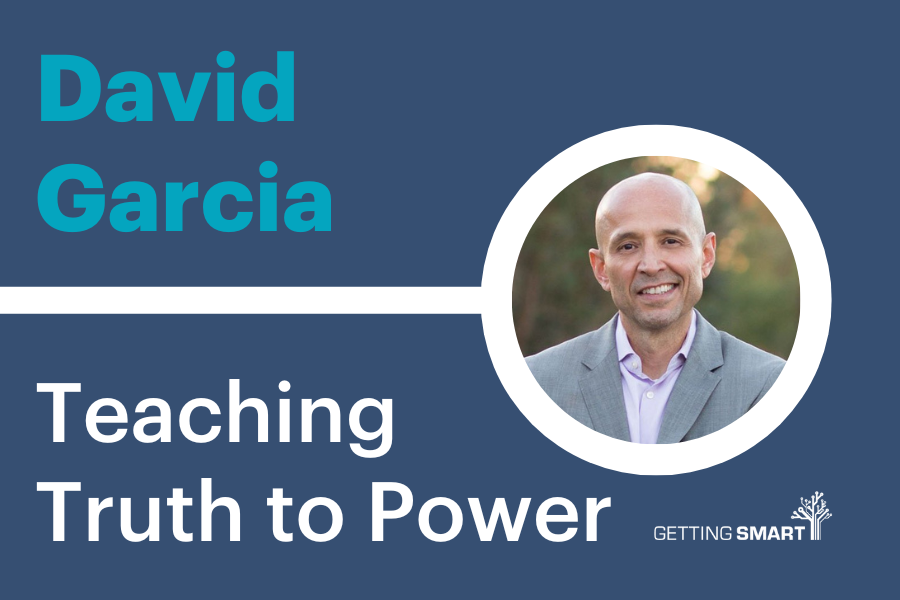
David Garcia on Teaching Truth to Power
Key Points
-
Everything an academic publishes needs to be translated into a localized language.
-
Policy must be consequential, applicable and jurisdictional and therefore research must support policy in getting to this end.
This episode of the Getting Smart Podcast is a part of our New Pathways campaign. In partnership with American Student Assistance® (ASA), Stand Together and the Walton Foundation, the New Pathways campaign will question education’s status quo and propose new methods of giving students a chance to experience success in what’s next.
On this episode of the Getting Smart Podcast, Tom Vander Ark is joined by Dr David Garcia, Associate Professor in the Mary Lou Fulton Teachers College at Arizona State University. A former Arizona Associate Superintendent of Public Instruction, and recent author of Teach Truth to Power: How to Engage in Education Policy.
To g-e-t you have to a-s-k.
David Garcia
Links:
Transcript
This transcript has not been edited for spelling accuracy.
This episode of the Getty Smart podcast is part of our new Pathways campaign. What is something you used to think that you’ve changed your mind about? It’s time for us to do that with all things learning. Previous Getty Smart campaigns have laid the groundwork of networks, place, purpose, and innovation. Our latest effort, the new Pathways campaign, will serve as a catalyst for an unbundling education
to allow for new learning models that are sustained by supporting guidance and embedded in scalable systems. In partnership with ASA, the Bill and Melinda Gates Foundation, Stand Together and the Walton Foundation, the new Pathways campaign will question education status quo and propose new methods of giving students a chance to experience success in what’s next. Find out more at www.gettysmart.com.
Backslash, New Pathways. Music David, why should research influence education policy? Tom, I think really if you thought about that for that second research is how we know what we know in policy. And you know, it’s important to have research influencing policy for people to make good decisions.
Look, rather you’re a Democrat or Republican, you put the politics aside. If you put people who aside who are trying to persuade your opinion and just start asking the question, what’s happening out there and what do we know and what’s going to happen next? If you’re looking at a means to answer that question, then you go squarely into research. And that’s why research is important.
Now, I also recognize that there’s a lot of folks out there and there are ways, you know, statistics and lies, and a thousand ways to lie with statistics. I’m not arguing that in any way research is completely benevolent, doesn’t have the same tendencies as other places. But in the end, as we look at education, as you look at the state of the world, if we want to stand on firm ground instead of sort of sifting sand,
we’re going to turn to some way of having an inquiry and getting an answer to what’s going on. And that’s where research gets in. I’m Tom Van Erick and you’re listening to the Getting Smart Podcast. Today I’m joined by Dr. David Garcia. He’s an associate professor at Arizona State University.
He’s also spent time in state government. He was the associate superintendent of public construction in Arizona. He staffed the Senate Ed committee. And David also ran for governor in 2018 in my co-home state of Arizona. David’s the author of a recent book, Teach Truth to Power, How to Engage in Education Policy.
David, it’s great to have you on the podcast. Tom, thank you. I’m excited to be here. I appreciate you investing a little time in research. I have a related question to the opening. Does education policy matter? Why should we pay attention to policy, particularly state policy?
That’s a very good question because sometimes I think people start asking questions like, do schools matter? Because it’s around us. It’s almost, we don’t know, at least in for a very long time, that the United States, without public education, for example,
without the idea of having folks locally as well as nationally trying to make decisions around schools and schooling. And I think because it’s always around us, we may have the tendency to have taken it for granted. Until you get circumstances where if you’ve ever been out of the country, for example, I’ve seen a public education system that doesn’t work.
You come to appreciate, for example, the United States public education system. And so if you answer the question about policy mattering, if it’s going well, you almost don’t see it, right? You almost don’t see it because your schools are operating well, because your students are getting educated,
because your community is getting the benefits of education. You come to notice it when it isn’t going well, when your school board is spending more time fighting with each other and getting something done. When you look and you see that your buildings are dilapidated
or you find out that your students aren’t, or your kids aren’t where you want them to be, then you start asking policy questions. You start asking questions around what’s going on, what kind of decisions need to be made, what kind of changes need to be made. And you come to realize that policies really do matter.
I’m curious, David, what percentage of your colleagues, your fellow academics, do you think have an interest in and maybe more specifically are involved in policy and policymaking? Is it five or 10%? That’s a great question. Let me tell you what percentage have an interest in it,
and I’ll tell you what percentage I think are actually involved in it. So, Tom, you’re likely familiar with journal articles, well enough to know that at the end of every journal article, you’re going to see a sentence that reads something like this. Policymakers should.
After all the research, after the statistics, after everything has been reported, at the end we put these policy recommendations and they’re ubiquitous. They’re in almost every journal article, almost every book. And I would argue that a lot of my colleagues believe that they want to believe, I’ll say, they’re engaging in policy because at the end they put that sentence that says policymaker should
and they put some recommendations. As you mentioned in my opening, I did spend some time with politicians at the state level, as well as the national level. And I know well enough that at the end of my journal article, the end of any researchers to academic journal article,
that sentence alone doesn’t mean you’re engaging in policy. Likewise, we got a number of academics relatively recently, the last 10 years or so, who do things like you’re doing, podcasts, blogs, et cetera, and they feel like they’re engaging. I think that is a step forward.
But if you are engaging, in my opinion, you’re getting face to face with politicians, because politicians are the ones that create policy. And if you’re not getting face to face with politicians, you are engaging from arm’s length, and I would argue probably not engaging effectively. The book comes and it has lessons from lobbyists.
And I know that’s kind of a dirty word out there for academics. We don’t see ourselves as lobbyists, you know, but the reality is lobbyists are an exact, if you think about it, we’re doing the exact same thing lobbyists are. We’re trying to get politicians to pay attention to what we have to offer to make a decision in no direction that we think they should go.
That’s no different than a lobbyist. We’re not getting paid like a lobbyist. We’re not officially a lobbyist, but we’re lobbying in that respect. And so the book takes lessons from lobbyists. And lobbyists will tell you that a sentence at the end of a journal article
or a one-way communication on a blog isn’t a way to create policy. And so I would argue if you’re not engaged face to face, if you’re not face to face, then you’re not engaging. David, it seems like there’s pretty strong at least early career disincentives for academics to get involved.
Do we have to wait until people are tenured and on the back half of their career to start getting involved in policy? How do we deal with the structure of disincentives? Tom, that is a great question. In fact, I’ve done a number of these from the book,
and you’re the first to ask that very, very insightful question. Yeah, you’re told as an associate professor, put your head down and write for six years basically to get tenure. You’re not really too engaged. And there is disincentive to engage.
You know, it doesn’t count on your VEDA. You don’t get promoted. You don’t get tenure from it. In fact, you’re probably going to get in trouble from it. You’re dealing with folks who have power and can handle the purse strings for university. And so there’s a lot of disincentives.
On the other hand, however, Tom, one of my favorite things to do when I go to academic conferences is I’ll go to the graduate student sessions and I’ll go listen to graduate students. Tom, they’re in graduate school to do something with their research. They’re in graduate school, yeah, to do research and to study and to engage and to answer questions
and pursue inquiry just like I was. But in the end, they want to go do something with it. And it was kind of an inspiration for me in the book because these graduate students, they’re there to go out there and change something. They’re there to engage.
And somewhere along the way, they become associate professors who get dissuaded from engaging and eventually become professors who engage from a distance. And if the book can change some of that, if the book can give some of these early career graduate students a path to engage, then I think not only are we writing for each other and writing for to create knowledge, we hopefully are putting ourselves in the position to write for those who are going to make decisions for the students
and communities that we care about. Let’s go back to the research question and talk more specifically about how research can help. Help in policy formation. And I want to talk about special purpose research that might be specific to policy development as a and or a general review of research that’s used to guide policy. So are both of those important to sort of lit review guidance and the special purpose research?
All right, so I don’t want to complicate it too much here, but I’m going to I’m going to give you this the straightforward as I can. Politicians don’t use research. They don’t. What I publish with anybody else publishes in an academic outlet is not useful to a politician. And it’s not useful to a politician because if I were staffing you, Tom, and you were elected official and I used to be a former staffer,
I would try to get you the most localized information I can about your constituents and about the other policymakers around you, because that’s what you need for the horse trading and for the work that politicians need to have in it. That’s more like accounting. What politicians ultimately covet is accounting. The problem is we don’t do accounting as researchers.
That’s not what we do. You might get some of that from some government agencies and the like. And so everything I publish, everything that academic publics needs to be translated to local context. Somebody needs to take it and take pieces of it, not the whole thing and apply it to a local context so that even if you don’t have localized data, you’re translating, you know, generalizing is another way to maybe say it, but I think it’s more specific.
So if I were staffing you and it was a study that was coming out on a topic you were interested in, I wouldn’t tend it to you and say, here, Tom, you’re elected official, go read this along with every other decision you’re going to make. You’re not going to read it. Me as a staff person would narrow it down and say, all right, Tom, from something I just read, here’s what you need to know about you and your constituents and what it means for something that matters to you.
And, you know, that to me tells me that they don’t just take it off the shelf and use it. It has to be translated. Again, we take a look at it in the book, but your question is an insightful one because no specific journal article alone is going to move policy in that way. And like I said, policymakers are going to want to know, OK, great, the study’s been done, but how does that affect my constituents? And there’s where we need to do a different job as academics.
In Chapter 10, you really made this point really well. You invited your colleagues to think about their research around practical problems and said the research to be meaningful has to be consequential. So, you know, meaningful difference, number two, widely applicable, and almost the flip side of that coin, jurisdictional, like relevant to localize jurisdiction. And so I love that sentence, that idea of being consequential, applicable, and jurisdictional. I don’t think there’s many academics that think about their research in that way.
I think we typically rely on a 26-year-old staffer to make those decisions when you’re inviting academics to think about the work that they’re doing about is this and where would this be consequential, applicable, and jurisdictional. Is that fair advice? Yeah, well, you know, let me, you know, one of the things we, when I talk to academics, Tom, one of the things they say is, you know, people get elected and they don’t know anything about education. And in the book, I argue, yes, that’s the way it’s supposed to be, right? So, Tom, you know, if you were to run for office and win, OK, I’m going to venture these say if you were on an education committee, you’d know plenty.
But you probably, you, not probably, you will be on other committees. And you would be on, for example, the transportation committee. Tom, what do you know about transportation? I have a car. You have a car, that’s exactly right.
And so in transportation, do you know who you would rely on? You’d rely on that 26-year-old staffer. Yeah. Because, and by the way, you’d be making health decisions, forestry decisions. And so I argue in the book that politicians are novices and it’s by design.
It’s not a bad thing. It just means that, you know, they come in, they’re lawyers, they’re car salesmen, they’re insurance salesmen in Arizona, they’re ranchers, and they’re not in education. And but I don’t see that as a bad thing. I see that as an opportunity for us as academics to teach. And so that’s the reason why the book is called Teach Truth to Power.
It’s a take off of Speak Truth to Power, as you probably know really well. You know, the famous book. But there’s a lot of people who will speak truth. There’s a lot of people who think they speak truth. They’re down at the legislature yelling.
One of the things that we can offer, we’ve got information, we’ve got good research. We can put ourselves in a position to teach. And so for you, Tom, if you were coming in and you were in the legislature and I was a transfer, you know, and you were making a transportation decision, you would rely on a 26-year-old lobbyist. And you would need me as a transportation researcher to put this in a package where you can understand and make some decisions. It’s the exact same thing we see in education.
I appreciate it. You have a chapter on doing one pagers of actually turning research into brief, useful briefs. So I want to back all the way up and you argue that this is not really a science. It’s a craft. So I love that.
But what do you mean by that? This influencing policy is really a craft. Well, so you’re going to have some of the science, right? Just like in any craft, a good craftsman has some skills that they have honed, that they bring in. However, a good craftsman walk into every situation and assess that situation for what it is, right?
Whether you’re carving wood and every time you get in front of a new piece of wood, you’ve got to figure out what to do with it and how or whether you’re dealing with anything. It’s the exact same situation. We’ve got skill sets and we bring those skill sets into interpersonal situations with different people. And it is adjusting.
It is getting yourself to communicating with different types of people with your skill set that makes it a craft. And so, you know, you can walk in the door and if I were, if I were, you know, if I were walking in with you and you were talking about an education issue, I’d approach you differently than a transportation issue. One of the things that I talk about in the book, for example, around this idea of a craft is one of my favorite questions. And every time I’m working with a new politician, I ask him the same question.
I ask him the education story. I get them talking about their education story. And I learned so much. I learned that maybe they’ve never been to a public school. Maybe they went to a one-room schoolhouse in the middle of Arizona and the middle of Washington.
Maybe they’ve never been in an urban school. Maybe they’ve never been in a special education classroom. Maybe their sibling or son or daughter is in special education. You gather and a good lobbyist do this. I watched them do it over and over and over again.
And they’ll tell you, you know, did they like their teachers? Did they not like their teachers? And now that I’ve taken that information about you, Tom, here’s where the craft comes in. I take what I know. I take my research and I tailor that to where you are in terms of understanding the issue or understanding public education.
We in education, we study a lot of niche groups. We do a lot of, for example, intersectional studies where we study students who are of multiple, you know, races or characteristics. And how do I explain to you the importance of, let’s say, paying attention to female Latinas if you’re a white male? And what do I do to make that connection? You know, the book talks about that because there is where the craft comes in.
I mean, every politician I’ve been in this office is both for a Democrat, by the way, you should know I worked in my position. I worked with it was about research position. I worked with Democrats and Republicans and both groups had what they called their people, people that they connected with because of some affinity and affiliation. And the good lobbyists told that education story and then they tried to make a connection, any connection so that they could be counted as their people, right? And once you have counted that, once you kind of pass that threshold, it’s much easier to start getting information across if you’ve got some kind of connection.
Ken, you mentioned lobbyists sometimes line up by political tribe. Does that happen in academics and as academics, do we have to try hard to be effective across political aisles? I think we need to be brave enough to reach across political aisles. Yeah, I think we do. You know, a lot of politicians I talked to would argue that most of coming what’s coming out of the university is pretty left and pretty liberal.
You know, the exception might be quantitative studies. For some reason, they politicians see numbers and they don’t think that they have a, I think they find them to be more like conservative or center right or whatever the case may be. But you know, the reality is we’ve got to get across both sides. And one of the questions that I’ve gotten from academics is, well, nobody’s a legislature wants to listen, right? You know, everybody’s got their own position and they want to listen.
Well, if you were to talk to lobbyists again, the guys, the men and women who do this, they would say, if anybody’s going to give you an audience, you bring what you know, you bring your best presentation in and you give it. Because you never know where you might find a connection and you never know where you might find some allegiances. We just need to be brave enough to do it courageous enough as academics. And the purpose of the book is to help academic who do exactly that get themselves in the position to get a good presentation that one page or you talked about, by the way, I want to be clear. It’s not a summary of your research because a shortened version of a longer study that isn’t applicable isn’t any more applicable than the longer version.
It’s a different one pager. It’s a different one pager that I have. I spell out in the book that specifically intended to communicate to politicians and you get that in front of anybody who will give you an audience regardless of party. And that’s how you start building some coalitions and making things happen. All right, this is two questions here you the book in a lot of chapters talks about getting face to face with politicians.
So I want to know more about like where and how you’re advising people actually do that to go face to face. And then secondly, your book talks about unusual or unexpected allies like interest networks. I’d love to have you talk about both of those as academics think about getting active. What does it mean to go face to face and then and then how might you network with other potential allies? Yeah, good question.
Let me start by flipping that around. Let’s start with the unlikely allies because that’s probably going to be step one to get you to politicians. So look, working at the legislature is a lot like Groundhogs Day, Tom. You know, you get the it’s the same much of the same issues every single year. In fact, you know, having former staff there, people get elected and they come with a lot of the same issues that the previous people who just got elected come because, you know, they’re paying attention to the same things out there in the public.
And so what you also get, however, is you also get these these affiliation groups that come to the legislature, right, the business community, the education community as a former staffer. If you were, let’s say with the teachers union, I know what you pressed. I know what you were pushing last year and you’re probably pushing the same thing that you right. And you tell me Garcia, we got this new study. I know what it’s going to say because if it doesn’t support your position, you wouldn’t be bringing it to me, right?
You only bring the things and there. So you got people bringing the same directional team type of research around the same issues and it starts to become, you know, a bit repetitive, very, very repetitive. And so if you’re study, if you give it to a one of those affiliation groups who’s oriented toward your perspective was going to take it to the same members, you’re probably not going to have the impact you think you’ve done. But what does have an impact? Every once in a while at the legislature, somebody got involved in an issue that was not expected.
They were an ally in an unlikely way. You had, for example, a really good example, had a business developer here in Arizona for whatever reason was very interested in childhood hunger issues. And he went down to legislature, not as a developer. He went down as looking at childhood hunger issues. And it changes things because you get somebody that breaks up that rhythm.
Like, why is this guy down here? One of the bigger developers in Arizona focused on childhood hunger and it starts to break in. So what if we want to be successful and really get our work to stand out, get it to an unlikely ally? Because if an unlikely ally does, takes it forward, then it starts to break up that monotony. I’ll give you another good example.
If I’d like to get something published or I’d like to get something to somebody, I’d go to somebody who’s not in education. I’ll go to somebody in another field and I’ll say, hey, will you read this paper for me or you read this report I just put out? And they read it. That’s kind of interesting. You know, I didn’t know what was going on.
Well, will you do me a favor? Will you get a hold of Tom over in the media and tell him you read it and that you thought it was interesting? And when they do it, Tom over in the media, newspaper, whatever the case may be, legislative staffer, it stands out because they didn’t expect Tom to show up advocating for Garcia’s work. And so in this case now, how that gets you to politicians is you get that one pager and you start with the networks around you. And I got them listed in the books and you start getting your work out there.
And you one of the key things at the end of my one pager, which is very different than any one pager out there is the end has to have an ask every single, every single time you meet with somebody and ask and an ask is direct, specific. Yes, no. And your ask is, hey, will you introduce me to somebody else? Will you now introduce me to somebody close to a politician? You get close to the politician and you say, will you introduce me to Senator Congressman, representative so and so.
And that’s how you get in the room. I teach a class and the students are, their knees are not contrived about the ask. They don’t want to do the ask, you know, it doesn’t need to be big and grand. It doesn’t need to be direct and specific and yes, no, but you know what happens? People say yes.
And, you know, these students come back and they say, Dr. Garcia, what should I do? And I said, go, you know, this is what you want. This is how you change policy. But a student, for example, who was interested in sex education, he wanted to get in front of a school board. And I said, man, that’s going to be a tough one because school boards and sex ed is that’s kind of a, that’s a real, real, real tough issue for them.
And he came up with an ask and his ask was, will you just do a study session, a study session on sex ed? And he met with three school board members and one of them said yes. And he ended up leading a study session, you know, on sex ed. That’s fantastic. So yeah, it’s, it’s, you know, you get there eventually you get face to face by building this network by going through unlikely allies and asking, asking, asking.
One of my favorite sayings is in there and that is to get you have to ask. And that is, that’s why, you know, that’s, that’s what makes my contribution here different than a policy make policy recommendation at the end of a journal. You can read it, not have to not be compelled to do anything. Well, that’s what we appreciate about your book, Teach Truth to Power. It’s, it’s super specific.
It is a how to guide for people that want to, to help shape education policy, particularly academics. And as we enter this last phase, I want to, I want to zoom out and I think I want to make the case that there’s more opportunity to influence policy than there’s ever been. And I want to make that argument by suggesting that we’re, we’re probably at the end or the beginning of the end of the 30 year standards based reform, which was a shared mental model that standards and assessments and accountability would drive quality. And almost all of us that operated in education as policymakers or administrators, to some extent, bought into that framework of how education was supposed to get better in America. And it feels like the pandemic really brought that to a conclusion, but left a big opening with a lot of questions about what the next framework will be of how we’ll think about a framework for guiding collective action in this delivery system called public education.
So it feels like a bit of a free for all right now, we’re particularly at the state level. There’s a big shaping opportunity. Do you buy that that were there’s an opportunity for a new policy framework and that that equates to a new opportunity for academics. Well, you said something that is in the book that I think is important for anybody out there who wants to engage in policy and that is you asked fundamentally right now the question, what’s next. Okay, Tom, how many students do this all the time journal articles do this all the time. We love having people understand an issue we love writing through the beginning of an issue a chronological history.
We take everyone from the beginning of an issue up to the present day today it’s it’s we always do it right. And then we stop we stop right there. That’s not what politicians need. You don’t need to know what’s happened over the last 30 years what you want to know is exactly what you just said right now, you want to know what’s next. Right. And so when you know what I again what I write in the book is you walk in the door you want to be valuable in the policy context. Don’t be the guy that says let me give you 30 years of standard base reform. Be the guy that walks in the door and says, let me tell you what’s going to happen next. Now it means you have to predict. And again, my colleagues are sometimes really apprehensive to predict what if I get it wrong.
What if it doesn’t happen, you know, there’s so many variables that could play. But Tom, let’s go back to our friends the lobbyist here I don’t never know a lobbyist to walk in the door and I’m getting 30 years of something. They walk in the door and said let me tell you what’s going to happen if you pass that piece of legislation right now. They’re predicting. Now the prediction doesn’t need to be big and grand but boy, if you’re an expert in your field, if you’re an expert in whatever it is you’re studying, who better to predict what’s going to happen next than you. Right. We just need to get ourselves into that orientation. And so to me, you know, I think that you bring up two different two different things. I think the standard base movement has been had been eroding slowly over time, giving opportunities for states to rethink, not just standards but the idea of control and how decisions are made.
But the pandemic is a whole nother issue that has just flipped education upside down, not just education but a number of other others as well. Industries as well. And I think that’s going to start baking, you know, bringing the question of do we need to be in the same room and do we need to be in the same room all the time and I tell school districts that you know if I were to think of getting you ready for what’s going to come next hybrid environments. It’s something I’d be spending a lot of time and energy thinking a lot about. One, we love the convenience but two, unfortunately, I think we’re coming into a world that’s going to see more and more catastrophic situations where schooling is interrupted for long periods of time. I saw a study that over the last handful of years, especially in the southeastern part of the United States, it has not been atypical to be out of school for a week, two weeks, couple times a year for a hurricane. And so wildfires, whatever the case may be. And so, yeah, to me, I think it’s the delivery system and the idea of hybrid education that if I were a school district, I’d be looking long and hard about how to make sure that that’s part of my infrastructure.
Are there other policy opportunities that you see that are going to be important in the second half of this decade? Talent development, funding, other new learning models, new ways to express learning goals? Where are the big opportunity areas? Yeah, I think some of the big opportunities are going to come. The standards to me have not been as detrimental to education as the testing that comes with it. I could give you a standard, let me give you a standard like find the area of a room. I can give you, and to answer that, I can give you multiple, four multiple choice questions, or I can give you a tape measure in a room, right? And I believe that getting to practical, applicable outcomes to me is going to be a difference maker going forward. Part of the challenge of so much testing is it’s so modular. And one of the things psychometric psychometricians talk about is if you test all these modular pieces, you end up with what they call a Humpty Dumpty problem. Nobody puts it all back together again. And to me, those educational environments that are going to be truly innovative, get students out there that have both the technical know-how as well as that innovative spirit, they’re going to have solved the Humpty Dumpty problem.
And allowed students to take all these bits of information that are out there and apply them in brand new ways. I mean, you know, look, you’ve done a number of these, my guess is your most exciting conversations are people who have put together two things that probably nobody had thought about putting together. They put them together in a meaningful way and that intersection is absolutely right for innovations and idea and creativity. But that doesn’t happen by accident. And in my opinion, I think those school systems that do that well, the schools that do that well, are the ones that are going to prepare students for the future best. David, are there a couple people that have influenced your thinking on on education policy? Who have been important mentors or authors for you on your journey? Good question. There’s a number of folks who have done this, done this really, really well. Alan Auden, who does school finance work, is routinely in front of legislators and politicians. And Alan, I think does does does some really, really good work there. You know, Linda, Linda Darling Hammond has always done has always worked in this in this intersection, really well and has done impressive work now with the Learning Policy Institute and found some impressive work.
You know, there’s a group of folks that I’m involved with. I’m a fellow at the National Education Policy Center originally started with Alex Molnar, Kevin, Kevin Wellner at the University of Colorado. We get together once a year and this is what we talk about. We talk about how do we get out there and engage in public sphere. There’s a number of folks who are involved with any PC that are doing that are doing really, really good work. So yeah, you know, and those are the those are the some of the macro guys. Since the book, I’ve had a number of people who are, you know, assistant professors, clinical professors who are on school boards. And, you know, being on the school board is important, but often thankless work. But yeah, a number of those have reached out to me and have talked about on the book has kind of helped them, the better understand their unique positionality as somebody working as an academic doing let’s say, you know, local education policy. When when you run it for governor again, David. Oh man, if I was running for governor, I would not well time first of all, I was running for governor I’d ask you for money right now.
Because you’d have an ask every time you’re running they tell you if you’re talking meeting with somebody, you’re not asking them for something we’re wasting your time. But, you know, I did my runs we did some we did some good good work in Arizona, but you know, I’m helping out but it leave that leave that to somebody else. We’re talking to Dr. David Garcia, he’s a professor at Arizona State University and author of a great new book called Teach Truth to power it’s really a how to guide for shaping education policy. David, we love the book it’s super specific it’s useful it’s a guidebook. I think it’d be super useful for academics I actually think it’d be useful for policymakers and those working with policy makers is that fair.
You know, yeah, I do I think it but you know not just academic researchers graduate students. You know, I think I think I’m in one of those audiences every at policy class Tom out there. Thank you for listening to the getting smart. The new pathways campaign serves as a catalyst for fun education to allow for new learning models that are sustained by the word guidance embedded in the system. The new pathways campaign will showcase how learners can shine as different makers and learning curators when opportunities are intentional, equitable and personalized.
Find out more about new pathways at gsmart.com backslash to pathways. Thanks to ASA, the Bill and Melinda Gates Foundation, stand together and the Walter Foundation for their support in this campaign. Alright, go get a copy of Teach Truth to power. It’s a great book. David, we really appreciate your leadership on Ed policy.
We hope as a result of this book more academics and interest groups get more involved and are more effective in their in their education advocacy. So we look forward to this. Thanks Tom. Much appreciated. Enjoy the conversation.
Thank you. Thanks to our producer, Misha and the whole getting smart team for making this possible. And until next week, keep learning, keep leading and keep innovating for equity. Thanks for tuning into the getting smart podcast today. We want this podcast to be actionable and insightful and a great way to learn about what’s next in learning.
We want people in the field to tell us what they’re hearing, what they’re wanting and what they’re needing to learn more about. Got a topic or a guest in mind? Send your recommendations to me, Mason at gettingsmart.com. And if you like what you’re hearing, don’t forget to leave a review in Apple podcasts or subscribe wherever you listen.




0 Comments
Leave a Comment
Your email address will not be published. All fields are required.