

Briony Chown on Exploring the Potential of Elementary Education
- It’s your passions + student passions;
- You never want to switch off because the work is so close to your heart;
- It’s collaborative work;
- Teachers need to define the what of their classroom as well as the why of the classroom;
- Every project we do should encompass the genius of the whole school.
Transcript
This transcript has not been edited for spelling accuracy.
Hey there. Before we get to the conversation, we wanted to tell you about the Getting Smart Smart Update. Do you love hearing about new innovations in learning? Every week we send out a newsletter blast at thousands of leaders in the field that highlights what we’re thinking about, what we’re excited about, and of course, the most innovative things in education. If you’re not on the list yet, then we’d love to have you. Sign up for the newsletter at
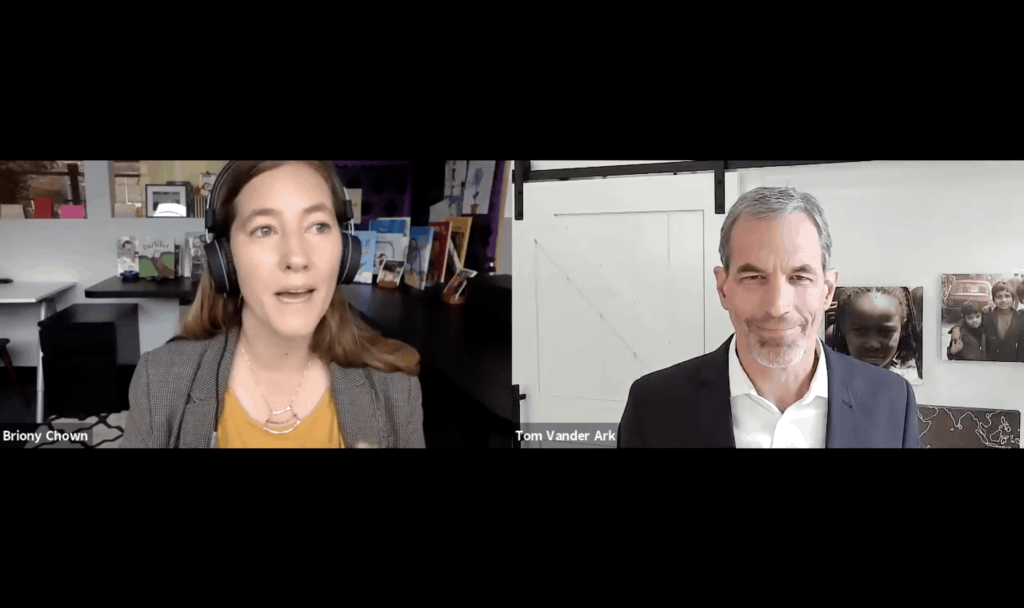
www.gettingsmart.com. Alright, let’s jump in. You’re listening to the Getting Smart Podcast, where we unpack what is new and innovative in education. I’m your host Jessica, and today, Tom sits down with Breany Chown, Director of Hightech High Elementary Explorer. Breany is a seasoned educator who is passionate about creating a better future of elementary education. She is going into her sixth year as Director
of Hightech High Elementary Explorer and her ninth year with the Explorer team. Let’s listen in as Tom and Breany chat about what elementary schools could be, international approaches to learning, and community-connected projects for young learners. Breany Chown, welcome to the Getting Smart Podcast. Thank you, Tom. It’s lovely to be here.
It’s great to have you here. I think you grew up in London, but how did you make it to the University of Sheffield? Well, when I was looking for colleges, I wanted to make sure that I went somewhere different so I could expand my knowledge of the UK Sheffields, a very different place. To London, it’s a much more of a small town. It was devastated by the closure of the steel industry, and I
wanted to see somewhere that I’d read about in the newspapers but never actually been to before. For our US audience, they may not know that area of Central England, but it’s quite scenic, isn’t it? Absolutely beautiful. Yes, it’s right by the Peak District.
I look forward to visiting sometime soon. You taught in London for a few years, and then how in the world did you hear about High Tech High? Well, that’s a good question. I started off teaching in London with very big dreams that I was going to help children to become deep thinkers, to learn more about the world around them, and to understand that every avenue that you look is a way to get more knowledge
and to learn more about the world. And as I embarked on teaching, I realised that there was very little capacity to do that. The teaching was pretty prescribed. They focused on testing and children being at a certain level at a certain time was extremely narrow. And so I started looking around for something else. At first, I thought I needed to go to a different school.
And I went to a couple of conferences and asked everybody there, well, what can I do if this isn’t what Ofsted, which is the regulator of teaching and learning in the UK, if this isn’t what Ofsted believes, how can I have children do more authentic work, do work that really matters to them and have this feeling about education where it’s like a route to knowledge, a route to understanding about the world, rather than a very narrow set of
skills that you have to acquire out of within a very short timeframe. So at that point, my husband was working as an education consultant, and he found out about High Tech High, and we started talking more and more about actually seeing if we could come over here and see what it was like in action. So we had a very exciting year of applying to High Tech High and saying to ourselves, we
might be in California at this time next year. And then of course, we were delighted when we both got jobs. He came over as a 11th grade humanities teacher, and I came over as a fourth grade teacher. And it was such a transformation. Was it, was it daunting beginning to teach in in in what is basically a feeder school to one of the world’s most famous high schools?
Yes, it was not so much daunting. It was more of like this huge open possibility. It was very, very exciting challenge. I had taken a few of High Tech High ideas and tried to do a mini project with my class in London, and then some student led conferences with them and seen such a transformation with such a short research, the small changes that coming to High Tech Elementary Explorer and realizing that, you know, this is what I could do all the time
with students. I could have them learning about the world, getting out, listening to what their interests are, exploring the community, analyzing, drafting and giving each other feedback. So all these things, which I saw the impact in a small way on my class in London, I was able to do all the time. And it was just this incredible feeling of excitement and feeling very inspired by all the practices going on around me.
So you taught at Explorer Elementary, which is sort of a feeder to High Tech, High Tech Middle and High Tech High. Is it fair? Yes. So we started off as a school which was affiliated with High Tech High. We’re now fully part of the High Tech High family, so we’re High Tech Elementary Explorer now. And then, yes, children when they graduate go to middle school and high school with us.
And does Explorer Elementary really share a set of design principles with High Tech High? And if so, how would you describe those core design principles? Yes, we have the same design principles. They’re first and foremost equity. We want to make sure that we are addressing the social and political inequalities and we are seeing education as a way to transform student lives and experiences and also change people’s perception of kids.
Then we have personalization. We want to make sure that we’re really looking at the individual child and designing the curriculum around them and their needs and their voice. We want to make sure children are doing authentic work. That’s the next design principle. So they are doing work that matters to them and matters to the world. And the last one is collaborative design. And that actually started off as teacher as designer. And we realized that that didn’t
capture everything that we wanted to do. We want our teachers to be able to design curriculum and we want them to do that in collaboration with each other, but also collaboration with children as well. At, at Explore Elementary, how do you think about priority learning outcomes or student learning goals? How do you describe those? What you want children to know and be able to do?
We want children to, I think the best way of describing it is we want children to really self-actualize through doing work, which is powerful, meaningful to them, authentic to them and to the community, so that they feel like and know that they are key members of not just our school community, not just the San Diego community, but also the world community as well. So we want children to be able to make changes which can contribute to the world. We
also want them to feel very equipped to tackle any challenge. We know that there are challenges ahead in our society and in the world that we don’t, and we don’t know what they are. So we want children to feel like they have the capacity to tackle anything. And some of that is knowing how to manipulate numbers and look at data. Some of that is knowing how to communicate, whether spoken communication or written communication as well. So we want them
to be the very best that they can be, and we believe that every student has what it takes to do all of these things. Every child knows how to learn. The youngest child knows how to learn to walk, but sometimes we take that aptitude for learning when children come to school and we sort of disregard the learning that children can do by themselves and then try and put instead this other type of learning which doesn’t start from the child and doesn’t start
from this respect for children and their vast capacity. I think unlike other school networks and some leading school districts who construct elaborate competency maps, I don’t get the sense that the High Tech High Network has a really elaborate competency map, but instead in the in the more general ways that you’ve described tries to promote student learning and growth. Is that fair? Yes, and I think it all starts for us with what’s happening in the real world. So
we look at what skills children need to do a project which their interest in and their teacher thinks that they should be working on as well. So for example, our third graders recently were furious about the lack of equipment for third graders in our playground. So this is an example of a very small change, but they designed and built playground equipment for our playground which is still up and usable and safe for children to do today. Now within the course of doing that
they had to learn mathematical skills, they had to learn building skills, they had to critique their ideas and get feedback and they had to communicate, they had to persuade me and to persuade their community to pitch in as well. So we look at the skills that children need in order to achieve what they want to achieve. We set a very high bar for what they should be doing and then we help them to get there. So it’s all grounded in what they need to learn because then
the learning is really relevant for them and then it’s sticky and what their individual growth area is as well because of course not every child’s work will look the same but we have very high expectations of all of our children and we’re constantly thinking about how we can help them to get there. Another example would be a city planning project where children redesigned a city and talked to waste management experts and talked to logistics experts and designed a city system
which addressed some of the problems of San Diego and the standards were set by the experts that they spoke to. So they spoke to people who are expert architects, they spoke to people who were involved in transportation and they created a rubric of what success would look like and they learned and then they made sure they matched that. So we take we take tasks which are meaningful to children which people don’t always believe elementary schoolers can do and we make
sure that the standards we are setting are the standards that are out there in the community, in the real world. Any of the projects that Explorer end in some kind of a presentation of learning. In fact I think some of your students have even published books and articles, is that right? Yes that’s right we always want to make sure that there is some kind of product which is transformational either to the students themselves or to the community and we always make sure that
we have an exhibition to share that work. We don’t believe that the best work we do lives between the pages of an exercise book. The best work that we do is something that other people see and if we’re saying that children can make a difference we want to show the community that as well. So every project ends in an exhibition. At an exhibition we invite the community in, we invite the most important people in children’s lives which are their parents, their grandparents,
they come into the school or to a place which is relevant to the project and they share what they did, what were the challenges, how they approach those challenges and then they defend their work as well. Brian if I was going to visit one of your third or fourth grade classrooms maybe describe what that might look like. Would all the students be working on the same project or would there be
different versions of the project? How might that look? Yes all children will be working on the same project but each child would be approaching it slightly differently. So we believe in a culture of critique and revision and we know that it’s much more powerful to do if everyone isn’t doing something that is completely individualized. So we want to make sure that children are engaged in the shared purpose, that they have the opportunity to really learn from each other and they can go
really deep with that learning and so what we have found is that when children have that shared purpose they’re doing all the things so which we put in place in the project so they’re going to each other and asking for critique. So if you’d walk into a third grade class you would see children sitting around the room some of them working individually, some of them working in groups, you’d see them asking each other for advice and feedback on the work that they were doing.
You would have a hard time finding where the teacher is because the teacher is involved in the work just as much as the children is so you wouldn’t see the teacher up at the front giving directions. Of course it looks a little bit different with COVID at the moment but in general it’s always very hard to find our teachers because they’re right there involved working with some children critiquing their ideas helping them to take the next steps towards the project
that they’re working on. How would you for a perspective parents of a kindergartener how would you describe your approach to developing literacy? So literacy is all about communication and it’s all about analyzing information and analyzing communication just coming to you. So we’ve just had kindergarten orientation or kindergarten welcome events recently and while we want to make sure that children they know how to write because you can’t communicate your ideas unless you have those
tools at your disposal. So our children practice writing but they write for a purpose. We have phonics instruction and that happens for a purpose as well because we want children to be able to communicate their ideas to share their thinking. Last year our kindergarteners were working on a musical to share more about the bugs that they found in our garden. So we take things that are very interesting to kindergarteners and we work on well how can we make something which starts
with their interests in this case bugs be more broadly known to more people. So it’s always focused on that communication piece it’s always focused on something which matters to the kids and helps them to expand on their ideas. What’s it like to be a teacher at Explorer Elementary? Well in my experience it was absolutely wonderful because as I said earlier you have all this
opportunity to teach into your passions and your students’ passions as well and it’s like nothing I ever experienced in education beforehand. I think that our teachers are phenomenally talented they work incredibly hard to hear student voices to design experiences for children that really capture their imaginations and bring out all of their different skills. So it is an experience it’s hard work because you I think you never switch off because it’s so close
to your heart what you’re doing but it is absolutely wonderful. How do your teachers experience community both within your school but also within the network? So we meet to collaborate several times a week teachers collaborate during their planning time and we want to make sure that teachers have that time not just to think about the what of their classroom but also the why of their classroom so that people are learning from each other. Of course we learn from each other by looking at
student work we learn from each other we tune up the projects that we do and what we mean by that is that when a teacher has a project idea they bring it to their colleagues and they ask for feedback so they share that they’re thinking about doing a project about x and they share some ideas about it that they’re thinking of people ask them questions and then that they remove themselves from the conversation and just listen to their colleagues discussing it and it’s such
an inspiring process because you get so many ideas and we want to make sure that every project that we do contains the genius within all the stuff from all the staff within the school. In what ways do you engage parents inform parents how ideally are they involved? There are so many different ways I would say the most powerful one is exhibition so when parents come in to see the work that’s when the penny drops and it clicks and to say oh this is what
you’re doing with my student with my child and this is where you’re going to so we always say when a new family joins us the relationship deepens after they’ve come to one of our exhibitions. However there’s multiple touch points along the way before that so we share the project with parents sometimes we’ve been tuned the projects with parents as well because we want to get their feedback and then one of my favorite pieces is inviting parents and as experts.
So I remember in my fourth grade classroom and this happened recently with the third grade playground project we had some I had a child whose dad had had a really hard time at school and he really hadn’t stepped foot into the building since his son had come to school because his own experiences of school had been so negative and my class at the time were doing a project where we were building screens and different items of furniture for a project around the refugee
experience and the immigration experience and so I put out a call to families asking if anyone was a woodworking expert and we had several families come in who’s had never seen themselves as experts had seen themselves as being very separate from school and they came in and taught the students and I heard from the parents and from the children how transformational it was to see their parents coming in and teaching other children and seeing their skills valued as well
so whenever possible we’re bringing in parents every step of the way as teachers. Briani how do you think about your job as a school leader particularly within the the Heizer Kai system? I think it’s a very collaborative position you know I’m passionate about the projects that teachers do with students so I always see myself as a co-designer of those projects with
teachers but I want to make sure that the teachers are making decisions as well so we talk a lot about the challenge of leading leading from the front and leading from behind making sure that we’re creating space for teachers to collaborate with each other to collaborate with students and to make big decisions that affect the school while also making sure that we’re not adding to people’s workload too much because
it can be exhausting making every decision so trying to find that happy medium where teachers have the opportunity to be inspired to get out into the community to bring that back to their students and then to have those conversations around how we can best design projects that support that natural inquisitiveness and capacity for deep thought in students. What about your own learning how do you continue to grow as a professional and
is that aided by being part of a network that happens to also have a its own graduate school of education? Oh tremendously so it’s funny I shared with my teachers this week that I am happiest when I am like actively learning as well I am someone who values learning enormously and so the fact that we have the GSE the Graduate School of Education the fact that we have we host the deeper learning conference at High Tech High as well which is just a tremendous event it’s like
a festival for progressive educators all of those things but I think the deepest learning that I have comes from when I get into classrooms and I see what’s happening with students and what they’re working on and ask here the questions that they’re asking as well because we can always learn more from the children in our building and from the children that we’re teaching because they’re always going to have a different approach to one that we’ve ever thought about and then of course
to answer the second part of your question you know being a network of progressive schools being part of High Tech High is always a learning experience there are so many amazing educators who have come here from around the world to learn from each other to seek out what does it mean to truly learn in a way which is different with students in a way where children are not engaged in school as we think about it but in work that really matters to them. All right last question
this is a cocktail party question a parent wants to know they’re moving to a new town and they’re evaluating different elementary schools what should they look for how would they know which is the most effective school for their child would it be data that they would look at would it be look for is in a visit how do you know whether an elementary school is a good school? I always say to parents when they come to our school that you need to trust yourself you know
your child and so going into the school walking through the school buildings seeing the type of work that is up on the walls like what does the school value does it value like rows of identical work or does it value work which is um deeply individualized and really high quality but also very student-centered too so look at the work on the walls listen to what children are doing ask them questions ask them what they’re doing and why I think that’s probably the the biggest thing
that will tell you about what the school is like is hearing from the children and hearing what they’re doing and why it’s important. That’s a beautiful answer and because I visit itekai schools frequently I can vouch for the the student work on the walls it’s really the best art network in the world where students produce just extraordinary expressions of who they’re becoming I think that’s my favorite thing about visiting your school and the other schools in
the network. Oh thank you our children take great pride in it and so do our teachers. We’ve been talking to Riany Chow she’s the principal head of school at a Explorer Elementary it’s part of the high tech high network in San Diego thanks for being with us on the Getting Smart podcast. Thank you so much Tom. Thanks to Riany for joining us today we appreciate her dedication to making elementary school a place of wonder inspiration and care for more information
on early development check out episode 217 how educators can positively impact a child’s cognitive development with Dr. Pamela Cantor you can find a link in the show notes and on the blog. All right listeners that’s it for today thanks again for joining us for the Getting Smart podcast this is Jessica signing off.


0 Comments
Leave a Comment
Your email address will not be published. All fields are required.