


Aaron Schorn and Trinity Asing on Sustainability and Youth Entrepreneurship
Key Points
-
The key to regeneration is taking less and ensuring that it regrows.
-
School has long been a lonely process – this must be challenged.
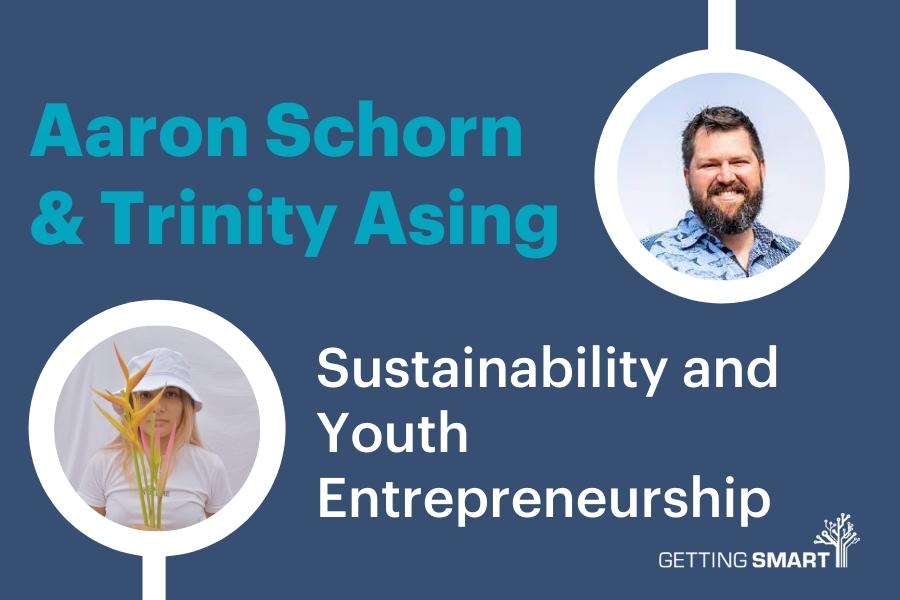
On this episode of the Getting Smart Podcast Nate McClennen is joined by Aaron Schorn, Head of Growth & Community at Unrulr. He is also a Getting Smart columnist.
They are also joined by Trinity Asing, the founder of Mauka Market – the world’s first regenerative marketplace.
Aaron supported Trinity’s journey at Nalukai, a youth leadership and entrepreneurship program in Hawai’i. We’re thrilled to talk with these inspiring guests about youth entrepreneurship, sustainability and ecoschools and much more.
Links
My senior year of high school I started a farmers market as part of a class project on how we could to make our school more sustainable. This made me fall in love with entrepreneurship and sustainability.
Trinity Asing
When you when you work with others you [start to] care about the problems they face, the communities they’re in […] Making entrepreneurship place-based is so vital.
Aaron Schorn
Transcript
This transcript has not been edited for spelling accuracy.
You’re listening to the Getting Smart podcast. I’m Nate McLennan and today I am super excited to be joined by Aaron Schorn, head of growth and community at Unruhler. He’s also a Getting Smart columnist for us. And we’re also joined by Trinity Asing, the founder of Maoka Market, the world’s first regenerative marketplace. Aaron supported Trinity’s journey at Nalukai, a youth leadership entrepreneurship program in Oahi. We’re thrilled to talk to both of
you today about youth entrepreneurship, sustainability, eco schools, climate change, all the things that you two are both passionate about. So welcome and thank you so much for joining us today. Thank you so much for having us. Thank you. I’m really excited to be here.
Great. So to kick us off, I’d love to think about both of you have passions on entrepreneurship. You also have connections to the natural world. I’d love for you to just share with our audience. If you could choose one place to be in the natural world, what’s your favorite place? Where would you choose? Trinity, you’re up first. I would definitely choose the ocean. I love surfing. I love spear fishing. And just being
in the ocean is a really calming place for me. So definitely anywhere in the ocean. And Trinity, can you tell us where you’re calling in from today? Where do you live? I’m calling in from Kailua, Oahu in Hawaii. And what’s the weather like there today? It’s about 80 degrees and beautiful and sunny.
Is it always like that there? We actually just had some really gnarly rain, but that’s pretty much the coldest it gets, maybe in the high 60s. Got it. Got it. Aaron, what about you? Favorite place to be?
I’m going to be hyper specific. Mine is Lailai, which is this pu’u or hill right behind HPA’s campus, an independent school on the big island of Hawaii in a town of Waimea. And it overlooks, I think, the most beautiful place in the world, which is Waimea on the big island. I might have to fight Trinity on that because she lives in a really beautiful place too. But for me, it’s almost a spiritual centering place and a place where I kind of get a lot
of energy from. And you’re calling in from California today. Is that right? I am. We moved in July from Waimea to Ojai, which is a beautiful part of Southern California, but does not hold a candle to Waimea. Got it. Got it. Well, again, thank you both for being here today. And Aaron, I think I want to start with you and talk a little bit about the genesis of Nalukai.
What is it? Where did it originate from? And how does that connect to Trinity and her amazing work? So Nalukai was founded by Darius Moncef, who was a brilliant, creative and entrepreneur who successfully sold some of his tech startups. And he grew up in Waimea and Honoka on the big island and wanted to create a hui, a community for youth, to become entrepreneurs and entrepreneurs. But most importantly, to have this kind of family of human beings that believe in each other and want to make change. And it evolved. It evolved from a tech and kind of lean startup entrepreneurship camp to when Trinity came in 2019,
a social and cultural entrepreneurship program where youth from across public, private and charter schools came together and boarded for two weeks and took their ideas and turned them into actual startup companies. And at the end of the experience, it culminated not in a pitch day, but really in this authentic storytelling day where they told the story of what they created, the kind of partners and funding they would need. But most importantly, the journey they went on. And so the power of our program is the diversity of the cohorts and getting youth to do this work on teams. And you were involved how you were, I think, teaching or leading or working in an independent school at that point and you somehow got pulled in? Yeah. So I met Darius. He goes by a lot of names, Bubbs, Bubba.
I met Darius at a kid’s birthday party. And he heard about what I was doing in my digital journalism class centered around apprenticeship and mentorship. And I had him involved in my class and he eventually asked me in year one in the OG year to kind of come in and help build out the curriculum. And from there, every year we evolved and every year we changed the outcomes and curriculum and how we did the program to be much more centered around sense of place, Hawaiian culture, and these brilliant youth like Trinity. And so right now I’m the program director for Nalukai. Right now we are a two week startup camp that occurs either in the month of June or July, the last two years we’ve been virtual. But my role is as a facilitator, a connector and as a curriculum developer.
Got it. Got it. Okay, Trinity, so your story, so you somehow got connected to this really amazing program. Can you talk a little bit about that story? What was your journey? Yeah, so I kind of fell in love with entrepreneurship, my senior year of high school, and sustainability around the same time as well when I started a farmers market as part of a class project on how we could make our school more sustainable. So I started a farmers market up at the campus, fell in love with entrepreneurship and sustainability was recommended that I check out this Nalukai program to further my knowledge and, you know, learn more about entrepreneurship and I luckily got accepted. I spent the two weeks there learning from so many mentors, connecting with the different my teammates there. And yeah, that’s that’s how I made my way into Nalukai was, you know, falling falling love with sustainability and entrepreneurship and then searching for more ways to learn and grow that entrepreneurship.
So I’m always curious about how passions evolve in folks in terms of learning and so you talked about it was in 12th grade your senior year you had a class project. I guess two questions one is what what class was it that you allowed you to do a project that created a market at your school so that’s the first question and then the second question is, did you have any inkling of this beforehand that this was your your path had you always been thinking in a more entrepreneurial way or is this a an aha moment for you in 12th grade that I want to think about sustainability and entrepreneurship. Um, I would say I’ve always been, I guess you could say hustler. My parents always like they always just knew like, oh, she’s gonna she’s gonna be entrepreneur because a little not bossy but I guess I was always a little more, you know, like bossy you could say growing up but in a good way like leading and
and always wanting to be, you know, I guess in charge but like strong like I wanted to be my own boss and I wanted to, you know, create something and make a change somewhere, which was always my goal growing up is to do whatever I do to make a change in something. So I always had that entrepreneurial spirit. And then senior years when I really dove deep into my culture, and I learned that through the Hawaiian culture really everything that they do and they believe in is sustainability, you know, everything in Hawaiian culture is valued around the land and taking care of the land. And so when I fell in love with my culture, I fell in love with sustainability, which is, which is where they connect and through Nalukai is where I learned that you can find your passion and your love and turn that into an occupation. And I think one of the mentors there actually taught us a word called occupation, which is essentially that finding something you love creating a career out of it, and you know, using that to drive you.
And yeah. And was it a specific class that allowed you to create the market or was an independent study that you had to do outside of school. Oh, yes. Prior to Nalukai, priority even going to Nalukai the first effort. Yeah.
The senior class that I took was called Malama Honua, which is an environmental science. Got it. Got it. Okay, great. Okay, so you created this first prototype at your school.
Was it successful? Yes, it was, it was a lot of hard work. But it was, it was successful. We had three markets in the time being for that senior year until I left and unfortunately couldn’t find anyone to continue on the market after I left the school. But fortunately through Nalukai, I made it to the purple prize competition, which is a startup competition where I was an intern there.
And that’s how I kind of segmented into Malcomarket, which we can talk about later. No, so we’re ready. So I help our listeners understand what the purple prize is and then what happens at Nalukai that then generated Malcomarket. So through Nalukai, they were looking for three, about three youth interns. They called us fellows to join the purple prize, which the purple prize is a incubator startup competition for Hawaii owned businesses.
You know, just incubator. They brought us on first time ever bringing students youth on to join the teams as interns there I was paired with the Albezia project because they focus a lot in sustainability and regenerative business, which I was just learning about. And what they do is they remove invasive Albezia trees, and then they use the lumber for various projects like furniture surfboards interior design. And from there, after they remove the lumber, the trees, then they replant native trees that used to grow there maybe 200 300 years ago before the introduction of invasive species. Their business is completely regenerative.
But they saw this need for a market to help promote this type of business because it’s such a new species of business. Not everyone understands the regenerative side, which is where I came in with my experience in markets. And we created this Malcomarket, the regenerative marketplace to help people to educate people about how important regenerative businesses and and yes, there’s sustainable business, which I would define as, you know, doing more with less, but regenerative business is doing more with less and replenishing what you take. So that’s kind of how I segue it into everything.
But without Nalukai, I wouldn’t have been accepted into the purple prize without Nalukai wouldn’t have the foundation and the understanding of entrepreneurship. And, you know, being the youngest on the team of Malcomarket in a management position, having to lead adults is kind of scary for me. And like having to tell older people what to do sometimes is like, whoa, but that’s something I wouldn’t have been able to do without Nalukai. Can I just jump in for a second? Like, this story arc is insane, but it shouldn’t be insane.
Like so Nalukai’s dream is to be a culminating experience for students like Trinity, to give them that confidence and sense of belonging that they belong in this world, that they belong as creators, right. And what we’ve turned into is a pipeline to partner with other organizations like purple Maya, the organization that has this adult incubator and accelerator program. And we created an agreement where we sent free Nalukai alumni, which she quickly became into their program. We did not, we wanted one of them to become a co-founder, but we never thought it was immediately possible. Trinity proved that completely wrong. Trinity is now a co-founder of Malcomarket.
And if you think about that story arc, right, it seems nuts that someone right out of high school could join a team, could take her marketing and digital storytelling skills and do that. But for us at Nalukai, and I think for me in general as an educator, we want that to become the norm where she can add her, mana’u, her wisdom, her ideas to a company that she’s passionate about and believes in. So just Trinity is amazing. Did you see Aaron, when you went as you went through different cohorts, what worked with different cohorts at Nalukai? Did you find that you were drawing out these innate talents and students that just had been latent and not exposed for so long, or were they gifted?
Like Trinity came with some entrepreneurial experience and she’s ready and raring to go. I’m always thinking about, can everybody do this? I mean, I have this bias that we should be teaching entrepreneurship in schools across the world. I have a bias that every young person should have the ability and skills and opportunity to make a difference in the world. And so, but what about the students that are coming to you? Are you seeing that?
It’s a total mix of both. And that’s the beauty of diversity, equity and inclusion. It’s creating a program that hits students at all different levels. And so we have a pretty intensive application. Thank you, Trinity, for completing it and not cursing at us too much. And a part of that application is an upload of what you’ve done. And it’s not just tech projects. It’s anything you’ve done with your parents in the backyard.
We wanted a diversity of skill level, technical skills. I personally believe that it’s disingenuous to talk about entrepreneurship if you’re not talking about technical skill development, because you need to have students in these programs that have a skill as well. That doesn’t mean you can’t do both at the same time. But for us at Nalukai, we were successful because we had an application that allowed us to look at these skills that students and youth had
in leadership and writing and project management and graphic design and coding and videography and put them all together. And the miracle, I think, of Nalukai is in the group work. It’s teaching youth the power of working on diverse teams. And so Trinity was on a team with people that had different skills, and I think in hope that that’s been a really powerful lesson for her at Maoka. Really interesting, and that makes a lot of sense.
And I think these are the competencies that we want in all humans, because this is what makes the world a better place. We think about regenerative practices and thinking about the world and climate in place. Trinity, when you were going through the program, did you see your idea pivot back and forth a few times based on feedback or were you pretty linear during those couple of weeks when you were intensely involved with this? How did the idea evolve?
Actually, for Nalukai, the Maoka market wasn’t established yet. We had created a different startup with my group. That was actually completely different from a market, but the ideas that I used were very similar, like, based around community sustainability culture, which was kind of what we started there with our startup, was called Rendezvous. It didn’t go anywhere after that, but a lot of them had gone off to college.
Some of them were still in high school in my group, and I had other plans after that as well. But the team that I worked with, we still stay close. We still talk to this day. So the idea of Maoka market was already in me there, and I used the knowledge from Nalukai to kind of push it after leaving Nalukai. That makes sense.
And I see that pattern of in high school, you had a project that was starting a market, and then you did this Rendezvous project, and then the Maoka market comes up. And so I have a sense in entrepreneurship, and I have done some startup stuff myself, is that we have a lot of practice runs, and those practice runs, every time we learn something from those practice runs. And so I see that evolution.
I suspect that you’re going to have many more along the way. I’m interested, Trinity, on the e-commerce part of the platform. So it started as a physical market, correct? And then went to e-commerce. And what have you learned through that?
Is it still meet your goals for sustainable practices? Are you still thinking that it’s the same thing yet just digital? Or what’s your thought on that? The e-commerce is something that we are still kind of playing around and finalizing. Digital e-commerce is not my expertise, so it’s something that I am really trying to learn.
And as far as the, you know, is it still sustainable? I think yes, because we, all of our vendors that sell through us at our in-person and online, go through a certification process, which helps us understand, you know, how much of their material do they source from Hawaii? How much of it is organic?
Is it from a waste stream? Is it from an invasive species like the albizia tree? So our vendors in themselves are certified to, you know, to our standard. And then, you know, as far as shipping, we use low waste. We repurpose most of our shipping material, which I think is probably the biggest thing,
you know, that makes e-commerce a little bit more not as eco-friendly as just buying it right there in person. But our idea too is to connect these regenerative and sustainable businesses to people outside of Hawaii, you know, and to just educate people outside of Hawaii about this type of business, about this type of practice. So I think, you know, that is where the e-commerce comes in and that’s what the digital platform comes in, is that helps us reach a way huge audience than just here in Hawaii.
Because in Hawaii, most people, you know, if you know anything about the culture, you have a sense of sustainability. I like to call it an island mindset, knowing that we live on an island in the middle of the ocean. It’s like, it’s our job here to fight climate change because, you know, if we don’t, we’re the ones who are going to drown eventually. You know, not the continent, the US.
There’s a big land mass there. Of course, the sea level is rising everywhere, but, you know, if we don’t take care of it here in Hawaii, we’ll be underwater. And I think a lot of people here understand that problem around with the Hawaiian culture, values of land and how important it is. I think everyone here kind of knows it. Our goal is to now expand that knowledge, teach people about this Hawaiian way of loving the land, taking care of the land,
that you don’t own the land, that, you know, your job is to take care of it for future generations. And so that’s our goal with Malcolm Market and the e-commerce and online platform is to teach others outside of Hawaii. It seems that there’s some messaging for schools and educators that are listening to this podcast. And I wonder, maybe starting with Aaron and then Trinity, is this island mindset concept and how it relates to climate change is a lot of schools aren’t on islands, but yet a lot of schools and communities could benefit from understanding this island mindset or island thinking.
What’s the, where do you see education needs to shift to really think about climate change as a core challenge of our generation and generations to come? Aaron, what are your thoughts on that? Like, what do we need to change in schools? I think at its most basic learning has to become more communal. There’s a, and learning has to be more centered in reality.
So the Hawaiian phrase Makahana ka ike, which means by doing one learns is like my entire pedagogy and philosophy of education. You learn through action. And all of the programs I’ve built at Nalukai, at, at HPA Hawaii Preparatory Academy, when I was the K-12 capstone coordinator, and now at Unruhler, are about communal learning. And so when you, when you work with others, you now care about the problems they face, the communities they’re in. And I think what you heard from Trinity, I don’t know if this answers your question exactly, but making entrepreneurship place-based is so vital.
Like looking at your background, Nate, I saw that place-based so many times. But when you heard Trinity talk, I just kept hearing that, you know, that, that where she grew up, like what she cares about is so unique. It’s her unique value proposition to Malcolm market, right? And rooting entrepreneurship and identity, you know, rooting schooling and identity. There’s that great Paul Graham essay, one of the founders of white combinator that talks about how great startups come from people who’ve lived the problems they’re trying to solve, you know, have lived those lives.
You know, that’s Makahana Keike, you know, and so I think, you know, in order to address things like climate change, in order to address things like structural racism to address, you know, the, what discourse looks like in American society, we have to make learning more communal, more place-based and more kind of student identity driven. So sorry, it’s kind of, it’s not the precise answer. But I think Trinity like just totally represents that in, in her life and how she went through Nalukai and in the answers that she’s giving. Journey, what do you think? Aaron, great thoughts there.
What do you think about schooling and what needs to shift? Well, I think that personally, you know, the youth is, is the future. And I was talking to Aaron about this, how the, you know, the older you get, the harder it is for your mindset to change. And you’ve learned this way for this long. It’s harder to change the minds of older people.
But for youth, if you teach it in them young, the importance of climate change, the importance of their own culture and their identity, if you can start that from, you know, kindergarten, they’ll, they’ll, they’ll have that for the rest of their lives. And they’ll have this mindset of, oh, I need to consume less. Oh, I need to, you know, stop using plastic or, you know, whatever, whatever they can do to live more sustainably, to help combat climate change. I think it needs to start earlier.
And, and I think Aaron’s right that it needs to be implicated in schools around the world and, and from a younger age, because I didn’t really learn it until senior year. And I wish that I had learned about sustainability, how to grow my own food, how to fish, you know, the triple bottom line. I wish I’d learned these things earlier, not at 18 years old. So definitely.
It makes so much sense to me, Aaron, as you were speaking to you before, as I’ve thought a lot about place based education and part of the concept there that’s important for me is that when, when people are deeply immersed in the place and whether that’s the, the social part of place ecological part political economic, but when they are deeply immersed, they will find the things that drive them and they’ll care deeply about making a difference, right? And Trinity, you’ve done exactly that, which is so amazing. So I to agree that there, there, we start with innate curiosity and inquiry at a very young age.
And then we move into exposing students to things like the triple bottom line and things like sustainability. They can pick and choose where they end up and how they end up applying it, but everybody should have that core of place and sustainability. I’m also fascinated by this idea of communal learning. And I think that increasingly the world, the worlds in the future, it’s, it’s, it’s more complicated. It’s more uncertain, but I also think it’s more mutualistic.
I think it wouldn’t depend more and more on one another. And the program that you’d both described, Trinity, the solution that you found are thinking about how do we depend on one another, which is really, really interesting. So let me think a little bit about sort of future work. So what’s next for the market, Trinity? I know I think you’re in university at the same time.
Are you doing that? Or you, so you’re pretty busy. Any, any future plans? It sounds like e-commerce is there, but other ideas that you’re thinking about? Yes, I would like to expand the Malcolm market kind of brand to not just markets, but also like different events that highlight the same type of practice, you know, like an event that
showcases how to cook invasives, you know, how to catch an invasive fish and turn it into a meal to, you know, feed your family. Just educating people about how they can, you know, remove invasive species and live regeneratively, not just through what they buy, but live their whole life regeneratively. So moving away from just markets, but different types of events that somehow showcase my Hawaiian culture and this regenerative business model. That sounds great. I also think that when you’re ready to grow even bigger, think about how do you replicate what you’re doing in all sorts of other communities?
I think that you have a model that’s really amazing and it’s, it’s dependent on the OIE culture, but also it could be dependent on whatever culture is in a location. So I think there’s you have a lot to share with the world. So look forward to seeing what happens there. Aaron, you are at another organization, although you’re still involved on ruler, a quick, what’s the connection here? Why is that connect technology solution connected to your work with Trinity and and now look I mean, at its core on ruler is a visibility tool.
It’s a tool that’s mobile and web. I used it for two years as the K12 capstone coordinator, and I’m using it now with the now look I alumni program that we’ve got funding from on rulers a collaborative mobile and web platform that makes culture and growth visible in schools and learning communities and really has applicability, not just in K12, but any place that has a cohort. It looks and feels like social media is UX and UI are really beautiful, but it allows the school and an organization to tag their learning with their learning outcomes their values their KPIs or OKRs and be able to look and track. And so every post and on ruler basically becomes evidence of these skills that we’re trying to live.
Everything we talked about on this call about communal learning about agency about visibility. That’s why I took this role and why I’m really excited and I do not think that tech solves all problems. I don’t especially in schools, but I’ve never been more excited to to use and to grow a platform that really manifests agency changes the power balance between teachers and students. And allows youth and adults to build these really beautiful journals and portfolios of their experiences and work. And so, you know, I think we have to challenge a lot and Nate, I’m sure you feel it too.
And the status quo of education and, you know, pre COVID post COVID during COVID, our youth are tapped out. There is an anxiety in this really lonely process that is middle school and high school and going to college. And I took this job at unruly to challenge the trajectory of after high school and to see if there’s different ways of getting into college and getting your first job than your GPA and a standardized test. And this is my R&D for that. Yeah, I think about it’s all about purpose finding and how do you help people use each other to do that that well.
I keep going back to my North Star and the North Star that I think about a lot of how does how do we provide every young person with an opportunity to change the world no matter where they live where they come from whatever the case may be. And I think all of what you have described, both you Trinity and Aaron are helping move the needle in that direction. I’m super appreciative of our time together. I love if each one of you could share you have an audience that’s listening. What’s the biggest takeaway message you want them to hear about education about regeneration, whatever it is, whatever message you would like to share Trinity. Do you want to start? Um, sure. I guess the biggest thing I could say was to, you know, really connect with your culture and who you are where you come from.
Because I really believe that the solutions to a lot of our modern day problems are woven into our past and our ancestors and what they did here long ago. So I and I jumping off of what Aaron said that, you know, tech is a solution. Yes, it’s not a solution to all our problems. But how do we connect our past and our ancestors and their knowledge with a modern twist. And that’s what I want to leave you with is look back to your culture, look back to your roots and figure out how they lived, you know, 100 years ago and how that can solve many of our problems today. We learn a lot by looking backwards. That’s for sure. If we’re willing to look. Thank you, Trinity. Aaron, what do you have for us? Let your students be seen and let them feel that they’re seen. The hardest thing to do in teaching entrepreneurship at a formal setting or at Nalukai is building confidence and a sense of belonging and almost decolonizing what high school and middle school have done to so many youth around the world and in the U.S.
And letting them know that they’re worthy of investment, that they’re worthy of mentorship, that they’re worthy of partnership and collaboration. So much of the first few days of Nalukai this two week intensive is just getting them to feel like they belong and that they’re worthy of this work and worthy of their getting getting their ideas out into the world and why I took this job at unruly is because it makes their process and their life visible and shared. And it tells them that they’re not just the products they create, but their thought process and their learning journey is worthy of being shared. And if I could tell every educator to just not just differentiate, but change your curriculum to make sure your students feel like it’s relevant and seen to them. That’s my message. Beautiful.
I am grateful for the time that we spent together. You both are doing amazing work and it matters. If listeners want to hear more take a look at the show notes, there’ll be links to my car market now look high on ruler and a bunch of other resources that we talked about today. Please look them up take a look at what they’re doing reach out to Trinity reach out to Aaron and figure out how you can partner or do more of that in your own community. So Trinity and Aaron thank you so much it’s been a pleasure and we look forward to seeing what else happens in your futures. Thanks for tuning into the getting smart podcast today.
We want this podcast to be actionable and insightful and a great way to learn about what’s next and learning. In order to stay on the cutting edge we need people in the field to tell us what they’re hearing what they’re wanting and what they’re needing to learn more about. Got a topic or a guest in mind send your recommendations to me mason at gettingsmart.com and if you like what you’re hearing don’t forget to leave a review in Apple podcasts or subscribe wherever you listen. Feel free to share the podcast on social media using the hashtag GS podcasts. Thanks so much. you


0 Comments
Leave a Comment
Your email address will not be published. All fields are required.