


Barbara Kurshan and Kathy Hurley on InnovateHers
Key Points
-
Women are a majority in nearly all higher education schools, except for business school.
-
Everyone needs to be more open-minded to network – escape your tribe, learn and listen.
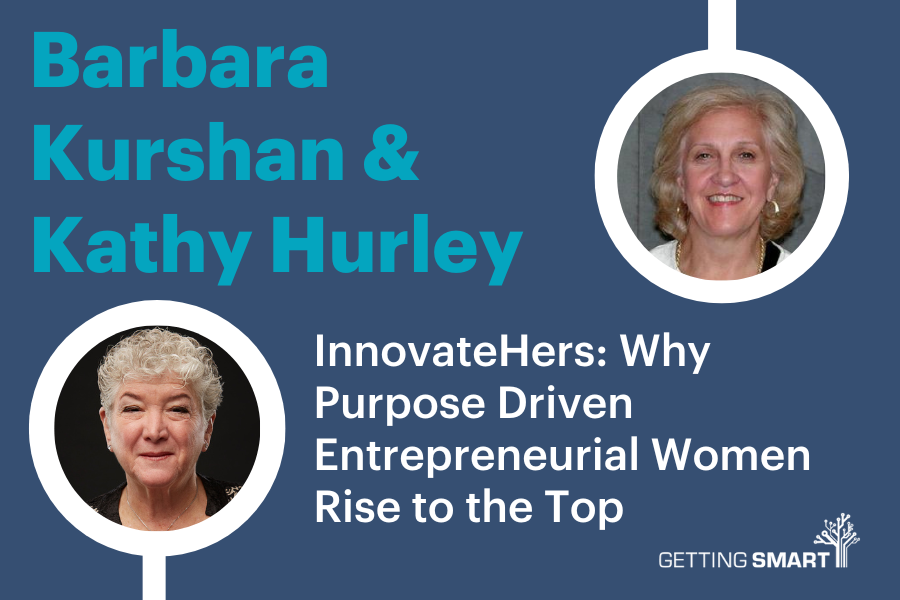
On this episode of the Getting Smart Podcast, Tom Vander Ark is joined by Dr. Barbara “Bobbi” Kurshan and Kathy Hurley the co-authors of the new book InnovateHERs: Why Purpose Driven Entrepreneurial Women Rise to the Top.
Dr. Barbara “Bobbi” Kurshan, is the President of Educorp Consultants Corporation and Senior Innovation Advisor, at the Graduate School of Education, Education Entrepreneurship, University of Pennsylvania, and a former education industry entrepreneur.
Kathy Hurley is a former senior executive for numerous educational publishing and technology companies, including IBM and Pearson. After retiring from Pearson, she was selected as a Fellow of the Advanced Leadership Initiative (ALI) at Harvard University and co-founded a global nonprofit organization, Girls Thinking Global.
Tom Vander Ark: Um, Bobbi, what is an entrepreneurial mindset?
Bobbi Kurshan: Good question. Makes sense to ask it first. An entrepreneurial mindset is a set of personality skills and traits that reflect your ability to think entrepreneurially, like an entrepreneur, to think innovatively. It includes a set of skills and traits we’ve outlined in the back of our book and a profile we’ve given to all the people featured in the book. There’s also a self-assessment of their skills, plus we’ve analyzed data from around 250 people who have taken the profile. The personality traits, or skills, are often ones you can’t change very much. You can improve them slightly and be aware of them, but they’re generally fixed. These include things like independence, preference for limited structure, nonconformity, risk acceptance, action orientation, passion, and the need to achieve.
We certainly can’t make you passionate, but we can teach you to appear more passionate or try to foster that passion. When you ask a VC about the type of company they invest in, they’ll often say that someone needs to be passionate about what they’re doing. We don’t know how to train for passion, but when it comes to other skills, we can help. We can train or teach you things like future focus, idea generation, execution, self-confidence, optimism, persistence, and interpersonal sensitivity or empathy.
So, while there’s a bit of gray area regarding which traits can be taught, there’s a distinct difference between the entrepreneurial mindset in terms of personality traits versus the skills you can learn. That’s what I’ve been studying for the last ten years in my research at Penn. It’s been fun and interesting. I’ve looked at lots of entrepreneurs and trained many of them, asking them, “Are you born an entrepreneur, or can we make you one?” We asked every single person in the book this question, and we got a fascinating set of answers.
Tom Vander Ark: You’re listening to the Getting Smart Podcast. I’m Tom Vander Ark, and today I have the pleasure of being joined by Dr. Barbara “Bobbi” Kurshan and Kathy Hurley. They’re the co-authors of a fantastic new book called InnovateHER: Why Purpose-Driven Entrepreneurial Women Rise to the Top. The book came out in April of 2022, so it must have been a pandemic labor of love, Bobbi. But you’ve been at this for a long time, right?
Kathy Hurley: Um…
Bobbi Kurshan: I’ve been writing books and working in this field for a long time. Kathy wrote a book a few years ago as well, but yes, this was a pandemic project. It kept us busy, and we got to talk to many incredible people. All the video interviews were done during the pandemic. It was a labor of pandemic love and was completed just as we were all coming out of it.
Tom Vander Ark: Bobbi, I know this has been an area of research for you for more than a decade. But Kathy, you and I have known each other for 20 years. We worked together when you were an executive at Pearson and with the Pearson Foundation in various ways. How did you connect with Bobbi and decide to write the book?
Kathy Hurley: Bobbi and I have been friends for about 35 years, and we’ve had a great admiration for each other. We’re very different, as you might imagine. Bobbi’s focus has been more on higher ed and research, while I’ve been more in the trenches with K-12 marketing and sales, and then later at the Pearson Foundation doing purpose-driven work. As we started talking about writing a book, we thought about people we knew in common and wanted to make this a global book. Bobbi and I have both traveled worldwide, and we thought it was the right time to collaborate. We brainstormed ideas and had a fantastic time planning what we wanted this to be. Interestingly, we didn’t initially choose women specifically in education, but many people in the book, even if they were in other fields like law, had an educational background. Education itself is purpose-driven, so we had a great time working on this together. Of course, we had a few tense moments, but we got through them.
Tom Vander Ark: I can imagine! Knowing both of you, I’m sure it was lively. Who came up with the name InnovateHER? It’s clever. Was that you, Bobbi?
Bobbi Kurshan: Good question. No, it wasn’t me. We have to give credit to our publisher for that. We went through many names and struggled to decide if we should include the word “education.” We kept playing around with words related to innovation, entrepreneurship, purpose-driven, and entrepreneurial, just moving the words around. Ultimately, our publisher helped put it together, and Kathy and I loved it. We had to research to ensure it wasn’t already owned by someone else. Once we confirmed the URL was available, we settled on it.
Tom Vander Ark: My daughters and granddaughters love it, too. It’s a great title. So, Bobbi, I love the exploration of cultivating and teaching an entrepreneurial mindset. Why the focus on women specifically? When and how did you decide it should focus on women entrepreneurs?
Bobbi Kurshan: Great question. Initially, we didn’t set out to write a book solely on women. My research has generally focused on the entrepreneurial mindset, and our writer and researcher on the book, Lars Bullian, and I began dissecting the data. We started noticing patterns around women, which is when I reached out to Kathy. The themes that emerged seemed to match so perfectly with the skills and traits we had been studying, and it highlighted a different perspective women had.
Tom Vander Ark: Women have already surpassed men significantly in terms of higher education enrollment and completion. We’re beginning to see parity in many professions, but in entrepreneurship and investment in entrepreneurship, it’s still a male-dominated field. Do you think this gap in entrepreneurship is just a historical one that will close over time? Or is your book addressing some systemic issues within entrepreneurship that need attention?
Bobbi Kurshan: Two things came up. You’re right; we’re seeing parity in many fields, but not yet in entrepreneurship. This lack of parity even extends to professional schools—women are now the majority in medical, dental, vet, and law schools, but not in business schools. This gap may influence the disparity in entrepreneurship. Another area where women excel is their return on investment. Women return more per dollar than men from startups and venture funds. Men typically return about 31 cents on the dollar, whereas women return about 76 cents. This difference may be because there are fewer women, so they tend to be more calculated and thoughtful in their risk-taking. However, women’s returns generally occur over a longer period, so patient investors are essential.
Kathy Hurley: Right. In my experience, women tend to perform better in 21st-century skills or soft skills. In my first book, Real Women, Real Leaders, we found that women generally excelled in these skills. Although they might not score as high in financial acuity or strategic planning, women have developed problem-solving, optimism, and communication skills, which tech companies now highly value in team players. Doing a global book allowed us to see that women worldwide, including South America and Africa, demonstrate these skills. Interestingly, most of the women we interviewed mentioned their mothers as mentors, showing them how to juggle multiple responsibilities and be flexible. We felt it was the right time to highlight these strengths.
Tom Vander Ark: The future is female for all the reasons you’ve described. I think us men have probably screwed things up pretty badly, and we need to count on our daughters and granddaughters to make things better. One of the things I love about your book is the case studies. You have about 30 of them, each chapter featuring around three in-depth stories that illustrate your points. Did you know half of these people already, or were they all new?
Bobbi Kurshan: Between Kathy and me, we knew everyone personally and asked them to participate. Our networks overlapped, so we probably both knew about half of them, while the other half came from other connections. We started with a list of about 100 people and narrowed it down based on who was willing to take the assessment and give us their time. We wanted to make sure the book was demographically diverse, with a range of ages, geographies, and industries represented.
Kathy Hurley: Yes, we wanted diversity in terms of nonprofits, for-profits, smaller companies, larger companies—you name it. If you look through the back of the book at who we interviewed, you’ll see we met those criteria.
Tom Vander Ark: Bobbi, I want to delve into this idea of the entrepreneurial mindset. You’ve laid out traits that capture what’s needed to produce impact, spot opportunity, and make a difference. I wonder if we still, as a society, teach girls to be conforming and “proper” while boys are encouraged to be risk-takers. Do you think these societal norms hinder the development of some of these entrepreneurial traits?
Bobbi Kurshan: Maybe I’m viewing the world with rose-colored glasses, but I hope it’s changing. As a university professor, I see young women coming into my classes challenging norms. They take on leadership roles and believe they can do anything. I see a shift in younger women and also in what the workplace expects from them. For instance, at Noodle, a company founded by John Katzman, there’s a different expectation for the women he hires and the roles they’re placed in. We did a book talk for him, and it was clear he believes in empowering women in significant ways. I think we’re seeing change. Women of previous generations, like mine and Kathy’s, might have faced more constraints, but all the women we interviewed had taken on the challenge of not conforming. They were independent, looked at risks thoughtfully, and displayed self-confidence, though they were also conscious of impostor syndrome—something men don’t admit to as openly.
We found that women entrepreneurs are risk-takers, like all entrepreneurs, but they tend to take more calculated risks. They’re generally more thoughtful, looking at the data before making decisions. Unlike male CEOs, you don’t see them jumping off mountains or flying into space. They assess risks differently, showing more empathy and interpersonal sensitivity, traits that are essential in their roles as leaders.
Kathy Hurley: We also found that women are often more authentic. They’re not afraid to show empathy or express that they care. I’ve been in the industry long enough to see that women treat difficult situations, like letting someone go, with a personal touch. They’re more likely to offer support, help someone transition, or find another position, whereas men might look at it from an organizational standpoint, focusing more on restructuring.
Tom Vander Ark: I want to ask a couple of questions about education. When I look at the traits and skills you’ve outlined, it strikes me as a strong framework for student outcomes—a portrait of a graduate that high schools and colleges could adopt to focus on building an entrepreneurial mindset. Do you think this profile could serve as a good model for student learning goals in high schools?
Bobbi Kurshan: Absolutely. I wouldn’t want it to turn into a personality assessment like the Myers-Briggs, where everyone is defined by a type. But I do think it’s valuable for people to get a sense of their entrepreneurial mindset. Teachers, for example, could use this to understand their approach to problem-solving in the classroom. Recognizing one’s strengths and ensuring a team has diverse strengths can be incredibly powerful.
Kathy Hurley: I agree, and people are already using the Entrepreneurial Mindset Profile (EMP) with their teams to understand the different strengths on their team and to complement each other’s skills.
Bobbi Kurshan: We’ve published a white paper on our website that explains how to use the EMP, breaking down the various traits and showing how they might manifest in different situations. For example, if you’re strong in a particular area, here’s how you might react under certain circumstances.
Tom Vander Ark: If a high school took this profile seriously, valuing traits like independence, nonconformity, risk acceptance, and future focus, it would suggest a very different educational experience. Wouldn’t it?
Bobbi Kurshan: Oh, absolutely. If I could redesign high school or college, I’d want students to take this profile upon application and, instead of writing an essay, present a problem they want to solve. Then, I’d design a course sequence based on their strengths, connecting them with experts and relevant courses. It would be a learner-centered approach, co-constructing their learning journey.
Tom Vander Ark: That’s a beautiful picture—learners co-creating a path that builds their entrepreneurial mindset. I think that would give students a real sense of agency and purpose.
Bobbi Kurshan: Yes, it’s the next stage of project-based learning (PBL). At Penn, we’ve done a lot of work on PBL, and I know you’ve written about it extensively. This approach takes PBL further, focusing on each student’s strengths and allowing them to explore big problems.
Tom Vander Ark: Kathy, if you could design “Hurley High,” a school that enhances entrepreneurial traits, what would it look like?
Kathy Hurley: I think the idea of a “profile of a graduate” is a great place to start, similar to what organizations like EdLeader21 and P21 have done. It would be interesting to see how this could be incorporated into a student’s profile of a graduate. It’s about changing the model to focus on skills and traits that are essential for the future.
Tom Vander Ark: We had Ken Kay on the podcast recently. His new book, Redefining Student Success, suggests that high schools and colleges should be focusing on big, complex problems without easy answers, building leadership and problem-solving skills along the way. His vision aligns with yours.
Kathy Hurley: Yes, I’ve talked with Ken, and we’ve discussed these ideas. He emphasizes that it’s essential not only to reach students but also to educate parents about why these skills are important. I recall one parent whose daughter didn’t get a job at Google despite being valedictorian. The reason? She lacked strong verbal communication skills and wasn’t a good problem solver. Google didn’t just want an answer; they wanted to see her process. This experience highlights the need for students, parents, and communities to understand that these skills are critical for career success.
Tom Vander Ark: Chapters 3 through 6 of your book explore some fascinating combinations of traits, like passion and empathy, or calculated risk and optimism. Are these combinations meant to represent archetypes illustrated through your case studies?
Bobbi Kurshan: Yes, exactly. Those combinations are based on research from the EMP, linking specific traits and skills to archetypes. The stories in each chapter align with these combinations, and at the end of each chapter, we include a case study that provides a real-world example of someone using these skills in their career or venture.
Kathy Hurley: Unlike my previous book, which focused on general leadership stories, this one incorporates specific skills and examples to show readers that there are multiple ways to lead and succeed. The diversity in the examples has resonated with readers, offering valuable insights.
Tom Vander Ark: Bobbi, Chapter 7 discusses “internal inhibitHERs.” I love that term. What’s an example of an internal inhibitor, and how do you turn it into an “activatHER”?
Bobbi Kurshan: We created that section because certain themes didn’t quite fit into the other chapters but were still significant. Internal inhibitors can include one’s upbringing, financial background, or early life circumstances. For instance, some of our interviewees grew up with single parents or in challenging environments, like Silver McDonald, who was raised in a commune, or Jane Kubesek, who grew up in a trailer park. These experiences shape people and impact their careers.
Kathy Hurley: Right, and some of our participants took jobs specifically to pay back student loans before they could pursue entrepreneurial dreams. Lisa Hall, for example, waited until she had the financial means before fully diving into entrepreneurship.
Tom Vander Ark: Kathy, what’s an example of an external inhibitor?
Kathy Hurley: External inhibitors can include things like financial barriers, access to capital, or even societal expectations. Many women in the book encountered speed bumps in their careers but learned not to let those setbacks define them. They pushed forward, knowing that failure can be a valuable learning experience.
Bobbi Kurshan: A big external inhibitor is financial support. Women still struggle to access capital, whether they’re starting a business, trying to innovate within a corporation, or driving change in a nonprofit or government setting.
Tom Vander Ark: It’s exciting to see new funds emerging to support women, especially women of color, but there’s still a long way to go. Kathy, why do mentors matter so much?
Kathy Hurley: Great question. Every woman we talked to in this book mentioned a mentor, and it wasn’t always another woman or someone from work. Sometimes, it was a family member. Mentors can come from anywhere. The word “mentor” is often thrown around, but real mentorship is about guiding someone and helping them grow. I had a mentor, Marjorie Carden, who played a pivotal role in my career. It was one of my first female mentors, and she even wrote the foreword for my previous book.
When I left Pearson, interestingly, many young men reached out for mentorship. They recognized that I had been successful and saw an opportunity to learn from me. But women often juggle many responsibilities and may be hesitant to ask for help. I think that’s changing, but mentorship is crucial. I’ve also gained new mentors through my involvement on nonprofit boards. It’s about putting yourself out there and learning from different people.
Tom Vander Ark: Bobbi, if you could offer one piece of advice to a young woman inspired by your book, what would it be?
Bobbi Kurshan: My advice is, if you have a solution to a big problem, go after it. If you’re passionate and have a mission, that’s the essence of being a purpose-driven entrepreneur. Whether you work within an organization or start something on your own, focus on the problem you want to solve. One of my favorite investors always says he only invests in ventures addressing a significant problem. That’s the foundation of entrepreneurship—you need that entrepreneurial mindset to tackle meaningful challenges.
Tom Vander Ark: Kathy, any advice for teachers or parents inspired by your book?
Kathy Hurley: For teachers and parents, my advice would be to stay open-minded and network outside your usual circles. The world is incredibly complex, and we all need to listen more and value others’ perspectives. Take, for example, Lisa Schmucki, who founded EdWeb. She faced numerous naysayers but persisted, saying, “This is an idea I believe in, and I’m going to stick with it.” Now, EdWeb has over a million users, thousands of webinars, and is widely used in schools for professional development. Lisa’s story shows the drive required to be an entrepreneur. She didn’t let criticism deter her. So, I think it’s essential for teachers and parents to encourage persistence and open-mindedness in students and young people.
Tom Vander Ark: We’ve been talking to Dr. Barbara “Bobbi” Kurshan and Kathy Hurley, authors of the book InnovateHER: Why Purpose-Driven Entrepreneurial Women Rise to the Top. Bobbi and Kathy, it’s been such a treat to spend time with you both. Thank you for being on the podcast.
Bobbi Kurshan: Thank you for having us, Tom. It was a pleasure.
Kathy Hurley: Yes, thank you, Tom. This was fun. You ask excellent questions.
Tom Vander Ark: Thanks to Mason Pasha, our producer, for making this all possible, and thanks to the whole Getting Smart team. Until next week, keep leading, keep learning, and keep innovating for equity.
Links:
- Amazon Link
- Barbara Kurshan LinkedIn
- Kathy Hurley LinkedIn
- Innovatehers resources
- EMP Whitepaper
- Ken Kay on Redefining Student Success
- Innovation Ecosystem
- Newsletter Subscription
Transcript
This transcript has not been edited for spelling accuracy.
Bobby, what is an entrepreneurial mindset? Good question. Makes sense to ask it first. So an entrepreneurial mindset is a set of personality skills and traits that reflect your ability to think entrepreneurially, to think like an entrepreneur, to think innovatively.
It comes with a set of skills and traits that we put in the back of the book. It has a profile which we’ve given to all of the people that are in the book, self-assessment of their skills. Plus, we’ve looked at the data of about 250 people that have taken the profile. The personality traits or skills are those that you cannot change very well.
You can improve them, you can make them have a little bit of difference, but you can be aware of them. They include things like independence, preference for limited structure, non-conformity, risk excess, action orientation, passion and need to achieve. We can’t make you passionate.
We can make you appear more passionate or try to be more passionate. But when you ask a VC what kind of company they invest in, they say, oh, somebody has to be passionate about what they’re doing. But we don’t know how to train you to be passionate. But on a set of skills, we can help you.
We can train you or teach you or expose you to things like future focus, idea generation, execution, self-confidence, optimism, persistence and interpersonal sensitivity or empathy. So while they’re somewhat of a gray area between whether they can be taught or not taught, there’s a distinct difference between your entrepreneurial mindset with your personality traits and the skills that you can learn.
And that’s what we looked at for the last 10 years in the research I’ve been doing at Penn. It’s been fun and it’s been interesting to see as I’ve looked at lots of entrepreneurs and trained entrepreneurs, we found one of the questions we asked them was, are you born an entrepreneur or can we make you an entrepreneur?
And we got, that was a question we asked every single person in the book and we got a very interesting set of answers. You’re listening to the Getting Smart Podcast. I’m Tom VanRick and I have the pleasure today of being joined by Dr. Barbara Bobby Kirshen and Kathy Hurley.
They’re the co-authors of a great new book called Innovate Her, Why Purpose Driven Entrepreneurial Women Rise to the Top. Book came out April of 22. So it must have been a pandemic labor of love, Bobby. You’ve been at this for 20 years, Bobby.
I’ve been at it a long time writing books and stuff and Kathy wrote a book not too a few years ago also, but yes, it was a pandemic project. It kept us busy. We got to talk to lots of great people. We did all the video interviews during the pandemic.
It was a labor of pandemic. And it actually finished just about as we were all coming out of the pandemic. So Bobby, I know this has been an area of research for you for, as you said, for more than a decade. But Kathy, you and I have known each other for 20 years.
We worked together when you were an executive at Pearson and the Pearson Foundation in a number of ways. How did you connect with Bobby and decide to write the book? Well, Bobby and I have been friends actually for about 35 years. And I think we’ve had a great admiration for each other.
We’re very different, as you might imagine. And Bobby has really focused a lot on higher ed and research where I’ve really been kind of in the trenches with kind of the K to 12 marketing and sales and was then moving over to the Pearson Foundation doing a lot of purpose driven work. So as we started talking about doing a book, we started talking about people that we knew
in common, people we wanted to make this a global book. Because you know, Bobby’s traveled all over the world as I have. And we thought this is the time to come together. We have some time. We can interview these women.
We brainstormed what we wanted this to be. And it was an interesting brainstorm that, as Bobby always talks about, we didn’t really pick women in education, but that a lot of people who are in the book, even though they were lawyers or other areas had an education in their background. So education itself is purpose driven.
So we had a good time doing it. We did have a few little tense moments, but we got through it. I have no trouble imagining but knowing you guys. So who came up with the name, Innovate Her? It’s clever.
No, it wasn’t me. I mean, we actually have to give credit to our publisher, the woman that we worked with for this. We struggled. We had lots of names along the way.
And we also struggled with whether we should say education. And so coming up with Purpose Driven, both of those things took us a long time. And we kept saying, we were talking. We put the four words we wanted, innovation, entrepreneurship, purpose driven and entrepreneurial. We just played around with the words until we came up with it.
And I think the final person who put them together was our publisher. And Kathy and I said, oh my goodness, we just thought that we loved it, but we weren’t sure we, it wasn’t already owned by someone. So we did a lot of research. The URL was available.
We could get it. So that’s how we came up with it. I love it. My daughters love it and my granddaughters love it. So I love the idea of entrepreneurial mindset and this exploration of how to cultivate and
teach entrepreneurial mindset. Why the focus on women? Like when and how did you decide it’s entrepreneurship and specifically to women? Well, it’s a good question too. I don’t think we set out to do a book on women.
My research has been in general about entrepreneurial mindset. And Laura Smullian, who’s our writer and researcher on the book, she and I were spending a lot of time dissecting the data. And we began to see patterns that came out of the data around women. And that’s when I called Kathy because I knew she’d written this book and we were looking
for a large network of women that we both knew. We decided to do women because the themes that came out matched so perfectly the skills and traits and it seemed to be a different way that women looked at this. Women have already surpassed men significantly in terms of higher ed enrollment, higher ed completion.
We’re beginning to see parity in many different professions. Although I would say in entrepreneurship and certainly in investment in entrepreneurship, we see still a male dominated field. So I guess my question is, is this gap in entrepreneurship just a historical one that is going to be closed?
Or do you think your book is trying to address some systemic issues specific to entrepreneurship that we need to pay attention to? Two things came out. As you’re right, we are getting parity in a lot of fields. One of the areas we haven’t gotten parity in is entrepreneurship, but that also carries
over even to the parity in most of the professional schools, women now are a majority of medical school, dental school, vet school, law school, and not in business school. So that’s probably one of the areas driving this. The second area where women do better than men is that they return more on the dollar than men do from start-ups, from venture funds.
Men only return about 31 cents on the dollar and women return about 76 cents on the dollar. It’s a somewhat skewed backed, but it’s true because there’s less women in, so they tend to be more calculating and they’re risk-taking and they’re more thoughtful about it, so they’re generally going to return. Where there’s a kind of a not balance is that women take a little bit longer, so if you’re
a venture capitalist and you’re looking for three to five year return, women’s may return more towards the five year, not the third year, but they do return more on the dollar. So we need patient investors, but we did see that. Yeah, I think that my background has always been more 21st century skills and that kind of thing, which I think is an overused term, soft skills, 21st century skills.
The first book that I did, Real Women, Real Leaders, they really found out that women did much better than men in those skills. Now that said, they didn’t score as high in some of the financial acuity or strategic planning, which is something, now this book was seven years ago, but I think the same thing if you look at the skills and entrepreneurs, they are those soft skills.
They are those skills that technology companies have really made a big point about hiring people who are team players, who really are problem solvers, optimists, good communication, so I think it is the time that people have realized that women have those skills. And by doing a book that’s a global book, we found out that women in South America and in Africa have these same kinds of skills and they’re entrepreneurs.
And then the last thing I want to say, and Bobby and I talk about this a lot, that when we talk about mentorship, most of the women pick their mothers as being the person who taught them how to be an entrepreneur, unlike them picking their fathers to be a leader. But the entrepreneurs was they can juggle everything, they’re flexible, they can do these kinds of things.
So we really felt that it was the time, and I think you said it’s a woman’s, what do you say, a female world. And I think we feel the same thing. Yes, the future is female. For all the reasons you said, I think us men have screwed things up pretty badly and we
have to count on my daughters and granddaughters and yours to make things better. The thing I like most about your book is the you have about 30 case studies in there in the 10 chapters. So every chapter has about three really in-depth case studies that illustrate your points.
I imagine you knew half of these people and maybe half were new. Is that about right? And was it just wonderful building these case studies? We knew all of them between Kathy and I. We personally asked them.
So we knew them through our work, through friendship. Kathy and I probably overlapped on knowing like probably half of we both knew. And then the other half came from our other networks. We had started with a list of about 100 people. And we narrowed it down one on people that were willing to take the assessment and give
us the time. Two, we were trying to be diverse, demographically, age-wise, geographically. So it’s a very diverse group of women. They come from all over the world and they come from all age categories. So we did know them.
They were often doing us, you know, as a favor or as a friendship, they did it for us. One of the interesting things though that we learned was that we interviewed everybody on video and we then clearly had to share the stories with them before we published them. And because we wanted to make sure we didn’t have anything wrong or didn’t say anything. It was fascinating though.
Two things happened. One, several women said, oh, I didn’t say that. That’s not me. And we had this right on tape. You know, here’s the quote.
It’s right what you said. And then the second thing that was kind of interesting is that Sherry Western, who’s in the book, was very clear that she wanted her story rewritten. And she said, I said, well, why? And she said, it’s not because you’re not telling the story the way I told it to you, Bobby,
but it’s because I don’t know who’s going to pick this up and I don’t want the New York Times because of my job. I don’t want them picking something up out of context and blowing it out of scope. I said, Sherry, I should be so lucky that somebody’s going to pick up my book in the New York Times, but we did rewrite it.
Well, the other thing, the other thing, Tom, we looked at as age was really important. We really needed to get a kind of a diverse viewpoint, but we wanted to get people from nonprofits. We wanted to get people from profit companies. We want to get people from smaller companies.
We want to get people from bigger companies. So if you really looked through the back of who all we interviewed, we did. We did meet that criteria. So, Bobby, something that you just said. I want to dive into this definition of entrepreneurial mindset.
And so first of all, I believe the traits that you’ve laid out really do a nice job of describing the mindset and skill set needed to produce impact, to spot opportunity and produce impact. So I think we still have strong gender norms, particularly in America. And for young women, we depress a number of the traits that you have listed here in the
personality side, nonconformance, risk-accepting, action orientation. Do you guys think that we still raise girls to be conforming, to be prim and proper to behave, and that we encourage boys to be the rambunctious, risk-taking? Are there a set of gender norms that you see that dampen the profile that you’ve laid out? Well, maybe I’m seeing the world through rose-colored glasses, but I hope it’s
changing. I do see, as a university professor, I see the young women at 18 coming into my classes or 21, coming into my classes, trying not to fit that norm, that they are challenging themselves or taking on challenging positions. They see that they can do anything they want. So I’m seeing a change in younger women.
I’m also seeing a change in what’s acceptable in the workplace of what they expect from women and what there isn’t there are men. I just did this talk for John Katzman at Noodle. He has a different expectation of the women he hires and the roles he puts them in. We did a book talk for him live and he was there.
And so I think we’re seeing change. I think those women that come from a generation of Mike, generation or Kathy’s are less likely to change those norms. But all the women we interviewed had challenged it. That’s why we interviewed.
They had taken on the challenge of not conforming, of being independent, of looking at what risk was. A couple of the themes we found was that women were risk takers, las all entrepreneurs, but more calculated risk takers. They’re more thoughtful about risk.
They looked at all of the data. They didn’t just decide, well, I’m going to do this. And, you know, you don’t see them jumping off mountains. And as men CEOs do when they get or flying in space shuttles like Jeff Bezos, they’re more calculated about the risks they’re going to take.
We also found that they were more empathetic. They had a higher personal sensitivity scales. And we also found that they were highly self-confident, but tended to have more conscious of having imposter syndrome, which men don’t admit. They may have it, but they don’t admit that they have it.
Yeah, we did come out with some really, I think, good findings after we looked at all the research and after we got that all done. And we do talk about those kinds of things that Bobby just mentioned. But what you were mentioning are some of the traits. And that’s the thing as Chris Didi would call it is what?
I forget what the word was, but it’s like you’re born with these, some of these traits, you know, and you’re not going to really change them. And that could be because of the culture. We you talk a lot in the book about interpersonal sensitivity. And I this may be stereotypical of me, but I often I find more women
have stronger interpersonal sensitivity. And you have named that as one of the important skills. And we really do. And actually, because of that, women tend to have teams that are more collaborative. They also tend to have teams that stay with them longer because they are
empathetic to the needs of their teams. And then they also have fire people better is what we found out because they go in and say, you know, you don’t fit here, but let me figure out what I can do to help you. Or maybe this isn’t the right place.
Men are not unkind, but they look at it from the filter of I’m reorganizing and you don’t you’re not the right person for my new organization rather than looking in from the filter of the person that’s being let go. So we they are the interpersonal sensitivity is the big one that women score significantly higher than men on the profile.
Some of these other areas are the scores are different, but not as significantly different as that one. Well, and I think women have a tendency to be more authentic. And I think that ties in with the they’re not afraid to let people know that they’re empathetic or they are upset if they’re losing their job.
They’ll say, I’ll help you find another one or don’t take this personally. Where, you know, I’ve been around the I’ve been around the block enough with I always tell people I’ve been bought and sold to more companies, you know, than most people. But I think that, you know, they they do treat things a little differently.
I want to ask you the first of a couple of questions about education. When I look at your your traits and skills, it looks like a thoughtful outcome framework or a portrait of a graduated the sort of thing that high schools and colleges could really focus on because it really describes an entrepreneurial mindset.
Would do you think that that profile would be a good thing to incorporate into student learning goals for a high school Bobby? Oh, absolutely. We I don’t want anybody to, you know, I don’t want it to become the I N T J that everybody’s going around saying what your Myers-Briggs score is.
But I do think that people can get a picture of their entrepreneurial mindset and use those skills to look at the ones they’re strong in and make sure their teams have people or that are stronger in other areas. Teachers can use it to figure out how they approach a problem in their classroom. If they’re entrepreneurial thinking about how they’re going to solve problems
or how they’re going to teach. So definitely it should be incorporated and people should be aware of their on an entrepreneurial scale, as well as we didn’t do in this book. We thought about it. We did not also do an innovation profile.
So while I think there’s an overlap between innovation and entrepreneurial or entrepreneurship, they’re not synergistic. They’re not the same, but they’re synergistic. And so we didn’t include that in the book because we were asking people to give us time and we didn’t want to ask them to have to fill out a different another profile.
But I do think it is something people should use in thinking about where they’re going in classes. Well, people are wanting to use it with their team members for the EMP so that they have different people again on their team, you know, as they’re as they’re building the team.
And the profile is a white paper on our website, www.innovateherge.org. On our website, we have a whole list of resources. And one of the resources is the white paper that describes the EMP and how to use it and where the interactions are. And it kind of breaks it down.
Interestingly, it says if you’re this type of person and these are your strong traits, then you might want to, you probably will react this way in these situations. So another education question, if high school really took seriously this profile and some of these important traits of independence, nonconformity, risk accepting, action orientation, future focused, idea generation, persistence
through difficulty, if you really value those, it would suggest a very different learning experience and different learning journey than is typical today. Is that right? Oh, absolutely. I, you know, I, I share this and if I were, if I had my druthers and I could
change high school or college in particular, I would ask people to apply to college to take this profile. And then instead of writing an essay, I would ask them to solve, to present a problem that they want to solve and then design a course for them with these traits and the problems they want to solve and the experts they should meet
and the courses they should take. Well, that’s not happening in my lifetime, but I agree with you. No, that’s a beautiful picture, Bobby, of a learner constructed or co-constructed sequence of experiences focused on building the sort of entrepreneurial muscle. Well, it’s kind of was the next stage of PBL.
And as you know, at Penn, we’ve done a lot of work in the PBL area. And so I think it kind of, and you’ve done a lot of work in writing about it. I think it takes it one step further because one of the negatives of PBL, not negatives, the problem we always face is how do we assess the learner and what they’re bringing to the table?
And if one person does one thing, does he get it? See, because he didn’t do the other thing. So this gives you the ability to explore where your strengths and weaknesses are. Kathy, what would Hurley High look like that would really enhance somebody’s entrepreneurial profile?
Well, I think what you just said about profile of a graduate was really interesting because of course I was very involved with Ed leaders and P21. And I do think that’s been a successful model. And it’d be interesting to talk to Karen or talk to the people from Mattel to say, maybe this is something they should be adding to this profile of graduate.
I mean, it’s just changing. We had Ken Kay on twice in the last year, his new book, Redefining Student Success, I think comes to very similar conclusions to yours that high school and college ought to be taking on big, complicated problems that don’t have easy answers and developing the leadership and problem
solving muscles that you guys have listed in your profile. So I think he’s very much on that same page. We know Ken and I still keep in touch and we were talking about his book. And, you know, we we talked a lot about it’s one thing to talk to students. It’s another thing to talk to parents who have to understand that these are
important skills and they don’t always understand it. And I’m just remembering one parent whose daughter didn’t get a job at Google. And the reason that she didn’t get the job she was valedictorian of her class was because she didn’t have really good verbal communication skills. And she wasn’t a good problem solver.
And it wasn’t that they asked you to solve a problem. They just want you to know what do you what do you do to get the answer? Not the answer. So I think there’s more. This is more of a community kind of a thing.
Students letting everybody think this is what really kids really need to know to be successful in their careers. The heart of your book, chapter three to six, has these interesting bundles of parts of your profile where you link a few things together like passion and empathy and persistence is one and calculated risk and
optimism and empathy is another. Are those a set of archetypes that that you illustrate through case studies? Yes, it is. I mean, those are based on the research by the EMP group of combining a trait and a skill and what type of archetype you’ll get.
And then in telling the stories, we match those stories to the chapters in the book. And then we at the end of each chapter, those three chapters, we also included case study where we gave an example of somebody actually using the skills in their job or in a program or in a company that they started. I think unlike the first book that I did, we really just told stories about the women
who were leaders where this one, we really wanted to take excerpts from different women from different careers, different places so that people could learn. It doesn’t always have to be the same. And I think that’s what people like about the book, that they get some really good ideal life ideas.
Bobby, chapter seven is about internal inhibitors and how do you turn those in? Activators. Right. Yeah, that was we did that because we found some other themes that didn’t fit through the chapters three, four, five and six that were these themes kept running
through and things like did you have what was your safety net like in your home? And where kind of background did you have? Did you grow up underserved or several of our people grew up with single parents? One grew up in a commune and she tells a wonderful story about that experience. Silver MacDonald.
We also have people that grew up in trailer parks and Jane Cubasic tells about that and how that influenced her career. So we looked at so finances, home life, whether you had a what if you had to pay back loans, for example, several of the people we talked to, including Lisa Hall, talked about they took a job that would
pay back their student loans, but they really wanted to do something entrepreneurial. And it wasn’t until they had the money or they had a safety net that they could do it. You were talking about that just a minute ago with your own experience with your daughter and wife starting being coming entrepreneurs. Kathy, what’s an example of an external inhibitor?
Well, I think that people, you know, having failures and, you know, really not realizing that can be helpful for them. You know, but as Bobby said, we had several women that took some big choices in their careers, they left corporate America to become artists, you know, and things, you know, things of that nature and they weren’t afraid to do it.
But, you know, you always have these I like the in there where we say speed bumps, you know, you can’t let a speed bump really get you down. You have to keep going. So I think the inhibitors, you know, all of it has been again, again, an eye opener that you don’t have to be perfect.
It’s not it’s not a perfect trail. Big external inhibitor is financial support. The community has not been very effective in getting women support, whether they’re starting a company, whether they’re trying to rise up and be an invader within a corporation or whether they are working within a government
or foundation and trying to make change. I mean, it’s exciting to see that change, but it’s been a huge disadvantage for female founders. It’s really exciting to see all the new funds that are really focused on on women and particularly women of color.
Kathy, why did mentors matter? It is a good question because it is one of those things I’ve always felt mentors mattered, but every woman that we talked to would bring up a mentor. And it wasn’t always another woman and it wasn’t always in the workplace. It could have been someone at home.
And we talked about, you know, mothers or relatives in the house. We talked about the workplace, but you can meet mentors anywhere. And I think mentoring isn’t taken as seriously. I think it’s a word that people use. You mentor me instead of that whole thing of knowing how someone can really guide
them in their career. So I think mentoring is critical. I’ve had a mentor and I think you know who she is, Marjorie Scardino. And it was the first woman mentor I really ever really had because I was in the 70s and 80s and all of the all the people I had were male mentors.
But I had a woman mentor and she was critical, critical in my career. And someone when I did the last book, she she wrote the forward. And you wouldn’t you wouldn’t can’t imagine how many people say, how did you get her to write the forward? And my answer is I asked her.
You know, again, people are just afraid to ask people to do things or for ask advice. I was telling Bobby when I left Pearson, a lot of the people who called me who wanted to be me to be their mentor were young men. Because they understood that I had been successful and I could help them. And I went to all the sales meetings and they kind of watched me.
And but I think the women, because again, it’s a lack of time, they have things going on at home. You know, they don’t they’re afraid to ask sometimes. I think that’s changing. But I think mentoring I was I feel that I’ve
I’ve gotten some new mentors because I’m on nonprofit boards and I’m going to meetings where I don’t know a lot of the new people. I went to a dinner at ASU GSV one time is 25 women that I didn’t know one of them. You know, and I thought I can learn from these people. And by the time I left the dinner,
there were five or six people that I really got, you know, that I really can’t now keep in touch with. So you have to put yourself out there a little bit. Bobby, what a word of advice for a young woman that you have thought about as a result of this book project.
I know that’s good. One word, one word of advice is hard. But I think the main thing that I always tell people is that if you have a solution and you have a big problem that you’re solving, go after it. Because you know what the problem is.
And if you’re passionate about it and you and you have a mission to solve that problem, then you are a purpose driven entrepreneur. And whether it’s within an organization with that. So you have to be thinking about what problems you’re going to solve. I mean, I always I, you know, one of my
favorite investors who will remain unnamed, but he always says, I don’t invest in anything if they don’t have solving a big problem. And I think that’s the start of everything you’re going to do as an entrepreneur. And you need your entrepreneurial mindset to solve big problems. Get the advice for teachers or parents from this book.
I don’t know whether I would say yes, it could be teachers or parents is just to be more open minded to network, to not just stick with your own tribe, you know, to go out there and get some new ideas because the world is pretty complex these days. I mean, look what we’re going through.
We would politics. People need to listen. They have to value other people’s opinions. And that’s I think of being an entrepreneur. You have to like move ahead if you have an idea.
One of the people in our book was Lisa Schmucky, who you may know, who’s Ed Web. I mean, Ed Web, you know, has over a million customers now. They have thousands and thousands of webinars and people are using them in schools and professional development.
She had more people tell her it was a terrible idea and she just plowed ahead and said, this is an idea I’m going to stick with. So I think you have to have that drive to be an entrepreneur. We’ve been talking to Bobby Kirshen and Kathy Hurley. They’re the authors of a great new book called Innovate Her.
Why Purpose Driven Entrepreneurial Women Rise to the Top. Bobby and Kathy, what a treat to spend time with you. Thanks for being on the podcast. It was great. It was fun. You know how to ask the question.
You’re very good at that. Mason Pasha, our producer for making this all possible. Thanks to the whole Getting Smart team. And until next week, keep leading, keep learning and keep innovating for equity. Thanks for tuning into the Getting Smart podcast today.
We want this podcast to be actionable and insightful and a great way to learn about what’s next in learning. In order to stay on the cutting edge, we need people in the field to tell us what they’re hearing, what they’re wanting and what they’re needing to learn more about. Got a topic or a guest in mind?
Send your recommendations to me, Mason at GettingSmart.com. And if you like what you’re hearing, don’t forget to leave a review in Apple podcasts or subscribe wherever you listen. Feel free to share the podcast on social media using the hashtag GS Podcasts. Thanks so much.





0 Comments
Leave a Comment
Your email address will not be published. All fields are required.