

Ken Kay & Suzie Boss on Redefining Student Success
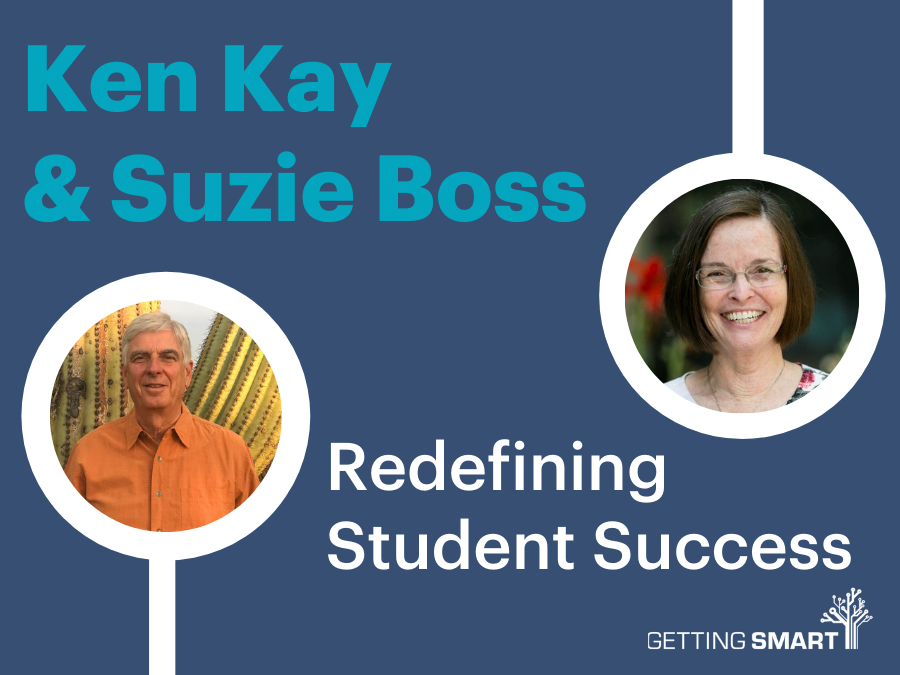
 For two decades Ken Kay has been talking about the 4 C’s (communication, collaboration, critical thinking and creativity), recently, as documented in the new book, this shifted to student success.
“People started with the 4 c’s but it isn’t the best way to start your learning journey. Suzie and I had to write about the urgency of the work – it isn’t gradual change… it’s a need for local communities to have local conversations.”
Suzie has long been an advocate for PBL and, in particular, high quality PBL “we have a much better understanding of how to create PBL experiences that are well designed. It needs to be rigorous, not just messing about.”
In the book, Ken says that “transformation starts with a backward design process, informed by diverse stakeholders, to develop a portrait of a graduate.” He and Suzie both agree that portraits of graduates are a great moment to reflect on the district’s performance of equity. Ken also advocates for a “green light culture”, one where schools and districts feel empowered to innovate.
Much of what was said in the book reminded of us How to Citizen with Baratunde Thurston. We appreciate how he uses citizen as a verb and got the sense that student success often implies engaged citizens and focused on civics, contribution and action. Suzie highlighted that it is about both “the knowing and the doing.”
The authors also explored questions around problem finding and our new mutuality: “Why aren’t your students a part of the 10 year plan for reducing carbon in your building.”
The book also share great examples of edleaders changing mindsets and changing practice: “When Jason Glass was superintendent of Jeffco Public Schools in Colorado, he brought a singular focus to ‘the task as the unit of change.'”
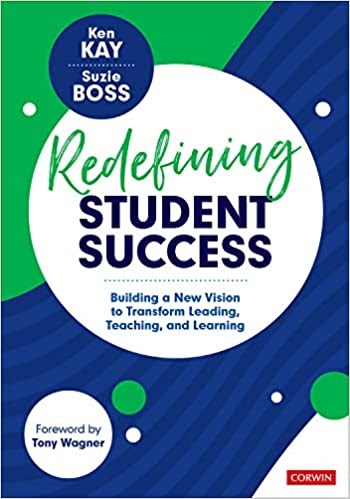
Overview of Redefining Student Success: Building a New Vision to Transform Leading, Teaching and Learning by Ken Kay and Suzie Boss
Be the leader of a fresh, bold, enduring vision of education for your district or school.
The future of learning has arrived, and it requires bold educational leadership and a dramatic redefinition of what it means to be a successful student today.
Redefining Student Success invites you to lead this transformation with audacity. It engages leaders with the concepts and actions needed to reimagine schools, address inequities, and help today’s students develop the skills they need for personal, economic, and civic success. This vital guide supports transformative leadership with
• Concrete guidance on how to create a Portrait of a Graduate and Portrait of an Educator which will help ensure teachers have a unified vision for professional growth and student success
• Reflection prompts that help you recognize your strengths, spark discussion among stakeholders, and identify next steps for inspired action.
• Compelling examples of students already engaged in creative, self-directed problem-solving around issues that matter to them and their communities, together with stories that illustrate how districts and schools have arrived at their own vision of what education must become.
• Companion guides to 21st century learning for parents and students available online.
For two decades Ken Kay has been talking about the 4 C’s (communication, collaboration, critical thinking and creativity), recently, as documented in the new book, this shifted to student success.
“People started with the 4 c’s but it isn’t the best way to start your learning journey. Suzie and I had to write about the urgency of the work – it isn’t gradual change… it’s a need for local communities to have local conversations.”
Suzie has long been an advocate for PBL and, in particular, high quality PBL “we have a much better understanding of how to create PBL experiences that are well designed. It needs to be rigorous, not just messing about.”
In the book, Ken says that “transformation starts with a backward design process, informed by diverse stakeholders, to develop a portrait of a graduate.” He and Suzie both agree that portraits of graduates are a great moment to reflect on the district’s performance of equity. Ken also advocates for a “green light culture”, one where schools and districts feel empowered to innovate.
Much of what was said in the book reminded of us How to Citizen with Baratunde Thurston. We appreciate how he uses citizen as a verb and got the sense that student success often implies engaged citizens and focused on civics, contribution and action. Suzie highlighted that it is about both “the knowing and the doing.”
The authors also explored questions around problem finding and our new mutuality: “Why aren’t your students a part of the 10 year plan for reducing carbon in your building.”
The book also share great examples of edleaders changing mindsets and changing practice: “When Jason Glass was superintendent of Jeffco Public Schools in Colorado, he brought a singular focus to ‘the task as the unit of change.'”
Overview of Redefining Student Success: Building a New Vision to Transform Leading, Teaching and Learning by Ken Kay and Suzie Boss
Be the leader of a fresh, bold, enduring vision of education for your district or school.
The future of learning has arrived, and it requires bold educational leadership and a dramatic redefinition of what it means to be a successful student today.
Redefining Student Success invites you to lead this transformation with audacity. It engages leaders with the concepts and actions needed to reimagine schools, address inequities, and help today’s students develop the skills they need for personal, economic, and civic success. This vital guide supports transformative leadership with
• Concrete guidance on how to create a Portrait of a Graduate and Portrait of an Educator which will help ensure teachers have a unified vision for professional growth and student success
• Reflection prompts that help you recognize your strengths, spark discussion among stakeholders, and identify next steps for inspired action.
• Compelling examples of students already engaged in creative, self-directed problem-solving around issues that matter to them and their communities, together with stories that illustrate how districts and schools have arrived at their own vision of what education must become.
• Companion guides to 21st century learning for parents and students available online.
Transcript
This transcript has not been edited for spelling accuracy.
Hey there. Before we get to the conversation, we wanted to tell you about the Getting Smart Smart Update. Do you love hearing about new innovations in learning? Every week we send out a newsletter blast at thousands of leaders in the field that highlights what we’re thinking about, what we’re excited about, and of course, the most
innovative things in education. If you’re not on the list yet, then we’d love to have you. Sign up for the newsletter at www.gettingsmart.com. All right, let’s jump in. You’re listening to the Getting Smart Podcast.
I’m Tom Van Der Rik, and if you’re a regular listener, you know that we talk about innovations in learning, and those usually start with a reconceptualization of learning goals or learning experiences or both. And today we’re joined by Ken Kay and Susie Boss, who have been thinking about learning goals and learning experiences for several decades.
Ken and Susie are the co-authors of Redefining Student Success, Building a New Vision to Transform Leading, Teaching, and Learning. Ken and Susie, welcome. Thanks so much for having us. Thanks for having us, yep.
As many of you know, Ken Kay was the founder of the Partnership for 21st Century Skills. Can you start at that about 20 years ago? Yes, 2002. The partnership was really critically important because it was a business and education partnership that really, for many of us, redefined what students should know and be able to do, and
it added to our common vocabulary, the four Cs, communication, collaboration, critical thinking, and creativity. Ken, what has changed in the recent years that led you to want to write this book and redefine student success? Well, I think really two things, Tom.
One is that people took the four Cs and started to quickly think that their mission was to embed the four Cs into content standards. And so that wasn’t a bad place to start, but it isn’t a good way to envision your end journey. And so that was one troubling piece of what we saw happening.
And I think also that there was a lot of conversation about how to do this slowly and incrementally. And Susie and I felt strongly that we needed to urge people to be faster and bolder about the work. So the real transition here is that the four Cs started a great conversation about how
many Cs there ought to be. Should there be seven, eight, 10? And I think that was a false premise. It was actually like we were trying to define the holy grail that everybody would then agree to.
And I think what Susie and I realized as the launching point for this book is that we needed to give communities the power and the encouragement to finalize their own set of outcomes. So I think those two things, the need for boldness over incrementalism and the need for local conversations that empowered local communities, were the two new drivers that
made us want to go beyond the four Cs. I love that answer. And, kid, I want to come back and explore the need for communities to have this conversation. But Susie, Susie Basu, for decades, have been a great advocate for project-based learning. We really appreciate your writing and teaching on that subject.
But I was reminded that recently that John Dewey talked about project-based learning 120 years ago. How has this project sort of updated your advocacy for project-based learning? What’s the new case for PBL? Sure.
And, you know, thanks for that question and your comment, Tom. This has clearly been my passion for the last couple of decades. I think there’s three things that are worth thinking about as we redefine project-based learning and the urgency of now to bring this to students. You know, I think the first one is we have a much better understanding of the importance
of how to create project-based experiences that are well designed. So it’s not, you mentioned Dewey. You don’t want it to be just messing about in Dewey’s words. Really needs to be a rigorous approach, you know, to learning and teaching. There needs to be a framework that gets you to really substantial goals.
And I think PBL works, where I’ve been part of their national faculty. I’ve now emeritus status, but their gold standard framework for project-based learning has helped with that deeper learning and its high quality PBL framework. And those are very much aligned around, you know, the necessity for good design and projects. So that’s a big one, I think.
I think another one is this growing evidence that PBL works really well. Just this year, there were four big white studies released by the Lucas Education Research folks, you know, high quality university driven studies comparing PBL with traditional teaching and wonderful outcomes for academics, for everywhere from AP, high school courses down to elementary literacy work.
So, you know, we’ve always felt that this is the best thing for students. That evidence is stronger than ever. And I think the third piece is scale, that there’s much more system-wide embracement of project-based learning. When I started writing case studies about innovative teachers doing PBL as technology,
you know, 20 plus years ago, and they were often the singletons. They were the outliers in their buildings who were, you know, that one teacher with that fantastic project. Now, it’s much more likely to see a entire system embrace PBL as something to bring to their students frequently and regularly. It may not be wall to wall.
It may not be projects every day in every classroom, but there’s repeat experiences so students can really go deep. So, those are a few of the trends I’ve been paying attention to. Thank you, Susie. I really appreciate that.
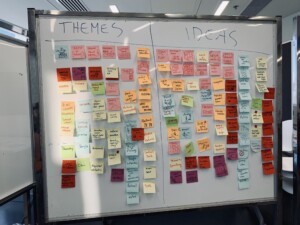
And the link back to the portrait of a graduate is that if we make really clear what learners should know and be able to do, we can invite them into the process of constructing projects that are really valuable and ensure that they’re working on topics that are important to them and their community. So, Ken, in the book, you say that transformation starts with the backward design process
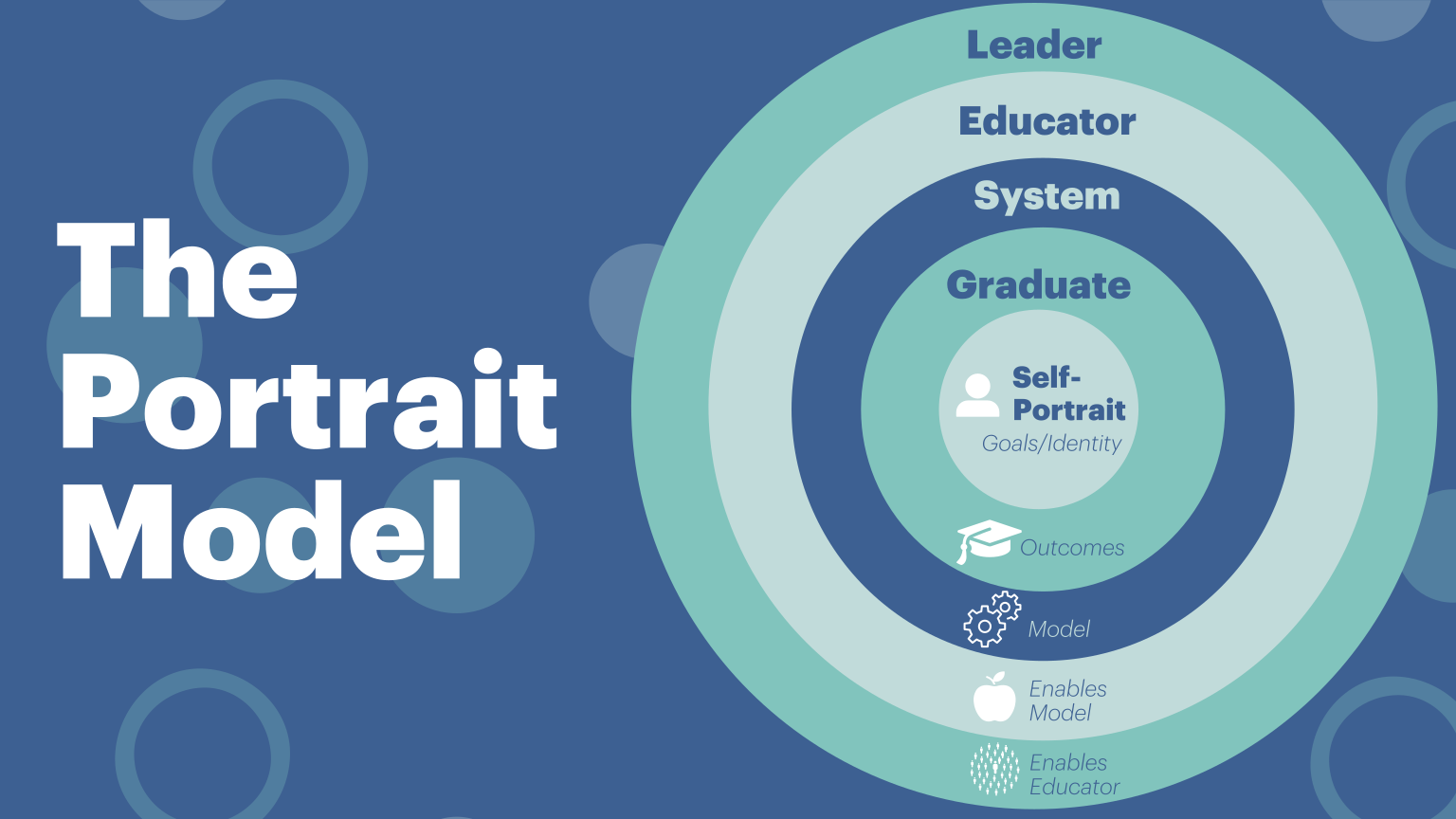
and forms by informed by diverse stakeholders to develop a portrait of a graduate. So, what is a portrait of a graduate? Who should be involved? And then how does it become a North Star for a community? Well, the idea here is, and I think that maybe we should say we’re at a moment in COVID,
post COVID, where this idea of redefining student success is gaining momentum because parents and teachers and students have just seen the old system defining outcomes that are fundamentally ineffective and not interesting. And so, the idea now of resetting the goals is something that’s catching on. So, from our perspective, one of the best ways to reset the definition of education is for
communities to identify the outcomes that really matter. So, we’re talking about moving past memorization, moving past compliance, and moving towards a set of activities that the broadest community, the teachers, the students, the parents, but the business community, the local government community, the workforce pipeline community, the student, the youth development community, all the pieces of the community that have an
interest in how our students are growing and where they’re headed can be encouraged to come together to define this portrait of a graduate that will then state the outcomes for the K-12 system and, in some cases, for the community writ large or the region writ large. I appreciate how you did that, particularly with a group that you formed, Ed Leader 21. You worked with hundreds of communities around the country and then Ed Leader 21 is now part of
Battelle for Kids and Battelle for Kids has extended that to hundreds of communities where they have had this conversation where they built the portrait of a graduate. There’s similarities and differences, but the one thing that’s common in all of those communities is that it’s built really strong support for a new set of learning goals and with it a new set of learning experiences.
So, we appreciate your leadership on that front, Ken. Suzy, I’d love to have you reflect on how having this community conversation about what learners should know and be able to do. What’s the equity angle or how does equity emerge or what do leaders need to do to ensure that this process advances equity as opposed to dampening it?
That’s such an important question right now, isn’t it? And equity is a big focus of attention in our book for obvious reasons. And I think a couple of things to keep in mind here are really helpful. First, that community conversation that has to include a very inclusive community. We mean the entire community, particularly voices that haven’t been heard much in the past.
And we give lots of examples of how different school systems have brought people into those conversations who didn’t feel like they had a voice in what education was and where it was going. So ways to overcome those barriers and make people feel part of that conversation. So that’s on the visioning side. But then I think when it comes down to the aspirations of that vision, when you agree on a vision,
that’s a vision for all your students. It doesn’t mean just some students who might fit a certain profile, they’re going to excel in all these ways. It means this is what all of our students need to be ready for active citizenship or whatever happens after high school for the sort of career paths that they’re going to be on. And that means students need whatever supports might be necessary to help them reach that vision.
So if you’ve had students who have been, you know, on the, you know, one side of the achievement gap you don’t want to be on in the past, how are you going to support them to get them up to speed? We have a wonderful example of, it was Umbil, ISD and Texas where they had their strong community vision. They had the portrait of a graduate. They recognized that there were students who were not probably going to be reading by grade three,
which is one of those big milestones. And so they brought additional support to students who were in, to classrooms that had a high percentage of kids who for various socioeconomic factors were not going to be reading by grade three. Great. So let’s identify that. Let’s use data to figure out who they are, where they are.
Let’s bring a co-teacher in. Let’s bring in professional development. And all of that aligns to the portrait of a graduate because the goal is all kids need to reach this vision. And it’s our job as educators to figure out what are the supports we need to provide so they can all get there. So we talked about closing, not just the achievement gap, but the readiness gap to get kids ready for the future that, you know, that they want.
Tom, one of the pieces of the book on equity that I’m proudest of is to, is this point, which I’m not sure has been as emphasized as it may be because their district’s taking on the portrait of a graduate. And our point is if you take on the portrait of a graduate and don’t look at the equity issue really carefully, you’re going to build in the inequities of the past. And the portrait of a graduate is is a good moment. It’s not the only moment, but it’s really a good moment to say we are going to look at this work with an equity perspective.
So that we aren’t going to bring with us into the new system, the inequities that we’ve been carrying. And I think that that’s a very important and potent conversations for communities to be having while they’re looking for their portrait of a graduate. So Ken, an Ed leader might lead this community conversation, thick, rich dialogue with diverse stakeholders about what learners know and be able to do. In Chapter two, you move into building a Greenlight culture. What is that? Well, it’s very interesting.
It starts with the premise, Tom, that some districts think that once they have their portrait of a graduate, they can just run it into the classroom. And one of the points that Susie and I make very strongly throughout the book is you got to embrace your adults before you embrace the students. And you really have to have the adults on board. So that’s the starting point. But as we started putting together the stories that I know we’ll talk about more with you, one of the things we found on great PBL and great pedagogy around creative problem solving is that when we ask people, well, how did you know to do this project? How did you know you’d have the support for this project?
We looked at our notes and we found seven, eight, nine examples of people using the term, well, my principal gave me the green light, or I knew that my principal would give me the green light, or the principal would say, my superintendent gave me the green light, or I knew my superintendent would give me the green light. So we really took this term, we didn’t invent it. We took this term out of the conversations we had with leaders and educators and realized that this notion that educators need a green light to experiment and we need a green light to innovate became really important. And then Susie had this wonderful revelation when she started talking about self-directed learning that we needed to give the same green light to students.
So the notion of a green light for educators and a green light for students is prevalent through the book and it’s, I think, one of the nicer, newer conversations that we’ve had that has really resonated with everybody we talked to. Susie, this is the first book that I’ve seen that in addition to discussing a portrait of a graduate as a portrait of an educator, I think you suggest that if we want new experiences and skills for young people, that we really need a different vision of the knowledge, skills and dispositions that educators need to bring to the table. How should a system go about developing a portrait of an educator? It’s, you know, again, this is kind of a new trend.
The portrait of a graduate has been growing and portrait of an educator is really something pretty new on the horizon and pretty exciting. And we identified a couple of different strategies. One is taking a look at your portrait of a graduate and thinking about how can our educators live up to this same vision? Do they have the skills and competencies that we’re asking of our students? So you can use sometimes the very same portrait, but think about what are the adult learning needs and the adult learning opportunities.
Other systems have had a great conversation with their teachers and have come up with a new portrait that identifies additional competencies that educators need. So they start with their vision of how are we going to get students to these competencies and they may add on some additional skills that educators need. And again, these become aspirational. They become the tool that you can use for backward planning, thinking about, OK, if this is our vision for educators, what are the stepping stones we need? How do we put professional learning in place to help our educators get to this point?
So it gets aspirational and then it informs your professional learning that’s going on in the system. Ken, I was reminded a couple of days ago that marketing guru Seth Godin for 10 years has been saying, there’s really two things kids need to learn. How to lead and how to solve interesting problems. And you discussed that in chapter three of redefining student success. What’s new on this subject of problem solving?
Well, you know, Tom, in a way, the whole middle of the book is devoted to creative problem solving. And in a way, you know, it was we had to make a tough decision because we say at the front end of the book, each community should decide by themselves what competencies are. Important, but we really weigh in in the middle of the book and say, maybe creative problem solving is the first among equals. And the reason we did that is is we thought that that would get people to see what they needed to do differently. And so it goes back to the point I made earlier that just trying to weave in some communications and critic and critical thinking and communication and.
And collaboration standards into existing content may not get you as far as you need to go when you look through the lens of creative problem solving, you realize that kids really need to be working on big problems that matter to them. And so that’s where we moved off and said there’s a whole. First of all, there’s some great literature around how to create pedagogy around creative problem solving and what do you need to do to incentivize innovation and creativity with teachers. But maybe the most important contribution is that we start digging into those contexts in which student creative problem solving is really going to flourish. And we’ve identified entrepreneurship, innovation, invention, civic engagement as areas where we think that educators now need to start looking at interdisciplinary problem solving and not continue in their siloed domains that isn’t really going to create context that kids are fundamentally interested in and that don’t comport to the challenges of their community.
Yeah, I I deeply appreciate this chapter and you’re. The way you unpack creative problem solving it reminds me can of the work we’re doing in Kansas City with about 45 school districts where there’s a regional agreement. To insert new experiences, including client connected projects and entrepreneurial experiences and work based learning. And one of the reasons those agreements exist is because the educators at Kaufman had the insight that if they had just agreed on creative problem solving teachers would have said, yeah, we teach that in. In these three classes, but instead they came up with these regional agreements to say kids need big community connected problems to work on problems that are important to the community as well as to them.
And I love how they prioritize that as a as a region. I think it’s a terrific example of what you talk about in chapter 3. And we also I think we highlight that example in in chapter 7 under partnership. So we we and we appreciate you. You you you sharing that example and we followed up with some really great storytelling about them. Susie on a bike ride yesterday I listened to how the citizen with Barry Tunde Thurston and he just finished his second season of his podcast and I just love how he talks about. Being a citizen as a verb as this active sense of knowledgeable engagement with your community and I felt like in chapter 4. You took that. Ethic of being an engaged citizen into the way that you described a new approach to to civics and history with a focus on advocacy and contribution and service.
Maybe you could share a couple examples from that chapter. Of course. And you know, we feel like this is one of the big conversations at the moment. I mean, you know, have we ever had a. More, you know, clear case for the need for students becoming engaged informed citizens. So some of the examples in that chapter that we were excited about go all the way from elementary kids who are tackling issues in their communities. Maybe they want a new sidewalk or a better pedestrian access to get to school to get that done. They need to understand how their local system of government works. Who holds the levers of power. How do we get to those people. How do we make a convincing presentation to them. You know, all the way up to high school students who in my hometown in Portland, Oregon, really exciting project emerged around environmental justice. They saw the connection between environmental issues and social justice and they wanted this to be something that they could learn through. They wanted this to be the lens for them to learn and take action.
So throughout the book throughout that chapter in particular, we keep coming back to this combination of knowing and doing. So you don’t just turn kids loose and say go solve a civics problem and we’ll check the box that you’ve done something. No, you really need to understand how does our democracy work. How did it get this way. What’s our understanding of the citizens role in the democracy. You know, how does all that work and what’s our as Americans what history do we need to think about to understand that and then taking that knowledge all the way to action. So really aligns with with the National Council of the social studies has done with its new framework that calls for knowledge and action. And I think all the examples we highlight in the book. It’s kids who really understand deeply something about how their democracy works and they see the need for change that they can be part of they can.
So we were really excited to see that many, many examples, you know, in that chapter that we’re pretty, pretty exciting about what the future holds for citizenship. Susie, there’s a terrific example from Portland. Your school district has a great K 12 sustainability curriculum in part because students demanded students protested. And as a result, the school board responded with with your local power company and help develop a really great K 12 sustainability curriculum. So can a great example of young people being involved in the in the dialogue about portrait of a graduate. Absolutely. And all those competencies that kids are developing, you know, at the same time that curriculum was coming together with the partnerships and the student leadership you were describing. The same district had been doing some deep work around portrait of a graduate portrait of an educator. And so the skills that students develop the understanding knowledge dispositions they develop through that curriculum, align beautifully with, you know, what’s the portrait that our community wants.
Well, you know, being engaged citizens as part of it being stewards of the world of the earth is part of it. And so really nice connections there. One of the one of the places you know we tried to be provocative Tom shocking. And one of the places I think we nailed it is in sustainability where, you know, we challenge leaders to look at the next 10 years and say, you know, there’s a, we don’t want you to limit yourself to the just thinking, well, pack kids on the on the head and tell them to go off and do a recycling project. Why aren’t your students involved in helping you create a 10 year plan for your buildings to be carbon carbon neutral. And what does that look like and what would happen if your kids were part of the process of converting every building in your district. Those are the kinds of both it’s really not just a national challenge. It’s also a global challenge that kids could very much partake in and I think that some leaders don’t understand that their own physical plan is an opportunity for kids to break through for them and their kids to jointly break through and see the possibilities of the kids co co developing the future of the sustainability practices of the whole school district. Right. And as Ken’s talking about this that the message from leadership is so critical there that this is what we want you students to be doing.
We profile that length the district in Encinitas, California and elementary district where they have a protocol developed around questioning, asking good questions, identifying problems that are worth solving. And then what’s the process you go through to solve them. And you know these kids are kindergarten through sixth grade I think and they’re consistently finding things in the school campuses that you know we’ve got a water runoff problem here and we’re going to bring the watershed board in and we’re going to get this fixed and you know they just get it done. And you know it doesn’t you don’t have to wait I guess is the point here. You know kids don’t have to wait until they’re of a certain age or you know they’ve taken certain courses. If they recognize a problem that needs solving and they have the support of a school system that’s going to let them learn by solving it. Well and we have examples in the book where the kids were able to get things done in half the time that the adults got them. Yeah, it’s hard to say no to a impassioned, you know, informed young person.
Hey school boards and city councils. Listen to kids. This this leads me into chapter five Susie which is a terrific discussion of self directed learning that chapter feels new and important. What why is that in there and what’s the link back to portrait of a graduate. Sure, you know it seems to be at the heart of everything the book talks about. You know if students don’t have a sense of their own agency that sense of I can direct my own learning I can set goals I can get the help I need. They’re not going to be successful in projects that that require them to make decisions and you know and step out. It’s part of this big shift in the world from being compliant and being a good rule follower to having a sense of you know your own abilities and directing your own goals. And so we have to take a different path and you know taking the world where you want it to go. So I think one of the things that we’re recognizing is the education field is recognizing is the importance of self direction, but also how do we nurture it. How do we inculcate that how do we help students develop that capacity. And so we heard from many districts about how they’re intentionally scaffolding self direction you don’t just turn kids loose and say go off and you know lead your own journey.
There are you know some districts that we spoke with Lindsay California has done this amazing job of identifying classroom look for us. Here’s what it looks like when kids are directing their own learning because their goal from their community is to have lifelong learners. Well how do we build that over time Mansfield Connecticut really unpacked what does it mean in the classroom. When students are setting goals when they’re being supported by teachers. So again and again it’s these this backward design if you want students to have these competencies. How do you get them there and for you know I in my PBL work over the years. I’ve seen a lot of students by high school who have lost that sense of agency. You know they’re given the opportunity now you get to do a project you want to do and they don’t have a clue where do I start. They go googling passion projects what could I do for passion project instead of tapping in you know what do I really care about. So for us it just seems essential to develop the sense of students who are about something who have goals and then can get the support that they need to.
Reach this goal. So it’s right at the heart of everything. Thank you for those examples. Those districts are great examples of student goal setting where every day every week students are setting their own goals you can go up to any student in Lindsay California and they can tell you what they’re working on today. What their goal is and what what they have to do to move to the next level. So great example of student directed learning. Chapter six is on board learning experiences. I think you suggest in that chapter that these community conversations that result in new agreements around outcomes also create the platform for you to innovate in terms of student learning experience. And we’ve talked about project based learning. It would be an example of something that you can do more of based on these new agreements.
What else did you describe in terms of bold experiences. You know and I think our big message there is that there are a number of bold moves you could make. When it comes to pedagogy we unpack a lot of those. But they’ve got to align with your vision. They can’t just be one off. We’re going to do a little of this and a little of that and a little of this you know instruction assessment professional learning.
They all have to be going in the same direction. So for something like that we see is really powerful student led student engaged assessment leading to things like portfolio defenses. You can’t just throw those into a system if you don’t also have really rich learning experiences leading up to those defenses where students have something they can talk about that’s worth reflecting on. So they really had rich self directed learning experiences that they can then explain you know to the folks that are defending their portfolio to. So you know there are many great strategies but they seem to have in common.
They clearly have to be aligned to your vision where are you trying to go how are we going to get there. And they also really have to be teacher directed teacher engaged. You can’t just be top down about this. So what’s your structure for giving teachers that voice. Go ahead Ken.
No I’m sorry. One of the stories in the book that I that I love is we interviewed Jason Glass when he was still in Jefferson County Colorado and then also as superintendent in Kentucky. And he really made the point well that Susie is describing about how is a leader. Do you figure out what your leverage point is. And he said to me you know we had a district that was so decentralized with different strategies we had.
We had four or five different programs which a lot of which you know they had a high tech school they had a big picture school they had. Global curriculum and all of them were on their own journey and he said the thing we realized that bind them all together was that what we could do as a leadership team at the district level was to focus on the task. The actual task that no matter what program you were under no matter what kind of school you were operating in. The ability to improve the task that the student was working on was a unit of change that he identified to leverage his vision in every context in the district. And that’s the kind of bold leadership I think Susie and I were talking about how do you look across all the things you’re doing and say the unit of change and it doesn’t have to be in every district this won’t work but in that district it was very powerful.
That if we get everybody to focus on the task as the unit of change we can bring our whole district along powerfully and that that sort of really grabbed me as a way of thinking about what the leaders role is in all this. Jason we appreciate his leadership and we have a podcast with Jason from two years ago where he explores this idea of task as the entry point and giving kids co constructing with kids work that is more challenging more extended more important to them in the community so appreciate that. And we should just add that at the state level now he is spending 2021 driving a portrait of a graduate at the state level in Kentucky as the new commissioner there and had some very powerful things to say about about that process as well. Now it could if I could add one more piece there and that is connecting this this what Ken was talking about the task is a unit of change in that district in Jeff co the professional learning is also around the task as a unit of change so that’s that alignment. We’re small groups of teams of teachers self identify an issue they want to tackle they do it as a learning lab. They dig into research they visit each other’s classrooms they gather model lessons all focused on what’s the task that students are engaged in how can we improve that so that’s the alignment that you want to see.
Susie let’s wrap up with chapter seven where you describe the importance of partnerships what role do they play in building and supporting a portrait of a graduate. Boy this is just one that’s near and dear to my heart after years of PBL advocacy you know having students connect beyond the classroom is critical for all kinds of learning experiences and in this chapter we look at it different kind of stakeholder partners including parents and families business and community partners the nonprofit world and ways that school systems have made it easier for those partnerships to really flourish. You know a lot of teachers and potential partners will say we don’t know how to get started but in districts like Anaheim California for example they have a whole menu of options for potential partners to choose from so partners can come into working with students on career and technical education by being offering field trips or being mentors or really being hand in hand in terms of assessment and curriculum design.
There’s a menu of options and it makes it a lot easier for partners to be part of the process with students so that’s a big piece of it I think really thinking of who are potential partners how do we make it really easy for them to engage in a way that’s going to benefit our students. So you know smoothing the road for partnerships is a big message of that book or that part of the book. And also I think just to the other great connection is that if you look at the topic you raised earlier Tom which is creative problem solving really focus on the partners. As they can specifically help the school and students work on the challenges of the community. So I think we do a good job in the book of talking about partnerships specifically focused on community problem solving.
And we make the point we believe that in 30 that in over the next decade 30 to 50 percent of student time will be focused on creative problem solving and and the community problem solving will be a huge piece of that and having good partners help identify those problems and partner with the students on solving those problems is an essential piece of the vision that we lay out. The other thing I should say in this chapter I’m particularly excited about is that we develop along the way a real focus on wanting to better help educators better communicate with both students and parents around this whole topic of 21st century learning. And we created some initial drafts of guides we went into the field with some focus groups we got a lot of great feedback and we’ve developed a four page guide for students and a four page guide for parents. Both of which are going to be translated into Spanish which we’re also excited about. So when the book comes out in late July folks will not just be able to get the book but they’ll also be able to get their hands as a free resource as a student guide for 21st century learning and a parent guide for 21st century learning.
And we hope this is our give back to the field. We’re very excited about the possibilities of getting districts to better connect with both parents and students about this topic. We’re talking to Ken Kay and Susie boss the coauthors of redefining student success building a new vision to transform leading teaching and learning for both of you guys I love the book and love the all the special features in the book. You made it super valuable. Whose idea was that.
Is that yours Susie. Oh it was a wonderful collaboration. I would say we we brainstormed every bit of the way and built on each other’s thinking. And also and also we had a wonderful publisher that helped us figure out how to how to develop some of the tools in the book as well so it’s been a great collaboration. Corwin published our last book and we really appreciated their collaboration as well.
I love how the book starts with every chapter starts with a summary. You have quick tips at the end. You have case studies that are really well noted. You have these sort of journaling questions that are provocative and interesting. So beautifully done.
Wonderful. Really appreciate your your comments and you know I mean our goal was for people to use the book you know really make notes reflect talk with other folks so we tried to provide all the tools to make that happen. Tom coming from you that compliment means an awful lot. We really we very much appreciate it. It’s kind of booked that you can you can page through it in in 10 minutes and get a lot out of it.
You can come into it in different points or you can use it as a book study over the course of a semester. So I just love that it it can be accessible and useful to a lot of different people in a lot of different ways. So congrats on the book. Thank you so much. And thank you. Thank you so much for making this forum available to us and we always I love I always love conversing with you on these subjects and appreciate the work you’re doing to to continue to get innovation and transformation at the front of the education agenda.
So you’ve been a great steward for all of us in that regard. Well can let’s let’s keep this going with a couple other discussions really diving into some of the important topics that that you’ve raised in the book to our listeners. Thanks for joining us today. We appreciate our guests Ken Kay and Susie boss have really dedicated their lives to saying on the cutting edge of learning for more books on education leadership. Check out these Corwin authors that we’ve interviewed recently. Randy Weiner and James Bailey.
Dr. Debbie Silver and Dwight Carter and Mark White. Until next week keep learning and keep innovating.


0 Comments
Leave a Comment
Your email address will not be published. All fields are required.