

Dr. Ellen Perconti on The Practice of Contributive Learning
Key Points
-
The students must see themselves in the learning.
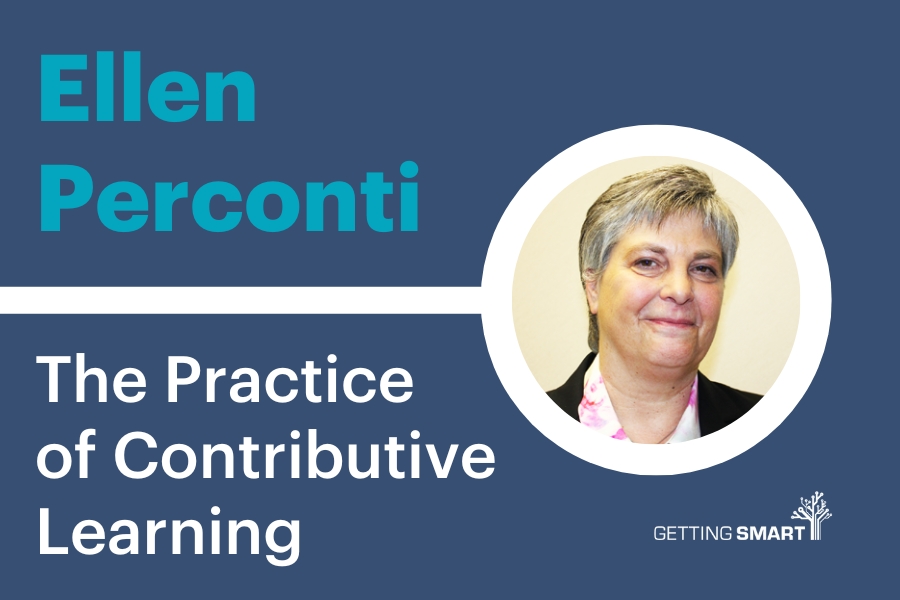
On this episode of the Getting Smart Podcast Tom Vander Ark is joined by Dr. Ellen Perconti, Superintendent at Goldendale School District. Dr. Ellen Perconti is an experienced education superintendent with a demonstrated history of leading instructional reform and creating cultures focused on engagement.
Links:
- Goldendale School District
- Getting Smart Podcast with Joanne McEachen
- Education Leaders Organization
- Marc Johnson Sanger Unified
Transcript
This transcript has not been edited for spelling accuracy.
Ellen, what is Contributive Learning? You know, Contributive Learning is really about the desire to have students feel like what they’re doing every day in the classroom make a difference. So they’re really looking at using their learning and being part of that classroom environment that says I’m making a difference.
And then it’s about those bigger things as well. So taking what they’re learning and using it in the community to say, how can we make our world a better place based on what we’re learning? I’m Tom VanRak and you’re listening to the Getting Smart podcast. And today we’re joined by Dr. Ellen Percanti.
She’s the superintendent in Goldendale. I can’t say that I’ve been in Goldendale, but it looks like it must be beautiful on the bluffs of the Columbia River. It is gorgeous. We have views of both Mount Hood and Mount Adams from the area as well as being able
to overlook the Columbia River. We’re kind of right on the edge of what they consider the gorge, which is kind of nice in some ways as well. So we’re still very small, very rural, have those values within the community. And it’s a gorgeous setting.
I’m heading to Walla Walla for a little wine tasting in a couple of weeks. So I won’t go through Goldendale, but I’ll be in the neighborhood. Well, if you’re going through, you should stop at a viewing area. It’s a beautiful part of the state that a lot of people don’t get to visit. You’ve been there about three years.
Is this your fourth school year, Ellen? Going into my fourth school year, yep, we’ve just started the fourth year with this district, yes. But you’ve been a public school superintendent for now for over a decade, is that right? Yes, you can continue to age me there, but yeah, this is my 11th year as a superintendent. So prior to that, I was a curriculum director.
Prior to that, a teacher on a special assignment. Prior to that, I was a music teacher. So I kind of worked my way through the system in that way. And 11 years ago, I took my first superintendency in Northern Idaho and then was able to move into Washington about nine years. So this is my ninth year as a superintendent in the Washington state.
Why be a superintendent? There’s a lot of tough days involved, but what is attractive to you about the role of being a public school superintendent? You know, when I was curriculum director, I kept seeing the things that I wanted to have in place and always kind of ran up to some resistance, either, you know, in the higher ups in the district or whatever. And really wanted to know, can I make that difference at scale? So that was kind of the impotence of, you know, I think I know something and can I really make a difference for kids?
And it is a journey. And it’s not what you think it is. But I guess at the end of the day, I do feel like I’m making a difference. You have been, you’ve served in a number of smaller districts. What are the particular joys and if there are particular challenges of working in smaller systems?
You know, the joys are knowing the people and getting to lead some of the professional learning for the staff. Most days, I can’t say all days, but most days I get into a classroom. I’m able to see the students see the impact of what we’re doing in the classroom. And I think the larger your district, the fewer of those times you get. And so that’s, I guess, primarily why I like small.
I also just enjoy more of the rural kind of atmosphere than bigger cities. So that’s just kind of a personal piece. I love being outside and having those, you know, being able to go for a hike and seeing the birds fly, those kinds of things. So that’s a piece of it. But, you know, professionally, it really is feeling like you can work more with the staff, build those relationships better with the staff and see the difference that it creates for students.
Ellen, it feels like we’ve been on a parallel professional journey. I think we both discovered the power of contributive learning or of difference making. Some people call it preparing kids to be solutionaries. This idea of making a difference is a powerful sense of mission and seems to be more important than ever. I’d love to have you describe that journey for yourself of sort of how and where you discovered that as a high impact focal point for, I guess, for yourself and for young people.
So I have to admit that I am a recovering data holic. As no child left behind swept through, I was one of those people who was responsible for collating the data and looking at the data. And I had a colleague who every time we would sit down and look at data would come alongside me and say, you know, Ellen, it’s about relationships. And I would always say, yes, I know it’s about relationships and here’s the data. But as I have continued to work to continue to be in the system, I continue to realize every child is so much more than their data points.
And so in looking at what does success mean and looking at what is it we really want for our children. I really have, I guess, developed in that area that I really want our children to be able to make a difference and to have that feeling that what they’re doing is important. I think that’s going to be better for our society in the long run and it’s so much more fulfilling. So and and quite frankly, we just, you know, Tom, people are more than the data point. And I can’t tell you the number of times that I have led sessions about, you know, here’s the data point of the kid.
What are you going to do next? And now what I try to do is look at here are the data points for the child. And we look at, you know, what is their self understanding? What are the connections they’re making? What are their competencies as well as their knowledge, their academics and trying to put them together in a way that allows our teaching staff to then design lessons that engage students so much more powerfully.
And then that ultimate goal of let’s let’s make a difference somehow. So whether it’s with the child next to you, whether it’s with your classroom community, whether it’s the school or our broader community, how do we use what we’re learning to make that positive impact? If if the goal is contribution or difference making, that would sounds like it would change the desired learner experience. How do you now think about a good day in Goldendale?
What kind of learner experience do you hope to see when you visit classrooms at the elementary level? And then at the high school? So all the way through what I’m looking at is for the children to see themselves in the learning. So it’s not something designed for somebody. Textbooks are typically designed for somebody in Texas or California.
And I want them to feel like that learning is designed for them and that they see themselves in that learning. That’s a huge piece of it that they have their curiosity peaked so that they come in and we acknowledge that they have background knowledge. We acknowledge that they have experiences outside of what we know about and can use those productively within that learning. So it’s there are foundational pieces of learning and sometimes those are wrote and sometimes those are pretty perfunctory.
But ultimately what we want is for them to end the day with more questions than they began and to feel like when they’re interacting with others, they’re growing together. So that vibrancy that comes from that all the way through to the high school level. What I know is that we don’t know what our kids are going to need to know and be able to do. And so rather than thinking about how they covered every piece of the curriculum, can can they generate another idea? Can they use what they’re learning to see beyond what is already there in front of them?
Can they take the novel they’re reading and apply it to something in their own lives or to see more broadly because of it? So that idea of innovation, I guess, comes into that that curiosity sense of wonder. I mean, wouldn’t it be great if every day started with some experience that just left you going, wow. And then being able to use that of, you know, what created that? How did I get there?
What am I what do I need to learn next in order to just expand on that? I’ve heard you in other settings talk about the sense of awe and wonder. We are our fans of play space learning of really inviting kids to get to know their community and and allowing that to be become an important part of their identity development. What what does that mean in Goldendale and in what ways do you try to
encourage community connected learning? You know, with COVID not to make excuses for us, but it did have an impact on what we were able to do outside our school setting as well as what we can bring in. They get expanded what we’re able to do in terms of video conferencing those kinds of pieces. But really looking now again to kind of reestablish what what are the things happening in our community?
I was at a meeting this morning and reminded again of the renewable energy that is in our area. So we have some fantastic people who are just looking at all different ways of how do we have this renewable energy and looking for ways of how do we connect our students with that? So again, how do we spur their curiosity? So they’re not just learning their physics, but they’re seeing how physics works in the real world,
not just learning their math, but you know, how does that actually work in the real world? So we’re we’re still a work in progress, Tom. I’d love to tell you we’ve got it all figured out and we don’t. But it really is just trying to figure out, you know, who are you? Who are you in the world?
How do you use your learning in that positive, productive way? Ellen, we recently launched a new pathways campaign to the world. So we’re going to be doing a pathway campaign to try to help people co construct with learners, you know, learning journeys that are more intentional, more linked to opportunity, better supported. Are there are there ways in which contributed learning fits with that pathway concept?
Or is pathway the wrong way to think about a secondary learning journey? What’s your take on pathways? You again, I’d have to ask you a bunch of questions of what you mean by pathways. What do you think it should mean? Is it a the appropriate metaphor or do you think about it differently?
I think sometimes so in my head, what I think about when I hear the word pathways is like our career technical pathways. And so here are the set of courses to hedge you in this direction. And I think some kids are ready for that and can just take off and flourish. And I think a lot of kids don’t know. They don’t know what their pathway should be.
So I don’t know what the right metaphor would be, but how do we expand for them? All the opportunities are there and let them kind of sit in that area of confusion for a bit. You know, I don’t really know which pathway I went at this point in time, but I’d really like to learn about this today and maybe that tomorrow so that they continue to build on those concepts and ideas as they’re moving through.
I guess in general, I think sometimes we’re just too lockstep in what we’re asking for. And you know, had had somebody said, here’s a wide open door to me. I wonder where things might have gone versus here’s where we see your trajectory. When you think about Contributive Learning, does that mean a class service project? Or do you hope that every student begins to take on for themselves a sort of a unique sense of purpose
and works out for themselves how and where they make a difference? I think it’s some of both. I think it is some of the larger projects because I think that’s where kids get the experiences they need in order to see themselves as successful in that way. We a couple of summers ago had some kids just, you know, what is it you would design if you could design
something different for your playground area? So what they wanted were picnic tables so that they could go and eat lunch there so that they could sit with their friends and do artwork, those kinds of things outside. So that’s what they created where, you know, they built these picnic tables. And so I think there’s a part of it that they have to see what it is and what it means.
But we talk about Contributive Learning in small and big ways. So those are the big ways, the class projects, the, you know, the big grand thing that we get publicity for. Those are all cool and wonderful. But I think what feeds our hearts most is that smile that happens when you do something nice or caring or contributing to the person next to you.
And that’s the kind of thing that I think that we need to do more of. What is it today that you can do that is contributing to someone else, to their well-being? Have you, as a result of this journey on Contributive Learning, have you modified the way you describe your desired student learning outcomes or changed the mission of your school or anything?
Are there ways that you’ve tried to create community agreements around Contributive Learning? Again, we’re a work in progress. But one of the conversations that we’ve had over the last three years is, what does success mean? So our board has established a goal that all students will be successful. And then we had to start playing with the idea of what does success mean?
And our school board actually brought in, in the conversations of what they see in the community are some of the star academic students who really struggle when they leave high school. So they have the GPA, they get to the college level, but they don’t have those internal resources to be able to be resilient to feel like they are meant to be there and continue that learning.
So sometimes when learning is easy for us and then we hit that rocky part, it’s even more difficult. So they shared those examples and then they shared the example of the student who maybe didn’t have that GPA, but was hardworking and now has a business within the community and is contributing back to the community, you know, as someone involved in the community. And so have had to try to really figure out what does that look like as a student?
And we have worked on the idea through Joanne McKekin’s work of looking at how do you have self understanding? What is that self understanding and some of the components within that part of that is purpose, part of that is being able to set goals that are meaningful to you and to work through them. Competencies, so critical thinking, creative thinking, those kinds of pieces.
Connection and we really focused on connection last year especially as we came back in full time schooling after COVID. And it’s a piece we still have to work on. I mean, connection is kind of at the heart of students feeling like they belong and until you know who you are, it’s hard to connect with other people. It’s hard to know that you belong.
So all of those are wrapped around that idea of success, including the academics. And, you know, the hard part as a leader is to be able to articulate all of that all at once. Because people will take one thing. Well, you said we were supposed to focus on connection. Yes, not to the exclusion of academics.
So it really has to all play together and trying to figure out what are those ways that we look at student data. More holistically. And then again, that we design our learning in ways that really takes into account specific learners. An equity question, Alan. I guess it’s easier sometimes to see.
Contributive learning or deeper learning. Difference making is something extra, something for high flying kids. Is it for everyone? What about struggling learners? And do they get a chance to experience?
Contributive learning? Definitely. And it’s it definitely has to be for all learners. And it can’t just be for one sector. And it’s not it in my mind.
It’s not an add on at the end. So it’s not you do all of these things and then you get to. And that’s why I’m continuing to try to articulate how do we do that on a daily basis? So it’s not just the big thing at the end. It really is along the way.
Had an experience. I was working with a teacher the other day and she expressed that a student in one of his reflections to her had identified that he was high functioning autism. And he said, what you will notice is I struggle interacting with others. I struggle being able to articulate verbally what’s going on. But I want you to know this about me so that we can work better together.
And, you know, those are the kinds of things, you know, he was advocating for his own learning, but also providing the teacher a lens to, OK, I can’t just ask him these questions. I have to provide him another means of expressing that. And when he sees himself then in that learning environment, when he sees himself, when the teacher adapts those lessons specifically for. him, that’s where you really get that difference in the classroom that feeling of yes, I belong and that’s how I can make a difference in my learning and others. Ellen, I noticed that you’re that you chair a leadership learning group called the Education Leaders Organization.
Why the commitment to leadership learning? So the organizer Kevin Stohler articulates it really well. He says, if we don’t have healthy leaders, and we can’t have healthy systems, if we don’t have healthy systems, we can’t do what we need to for kids. So that was a piece of it. And then just the avenue being created of a confidential group of other superintendents who are able to meet monthly.
Talk together, share experiences is extremely powerful and supportive. So I supported another group getting started and that was that was their takeaway at the end as well. There are other people are going through similar things to me. So even though it’s not exactly me, it’s not exactly my organization. Knowing that other people are dealing with some of the same problems is supportive in itself.
And then just being able to talk through them is extremely powerful. I’m curious who’s influenced your learning in this area on your journey. You mentioned Joanne McKeckin earlier. It sounds like she would be on your list. She’s definitely on my list.
She’s one of those people who has the right knack of reaching out and pushing kind of, you know, here’s the next step. Encouraging, but also just really pushing my thinking and she’s been amazing at providing me kind of that idea that I’m stepping into my own leadership. So that’s been extremely impactful. There was another person that did much the same. So Mark Johnson and he was the superintendent at Sanger Unified years ago and has since retired.
But he did a lot of the same kind of thing. He was able just to reach out and give me that push that I needed and support when I needed. I listened a lot. So he would be another one that was a great role model along my career. We’ve been talking to Dr. Ellen Furkanti about contributed learning in the Goldendale School District.
Ellen, I love the idea of inviting kids into learning that matters to them and to their community. We really appreciate your leadership in Goldendale. We’re glad you’re in the state of Washington. Thank you. It’s been a pleasure talking to you today.
Thanks to our producer Mason Pasha and the whole Getting Smart team for making this podcast possible. Until next week, keep learning, keep leading and keep innovating for equity. Thanks for tuning into the Getting Smart podcast today. We want this podcast to be actionable and insightful and a great way to learn about what’s next in learning. In order to stay on the cutting edge, we need people in the field to tell us what they’re hearing, what they’re wanting and what they’re needing to learn more about.
Got a topic or a guest in mind? Send your recommendations to me, Mason at GettingSmart.com. And if you like what you’re hearing, don’t forget to leave a review in Apple Podcasts or subscribe wherever you listen. Feel free to share the podcast on social media using the hashtag GSPodcasts. Thanks so much.


0 Comments
Leave a Comment
Your email address will not be published. All fields are required.