


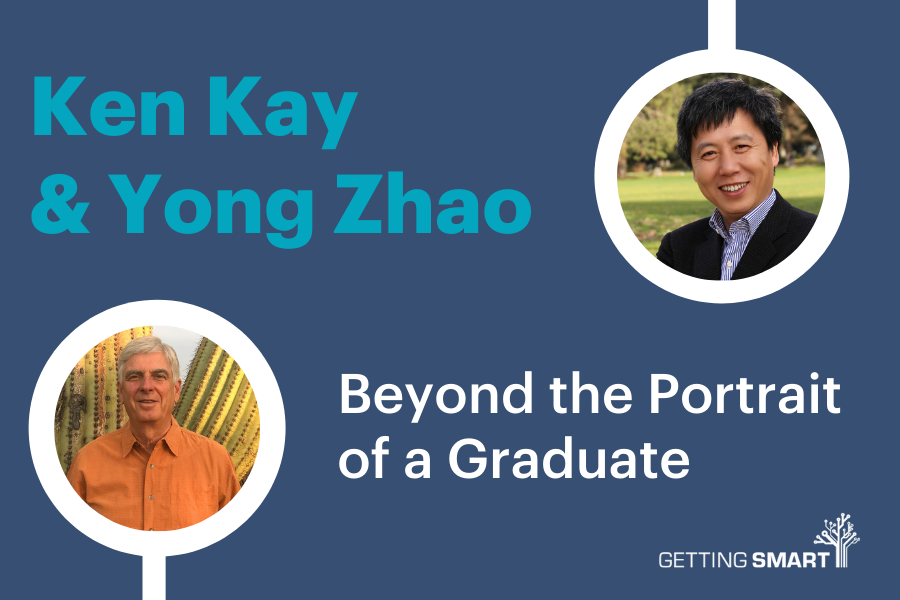
Ken Kay and Yong Zhao on Portrait of a Graduate
Key Points
-
Communities are global now. We must educate our students to be students of the world.
-
Credentials must be student-driven in order to be effective and equitable.
This episode of the Getting Smart Podcast is sponsored by GettingSmart.com.
On this episode of the Getting Smart Podcast Tom Vander Ark is joined by Ken Kay, founder of Partnership for 21st Century Skills, leading advocate of the 4C’s and its successor EdLeader 21, and co-author of Redefining Student Success, featured on an August episode of the Getting Smart Podcast.
We are also joined by Dr. Yong Zhao, a Foundation Distinguished Professor in the School of Education at the University of Kansas and professor in Educational Leadership at the Melbourne Graduate School of Education in Australia. He is also the author of the new book Learners Without Borders: New Learning Pathways for All Students.
Let’s listen in as they discuss Portrait of a Graduate, learning pathways and more.
We confuse floor expectations as ceiling expectations–schools must cultivate students as citizens of a society and the globe
Yong Zhao
One-Two-One
1 person who influenced your thinking
- Ken, interviewed his grandson. “You gotta stay inside the lane they give you, but if you do that they give you a lot of freedom within that lane.”
- Director of career academies in Akron
- Yong said David Berliner (author of The Manufactured Crisis and collateral damage)
2 insights from your work for edleaders
- Host community conversations and build agreements on updated learner goals.
- Make sure grad requirements, postsecondary pathways respect individual ( jagged) profiles and ensure community connected learning.
1 additional insight
- Whatever we do, we should be expecting our own behaviors. We should always be thinking about “but what if we’re wrong?”
- This is a moment of opportunity. COVID has shown us how wrong we already are.
Transcript
This transcript has not been edited for spelling accuracy.
Before we jump in today, we wanted to tell you about a new campaign and newsletter from Getting Smart. It’s called What If, and it’s all about encouraging educators and ed leaders to think differently about education and learning. Every week we will send you a What If question about the future of learning, leading, and
community. This campaign is all about engagement, so we’d love it if you’d sign up and share your thoughts on Twitter, or send them to editor at GettingSmart.com. Sign up for the list today at GettingSmart.com slash What-If. You can’t wait to see what you’ve come up with.
Alright, let’s jump in. Hi, Ken, what is a portrait of a graduate and why should a community consider developing one? Well, Tom, the portrait of a graduate is something that several different groups developed as a way of going forward to try to redefine the goals of education to be consistent with
the realities of 21st century life and work. And what we came up with was an idea, a number of us had been working on a paradigm like the Four Seas, Critical Thinking, Communication, Collaboration, and Creativity. But the portrait of a graduate notion was that each community actually had to have that discussion themselves and come to their own conclusion about what are the competencies
that all the stakeholders in that community felt were the ones that really would make a difference in students’ lives going forward. And so that’s become to be known as the portrait of a graduate, and it’s a community-based conversation and a community-based consensus building process to create specific student outcomes that are central to their life’s success.
So listening to the Getting Smart Podcast, I’m Tom Bandererke, and I have the pleasure of being joined today by Ken Kay. He’s the, many of you know him as the founder of Partnership for 21st Century Skills for 20 years. He was a world-leading advocate for the Four Seas, Communication, Creativity, Collaboration,
Critical Thinking. He founded a successor organization, I’ll call it the later 21, and in August released a terrific new book called, Re-Defining Student Success. We had the pleasure of having Ken and his co-author Suzy Boss on with us back then. And we’re also joined by Dr. Yang Zhao.
He’s a distinguished professor, the School of Education at the University of Kansas. Many of you know Dr. Zhao. He’s really a world-famous advocate for modern pedagogy. He also has a terrific new book out that you’re going to enjoy. It’s called, Learners Without Borders, New Learning Pathways for All Students Ken.
Dr. Zhao, welcome. Thank you Tom. Delighted. Thanks for having us Tom. And Dr. Zhao, what could possibly go wrong with this great idea of having communities
update their learning goals and develop a portrait of a graduate? Well thanks Tom. I think me getting a community to talk about what they want their students to become is definitely a very valuable approach. I don’t think many communities have gone through that.
But my concern really are multiple forward. One is that I always think what if the community gets it wrong? So when you describe a portrait and you force all your children to get that portrait and to become that portrait. But society’s changed and technology’s changed and I’m sure you are very aware of that.
And boom, you just missed that. So that’s a potential danger. I’m always worried about people working in their stone age and suddenly God, we’re in the bronze age. How to find rocks doesn’t matter anymore.
So that’s one thing. Another thing I worry about is what if children are not interested? Any community you get 10,500 students, they’re very different. Children are extremely diverse and different and differences in terms of both natural born talents and experiences.
So some students can be very weak in one area which is okay. I mean, you feel free to be bad at something. That’s what I’ve been arguing about the jagged profile. You’re like I’m worried about the Chinese guy in math. Actually I’m worried about the American guy in math.
I got three out of a hundred points in a college entrance exam. If you know math, that’s very bad. But I never tried to fix that. I try to become what I can become. I mean, that’s why people try to say that I can teach you how to play American football.
I said no, never try that. How many Chinese have you seen on the football field? But anyway, that’s the one thing. If you have a prescription from externally to describe what you should become, but what children are, it’s different.
Another thing is children have intentions. If they don’t see the immediate outcome of doing something, why would they do that? Actually I want to go back to what Ken was talking about, the four Cs. I said what if a guy is extremely collaborative but just is not really creative? That’s actually can be very valuable.
You don’t need this to be equally in that domain. I mean, a final point I want to say is this, is that a portrait can be discussed and come up at the community. But our communities are so global now. If they may not work in the community of Tucson, where Ken is, but you may need the skills
that might reach another community in India. Or what if we exist a global community and how do you get to that piece? Of course, finally I want to say do communities have the competence, knowledge, skills to come up with those things? So there are many, many kind of issues but I think it’s a good approach to get started
with that. Ken, we’re really excited that globally we’re seeing so many communities getting serious about updating their learner goals. But how do we square Dr. Zau’s interest in a jagged profile of the individual with a community agreement around a new set of learning goals called a portrait of a graduate?
Well, let’s get back to the jagged piece in a minute because I think that’s actually easier to deal with and I think that we probably have a lot of concurrence on it, I suspect. But let’s start with reality, which is I would love if we could have a global conversation and global, and there are some great conversations happening around the world about 21st century competencies.
The United States is actually quite behind the eight ball with regard to those conversations. I suspect and I think both of you might agree with that. So we’re stuck in a situation where federal and state policy is completely anathema to the notion of modernizing school models. And we don’t really have any good conversations happening at the federal or state level very,
very few. I guess I have a few examples at the state level where people recognize the need to shift to a new set of outcomes for the 21st century. So I look at that landscape and feel that the only hope in this country right now is the 100, 200, 400 districts that have gone through this exercise and are leading the
way. They’re finding great models. So I think, Young, you can worry about whether communities will get it right or not. But the reality is that the communities are getting at a whole lot more right than the state or the federal governments are.
So I start with the premise, how do we create a base of success stories in this country in which maybe we can get to 1,000, 2,000 districts out of 14,000 that are doing the right thing and use that as a basis to try to reset the conversation about 21st century goals. Ken, the thing I most appreciate about your new book, Creative Finding Student Success,
is the focus on problem solving, creative problem solving that school for too long has been about small problems with right answers. And you and your new book really advocate for a series of big gnarly problems that don’t have right answers and inviting young people into that community-connected problem solving space.
Dr. Zah, would you agree that problem solving is a priority set of skills? Yeah. I think so. And I would like to push a little bit more is not only solving problems, but it’s really finding problems worth solving.
And I think a lot of times, yes, you know how to solve a problem, a predefined problem, but do you know why we need to solve the problem? I mean, I know both of you deal with a lot of venture capitalists. For example, if you had a proposal to go to, you want to ask for some money, people will say, why do you want to solve that problem?
Why is that worth solving? I think that’s really key. I think schools don’t teach kids to train their mindset to select problems, identify problems, to drop problems, to switch problems. I think that’s really important.
So I would love to add problem identification, you know, to move on and problem solving because, you know, identifying the problem worth solving is, you know, why we are doing certain things and how that may create value for others. And plus with technology, we’re going to have fewer and fewer identified problems now. We need to really look for more problems.
Tom, you know, one of the great interviews in the book is with Daniel Pink who wrote A Whole New Mind 15 years ago, it’s hard to believe. And we asked him what he thought about how things have progressed. And he said exactly what Youngja said. He said, look, when I wrote that book, I missed the whole topic of problem finding.
And now because of AI, artificial intelligence, that’s probably more important than problem solving. So I think that that Young makes an important point. But I wanted to go back to really what motivated us to emphasize creative problem solving so much, which is the ghost of this issue that I think the three of us could discuss about incremental versus more transformational change.
What we worried about with the four C’s is people would look at those and basically say, well, we’ll just shoehorn a little critical thinking or a little communication or collaboration into state standards. And that’s not going to get us where we need to go. I mean, it’s not a bad thing to do, but it’s not the ultimate solution of transformation.
And we felt that if we get people to focus on creative problem solving as maybe the most important of all outcomes, that they would realize they have to start looking at cross-disciplinary, interdisciplinary, big problems like sustainability, like civic engagement, a whole bunch of societal challenges. And that that would have them begin to see how important it will be to not just shoehorn a few standards
into existing curriculum, but to reconceptualize interdisciplinary curriculum. Dr. Zah, I’d love to, I want to ask you about equity. You’re great new book learners without borders, learning new pathways for all students, new learning pathways for all students. I love the concept.
Appreciate your embrace of the jagged profile. How do we help all learners create pathways that make sense for them and do it with equity? Well, thanks, Tom. Well, I mean, first of all, let me actually say a little bit. I love what Ken K. said.
Communities can find a better outcome for students than states and federal government. I completely agree with you. Let’s go for that. So I think that may also come to the idea about equity. There’s so many issues involved in equity.
I just want to highlight one thing. I think it’s providing resources. And now there are so many different ways to provide educational resources. You know, online, for example, is a piece that we have lost. You know, state can do that.
You know, district can do that. Another one is about educators. You know, I bet I don’t really highlight that this is actually what’s happening strangely now in China. So in China right now, they are forcing, by the way, I’m not necessarily in agreement with this. They’re forcing teachers and school leaders to rotate across different schools.
In a way, it’s to equalize educational opportunities. I am not sure that’s not that’s the best way, but that’s just an approach. It’s trying to equalize education resources. And I think right now we will mix outcomes with the resources. What we want our children to become, to be able to do, like you are mentioning in my new book.
I was really talking about following the students and parents, their intentions, their abilities, so they can have different pathways. Because today, given all the education resources, you could really get a traditional college kind of degree without going to college. It’s all possible to do that. So I was more talking about where you can go.
But at the same time, states, federal government, and the state, federal government, and communities have to provide enough funding, enough education. This is going to be quite challenging. Think about your students can now learn all from YouTube. But who is creating YouTube, right?
And then you can take a course from a MOOC course from Harvard. But who is creating that? I think also our students being taught to access these resources is another part of equity. I think now we have this deficit driven model applied to our disadvantaged students. We’re teaching them only what I want to teach you is right.
Let’s do more reading, more math. And so they are not taught to access things beyond their schools, beyond their classes. I think that’s what we can help the disadvantaged children. I know there are a lot of other issues. We can address social, school inequity is a social inequity.
But that can go on for a long time waiting for public policies. We have children in our classes every day. Every day we got to help them to access what’s available, to increase the equity ability in our students, not just to giving them some, but to enable them to master their own learning.
Ken thoughts on equity. Portrait of a graduate, new pathways in equity. How can we embrace all three of those ideas? Well, a couple of thoughts. One of the things that we found was that people who are embarking on a portrait of a graduate
really need to embrace the equity issue at that moment. It is a absolutely, a perfect moment to be addressing inequities in your system. In fact, if you don’t, you’re going to be building the inequities into your new portrait of a graduate, which makes no sense. We had one district in Bellingham, Washington that has done some really excellent work around equity
and found by really looking hard at the equity issue, they’ve dramatically changed practices. So for example, they eliminated every fee, parent or home, family fee of any kind, because they thought it was a disparity and they made the decision as a district that in order to eliminate those inequities, that the school would absorb any cost of any program that students were going to participate in,
which is really remarkable and very powerful. So I would just say, if you undertake the portrait of a graduate, you have to undertake your equity conversation and analysis at the same time. As far as career pathways go, I just happened to spend last week at the annual conference of ACT, the group that focuses on career and technical education,
and really have always been a big fan of theirs for the last 20 years, and think that they do a great job of teaching a lot of the 21st century competencies, but people outside of CTE don’t realize that. And so you have a system right now where people not going to college don’t address CTE skills and aren’t getting them. And so we had some very good conversations in time.
You might share a little bit about how one could broaden the pathways of CTE to include things like community problem solving and public policy that are not traditional CTE pathways, that might make people realize that the CTE option should be available and encouraged for every student. Tom, I might want to add something about equity. Really, why is it the issue of race?
You know, I’m Chinese. Honestly, I came here quite old, was 27. I kind of ignored my Chinese background, but my two children kind of grew up here. And during Thanksgiving, they were talking a lot about racial discrimination against Chinese. I said, you know, I never paid attention to that. But anyway, because I was stuck in a university.
So it’s one thing about when we talk about equity, talk about the future pathways, people have to come out from their cultural background, their cultural strength. And another thing is equity is global equity. I think right now in the US, we talk a lot about equity within the US. We kind of have retracted from the global concerns.
You know, in sub-Saharan countries, the global south, we have so many people, they are technically in a globalized village, they’re technically online. And technically, they could access the market any place. But what’s their education? How are we helping them to build?
I’m sure in education, you cannot be the only rich guy on the block. You have to think about how do we help with the global equity, but still with the cultural sensitivity. I appreciate that. We’re excited that so many schools are adopting or using the UN Sustainable Development Goals
as a way to guide and invite young people into the most pressing issues of our day and to frame projects around those goals. I want to talk about credentialing and see if skills credentialing and experience credentialing and creating these digital learning records could be part of how we express new learning goals as a portrait of a graduate, respect jagged profiles, and promote equity in our systems.
Could skill credentialing and credentialing individual achievements, capturing those in a digital record that helps learners tell their story, is that a way that we can honor uniqueness and have a set of system priorities around new skills? Are both of you bullish on this move towards credentialing or nervous about it? Well, I mean, I’m always suspicious of credentialing.
Because any kind of credentialing, unless it’s really driven by students, it can distort a picture. Because people say, oh, there’s two rubrics. But rubrics kind of reduce authenticity of the work. So what I’ll be interested in is what I call a strength profile.
So maybe we can combine that. Is each student has a strength profile. Yes, indeed, you have to have like 3% of your time taking care of what you need to know as a citizen. Everybody needs to know that. But then a lot more is about how to build your strength.
And that strength can document what you did, what you learned, can document where you might go. So that is like individualized, personalized strength profile that added towards the common portrait. But again, there’s no predetermined criteria. Instead, we look at what you have.
It’s like you look at artists, when artists work. It’s what you have. And instead of trying to invite you to say, well, we are looking for work of this kind, and then you do something. But it’s driven by the students’ passion and ability, and we document that.
Ken, how do we help learners tell their story once a system has adopted a portrait of a graduate? Well, I think there are lots of systems developing. And there are lots of profiles being put together, the Mastery Transcript Consortium and others, which I think I offer some hope for. Let me talk about, I’m a little bit more bullish on the credentialing issue.
And I think it goes to the issue of whether it or not it is student-driven. So I have run across programs where kids want to get close to a health sector credential or are within a year of it when they graduate high school and can do that with a community college, or they want to go into the military by the end of high school. So it seems to me that the idea that we can help students actually at an earlier age
identify pathways that really mean something to them, if that is the case. And I know young’s worried we’re imposing that on them, but if we’re not, and they say, well, in my community, I really want a credential in high-level farming skills, you know, farming IT, I think we should help them get that. And I think that the partnerships in communities can allow that.
I want to go back to the issue of jagged, because I do think the three of us have a lot to offer that conversation, which is the reason that this all came up is we looked at a terrible landscape of state and federal standards, and we said, okay, let’s work on a profile of a graduate. And then some people like Young Go, but I’m worried that that profile of a graduate is going to be imposed standardization. And that’s the conversation we’re really having.
How do we create a profile of a graduate and not have it look like traditional standardization? I think the profile of the graduate can be a North Star for districts, for students, for parents. If it’s within the context, I don’t know that jagged is the term that we’re going to stick with, but I think we all ought to work on that description, which is, from my perspective, how do we allow students to grow and flourish and fulfill their potential within the contexts
of general competencies that the society needs? And it’s that balance of allowing the students to fulfill their own potential and address their own self-directed learning plan within the context of a portrait of a graduate, that is the balance we’ve got to try find. I think that’s what we’ve been struggling with in this conversation. Well, Ken, I think if you are describing what I call the floor expectation, that is the floor that makes everybody walk, that is in
your schools curriculum, we describe this, we don’t distinguish that. We say, okay, what the society expects you to be as a citizen of the community, of the state, of the federal government, of the globe versus what makes each and everybody successful and thriving. I think there’s a two different set. I wouldn’t have no problem to agree to say, okay, we have one profile for all students, but that’s very minimum. That’s very basic. That’s maybe, again, as a 30% of our
student time. Then the rest should be about who you are, what problems you can solve, what problems you could engage in, what learning journey you could have. I would even venture to say, let’s get rid of 12 years. Why should we study 12 years? Why do we need to do that? I mean, a lot of kids have not finished 12 years. They’re successful on YouTube, they’re successful computing, they’re successful coding, and there’s a lot of examples. I think we have to have two
sets. One is the floor expectation, one is the ceiling expectation. The ceiling has to be jagged for individuals. The floor needs to be common, I think. There’s an interesting, I don’t want to compromise, brewing in Kansas City near you, Dr. Zhao, where the region has come to a set of agreements about experiences likely to be beneficial to young people. They include client-connected projects, and internships, and entrepreneurial experiences, as well as college credit and industry credentials.
While many districts are developing a portrait of a graduate and focusing on those skills, there’s this regional set of agreements that all kids ought to have access to powerful community connected experiences. It gives every community and every learner a chance to lean into that framework in their own way and shape experiences that are important to them. We think it’s really powerful because it’s mobilized 600 business and civic partners across the region that are
stepping in and helping learners create these really powerful experiences. So that might be the path forward of having communities agree on skills that matter and experiences likely to matter, and then giving learners the opportunity to co-create experiences that are meaningful to them. Yeah, I’ve been to one of those schools in the Kansas City area. They have built some really, really cool kind of professional learning opportunities. I also have heard my colleagues say
their children went there, changed their mindset, because all my work is when emphasis on the idea about one side does not fit all. That should not be a slogan. That should be how do we create opportunities to shape our children. I’m trying to write another book, it was really interesting. I was playing with this idea of the brain-computer interface. If PCI is correct, if we can fully change your kid through one PCI interaction, would you do it? There’s a lot of people, parents do
those things. Would you say, if I give your children a pill, that will get them into Yale? Would you be willing to alter your children for that purpose? That’s the kind of why I’m very hesitant to say one approach, one profile can cause problems. This is also why in my book, Learners Without Borders, trying to say the power of the individual should be liberated a lot more, and all individual children can achieve a different kind of education if we encourage them to do so.
I think there’s too much imposition by the federal and state government and individual students to say what we define you as good. That’s what we do, standardized testing, curriculum. I think we need to shift, change that. So I think we know that if there’s a point at which young moves from the Department of Education to the Department of Pharmacology were all in a lot of trouble. Well, I’m not doing that, and I can’t do that.
I did appreciate in the first chapter of your book, Young, is that you said unless students are involved as change makers and can make schooling work for them, it’s unlikely that school outcomes will change. So I appreciated that, engaging learners as change makers. I think of that, both as change makers in the school transformation, but also change makers in their community. Say more about that. How should we be engaging learners?
There are two things I want to say that. One is, I don’t know if you’ve seen the most recent NAEP data, the long-term NAEP data, and basically we made progress when we declined. So I was joking about it. Over the past 50 years, education research hasn’t done anything to be meaningful. I’m thinking about, oh, we haven’t really improved much education. I think one of the reasons is that we did not involve students. We’ve played with curriculum, we’ve played with pedagogy, played
with teachers, assessment. We tried everything. We tried to design the perfect prison for all our students. But unless you involve students to change their education journey, that’s not very possible. Another thing in this country, and in many countries, we have another wrong approach. We said parents should be a lot more involved in children’s education. That’s not necessarily so. We tried to blame poor parents for not being able to attend teacher conferences, for not being able to…
What I’ve been arguing, like we did research in Thailand, in Vietnam, and I came from a poor country in China, children should be the connector between family and the new society. Children can do a lot more, like you were saying, for their community, for their family, and for the bigger society. A lot of immigrant kids are translators to connecting with them. So I would like to say children, as the new owners of a new society, as the creators of our future,
should be leading their learning. And they can, if we give them the opportunity, I think we’ve grown children to be dependent on the teacher, dependent on the curriculum, to be dependent on the school to be successful. I think a lot of our children can redefine that. I’d like to wrap with a segment we call One, Two, One, and I want to start with a… The first question is, I’d like you both to name one person that’s influenced your thinking on this
front. Could be recent or historic, but Ken, who have you learned from recently? Well, in writing the book, I’m going to give you two really quick ones. One is, I interviewed my grandson for our book, and he was working on an entrepreneurship problem. And I asked him how he felt about the kind of teaching that he received in that example. And he made it in the book because he said, you got to stay inside the lane that they give you. But if you do that, they give you a
lot of freedom within that lane. And I just thought for a sixth grade project, that was pretty stellar comment. The other comment, I just was this past week with the director of career academies in Akron, Rachel Tecca. And I was reminded of my conversation with her when her superintendent called her and said, we’re thinking of creating career academies in every high school in Akron. And I want your high school to be the first. And I said to her, well, when you got that question
from the superintendent, what was your answer? What went through your head? How did you process that? And she said to me, you know, for the past four years as principal, I’ve been shaking the hands of every graduate in my high school, knowing when I shook their hands that they really weren’t ready for the world beyond. And when I thought about that, I turned to my superintendent and said, I’m in. That’s great. Young, who has been influential for you?
Well, there are many people, of course, as as we grew up, a lot of people influenced you. I think in educational thoughts, specifically, is actually Professor David Berliner out of Arizona State University. His book, Manufacturer Crisis, was written among the first for me to look at data differently. And I’ve been looking at data very differently. And later on, his book, you know, called Collateral Damage about High Stakes Testing. So I’ve always admired David’s work. And but the
most important thing is work, you know, gives you another way to think about education. You know, he is another big piece was talked about the equity issues, you know, in education was really powerful to think about how the society has actually changed how we think about equity. So Berliner definitely is, you know, one of the most important person who influenced me thinking about education. Thanks, those are both great answers. All right. The two insights that I draw
really from from both of you. The first one is the tremendous benefit of having a community conversation today about what learners should know and be able to do and how that not only can express new learning goals, but really begin to unlock opportunity to create new learning experiences and new pathways. So community conversations and number two, really from Dr. Zhao, to be thoughtful about how we express new graduation requirements, how we construct new pathways to make sure that
we’re engaging learners and recognizing individual profiles, check it or not, but respecting individual profiles. What would both of you add to that in terms of a key insight for head leaders in terms of what they should do next? You know, I would jump in. I think whatever we do, we should always be suspecting our own behaviors. When we prescribe something, design something for other people, we should always be thinking about we could be wrong.
We could be wrong. And if we could be wrong, what else could we do? Think about alternative possibilities. Well, I will do a nice counterpoint to that, which is I’m sitting here thinking that in the current moment, the COVID experience has really exposed how wrong we are now. And therefore, I’m viewing this as a moment of opportunity for transformation. And so my advice to leaders is that this is actually, it may seem daunting and weird to have community conversations
at a time of such dissonance, but these community conversations have been very unifying and very invigorating and very energizing just at a time that otherwise the dissonance in the education sector is so paralyzing. So I think my advice to them is I hope you take this conversation and realize it’s very challenging work. It’s not easy. And I think the idea of blending the portrait of a graduate with a jagged profile makes a whole lot of sense. But I don’t want people to
be paralyzed by it. I want them to be energized to take action and bring their community forward to a better model of education. This has been so fun having you on together. I’m glad that we did it this way. Check out Dr. Young-Zao’s new book, Learners Without Borders, New Learning Pathways for All Students. It’s a great new book from Corwin. You can find him on Twitter at Young-Zao-ED. Is there any other place you want to send us, Young? No, that’s fine. That’s good. You know,
they can go to Tom and then you can find me over there and go to Ken. And you can find Ken K on Twitter at KenK21. Check out Ken’s new book, Redefining Student Success. Go back to our August podcast and listen to that with Ken and Susie. It’s a terrific new book. Hey, we appreciate having both of you with us this morning. This was a lot of fun. Thanks for having us, Tom. Thanks, Young. Thank you. That’s great. And thanks to our producer and poet laureate, Mason Pasha,
and to the whole Getting Smart team for making this possible. Keep learning and keep innovating for equity. See you next week. Thanks for tuning into the Getting Smart podcast today. We want this podcast to be actionable and insightful and a great way to learn about what’s next in learning. In order to stay on the cutting edge, we need people in the field to tell us what they’re hearing, what they’re wanting, and what they’re needing to learn more about. Got a topic
or a guest in mind? Send your recommendations to me, Mason at GettingSmart.com. And if you like what you’re hearing, don’t forget to leave a review in Apple podcasts or subscribe wherever you listen. Feel free to share the podcast on social media using the hashtag GSPodcasts. Thanks so much.


0 Comments
Leave a Comment
Your email address will not be published. All fields are required.