


The Abundant City: Building a Coherent Public Education System
In a previous blog, I named how as humans we tend to default to scarcity thinking. This is mostly a survival instinct. We hoard, protect turf, box out, exclude, and create arbitrary limiting functions. In education, this shows up everywhere: in lottery schools, in college admissions panic, in fights over ESA funding that pit public schools against families. Education leaders are duking it out over a limited pool of resources—often from a place of wanting to serve learners, but in the process, creating a game of tug of war where the unresolved push and pull leads to stagnation rather than service.
Our education system is failing some young people not because it lacks resources, in fact those pools continue to grow, but because it has drawn its walls in the wrong places — serving too few people, governed by too many competing silos, and designed for an era that no longer exists. Now, a bolder future is possible. One where the city, system, and community can be conversant and sustain innovation.
At Getting Smart, we’ve begun thinking about the idea of abundance (Klein/Thompson, Diamandis) as a possible mindset and policy shift that could help the raising of the collective floor rather than creating ruptures, gaps, and stagnation. Despite not including education in those foundational and vision-setting texts, many of the same policies and tenants apply and, if done well, may result in a better distribution of what exists to building more, smarter, for everyone.
A Call For Innovation from Denver Public Schools
Because this idea can remain at a 20,000 foot view, I want to ground it in a tangible example. Former mayor of Denver, Federico Peña, used Denver Public Schools as a case study in a recent piece. The system is struggling and operating from a place of scarcity is unlikely to solve the system-level challenges:
- Near-70% of Black and Latino students are not proficient in reading and math, chronic absenteeism is above 50%, and enrollment is declining, resulting in school closures.
- The elected school board is overwhelmed: volunteer-level pay, no staff, overseeing a $1.5B enterprise. It is also insufficiently representative, as only 20% of voters participated in the last election.
- The city and school district share the same political boundaries and the same taxpayer base, yet operate as entirely separate systems with duplicated legal, administrative, transportation, and facilities infrastructure.
While some of Peña’s ideas are specific to the Denver context, this is not a Denver-only crisis. Most urban districts, and in fact, most districts, face declining enrollment, strained post-pandemic budgets, and a public that has lost confidence in the institutional model. As stated by former CEO of Chicago Public Schools Janice Jackson, this is unlikely to change. These new numbers are likely the new reality due to a number of factors such as declining birth rates, increasing migration between states, decreasing immigration to the country, aging facilities, school choice and much more as outlined by Bellwether.
Peña proposes that a new approach to governance and to city infrastructure may be able to better leverage centralized resources to reduce fiscal redundancy while increasing efficiency and performance. But versions of this have been tried before—to varying degrees of success.
A Brief History of Mayoral Control
School governance remained relatively stagnant for well over a century. The elected school board model as we know it has existed largely unchanged since 1862. Then, the release of “A Nation at Risk”in 1983, brought both corporate and political attention toward big-city districts with high dropout rates and low college-going rates, creating pressure to find a single point of accountability and to try something different.
By the late 1980s, critics argued that the school board model was structurally inadequate for the crisis facing urban districts — fragmented accountability, low voter turnout (often under 10% in school board elections), and stagnant outcomes for low-income students and students of color. A slate of cities — including Philadelphia, Boston, Chicago, Baltimore, Detroit, Los Angeles, Washington D.C., and Cleveland — all shifted their education governance structures in the hope that such changes would instill greater direct accountability and ultimately lead to improved student achievement.
Mayoral control was the term given to many of these shifts. This structure integrates school-district accountability and the electoral process at the systemwide level and has the potential to get far more electoral participation. This solution also boasts the following benefits:
- Accountability and Leadership Coherence: Proponents argue that mayoral control replaces competing board dynamics with a single publicly accountable official — if citizens are unhappy with the schools, they can vote the mayor out of office, which doesn’t eliminate democratic control but rechannels and potentially strengthens it. Also, big-city mayors who take control are willing to allocate their political and financial resources to create “enabling conditions” for principals and teachers — school safety, physical facilities, and labor relations are areas where urban mayors can make a tangible difference.
- Resource Allocation: Mayoral-led districts tend to have more resources per student overall, a greater percentage of staff who are teachers (producing lower student-to-teacher ratios), and less central office administrative overhead than comparable city districts.
- Labor and Contract Reform: New Haven stands out as a collaborative model: Mayor DeStefano and the teachers union negotiated a contract that incorporated student performance into teacher evaluation — cited as evidence that mayoral control can unlock reforms that fragmented board governance cannot. While this is also not a perfect metric, it is a gesture at systems that look at school wide accountability for growth and proficiency.
Did it work?
Sort of and sometimes. Out of 11 mayoral-control cities, five — New York, New Haven, Chicago, Philadelphia, and Baltimore — significantly narrowed achievement gaps, with students in New York, Boston, and Chicago outpacing peers in comparable districts on the NAEP.
In Boston and Chicago, achievement improvement was strong during the initial period of mayoral governance. Boston’s Tom Payzant era (appointed 1995 under Mayor Menino, served over a decade) is often cited as the clearest success case — stable leadership producing sustained improvement. Some of the most notable gains were among minority and lower-income students: for Latino fourth graders in Boston, for example, the percentage proficient in reading roughly doubled under mayoral governance.
In New York City, the model enabled sustained reforms over two decades, with rising graduation rates, stronger academic results, and narrowed student performance gaps — with the city directing a smaller share of spending to administration than peer districts, meaning more resources reaching classrooms.
But in reality, New York State Education Department review found that academic gains under mayoral control were not consistent across grade levels or cities, have not been sustained over time, and mayoral control has not been found to reduce race- and class-based achievement gaps. Researchers report no consensus about whether any specific form of public school governance leads to better student performance.
In both Boston and Chicago, achievement improvement tapered in later years after initial gains — suggesting that the model’s benefits may be front-loaded or leader-dependent rather than structural.
Other efforts ended more abruptly. Detroit’s mayoral control ended in 2004 after only five years via voter referendum, after the envisioned improvement did not materialize. Los Angeles’s version ended in 2007 after a declaration that it violated the state constitution.
While mayoral control is often framed as a way to increase equity in schools, the experience in some cities demonstrates that it has frequently led to school closures and privatization that disproportionately harm Black and Latino neighborhoods.
Public testimony in New York found repeated concerns that mayoral control doesn’t speak to equity, doesn’t allow differentiation at the building level, and doesn’t represent communities as a whole with constituents calling for meaningful incorporation of local input rather than top-down authority. In New York, the mayor unilaterally appoints the schools chancellor and controls the majority of the oversight panel, while the City Council (which provides checks on mayoral power in every other domain) has little authority over education policy. This asymmetry troubles good-government advocates across the political spectrum.
The real variable isn’t who controls schools, the traditional school governance model also fails our most marginalized communities, it’s whether the governance structure is designed with adequate checks, genuine community voice, transparency in decision-making (especially around closures and resource allocation), and mechanisms that prevent any single leader from concentrating harm. Past models largely failed because they were still organized around the same system — they just changed who was in charge of it. What Peña (and an abudance mindset) demands isn’t just a governance merger, but a redesign of what that merged system is actually trying to do.
Ways to Move Forward
While the research doesn’t paint a particularly rosy picture of mayoral control, it’s important to remember that, in most of these instances, mayoral control was a punishment for underperformance. A more fully redesigned system along with mayoral control may be exactly the right way to navigate our new education and funding landscape. Each of the following benefits have associated risks (increased politicization, further mismanagement of funds, etc.), but these are risks in the current system as well and much harder to combat.
Rethink Governance
The current elected school board model is structurally inadequate — part-time oversight of a massive enterprise, low voter accountability, and a track record of distraction over student outcomes. Peña’s piece proposes a full merger of school and city government. City council assumes school board functions; the superintendent becomes a cabinet-level position. The same voters, same tax base — unified accountability.
Rethink Financing and Assets
Most urgently, this consolidation would allow for both entities to rethink financing. Current funding streams are siloed: school district bonds, city budgets, state per-pupil allocations, federal Title funds — none coordinated, all duplicated. A merged system could eliminate duplicative administrative roles (lawyers, accountants, HR) and redirect savings toward learning model transformation, teacher pay, smaller class sizes, and student support. Unified capital planning for bonds and infrastructure investment could prevent the quiet debt accumulation that has plagued DPS and countless other urban districts.
In addition, it would give both entities the ability to dramatically rethink asset management. Project-based and work-based learning are having a real moment and often the immediate pushback is “but how will the students get there?” A merged city-school system could coordinate transportation across both entities — school buses, public transit, recreation access. This means that cities could spend more money on public infrastructure that serves all people rather than burning money on school buses. National expenditures for pupil transportation exceed $28 billion annually–nearly $600 per pupil (range of $300-$1,000) or about $1200 per transported student since only half of the students ride the bus. While almost every state provides some funding for pupil transportation, local school districts have been paying an increasing proportion of the transportation tab, now often 60-70% of the total (a growing unfunded mandate).
The Parks department could consider school facilities as public parks. Why build a new playground when a school sits unused? Why build a new pool when the school’s is closed to the public? School athletic facilities — football fields, tracks, gyms — largely closed to the public could become year-round community assets. Homeschool Connect programs in states across the country could pay a usage fee to use underutilized school spaces. With greater oversight, these facilities could have the potential to generate revenue and/or save money.
Rethink Who Gets to Learn
Perhaps the most disruptive and novel opportunity … what if we rethink who classifies as a “learner” in the public system. High schools exist in nearly every community; colleges do not. High schools are radically underutilized as community assets. What if all community members could use ESA-like dollars at their local high school or skills center — to upskill, reskill, pursue entrepreneurial pathways, or simply grow? 529 plan reform and the popularity of employer-funded education (25% of online college enrollments funded by benefits) proves the market for lifelong learning infrastructure —it’s time to redirect that energy through public institutions.
- Singapore recently introduced a monthly allowance to help mid-career professionals train in meaningful new skills.
- France offers the Compte Personnel de Formation, an account of training credits available to all workers, including freelancers, for use on a wide range of certified reskilling programs.
- Sweden’s Transition Study Support (Omställningsstudiestöd) covers up to 80% of salary for up to 44 weeks for workers looking to change fields.
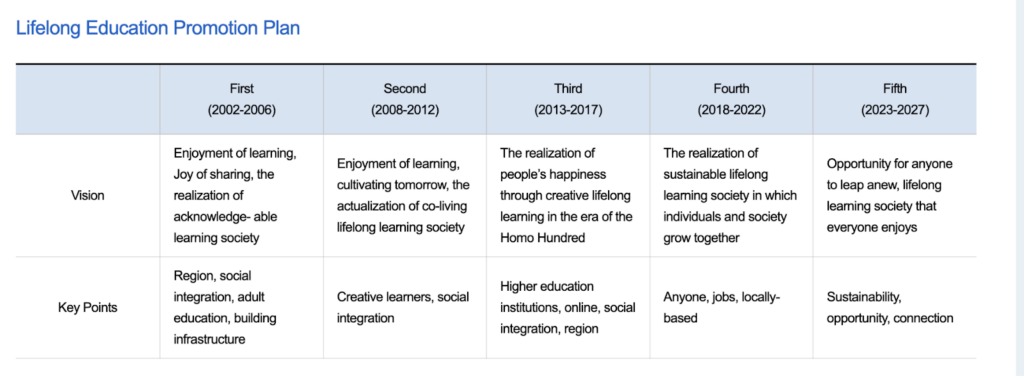
- South Korea has operated a Lifelong Education Promotion Plan since 2002, which includes the National Tomorrow Learning Card—a voucher system that helps fund vocational training for both employed and unemployed individuals.
Or turn your building into a usable asset… Healthcare providers embedded in schools could serve the broader community; social services from a unified city system could be immediately accessible to families in crisis. While somewhat uncommon, this already exists in numerous models: Cajon Valley’s Launch Pad is a student and parent resource center co-located in a middle school, Oakland High School in Tacoma serves as a facility for online learners, in-person learners and has both health and childcare facilities onsite that are open to the community. Forney School District in Forney Texas is radically re-thinking how to include business in their Opportunity Center and also find new ways to make money as a public district. Dexter Community Schools recently purchased a community wellness center.
In Conclusion
This isn’t a policy innovation alone. It’s a cultural one and a challenge of coordination. It requires letting go of institutions built for uniformity and designing instead for interoperability, trust, and abundance. Peña makes the point that a complete merger of the city and school system is akin to a business merger where the new enterprise has the potential to be more efficient, improve services to customers, and may even create new products or lines of business.
The lesson of Chicago is not that centralization fails. It’s that centralization without community power is dangerous. The lesson of Boston is that sustained leadership committed to outcomes can produce real gains. Denver’s proposal must absorb both… and it won’t be easy. Colorado’s constitution would require amendment for a city-school merger. Bond commitments, pension and retirement systems, union contracts, and personnel policies are enormously complex. Seat-time regulations, legacy assessments, and siloed funding streams are not just bureaucratic nuisances; they prop up the legal and financial architecture of our current education system.
My friend and colleague Bobbi Macdonald and I wrote a fictional inaugural address for this someday mayor. Toward a future where all learning counts…





0 Comments
Leave a Comment
Your email address will not be published. All fields are required.