

Great Partnerships Are Like Gumbo, Not Fast Food
By: Judith L. F. Rhodes, PhD and Suzanne Navo, M.Ed.
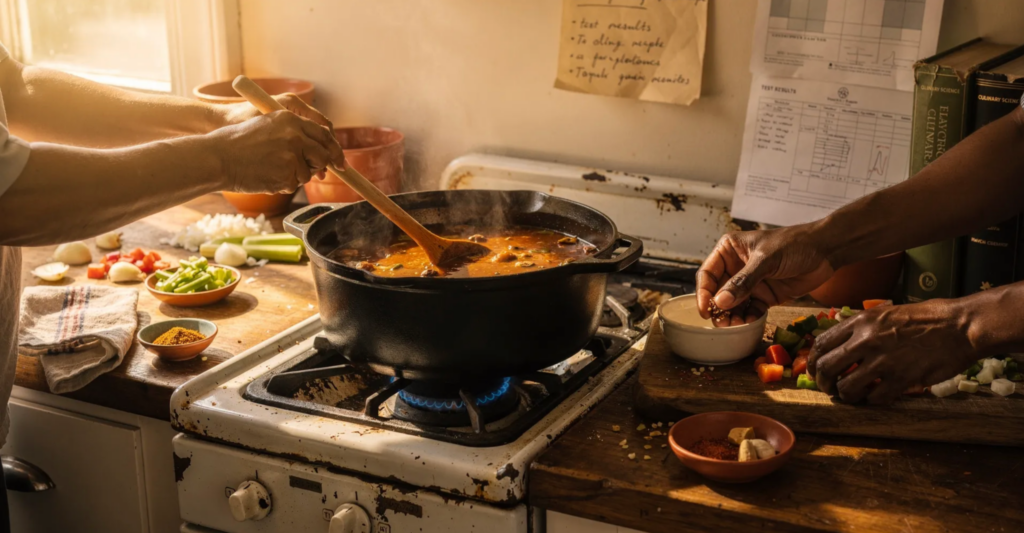
In school improvement work, the most durable gains rarely come from quick fixes. They come from relationships, shared purposes, and the disciplined use of evidence over time. That is the central lesson of the East Baton Rouge (Louisiana) Parish Schools’ (EBR Schools) effort to strengthen mathematics teaching and learning. Great partnerships are like gumbo, not fast food. They require thoughtful preparation, the right ingredients, slowly stirring the pot, and a willingness to stay in the kitchen long enough for meaningful, even wonderful results to be shared at the table.
The Chefs
At the center of this work was a research-practice partnership nurtured by the AIMS (Advancing Innovative Math Solutions) Collaboratory and funded by the Gates Foundation. The partners included EBR Schools, the Louisiana State University (LSU) Social Research & Evaluation Center, and Discovery Education. While the project included professional learning, coaching, data analysis, and dissemination, one of its most important contributions may be demonstrating why research-practice partnerships matter. The partnership itself was essential to the project’s success, ensuring that teachers, schools, and students all benefited.
The Kitchen
EBR Schools presented a context that demanded careful watching of the project “cook”. At the start of 2022, the district served 40,287 students across 88 school sites and was the second largest in Louisiana. The district’s profile includes high economic disadvantage, substantial racial and cultural diversity, increasing numbers of English language learners, and a clear need to improve mathematics outcomes. In that kind of environment, improvement must be cooked up with the district, not prepackaged or simply delivered to it.
The Recipe
This is where the research-practice partnership became essential, providing “flavors” of the partnership such as common team values, communication, leadership support, a co-created and shared agenda, continuous feedback, responsive and flexible decision-making, the ability to predict and address barriers, and mutual respect for each partner’s expertise. These are not random features. They make up the recipe that allows research and practice to inform one another in real time.
The Ingredients
A true research-practice partnership does more than bring different organizations into the same room. It creates a shared structure for asking the right questions and acting on the answers. When the practitioners drive the questions, the researchers can ensure that rigorous methods are used for findings that are meaningful for all partners. All stakeholder ingredients were included to inform the professional learning: Math Mind Measures survey, DreamBox data, district and state data, teacher and student focus groups, and teacher reflections and questions. The scale of this work was substantial, including 1,096 students in the Math Mind Measures survey, 83 teachers in teacher focus groups, and 37 students in student focus groups.
Watching the Pot
Over the three-year project, multiple challenges threatened to ruin the gumbo: leadership changes of all three partners, system and corporate barriers, district protocol, and school board approval. That is precisely why partnership matters. Improvement work in education is never just technical; it is relational, procedural, and contextual. Partners stayed true to the recipe by maintaining the goal of positively impacting student math learning.
Our recommendations for a successful research-practice partnership are especially telling. Collaboration between partners should begin well before the start of an intervention. That statement reflects a sophisticated understanding of district change. Trust, clarity, and readiness cannot be added at the end. They must be built from the outset. When research and technology partners understand the local school system and practitioners help shape the questions, the resulting work is more relevant, more actionable, and more likely to last.
A district alone may have curriculum or pedagogical knowledge with access to operational and achievement data. A research team may have expertise in survey design, analytic frameworks, and interpretation. A platform or tech partner may contribute to implementation supports and usage data. However, the strength of the work came from combining these forms of knowledge rather than privileging one over others. The result was not simply more data, but better-informed decision-making.
The Math Mind Measures component is a useful example. The survey was designed to help the team understand how student motivation, engagement, and persistence in mathematics changed over time. It examined factors such as math anxiety, amotivation, self-efficacy, identity, intrinsic motivation, liking, utility value, normative value, extrinsic motivation, and math-contingent self-esteem. That broader lens reflects the contribution of a research-practice partnership at its best: the work did not stop at test scores but instead considered the student experiences and motivational conditions that shape achievement.
The partnership strengthened professional learning. Educator training was intensive and sustained over multiple years, offered in school-based, district-based, and individualized formats. It included targeted training and coaching, a teacher book study on engagement strategies, support grounded in curriculum, student work, student assessments, and resulting data reports. The work was also driven by district-level leadership and supported by measurement for improvement and impact, including year-over-year analysis at district, grade, school, class, and student levels, along with teacher and student feedback.
Those features are significant because they show that the partnership was not peripheral to implementation. It was the mechanism that connected evidence to action. The professional learning was continually improved through a feedback loop among researchers, district leaders, coaches, teachers, and our educational technology partner.
The project outcomes underscore the promise of this approach. With 84 schools, 180 teachers, and 38,350 students participating in the project, EBR Schools data showed that the percentage of students who were “Algebra 1 Ready” increased 14% over the life of the project. Teacher feedback from DreamBox professional learning and the teacher book study showed that more than 85 percent saw improvements in their instruction. These are encouraging findings, but just as important is the disciplined way the team approached them: with evidence, reflection, and an understanding that improvement is iterative.
The Dinner Bell
Finally, the partnership was impactful because it extended beyond implementation into dissemination. Findings were shared through updated teacher professional learning, bi-annual funder meetings, school reports, a data guide, a Math Mind Measures guide, teacher and student focus group reports, a final research report, and many conference presentations. In other words, the partnership did not simply generate knowledge. It organized that knowledge for use by multiple audiences.
The most important takeaway is straightforward: Research-practice partnerships matter because they make improvement work smarter, more responsive, and more sustainable. They align evidence with local realities. Districts are able to amend targeted professional learning with a quick turnaround, bypassing long academic contracts. They help districts move beyond one-time projects and toward long-term mutually beneficial relationships. In turn, they create conditions in which professional learning can truly support better teaching and stronger student outcomes. Like a successful gumbo, that kind of work cannot be rushed. But when the partnership is right, the result is worth the time!
Judith L. F. Rhodes, PhD, LMSW, Louisiana State University, College of Human Sciences & Education, Social Research & Evaluation Center
Suzanne Navo, M.Ed., East Baton Rouge Parish School System, Baton Rouge, Louisiana





0 Comments
Leave a Comment
Your email address will not be published. All fields are required.