


Town Hall Recap: What’s Next in Learning 2022
The Getting Smart team recently hosted the second annual What’s Next in Learning Town Hall. These special town halls kick off each new year by giving you an idea of what’s on our mind and giving us an idea of what’s on your mind. This information enables us to provide content and resources that speak to your needs throughout the year.
Once again we kept coming back to innovation for equity: “What does equity and inclusivity really mean? It goes past the work,” said our MC, Shawnee Caruthers.
Throughout, the audience asked some great questions to both push our thinking and to further push us forward in developing resources:
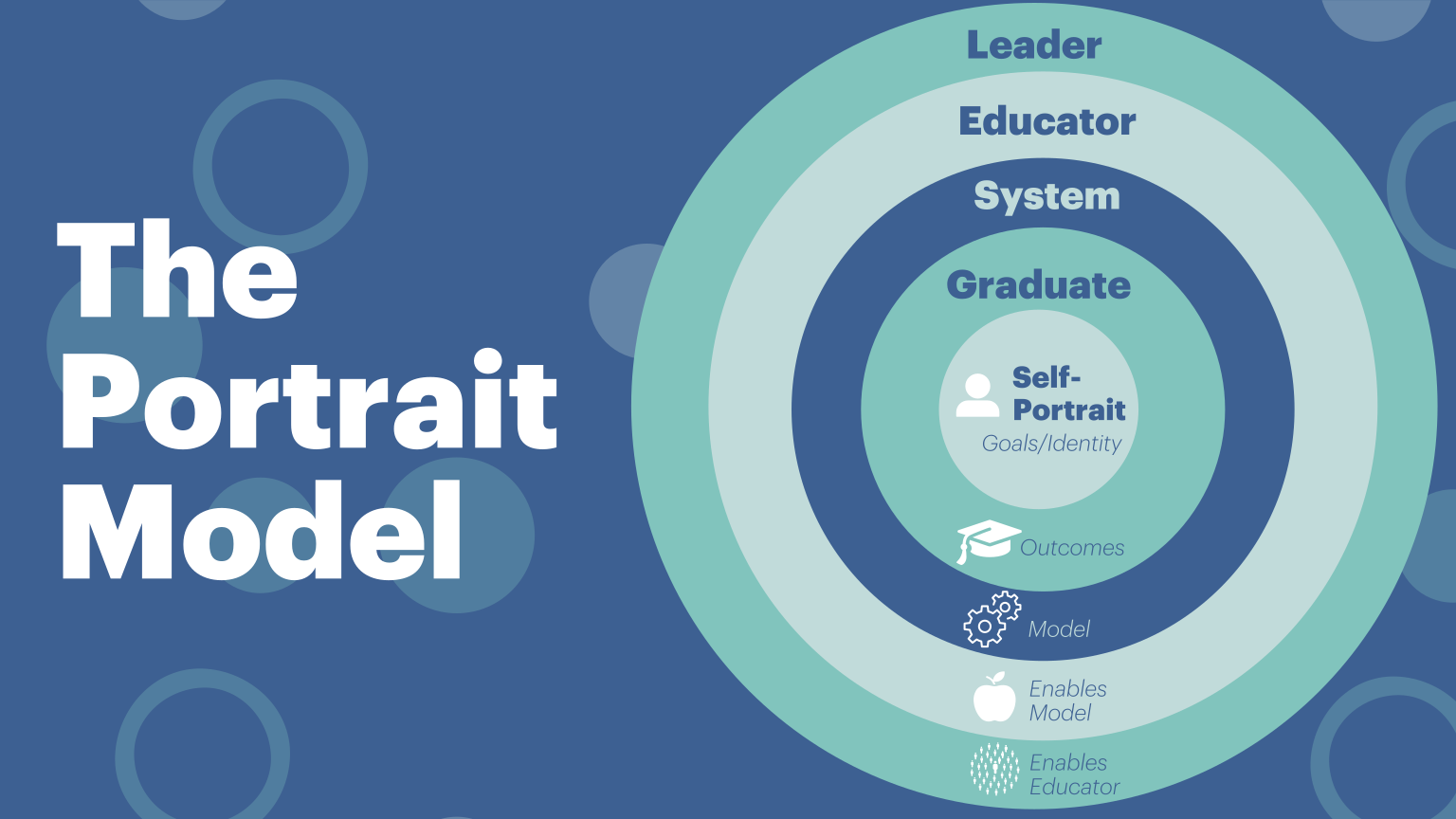
- How do we operationalize POG and get it off the wall?
- What do we do when our PoG runs into the reality of our situation/system?
- What are your thoughts on teacher trainings that prepare teachers for the depth of knowledge effective implementation of exploratory learning requires teachers to hold?
Together, we discussed community-connected projects:
“The challenge question is always relevant and applicable to the local community, i.e., ‘Reimagine a product, process or place to make it more equitable, accessible or useful to your community.'”
We discussed the role of design:
“The process is probably more important than the actual result. We need to get people thinking in the same pattern to get any change.”
We got TONS of examples of Portraits of a Graduate:
“Our POG also is serving as our overarching framework in our strategic plan and was instrumental in the development of our new mission and vision.”
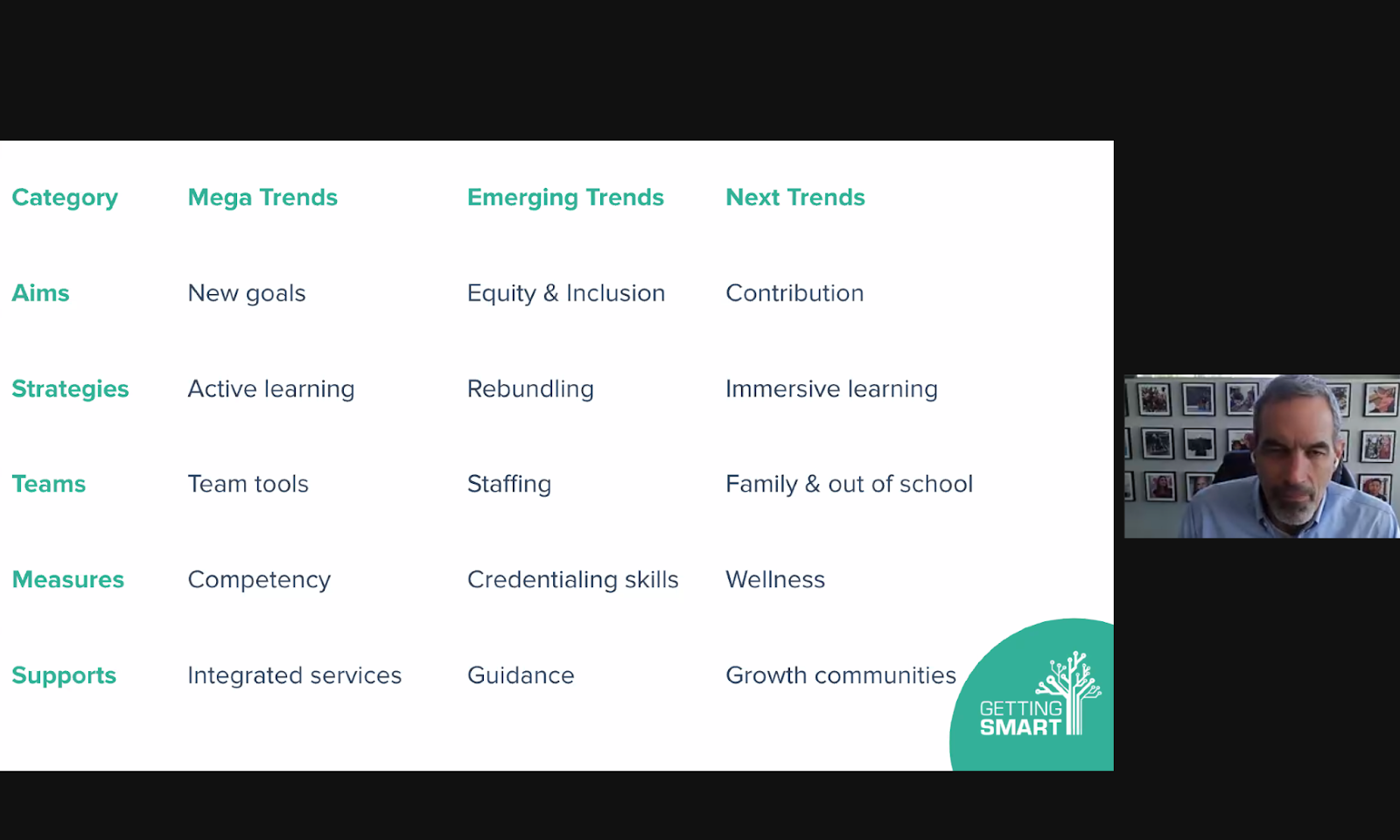
And we discussed a range of trends and innovations that we’ve been seeing in the field:
What’s Next?
Our next Town Hall will take place Feb 10, 2022 and will focus on The Great Unbundling: Rethinking Credit in the Modern Age. We can’t wait to discuss this super important and future forward topic with you all. Register here!
Transcript
This transcript has not been edited for spelling accuracy.
The Getting Smart team recently hosted a town hall called What’s Next in Learning. This live, virtual event focused on the trends that we’re seeing and expecting to grow in both impact and importance in 2022. We shared examples, highlighted some of our inspiring audience members, and as usual, dropped a ton of links in the chat.
You can find all the mentioned resources at the link in the show notes. We recorded the session, and you’re listening to it now. Nate, Tom, Rebecca, and Shawnee are members of the Getting Smart team, and they were the facilitators of the session. Hope you enjoy.
Today, we’re going to talk about What’s Next in Learning for 2022. Here at Getting Smart, we pride ourselves on continuously thinking about the trends, the innovative things that are happening across the country, and we get so excited when we get to talk to you all, talk to the schools, the districts, the states, the teachers, everyone, the people who are boots on the ground doing what’s best for students.
At this Getting Smart town hall, we’d like to create a space to collaboratively design, discuss, discover what’s next. Our time together will help to build a collective momentum of understanding and better enable us to empower every learner to drive and act with purpose, which is what I know you all do every single day.
So welcome. If this is your first event with Getting Smart, you know that we start every event off with a poem, and today is no exception. Today’s poem is called To Be Afused by March Piracy. I want to be with people who submerge in the task, who go into the fields to harvest, and
work in a row and pass the bags along, who are not parlor generals and field deserters, but move in a common rhythm when the food must come in or the fire be put out. The work of the world is common as mud, botched, it smears the hands, crumbles to dust. But the thing worth doing well done has a shape that satisfies, clean, and evident. Green forests for wine or oil, hopi faces that held corn are put in museums, but you
know that they were made to be used. The picture cries for water to carry and a person for work that is real. Thanks, Shawnee. About a week ago, we posted a trend blog for 2022, and we did it in these categories, a sort of mega trend, some emerging trends, things that we’re seeing around the edges,
and then next trends, the early signs that we think are beginning to turn into major trends. We want to create some space today to spend time talking about each of these. We’re going to combine a couple topics, but we’ll try to create a lot of space for you to tell us what you’re seeing. In general, we’re going to talk about the global trend towards expressing new learning goals,
broader goals, adopting more whole child approaches to education, acknowledging that there’s many competencies needed to be a contributing citizen today, that reading, writing, and math are critically important, but that there are other really important goals that many people are addressing, and that in turn calls for new ways of learning, particularly active learning. We’ll talk about what’s happening there, and then the shift from individual contributor
roles and education to much more team tools and team staffing. We’ll talk about how learning is being measured and credentialed and finished up with learning supports, but let’s jump into new learning goals and we’ll make a couple comments on what we’re seeing here. Rebecca, you’re working with school systems around the country and new learning goals. How are they expressing those?
Yeah, sometimes referred to as shared vision of graduate goals, but we’re talking about portrait graduate profiles, sometimes learner profiles. We also are seeing that called learner goals, common learner goals, such as the XQ learner goals, which we can put a copy of that in chat for you to look at, but definitely seeing new ways that that’s being visited. Thankfully, though, the real work is making those a reality.
That’s the new phase of the portrait graduate, not enough to do the community vision, it’s great, but then how does that unfold and unpack into a K-12 system to make that an actual reality? We talked about this in our blog from yesterday about next steps. You have a portrait graduate, now what? The reconsideration of such goals like this drives many of the trends that we’re going to talk about today and why we’re seeing a change and credentialing, why we’re seeing a change in
whole child, the design principles, the science of learning, all of that to look at different meta goals, if you will, and active learning. You’ll see how this really drives a lot of the pieces we’re talking about today and we hope eventually it will influence our lexicon around goals and how we support, report, and recognize these. Thanks, Josh, for the What Schools Could Be blog. It’s another great resource.
Many of you know portraitofagraduate.org, a great resource from Battelle. These are hundreds of communities around the country that have engaged in a community conversation about what young people need to know and be able to do and they’ve found beautiful ways to express them, often visually, and shared them on portraitofagraduate.org. Rebecca, I would love to hear you comment just about, we’re seeing a bit of fractiousness in education in the last few years.
Has that made it harder to develop a portrait of a graduate, more important to develop one? What’s your take on the importance of a community-engaged process here? Well, it’s a wonderful opportunity. Many of you on the call today have been a part of those, if not led them, but as we would all speak to, they can become just like a mission on the wall. So I think the reality of what that looks like and how that starts to differentiate was certainly part of the tension of what we experienced in the
pandemic because portraitofagraduate are often not required to be time-bound and they’re not necessarily couched in nice content labels. They’re really like what’s going to happen after high school and in life and so those have really been drawn upon in ways that those can be used as a system is making those changes and so you’re seeing those learner goals become a driving force for curriculum and instruction and learning change but you’re also seeing that show up in
different ways to report and I think a different call to action and what a school day looks like for learners. I also think Tom that with all the work going on with portraits of graduates around the country and internationally, we should be looking to borrow liberally from others rather than feeling like we have to create from scratch everything from scratch. So coming to a community consensus on what those goals are but then looking for details that other people have developed already.
We don’t all have to do this alone. We’ve seen that attention in Kansas City where communities are agreeing on some specific skills in there but they’re also looking at shared research around durable skills, success skills or essential skills and keeping in mind that tension between a local adoption and skill categories that are recognized more broadly. We’re going to move into later on, we’ll talk about skill credentialing. We think that’s a big trend that’s going to move into high
schools this year and if you’re going to credential a skill you want it to be portable. You want people to recognize it and so Nate that speaks to the tension between you want it to be locally owned but you want it to be widely recognized to benefit learners. In a sense it’s codifying the portrait of a graduate right like what you’re talking about is actually putting it to action and I think that also requires a revisit to a learning model. It’s not enough to say we want
different outcomes you have to also commit to what does that look like then the classroom and how do we support teachers. Jim, Jim Flanagan talked about how their portrait kind of stalled given COVID response just being swamped with running school in a new way. The importance of social-emotional learning, racial reckoning that happened in our country. Shawnee, you’re probably seeing some of that where it stalled the process but we’re also seeing
communities that have really embraced social justice and incorporated that into their outcome frameworks right? Yeah absolutely just the notion of equity and inclusion is becoming more of a global phenomenon but recognizing that it’s easier to set goals than to determine what the measures are that are actually going to make those goals a reality and so we’re seeing more and more people including those equity and inclusion goals into their learning goals and making it a part of their
shared values and more importantly incorporating them into their learning experiences because putting them into action is what’s really important and we’ll see that more and more as we talk about the act of learning but we really do appreciate that it’s a priority on all facets and as people are thinking about equity and inclusion that work can’t be done until they start to reflect on their own beliefs until they start to look around their own environment and ask
themselves just within their personal beliefs are they promoting equity and inclusion and then how are they bringing that back into the classroom environment and as you think at the classroom level how was the curriculum being diversified? What does equity and inclusion really mean because it goes past race? It goes to the people’s ability to do the work and the disabilities and things of that nature so it’s just really important to not have students feel uncomfortable in their environment
that just to be mindful that the environments that we’re putting students in are inclusive and feel safe and that we’re not expecting people to speak up for all of the equity that’s going on or who it seems like they are and just using a variety of learning styles so just being really mindful of equity and inclusion and appreciating the work that’s being done but recognizing that we still have a ways to go. Hey Scott, Pasha, Scott’s an architect with DLR in Kansas City. It’s
super interesting that you said that equity conversations are becoming sort of moving into the heart of the master planning that you’re doing with a lot of districts. That’s interesting because at that stage you’re not just talking about the academic program but you’re talking about what the architecture is and the enrollment pattern and transportation sort of multi-faceted view of equity. Scott, is that what you’re hearing? Yeah, that’s exactly right Tom. Not only just
access to the programs kind of holistically across the district but you know how do you get to the buildings, what neighborhood amenities are within, kind of strategic locations within the community as well and access to all those components. That’s promising. It’s encouraging. Scott Ellis is doing some POG work. Adrienne, are you, you feel like you’re doing productive work on your portrait of a graduate? Thank you, sorry, I’m eating my lunch. Yeah, we had excellent work done last
year to develop our portrait of a graduate and had our faculty school-wide identify how the different tenants in our portion of a graduate are already evident in their curricula and our curricula review this year is an advance of our self-study next year for our re-accreditation. So it gives us an opportunity to really lean in to look at how we advance that further throughout the trajectory of our program pre-K-12. Thank you so much. Rebecca and thanks for the
post that you put up yesterday on sort of moving from POG to reality. My favorite comment that you got, Rebecca, was what do we do when our portrait of a graduate runs into the reality of the structure of our systems? Right? That’s a beautiful question. Yeah, I think I just was putting something in chat about that, Tom, you were calling that too and I think Fadwa was calling that, like how do you then begin to make those changes? And I think it’s really important that once you have those
progressions, K-12, their strength-based, of course, what those look like, that’s wonderful, but if you really want those to be co-designed, I think you start with look-force. And you look for so teachers can get used to seeing it in their own practice and really have a more equitable invite to the table to help co-design those. So they can start to see where those are naturally showing up and then it’ll also highlight areas that aren’t currently in your system. So basically,
it needs assessment with teachers and then design a professional learning pathway around that to bring support in your PLC network. So I love that that came up. It’s definitely a challenge and I think the learning model is often overlooked. And in some cases, some districts don’t really have a learning model or strategies that they highlight in their professional learning and give language to teachers to know what to ask for. So those are really important steps to help make it a reality
and support teachers in that process. I love that, Nate. Let’s move to active learning, the second category we’re going to combine to and talk about sort of what learning looks like and how we capture and communicate it. So, Nate, what are you saying in terms of ways that people are activating these new learning goals? Yeah, thanks, Tom. I think I’ll talk about a few things here. This idea, I mean, many of us are playing the project-based learning realm. It’s been around
for a long time and I think the one of the bigger trends is how do you connect high quality project based learning to real world experiences so that we’re meeting the portraits of a graduate in really interesting ways that are authentic for those students and they can see what’s happening. Often connected to place, connected to projects that are needed to be done by the community, etc. So I think high quality project based learning continues to evolve and develop
and then how to link appropriate authentic assessment within that and there’s so much great support for that in the resources that are out there and implementing that well needs good professional learning experiences. Also, just acknowledging that it, PBL was hard to do during the pandemic. It was not an easy thing and so figuring that out and reemerging as we ideally move beyond the pandemic into maybe more of an endemic is really important.
The other thing that I would say is we are thinking about unbundling a lot which we have to imagine all these outside learning experiences and I’ll give a shout out to say out school is one that has experiences that students can register for that are interesting to them from teachers from all over the world or something like Symphony another platform that is offering week-long internships and projects or problems for students to solve that are authentic and real
and then the hundreds and hundreds of other unbundled experiences and how do we make those an opportunity for students that count that are Carnegie connected etc. We’re still limited by the single credit or half credit Carnegie system and if we can unbundle these and then allow young learners to re-bundle these experiences from a huge variety of authorizer providers we suddenly personalize the system more and as someone said right in the beginning in the chat stream is
we figure out how to keep students engaged especially as engagement we know drops as they move through high school. So those are the project-based learning and unbundling are things that we are interested in as trends. Project-based learning is fairly straightforward because we’ve been doing it for a long time it’s just commitment unbundling requires some significant work at the state level to figure out how to do that from a legal standpoint and related to credits.
Nate, well two quick things one is this morning we, Shawnee and I did a great webinar with our friends in Kansas City on educating for climate crisis and our friends at the Green Schools National Network did this beautiful presentation where they talk about four pvl focusing on phenomena place project and problem and I love how they they use local issues local problems often in their case focused on climate sustainability to to frame up problems so
can be as simple as opening the door and going outside and seeing what you can do to make your community better. Yeah and New Hampshire and Rhode Island have led the way and sort of you know these extended learning opportunities where they’re allowing a lot of opportunities outside of the normal school walls to count for credit. It just hasn’t unbundled beyond the credit yet so yeah. I’d love to have you and then others
sort of riff on unbundling and the implications for equity and inclusion. Unbundling worked well for kids that are really well supported during a pandemic because parents and caregivers could unlock lots of learning opportunities but it strikes me as learning becomes more and more unbundled that it has the risk of great inequity that the the best supported kids will take the most advantage of expanded learning opportunities. Any thoughts
from you or anybody else on the call on on how we sort of re-bundled for equity and inclusion and how we expand access to cool learning opportunities and help more kids sort of re-bundle them into meaningful pathways. Yeah Laurie also mentioned that super important who is accessing it and there’s a real risk there and I my comment would be I think one of the things we can take advantage of is the the push for one-to-one tutoring that we have seen as
effective during the pandemic. That may be a place to pivot into not only one-to-one tutoring around math and literacy but perhaps coaching and helping support students to find really interesting ELOs that are accessible to everybody. So can we that’s just one thought of can we pivot that idea that seemed to work into providing increased access for these ELOs. Tom I’m just going to invite Jim to unmute for a second to say a little bit more about what Massachusetts is doing about
their learning time waivers. Hi Jim. Hello everyone. Thanks I didn’t mean it as a leading practice actually we’re probably kind of behind but you know even Massachusetts is recognizing the need to rethink student learning time so there’s a program out of Cambridge that has been allowed a waiver there the only program of 12 that applied throughout the state so I’m starting to catch up there and with some with some new virtual school options too but I wouldn’t put Massachusetts
forth as a leader by any means. Thanks. Nate in this category I called an emerging trend the idea of contribution and our difference making projects that matter to kids and community more education driven by student community interest. A couple weeks ago I wrote about some really exciting examples that I saw in Kansas City last month one at Bacer-Linwood high school called the Innovation Academy which is kind of an all-ocard academy where students can
step in and do student driven projects that are often about making a difference in their community and then a few miles away in Kansas Notre Dame de Sion Catholic School really leaning into their mission, teeing up difference making opportunities for for the girls there. I wonder if anybody else is seeing more of that student driven work work that’s connected to community is that just my aspiration or are we are we seeing will we see more of that? Yeah I mean my sense is that when
when student agency and learner centered models are built into the learner the the school experience then that’s where we’ll start seeing more of those and it does make me think about moving forward in in our list on active learning and new measures this idea of microschools and credentialing Rebecca I know you had some things to share about that but just that ties into this idea of how are we allowing students to pursue pathways that are interest of interest to them that allow them to
make a difference. Yeah I think the credentialing piece that we talked about the unbundling of essentially what is a POG pathway so I think that makes sense you highlighted Tom the real world learning movement and for those of you in the Kansas that don’t know about the Kansas City work that’s that’s a common set of agreements around what they call market value assets which is another way of looking at common learner goals except for this is shared with the community and
business at large across multiple districts across two states and so it’s a really common agreements is an understatement with this work so there’s a real strong commitment and understanding to provide that opportunity so that learners have that exposure and experience but also businesses can and get a better sense of what students are leaving with and an idea of like how to give back to the schools to help provide more opportunities and internships so wonderful work that’s happening
there that I think lends itself to a need obviously for some common agreements around credentialing across outside of the district area so really exciting work that we would love to continue to highlight and we have some articles on it that you can see now but we’re always bringing them in because I think that it’s a it’s it’s one to look for and as far as common agreements and common goals and Tom mentioned earlier had that’s also adding to the equitable
opportunities for students if you don’t know a lot about Kansas City I’m sure this is true in a whole lot of areas but the population can be very transient and so a student who might be in more of an urban school sometimes may transfer to a suburban school or rural school whatever the case may be and the experiences need to be the same it was closest I can get so by using these market value assets through this real-world learning initiative is guaranteeing that every
student in the Kansas City region has the same opportunity to internships and entrepreneurial experiences using the same rubric so regardless of what community they’re from what schools they’re attending and no longer does their zip code determine how successful they’re going to be. Michael talked about the importance of internships and apprenticeships and and Michael the exciting thing that Shani was talking about is 75 high schools there in Kansas City committed to expanding
access to internships and apprenticeships so we’re we’re super excited about that. Jim we’ll come back and talk about learning platforms in just a minute and our general disappointment in that category. But not with the great people represented on this call. No we’re going to give Shane a shout out in just a minute. I want to talk about integrated supports because that it’s a many of you have been involved in in responding to the mental health
crisis of the pandemic the the families and kids in need more kids food insecure housing insecure just facing sharp aspects of trauma and the soft aspects of protracted challenge that that so many kids are facing and and as a result thousands of schools updated and strengthened their multi-tiered support our friends a turnaround for children that’s turnaround USA early in the pandemic published a great
to the design principles that Mason just shared with you. They published a toolkit on multi-tiered support and then with LPI and others in the in the science of learning and development published design principles.org really a beautiful set of whole school design principles but really at the heart of that is strengthening supports for kids identifying and meeting individual needs of students with support in school and then matching them with youth and family supports
out of school and just it’s been heartening to see nationwide the work that people have done on that front accompanying that is just been a long-term trend in improving guidance particularly at the secondary level exposing young people to career opportunities and post-secondary learning opportunities and good news and bad news just like unbundling is the big proliferation of career options and post-secondary options that has just made guidance more and more important. I know a lot
of you are scrambling to try to update your approach to guidance and equip teachers to really provide really teachers and counselors to provide really good advice to young people. Rebecca’s had the chance to work with our friends in Cajun Valley both at the K-8 level a great career ed program and Rebecca they’re now opening a new high school that’s going to embed that rich guidance system in a new high school experience right? Yes and it pulls from a lot of great traits in
education reimagined big picture learning many that are on this call today but it’s going to be a great example of how the K-8 world of work career focus manifests itself in a dual language K-12 commitment so pretty pretty new and thinking and one to watch and we’ll keep you posted on that with more podcasts to come but I think what we really notice is that commitment and agreement again with the workforce center in San Diego Tom which I mean there again is a nice strong community
support to make this happen and community asking for it so as that journey unfolds they’re really strong supports and participation from the community. Yeah let’s check out workforce.org really the best example in the country of personalized unlocalized guidance we really we appreciate them as a workforce board and the way they’ve partnered with Cajun and other school districts in southern California both for learners and for working adults.
Since we’re talking about workforce and I see Jack put the comment about successful career fairs for that middle level is anyone doing that successfully anyone preparing middle school students using that sort of techniques if so please unmute and tell us about it. Jack we’re talking about Cajun I would say that they they have big career they have immersive career units 54 of them from kindergarten through eighth grade so they’ve really taken
they do some career fairs and they have a beautiful career lab that they built in the middle school in conjunction with workforce.org we have a blog on it that we’ll share but it’s a career center and it’s a two-gen career center that both middle school kids and their parents can make use of so we love that idea and we love the idea of taking career education and integrating it in a immersive way into the into the curriculum. Nate you you are involved in
setting up the place network so these are small rural schools around the country. Any examples of how small schools are are trying to go big in ways of exposing kids to career options even when you know their local business partnership opportunities might be limited. That’s a good question you know I’m intrigued by so it is a challenge in the rural space and I think rural rural small schools have long been limited in that area I think that there are some interesting
emerging pieces I’m intrigued by I mentioned it before the symphony platform which is connecting students virtually to organizations that have problems to be solved and small groups teams work on them and they can be anywhere so that seems to be interesting. The other thing that I saw when we were when we were working in the network is that small communities that rally around things that need to be done in those communities that the students discover goes back to difference making
and there was one district in Idaho that I was working with that built a tiny house because that was there was a housing need in the community and that tiny house was then sold at an affordable rate and then they used the proceeds to build a new park in the center of town a new jungle gym etc playground structure so so the discovery process was was more robust perhaps because it wasn’t as obvious there wasn’t a surrounding ecosystem in those small spaces so some options I think.
I’ll chime in here with I think in the K8 space you know ideas like people are familiar with novel engineering which comes out of the Tufts and I get it wrong the CEEO the center for engineering and education outreach but it basically it’s the idea of you read a book so literacy is in there and then you figure out what what’s a problem that the character has and then you do engineering design around it and you know with what you have right it can be with like
you know paper and glue and cardboard and popsicle sticks or it can be with something more but I’ve seen so I’m working with the school now they’re doing the boy who harness the wind and it’s very rural eight kids K8 and they have you know different projects for the different age groups and all leading towards they’re going to solve a community problem that they identify and you know there are community problems in this rural tiny town and so you know and the kids will
get to decide so you can kind of go big with it school wide or can do something smaller like another one I’ve heard of is if you know the book dragons love tacos like how can we design an app if you’re like doing coding how can we design an app to help the dragons decide if they’re going to like the taco so there’s like all kinds of range there and it’s grounded I think it’s a very accessible way to get started because there’s a whole because it’s grounded in reading and
everyone is learning to read and you can kind of go with you can go however far however like simple and you know it’s still engages kids and you can also take it really far thanks Laurie appreciate that let’s let’s shift to team tools and team staffing a lot happening here in this space we pandemic really forced everybody to that hadn’t to adopt a learning platform or at least adopt a uniform learning platform
that that and the related trend of moving to to team staffing I think is a really historic uh step in education and this is a little bit of an overstatement but it it it it marks the end of the 200 year period in many schools where teachers have a high degree of autonomy to to much more of a team based approach with common tools and working together in teams um that doesn’t mean a dramatic loss in in autonomy it may it may mean that teams
have a level of autonomy but it does mean more interdependence in more schools on common platforms so let’s talk about platforms for a minute Jim asked about these uh I think it’s fair to say that still the most widely used learning platform in America is Google Classroom this particularly true K8 it’s not really a full LMS it’s really a simple assignment management system but it it’s certainly widely used at the secondary level um canvas from
Instructure uh is probably the the leading platform um Schoology two years ago was acquired by PowerSchool now now both in Instructure and PowerSchool are are public companies they went public like a lot of other tech companies during the pandemic and quite widely used but to Jim’s question um neither one very well suited to the kind of learning that we’ve been describing active project based learning um around a portrait of a graduate so focused on on a broad set of competencies
neither of those do a great job authoring uh projects or tracking competencies uh that’s why we’re a big fan of Shane and and his work at um at Head Rush anything new at Head Rush Shane? We’ve got a bunch in motion but um I’m excited to be working with you know people like Iowa Big and AAU Taw those are some new people we’re working with latitude, cross town, ex-Q schools so just honored to be able to serve their needs they’re moving away from
things like canvas um empower and and um so we we feel good about what we’re doing because if we can do the right compared to those juggernauts uh we think we’re not living to the mission we want to live but uh we’re serving the people we want to serve so are you appreciate the call out A couple years ago I thought of Head Rush as sort of a pvl platform are you closer to being a full function um learning platform? Well we are for you know we tend to
do better with schools that are 500 students or less and I think that’s just because you can build a better culture around the kind of learning model and so why people that are using Head Rush like us is because you can still kind of manage a class as a module versus you can do project base and we allow that kind of SAMR approach to leaning in. The other part we do well is the ability to align competencies interdisciplinary as well as visualize those in different ways
that a lot of course-based tools just they’re just not structurally set up to do it that way so to your point Tom what we really find is we more schools are trying to unbundle they’re trying to we call it um dethrone the course and crown agile as queen is our little internal tagline so by that unbundling um we used to say kill the course but that that’s not congruent with our value system so we we changed it. You know Shane let me interrupt and just say um thanks
for plugging my next blog because um our team is really we’re excited about schools that are trying hard to move away from the confines of courses I mean courses have served us pretty well for a couple hundred years of organizing learning and staffing and funding and recording learning it’s all been based on that Carnegie unit but it’s a pretty confining way to architect schools and we’re excited that many of the schools that you talked about are incorporating big blocks
to often a double or triple block and and they’re sometimes at Purdue Poly for example they’re organizing around skill sprints and projects so you know blended skill acquisition and then big client connected projects and they’re they’re using those as the as the new pillars of the the architecture of learning and so it’s exciting to see you supporting so many of those schools. Yeah well right on well big fan so of what you guys do to just shine a light on it and articulate
it because I think the other challenge for big systems is to really prevent them from getting away from brochure run where they have it on their brochure but then they get away with not really doing anything and I feel like some of the the precision you guys bring to the conversation helps people navigate that so. Tom just as a quick pitch is that Rebecca and I are dreaming up our next blog post that’ll come out in the next few weeks which is our own manifesto on what is the
technology we need to to scale POGs and make them real and I think head rush is on that track someone mentioned area nine out there and asked about there they’re thinking about that so there’s a few companies but it hasn’t permeated the big players yet and so I think we need to pay attention to some of the smaller players and make sure that we’re testing them and using them so that and Shane hit it right it’s like we need to break down the course wall because that’s what’s missing
there’s no aggregator and portraits of graduates require technology that aggregates multiple courses together around a single student in easy ways to display progress towards developing the learners that we want to develop so. Thanks Nate let me just plug Nathan Nathan and Fielding have been running this beautiful series on design patterns including one that that went live today we just love Scott Pasha talked earlier about the similar work that they’re doing with communities just
how these two leading architecture firms are helping from the ground up literally helping communities reconceptualize what secondary schools could be how they work that support the kind of direction that Rebecca and Nate are talking about. Nate I’d love to have you talk about team staffing you know for 10 years our friends at Public Impact and Opportunity Culture have been promoting the idea of team staffing but you you recently have been working with ASU and their next workforce
and they’re doing an important work on rethinking the basic staffing model right. Yeah you bet and I noticed Sarah Rich is on the call so she might have more more additions after I just give a quick prelude but yeah the ASU next education workforce is doing some really interesting thinking not only around teaming because because we’ve certainly seen experiments with team teaching for years and years so that’s not necessarily the new concept but this concept of skill specialization in teaming so
having different types of educators working together around a larger cohort of students they’ve included community educators as well so they’re thinking about pathways to train community members to be working with our students which connects with these extended learning opportunities we discussed before and then that ties into the concept of personalization so every teacher having a different skill backpack that would be used for specific groups of students and then combining
groups of teachers who have unique skill sets and how do we credential around that rather than general credentials say around elementary ed or science or for whatever reasons and so really trying to elevate the profession to be less generic and more specialized so that everybody’s talents can be utilized just like we would do with personalizing for students in their learning. Sarah do you Sarah love to hear what your thoughts are on that. Yeah so probably the two teachers
that stand out to me are two teachers from our Casa Grande campus and they were very involved in the blended personalized implementation but needed to take it farther for their students and so that campus is great because we have the accordion walls and so you know if we want bigger classes we have that flexibility but we have an ELA teacher and a social studies teacher that I’ve teamed up together and their blocks are I want to say they’ve moved them to like 120 minutes
maybe even a little bit longer and they integrate both subjects in basically everything that they do and you know that’s a great thing to do because obviously ELA and corporate beginnings get be included in everything and I think it’s also allowed them to have a little bit more flexibility with that one-on-one time or that small group work by having both of them in the classroom and I think the students have really enjoyed being a part of the journey so that piece has been
really exciting too. They’re very transparent about the time it’s taking to prepare for this because it is their first year doing it and you really have to have leadership that understands that and and we do which has been a great part of that as well and but they are seeing a lot of success with it. Sarah let me also plug our friends at ASU Prep Digital they’ve been working nationally to provide sort of backfill staffing you know people are struggling with staffing issues
nationwide sometimes just because you can’t hire a teacher sometimes because a teacher has to step out and quarantine and ASU Prep Digital has been has sort of become part of the team at many schools where when a teacher is out they can quickly flip the virtual and an ASU Prep Digital teacher can step in and cover a class on a short-term basis so that’s the cool thinking that we’re seeing from ASU of just thinking about a team often with a team leader so it’s a distributed
model and that is a porous team that often includes community members and sometimes virtual teachers but a real interesting way to think about staffing. May I add one more thing please okay I was just also thinking we also have been trying out still having a hybrid model and we have it now just at the high school and sort of trying to decide how big is that need and do we want to continue it so we have the digital piece
we also have our kids that are going to school each day and then we are continuing to try the hybrid model anticipating that there may be more need for it and it has been a bumpy road but the high school one has really taken off. Another thing that I just want to mention that I actually don’t know if you guys know about Nate and Tom is that we also if you have a teacher that’s leaving because of a situation where they need to move across the country to take care of a
parent now or whatever in these hard times that we’re having we actually have a teacher who left who now lives in a midwestern state and he’s still teaching these students virtually but we’re doing it in a little different way where they have a learning facilitator there and he was taught about the blended per slice model and was part of that design team and so my team describes it if you close your eyes it seems like he’s still in the classroom and it’s not so much that he
knew the kids and was connected to them from last year it’s more the way he’s delivering his classroom and connecting with that learning facilitator that’s in front of them. I think that was at the ASU prep downtown campus right? It’s actually happening at Polly yeah it’s Joey Hessinger. I think I saw a couple examples of that on recent school visits so that that’s an interesting brave new world with kids present and teachers remote. We had a question about teacher prep and
Nate since you were talking about ASU and then Mary Lou Fulton teachers college the questions just around required depth of knowledge in prep. ASU Fulton has such deep partnerships with so many local districts here in Phoenix that I think that’s part of the answer. Any other answers there? I’ll say a few things about pre-service and then Rebecca should talk about just in-service and what does it look like when they’re already out of school that is a unique learning model and how do
you we have to think about unlearning before we learn and so from a pre-service perspective I’m seeing some many of you know Hightech High and their grad program and they’re doing innovative work around they’re teaching to a specific learning model. Teton Science Schools does that as well with their grad program and so grad programs and then undergrad I’ve done some work in the rural space and there’s more and more rural university training programs that are focused on what is
it like to teach in a rural place and even advocate in rural places and how to exist so very specialized type programs and I think we need to see more and more pre-service programs think about the learning models we’re all talking about today competency project based learning place-based portraits of graduates that all should be routine but Rebecca once they have a learning model in place what is the professional learning like what can schools do in districts? Yeah I’ll be brief
because I know we want to give space for people to share and I also post a link to that version but I think when you’ve co-designed a learning model it’s a quick jump to then co-design professional learning pathways because you’ve had teachers at the tables and educators at the table the whole time so helping them understand that so for example I personally as approach that many would take would be revisiting their workshop model or their understanding by design or assessment
literacy assessment as learning or for learning not just of learning so all of those instructional strategies that we know to be really foundational revisiting those to see how strong they are actually in effect in the district as a place to start so you build off strengths and trainings that are already there and then get a sense of your gaps and the transparent progressions of what is expected see what’s not showing up and you’re giving language to teachers to then ask for professional
learning or seek professional learning I think that’s the biggest piece if you really want to give them agency and advocacy you have transparent workforce from the beginning and they’re invited to be in those discussions and to help create solutions. We with the University Charter School down in Livingston Alabama they have created a entire set of professional learning outcomes and then they’re personalizing professional learning
around those outcomes so teachers are self-reflecting on those evaluating themselves and then choosing a pathway that makes sense but every PLO professional learning outcome is connected to the learning model so any teacher coming into that school knows exactly what to do in terms of building capacity around meeting the learning model which meets the portrait of a graduate. I want to make a quick addition just as we wrap up here it strikes me that the depth of
knowledge that teachers most need today is really around learning design and how to co-authored really powerful learning experiences. The challenging and frustrating thing across the curriculum is that more often in this decade we’re going to be working as educators on projects where the answer is I don’t know how might we we’re going to be working on projects with students that we don’t understand on topics we don’t understand for that nobody understands that we’re taking on projects
that don’t have known answers to them. I was thinking of this during our webinar this morning on climate change it’s so complicated and so new and moving so fast that inviting learners into that space requires a new sense of vulnerability for us as educators to say I don’t know but here’s how we might frame a project and how we might learn about it together but that requires a real confidence in co-authoring projects and scaffolding it quickly both with external forms of knowledge and external
sources of expertise for many of us that’s really new work and I think it’s going to become a bigger and bigger part of particularly secondary education in this second. Nate or Rebecca closing thoughts on on that front? Well I think what you just handed us and I’m seeing it come up in chat is really that leading transformation because if we already knew where we were headed then there would be a roadmap to get there and so really playing off the strengths
of the work in front of you and then navigating that ambiguity is is tough for a lot of leaders so co-designing co-authoring really gives people a seat to kind of flatten the view and the work so I really appreciate that that’s being called out because we don’t always support leaders to be that type. And I would just call call out what Camille said before is how are we helping educators develop these skill sets to be confident comfortable and tap into these great great
resources that are out there and that takes system-wide work both at the district level school level but also system-wide in terms of how are we helping develop the educators that are ready to meet this new expectation and challenge. Yeah thank you if we want kids to lead we got to let them lead we got to create more leadership opportunities for youth and keep saying how might we with kids. Hey we really thank you for for joining us today you’re either working in a school
or supporting people that are so you’ve done you’ve chosen a good thing to do with your life and just given all the challenges of the last couple years we appreciate that you keep showing up here at work and at events that we host so thanks for your input your insight your participation Shawnee what’s next. Yeah thank you for all the great conversation for all you dropped into the chat I love thinking about what’s next and how do we create those portrait of educator administrators
how do we make the people comfortable and then what do we do when they’re uncomfortable what we still need to need for them to push through so great conversation today please continue to thank and we will post this town hall as a podcast in our feed and we’ll also post the run this town hall as the podcast and do a recap blog with the links mentioned on this event and then lastly Mason dropped in the the comment about educator a place where we get to talk to educators about
the things that they’re doing in the classroom every day so if you have any guest ideas please submit those to mason at gettingsmart.com so again thank you we know you can be doing a lot but instead you chose to join us today so we appreciate you have a good day stay safe stay warm thanks for tuning in to the Getting Smart podcast today we want this podcast to be actionable and insightful and a great way to learn about what’s next in learning in order to stay on the
cutting edge we need people in the field to tell us what they’re hearing what they’re wanting and what they’re needing to learn more about got a topic or a guest in mind send your recommendations to me mason at gettingsmart.com and if you like what you’re hearing don’t forget to leave a review in apple podcasts or subscribe wherever you listen feel free to share the podcast on social media using the hashtag GS podcasts thanks so much
you


AHZ Associates
The emergence of COVID-19 served as the impetus for a digital education revolution. Schools and universities were pushed to embrace new modes of learning, such as remote classes and creative learning platforms, as a result of the lockdowns. "COVID prompted us to accelerate the use of digital learning tools that we'd been considering for a long time," says Dr. Amjad, a professor at the University of Jordan. They've revolutionised the way we teach. We can communicate with pupils more efficiently and effectively, and they find it easier to do so. E-learning will continue to rise as these technologies become more integrated into the educational experience. For kids and educators, this is an exciting time."