


Timothy Jones on HipHopEd and Techniques4Learning
Key Points
-
Culture should come before content. Educators must bring their humanity into the classroom space.
-
Educators, like MC’s and ministers, must remain true to message regardless of who they are speaking to.
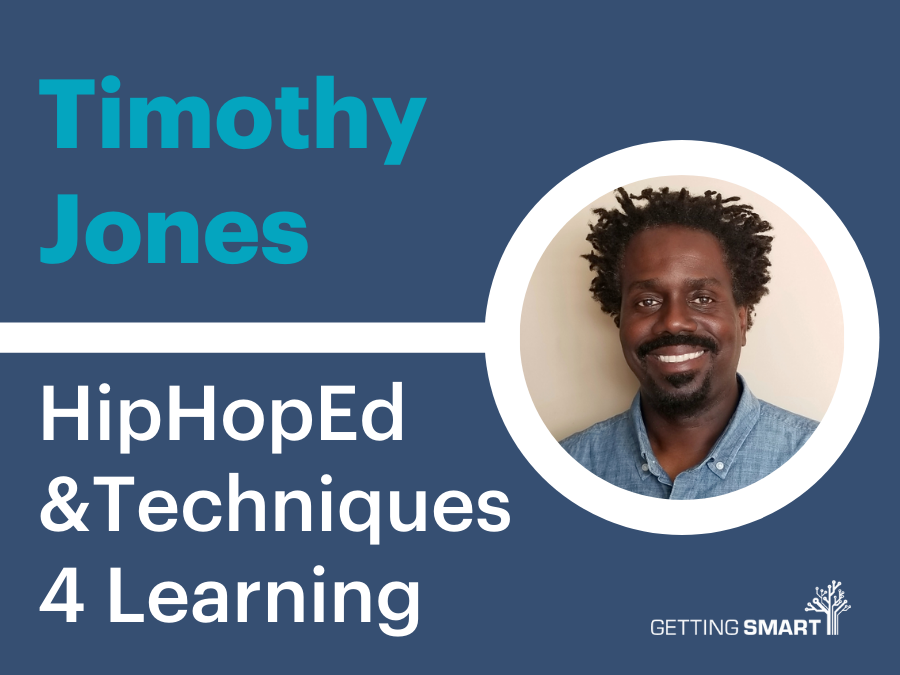
On this episode of the Getting Smart Podcast, Getting Smart team members Mason Pashia and Shawnee Caruthers are joined by Timothy Jones, a long-time educator, coach, mentor and someone who lives and breathes hip hop. Timothy is the Chief Visionary Officer at HipHopEd, a digitally-birthed organization with a sprawling membership of brilliant educators and passionate advocates that know just how powerful this intersection can be.
He is also the founder of Techniques4Learning, a company dedicated to utilizing Hip-Hop and Culturally Relevant Pedagogy to develop and implement strategies, curriculum and activities to improve teacher student engagement for schools, universities, education organizations and community based organizations.
Let’s listen in as they discuss the role of hip hop in school, how being an MC is like being a minister, what educators can learn from other professions, student engagement and much more.
Transcript
This transcript has not been edited for spelling accuracy.
Before we jump in today, we wanted to tell you about a new campaign and newsletter from Getting Smart. It’s called What If, and it’s all about encouraging educators and ed leaders to think differently about education and learning. Every week we will send you a What If question about the future of learning, leading, and
community. This campaign is all about engagement, so we’d love it if you’d sign up and share your thoughts on Twitter, or send them to editor at GettingSmart.com. Sign up for the list today at GettingSmart.com slash What-If. You can’t wait to see what you’ve come up with.
All right, let’s jump in. You’re listening to the Getting Smart podcast. Today we’ve got two members of the Getting Smart team. I’m Shani Carruthers. And I’m Mason Pasha.
Today we’re talking with Timothy Jones, a longtime educator, coach, and mentor, and someone who lives and breathes hip-hop. Timothy is the chief visionary officer at Hip Hop Ed, a digitally birthed organization with a sprawling membership of brilliant educators and passionate advocates that know just how powerful this intersection can be.
He is also the founder of Techniques for Learning, a company dedicated to utilizing hip-hop and culturally relevant pedagogy to develop and implement strategies, curriculum, and activities to improve teacher-student engagement for schools, universities, education organizations, and community-based organizations. Timothy, thanks so much for being here today.
Thank you for having me. Great to meet you both and looking forward to having a great conversation. The three of us will get smarter together over this next session. Yeah, and I’m not going to lie. I’m a huge fan.
I saw you first at a Big Picture Learning event, and then I got on your Twitter and I started following the things that you did. So when Mason said that we were going to talk to you, there was no way I was staying out of this conversation. So thank you so much.
I’m humbled and honored at the same time. Thank you so much. You’re so welcome. You grew up in New York and were super shaped by hip-hop as a kid. What did hip-hop mean to you and what does it mean to you today?
That’s a great question. Born and raised in Brooklyn, New York. Born in 68. So I was coming of age in the 70s. And honestly, now I can look back and realize that I didn’t know it was hip-hop because
it wasn’t presented in this packaged cultural form. It was more just different things that was taking place in my projects. And what I mean by that is at night, certain nights on the weekends, there would be a park jam. And at the park jam, you get to listen to the DJ.
And then there may be somebody on the mic. And then you start to see people dance. And I remember riding the trains with my mom and seeing graffiti, but it wasn’t all together at that time. Like, hey, this is hip-hop culture and these are the pillars.
So for me, it was just about identity. It was really a pathway to just come of age from something as simple as asking to stay out a little bit later so I could stay in the park because you start to know that the DJ is going to do something with Sheik’s Good Times or you’re going to hear sucker MCs and different things like that.
And so for me, coming of age, it was just like a friend that was part of who I was. When I got to college in 86 and went to Howard University and began to see this music as a way of connecting beyond me just coming from New York, that’s when I really began to see it as not only just a formation of my identity, but an expression of my identity as well as an educator that knew me better than my traditional educators.
I tell people often that Chuck D, who is like a big brother and a mentor to me, taught me more history that was meaningful to the armor that I put on to venture out into this world as a black man than what I learned K through 12 school. So as I became of age, Hip Hop went from just being that friend to actually being part guide and we began to feed and guide each other.
And so the fact that now I get to say that Hip Hop is kind of the fuel of my career, but I am not a typical artist, even though what I do, I believe is artistry is nothing short of amazing and just God given. I love how you’re able to blend everything together, how you call Hip Hop a friend, how you use it to shape your identity and your self-esteem and you kind of lean into that.
And you’re also a minister and our day minister. Yes. What do you think ministers and emcees have in common? I would say that outside of a oral ability, I would say that a good minister and a good emcee or a great minister and a great emcee has a way of acknowledging who they’re speaking
to, but remaining true to their message, regardless of who they’re speaking to. So I’m not going to placate to you to the point that I’m not being true to the source of my message. So if I’m at the pulpit, then I’m being led by the Holy Spirit for me as a minister and I want to be first and foremost pleasing to God.
As an emcee for me, I believe that it’s a spiritual thing taking place as well because I am giving birth and I have to do that where I have to be the first partaker. I think for the minister, whatever he or she is being led to share, they should be that first partaker. And I feel that as an emcee, what you are writing and creating, you should be that first partaker
as well. So those are just some of the initial similarities. And the last thing I’ll say that both have to have an ability to freestyle, to operate in the moment. Some ministers will have their things written out and that’s what they follow and no matter
what’s going on around them. That’s them. That’s really not me as well as an emcee, coming with a script versus having that freedom. We saw what happened when dipset came and they were doing their songs via teleprompter and the locks came like we in the moment and you got to see what those differences are.
So those are some of the similarities I would say between a minister and an emcee that allows me to feel comfortable operating in both identities. I’m curious, do you also feel like that applies to educators? Like the role of educator? I mean, definitely need to improvise.
No, without a doubt. And I’m glad that you said that one of the things that we’re working on as hip hop ed, Dr. Chris Emden and myself is this notion of teaching like an emcee. We’re working on this concept that’s actually called Tupac, which stands for teaching, utilizing performance art competencies.
And we’re going to use rock him and Rhapsody as exemplars. So to your point for that teacher, you have to, how do you move the crowd? How do you engage your classroom? What is your ability to freestyle within the realms of the content that you’re presenting? So this is not something that we’re working on where in order to take full advantage of
it, you have to become an emcee in the sense that you got to be able to spit bars, but those competencies and sensibilities and the things that you need to pay attention to. And for a teacher to see their teaching as an art that is just as important to cultivate as their knowledge of the content. So it’s not just going to PD if I’m a science teacher to continue to learn new curriculum,
but how am I delivering that curriculum? Just as that emcee that’s like, okay, you was rocking in 86, but how do you sound in 2021? And the difference with the emcee is that emcee may be able to get by sounding exactly the way they sounded in 86 because they’re going to fill the room up with people who
were fans of theirs from 86. Whereas as a teacher, you get a new audience sometimes three, four times a day, every quarter, every year, so they don’t get to grow with you. So that’s a nuance from an artistry standpoint that the teacher actually has to remain more relevant in their craft than actually the emcee.
That when you go to Nas, there’s a part of me like, I love the new, but I want to hear half time. You better, like you better not walk up that stage without giving me ilmatic, but you’re not going to sit in a class and be like, yo, you better give me that old third grade feeling when I’m in 10th grade.
So there’s a level of remaining current and relevant that the teacher has to do in their artistry that is even greater than an emcee. I love that. You mentioned the performing arts competencies. Is that something that you have kind of mapped together or where did you go to find that
competency set? It’s just from Chris and I just having conversations and studying artists. He’s done some work with the Lincoln Center out of New York City. So just even the part of the formation of it is really our take on the art. And I’m glad you asked the question because in some instances, this is my personal feeling.
I feel the academy and scholarship, as much as they want people to be innovative, it always has to be rooted on things that were in the past to validate you saying something new, which actually is kind of an oxymoron because I could be influenced in my creativity, but I should add a chain to the legacy and not be like, okay, you should hear me because I’m rooted in my bibliography being 10 times longer than the new thing that I’m saying.
So I’ll pause right there. So part of it is really about our experiences as educators and as emcees and channeling that in through this hip hop lens because we’ve been working together now for a little over 10 years. That’s so cool.
This is kind of a twofold question, but I love your science genius program. So I would love to hear just like give some space for you to talk about what that is. But I would love to hear that kind of point into just your view on how arts can be better integrated into school or like education systems. Okay.
But so science genius was started in back in 2012. Chris had this concept and he actually collaborated with at the time it was called rap genius, but now it’s genius. But his thought partner in it was Jizzah from Wu Tang, who was heavily into science, but didn’t have great experiences in school.
And Chris is a trained science educator and a hip hop head. And so his thought was if we could integrate hip hop into the teaching of science. And this is the subject that most young people just check out like, oh, I’m not into science. I’m not into math. So we felt like it would be easily acceptable if we were able to do it in English, but let’s
shoot for the fences. Let’s go for science. So science genius is a program where we would come in, work with a science class, and the teacher would work with the students and the students would pick a concept from the curriculum and actually work to write a battle rhyme that would serve as an oral presentation of teaching
back. So if it was a biology class and someone wanted to do something around ecosystems, the science teacher would make sure that, OK, here’s the content. You got to have these. This is your vocabulary.
These are your definitions. But then you got to be able to write a rhyme that not only meets the academic requirements, you have to meet these artistic aesthetics because we didn’t want it to be, oh, except this rhyme because it’s positive and educational. It’s like, no, you need to put together a dope rhyme that when I’m listening to it, it’s
like, wait a second, is he just what did he just say? What did she just say? How did they put that concept together? Hold up. Rewind that.
Rewind that. That really is where the marrying of the term science genius comes into play because what we have been able to prove is that the process of writing a complex rhyme requires you to spend more time with the content than just preparing to take a test being given in a standard way.
Because the standard way that you’re going to test me is just going to require me to memorize the facts. But for me to put together a battle rhyme because it’s not just me writing a rhyme, I have to write a rhyme where I’m processing the content and I’m being mindful of my competition. So now I’m spending two to three more times with this content and constantly drafting
and performing. And so now this concept is becoming a part of me because now I’m giving it to you as to not just what I learned but what it means to me. And so I believe to build to your second question about how arts can be better integrated is that I believe that art has to be viewed as a full on core subject.
You see what I mean? That it’s like it’s not, oh, art is that easy period. You know what I mean? And it should go both ways that I feel like the math teacher should spend some time in the art class and then allow the art teacher to spend some time in the math class.
And so when you begin to work together, you should walk away with two lessons. How can math show itself within art in a way that is recognizable to your math course? And then how can art show up in your math course that’s recognizable to your art? Because all of the measuring and different things that you’re doing, like how does that show up in my math class?
And then when I’m in my math class and maybe I am thinking about word problems or I’m a visual learner, I could be doing the graffiti lesson to show you that I understand these geometry concepts. So now my art class is showing up in my math. So I think the integration has to be on the curriculum development level and on the administering
of the content. Imagine a art teacher being able to co-teach and vice versa. I mean, a mayor may or may not have been crafting on a logo in my head for STEM and bars, like for your science genius program. So we’ll come back.
We come back to that. Okay, there you go. I love the cross-curricular partnership that you’re talking about within the programs and the lessons that you can learn. And I know you spend a lot of your time thinking about lessons and feeling connected.
And you have this thing that you call hashtag PPP. What is that? So that is prayers, proverbs and parables. And I am a minister. And one thing that I’ve done that I need to revisit is a concept that’s called lyrics and
scriptures. And what I would do is start to evaluate the lyrics in contemporary songs for their either complimentary or contradictory reference to biblical scriptures. And it was a way of building spiritual media literacy. I have a daughter who’s 30.
I have a son who’s 22. When my son was going to college, him and I were having a conversation and I was asking him, you know, what can I do to at least help feed you spiritually as you go off and do what you’re going to do? And I know how it is to the kids at a preacher, the kids at a minister, they go out and they
go and do whatever they’re going to do to find their way. Let’s keep it 100. And his thing was, you know, you can just send me a text. And that was where the devotional started, where the PPP stood for because I was telling him, like, listen, if you want to have a relationship with God, you have to understand
prayer. If you want to use the Bible to give you lessons for life, whether you are of the faith or not, understand proverbs. Those are just solid principles. And then if you want to grow to understand who Christ is, understand the parables.
So that’s where the PPP came from. And on August 25, 2017, I started sending him and two or three of his friends text messages and last week we hit our fourth anniversary. I’ve since published a book called Prayers, Proverbs and Parables. And now we’re looking at creating videos.
I place it on IG now. I’ve been placing it on Facebook and text messaging it. So it’s been just a ministry that has grown out of just giving these daily thoughts to keep people on the narrow path. So it’s been as much for my growth and development.
I never thought that this would be something that I do between seven and eight a.m. constantly every day, 365 days a year, spend some time in San Diego. So I’m waking up at 3 30 their time, which is 6 30 East Coast time to have it ready to send out. So it’s just been a part of my life.
And I want to thank my wife because she supports me in that effort. So that’s that’s what that’s what it’s about. It’s just being able to present ministry in a way that is palatable to young adults, but it’s applicable to us all. That’s really beautiful.
How can we make parables and all learning more applicable? The beauty, the beauty of the parable, one, it exemplifies. A heightened level of understanding of their audience. So if you think so, if you’re looking at it from a scripture standpoint, like, OK, I’m going to give you a parable about seeds sowing because I’m talking to a group
of people where agriculture is their main way of life. If I’m talking to people who fish, so then I’m giving you those types of things. So for the educator, the parable would be a heightened understanding of the cultural norms of their particular audience. Where is my school?
What is what are some of the cultural norms of my students? Are there certain things and practices that they may do at home and in the community that I could then use to present this academic content? So using biology, if I’m talking about ecosystems and then OK, am I bringing in elements from the neighborhood?
Am I bringing in people from the neighborhood? If I’m developing word problems, am I creating scenarios that really speak to the livelihood and the value system of the people that I’m talking to? Then I’m giving you a parable. So parables to educators is, like I said, having that relationship,
understanding those nuances and then being able to help your students see what you’re trying to share with them through something that they’re already familiar with. Yeah, we are in our memory really seeing that is amplified on one of the episodes of the wire, so that really is a powerful learning experience to get kids to connect to things instead of just like something random.
But when you bring it to something that you truly understand, it really cements the learning. And when you think about it and we’re coming out of this to an extent coming out this pandemic and everybody keeps talking about learning loss, but I’m not hearing anybody talk about learning different.
And so let’s say, for example, that young person, they may have been struggling in math, but they’re close to the oldest in their family. And during the pandemic, you know, mom, dad or auntie had a job where they actually had to go when they wasn’t able to be like us, where we were able to work from home. So now that eighth grader is helping do things around the house.
They’re helping to cook. They’re going to the store. They’re making sure that their younger siblings are OK. You’re going to tell me that the math that you were teaching them that they haven’t been applying it to survive.
And so you’re just going to say is learning loss as opposed to less examine how they may have been learning different, that maybe the fractions on the worksheet wasn’t working, but you’ve perfected two or three recipes and even put your little spin on it, which means that you understand fractions. And then you understand chemically how salt and sweetness, like all of these
things that are right there, but we’re just focusing on this is where he or she was on their standardized test before they haven’t been in the building in 180 days. Thus we calculate their six months behind. So that is another place like for parables to even engage in what have they been doing during this time where some of our concepts and content
could be living right there that we could then help build them up. And it’s like, yo, you you might come back ahead. Yeah, I think that that speaks to a lot of the stuff that I think is probably talk about often with like real world learning experiences or even like sort of redefining the word entrepreneurial, like how we think about that word
in the context of the mindset and what people are doing. On a day to day. Yeah, for sure. And I have a background in the arts as well. So like entrepreneurship has always been a little muddy for me because I’m like,
all artists are entrepreneurs. Like what are what are you doing? So I love that. But I I think an interesting piece here too is like. That’s working towards applicability.
But what are some other sort of like and in some ways that’s a learning goal, I guess. But like what are some other key learning goals of young people that you see being more and more necessary and that you believe your approach through hip hop and other things can sort of speak to. I think the.
A deeper understanding and appreciation of themselves as learners. Their ability to adapt and to overcome. And a lot of these fall under the buckets of non cognitive
or fall under the buckets of social emotional learning. But I feel that there is such an increased level of stress that a lot of young people are dealing with that they’re carrying as they show up that it’s not even fair to the teacher to just start with less open to chapter two, that we have to
help them see themselves differently as young people. Because the music that they’re listening to may be promoting a lifestyle that is exciting to them, but their pockets don’t allow them to afford it. So they’re front in there.
Then if they’re at school and they always feel in less than and they’ve never really felt connected, then they’re really not acknowledged there. And then depending on what may be happening at home, everybody’s home isn’t isn’t good. And it may not be because there is a lack of love.
It may be just not knowing how to show it because you are just doing everything that you got to do to survive. You know, if you think about I’ve been married for 23 years, if every day I was really working on just trying to make sure that ends me and the lights would stay on, that would take away from the time
and energy that I would have to really just cherish my wife. And so in some instances, in most instances, it’s not a lack of love. You just don’t have the bandwidth. And so before that young person, they’re trying to find who they are. They’re trying to identify their strengths.
They’re trying to see themselves not only as being great where they are now, but having that capacity to do what comes to their mind. So how we go about building that up in them so that they believe that, oh, I could do that AP class, that’s nothing. Oh, I can do that because I did this.
And even if I struggle, we also have to help. We have to re totally reposition what failure means. Because that’s one of the things I notice when I work with more affluent communities and work with approaches that are more learner-centered. The young people have the freedom to fail
because they don’t even view it as failing. It’s like, oh, I tried this hypothesis. It didn’t work. So I learned from why didn’t it work? Then I go back and then I tweak it.
It’s the same way I see guitars behind you and you’re an artist. OK, I tried that. This core structure really wasn’t hitting. Let’s say I failed. I remember that this core structure didn’t work.
So now I’m going to go back and I’m going to add and this that and the other. But in more marginalized communities. Where education is presented as this only way out. It’s about you got to get it right because you got to be accepted. It’s not about individuality.
It’s not about self self love. It is about lining up. Hey, you got to do this, get a good job. So you don’t have to live in this hell hole that we call home. You know, you really talk about the connecting and.
How different kids are kind of living in different environments. And we know, especially in these, well, always, but especially in these last couple of years, the struggles that we’ve been having this as a country with race and helping kids to truly understand who they are and how to make that emotion, that emotional connection to what they’re learning and how that can be really
accomplished through history and culture. And Austin, Shannon Brown talks a lot about that and how even when students who are black and brown and they’re sitting in sometimes these classrooms where a lot of kids don’t look like them, how sometimes everybody has to sit in that pain.
How do you? How do you make that real for educators using some of your techniques in order to help everybody emotionally connect to what’s happening so that all students can feel seen and heard and have a strong identity? You know, it just so happens.
We’re recording this on a Tuesday and this hip hop ad and we’re doing a back to school series and we’re talking about culture over content, a culture before content, rather, and for that educator, one, it’s about them bringing their humanity into the classroom space. One of the things that I feel people are more open to that notion now,
coming from this pandemic, because their humanity got exposed, their vulnerability got exposed, their need for grace, because teacher A had to pivot and jump online and create Google classrooms and be engaging in Google Meet and still meet certain deadlines. So you’re like, whoa, I wasn’t ready for this.
So I was like, oh, welcome to the world of your students. And then some of your administrators, you felt really wasn’t seeing you as human. They just was like, hey, everybody needs to come back. And this was before the vaccine was available.
And it’s like, but nobody is paying attention to the fact that I have underlying health issues, nobody’s paying attention to the fact that, hey, I’m caring for my grandfather who lives with me. Oh, welcome to the world of your students. So there’s nothing like experiencing somebody else’s pain to make you want to
know more than just their name. So I’m like, let’s use that moment. Because now when you come together as a classroom, what’s going to be that culture? What do we have to do so that everyone feels valued?
Because you can’t change the physical features of the students inside your classroom. You can’t necessarily change the experiences that are causing them to bring in this emotional baggage, but you can create a space where they feel like, hey, some things I can put down and there’s other things that I can pick up.
And so whether that’s even to how my classroom is designed, how do I start my classroom? What are some of my rituals? And I’m not talking about just oh, we came up with cool hand slaps and things of that nature, but just what am I doing to really touch the pulse of my young people?
One of the things that I realized now, I was having a meeting yesterday. I feel like now when we start our business meetings in any setting, the check-ins now are real. Whereas before it was like, listen, we’re professional and we’re going to start to do blah, blah, blah, whereas you jumped on, you’re like, hey,
before we do this meeting, give me a second because I need to get right. There would have been a time that that would have been professionally taboo. You know, I got on a few minutes before like, hey, how are you doing today? Like, are you good because we are now creating the space to be like, hey, I was looking forward to this, but I’m feeling a little down.
Well, hey, maybe I can give you a word to pick you up so then now we can dive in. And so imagine if a classroom had that space like, hey, is everybody good today? Like, you know, tell me something good, you know, go to the song, tell me something good, tell me that you like me, whatever. And so then when you have those moments where it’s like, listen,
I was planning on going to this today, but we need to sit and talk. Well, we might need to sit and turn the lights down and just play some music. And because if you focus on creating the culture, they will work double time to make sure that you meet the deadlines of your content. The same way that we do in our professional lives, especially now,
some of us are working at home. So it’s like, oh, I got to go walk my dog. I got to go do different things. Can we meet 15 minutes later? So, OK, if I say yes to that, don’t you think you’re going to come back after that
15 minutes and you’re going to be on point, you’re going to be shot because that is how you show appreciation to the latitude that was given to you. Give our students that same thing. Create that culture in your classroom. Thank you so much for this conversation.
I think we can all touch and agree that you are doing some amazing things for kids. You’re so student center. It’s it’s just really great to have someone in the space that’s, you know, trying to keep it real and and do us right to advance education. So just thank you so much, Timothy, for joining us today.
We strongly believe in this important work of bringing culture and community into the classroom, and we just really appreciate you joining us today. Thank you so much. It was a pleasure to talk with both of you and look forward to coming back again.




0 Comments
Leave a Comment
Your email address will not be published. All fields are required.