


Learners from The Knowledge Society on Making the World a Better Place
A New Initiative
“TKS‘ main goal is to train students to be innovators and to solve real-world problems. Every year, TKS announces its Global Challenge that every student participates in, and this year, TKS and the United Nations are working together on the challenge. TKS students will be working on tactical solutions to get women and girls in developing countries to thrive in the digital economy. This isn’t just for show, but is meant to produce real initiatives that the UN and partners can pursue.
Here are the three challenges students can choose from in the theme of ’empowering women in developing countries to thrive in the digital economy:'”
-
How can we enable more women and girls to access, create and influence technology by increasing digital skills and access to digital devices and the Internet by 2026?
-
How can we increase women’s employment in the digital economy by 2026?
-
How can countries provide women and girls with equal opportunities to thrive in the digital economy by implementing policies that support female inclusion by 2026?
- The Knowledge Society (TKS)
- Getting Smart Podcast Ep. 305: “Navid Nathoo on What Education Can Learn From the Real World andThe Knowledge Society”
- Sofia Sanchez’s LinkedIn
- Sofia Sanchez’s Website
- Sofia Sanchez’s Medium Profile
- 2045 Podcast by Sofia Sanchez
- Naila Moloo’s LinkedIn
- Naila Moloo’s Website
- Chronicles Of Illusions: The Blue Wild, by Naila Moloo
- Aaryan Harshith’s LinkedIn
- “LightIR: Changing the Way We See (and Treat) Cancer Forever,” by Aaryan Harshith | Medium
- Difference Making at the Heart of Learning: Students, Schools, and Communities Alive With Possibility,by Tom Vander Ark and Emily Liebtag
- Well–Being Index | Turnaround for Children
Stay in-the-know with innovations in learning by signing up for the weekly Smart Update.
Transcript
This transcript has not been edited for spelling accuracy.
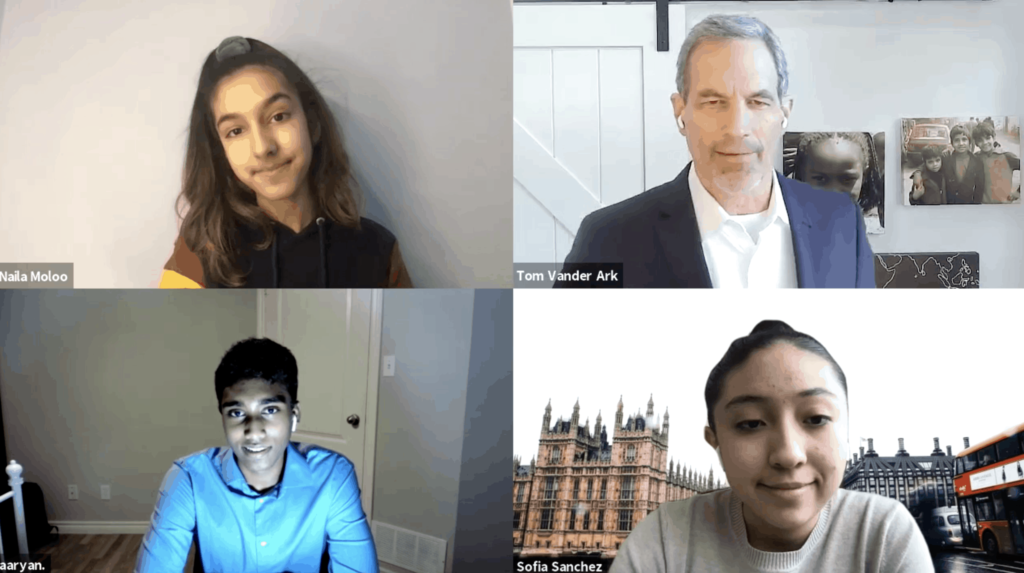
You’re listening to the Getting Smart podcast where we unpack what is new and innovative in education. I’m your host Jessica and today Tom Van Der Rook sits down with three outstanding learners who are passionate about difference making, innovation, and making the world a better place.
All three students, Sophia Sanchez, Nyla Malou, and Ariane Harshith are high schoolers and left us inspired for weeks after talking to them. These three participate in the Knowledge Society, one of our favorite after school programs. If you haven’t heard our episode with co-founder Navid Nathu, we highly recommend it. I’ll put a link to it in the show notes.
Let me give you a quick intro to each learner. Sophia Sanchez is passionate about synthetic biology, biotechnology, and innovation. She attends Technolajico de Monterrey in Mexico and is currently learning a lot about exponential technologies so she can soon start a company that impacts the world positively. Nyla Malou attends the Elmwood School in Ontario and is passionate about sustainable energy,
specifically where it intersects with nanotechnology. Nyla loves to learn about anything related to emerging technology ranging from quantum physics to space exploration. Ariane Harshith attends Lowellon Park Secondary School in Ontario and is working to create a better, healthier world through the things he builds and the research he conducts.
For the past two years, his primary focus has been building a medical device to enhance cancer diagnosis during surgery and he’s currently in the process of running human trials for it. Let’s listen in as Tom talks with these learners to hear about their motivations to change the world, the emerging opportunities they see, and how they keep learning.
Today on the podcast we have a real treat for you. We have three young scientists that are joining us today, Nyla Malou, Sophia Sanchez, and Ariane Harshith. Hi all. Great to have you guys on the show.
You know, for the last couple years we’ve been writing about difference making. We published a book called Difference Making at the Heart of Learning and in that book we argued that high school should really be a place that helps you figure out who you are and what you’re interested in and how and where you want to make a contribution in the world.
We have three of the best examples in the world that we have spotted, three young people whose school experience and their out of school experience has really helped them gain a sense of what they’re really passionate about and to be able to dive deep into that both in and out of school. What these three have in common is that they’re all from North America.
We’re representing Canada and Mexico today and they all have participated in or in a program called The Knowledge Society, TKS.world. And we’re going to talk about that today. Sophia Sanchez. Hi Sophia.
Hi Tom. You’re joining from Mexico today. Yeah, I am from the center of Mexico. Yeah. Sophia, you have a real passion for synthetic biology.
Where did that come from? Sure. So it’s kind of unconventional, I’d say in some sense, maybe not for the 21st century, but you know, I discovered biotechnology thanks to a YouTube video because nobody talked to me about this in school or anything.
But I just, you know, became obsessed with the topic and started to learn more and more about it. How did you find out about TKS? Sure. So that was also actually thanks to the internet. I actually saw a tweet with a TKS student who had met a scientist who’s a very recognized scientist.
And I was really, really impressed by how young she was and all of the things that she was doing. And, you know, the fact that we both had this passion in common and that she already had, you know, done something about that passion. So then I discovered that she was part of the Knowledge Society. And, you know, the moment I discovered that I knew that I had to be part of this program,
but they didn’t have an online version of the program at that moment. But, you know, then it happened and now I’m here. Sophia, some of your projects have included explorations in gene editing, looking at gut biomes and even creating a biosensor for COVID-19. I would love to dive into one or two of those and have you talk about how did you learn about them
and then how did you turn that interest into a project? Sure. So I first want to say that these have all been, you know, theoretical research to the moment. I would love to get into the lab up to some point, you know, but because of the pandemic, none of the labs doing research in Mexico are open or at least, you know, as far as I know,
nobody’s doing like something in the lab that isn’t related to COVID. So, yeah, as of the GodMakerBioM project, I was just curious about the topic and I started to learn about it on the internet. I started to do my research and then, you know, in the Knowledge Society, we learn about innovating and not actually the first phase of learning is just doing the research, right?
But then you have to think about how can you solve problems? How can you innovate in that subject? So, yeah, I would say it’s first learning the basics, then going a little bit deeper into what you like. And after that, thinking on yourself, how can you solve problems with the technology that you’re working with? Sorry.
Was there any information on TKS about those topics or was most of the learning self-directed on the internet? Oh, sure. So in TKS, we actually have something called Explorers, which are like modules in which we can learn about different technologies. And so to kind of have an overview of different technologies like blockchain or artificial intelligence and
biology and others. And then if you like one of these, you can dive deeper on yourself and do the research on the internet. And did you get help from a coach at TKS at forming any of the projects that you have worked on? Sure. So I think that our mentors are really, you know, supportive.
They kind of teach us the right mindset, like figuring things out. I know that you talked about it with Naveed on the podcast. And I think that’s a very important aspect of it because you’re not, you know, we don’t have specific teachers for synthetic biology at TKS. We have mentors who tell us how we can learn better and how we can learn faster about different topics.
But in the end, it’s the work that you put in, the results that you get. Sophia, we love your medium blog and you’ve also started a great podcast called 2045. What are you trying to do with that podcast? So I started the 2045 podcast last summer when I was very interested. Well, I’m still very interested actually in exponential technologies, right?
So pretty much everything that we learn about in TKS. And since I didn’t, you know, know any other podcasts that we’re specifically talking about exponential technologies in an overall way, like, you know, kind of surface level. But having as a target audience, people who are just curious and want to learn and who don’t necessarily know about very specific topics.
Then I said, let’s let’s do this. Let’s create it. And, you know, I have it as a hobby. It’s not something that I commit to a lot. As for example, the medium blog, I see my medium blog as an opportunity for me to learn because,
you know, that they say that teaching is kind of the best way of learning. So I think that’s true. And I also like to write about personal development sometimes. So that also helps me put my thoughts somewhere. I love that, Sophia.
I often say that writing is the best way to learn. You have to write it down to figure out what you think about it. So I really appreciate your leadership on both the blog and the podcast. Naila, I understand that you found out about TKS because you want a science fair. Is that right?
Yeah, for sure. Tell us about your project in the science fair that led to you winning a scholarship to TKS. Yeah, so I was trying to address the pain point of the high cell phone use in teenagers. And so I actually worked on this for a few years. And the first product that I built was this sticker that I designed to go on the back of your phone.
And I did some statistical testing and I designed it based off research and like on color schemes and word schemes and things like that. And then that decreased student screen time by an hour per day in a week. And so I was like, OK, it’s pretty cool. And then I got some feedback and they were like, well, what would be better
if we would something on the front of our phone instead of the back of our phone? You know, that might be more impactful. And so I was like, how can I do that? I can’t really stick a sticker on the front of your phone. So I was like, oh, but we do have these cell phone wallpapers.
And so then I designed a cell phone wallpaper specific to decreasing screen time. But I still wanted them to be aesthetic. Otherwise, people wouldn’t want that on their cell phones. And that actually decreased student screen time by two hours per person per day. So it doubled that.
And I was like, wow, that’s awesome because cell phone screen time. I mean, cell phone usage is is a pretty big problem, especially in teens. So I won my science fair at school and then I got to go to regionals. And then I went to nationals. I didn’t win nationals.
I just placed there. And then from nationals, I think that’s how I got the scholarship to TKAS. And I was like, OK, this is super awesome. So, you know, gotta gotta try this out. And highly exceeded my expectations.
TKAS is super awesome. So yeah, it’s a little bit about my project. Nyla, are you 14? Is that right? Yeah.
How how does a 14 year old get interested in sustainable energy and particularly superconductors? Yeah, where did that come from? Well, I’ve always been really interested in the environment. I think I found out a lot more about it, though, when I actually entered TKS.
So I was doing like these four modules. I did the first one I did was on alternative energy, because I was like, I know I like this. This is cool. And then there was a module on fusion energy.
And I was like, whoa, that’s really cool. I hadn’t really even heard about fusion energy, like maybe the tiniest bit. I didn’t really know what it was. And as soon as I did that module, I was like, this is insane. This is like the coolest thing I’ve ever heard about.
There was actually an entirely separate explore on fusion energy itself. And so I love the alternative one just for a little bit to go and do that fusion one, because I was so excited. And you can start these things called focuses at TKS, which is where you go really deep into it.
You do experiments, you build projects, you have to build an idea at the end of it all. I was like, OK, I need to do a focus in this. This is crazy. And so I started to focus in that. And the sector, so fusion seems like pretty niche, right?
But when you actually start learning about it, there are different topics within fusion energy. And so the part that I’ve been doing most of my work in has been in super connectivity. It’s pretty cool. So I’ve been looking at high temperature, super connecting tapes and how we can
improve those, because those would allow more compact fusion reactors to operate more closer to room temperature operations as well. And so that’s what I’m really interested in right now. And I’m working on ways to get that more commercially available. I’m curious, Naila, you go to a good school.
Is it Elmwood? Yeah. Do you study any of this stuff at school? Or are you doing all of this outside of school? So I mean, you learn like in science class, I think that’s probably where I get the most exposure to these kinds of things.
I mean, you don’t really talk about these kinds of sustainable energies or like nanotech in science class. My science teacher is amazing, though. So like I’ve been, she’s been helping me and she’s been like super awesome for sure. But we haven’t really talked about like blockchain and like these
cryptocurrencies and the sustainable energy and nanotech and stem cells and things like that. But we definitely do touch on some of these things. Like I’m doing an astronomy unit right now and I definitely find space super interesting. I don’t think it’s like my niche kind of passion. But for some people in TKS, it definitely is.
So that could potentially help them to develop an interest there. So yeah, we touch on these kinds of things. I think our next unit is in biodiversity and like the environment. So I should find that fun. That’s awesome. We’ll come back and talk more about that.
Arjen, I’d love to know how did you find out about TKS? And this is your second year in the program now. Is that right? Yeah, that is right. How did you find out about the program?
Yeah, so finding out the program was a huge string of events. And I don’t even think I can fully remember them, but to the best of my recollection, I also went to science fairs, went from regionals to Canada, to the White Science Fair, just like Nila did. And I was just thinking like…
Let me interrupt and just ask you like what kind of projects were you bringing to science fair? What was your original interest? All right. So the project that I went into that science fair with was using artificial intelligence to diagnose diabetes more effectively. So yeah, I did pretty well in the science fair with that.
But I was thinking like what could I do more than this? Like I had kind of a motivation in me, so I just win. I wanted to win the entire thing. And I don’t necessarily think now that that was the best thing to motivate me, but I started to just see how I can develop myself, personally develop my knowledge,
slowly build on things outside of just what I learned outside of school. Slowly I was looking into ways I could do that. And the first thing that I found was, well, I needed to surround myself with a community of extremely, extremely smart people that would make me feel uncomfortable and make me grow.
All right. So that’s kind of how I ended up finding TKS. So I created a LinkedIn account. I was scrolling through the pages. I saw one of the innovators. That’s the first years at TKS.
And back then, of course, I didn’t know a thing about TKS. So I tried learning more about the program, looked at their website, and I said like this blew my mind. So like if there was a community that I wanted to be in, like that was going to be the community.
So that’s exactly why I applied. I didn’t think I was going to get in, but I somehow got in. And it really changed the course of what I’ve done so far. Say that’s my journey. How would you say it’s different than traditional learning in anger high school?
Right. So in terms of what they teach you at high school, I think it’s it’s surface level and they cover a lot of different things. And we don’t really focus on one main thing. And I do see the merit in that to a degree because well, we need to train people
capable of doing jobs in all walks of society. We need to do that, right? But I don’t think we encourage students going deep into their own subjects outside of school enough, right? We have homework, but I mean, who looks for homework, right?
You need to essentially train students in a better way. And I think that’s something TKS provided that high schools did. And I also think TKS provided me with a whole bunch of different skills. In fact, the biggest skill TKS provided me wasn’t even tangible knowledge.
What they provided me was the ability to socialize with people, to talk to people. I don’t I don’t know if you’ll believe this, but before TKS started, I couldn’t look a person in the eye, right? And TKS taught me that and they taught me how to deal with people. And it taught me that if you don’t know how to deal with people,
you don’t know how to live life because life is all about people. Right. So that’s one of the lessons that they taught me. And I don’t think school stresses that nearly enough. What sparked your interest in a universal cancer vaccine? I was thinking as soon as I joined TKS, right?
Like we were encouraged to figure out what we wanted to do, right? Because it’s never too early to start. So I was thinking which of like these infinite number of fields could I be working on? And that was kind of a big problem on its own, right? Like there’s thousands of different things that I could choose to work on.
What’s the one thing I could, you know, choose to do? And I made a decision to myself saying that, OK, if I choose to do something, I might as well do it for a long time and I might as well do it well. Right. That’s the focusing part of it. So I said, what’s something I’d be willing to spend my time working on?
And I was looking at things, making connections. Cancer ended up being the thing that I wanted to choose. And a lot of people ask me, why did you choose cancer? I don’t think I have a specific reason. It’s a combination of multiple different things.
And it went into me choosing cancer, partly the fact that many of my family members were affected with cancer, many of them died with cancer. But also I think there is this curiosity within me to say, well, cancer is just one of those diseases that you don’t really know why it happens and you don’t know why it’s so hard to cure.
And I wanted to try understanding that better. And so in a way, you could say I started to research cancer because it was a hard challenge to tackle. And I mean, developing a universal cancer vaccine is my end goal. I’m doing the foundational research behind that.
But yeah, so that’s kind of the logic behind why I chose to do cancer because it’s hard and a whole network of other things. Each of you seem to share a passion for making a difference, for sort of combining an area of interest with something that will change the world. Sophia, I read one of your blogs this morning,
about, I don’t know, about a month ago, you wrote about this topic. Life is short, you know, do stuff that matters. How would you describe your evolving philosophy on that, on making a difference in the world? So I think that I’ve been a person who’s always wanted to somehow change
the world or make an impact or, you know, be the best version I can be. But I didn’t know how I didn’t know what that thing was going to be. And I still don’t know. I don’t think that a lot of people actually have figured these things out. But I think that writing, as you say, helps.
And I think that this has evolved a lot with TK, since I discovered that I can actually start working on things that I like now. I can actually start to create projects today. So in 10 years, 20 years, I have already acquired those skills that are necessary to build a project, or I already have some experience.
And, you know, they say that when you’re young, it’s kind of the best time to fail. So I don’t have to worry about, you know, family or a lot about money and those kind of things. So I think that, yeah, throughout these years, I’ve been learning about what I
like to do and what I need to do it. And it’s basically just having that bias to action and getting started. Hey listeners, time for a quick break, but we’ll get back to the podcast soon. However, in the meantime, I wanted to share with you a powerful, new tool that we think every teacher should be using with their learners.
With the persistent disruptions to learning, systemic racial oppression, and the collective trauma of the COVID-19 pandemic, the well-being of so many young people has been severely impacted. Turnaround for Children has developed the Well-Being Index, a new, free tool that’s helping educators hear directly, quickly,
and frequently from their students. This brief self-assessment captures a holistic view of each learner’s sense of their own physical and mental health. Each learner’s sense of their own physical, emotional, and social health so teachers can better understand, attune to, and give voice to their students.
You can learn more about this new tool and start using it in your classroom today by going to turnaroundusa.org slash well-being index. We’ve also got it linked in the show notes. All right, let’s get back to the show. Nila, how has TKS helped you think about sort of how and where you want to make a difference?
I feel like TKS has really given me the resources to be able to go out and make an impact. Sophia said, I’ve always wanted to make impact. I just didn’t know how. And so I’ve learned all these crazy things at TKS.
I’ve learned about mindsets and how to grow myself that way. I’ve learned about emerging tech, and I’ve learned tips. A really big one for me was just like, you can go on LinkedIn and just reach out to experts. And some of them won’t respond, but some of them will.
And then they’re just like humongous helps. And so you’re learning all these really valuable things from a young age, and that’s compounding. And that’s going to help you succeed in the future and help you to start succeed now. You don’t have to wait until you’re like 20 to start making a difference,
start working on the things you’re passionate about. You can start now. And so I think that’s what TKS has helped me to really realize. Aryan, do you want to add anything to that? I think Sophia and Nila covered most of them, like the act of compounding and all of that.
But I think one of the biggest things TKS has done for me, aside from teaching me how to communicate with people, cooperate with people, is the fact that, well, before, I think my best case scenario, going out of high school would have been, well, getting a degree and maybe becoming a software engineer,
maybe becoming a doctor. I mean, there’s no offense to doctors or software engineers. They’re doing great things. But I think TKS turned that now into my worst case scenario. Everything else fails, I could do that.
But there’s so much more potential out there now that I’ve joined TKS. They’ve unlocked a whole new dimension of things I could be doing. So that’s what they’ve done. So here’s one thing I worry about for the three of you. I’m afraid that college is going to suck because you guys are so smart and so thoughtful
and so self-directed. Aryan, how is the college going to keep up with you? How are you thinking about your college experience and what you hope it to be? I think if I do end up going to college, I want to go to a good college. I want to try replicating another good environment to surround myself in with extremely smart people.
So it’ll probably be one of the select few colleges that have extremely high intellectual horsepower people. But I don’t know. I still don’t know for sure if college is the right option. I might go and do my own sort of venture.
But there’s risks and rewards to both of those. And I think for anyone that’s watching this podcast, I think that’s something you need to consider. Don’t blindly go into one option. Keep your eyes open. No, I appreciate that.
You’ve already shown a real drive and self-direction. And college may not be a good option for you. Continuation of the project that you’ve started might be a great answer. Sophia, how do you think about what’s next? And how is the college going to help launch your career?
Well, this is a question that I’ve actually asked myself a lot during the past month. Because, yeah, I don’t know. I think that’s actually I’ve discovered through asking a lot of experts this question. Sometimes it varies between different fields. So if you’re probably into computer science, it’s something that you can learn even on Coursera
or any other platform. If you know how to code, maybe you can create something and even start a company out of it. But then with biotechnology, I think that can be really different at least at this moment in which you need a good lab to do your stuff. You need to have a deep knowledge and understanding of the subject.
For example, Ginkgo Bioworks, which is like a billion dollar biota company, you see the profiles of the people who work there. And they mostly have all of them, half PhDs, if not most of them. So I think that for me, college would be probably a good option considering the field that I’m working in. That’s great.
Maybe Sophia, maybe a graduate program will you can just get credit, you know, a BS credit for the work that you’ve done and you can start working on your master’s degree. Yeah, that would probably be better because starting sometimes I see what undergraduates are working on. And it’s sometimes not what you’re looking for. So maybe keeping to the PhD would be great if that was possible.
Nila, how do you think high school could be more valuable for you? Well, in terms of high school, yeah, I’m just thinking I feel like I didn’t learn about a ton of these like crazy emerging technologies that are going to completely revolutionize the future. I didn’t learn about them in school. I only learned about them when I came to TKS.
And so I think that schools need to put like more direction toward these emerging techs because that’s what’s really going to be making impact. And if you’re talking about it in schools, then people might get interested in it and they can help like actually make that become a possibility. Like we I think we take bio next year and I’m not interested entirely in like bio applications, but we haven’t really talked about that at all. And I never heard really about fusion.
The only thing I knew about nanotack was that it’s small. That is literally all I could tell you. And so I think just putting more emphasis on that in the curriculum would be super valuable to kids. Yeah. Nila, I just wrote a blog that said the two things we should teach more of in high school are artificial intelligence and related exponential technologies
and climate science. Do you agree with that? Oh, yeah, completely. I think AI, we need to learn way more about that in schools like that is going to be very, very prominent in our future. I think we’ve learned a little bit about that.
We did like one class on it in tech class, but we should be doing way more with it. So yeah, and I also think I think my school is actually doing this now, but learning how to code should also be in that curriculum. I think that’s important as well. Aryan, I appreciate the way you’re combining areas of interest, including AI and exponential technology and biotech. Do you think more young people should have that kind of opportunity?
Right. Yeah, I definitely think that should happen. And it’s because we aren’t providing people with a range of different things to learn about. And I think that range of opportunities DKS provided me is what allowed me to keep my eyes open and say, OK, this technology exists and this technology exists. What if I combine them?
Right? Sophia, how do you keep learning? What do you have a tip for if there’s any young people listening? You already struck me as a very mature learner. What advice can you give for other young people? For sure. So I actually have thought about this as well.
And if I were to give myself like before, I started to learn anything about biotech. I didn’t even know or wasn’t even sure of what DNA was. So I was like in middle school and we weren’t learning things at a very deep level. So what I would say to any person, regardless of the ages, know that you already have the tools to learn anything that you’ve ever wanted to learn.
Like the internet can be used for either social media and wasting your time. And I’m not saying that all social media is bad. You can actually use it for good. But these are tools that you need to learn how to use them correctly. So if you start watching more YouTube videos about things that you’re passionate
and curious about, if you start, I don’t know, following people on Twitter who you think may give you some value, then you will continue to learn even outside of school. So just use these tools for good. Nila, what would you add to that? Yeah, I think just knowing that you are capable.
Like I think we use age as an excuse. Like we can learn whatever we want. Don’t don’t use age as an excuse. And also I think another big thing is embracing failure. I think we’re all scared of it, but honestly, failure is good.
And we learn that at TKS, like we strive to fail and do things that that are hard to you and that scare you. Like ask for mentors, reach out to people. They may say no. Ask for that internship. Like think of the worst case scenario and think of the best case scenario.
Because the worst case scenario is that this person says no. And the best case scenario is that, I don’t know, it depends on the scenario. But some really cool outcomes. You get to work with this crazy person. You get to work at this lab.
So many opportunities can be opened up to you. So just start now because now is the best time to start. Aryan, how do you keep learning? How do I keep learning? So is this a question of like, how do I stay motivated and not give up?
Yeah, both for you and what advice would you have for others? Right. I think considering what I’m learning right now, while comparing that to high school, I used to be the kind of kid in high school who didn’t really need to study for tests. I used to like coast.
I used to, it’s starting to change now in about grade 10. And I actually need to start studying for things. But I used to do that. And I used to coast mainly because I think I was just naturally good at things like math, science, stuff like that.
But I wasn’t really interested in them because I think if I was truly interested in the things that they taught us in high school, I wouldn’t coast. And I’d probably spend the rest of my free time learning about those things. For cancer, for AI, the things that I’m researching right now, they’re things that I look into involuntarily at this point.
Like, no one needs to push me to do it. And it’s because I’m interested, I’m not, okay, there’s a different kind of interest and passion. I’ve gotten to the point where the things that I’m researching are things that I truly value. And I do them without any extra motivation.
And I think Nila said it correctly a few minutes ago, and she said TKS feels like fun to me, specifically cancer research feels like fun. Right. So I’m researching a specific thing that I truly enjoy. And there’s no extra effort that needs to be put into that. We have been talking to three high school scientists today.
They’re all members of TKS, the Knowledge Society. The three of you have not only made my day, but I’m sure this will be the highlight of the 2021 year. It’s, you’ve given me a renewed sense of hope about life on planet Earth as being greener and healthier because of the work that you do.
Nila, Milu, and Sophia Sanchez and Arianne Harsheth. Thank you for joining the Getting Smart podcast. Thank you so much. My pleasure. Thank you, Tom.
A big thanks to Sophia, Nila, and Arianne for joining us to talk about their incredible commitment to growth and changing the world. For more on making a difference in the world, check out Episode 288, Tom Van Der Rook on Difference Making and Schools Alive with Possibility. I’ve got it linked in the show notes and on the blog.
That’s it for today, listeners. Thanks for tuning in for the Getting Smart podcast. This is Jessica, signing off.



0 Comments
Leave a Comment
Your email address will not be published. All fields are required.