


Shannon Buerk on engage2learn and Equitable Support for Educators
Key Points
-
Educators need individual support and recognition for the important work they do.
-
Thinking about organizations as systems is a great way to learn to lead and affect change.
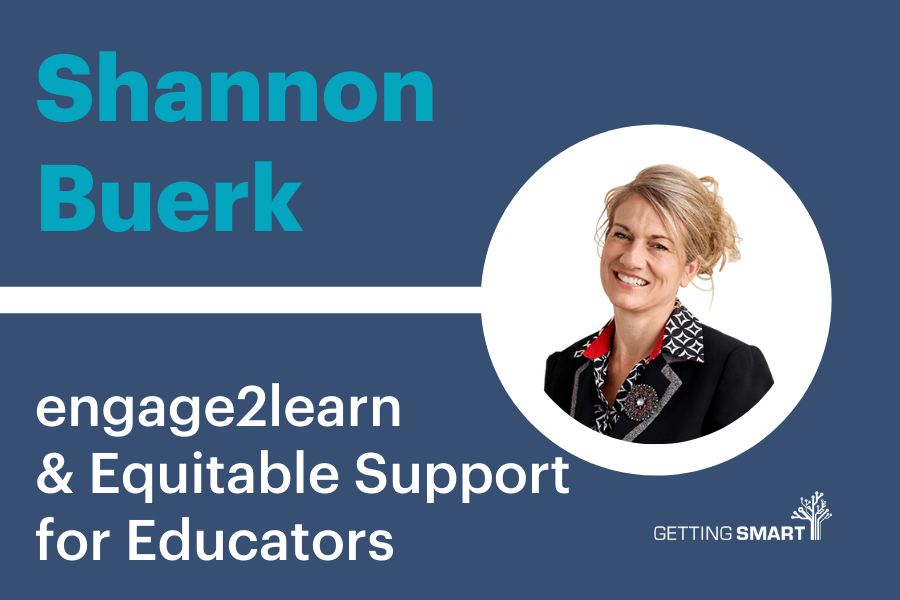
On this episode of the Getting Smart Podcast, Shawnee Caruthers is joined by Shannon Buerk, the Founder & CEO of engage2learn. Engage2learn is a platform that grows high-performance cultures in public schools to sustain local visions of learning for students. With 28 years of K-12 experience, Shannon has partnered with 225 school districts–impacting 2.3 million public education students to date.
A great team makes you a great leader.
Shannon Buerk
Links
If we truly want equity we’ve got to look at our neighborhood public schools. Choice [alone] is not a way to achieve equity.
Shannon Buerk
This episode of the Getting Smart Podcast was sponsored by engage2learn.
Transcript
This transcript has not been edited for spelling accuracy.
You’re listening to the Getty Smart podcast. I’m Shani Carruthers and today I am joined by Shannon Burke. Shannon is the founder and CEO of Engage to Learn, a platform that grows high performance cultures and public schools to sustain local visions of learning for students. With 28 years of K-12 experience, Shannon has led a thriving organization since 2011 that has partnered with 225 school districts impacting 2.3 million public education students
today. Shannon, you’re doing a lot and you’re doing a lot of great things. Thank you so much for being here today. Thank you for having me, Shani. It’s certainly not just me, myself and my team and our amazing partners, but we’re very honored and excited to be able to work in this space and make a difference. Yeah, I really wanted to highlight that 2.3 that is amazing and what an impact you’ve had on students. How did you even find your way to education?
Well, that’s a great question. I always loved school. I actually grew up, my parents were really young and my mom actually dropped out of school when she got married at 16. She had three kids before she was 20 and my dad wasn’t able to go on to higher education and so we grew up kind of frankly scraping to make ends meet. But my parents, they love to read, tell stories, talk to us. We didn’t have a TV so we read all the time. We heard storytelling and I just loved school. I think we
were prepared in that way to really enjoy school so I loved school. I ended up, you know, I had great teachers and I ended up graduating Maledictorian and going on to be a first-generation college student. The way I made my way to education, so I love school to start with, but then I ended up becoming a teacher because of my sister. My sister is only 15 months younger than I am, we’re two IQ points apart. She just had a very different experience in school. She had, you know, starting at about
third grade. She did not get great teachers. We had different teachers even though we were in the same school system and school just did not work for her by junior high. She, you know, felt not valued and ended up dropping out of school and it just, for me, knowing how brilliant and amazing she was, it was just like, wow, it should not be the luck of the draw. What teachers you get, you know, and my parents because they were poor and didn’t have education, they didn’t know to, you know, there was
a system of like requesting the good teacher. So for us, it was the luck of the draw. So I just became a teacher because I thought, I know there are a lot of learners or a lot of students out there that they have a lot of gifts in them that maybe, you know, aren’t being valued and I want to be able to help them discover and use their gifts and I love teaching. I loved education and that a-ha moment that you get with students that maybe have never had that before. So that’s, that’s
my story. Yeah, no, that’s such a personal journey and one that so many students can relate to. Where maybe their parents didn’t have the same access to education, being a first-generation college student or growing up in a household where there are multiple siblings, but with different education opportunities and stories to tell. What, you talked about that a-ha moment that kind of led you there and I’m sure that has also influenced like how you lead others and even
within the school or outside of the school and what you do now. Where did you learn, like, to lead? Where did you learn those leadership skills? I’ve thought about this a lot too over the years and I’m really thankful for, you know, early formative experiences that helped me learn to lead, like, you know, playing high school and college basketball and my, you know, my high school basketball coach was a great leader learning from him and I was a point guard so, you know, you learned a
little bit from that. Teaching, I think, is a great way to learn to lead too because, you know, I taught seniors when I was 22, I’m teaching 18-year-old, you know, that’s a singer swim, you better learn to lead quick and so I learned a lot from that. I think, you know, in terms of really more kind of formal ways of learning to lead in my graduate work, I studied systems thinking which was very helpful to me, you know, to think about organizations, systems and the organization kind of life cycle.
I was in assistant soup and learned from a great superintendent about strategy and vision and why those things are so critical as a leader to be strategic and be real intentional about that and then probably the most important or maybe the most impactful in terms of me learning to be, you know, actually a CEO of an organization was we conducted this kind of a project where we convinced nine innovative organizations to allow us to bring 30 of our just partner districts into
learn from their C-suite so we got to hear about their culture and systems and so, you know, I really learned to be a CEO from CEOs and COOs and like, you know, Dell and Google and Rackspace and Container Store and Southwest Airlines, Steelcase, TD Industries, these, you know, great Apple, these great organizations that allowed us to hear exactly what they were doing with culture and systems and so I picked up a couple things from that that really made a big difference for me to be intentional
about culture, to be intentional about systems and then, you know, put that with the strategy of vision piece so all of those things have been really beneficial in me learning how to lead and then, you know, a great team makes you, you know, a great leader so that’s a big part of it too, of course. Yeah, absolutely. And so many people think that they have to be quote-unquote in positions of leadership to be a leader but that’s not true. You say you were a high school teacher and you led
with your seniors and then you led in other arenas. What are some key components of leadership that anyone can implement regardless of the title? I love that question and, you know, of course, I feel like every educator is a leader and I learned from Bill Cook a long time ago really if you empower folks, any person in any organization can be a leader and so one of the things that we like to talk about is, you know, leaders model, mentor and measure, right? There’s like these three key
things and so if you’re modeling the cultural tenants, the things that you, you know, your values and you’re being authentic and what you believe and putting that into practice, I think anyone can lead, lead by influence and by what they model more than anything else and so I love seeing, you know, folks in school districts. I mean, I’ve learned a lot from superintendents in school districts, of course, about how to lead because I know so many, you know, probably 250 superintendents
and I think, you know, different folks throughout the organization can do, can be a leader and have a huge influence on the organization by what they’re modeling and how they’re coaching and influencing others and, you know, helping other people rise up, right? Encouraging people is a great leadership trait, you know, contributing to the ability of other people to be at their best and highest use like that’s one of the key traits of a leader. So you see that throughout an
organization and a lot of educators exemplify that. Yeah, absolutely and you talk around about smart coaching and smart professional learning. What does that look like for you? Can you talk a little bit more about that? Absolutely. This, this is, I could talk about this for a long time. This has become the passion of my life and my career, you know, my 30-year career and it’s because, you know, the most important lever in, in a child’s education is truly
the teacher, right? I mean, we know that the teacher has the most impact that, you know, that, that was true for me and my sister like I talked about and then also, you know, the research shows us like a good teacher or different, the difference between a high performing and low performing teacher is about five to six months growth per year for kids. So over the course of a K-12 education, that’s like six years difference in growth. So for me, it’s like, I believe in
humans, I believe in the human capacity and it’s, we, we have such a teacher shortage that we can’t afford to just say, oh, well, let’s get the right teachers. No, we have to have systems of support that grow teachers. So we developed what, you know, we essentially call smart coaching or, you know, smart, which, you know, getting smart, you should, you guys should love this, right? That smart coaching, smart professional learning, because we know that so much. In fact,
I mean, the research shows us that training doesn’t transfer to the classroom, zero percent of the time. In fact, that’s what we typically use for professional development, or we might go in and do, you know, another typical thing in, in education today is to go in and do observation based coaching. And unfortunately, that just mirrors our evaluation system. So it creates more of a compliance culture, like you’re critiquing, you know, teachers don’t need someone like whispering in their ear what to do
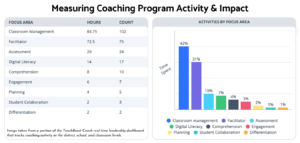
or like critiquing their performance as much as they need true coaching, which is, you know, evidence based conversations based on competencies that are a progression over time. So those are some of the keys to smart professional learning or smart coaching, as we call it, is developing competencies and those competencies being something that teachers can, can develop over time so they can see the progression of their learning and growth, enhancing their craft, and then individualizing
the conversations because not every teacher needs the same thing, right? So this one size fits all model of professional learning is not smart. And it being able to individualize in individual conversations, and then basing it on evidence of practice, rather than observation, those are keys. And then you got to collect data on that. And the super exciting thing is once you can connect that formative educator growth that you’re seeing on those competencies to student growth, we can
actually know what’s working. And that’s not necessarily the case in terms of it works everywhere the same way, but in a local, you know, context and environment. What we’ve been able to do is see what are the competencies that are working to create student growth in this context. And then we can know that everything we’re doing that that’s smart professional learning right now. You’re saying to other teachers, you can be prescriptive, you can be predictive, you can say, okay, if you
badge on these competencies, you’re going to get this kind of result with students. And by the way, we know that because your peers who are teaching students just like yours, that look like yours and are in the same context are getting these kind of results when they’re badging on these competencies. So that’s the way to make professional learning into something that we can be, you know, predictive about prescriptive about and make sure that we’re not wasting teachers time, right,
adding to the overwhelm. And their time is so valuable, and they have so many things that are stacked that are on their to do list that are important priorities that it is important that you’re giving them that just in time learning that is really applicable to them and not to the masses. And it really sounds like you’re just taking the tenets of really good student learning and now applying it to the teachers. That’s right, Shawnee. And that is the thing that I think is
interesting. It’s like if we want equity for learners, we need equity for educators. If we want social emotional skills and learning and awareness for learners, we need to provide that for educators. If we want differentiation for learners, we need to provide that for educators. So the model of professional learning that we believe is smart professional learning is you’re, you nailed it, exactly what we want to see in classrooms. And the more we model that, the more,
you know, it’s always bothered me to hear provocateurs or see consultants, you know, lecture teachers on not lecturing students, you know, like everybody in one size fits all lecture with slides and saying, don’t do this. And it’s like, okay, well, you know, if you can’t figure out how to do it. So we need a model and professional learning exactly what we want in classrooms. And once teachers are both immersed in that and then get the value of that,
they’re going to trust it, right, to be. Yeah. And I love that connection back to student growth. I was listening to a webinar recently and they were talking about in good professional learning or prep professional development, that students should be able to see the difference and notice like they notice when you have new classes and they know it’s like when you have a new haircut. But so often when professional development happens, they don’t notice a change in your
teaching. So this sounds like you’re really trying to make that change even apparent for the students in the classroom. Shawnee, that is if we that’s the whole goal of what we’ve done with professional learning. And really, again, my whole career, it’s like, if it’s not actionable, why are we wasting our time and money? If it doesn’t impact learners, because we know, you know, 90 plus percent of the people that get into the profession, they actually do get in the profession to make a
difference for kids. So that’s why they get frustrated when their time gets wasted on things that they know is not going to transfer or translate to the classroom. And so exactly. And here’s the thing, those competencies that I was talking about competency based professional learning, which is a part of the way that we’re defining smart professional learning, those competencies are based on research that are things that make a difference for kids. So
whether that’s, you know, what we’ve included are in the competencies that we’ve developed. It’s not just student achievement, but it’s also what contributes to their social emotional welfare, what contributes to a culturally relevant and inclusive and sustaining classroom, you know, what contributes to their ability to develop life ready skills. And those competencies are included in there. So they’re, they’re defined in ways that, you know, are sure to translate
to the classroom. And then, you know, what we observe in the classroom is not the teacher practice, it’s the learner behaviors. Did it actually make a difference? That’s how you know, right? That’s how you know if it worked. So I mean, obviously there’s nothing more, just like that, when you’re teaching, there’s nothing more, you know, gratifying than to hear the stories about what happens for learners. Yeah, absolutely. Yeah. And you talked about
competence, our competencies, a line, which makes a lot of sense. But then there’s the notion of the cultural competence versus cultural proficiency. How do you move from cultural competencies? Okay, I know what it is. I know I understand like how the culture works in my school or whatever the case may be. And then I really understand and then can then put it into action and to teach others. How do you move from that competence to proficiency? So that’s a great
question. And it’s so important for us to be able to do that today. And, and, and, you know, I like that we’re on the progression. I feel like, you know, I feel like there’s a lot, you know, it’s like awareness, then competence, right? And then so the awareness is good out there. And that’s, that’s a great, that’s great progress. What we’ve done and what we’re seeing that works again, just to take it all the way to practice an application, right? And that’s true with any of
these competencies. But this is another competency that teachers can develop. And then once they’ve developed that competency, they’re able to apply it in practice. And the evidence of practice shows the proficiency, right? So when they’re bringing back that evidence to that coaching conversation, and, you know, I mean, we’ve just integrated this directly into best practices, because it needs to be part of a tier one instruction classroom, right? Just just an integrated part of what you do every
day. And so as that as that happens, and then teachers are able to apply it and see the results, that’s where you get to proficiency. And again, you see the difference with learners, right? You see that they are part of that and they’re feeling that and then they start to model and and, and, you know, exhibit those same types of behaviors because the teacher as the leader has created that type of environment in the classroom, which is great. Yeah. And this can happen in any sort of
classroom regardless of where it’s located, but you specifically focus on neighborhood schools. Yes. Why, why is that a focus for you? Well, two reasons. One is that, you know, the neighborhood is the heartbeat of the community, right? There’s the symbiotic relationship between neighborhood schools and in the communities. And we know it’s the haven for families. It’s the hub of so many things that happen. And so, I mean, we’ve seen it and you, I know you, we moved a lot, my
husband coach called basketball. So we moved 10 times in 16 years. We saw a lot of different communities. And when the neighborhood school is healthy, the community is healthy and vice versa. And so that’s, that’s the first reason it is, it’s, it’s so important to, you know, all of our society and all of our communities. The second one is equity. If we truly want equity, we’ve got to look at our neighborhood public schools. You know, choice is not a way to achieve
equity. Unfortunately, we’ve seen the results of that. I think it was a good idea, but it hasn’t played out that way in practice, right? And there is a difference between theory and practice. And so what we’ve seen is school shopping is what happens, right? And so that’s not equitable. And so we need that neighborhood. A lot of, a lot of families and students don’t actually have a choice for whatever reason, whether that’s transportation or like my parents didn’t know,
you know, that they had a choice. They didn’t know to request things or whatever they wouldn’t have known to shop around for a school. And so we need every neighborhood public school to be the first choice for every family because that’s the choice that most families have. And so that’s why we focus on neighborhood public schools. And it’s amazing to see the results in those schools, to see, you know, the educators that are dedicated in those schools, and then the family start to
become engaged and the healthy culture and the thriving culture starts to happen. And the students and educators and families start to become proud of that school and then that community. And that, you know, it’s just this healthy, virtuous cycle that happens. And so that’s, that’s our focus, 100%. We actually don’t work with anything but neighborhood public schools. Now we do that at scale, you know, full districts across an urban community, et cetera. But yeah, that’s our number
one. That’s our, that’s our sole focus. Yeah. And you talk about community, why is it important for students to kind of learn in service of their community? Well, it all, you know, this kind of goes back to the idea of systems thinking and understanding that, you know, everything is interdependent. And so I think maybe the best way to answer that question is to share a really quick story about a student who was in one of our schools and I ended up getting the honor of hearing this
student by accident speak at a luncheon that he was being honored and he mentioned us and mentioned how his life had changed as a result of our work with his teachers and his school. And he, he shared the story that coming out of junior high and to high school that his plan was to become a drug dealer. That’s what his siblings had done. That’s what, you know, he saw was going to be his way to success, his path to success. And then when he became part of a school in high school that we
were working with and we had this connection between the school, the classrooms and the community. And there, you know, there was like, you know, an authentic audience for some of their work and bringing folks in the community into the classroom that he started to see the opportunity for leadership within his community. And by the time he graduated, which was when I was hearing and speak, you know, he was number two in his class, he was going to Rutgers, he had created this community based
leadership forum for students to be connected and to do something in their community. He said, when I realized I can actually have a positive influence on my community is when I understood that, you know, I had value and there was something I could do and, you know, to be worthwhile. And so just the contrast in where he was headed and thinking what he was good, you know, the impact he was going to have on his community and the change in that once he realized that he
could have a positive impact, you know, of course, has stayed with me forever. And it’s just exciting to see what can happen when students realize I’m part of this community, they contribute, they come back to that community, you know, with that education and those skills and that talent and those gifts. And, you know, that’s how we heal. And that’s how we solve the complex problems and challenges that we’re dealing with today. Oh, no, that’s truly a beautiful example of the power
of community. And I know, you know, as you get inspired by those kind of stories, you probably have other people who are inspiring you as well. What is one or two or who are some voices in your community? And it does have to be like your physical community, but just in general, that are important for you to listen to or for you to hear. Oh, wow, that’s a great question. Well, I read like crazy all the time. So part of my community and, you know, and listen to folks,
like you guys, your podcast and other things. And there are so many great thought leaders out there, of course, and I am focused in education. So I, you know, I listen to thought leaders in education, but also thought leaders that are connected to organizational thought leadership. I appreciate and really pay attention to the thought leadership within our school districts. I think our urban superintendents, you know, are some of the greatest leaders in the world today. And they
are dealing with the most complex challenges where everything comes together, you know, around the school, all the politics, all the values, all the, you know, the different families. And so, you know, their leadership and their thought leadership, I think, are critically important as well. So I do pay attention to them. And, you know, I’m still a learner. I love to learn. So everything I can learn from others. And, you know, you can learn from anybody and what their experiences are.
And so, yeah, that’s a really critical part of my life is continuing to learn from those thought leaders. Yeah. And you talked about everything coming together. But unfortunately, sometimes things fall apart. And I know you feel very passionate about the great resignation. How can engaged to learn support the current challenges facing the teacher workforce? Well, just like we were talking about earlier, Shawnee, with, you know, the idea of
that professional learning should be modeled after what we want for student learning. I feel like, you know, we say equity for learners. And absolutely, that is our, that is the goal we, you know, there’s a lot, there are a lot of things that we’re all focused on right now in terms of changing those systems. I believe that one of the things that to get to equity for learners is to provide equitable support for our educators. And everyone needs a coach right now, everyone.
Everyone needs individualized support. And there is a way to scale that. You know, we’ve, we have created purposefully a way to scale that by taking observation again out of that process and being able to base it on the individual conversation. You know, during COVID, our coaches will say that almost every day, and at least every week, they do have a teacher pretty much breaking down in a conversation to them and just saying they’re so overwhelmed, they’re so overburdened.
They’re so thankful for someone to talk to about this, just, you know, someone to talk to. But I do feel like, so I think there’s really three things we can do with that great resignation issue. One is individualized support. We have to find ways to do that. We’re spending tons of money on technology and programs. All those things are important too, but without the individualized support, those just become a burden. Teachers are saying they’re overwhelmed by it, the initiative
churn, the program churn, everything that seems to come down to them. So number one, individualized support. Number two, recognition. It’s, it’s shocking how important small things can be in terms of recognition. We actually had a teacher tell us the other day, told one of our coaches that this, when they got their badge from their competencies, that was the first time they had gotten recognition or acknowledgement of something they’d done well in teaching in 25-year
career. We just, we just have to lift people up. And so recognition is really critically important. We can go a long ways in getting the behaviors that we’re hoping for through recognition. So I feel like that, that is actually really, really critical. And then, you know, I mean, we have to, so people need to understand and feel like they’re valued, right? I mean, I think that, that is critical. And then, you know, efficacy. Like people want to feel like they know how to do
what they’re doing. And right now, again, the challenges are very complex. Teachers want to do the right thing by kids. And if they feel like the opportunity gaps are widening, if they feel like they don’t have what they need to do that, you know, then, then they don’t want to be in that profession. And they’re getting recruited out. I mean, hey, who wouldn’t want a good teacher who’s learned how to be a leader. So, efficacy and making sure that they feel competent and they have the
confidence because of that. And they’re getting the results. They’re getting those, aha. So that goes back to that kind of smart coaching type, being able to tie the results back to student data so they can see, wow, what I’m doing is actually the thing that’s making a difference. Yeah. So in other words, personalize my learning, help me to get to where I need to be, recognize when I’ve reached some of those milestones, and then kind of get out the way and let me be the subject that are
expertise in the classroom, but knowing that I have the support of others. And those things don’t seem too hard. Right. Yeah, that’s you. I mean, you captured it perfectly. I think we’ve, we’ve inherited some systems that are counter to that in, you know, in the vein of trying to serve. Like, like I said, like observations where people, you know, have heard stories of people going in and they’re whispering in teacher’s ears while they’re trying to teach, telling them what to do is like,
what? Like, who wants that? Like, I don’t need a critique of what I’m doing while I’m doing it. I need you to talk to me about, you know, I’m a professional. And that’s the other thing. I think just professionalizing the profession, helping people understand. We can also, in terms of the reversing the great resignation. So all of that is about retaining teachers, right? Like, that’s the idea is like retaining educators in their roles, creating a culture that they want to be
part of because it’s a thriving culture. And so that I think that’s critical. Of course, there’s this whole other idea of attracting folks to the role. And I think, you know, the role that we can all play in that is like, let’s quit saying teachers don’t make any money. Let’s start talking about the value of being an educator and the, you know, the rewards of being an educator, which are great and attract more to the profession. But look, if we can just stop the leaky pipe, like we just
retain the educators that are there by valuing them and providing this individual as support, that’s going to go a long ways towards stopping the shortage that we have. Yeah, absolutely. And in all areas, if an educator is listening to this podcast, and they’re curious about what coaching will look like or how to get started, what should they do? Well, they can always reach out to me or you. They can reach out to me. I mean, we’re, we are
engaged to learn.org. So the number two, engage to learn.org. And everyone in our organization, it’s like, you know, Shannon at engage to learn.org, or, you know, on our website, there’s a start partnership. We, you know, we provide custom solutions. So there’s not really going to be a one size fits all. We do try to practice what we preach in every aspect. So there’s not even a one size fits all solution for every district. Every district is different, has different
needs and challenges and has already made a lot of progress in certain ways. So the custom solution is, is the right way to go. So yeah, we, we are excited to be able to partner with our districts to make sure we’re realizing the promise of public education for every learner across this great nation. And so yeah, we’d love to, we’d love to hear from anybody who thinks they’re interested in smart professional learning. It’s the most basic promise, but one of the most
important ones. And you all really live out the adage of if you don’t feed the teachers, they’re going to eat kids. And we don’t want that. You are allowed to feed the teachers and customize the learning for them so that they can be most effective with their students, which is literally all they want. So thank you for the work that you’re doing. Thank you for joining us here today on the Getting Smart podcast. And we appreciate the time that you took to talk to us today.
Thanks for tuning into the Getting Smart podcast today. We want this podcast to be actionable and insightful and a great way to learn about what’s next in learning. In order to stay on the cutting edge, we need people in the field to tell us what they’re hearing, what they’re wanting, and what they’re needing to learn more about. Got a topic or a guest in mind? Send your recommendations to me, Mason at GettingSmart.com. And if you like what you’re hearing,
don’t forget to leave a review on Apple podcasts or subscribe wherever you listen. Feel free to share the podcast on social media using the hashtag GSPodcasts. Thanks so much.



0 Comments
Leave a Comment
Your email address will not be published. All fields are required.