

Podcast: Susan Patrick on Transforming Education Systems for Equitable High-Quality Learning
5 Global Trends
In our conversation, Patrick outlined five global trends in learning: 1. Ensuring education systems are fit for purpose. Education systems should be “fit for purpose,” preparing youth to contribute to an open, healthy and just society. Compared to other OECD countries, Patrick sees many states and systems “just tweaking the old system,” and “missing the long game.” Community conversations are the first step for a system fit for purpose. Patrick appreciates the hundreds of communities that have updated their graduate profiles and continue to explore what’s needed in order to ensure that every student has the necessary models and skills. As the population becomes more multicultural, Patrick said, “We need to keep asking– how do we design a system fit for the world we live in?” 2. Modernizing educator workforce and professional learning. As school systems around the world develop more learner-centered models, it’s critical to build educator capacity. “Everybody learning as they build these new designs,” said Patrick. iNACOL summarized this trend in 2018 report, Moving Toward Mastery, that describes a teaching profession that is equity-oriented, learning-centered and lifelong. A growing number of districts are using microcredentials to make professional learning more personalized and competency-based. Kettle Moraine, working with Digital Promise, has been a leader in microcredentials. 3. Innovating education for equity, prioritizing diversity, equity and inclusion. Equity is the organizational driver and the fundamental moral purpose at iNACOL. Patrick is pleased to see inclusion and equity surfacing as a global priority in schools and in society. “We have to disrupt the structural inequities we’ve inherited,” said Patrick. “Transformation requires that we ask what practices, structure, and pedagogy support high quality learning for all students.” Environments that have rapidly changed to be more equitable are more focused on the whole child and are building knowledge and skills that are more well rounded. They hold the same high expectations for all students and use more robust evidence-based on student work. Despite progress on equity, Patrick said in most of our schools the demographics of the teacher workforce still doesn’t reflect the diversity of our youth. 4. Aligning pathways from early childhood, K-12, college and workforce. With the goal of “aligned lifelong learning systems,” Patrick said coherent pathways for learners start with a profile of a graduate like the ones Virginia and South Carolina have created. Aligned systems are based on quality design principles like those iNACOL published last fall.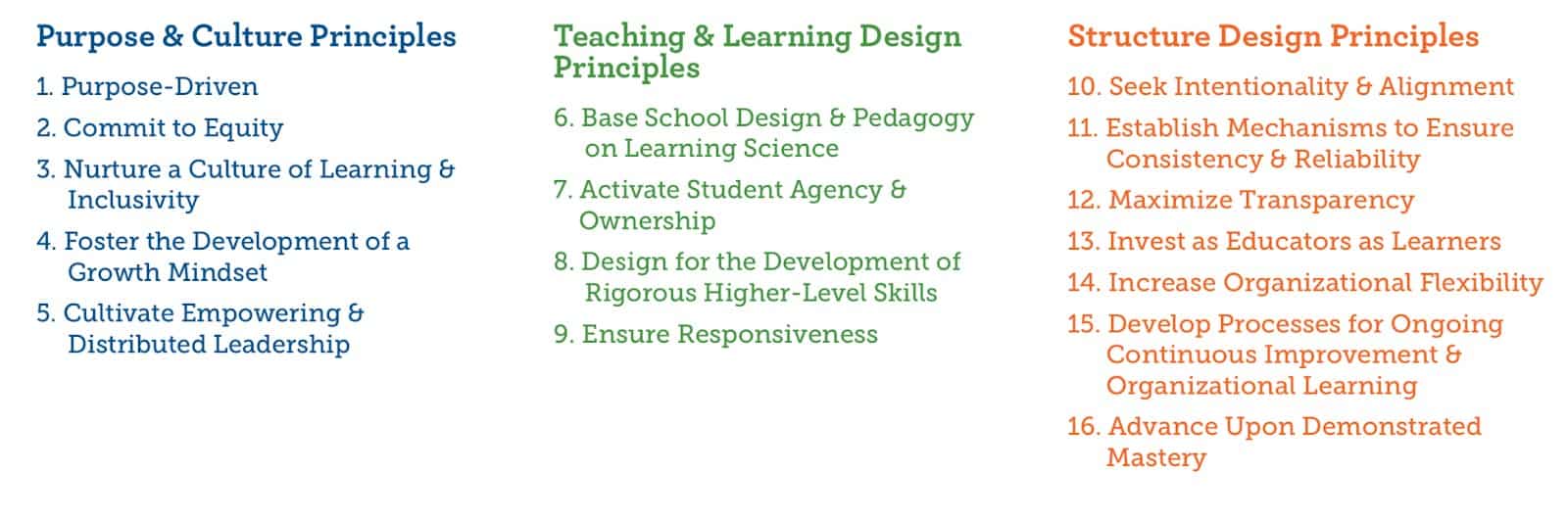 Aligned systems offer transferability and reciprocity between systems (as is common across Europe).
5. Redesigning schools based on the learning sciences. In Fit for Purpose, Patrick and colleagues said, “A school redesign informed by learning sciences puts student success at its center. It incorporates youth development theory, culturally responsive teaching, and evidence-based approaches.” She added, “We must ensure we are designing for equity using research on how students learn best, youth development theory and evidence-based approaches.”
Aligned systems offer transferability and reciprocity between systems (as is common across Europe).
5. Redesigning schools based on the learning sciences. In Fit for Purpose, Patrick and colleagues said, “A school redesign informed by learning sciences puts student success at its center. It incorporates youth development theory, culturally responsive teaching, and evidence-based approaches.” She added, “We must ensure we are designing for equity using research on how students learn best, youth development theory and evidence-based approaches.”
The Best Conference of the Year
The iNACOL Symposium will be held on October 28-31 in Palm Springs, California. The annual convening is the most mission-focused and well-curated convening of the year. It brings together educators, policymakers and researchers interested in transforming education. The sessions are well curated and the keynotes are always inspiring and push leaders and educators to think outside the box. Big themes for the conference this year include a future focus, whole child personalization, elementary education, and technical to adaptive changes. Our team has our flights booked and bags packed and we can’t wait to be in Palm Springs for this year’s event. If you haven’t already, get registered and plan your trip. You won’t want to miss the speakers or sessions and we promise you won’t regret it!Key Takeaways: [1:10] Susan tells the story of how she got to the office of Ed Tech at the Department of Education. [2:14] Susan tells the origin story of iNACOL. [3:17] Susan speaks about the shift of iNACOL’s focus to blended and personalized learning. [6:05] Susan speaks about the partnership between iNACOL and Next Generation Learning Challenges. [6:52] Susan speaks about the fellowship she did in New Zealand and Australia in 2016 and summarizes what she learned there. [10:04] Susan summarizes the mission of iNACOL today. [10:42] Susan and Tom look at some of the top trends that are driving education globally today, starting with the idea of being ‘fit for purpose. [13:00] Is the work of districts reconsidering their graduate profile and updating their learning outcomes encouraging to Susan? [15:03] Susan highlights some of the trends she sees with regard to modernizing the workforce in educator development and professional learning. [17:45] Susan gives her thoughts on micro-credentials. [19:04] Susan speaks about what she’s seeing globally in terms of innovating for equity and prioritizing diversity in education. [23:43] As learning environments are innovating, how does Susan suggest we create aligned pathways from early childhood to college? [28:03] How Susan sees schools being redesigned based on learning science. [30:18] Susan highlights some of the key lessons she has learned from the last 5–10 iNACOL Symposiums. [34:58] What to look forward to at the 2019 iNACOL Symposium!
Mentioned in This Episode: iNACOL iNACOL Symposium 2019 U.S. Department of Education Next Generation Learning Challenges Innovation Lab Network | CCSSO The League for Innovation in the Community College Digital Promise
For more, see:- Kettle Moraine’s Pat DeKlotz on Building a Culture of Innovation
- Empower Learners: 10 Lessons on Innovation Leadership
- How the Micro-Credential Revolution is Transforming Professional Learning
Stay in-the-know with innovations in learning by signing up for the weekly Smart Update. This post includes mentions of a Getting Smart partner. For a full list of partners, affiliate organizations and all other disclosures please see our Partner page.
Transcript
This transcript has not been edited for spelling accuracy.
We’re listening to the Getting Smart podcast. Where we unpack what is new and innovative in education. I’m your host Jessica and today we’re bringing you an episode with none other than Susan Patrick, the president and CEO of iNACL. For the past 14 years, Susan has led the international advocacy organization known as iNACL.
They seek the transformation of education systems and advocate for breakthrough policies and practices that ensure high quality learning for all. Their fall symposium is one of our favorite conferences of the year with well curated sessions on whole child personalization, competency based progressions and systems leadership. In this interview, Susan reviews five global learning trends and previews the 2019 symposium
which is happening October 28th through the 31st in Palm Springs. You’ll be there and highly recommend you add it to your fall travel plans. Let’s listen in as Susan talks to Tom. Susan Patrick, welcome to the Getting Smart podcast. Thank you.
It’s a treat to have you on. Susan remind us of how you got to the office of ed tech at the Department of Education. I had been working for Governor Hull in Arizona on policy related to education and technology and went to work with John Bailey, who was then the director of the Office of Educational Technology in a series of many excellent ed tech directors across administrations.
And when John Bailey left, I assumed the role of director of ed tech. Yeah, it really has been a remarkable group of people. Karen Catered was in that role recently. I think Linda Roberts was, was she the first? She was.
She was the original ed tech director that had the language to create the office and into law with Senator Kennedy’s office. Susan, you’ve been executive director at I-NACL for going on 20 years now. What’s the origin story of, in the early days it was called NACL, what’s the origin story of the organization?
The organization that started as NACL was created by a group of people in universities, in governments across North America and State Departments of Ed that were really working to expand access to high quality education through online learning. And they were mainly public, state, and district and university programs. They started with AP and the ADG requirements in California and created an organization
really focused on transforming learning for all students that would become NACL. And that was really the focus for the first 10 years. When I joined the board in, when was it, 2005 or 2006? I think around then we started to shift the focus to blended and personalized learning and that was an important area of focus as schools were really trying to engineer their
own transition from print to digital and trying to learn how to use technology effectively. What would you say about that period of time? I think people saw promise and the tools that were helping to empower teachers at a distance to create evidence of that student learning as they moved through courses with some flexibility and in time and place and pace, how to harness those tools that were helping teachers, better
personalized learning in the classroom became a real focus between 2006 and 2009. In 2009, which marks the beginning of a handful of innovators across the country really trying to think about what would a next generation learning model look like that was highly personalized for students that really empowered teachers with new ways of teaching and helping kids embrace new ways of powerful learning both inside and outside of school really shifted
the movement to looking at in this decade or in 2019 now. But how would foundations from moving from just seed time earning of credit to actually competency based credits where students are demonstrating they can show what they know. Along the way and have many much more individualized learning or personalized learning where all students are held to the same high expectations but their pathways may look different based
on their goals and their learning needs to really become relevant and more meaningful than just sitting in a single classroom with a single textbook. So the next gen learning models, they all look different. They look really the thing they have in common is they look very different from traditional models. Inaqal was an important partner for the next generation learning challenges.
Was that about five years ago? That was the conversations with the next gen learning challenges were in 2009. Eddie Carlos was the first higher ed organization involved in Inaqal was the first K through 12 organization involved in other partners. The innovation lab network at CCSSO and the League for Innovation and Community Colleges
all worked together to help reimagine what education could look like in the early end. You did a fellowship and spent some time in New Zealand and Australia. When was that and how would you summarize what you learned there? The fellowship was in 2016 and I would say one of the drivers was to build a much deeper understanding of how global education systems were changing, how innovations were taking hold
that were focused on equity. And that in the interest is it is Inaqal and then Inaqal the I signifying an interest in learning and international best practices and also having members around the globe help inspire what’s possible in education. That it really became more and more important and we know that technology is really constrained by the human design and so technology offers incredible benefits for expanding access.
But if the system itself is not designed in a way to ensure that all students are successful, then I would say I feel like I’ve worked for two or three different organizations even though I’ve been at the same nonprofit because our shift and our evolution from focusing on delivery models and online and blended learning and they still play an important role but if the system itself is fundamentally flawed and designed to rank and sort kids out and kids out potentially of
a future that how do we design a system that’s fit for the world that we live in? How do we design a system that’s going to ensure all students get what they need to reach high levels of success and future health and prosperity which is a very different question. So I did an Eisenhower fellowship in 2016 really studying global education systems change and had the opportunity to talk to leading experts in education policy and innovative practices around the world but my main focus
was on New Zealand that in 20 years has really built an education system with a balanced policy model of setting world-class expectations so that any student has a credential that’s backed up by evidence of their work aligned across K through 12 and higher ed and also globally recognized at the highest levels of excellence so that was a wonderful opportunity. It was, it was fun to watch and it’s been fun to learn from you in the subsequent years.
How for our audience not familiar with iNACL how would you summarize the mission of the organization today? Well the mission today is really move towards a focus on how do we drive the transformation of education systems to advance policy and break through practices that really ensure student success for all students. It really is much more about focusing on driving that transformation of our education systems. Let’s take a quick look at the the top trends that are
driving education globally today. I think the first one that we could start with is this idea being fit for purpose. You talk a lot about that you’ve written about that when you say an education fit for purpose what what do you mean by that? That’s interesting because this is not a common conversation in the United States but it’s a very prevalent conversation in many many other countries and that the fundamental question that people are asking is is the education system fit for
purpose? Like what are the outcomes we hope and see and the outcomes kind of the conversations globally are more centered on is our education system preparing us for an open and healthy and just society? Is it supporting a democratic society where all people are all people are being prepared to contribute to society, to their communities, and to lead healthy and prosperous lives? And it feels like in the in the U.S. we’re having conversations about
tweaking our existing system and which metrics to use for math and reading and some of the subjects and those are important questions and contexts but we’re missing the long game. We’re missing the real what is the North Star and communities need to have that conversation in the U.S. because education is local but states also need to have that conversation so we have to re-engage in that central question around what is the purpose of education and how do we think about how education
contributes to the well-being of our society, how we interact with each other as people, and of course our economic prosperity and growth. Susan, there are hundreds of districts that have been working with folks like Patel for kids to reconsider their graduate profile. They’re having community conversations about what’s happening and updating their learning outcomes. Is that is that work encouraging to
you? Is that at least part of this idea of creating a foundation of a system that’s fit for purpose? Yeah, those are the first steps and it’s really encouraging and I would say from our annual conference that brings together 3,000 people we saw so many session proposals around the conversations that communities are having to redefine success. It really is the first step for communities to start engaging with all of their stakeholders in defining the purposes of
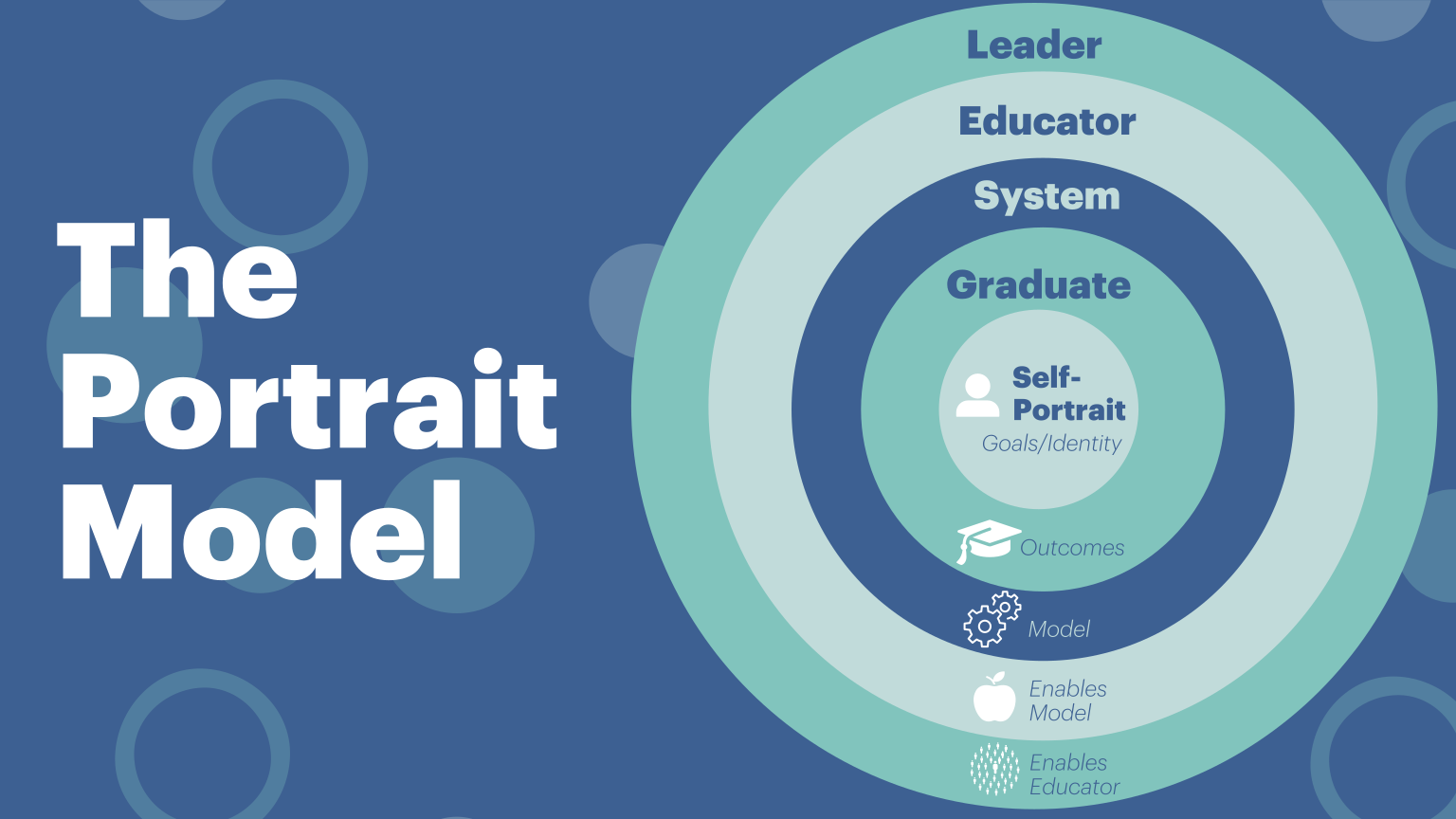
education and some people are calling this outlining the profile of a graduate. It’s essentially in our federal law, the Every Student Succeeds Act or ESSA from 2015, ESSA asked us to think about what do students need to know and be able to do and how would you map out a new profile of a graduate? So in other words, we’re seeing communities start to take on those conversations to determine the knowledge and skills students will need. The second piece of it is then asking the question,
what would we need to ensure that all students and each student that graduates actually has those knowledge and skills? So along with those conversations of redefining what student success looks like, it builds on to the next crucial question which is around how do we know that the diploma is telling us that students have those skills when they graduate and those skills and credentials are meaningful. Another big category of trends is modernizing the workforce. What
trends do you see there in educator development and in professional learning? Yeah, there’s a real need to have our teacher preparation programs to build educator capacity for this new future as systems are moving towards more learner-centered models. What do I mean by that? The change that we’re seeing in next generation learning is really happening from the ground up and so the need to modernize the teacher workforce
is absolutely critical. We’re seeing schools and districts engaging in design sessions. They’re all learning. Everybody’s sort of learning on their own on their own watch in real time as they’re building these new designs. So how do we from education policy and education systems start earlier to build the knowledge and skills that educators would need and by the way in a very personalized competency-based way so that they’re equipped to lead the kinds of
transformative roles that they’re taking on in creating new designs. So the field is just getting started. There are a few universities that are beginning new programs to help build skills for educators to lead in these new designs but too often K-12 education and the preparation programs are still relying on traditional approaches to preparing and even developing and supporting teachers. So this is a big trend and we’ve really seen programs start to change around
the world. There are some interesting developments in modernizing how we teach in terms of micro-credentials and really building up that the competencies, knowledge and skills that a teacher would need with those core skills learned in a preparation program but knowing that teaching is a profession over a lifetime and that there needs to be ways to utilize new learning designs for our teachers and make sure they’re supported too. So those micro-credentials are small units of
learning. They usually give teachers the opportunity to have some voice and choice over what they learn and what order, some optionality in terms of how they demonstrate their learning. So the micro-credentials can be a great example of how you said earlier that professional learning should be both personalized and competency based just like the environments we’re trying to create for kids. Right, right and digital promise is doing great work with micro-credentials. Those are a number of
school districts around the country including Kettle Moraine. If you imagine teachers identifying their core competencies and where they want to learn more, the teachers are building a portfolio of their own work that is illustrating their knowledge skills and strengths and giving the support to really build the muscle to shift how they do their work and build up the skills practices in the classroom. Great example. We have a podcast with Pat De Klotz on
micro-credentials in Kettle Moraine so we’ll add that to the show notes. Susan, number three, big category is what you’ve mentioned several times, innovating for equity and prioritizing diversity, equity and inclusion. What does that work about and what are you seeing happening globally? Yeah, our organization is equity driven and if you think about fundamental moral purpose to transform education so that every child has what they need to develop their full potential,
it also involves really digging in in the education system to look at institutional inequity and strive to disrupt the structural inequities that are driving the systems that we’ve inherited. Working on that education systems transformation means really looking at what practices, what structures, the culture and pedagogies that either support high quality appropriately designed learning models and how what we’re doing every day either drives or
doesn’t drive equitable opportunities and outcomes. So when we’re thinking about our work at this focus on innovation for equity that is prioritizing both diversity and inclusion, we’re asking questions like who is serving our students and taking a look at the changing demographics in our country on our students, we know that the teacher workforce does not reflect the diversity of our youth. So how do we better diversify the people going into the
teaching profession? How do we look at strategies that drive success for equity? So we’ve published a report that outlines equity strategies for educators that are designing new models. It’s about high expectations being held for all students while there may be different pathways that are relevant and cultural relevance is key. The progress must be really transparent and consistently monitored and reported so that every student, every parent, every educator
and even communities know how well their students are being served. So when we think about an equitable system of the future, ultimately this transparency and knowing how students are doing, having a more robust body of evidence based on student work and their knowledge and skills so that we’re holding all students to the same high levels that there will be better targeting in the education system of resources, investments and supports to continuously improve to drive
better innovations. But quite frankly, a lot of this boils down to designing learning environments based on the research on how kids learn best rather than this sort of ranking and sorting system that is part of the traditional system that we all have just accepted for a long time. It doesn’t have to be that way. And when you look around the globe at learning environments in K through 12 education that have a rapidly changed to be more innovative,
to be more equitable, they are really focusing on the whole child, educating for the whole child. They’re focusing on building knowledge and skills that are more well-rounded, that prepare students to go into the workforce, into college, but also are deeply culturally relevant and understand the importance of multiculturalism as, again, the population of our country is multicultural. And being able to be safe and productive in learning environments that honor all students’ backgrounds.
So as learning environments are innovating, how do we create aligned pathways from early childhood to college? This is another emerging trend of aligned pathways. But as schools are innovating along the dimensions that you described, how do we do that and create aligned pathways that allow learners to progress into the workforce? Yeah, I think we have to take a step back and ask what could this really look like? Right now there are a lot of conversations on while we have
elementary school, middle school, high school, and if you start to earn credentials that our career recognized, that may not fit in and may be completely disconnected from community colleges or higher education and universities. And so when you ask how do we create aligned lifelong systems of learning, it really does require us to take a step back and say it could be done differently. And this is really from a systems perspective at the state level. So our state leaders,
our governors and legislators, and those entities that oversee the different levels of education have the power to actually focus on what is the profile of a graduate when we’re coming out of high school and be really clear about those knowledge and skills. Let’s jump over to the career side. Each career and industry can have an articulated set of knowledge and skills and competencies. And if you start unpacking our degree programs, our bachelor’s, our master’s degrees,
this is something that I saw in New Zealand. They had articulated different levels from level one through level eight, from level eight through level 12. And it’s different from grade levels, because these levels are articulated for groups of knowledge and skills. So you could essentially just start earning the competencies that would be demonstrated, that would lead into any of these your higher ed degree, your certification for career and tech, whether you wanted to be,
have earning credentials and skills to be a graphic designer, and still go and get a law degree, you can do both. What this requires though, that’s fundamentally different from what we have in any state, is a learner profile that expands a student achievement record over time, over a person’s aligned lifetime. And that’s a new idea that I think people are ready to start thinking about, that exists again in other countries. So if you have knowledge, skills and competencies for careers,
for all of your degrees, and going down into high school, there’s no reason why a high school student can’t do early college and start building up those micro credentials or credentials, and end up with a whole range of skills and knowledge that’s indicated in their student achievement record over time. I don’t know if you saw a recent piece across Europe, across the over 20 countries in Europe, they’re so aligned in their university programs that you can literally
take a course and have reciprocity with this whole pact. This alignment just takes some collaboration work, and that’s of course easier said than done, and there’s some power structures involved, but it can be done, and I think states are beginning to think about this. Yep, does take some leadership though. Last trend category I’d love to have you reflect on is just how you see schools being redesigned based on learning science.
No, fundamentally, when I visited some of the most innovative schools in other countries, I say, how, where did you get started with the designs? And they look at me and say, well, a lot of the research on the learning sciences for how students have learned best has come out of the United States. Aren’t you using this? And right now it’s pretty piecemeal. So fundamentally, and this goes back to modernizing teacher workforce and leader workforce, getting much deeper on what
the learning sciences tell us students need for optimal learning conditions, and then reverse engineering the designs based on community needs, our students needs, and that research on the learning sciences, innovation, again, for equity, but a real culture of inquiry around what would I do differently with the research, what the research evidence base tells me. So essentially, there’s no cookie cutter model for using the research on the learning sciences to build new designs.
But it requires pedagogies that reflect what we know about this research on how people learn, and that’s students and adults, and ensuring that all students have learning environments and feedback loops and experiences that are powerful in that asked for powerful learning outcomes and evidence. On that topic, I’ll will include in the show some resources from I-NACL, and I’ll add some from Digital Promise. Minerva, a new higher education program also has
a beautiful summary of learning sciences, so we’ll add some resources to the show notes. Susan, you’re coming up on, is this the 15th I-NACL symposium, or will be 16th? It’s getting close. I think we’re at 14 right now coming up on the 14th. All right. I think I’ve been to, I don’t know if I’ve been to everyone, I’ve been very close, though. It’s really the best conference of the year. It’s, I think it’s the most mission-driven around the
task of creating powerful learning environments that produce equitable outcomes. So what, as you think about the symposium, and what have you learned from particularly the last five or ten of these? Well, thank you, Tom, first of all. I just am so amazed from year to year. We get over 700-800 session proposals and to see the shift happening in the field over time. So one of the biggest lessons learned is there is a lot of energy in the field of K-12 education
in the United States, and we have attendees from around the globe, and it’s happening. It’s still in early stages, but people are really working hard. I think what we’re seeing in terms of a lesson learned is three or four years ago, people were at really nascent stages of what the idea of what school could look like, how school could look differently, and we’re starting to see a depth in what people are learning in terms of really shifting curriculum, really shifting on instructional
models to go deeper and into changing, creating more responsive environments that meet students where they are. School redesign is really important. We’re starting to see how districts are making space for that redesign and the importance of autonomy for principals and for teachers in leading the work. We’re still seeing areas where people struggle. We don’t have strong quality frameworks in our systems in the U.S. We rely on accountability to not just give us data on basic
reading and math, but we’re relying on accountability to do our quality control, and people are struggling with that. In essence, in new designs, that flow of information and feedback that we get from practitioners connects back into the research that we try to lift up in helping educators with quality frameworks, with equity strategies, with guidance on modernizing educator professional learning. I’m really inspired by the incredible work that’s happening in the field, and yet we
have a very steep mountain to keep climbing because we’re far away from having true equity and excellence in education to prepare all of our kids. I think a big takeaway is where there are professional learning communities, where we can learn from each other at different stages, whether you’re just getting started or whether you’ve been working at this for 14 or 15 years. It’s important to come together and have a place to share knowledge and find your people, and we hope
to provide that. It’s humbling. What I appreciate about the symposium is that the topics are super relevant for the work that people are trying to do or need to be doing right now, and you also really give care to the quality learning experiences for educators. The sessions are just better designed than the awful panel, blah, blah, blah, that you get at most conferences. I do appreciate how you guys sweat the agenda, but also the quality of the sessions. What should we look forward to
at the 2019 symposium? It’s October 28th through 31th in Palm Springs this year. Yeah, look for big themes around whole child personalization, big themes around future focused education and this idea of purpose. Are we creating the future makers of tomorrow? And look for more sessions on moving from just technical changes to really adaptive changes for systems transformation. There are more than 20 tracks along those lines on supporting educators,
supporting our leaders in the new designs from across curriculum instruction, assessments for learning, and there’s an entire policy track too. So hopefully we’ve curated the best from around the country on the future of learning and there’s something for everyone. So go to inacol.org, i-n-a-c-o-l dot o-r-g, and you’ll not only find great resources, but you’ll find information about the iNACOL symposium this conference of the year. Susan, it’s been a treat to have you on the podcast
and to have been on this journey with you for the last 20 years. Thanks for joining us. Well, thank you and thanks for all the great work that you’re doing and all of the support for those in the field that are making it happen. I appreciate it. Susan mentioned the Kettle Moraine School District’s leadership on microcredentials. To learn more about that, check out season two, episode 12, for an interview with Kettle Moraine Superintendent Pat Declotz on building a culture
of innovation. Also, check out episode 181 with Jason Lang from Bloomberg as he talks about how the microcredential revolution is transforming professional learning. A big thanks to Susan for joining us for today’s episode. Be sure and register for the iNACOL symposium and we’ll see you October 28 through the 31st in sunny Palm Springs, California. Also, make sure you rate and review today’s episode so we can keep creating the content you want to hear and more people can find
us. That’s it for today, listeners. Thank you for tuning in for the Getting Smart podcast. This is Jessica signing out.

0 Comments
Leave a Comment
Your email address will not be published. All fields are required.