


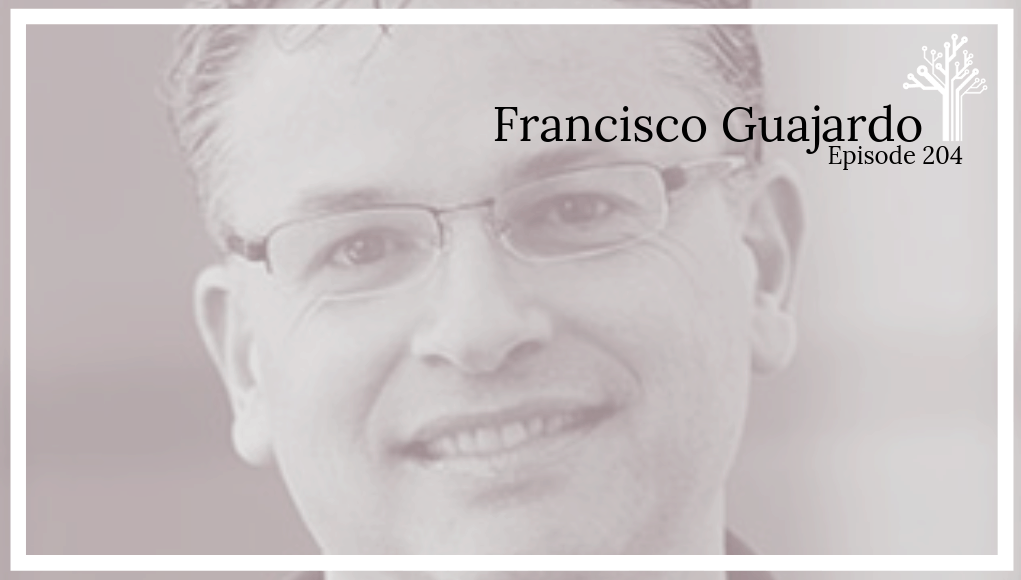
Podcast: Francisco Guajardo on the Language of Place
- Getting Smart Podcast | Experiencing Place-Based Education at Teton Science Schools
- Place-Based Education Anchors Learning in the Community
- All Children Should be Bilingual: The Dual Language Economic Imperative
Stay in-the-know with innovations in learning by signing up for the weekly Smart Update.
Transcript
This transcript has not been edited for spelling accuracy.
We’re listening to the Getting Smart podcast. Where we unpack what is new and innovative in education. We’re your host, Jessica. And Caroline. And today we’re speaking with Dr. Francisco Guajardo.
Francisco is a leading voice in bilingual, biliteracy, and bicultural education. He was born in Mexico and raised in a small Texas border town. As a professor of education at the University of Texas, Rio Grande Valley, Dr. Guajardo introduces young people to history, anthropology, and the culture of place. Like Tom on our team, Francisco is an advisor to the Teton Science Schools.
At a recent meeting in Jackson Hole, Wyoming, they spoke over breakfast. Let’s listen in to learn more. Hi, Francisco Guajardo. Welcome to the Getting Smart podcast. Good morning, Tom.
What a treat to have you here. We’re both together at the Teton Science School on a snowy but sunny Teton morning. Yeah, that’s for sure. When I woke up yesterday, the grounds were filled with snow. We had about six inches of new snow.
Six inches yesterday. I don’t think we have any new snow today, so that’s a different date. So I grew up along the Texas-Mexico border. I was born in northern Mexico in September of 1964. On the last day of the year, 1968, my family came from Mexico to South Texas, to what is
known as the Rio Grande Valley. I grew up in a small town called Elsa, and I grew up in Edcouch, Elsa’s schools in the community of Elsa. So then I graduated from high school, went away to college, and came back home to become a school teacher.
So you go to UT? I went to UT at the age of 18. The fall of 83 is when I landed at the University of Texas. I did an undergraduate degree in English, and then I took a master’s degree in history. And then years later, I came back for a PhD.
But we should be clear. Did you go to UT Austin? I went to the University of Texas at Austin, yes. Because you’re now a professor at UT Rio Grande. I’m a professor now at the University of Texas in Rio Grande Valley, which is a school that
iterated by taking up two smaller schools, the University of Texas at Brownsville and the University of Texas at Pan American, which is where I was a faculty member at UT Pan American. It’s one of the two legacy schools of UT, RGV. But yeah, no.
For many years, UT Austin was the UT. Part of why the expansion of UT schools, obviously, is because higher education is always looking to expand. But there are also lawsuits involved. Losses for where UT and A&M were sued and told by the Texas Supreme Court that they
needed to diversify. So then they spread out into places where minority students were. So A&M took over, prior to A&M, to get their black student rolled up. UT took over UT Pan American University. So it became UT Pan American, more Brown students.
Those kinds of things, political things. But also it’s good for development in regions. What did you do your doctoral studies in? I went back to, I was 35 years old when I went back to UT at Austin. So my degree is actually an ad hoc interdisciplinary degree, a PhD that brings in history.
Because I once upon a time was an ABD in history when I was 25 years old. That brings in anthropology. This is the ad hoc interdisciplinary part of it. So I have anthropology training. So I’m an ethnographer as well.
That brings in curriculum and instruction. And then my home department is educational administration. I was in the schools already and I was already doing a leadership work, administrative work. The high school where I grew up and my alma mater where I came back to work for 12 years. And so my PhD is in educational administration.
That’s the home base. But it’s an ad hoc interdisciplinary PhD. So I can actually teach in a history department in higher ed. I can teach in anthropology. But I taught in the College of Education.
You’re a noted expert in place-based education. I guess I’m curious when you became conscious of the power of place. I think that my awareness is a very formative awareness. And it really is born out of how my mother and my father raised us. I’m one of four boys.
And so they were my parents who were storytellers to be sure. My mother, a storyteller through her own nurturing duties. My mother was extraordinary with that. She always brought people from the neighborhood together. All the kids from the neighborhood.
I grew up in the federal housing projects in Elsa. And so my mother always ensured that all the kids from the projects came to the house. And she organized everybody and then just let us loose. So then we did our own self organizing, which is kind of interesting. The whole idea of self organizing and how people do that in communities.
But my father, my father was really the quintessential storyteller. My father always kept a little notebook. So he kept notebooks over a period of time, years. And so through these notebooks, he always took notes on the job that he had and then the next job.
And that’s what we think. So my father documented his life to the day. I remember when I was an undergrad, UT at Austin, I was a English major. And so I thought that I needed to study English in England. So I got this fellowship to study at this place called Brazenos College in Oxford, part
of the Oxford University system. So I went because I was fascinated with the bar. And I was fascinated also with stuff that happened like in Northern England, like in Howard. So I wanted to see where the Bronte sisters grew up.
I wanted to walk the streets of London like Dickensin characters did. It’s fascinating by all the stuff. So I went to do that. And it was while I was at Brazenos College that I really had my moment of clarity. That moment of clarity was really about the stories of my father and my mother.
It wasn’t about Shakespeare. It wasn’t about Dickens. It wasn’t about Charlotte Bronte. It was about my father and my mother. So when I got back home, I landed at JFK airport and I called home.
I called my father. I said to my father that I’d been reflecting a lot on stories, my mother’s stories. And I reminded him of those little notebooks that he had. And I asked my father if he had written stories of his own life. And he said he hadn’t.
But he had notes. I asked him if he would. And so my father took the next year of his life to write his autobiography. My father had gone up to the fourth grade in rural Mexico. And then I swam across the river.
The river was at its peak before the dams in 1953, 1954. So my father was the typical Mexican man before he was a man. At the age of 17, he was crossing the river, swimming across the river to come work. And then he swam back. Or as he sort of tells the story in a very humorous way, sometimes he and his brother
would flag down the border patrol to get a right from them back to the river. That’s how it was. Wow. Can you imagine? Different day, right?
It’s that there was a symbiotic hand of relationship between Mexicans and the border patrol for a long time. It was a short night. So my father, who at the time, because my father had been a laborer his entire life, but then my father landed his dream job when he was in his 50s.
And his dream job was as a janitor at Ed College Elementary School. And so during that time, my father as a janitor was also a scavenger of sorts. So my father went through every trash can of the classrooms that he cleaned up. And he would always look in the trash can to see what teachers were throwing away that was good.
And so he would collect stuff that he thought was good. And then the next morning he would show it to the principal to see if he could get permission to keep stuff. And so my father asked the principal one day if he could keep these scrolls, these big scrolls.
And so the principal said, yes. The principal would often tell my father, no, you can’t take that, Mr. O’Haraway, but you can take that, whatever. And so my father wrote his autobiography on big scrolls that he took from elementary classrooms at Ed College also.
At Ed College Elementary. And so then my father wrote this thing that is the, I think the most prized family article. And that is his autobiography. And so those stories, I think cemented a certain consciousness with my brothers and with me about this idea of place.
And so for me, coming to place as a vital, very significant way of understanding, I think was, was developed over a period of years. It wasn’t a conference that I went to, somebody said place. It was a conference I went to, somebody said place and I said, oh, okay, it makes sense. All these years, you know, being raised, you know, by this woman and this man makes sense.
Now I have a framework. But it was the same thing with culturally relevant for me. You know, it was because it was this accumulation of years of, you know, reflecting and sort of thinking about things and being in dialogue with my father and my mother and my brothers. So it was a formative thing that then clicked and you know, in certain ways.
You started a center at UT RGB. Maybe you could tell us what you’re trying to do there. When UT RGB was created by the legislature in 2013 to taking these two satellite schools, University of Texas satellites was Brownsville and Pan-American as they described earlier. The Board of Regents laid out a set of principles where the Board of Regents of the University
of Texas said, we want this new university to explore all these different things, including bilingualism, biculturalism, and bi-literacy. Now my work as a professor and as a researcher for years had focused on issues, even as a high school teacher. You know, I started an oral history project with my high school students back in the 90s.
You know, we took inspiration from the Foxfire Project. We took inspiration from different parts of the world where people were really examining their own local stories as a source of understanding who they were, how they were, and to build, you know, power individual, but also community power. So the oral history project I had been doing, we had been toying around with issues of bilingualism,
issues of culture, issues of literacy in K-12. When I came to higher ed, I brought this kind of awareness with me. And so then it all came to a head in 2013 when Regents said, why don’t you explore bilingualism, biculturalism, bi-literacy in higher ed? And so I thought, oh my God, this is extraordinary.
Not only me, I mean, there was a bunch of people I was working with who were floored by this because in our institution, our institution in the 50s and 60s and into the 70s had been using the speech test to remediate Mexican American students. So the university was telling them that they needed to change the way they spoke and the way they used language.
And so for the university then to say, we want you to explore this was really the mark of a new day. And so then, so what I did with some of my colleagues is that we built an institute. We called the B3 Institute to develop bilingualism, biculturalism, and bi-literacy in higher education.
And this university has 28, 29,000 students. So we’re building the bilingual university right now. We’re here at the Teton Science School. Why do you serve on that advisory board? What is it that you appreciate about this place and these people?
So the way that I come to the Teton Science Advisory Committee is through an old friend of mine named Greg Smith. So I first met Greg through email some 20 years ago when he was writing an article, I think for FICAP, and I think it was, or maybe he was writing a book perhaps. Meet us all of those things.
So Greg sent me an email because he had heard of the work we were doing in South Texas out of my high school through a program that I started out of my classroom in the 90s called the Yano Grandes Center for Research and Development. It was a college prep program, but through place-based kinds of pedagogies. So Greg sent an email and we corresponded to he wrote about our work.
And then many years later, Greg would recommend my name to the Teton Science Schools to invite me to be part of this advisory committee. And I think what Greg was thinking is that this Teton Science Schools that really looks very white can use an alternative voice to maybe create a little bit of tension so that people could think differently.
Or maybe think differently through maybe my ideas because they were already thinking about diversity and inclusion. But that’s a difficult proposition, especially if you don’t live that. So that’s why I’m here. And for a little snowshoeing.
I did that yesterday for the first time in my life. Yeah, that was fun. All right, I want to do a lightning round. I want you to describe the pictures that come to mind when we talk about place-connected learning and let’s talk about little kids and then maybe intermediate age and then older
kids. So when you think of primary age kids, what role should place play? What pictures come to mind? Imagination, creativity, name, fun, play, backyard, just a fulfilling life. Yeah, but really connected to place.
Lots of discovery-based learning. Yeah, yeah, I mean, fun comes from where you are. And sometimes where you are is really your imagination. But your imagination is going to be sparked based on your experiences, based on things that you have access to somehow.
All right, let’s think about fourth or fifth grade. So 10-year-old kids, what pictures come to mind in place-connected learning? Yeah, kinesthetic stuff, backyard, play, imagination. I don’t know that it’s much different, except that I think that there’s something going on with kids at that age where I think they’re playing with language in much more complex
and sophisticated ways. I mean, kids, when they’re four or five, they’re playing with language as well, but now they’re putting together ideas and a lot of those ideas are really pouring out of what they’re doing in their backyard and they’re playing and they’re having fun because they’re like integrated with their place.
I think that it unleashes a different kind of imagination for kids at that age. All right, high school kids, how should high school kids be interacting with their community? Yeah, I mean, when high school kids are listening to stories of elders, when high school kids are forming their own stories, when high school kids are coming of age, now having gone through puberty and that sort of thing, they’re developing a certain consciousness, they’re developing
a set of values. What do they stand for? What do they believe in? They see when they’re forming those kinds of ideas and if they’re examining place, those ideas can be based on who they are and where they’re from.
Oftentimes, if they do that, then they have this respect for their place. They’re also imagining themselves in the world in very concrete ways. I think that’s very exciting. They’re finding their voice as intellectuals, as citizens. The place has so much to do with how they find their voice, how their voice will look,
how it will sound. Where can people learn more about your work and any other resources on place-based learning that you appreciate? Well, I appreciate this place where we are now, the Teton Science School. TetonScience.org.
Yeah, I mean, TetonScience.org, I think is a leading place in this country and probably in the world. The team here is thoughtful. They’ve got it together. This is what they do.
They not only think about place-based pedagogy, but they practice it and they build an institution. There are many lessons to be learned from this place. They bring the world here. They go out also, different places across the country. I think this is a model.
There are some models that haven’t worked around place-based, but this is a model that has worked well now for 52 years. I think that their next phase is really to evangelize based on the work that they do. Where can they find you online? They can find me through the website, the University of Texas Rio Grande Valley website,
B3 Institute. And then of course, if anybody wants to send me an email, I’m not hard to find. Francis without Guajardo, UTRGB.edu. Great. That’s what it is.
Thanks for being on the podcast. Sure. Thank you. A big thank you to Dr. Guajardo for joining us on the podcast today. For more on place-based education, see Giving the Gift of Place, episode 168, which was
also recorded at Teton Science School. I love that episode. You really get a feel for place through it. And if you want to keep learning about place-based education, be sure to check out our place-based education series on GettingSmart.com.
As always, we have all of that linked in the show notes and on the blog for today’s podcast. Stay tuned as we also have a new book on the power of place coming out with ASCD in early 2020. All right, listeners, that’s it for today’s episode. And as always, thanks for tuning in for the Getting Smart podcast.
This is Jessica. And Caroline. Signing off.


0 Comments
Leave a Comment
Your email address will not be published. All fields are required.