

Podcast: Diane Tavenner on What Kids Need for a Fulfilled Life
 Chapter eight encourages curiosity-driven learning and learning how to learn. Chapter nine covers a set of universal skills (reading, writing, problem-solving) that Tavenner says are “the foundation of what kids are learning through projects.”
An epilog lays out a blueprint for parents–a playbook for Browne’s new initiative focused on helping parents nationwide navigate the complexities and challenges of raising happy and successful kids. The book includes these dozen tips for parents:
Chapter eight encourages curiosity-driven learning and learning how to learn. Chapter nine covers a set of universal skills (reading, writing, problem-solving) that Tavenner says are “the foundation of what kids are learning through projects.”
An epilog lays out a blueprint for parents–a playbook for Browne’s new initiative focused on helping parents nationwide navigate the complexities and challenges of raising happy and successful kids. The book includes these dozen tips for parents:
- Seek out opportunities to engage your child’s opinion and participation
- Make the self-directed cycle part of your everyday life
- Teach the five power behaviors of a self-directed learner (strategy-shifting, challenge seeking, persistence, responding to setbacks, seeking help appropriately)
- Remember skill development is lumpy
- Catch yourself when you feel the need to be needed by your child
- Teach collaboration by asking questions
- Mentor, don’t direct
- Focus on the ‘ings’ (what do you like doing?)
- Ask why–then ask why again
- Engage in knowledge acquisition together
- Reframe the college search (vision for life, purposeful, realistic, informed choice)
- Teach the principles of consensus
Key Takeaways: [1:22] Diane gives a quick origin story of Summit Public Schools. [2:15] Diane describes the Summit learning model. [4:55] Diane shares about the incredibly unique opportunity Summit offers for students: two-week expeditions four times a year! [7:00] Mira joins the podcast and talks about why and when she first joined Summit. [8:30] What’s Mira’s favorite thing to show people at Summit when they first come to visit? [9:50] Why did Diane write her book, Prepared: What Kids Need for a Fulfilled Life? [12:06] Tom outlines the three sections of Diane’s book as well as the first two chapters. Diane explains what the second chapter titled, ‘Because it’s a solvable problem,’ means to her. [14:57] Diane explains why she thinks the third chapter of her book, on real-world and project-based learning, is important. [16:42] Tom highlights more of what is covered in Chapter three of Diane’s book, and Diane speaks about why projects can be easy to take on but hard to do well. [18:17] Tom and Diane speak about Summit’s incredible teacher-to-teacher collaboration, why it is so successful, and how it makes a difference at Summit. [19:21] Why is Chapter four’s topic on self-direction important in education? [20:52] Diane speaks about chapter five’s topic on reflection and the role mentors play at Summit. [22:04] Chapter six is on collaboration — what does collaboration look like at Summit? [23:20] Chapter seven is on success habits — why are they important? And how do they help develop them at Summit? [26:26] Chapter eight is on curiosity — how do they provoke curiosity with their learning model at Summit? [28:22] In chapter nine, Diane talks about a set of universal skills and identifies a set of cognitive skills that are key in learning. How do teachers assess each of these cognitive skills? [30:42] In Prepared, the epilogue provides a blueprint for parents. How has this become so important for Mira and what is her new journey going to be about? [32:57] What will the Prepared Parents initiative look like at Summit? [34:55] Mira speaks about the self-directed cycle in the epilogue of the book and how a parent can make that a part of their child’s day.
Mentioned in This Episode: Summit Public Schools Prepared: What Kids Need for a Fulfilled Life, by Diane Tavenner Mira Browne (LinkedIn) Diane Tavenner (LinkedIn) Turnaround for Children Dr. Pamela Cantor Getting Smart Podcast Ep. 217 with Dr. Pamela Cantor PreparedforSuccess.org (The Prepared Parents initiative)
For more on Summit Public Schools, see:- 10 Innovative Features of Summit Public Schools
- Summit Public Schools Continue to Innovate and Expand Impact
- World Class PD at Summit Public Schools
Stay in-the-know with innovations in learning by signing up for the weekly Smart Update.
Transcript
This transcript has not been edited for spelling accuracy.
We’re listening to the Getting Smart podcast where we unpack what is new and innovative in education. I’m your host Jessica and today we’re talking with Diane Tavener and Mayra Brown. With the backing of a group of parents, Diane Tavener formed Summit Public Schools in 2003. Now a network of secondary schools in the Bay Area and Washington State, the 13 cohorts
of Summit graduates have all graduated college ready. As a mother, teacher and network builder, Tavener has learned a lot about getting kids ready for college, for work and for life. Tom recently had a chance to sit down and talk with Diane about her new book, Prepared What Kids Need for a Fulfilled Life.
Since 2011, Mayra Brown has served as the Chief External Officer at Summit. With the launch of the book, she’s stepping into a new role leading an initiative called Prepared Parents to share what they’ve learned about youth development and powerful parenting. Mayra will join Diane for this conversation to explain more about planned outreach and the book.
Let’s listen in. Diane Tavener, welcome to the Getting Smart podcast. Thanks Tom, it’s great to be here. It is great. It’s been too long since I’ve been at Summit Public Schools.
Give us a quick origin story of Summit. Great. Summit was founded in 2003. We started with one school. We’re 15 today across two states, California and Washington.
And we were started by a group of parents, actually. Group of parents who really had looked around at all their options in education and felt like every school had something they wanted, but no school had everything they wanted. And so they came together to start a school with a vision that they could really prepare every child for the world we were living in and that was emerging and to be able to live
a good life, a fulfilled life. So that is, it was a community effort to bring Summit to life and continues to be to this day. I think you just graduated your 13th class. Is that right?
I believe that is correct. Yes. Just about every kid at every summit school graduates and goes on to college. That is true. You’ve had a remarkable success rate.
How would you describe the Summit learning model? Summit learning is really rooted in ensuring that all of our kids leave us equipped with the skills, knowledge and habits they need to live fulfilled lives, to be able to secure meaningful work that enables them to be financially secure so that they can have good relationships and community and health.
And so the model is really rooted in real world authentic learning. So we have a project based experience that is very hands on and immersive focused on big universal skills like solving problems and thinking critically, communicating effectively. And a big tenant of that is the development of what we call the habits of success. And so these are these oftentimes people will call them the softer skills, but the ones
that really matter. The ability to self direct and drive your own learning and future. The ability to be curious and to really follow that curiosity in your learning and engagement and developing a sense of purpose and who you are and what you care about and what matters to you.
So when when I visit Summit schools, I guess the things that I notice, I’ll see groups of students that look like they’re doing self directed work. I’ll see some sessions that look like blended learning labs. And then I’ll see some teachers working with small groups. Is that a pretty good summary?
You will see all of that and more. You’ll also see teachers and students engaged in one to one mentoring conversations. You’ll see students working with each other, supporting each other. And so yeah, I think that that is a good summary of the way that it looks at Summit. One of my favorite features is that a couple of times a year, you students have a, is it
a two week expedition? It is four times a year. Eight weeks over the course of a year. Students will spend two full immersive weeks in what we call expeditions. And there are, you know, 50 plus options and opportunities for kids to really be exposed
to and then ultimately explore. And if they find something that they’re really interested in, pursue it. Everything from, you know, on one end of the spectrum coding to the other end, psychology, social media, creative writing, outward bound type of experiences, all sorts of assortments of things.
And what we’re really doing in this time is helping kids to figure out what it is that they really are interested in and care about and want to pursue. What brings them joy and happiness? Where they really sparked? And those eight weeks are not only extraordinary choice learning options for young people.
They provide an incredible amount of professional learning opportunities for teachers as well. Right? This is correct because while that is happening, our teachers are engaged in professional development. And so some of the teachers are spending five to six weeks a year. Actually, I’m sorry.
More than that, there’s maybe about 10 weeks a year engaged in collaborating with their peers and developing professionally, really deeply engaging in their curriculum development and their practice so that they can really facilitate these incredible real world experiences. What brings me to Mira Brown is Mira with you. Hi, Mira.
Hi, Mira. So I’m a big fan of Summit and I’ve been bringing people to Summit for a long time and that usually means that I give you a call. And you helped me organize a tour. So, Mira, when did you join Summit and why?
I joined Summit in 2011, so eight years ago, though I knew of Summit before that and interacted with the team. And I joined because I fell in love with the model. I fell in love with the focus on helping kids figure out who they are and what they care about and then how to actually go after that and achieve it.
I was just awed that every single student had a mentor, that there was a teacher who cared so deeply about their kids and checked in with them and supported them and was a connection to their family. And I fell in love with the people at Summit, quite frankly. Such amazing, talented teachers and educators who every single day are focused on what is
best for kids and who are just a joy to be with and work with. And so it was all of those things together that made me come to Summit and quite frankly, what’s kept me here over the years. You have so many people that come to visit you. What’s your favorite thing to show people at Summit?
That is a great question. I love to show people our kids. I think that there is nothing more powerful and over the years I’ve seen nothing more powerful than when adults get to talk to middle schoolers and teenagers and are just awed by how much these kids know about themselves and how aware they are of what they’re doing
in the classroom and what they’re learning and why they’re learning it and what they’re doing next. And they’re using words like, I’m setting goals and I’m working on my narrative and I need to grow in a particular area of the argumentative claim I’m making and it’s real and it’s authentic to those kids.
And so I think that that is the most powerful part of getting into a Summit school is just being with the kids and hearing straight from them what they’re doing. I appreciate that, Mary. You’ve put together student panels for me in the past, but you can just pick any three kids at any Summit school and they demonstrate all those characteristics.
We’re going to come back and talk about your new work with parents, which is super exciting. But I want to go back to Diane and talk about this new book that just came out. The book is called Prepared What Kids Need for a Fulfilled Life. Diane, congratulations on the new book. Thank you.
I appreciate it. It’s out now by currency. It’s an imprint of Penguin Random House. We were laughing before we went live about the challenges of writing a book. Why on earth did you take this on?
It’s a really good question. I always used to joke for many years after I opened the first school Summit, people would ask me, are you going to open a second school? And I said, are you crazy? That’s the hardest thing I’ve ever done.
I’m never doing that again. I think I might feel that way about a book as well. It’s a labor of love for certain. But I’m a mom and an educator. And what I’ve discovered over the years, 20 plus, is that in both of those roles,
I’m driving for the same thing. I want to get kids ready for successful life. And what I’ve noticed is that parents and teachers and educators want the same thing, but they’re not always talking to each other and they’re not always working together and collaboratively on that front.
And so I really wrote the book to bridge that a bit and bring folks together so that we can work on behalf of all of our kids and help get them ready for the world they’re facing and the lives we hope they can live. Yeah, Diane, I appreciated that approach to the book. I found it surprising and refreshing that you wrote both about from the standpoint
of being a mother and an educator and that the stories are great and touching. And so I appreciate that angle. The book is in three sections. Why prepare, how to prepare and what does it really mean to be prepared in that the first two chapters, that’s a pretty personal part of the book where you talk
about your role as a mom and as a teacher and then sort of winning the opportunity to open some at public schools. A lot of great stories in those first two chapters. The second chapter is titled because it’s a solvable problem. I thought that was such a cool title.
What does that really mean to you? It means that it is possible. I think a lot of times I just am running into people who feel a little bit hopeless and they think, gosh, our schools aren’t doing what they need to be doing or I’m a parent and I’m exhausted and I’m tired and I don’t know how to navigate this and it
feels overwhelming and we can’t actually get kids ready for life in a meaningful way. And just this morning I’m reading three more articles about the deteriorating mental health of our college age kids. And it’s a solvable problem. This is something we can actually do collectively together and we know how.
We have the science, we have the experience, we have good models. And so it’s a matter of us coming together and collaborating and a little bit of will, I think, in order to really focus on our kids the way we should be. Yeah, I appreciated that in that second chapter you introduced your personalized learning plan, which is really kind of a core technology.
It’s really simple, but it’s really core to the summit model that every kid needs a plan and every kid deserves a mentor that walks alongside them and helps them develop and work the plan. Indeed. And that has been the center of our work at Summit from the very beginning.
And I think you know that I was a mentor to our, in our first class, our first graduating class and everyone here at Summit is a mentor to students and works in partnership with our families. And we really are a community that comes together around kids. And you know, that’s what it takes.
And it’s also the really fulfilling part of doing the work when it becomes personal and when it becomes about the people. And quite frankly, when it’s human, that’s when it’s joyful and successful. So the second part of the book is on how to prepare the third chapter is on real world and project based learning.
Why? Why do you think that’s important? It really is the way to learn that is most effective when you’re engaged in solving real problems. There’s so many entry points to learning.
It brings the learning together in a really meaningful, real way. And quite frankly, it’s the way you develop the skills that today our world is demanding, employers are demanding and that are going to be the most useful as we go forward. It’s not super helpful to be developing very discrete skills any longer at the incredible direction of someone who’s telling you exactly what to do.
You know, what work today demands are people who can think and who can solve problems and can really work independently and thoughtfully and collaborate with others. And that’s what this type of learning teaches and requires. Yeah, I appreciated that you said projects aren’t dessert. They are the main course.
On a main course, you know, we’re all familiar, I think, with you know, the Science Board sort of project that gets assigned at the very end and the kids are doing at 11 o’clock at night and parents are pulling out glue sticks and scissors trying to help. And that wasn’t the way things were learned at school in that moment. That is just sort of the dessert at the end that isn’t really the learning.
And at some point, the project is the learning. It’s what’s happening every day. So I do appreciate that in Chapter 3, you dive into projects and you acknowledge all the different ways that projects can be easy to take on, but hard to do well. And you dive into some of the ways that you try to really provoke deeper learning
and high quality learning at Summit through projects. You also dealt with some of the obstacles of textbooks and accountability systems that we still work under and nostalgia that parents and teachers may have for a different version of school. This is true. So projects are important, but challenging to do well, right?
They are. And it really does require, I believe, a commitment by a school, by a network, by a community. To this type of learning, again, why it has to be the main course and not the dessert. I think that so often we blame teachers. And in this particular case, you know, real quality project learning,
an individual teacher cannot do this by themselves. They need to be in a community that is working to gather towards it, building skills collaboratively and collectively over many years and working together to really curate the resources and the high quality projects. Diane, last week I was with another school district and I was describing the teacher to teacher collaborations at Summit.
I think you really do have the best example of teachers that collaborate in a local team and collaborate vertically and then collaborate horizontally with job elikes across your network and have both the time and the resources and the structures to do that frequently year round. And that really does make a difference at Summit. I couldn’t agree with you more and, you know, those commitments to that preserving that time and keeping it sacred.
And quite frankly, finding the technology that supports teachers in Washington and California meeting together weekly is really critical to that and completely worth it. So I love chapter four on self-direction. Why is that a priority? You know, it’s what we know about people is that they want to, they have goals and they want to be in charge of their lives
and they want to have meaning and purpose and understand the why behind what they’re doing. And I think we really underestimate our youth, quite frankly. I think we don’t think of them as capable as they are and I think we don’t take the time to really explore what they’re curious about and what they’re interested in. And when we unlock that and believe in them and then, oh, by the way, develop the skills that they need in order to do that effectively.
What’s possible is limitless for them. And that serves you well in the future. You know, as I think about sending my son off to college next year, I’m not actually, I’m not worried that he’s not going to be able to take care of himself because he has been building the skills of directing his own life and his own learning for a very long time. Because as you know, he’s a summit student and he’s going to be able to handle that as we go forward, as he goes forward in his life.
Chapter five is on reflection and particularly the role that mentors at Summit play. Other people might call them advisors, but mentors at Summit really do a nice job of asking probing questions that encourage Summit learners to reflect on their learning. It’s so often the overlooked element of learning, that process that we go through where we actually mentally step back and we think about our own thinking quite frankly and we think about what has happened and what we want to have happen next time and what we might be able to do better or differently and to have someone who is there and dedicated to, like you said, asking those questions and providing some degree of accountability through a strong relationship and who can be trusted when failures happen and we need to be able to deal with that and move on.
That is really, I think, what so often gets overlooked as such a key ingredient to learning. Chapter six is on collaboration. What does that look like at Summit? It looks like it’s pretty constant here. We are, as you described earlier, you’ll constantly see people working together and again, this is just what our world demands today. Very little work is actually siloed an individual without engagement with other people. The reality is that our world that we are facing, the problems we’re facing, the challenges we have require groups of people to come together with different knowledge and experience and expertise.
You get better answers that way. Most of what we’re trying to do today is interdisciplinary in nature. Collaboration is people coming together around authentic problems because it doesn’t work if one person can do it. If you take an old school worksheet, a group doesn’t work because one person can do it better than four. If you take a problem where a bunch of people have different points of view and knowledge and whatnot and they bring that to that problem, you will establish a better solution with that collaborative effort.
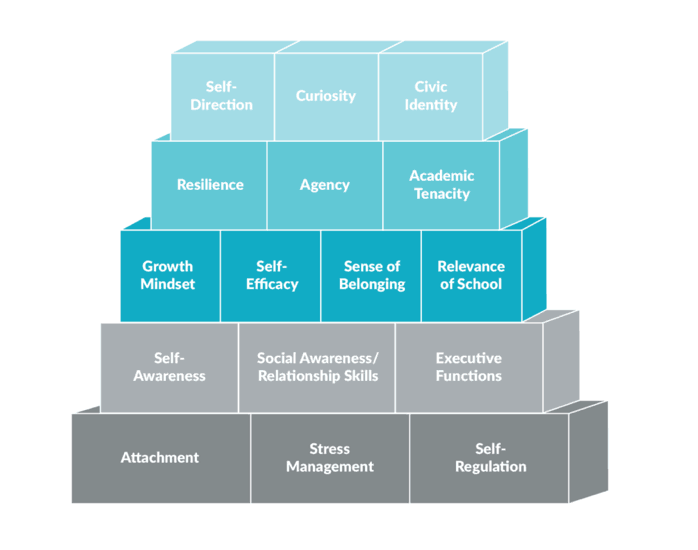
That’s really what it looks like for us. The last section of the book is on what is prepared and it’s really a deep dive into the Summit model in your outcome framework. Chapter 7 is on the success habits that you described before. You use the building blocks that Brooke Stafford-Rizard developed at Turnaround. She’s now a partner of yours at CZI.
It really is a beautiful, thoughtful framework that has the foundational elements and it culminates in self-direction, curiosity, and purpose. What else would you add about the success habits and why they’re important and how you develop them at Summit? I think that so many people have done such incredible work and I think a lot of people don’t realize how much science that we have about learning and how much we know about learning and the skills that people need to develop. We love the building blocks in the framework because it is really, for us as practitioners, simplified and allowed us to see a developmental progression that we can support kids through. I think the biggest aha for us has been that these are all skills that can be developed.
So often I talk to parents who say to me, you know, well, your school sounds great, but my child really needs structure. They would never be able to thrive in an environment without structure. And I have to sort of hold myself back from saying, well, when are they going to learn how to do that? Because what happens when they leave you? And those are teachable skills.
It’s not like anyone is born with them or not. And so that is really the focus of the habits is and we call them habits for a reason. It really requires day to day, day in and day out practice. You know, just like you learn to brush your teeth every day, you build these habits by doing them day over day over day. And that’s what the whole environment is oriented around.
And, you know, year after year after year, kids develop these habits. Two weeks ago, we had Dr. Pamela Cantor from turnaround on and she also talked about these building blocks. She talked specifically about the effects of trauma and dealing with chronic stress produced by trauma. And she talked about the antidote is relationship. So it goes back to the reflection and mentorship that is such an important part of your model.
Indeed. Indeed. So the next chapter is on curiosity. It was fun to read about the different iterations of the summit model as you looked for the right. The right learning experiences to provoke curiosity.
Maybe you could talk about how you try to do that. Certainly, you know, one of the things we discovered in building the model is sometimes folks, certainly we weren’t the first person people to come across authentic real world learning. And sometimes what happens when people go in that direction is they kind of stop focusing on helping kids develop knowledge. And the reality is it’s really hard to analyze something if you don’t know anything and it’s really hard to solve problems if you don’t have information. And so what we really are seeking is a way that kids build knowledge that’s still valuable even today, but through curiosity and interest.
And so entering into that knowledge building space through really legitimate and honest curiosity being piqued. And that comes with that real world learning that often connects back and drives kids to want to learn things. And it also comes with a lot of choice. And so this is where kids learn how they learn. And they’re given lots of different choices and opportunities to figure out how they learn individually and best.
And it’s really fun to over, you know, a series of months and then years to talk with kids at summit and really have them tell you their strategies and what they’ve learned about themselves as learners. And they’re all different and yet effective for them. So in chapter nine, you talk about a set of universal skills. You identified a set of cognitive skills that are really key. They’re foundational, they’re translational that includes reading with understanding and writing, presenting.
You have a set of rubrics for each of those. Maybe you could describe how teachers assess each of those cognitive skills. The cognitive skills are really the foundation what kids are learning and developing and practicing through their projects. And the power is that they’re doing that year in and year out and across different disciplines. So they’re learning that communication in science and history and math and English is communicated.
It’s the same skill and it’s done in different contexts, but it is the same skill and it’s being reinforced across. And our teachers are then really working together to understand what is effective communication across all of those disciplines. What does it look like? What does it sound like? And how do you actually build that skill when students aren’t proficient? Because your kids will, they’re going through expeditions four times a year.
Might those same rubrics be used even in an expedition? Indeed, yes. They are used in expeditions as well. So it’s such a cool schedule. It really is one that provokes curiosity. It gives kids different settings and different bodies of content to practice the habits. But then you have these common rubrics where the same things are important regardless of what your project is on.
It’s still important to produce a quality product to present it with articulation. So it’s great to see those used across all the different learning experiences. All right. Let’s pivot to parents. You guys close with a really great epilogue that’s a blueprint for parents. And now I’d love to know how this has become so important for Mira and what her new journey is going to be about.
So Mira, what’s next for you? So we are bringing the book to life for parents, and that is the goal of what we are calling prepared parents. And so I think one thing that we have found over the years of running summit schools and engaging with parents all over the country, quite frankly, is that these are conversations that parents are having with each other. They’re having them as friends.
They are worried and they aren’t clear what the roadmap to preparing their kids for the future is. There are all these feelings that come with that of not wanting to grow their kids into fulfilled adults who know what they want again and know how to go after it and are secure and independent and curious, but the roadmap for getting there doesn’t feel clear. And I have started to feel that myself and becoming a parent. I’m a parent of two, mom of two young boys.
My oldest is entered into kindergarten and the journey is just starting and all of those same questions are the questions that my friends and I are asking. And so prepared parents is the opportunity to provide guidance to bring to life these concepts of how do you nurture your kids into independent, confident adults? And what does that look like at home? Because I think too often we have separated what happens at school from what’s happening at home and the decisions that parents are making at home. And they’re not different.
They’re quite similar and it’s the same conversation. And so that’s our hope with prepared parents. So what will you do at the new nonprofit? What’s the activity set going to be? And so prepared parents is a project of summit.
And so parents can go to prepared4success.org and sign up to join the community. At the end of the day, we really want this to be a community for parents. And so by signing up, they will start to receive routines and activities and tips of things that they can be doing at home to build the exact same skills that you have been talking to Diane about. So how do you start reflecting with your child? What does that look like?
How can you use the five minutes you may have at night with your son or your daughter or your children to start to help them think about what happened that day or what happened that week? And how did they respond? And what were the obstacles? And what could they be doing differently in the future? Or it might be starting to think about how to spend the few minutes you have in the car to help them be intentional about the day and think about what’s coming up.
How do they start to set goals? Even as small kids all the way through to high school. Or when you see that spark of excitement or wonder in your child, how to help them unpack that and figure out where that spark or excitement is coming from. And is that actually an interest or a passion? Or we call it the ings.
What is it? Is it a fact that they’re doing an activity that really excites them? They want to explore that more deeply. You can start connecting that to things you’re doing as a family on weekends or during the summer or whatever it might be. There are things that we do every single day for our kids.
We are willing as parents to do whatever it takes. And our hope is just to be able to give parents some additional resources and tools to do that, to build these skills at home and give them the confidence and the decisions and the things that they’re doing every day for their kids. Mira, I’d love the epilogue of the book. It has a dozen really great tips in it. Focus on the ings, meaning ask questions like what do you like to do instead of what would you like to be?
Exactly. Right? Exactly. And other activities just like that. Yeah, asking why and then asking why again.
And again. And again. You could talk about the self-directed cycle and how might you make that part of a child’s day? I mean, when you think about it, the different steps, right, are set a goal, make a plan, do it, enact it, and reflect on it. And so that is really no different than what you do with your kids.
You can ingrain that into when you get up in the morning and you’re thinking about, again, you’re trying to be intentional with your child about what’s happening at school that day or what you hope is a family to achieve that day. And you make a plan with your children and with your child and you model that and you show them that. And then again, you ask how it went and you unpack it, you help your children unpack what happened again that day or that week or in that activity or what didn’t go well. And then you set a new goal and you start all over again. And so, you know, these are all things that we’re using in the Summit Model.
These are all activities and things as Diane was saying, that’s based on the best research and the best psychology and the learning science that’s out there. But they aren’t regulated to just school. We can do these things as parents at home. We are always looking for different things that we can be doing with our kids to help really build those skills again. And so, you know, those are the blueprints in the epilogue are things are just the start.
We hope that parents will go to prepared4success.org and we will keep providing them. It’s a terrific epilogue and it makes me think that that site’s going to be a great resource for a growing group of parents. So, loved that super practical end to the book. We’re excited to see the work that you lead, Mira. Thank you.
Diane, just congratulations on the book and thanks so much for your amazing contribution to the sector. This book gives us a great resource to learn more about the work that you’ve been doing over the last 15 years. And we’re excited to be able to share it with people. Thank you, Tom. We really appreciate it and we’ll look forward to continuing to make those contributions.
All right. I’m going to visit soon. Thanks for being on. Thanks to Diane and Mira for joining us for the episode today. For more on the building blocks of success, be sure to listen into episode 217 with Dr. Pamela Cantor.
We’ve got it linked in the show notes and on the blog. And lastly, don’t forget to leave us a rating so more of your friends and other innovators can find us. That’s it for today, listeners. Thanks for tuning into the podcast. This is Jessica signing off.
Thank you. Thank you.


0 Comments
Leave a Comment
Your email address will not be published. All fields are required.