

Mike Ruyle and Dr. Jason Cummins on The School Wellness Wheel
Key Points
-
There is no more human endeavor than education.
-
Relationship is the antidote to trauma
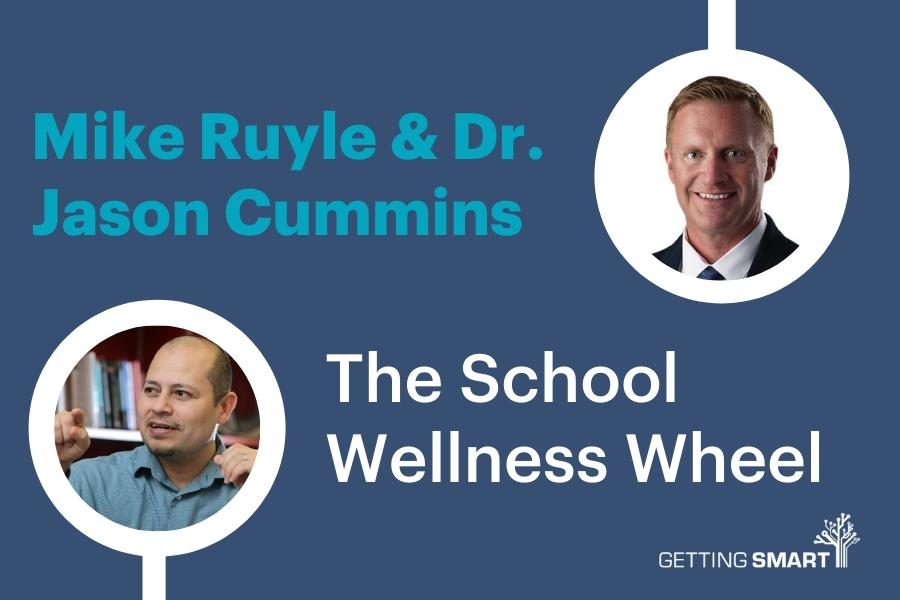
On this episode of the Getting Smart Podcast, Rebecca Midles is joined by Mike Ruyle, a former educator, a recognized voice in trauma-informed care and the recent author of the book The School Wellness Wheel: A Framework Addressing Trauma, Culture and Mastery to Raise Student Achievement.
We are also joined by co-author Dr. Jason Cummins, who is a Crow tribal member and principal from the Crow reservation in Montana. He was also recently the Montana Indian Educator of the Year and is the host of the podcast Trail-Cast.
Let’s listen in as they discuss trauma, the medicine wheel, personalized learning and much more.
If we want kids to be excited about learning then we need to be excited about learning.
Mike Ruyle
Right now is the perfect time. A lot of schools have been forced to be flexible and are now realizing the importance of our children and our schools. The importance of the humanity in education. Move into this more holistic and realistic vision of education.
Dr. Jason Cummins
Links:
- The School Wellness Wheel: A Framework Addressing Trauma, Culture and Mastery to Raise Student Achievement.
- Mike Ruyle
- Trail-Cast
- Crow Agency School
- Leading the Evolution
- Dr. Sarah Laser
- Dr. Benjamin Bloom
- Rachel Yehuda
- Zaretta Hammond
- Pamela Cantor
- Nadine Burk Harris
Transcript
This transcript has not been edited for spelling accuracy.
Hey listeners, before we jump in today, we wanted to thank you for choosing to spend your time with us on the Getting Smart podcast. If you’re interested in more conversations and thoughts on the future of learning, be sure to check out GettingSmart.com, our regularly updated blog that highlights the most innovative schools, leaders, and practices in education.
We post every weekday and hope that you find the stories and voices inspirational. Alright, let’s get into the episode. You’re listening to the Getting Smart podcast. I’m Rebecca Middles, and today I’m joined by Mike Rohl, a former educator, a recognized voice in trauma-informed care, and the recent author of the book, The School Wellness Wheel,
a framework addressing trauma, culture, and mastery to raise student achievement. Mike is also a longtime friend in the work of personalized learning, so I’m happy to have him be on the podcast today. He’s also joined by co-author Dr. Jason Cummins, who is a Crow tribal member and a principal from the Crow Reservation in Montana.
He was also recently the Montana Indian educator of the year. Mike and Jason, thanks so much for joining us today. It is a pleasure to have you on, and for you to share more about this recent book. Well, thanks for having us. Like I said, I’m so happy to be in a conversation with two of my favorite people and the people
who inspired this book. So thanks for having us. Wonderful. Can you please share a little bit about the title? I think you and I were talking a little bit before the podcast about your intentional
choices with the School Wellness Wheel. Yeah, absolutely. To me, one of the things that’s really critical in education is we continue to move forward and evolve as we’ve got to humanize education. And really remember why we’re doing this work.
A lot of schools, the focus has been on content, and we really need to be able to recognize and understand the people that we’re dealing with. So I was very purposeful in using this term, the wellness wheel. And Jason can kind of speak a little more to that. He and I really started to put the title together collaboratively.
So you can talk about where it came from, Jason. I think the inspiration for it, well, the inspiration for this is the medicine wheel. And culturally, the medicine wheel is known to be a place one can go. For guidance, direction, healing, insight, and empowerment. And in the same way, schools should do that.
School should be a place that our children can go for those things. And that’s a lot of the inspiration behind this. And with that, I’ll say that I did, I’m very familiar with indigenous research methodologies and conduct my research that way. So we made sure that we were responsible and we weren’t culturally misappropriating anything.
But we do acknowledge that was the inspiration for this. What a powerful lesson that schools should bring healing and help, insight, a relevant education. And I think with what Mike did, and was addressing the trauma and the culture piece, because a lot of times schools, we don’t do that.
And for a lot of BIPOC communities, schools can continue to traumatize those communities if they’re not sensitive. Yeah. And one of the things too, like Jason said, we need to really focus on healing for the kids, but we really focus on healing and resilience with the adults and the teachers as well.
Because it’s got to start with them before it actually can get down to the kids. So there is nothing more human. There is no more human endeavor than education. So that’s what I think we really try to bring out in this book. And it’s getting lots of buzz in the field, and so we’re really, really proud of it.
And the model allows the teachers to do what’s more natural and more intuitive to them, more authentic because realizing that their students are humans also with dreams, desires, aspirations, and their experience matters, their view matters, and taking that into account and helping them achieve rather. And it gives a model other than what you call it the factory-based model, treating kids
as widgets. You know, you’re going to enter in this step, and all of a sudden you’re graduated, supposed to be educated. And what about all those kids who didn’t make it that far and far through the cracks? So this gives an alternative model, and this is the way education needs to move.
Wonderful. You’ve already kind of broached this. So let’s go into the model. Let’s talk about the wellness wheel. You have three areas that you highlight in your book, mastery-based learning, trauma,
responsive schooling, and culturally responsive teaching. Can you share more about those at a big overview level? Yeah, kind of the big overview is this. The idea of mastery-based learning, I think, is really important. There are lots of buzzwords in our field today.
We talk about standards-based grading or standards-referenced grading or performance-based or competency-based. And there are subtle differences between all of those, but I think a lot of times we get caught up in the weeds. And really what mastery-based learning is, I used that terminology in deference to Dr. Benjamin Bloom a number of years ago.
But really mastery-based learning is just the idea that can we really help, can we identify what are critical skills and knowledge that our kids need to have, and how do we help them learn that as opposed to just, well, here’s standards and curriculum that we have to plow through. And so it really is focused on the kids.
What do we want them to know and be able to do, and how do we help them learn it? So that’s mastery-based learning, kind of the overarching view. The trauma-responsive piece of this, the trauma-responsive schooling, is really kind of SEL, social-emotional learning on steroids. Because one of the things I’ve been able to learn and really, during my evolution as an
educator, is we really understand now that trauma and toxic stress is real. And it’s only exacerbated by COVID. And we know the research is really clear that trauma and toxic stress can damage the brains and bodies of people. And so that’s one of the things we have to address right off the bat.
There are things that we can do that are responsive. It’s not just something to be layered on. A lot of schools, they just layer on some social-emotional. We have all these standards, and we’re also going to be social and emotional, do some social-emotional learning.
But really this is fundamental to learning, the trauma-responsive stuff. And the culturally-responsive piece that Jason’s really an expert in as well is people come from their own backgrounds. They have their prior knowledge, their own individual cultures. And so culturally-responsive teaching, I think, is just in a big view, is just how do you
really recognize people for who they are, where they come from, and use that prior knowledge that comes from their homes and their communities and really who they are? Why would we not tap into that? And I think if you bring all of those things together, you get higher levels of learning and wellness and literacy.
The same way with the, I like how you said that, Mike, not just to layer it on. And a lot of times what’s needed for our kids, the SEL and the to-be trauma-informed or culturally-responsive, is just kind of added on. And it doesn’t change the way we do things. We might have maybe one day of Native American cultural month, or not even a whole month,
just a day, and then supposedly we’re a multicultural school now. But the interesting thing is every single teacher in the classroom is very proficient at culturally-responsive teaching. The challenge is it’s usually not a BIPOC culture, that they’re teaching from their own culture or the dominant American culture.
Because we’re so used to the culture in our schools, we think it’s neutral, or we think our school doesn’t have culture without realizing there is culture in schools. And we need to acknowledge the culture that our schools are situated in. And also what I like about the trauma work in this book is that it’s not surface level. I went to a trauma workshop this week.
It was terrific. But what was missing was it was shallow. It didn’t go below the surface. You know, historical trauma was not mentioned. For a lot of our BIPOC communities, the roots of our issues now, you know, a lot of times
educators, we don’t want to talk about them. But we need to talk about them to empower our kids without bling-blam to anybody, without just acknowledging here’s why we’re at right now. And for communities like mine, you know, we need this. And that’s why we see a lot of the school improvement efforts haven’t worked, I’ll say.
Whether it’s schools of promise or the turnaround leadership model applied to schools in the no child left behind era, they didn’t really work because they only addressed the fruits of the issue and not the roots. So they’ll address content standards, research based teaching, the best practice is all that good stuff, you know, and that’s good stuff and it’s needed.
But they never addressed the culture of the student or maybe some of the trauma the students facing. And so this addresses all and we need those to get, you know, mastery learning. Yes. I love that you highlight the layers, both of you and your conversations.
Jason, you when you were sharing that, I was thinking about how often I know you know each other, both from Montana. But I was thinking also how often in my experience in Alaska, I would hear folks talk about meet students where they’re at because the competency based personalized movement has been up there for some time.
But often that was still layered in biases because there wasn’t that cultural experience or historical trauma as you referenced in their current environment that was taken into account in meeting students where they’re at. It was kind of like meet students where they’re at on this curriculum in front of me versus that holistic appeal, which is what I think we’re highlighting today here with your important
work. Maybe we could move into the educator self regulation piece. You had shared about how important that was for educators to self regulate in relation to students self regulation, often in SEL curriculum. We talk about how students need to regulate or manage or be aware of their emotions.
And we have adults sometimes leading that work who haven’t been given that same support or training or awareness. Could you speak more about that? Yeah, the idea of co regulation is really powerful. And essentially it comes from in really simplified terms.
We all know as teachers that there are some kids that can really push our buttons, right? And they can do things that can elevate us and get our heart rates up and they can push our buttons in a way that gets us, brings out some anxiety that we all know what that looks like. And so co regulation is simply, yeah, the kids can do that for us, but we can also kind
of bring them back down. Okay, humans have this great ability to connect. There’s a lot of science behind that, the idea of mirror neurons and that we can really kind of regulate each other. And it takes a calm mind to calm someone else’s mind.
So the idea is if we can train our teachers to really kind of regulate your emotions and bring your healthiest self into the classroom, then you’re going to be able to really connect with that part of the kids. And so if you’re able to keep your heart rate at 60, when everyone else is starting to rise, you can actually bring that down.
So there’s tons of medical research behind that. But getting smart actually just tweeted something last week about the concept of role models and teachers really being role models. And I thought that was a really, really powerful article. I loved it.
And that’s kind of the same thing that we get to co regulation too. How can we bring teachers who are at their best? Who are most mentally fit that are excited about learning? If we want kids to be excited about learning, we have to be excited about learning. If we want kids to be inspired, then we need to be inspired.
And so I think that’s really the idea of co regulation. Build the best teachers and then you build the best kids. And Jason’s really been doing great work with that in his school. What I like about this work also is that it isn’t just so the teacher can perform well. It helps them and enriches their life outside of the school also.
It’s a holistic work and being self-regulate and being self-aware is needed. But in the classroom, we all know that research points out that emotions are contagious. We rub off on each other and we catch vibes. And so if a teacher is triggered, how are they going to help a kid deescalate? And we need the awareness ourselves as adults to realize, hey, we’re triggered.
Here’s some strategies to bring me back to my prefrontal cortex and out of my lizard brain. And with our low, I think our low SES communities, our low social economic status communities, a lot of times we see that this is needed because of the high expulsion rates or the high, the disparate discipline.
Because relationships should be 50-50. And if we’re formal educators, maybe that number should be higher on the formal part in terms of accountability and responsibility. A lot of times in our communities that are low SES, 100% of the responsibility falls on the kid if there’s a behavior issue.
And we all need self-regulation. Students need to learn self-regulation. I’m kind of getting upset right now. Here’s some tools I can use. But then it’s just not just for the classroom, but for all of life.
I’ve had teachers say, hey, I learned that strategy and I went home and it works wonders. I learned that, especially with what we’ve all been experiencing lately. I’m sure that a lot of people can resonate with what you’re sharing, which was true before the pandemic, but certainly feeling that presently. I also love the fact that you highlighted, if there’s behaviors that we’re expecting,
then where are we teaching it and where are we providing opportunities to celebrate growth in that space as well, which I think you talk about as well. Let’s look at, early in the book, you talk about the powerful impact of healing and a resilient-centered model of education. That might be a new term for many of us, resilient-centered.
You sure, Mark? Yeah, absolutely. To me, that’s the fundamental piece. The pivot points around the wellness wheel, of mastery-based learning and trauma-responsive schooling and culturally-responsive teaching, those are the way we do things.
But at the center of the wellness wheel is building healing and resilience. What the research shows is very clear. That’s why one of the main reasons behind this book is we know more today than we ever have before about learning, about the brain, about the body. We know more today than we ever have.
One thing we know crystal clear is that trauma and toxic stress can have a huge impact on brain development, on brain architecture. Trauma can damage the brains and bodies of kids and adults. That’s clear. The question to me as educators is if we know this can happen, trauma can damage brains.
Are there things we can do to actually heal brains or build resilience in non-traumatized brains? There are. I think that’s what’s really, really powerful. There are things we can do that can actually heal brains.
If we do that, then you can have higher levels of learning. What does a resilient brain look like? There’s some amazing research out there that if we’re able to do things like have high-quality relationships, because I tell you one thing, if anyone takes one thing from this podcast today, relationship is the antidote to trauma.
To really understand what relationship is and really connect with people is huge. We also do things like practice mindfulness, practice voice and choice and student agency, empowers people. I think there’s two things I’d like to talk about here really briefly and then turn it over to Jason as well.
There was a report written in 2012 by the American Association of Pediatrics. It represented over 60,000 doctors. It talked about, hey, we now know that trauma and stress can damage the brains and bodies of our kids and we need to get this out there into everyone’s hands. Everyone needs to know about this.
Well I ask people, who here has read that 2012 report from the American Association of Pediatrics? Nobody. I don’t think you guys have, right? I have because I know about it.
You’ve never read that. The point behind that is that there is no organization that can impact entire communities like schools can. Schools are the bulwark of society and they can impact every element of a community. We’re sure seeing the flip side of that right now, right?
When schools went remote. It goes down. Absolutely. What we can do, think of the power of schools. Dr. Sarah Laser, who’s out of Massachusetts General Hospital and Harvard Medical School,
has done some amazing work with brain scans that if we do mindful practices and certain meditation, and there’s hundreds of ways to do mindfulness practices, but if we do this stuff well we can actually see healing in brains and we can build parts of the brains that directly have to do with learning. Four parts of the brains in particular, like the left hippocampus, the temporal parietal
junction, those are parts of the brain that can actually grow and heal and even if it’s not healing it can grow and get stronger. We can grow gray matter simply by doing trauma responsive practices. Think of the role of schools. Not only are we here to teach content and help kids learn, but we can actually grow
brains. Zoretta Hammond has done some amazing work in this as well in terms of how she brings in the culture piece. That’s really what the resilience is. We focus on healing and resilience.
Those strategies that build both, you will have higher levels of learning and success down the road. Another part that’s healing is also culturally, or it applies to the culturally responsive place because for a community like mine and many others like mine, historically schools have been weaponized against indigenous populations and other populations as well.
I think to flip that and make a school a center of healing rather than a simulation and elimination, that’s what’s needed and that’s what’s wanted. There’s a lot of us involved in that type of work and this framework moves us that way. For example, in my school, our frame of reference is the Absala Gat community. Our historical frame of reference in my school is the Absala Gat community where a sovereign
nation within the United States. I look back on my own school experience and I laugh. Ironic with a little bit of painful irony is that none of my own community songs were allowed or none of my own community’s history. We have a sprinkling of it every now and then, but to have 100% Native American students
and we’re singing settler songs, it’s kind of like a painful irony. They’re fun though, man. We sang them with gusto. We didn’t know we were singing though until we became adults and I thought, wow, that was…
So rather than get stuck there and there’s a lot of trauma work or trauma talk now that’s the buzzword, but this doesn’t get us stuck there. The school wellness wheel moves us past. All right, where do we go from here? We understand all communities suffering from trauma.
Where do we go from there? How do we build resilience? How do we make our schools more culturally sustaining? How do we empower teachers to live more healthy so the secondary trauma, they don’t get that vicariously.
So yeah, it’s a powerful work and it’s exciting. And that whole idea of historical trauma is really, really powerful and it’s almost like people are afraid to talk about it. The life expectancy of Native American peoples, for example, on the reservation or many people of color in different communities is up to 20 years less.
We have a 20 year difference in life expectancy. And to me, it’s like everyone’s afraid to talk about it because they’re afraid to bring in the race issue and this is so clear. Why don’t we talk about it? That’s why I love Jason.
We can just be real with each other. Let’s talk about this stuff. And Rachel Yehuda, who’s a doctor out of Cedar Sinai Medical School in New York, has done some amazing work studying the descendants of Holocaust survivors and Holocaust victims. And what we know is people who’ve suffered serious trauma, you can actually see kind
of an epigenetic change in them. There’s certain markers. There’s not a change to the gene itself, but there’s an epigenetic kind of marker that we see on people who’ve suffered serious trauma. And her work has highlighted that you can see those same epigenetic changes in the descendants
of the people who went through the Holocaust. And so when you talk of the trauma of the Native American population or the African American population or any traditionally disenfranchised group, and we wonder why that’s still present today, well, now we actually have a biological connection. It is still present today.
So why aren’t we addressing these things and trying to heal it? Because there’s things we can do to heal it. And so I think that’s the power. I was visiting with somebody and we were discussing this and we said, I didn’t know that I had anxiety.
It was just, I thought it was my personality. I thought this was just my normal experiences. Then when I came in adult and he got some help, one thing led to another, then he needed to get some help. He realized, hey, this thing that they’re calling anxiety is going on with him as a whole
childhood and he got the help. He’s got the tools now. He’s just doing really well. And the conversation was, where did this come from? Where did this come from?
Nothing bad happened to me. I have healthy parents. I have a loving home. And so then we got into the discussion and the possibilities that it was in the epigenetics of historical trauma inherited.
And so this is really needed. It’s a good work. And just the fact, like Mike said, there’s ways to heal the brain. It’s just powerful. And that’s really important to know that we don’t have to be defined by our trauma.
The one thing about traumatized people and traumatized kids in particular is their survivors. And so that’s our superpower. And so we do not have to be defined by that. But the thing is we can’t be afraid to talk about it. We need to be able to say, hey, this stuff is real.
And so what can schools do? Just again, think of the power of schools because not everybody goes to the doctor. Not everyone gets counseling, but everybody goes to school. So what if every single kid in the United States got 13 years of mental fitness that could result in healing and resilience?
Because there’s a lot of people who don’t have trauma. They don’t have traumatized brains, but we can still build resilience in those brains as well. So what if everyone got 13 years of mental fitness alongside their academics, not in addition to not layered on top?
It’s fundamental because I tell you what, I truly believe if kids are able to heal themselves and be good people, that’s just as valuable, even more valuable than did they master the quadratic equation? So that’s the work here, I think. That’s the humanness of the work and the intuitive, natural, organic real life of the work.
If you have a friend and you’re running and your friend is injured, you’re not going to overlook that. You’re going to stop what you’re doing, take the time and get them the help they need. And also the mastery-based learning part of the model is really healing too. I mean, how common sense is it to say, all right, this is what you’re going to learn,
and I’m going to help you get there? And then when you get there, how common sense is that, that mastery-based learning? You demonstrate, you learn, and you’re good to go. So my face hurts because I’m smiling. Mike knows why I feel strongly about all that you shared.
I also, I would love to come back to the point that you talked about, not all students are traumatized or have traumatized brains, but you can’t help but think they would all benefit from the empathy perspective taking of those who have so that they could be like you were highlighting, Jason, not just better friends, but better citizens, better people in the community next to one another to understand each other.
And I was going to move into tell me about mastery learning and how that has to do with healing, which I think you just touched on. But it also leads into maybe you could make it go this way. Why do new initiatives in the field of mastery and competency-based or personalized, as you mentioned, there’s lots of names.
Why do new initiatives in the field rarely transform school systems long term? Why do you think that is? And you can relay that to master learning and healing as well. Yeah. One of the, when I was doing my dissertation work right with Jason, one of the things I
was really interested in studying is when we brought the idea of competency-based learning to the school I was working with at the time, teachers were really struggling with a kind of a new frame of reference and new way of doing school. But what I found is when we really did mastery-based learning and we really embraced it, what we found is higher levels of engagement from the kids.
So our attendance went up, our discipline problems went down, our achievement, however you define that went up. So it worked for kids, but really importantly, it also worked for teachers. I saw some higher levels of engagement and happiness from our teachers. And I’ve heard over and over again from teachers who’ve gone through the competency-based
path and they’ve made it to the other side as they say, this is the way education should be. I don’t ever want to go back to teaching the old way. So it works. And so the question is, if it works, why does it not work everywhere?
Why is it such a challenge? And I think there’s a number of reasons. One is there’s some initial teacher resistance. I’ve never heard once, not one time, that when I go to a school and I talk about mastery-based or competency-based instruction, not one time do people disagree philosophically.
They just don’t know how to do it. Because a lot of the teacher resistance comes from this idea that, hey, I’ve been doing it this way for a certain number of years. Am I doing it wrong? And they only have a frame of reference for what they know.
People do schooling the way schooling was done at them. And so when you’re trying to get them to do something different, they might agree, but it’s a real challenge in a system that’s not necessarily set up for that. So that’s the first thing. There’s that natural teacher resistance.
And we need to break through that. You haven’t been doing something wrong. But we know more now. And why would you keep doing things the same way that we were doing it 150 years ago when we know more now?
The science and the research is here. Right. Like my antelope, when you know more, do better. Right? When you know more, do better.
Yeah. It’s that simple. And so I think that’s part of the thing. There’s that teacher resistance naturally, even though they agree. But I think the other big part is that schools, even if they believe in the work and they
want it to happen, there tends to be a lack of vision or funds to make it happen. But if you really want to make a change, there has to be a high level of deliberate practice. And that deliberate practice happens if we have vision and financing to make sure that, hey, this is where we’re going and we’re going to continue to build our people. A lot of times professional development is professional development as an event.
And someone comes in and they do something on the wellness wheel and everyone says, yeah, that’s awesome. And then they go back to their class and they do what they always did. So there really takes a level of commitment. There’s a couple of guys, Jocko Willink and Leif Babin, who wrote a book called Extreme
Leadership. And they were former Navy SEALs. And they said, they use this in the business world that if you want to change to happen, the leaders have to really own it. And I think that’s what has to happen in our schools, that we need leaders to own this
in their heart. This is not just a social justice issue, but it’s a science issue. Now we know the truth. And so the leaders have to spend the cognitive energy to really understand what this is and then continue to grow along with their staff.
They have to own it to move forward. And that takes a certain level of commitment to doing the right thing, but also to learn. And so I think that’s a lot of the stuff. We get into implementation fatigue or initiative fatigue and we don’t really see it. So I think that’s what really holds us back.
But what I love when we’re working with schools is they think that the wellness wheel is a framework that can really help them to get to the next direction. They say, hey, all of the initiatives that we’re doing, it actually fits really in the wellness wheel. And so if the wellness wheel can be our framework, if that can be the direction that we’re following,
all of these other things start to make sense. And right now is the perfect time. You know, a lot of our public school system and the other school systems in our country because of the pandemic have been forced to be flexible. Now, they’ve been pushed into areas maybe that they weren’t going to go and realizing
the importance of our children, our children, our schools and the importance of the humanity and education and making that a priority. So right now is a great opportunity to leave behind the factory model or the conveyor belt method of education and move into this more holistic and realistic form of education. Well, I think we started by saying there’s no more human endeavor than education.
You’re certainly calling out the challenges of why transforming school systems often fail because it hasn’t taken into account, I think, that humanness and the wellness wheel that you’ve highlighted today, that human endeavor and that holistic approach. I want to move to close. I’m going to give a quote and then give you some opportunities to do closing words that
you would like to know about this book. But one of the quotes from the book, schools can be designed to address the individual needs of the most vulnerable students while leveraging their strengths and simultaneously creating conditions and opportunities that support all students’ engagement and learning. So very hopeful, right?
This is an approach that people can look at and get started right away. Any closing words? Yeah, really, where I think that idea came from. I’ve been doing just a lot of research and I’ve been fortunate to have some great teachers, not just you and Jason, who are again the people who helped me.
And I mean that. You guys were two of my huge role models and the inspiration behind this book. I’m Rebecca with the work that you’ve done with mastery-based education and then just getting to know Jason through our program and him becoming just my friend. I have such admiration for him.
He’s one of the smartest guys I know. And so it was really, I like to say this, I was about as traditional as an educator as you can possibly be. I was a social studies teacher football coach, right? It doesn’t get any more traditional than that.
And so I was a very traditional educator and it was only by starting to work with you guys and start to see things a little bit differently. Like man, we spend so much time teaching stuff. We don’t spend enough time teaching people and teaching ourselves. And so I really think that’s where this comes from, that if we do this stuff well, we can
impact traumatized brains, non-traumatized brains, everybody from the earliest stages. And so I think I’ve been able to take the work of some of my mentors like Robert Macy, who’s the head of the International Trauma Center out of Harvard. Brian Farahur is one of the top trauma experts in the world. But I’ve also learned a lot just from the work of Pamela Cantor and Zoretta Hammond and
the XQ organization and Bob Marzano and Brene Brown and Nadine Burke Harris, who’s the Surgeon General for the state of California. She’s the very first Surgeon General in the state of California and they created that position for her. Largely with her work with childhood trauma and ACEs.
And so I was able to take all of this amazing work and put it together in one framework. And so I think that’s really what that is. Why would we wait until people are grownups until we start this stuff? We started early and we can actually impact people from the youngest age. And if you want to change communities, you change them from the schools.
Build healthier people in the schools and that will impact communities down the road. And I think just the whole field of education has known that we need to do things differently. You know, education should be relevant, meaningful and connected to everyday life. The wellness will is a model that can help us get there and will help us get there. So that’s just what’s so exciting about this work is everybody’s been calling for change
and calling to make things better. This is a way to get there. Thank you both. And I don’t know, Jason, if I gave you space to introduce yourself correctly, maybe we can close with that.
My name is Wajir Gada. I’m a member of the Absala Garnation. And that’s my real name. I’ll also go by Jason Cummins. Well, appreciate your understanding and flexibility.
Thank you so much for getting this book out there to the community. It’s obviously needed. This book is for leaders, community leaders, educators, support staff. I would also like to say parents. Definitely learners could be looking at this and studying it for themselves.
I don’t know why they would also not benefit. The school wellness wheel, a framework addressing trauma, culture, and mastery to raise student achievement. Thank you both for joining us today. Thanks for tuning into the Getting Smart podcast today.
We want this podcast to be actionable and insightful and a great way to learn about what’s next in learning. In order to stay on the cutting edge, we need people in the field to tell us what they’re hearing, what they’re wanting, and what they’re needing to learn more about. Got a topic or a guest in mind?
Send your recommendations to me. Mason at GettingSmart.com. And if you like what you’re hearing, don’t forget to leave a review in Apple Podcasts or subscribe wherever you listen. Feel free to share the podcast on social media using the hashtag GSPodcasts.
Thanks so much.
0 Comments
Leave a Comment
Your email address will not be published. All fields are required.