

Maggie Favretti and Benjamin Freud, PhD. on Regenerative Learning and Rediscovering Our Relationship to All Living Systems
Key Points
-
Generative learning is about action and creating. Regenerative Learning is about more than sustaining… it’s about thriving.
-
This work is revolutionary, but it is not new.
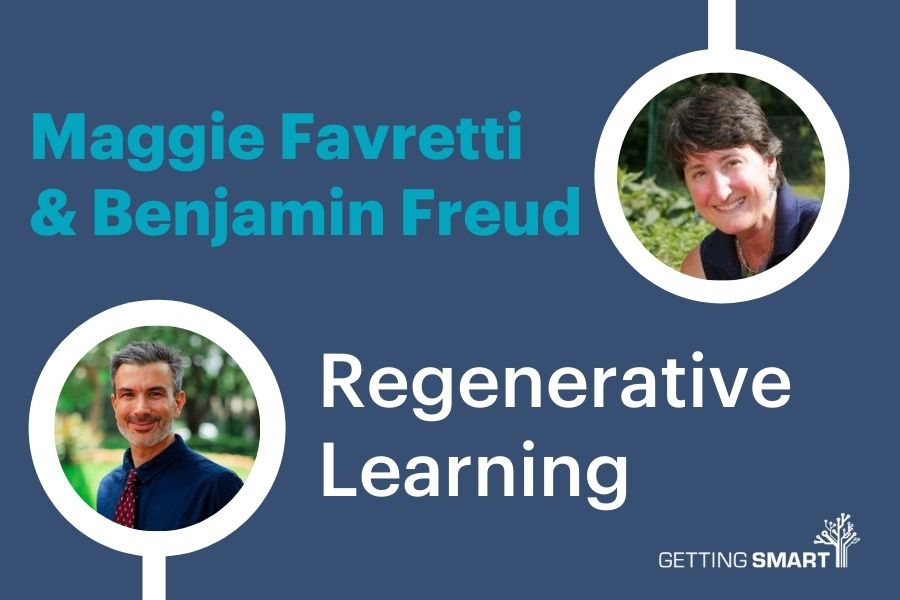
On this episode of the Getting Smart Podcast Nate McClennen is joined by Maggie Favretti and Benjamin Freud, authors, consultants and advocates for the environment, for people and for a more sustainable future. At Getting Smart, we are thinking a lot about Green Schools – sustainability, regenerative learning and equitable and inclusive future.
Maggie is founder of DesignEd 4 Resilience and is currently working on a new book titled Beyond Futurephobia: Teaching, Learning and Life in the Age of Climate Disasters.
Benjamin is the co-founder of Coconut Thinking and has years of experience in international schools, PBL, school leadership and more.
Let’s listen in as they discuss how we need to shift towards kinetic energy, how human beings are actually human becomings, the importance of regenerative learning, the metaverse and much more.
Links
- Benjamin Freud article
- Benjamin on the metaverse
- Learning in the Age of Climate Disaster: Teacher and Student Empowerment Beyond Futurephobia by Maggie Favretti
- Maggie LinkedIn
- Designed4resilience.org
- Benjamin LinkedIn
- Coconut Thinking
Benjamin also shared that we should tune into the work of Louka Parry and his podcast Learning Future to learn more.
We must get rid of the word school. That’s an old word from an old narrative.
Benjamin Freud
Maggie shared the important work of Ayana Verdi, the founder of the Verdi Ecoschool and also recommended that you check out the amazing work of Aula en la Montana. She also stressed the importance of developing a new teacher pipeline. “We can’t just use a new OS with the same hardware.”
Transcript
This transcript has not been edited for spelling accuracy.
Hey listeners. If you’ve been following Getting Smart for a while or read some of our blogs, you’ve heard us say that it’s never been easier or more important to make a difference. But how can we support learners in understanding their power to make an impact? Our Difference Making series is a great place to start.
Check out our book, workshops, and blogs to learn how to support your community of learners at GettingSmart.com slash Difference Making. That’s GettingSmart.com slash Difference Making. All right, let’s get to the show. Hello, you’re listening to the Getting Smart podcast. I am Nate McClennan and today I am very excited to be joined by Maggie Favretti and Benjamin Freud, who are authors, consultants, and advocates for the environment, for people in a more sustainable future.
And here at Getting Smart, we’re thinking a lot about green schools. How can education play a role in building sustainable, equitable, and more inclusive futures? And Maggie and Benjamin are really thinking deeply about this work. So today’s podcast is going to be part philosophy, part education, part future thinking, and just a really interesting conversation on how we can think about the future and sustainable futures for young people in our schools.
So Maggie is the founder of Design Ed for Resilience, an author of a forthcoming book titled Beyond Futurephobia. We’re going to dive into that today. I’ve done a lot of work in Puerto Rico in 25 or more years of teaching, history, and public policy. Benjamin is the co-founder of Coconut Thinking. I love the name of that org.
And my favorite line from the website or some of his writing is, we are not nouns, we are verbs. And we’re going to dive into that a little bit, some super curious, but a lot of experience and education across the board, international schools, project-based learning, writing, consulting, university teaching, and school leadership. So Benjamin, Maggie, welcome to the podcast. Thank you. Great to be here.
All right, well, let’s just dive in. So Maggie, starting with you, I know you’re calling in from Vermont, the United States today. For both of you, I’m going to ask this question. Let’s start with your thoughts on the future of learning. So both of you are thinking deeply about what’s happening next and what needs to happen next.
So Maggie, what’s going to be the big sea change, the big shift that’s happening in your opinion, as you think and write about this? Yeah, I think it’s not hard to identify because it’s happening already. So that’s good news. So we have lots of models that we can look at. But I think we are in the midst in the world today of a crisis of agency where there are huge fragmentation.
And a very big difference between what we know needs to happen and what we think we’re capable of. So I think one of the biggest shifts in education is going to be more toward finding the power that students have, bringing them home to it. And of course, the source of all of our power as human beings or becomeings is our holistic connection with life. So I am not only suggesting that we’re moving in the direction of greater agency for students and communities, but also that it will be based on regenerative life principles. And that that will help us to heal from the fragmentations splitting apart man in nature, rational from emotional thinking and so on.
And I better stop there because I want to hear what Benjamin has to say about this. Yeah, so interesting. So a couple key vocab words we’re talking about already and Benjamin, you can then jump in. So we have crisis of agency, this idea of becomeings, which you’ve introduced and regenerative learning, which I think we’re going to dive into a lot today. So Benjamin, joining us today from Thailand.
Welcome. What are your thoughts? What’s the big shift that’s happening? Or as Maggie alluded to already happening, I think Maggie put it very well. I think this idea of going towards more regenerative frameworks, living systems thinking, living systems feeling is certainly one that is emerging.
And maybe to take that in a slightly different direction, but maybe a complementary direction. I think that there’s going to be a real shift between in our mindsets because of technology and really what we’re going through is a great transformation, a biotech transformation, the metaverse AI. And we are going to be pulled in two different directions, one where we can connect with anybody at any point in the world. Instantly, it’s the closest thing to teleportation that we have ever had. So the virtual world that’s opening to the infinite and yet we have to stay very local or we will because the planet’s burning up.
So we might have to physically be a little bit more in touch with place, in touch with our community. So those two tensions are going to push learning in a direction, hopefully one that is going to keep us around for a little while. Thanks for that. We got a few more. Now we have teleportation.
We have place in our conversation, which is fantastic. So and I love how you’ve alluded to this idea that technology is moving us closer and closer to what are essentially mimicking this idea when we’re talking about metaverse, etc. So let’s do a few definitions. Benjamin, talk to me about sort of regenerative learning, like what for folks who haven’t heard that word before, some of our listeners may not have heard it. What does that look like specifically?
What do you mean by that? It’s a very good question. One that’s actually quite layered and I’ll put two layers there and Maggie will certainly add quite a bit to this, I’m sure. Regenerative, regenerative, you know, it’s pretty much the same word other than the re, which is the prefix. And the first level is generative learning, which is about action, which is about doing, about creating.
Generative from the word to create. So it’s about learning and going through this process of taking action in order to create something. So that’s the first thing, which is actually quite different from sitting in a, in a, on a desk and, you know, being fed information and maybe not necessarily doing anything with that. And I kind of think of it like potential energy and kinetic energy. We’re so long, we’ve been focused on the potential energy of skills, even competencies, all these things we’re supposed to be able to do to analyze a poem, to write an essay, all that.
But when we take it to action, we transform that to kinetic energy and that’s generative learning. There’s another level there that is a more philosophical level, which is living systems and thinking about systems where regenerative learning is about understanding that we as, as individuals, as communities, as a planet are all nested holes, that we operate really in a circular manner to really try to bring back, not, not just sustainable, we try to keep it. How is it going? We’re really feeding back, feeding back into those systems in order to allow us to thrive, thrive in ways that perhaps are much more diverse, like a forest. And that we appreciate learning that that is in a way that’s acid based rather than deficit based.
And again, just like a forest, allowing the biodiversity to really give it its power. Yeah, thinking about that sustainability piece is super interesting. It’s not just about sustaining, it’s about thriving. So I really love that point. So Maggie, want to add on to the regenerative learning piece and then maybe also just touch on the becoming concept.
You mentioned that word and I want to make sure we we touch on that. Yeah, I mean, that I’ll let Benjamin do most of that, but it does play a role in what I think of when I think of regenerative learning. Which draws its power from life, right, and living systems. And so Benjamin has used that phrase a couple of times. I can break it down a little bit.
So educators who are listening might be able to go, oh, that’s how it would look in school. So principles of living systems are interrelationship, right? Nothing exists for itself alone or by itself alone. Coherence or wholeness of the self, but also of the system so that nothing is superfluous. Nothing is wasted.
Biodiversity, which Benjamin mentioned a couple of times. Regenerativity. In other words, life creates the conditions for more life. So in school, right, we might think about that the way Sir Ken, the late Sir Ken Robinson thought about teaching where he said being a teacher is like being a gardener. And gardeners don’t make plants grow.
They create the conditions for life for growth. And so our schools, right, when they’re being regenerative and our learning when it’s being regenerative is constantly creating the conditions for more learning, for more depth, for more biodiversity, for more interrelationship, for greater coherence. And the last piece of it is going to link to the idea that we are verbs not nouns. And that is that living systems are continuously changing, right? That’s evolution.
And so our school systems as well in a very, you know, living systems, diversify power, right? There’s not an outside agent that’s saying, okay, trees, now you’re going to do this. And then, oh, no, you’re not growing right. You plant over there. And instead, right, power is diffuse.
And it is continuously evolving. So those characteristics, I think when we think about regenerative learning, all need to be there in order for it to be regenerative. I really appreciate that. And thank you for moving to that verbs not nouns definition and explanation because I continue to be enamored by that. And the constant change, I think, makes sense.
So, but let’s think about when we think about the modern education system, it seems like so much is driving towards this idea of economic growth. The idea of maybe the individual over the mutual or the communal. And so how these seem to be contradictions to a little bit about what you both are talking about. And I’m wondering if can we have an economic growth focus and a common good focus? Is this realistic in free market societies?
Can we drive more towards being mutualistic rather than individualistic? And what barriers have to be removed from our systems to make that happen? Benjamin, you want to start with that one? Sure. And I’ll maybe take a little bit back towards this idea of what it is to be a becoming not a being or how that plays out.
And it goes as follows this story that Heraklides said you can never step into the same river twice, but he was moved to the side by Plato and company who really started to think about an ideal form. And that started, you know, there’s a chair and then there’s an ideal form of the chair, which is fixed or whatever it might be. And ideas are fixed in the way that they exist out there. And so that created a dualism started to separate us from from this the mind, body, nature connections that we had. And so when we when we moved probably about 500 years ago towards more of a Cartesian Newtonian further separation of nature and humans of making humans the pinnacle of everything in evolution.
It really started to individualize us and that really comes from a European tradition, but you don’t really find that in Taoism. You don’t really find that in a lot of indigenous cultures. You don’t really find that in many places other than Europe. So Europe and North America have really colonized the world with this idea of separation. And of course they brought this form of capitalism out and it’s a mentality that has been quite colonial.
And this idea of becoming and being and being verbs is really that there is this person that we’re ever to but we’re really ever changing. It’s also the quantum theory that says that it’s not just, you know, we will spiritualism. And so when we talk about can we have common good and market capitalism, I would say no. I would say no because capitalism in itself is about accumulation. It’s about social status.
It’s about making it so that there are, it’s about consumerism and just that this accumulation, this growth, this consumerism separates us from who we are. It makes us want. And so there is a real contradiction between the two. And that’s something that’s going to have to be overcome and we cannot continue to grow because the planet cannot continue to take it. Simple as that.
Maggie, do you want to add on to that? Here, here. I laughed when I saw the question in the question, Democratic free markets. And I was like, okay, free markets are not Democratic. And nor are they free.
And so we really have been telling ourselves a lie. And by we, I mean specifically Western industrialized society because I think it’s a real problem that when we talk about big systemic changes, the we often defaults in a certain direction. A lot of the world functions and functioned for millennia without extractivist capitalism. And we’ve been telling ourselves this story that we can just extract indefinitely and consume indefinitely. And hello, no.
And so we need to bring that back into schools. Probably this idea of where this tradition started or this approach started, getting young people to really think about, hmm, why are we so focused on individualistic approaches? What is that driving? Sometimes I think I’m a big fan of personalized learning because of neurodiversity and every person learns differently. On the other hand, it does push us very much into an individual viewpoint of thinking.
So I have a lot of tension in my brain of I really want every young person being served well and how they learn best and how they can maximize their potential. And it does just think biodiversity, Nate. Tell me more about that Maggie. Right. Yeah.
Think unity, not uniformity. Right. So the love in the universe is what holds everything together like gravity. Right. The love is the unifying force.
Love does not demand that everything be the same. Life demands, in fact, the opposite. That everything be different. And that we have a unity that is whole. That only works because.
In your case, people are different. And so this idea of uniformity is a very industrial idea. The idea that everybody ought to be able to be efficiently taught the same way that you ought to be able to have one teacher and many students and, you know, they should move along the classroom hallway like and it’s on an assembly line. All of that is misguided. Right.
Right. I see that and I am pushing towards this idea of we are focused more and more on personalized learning, which is moving away from human uniformity. But personalized learning also is a focus on the individual rather than the mutual and the communal. So just to just point that out. All right, Maggie, we’re going to pivot to your book.
You’re a deep in writing. You have retreated to the Green State of Vermont to say, I’m going to get this book done. You have a book titled Futurephobia. Why did you choose that title? What are you writing about there?
So what I noticed when I went to Puerto Rico and I had been thinking about this for a little while, but you know how you have like the inkling of something that you’re picking up some vibe that you’re picking up from your students or from the world. And you’re not really able to articulate it. I met some students in Puerto Rico. I got sent there 10 days after the double hurricanes, the second one, Maria, and have just been meeting people and listening to people there pretty much ever since. And then, you know, allying and conspiring with people where I can.
Some students, I said, you know, if you had four minutes of film to tell a story about change, what story would you tell? And they said, we want to tell the story of how design thinking is helping us to believe we have a future. And I said, how many of you feel that you don’t have a future? And they said, quite matter of fact, oh, everybody. So I said, well, why do you come to school?
Because school is such a future like getting you ready for the future oriented kind of experience. And they said, a lot of the time we don’t. We come to school because we want to see our friends and the teachers who love us. So they made this little video and I started thinking, what are we going to find out? They started talking to make the video. They started talking to their peers and they began asking them about the future.
And their peers concluded that they are afraid to think about it. They feel powerless to do anything about it and that this was keeping them up at night and disturbing their sort of daily activities. So I began thinking that climate anxiety is really an insufficient term. And the more I started talking to psychologists and climate psychologists who were working in this field, the more they began, they also are sharing this frustration that, you know, when they say, oh, I deal with climate anxiety, people think it’s anxiety.
And then it’s part of it. But it’s much bigger, right? And the whole host, a constellation of fear and guilt and grief and betrayal and anger and frustration, all of which is held together by this feeling of powerlessness. So I felt I needed to write about that. I needed to say, look, this is big because powerlessness is also disabling in the sense that when you feel powerless to change something, you then start to feel what’s the point, right? What’s the point of going to school? What’s the point of engaging in my community, right?
You get this fatalistic sense that we’re done for. So what I’m doing in the book is putting together two really important concepts. One is how can we gather up the generative or regenerative, as I’m calling it, because of the two concepts together, powers that we have, right? There’s degenerative power in the world. We know what that looks like. And there’s regenerative powers in the world. And so how can we name those? How can we find the sources of those within and among ourselves as an emergent kind of power built on interrelationship?
And how does that teaching for agency look when we go to the source of all of our power, which is life and living systems? And so I’m combining teaching for agency, you might call it, and regenerative learning. And that’s kind of what the book is about. There’s only one chapter on the really horrifying stuff, and the rest is about teaching for power and life. You know, I, Benjamin, I’m going to come to you in a second because I really am interested to hear your thoughts on this. Maggie, A, that’s super inspiring. And it does make me think that when in schools, we develop in young people apathy rather than agency, because if you look at engagement statistics and surveys of young people,
the engagement just decreases over time in many, at least in a lot of schools, not all schools, and there’s so many great schools, great teachers. But then if you become an adult who is also apathetic, and then you have these large scale challenges around equity around the environments, pandemics, things like that. And you just throw up your hands because no one’s given you an opportunity to find that power, to have that agency, and given you practice in that. I can see we need some resolution there. So Benjamin, what are your thoughts on that? Is Maggie on the right track here? How does that tie into your thinking? Yeah, it’s the feeling of anxiousness, anxiety, it’s a feeling of being lost, of being alone. Again, it’s that separation, the separateness that we have from the whole, from realizing that we are connected to all life to each other.
But we are feeling alienated from ourselves. I mean, this is something that, you know, the existentialists were talking about, but now we feel it even more because now we have a crime crisis, an existential crisis to take the same word in a different way. And I also think that, you know, one of the things about schools that needs to be thought of is, you know, people want change really fast. They want it by tomorrow. It’s a long term game to completely change human consciousness. Now, we might not have it because the planet, again, is burning up, but it’s a big change. And I would say it’s probably as big a change required in human consciousness as the agricultural revolution 10,000 years ago, as the second industrial revolution. This is not just messing around. And so it’s going to take time, but it’ll take less time than it used to.
So I think Maggie’s completely on it. And I think that it’s normal. But the more people feel like this, the more I think we’re going to realize that we feel like this together. And then we have to do some inner work and change our value system so that we change the system. Yeah, building on what Benjamin was just saying, it’s huge. But we have a lot of sources of knowledge here. So indigenous people, when I talk with with indigenous colleagues about regenerative education, they kind of laugh. They’re like, Oh, yeah, you mean learning? Yeah, right. Right. And Toshoka Witko, who’s also known as Crazy Horse, made a prophecy back in the 1870s. And he said, Look, why people are going to try to destroy the earth? They’re going to get really close. And then they’re going to come back to us. And they’re going to say, How do we learn how to be human again?
And that is going to be the beginning of a group of people of all colors from all over the world, calling themselves rainbow warriors, who will actually change things. So one thing that’s really important is this is huge, but it’s not new. It’s revolutionary, but it is not new. And there are experts in the world who can guide us who are already teaching this way. Indigenous educators, people who are living in the teeth of climate disaster. People who are marginalized for other reasons, and you don’t have to talk to them about what it’s like to be in an existential crisis. They’re like, Why is everybody thinking that this is like some big new crisis? We’ve been in a state of black and brown people have been in a state of existential crisis for generations, particularly in colonized places and in the United States.
Hey, you know, we are not at the starting line here, right? We are just doing our part as inheritors of white settler colonial extractivist capitalist stories that we keep telling ourselves as if as if they are true. There are a lot of other stories out there. And so those people and nature herself is really going to give us everything we need to make this turn. And so I think we’re already underway. I mean, I love the idea that we’re on the journey. So I as you know, I write a lot about place based education and Benjamin, you alluded to place before. And and when people said, Oh, that’s an interesting idea. It’s like, Well, this place based education is how we how we’ve always learned that’s not an original idea. It’s just we sort of lost it in the process. So, so, Benjamin, I’m going to pivot to you and something you spoke to before. So we have a we have a massive sea change going on in technology we have, we’re moving from a web to a web three world and that’s including building metaverses and working in this crypto stuff and all these things are happening that are that are moving us exponentially faster towards this idea of can humans exist in these digital worlds.
And I would love you for you to expand on this idea that maybe the metaverse is a benefit and it allows us to connect with the entire world while staying local in a way to travel less to make sure we’re caring for local places to think about regenerative learning. Are you seeing this? I mean, where’s this idea? Where’s your thinking here? Is this is this going to be a really important move as we move into this web three world? I’m going to signpost by saying that nobody knows. I’m going to signpost by saying that, you know, where I’m assuming that it’s going to be open not owned by three corporations or one corporation. And I’m going to also signpost by saying that I understand that there’s also huge equity issues here as well. So taking those massive things and putting to the side, which is impossible, but we have to take the conversation somewhere. We can’t do it all in this one. Yeah, the metaverse, if you if you push it forward 10, 15, 50 years, imagine putting on a headset and a body suit, a lot like ready player one, and you’re able to go anywhere at any time with realistic graphics, physical form, you’ll probably have something connected to your brain that’ll stimulate your brain to make you smell to make you taste.
You’ll have what your sense of reality will change in the sense that, you know, if your brain thinks it’s happening, is it happening or not? It’s really going to push those kinds of boundaries. If I my brain thinks I’m smelling it, seeing it, hearing it, am I am I not? I don’t know. But, you know, if we think that there’s no reality, then, you know, I would say that it is real. And so that people might think that’s dystopian, but any kind of tech advances always been thought about dystopia, you know, like the Luddites who broke down machinery, but it allows us, if nothing else, the metaverse to connect to anyone we want to. And this is why school is in real danger, because now I can go, anyone can go talk to anyone else in the world, sit with anyone else in the world and have conversations about things they’re interested in and learn from one another. Consult any library, visit any place, do anything. Imagine you’re learning about World War One, you put on your helmet, your body suit and you go fight at the Battle of the Somme.
You’re fighting there, not like a video game, but like a fully embodied, integral experience. That’s going to build humility, that’s going to build empathy, that’s going to really make you understand what it’s like. Way more than anything else can be, because you’re feeling it firsthand, you’re living it firsthand. And so the metaverse is going to allow these connections to ourselves and others that if everything goes well, will completely change the way we are. However, it also means that we’re going to stay local, because we won’t necessarily need to go travel, because we’ll go in these virtual rooms. And then we can have these circular economies. Our wanderlust might be quenched. We will be able to be more local and more place-based, to really be with our community and know what the names of the trees and the birds are, and our neighbors, because we can teleport virtually and stay local. And that’s a game changer, assuming of course that we can get through the sustainability issues when it comes to data centers. There’s a lot of things that need to be resolved. There’s a lot of things, but that’s the idea.
Benjamin, super appreciate that. Maggie, comment on that, and then I want to wrap us up with some closing thoughts. So Maggie, thoughts? Yeah, just really quick comment, because I want to underscore all of Benjamin’s cautions as well. A third grader in India wrote to me, and he said, What he saw as potential in the metaverse was empathy for non-human beings and the comings. So like if you could actually see what it was like to be a tree, or to be a stock of corn in a giant field of corn, like, I think that’s really cool. Out of the third grade mind, there’s our future. Young people come the most extraordinary ideas. I think there is so each one of the, there’s so much we talked about today that we could dive into for hours and hours, and you all have sort of blown up all sorts of concepts around teaching and learning and schools and education. I’d love to wrap. We love amplifying others here, including both of you at getting smart and just if each one of you could do two things. So one is suggest a person that our listeners should know about, read about, should be known in this world, in this thinking.
And then one, what a key specific action step for our listeners from each one of you. So maybe Benjamin, if you’ll go first. So I’m going to amplify and a key action step. So I’m going to amplify Luca Perry, who’s got a podcast and a consulting company called Learning Future. And he’s a first of all, he’s the kindest, gentlest, nicest, most open human being I’ve met. He’s incredibly bright. He’s doing a lot of work as well in terms of environment in terms of working with local schools in terms of getting kids to heal, to heal deeply, and very local effort while working internationally to get the word out and working with organizations elsewhere getting first nations to views to come out. And he’s out of Australia. So I’m going to I’m going to amplify him to simply because of this idea of connecting one another and building networks. Let’s go as far as possible from the United States and go to Australia. Awesome. Awesome. And one recommendation or action step Benjamin for our listeners.
Yeah, I’m going to challenge. I’m going to invite listeners if they really want to change the system to get rid of the word school, not use it ever again. Because school has so much value, you know, school came from the comes from the Greek leisure because people used to go hang out and exchange ideas. That’s not what school is anymore. Get rid of the word school. If you really want to change the system. That’s an old word from an old narrative. We want to create a new narrative, new stories. We need a new word. And every time you enter conversation using the word schools, you already have your mental model. Let’s get rid of it. Let’s come up with a new word so we can have new mental models. Really appreciate that. Yeah, the definition, the old definition of the original definition of school should remind us that something is not working the way it should be. So, all right, Maggie, someone you want to amplify and a key action step for our listeners. So one of the people that I want to amplify there’s actually two is somebody that I think you may already know. Ayanna Verdi, who is the founder of Verdi Eco School. And as you already know, an amazing place.
And when I asked her if she wanted to be amplified, she said there’s a real problem with that because people assume that any new mental model about learning is scalable. And she said regenerative learning, place based learning is local. It’s place based. It’s not scalable. So don’t amplify me. That said, it behooves us to pay attention to what she and others like her are doing. And so I would also amplify Aula and La Montagna, which is a small mountain school in Puerto Rico that was started by the community in the absence of access to school. And so, you know, if you want to see what places do when they are able to generate their own learning experiences, then Dr. Eduardo Lugo, who’s advising them and Aula and La Montagna is the place to go. Both of them have the same request. What we have to do, and this is an action step, if we want to actually connect and empower the localized points of light here, we have to find a way to help teachers to learn and help education leaders, policymakers.
Maybe they just need to get out of the way, but we need to have a quote unquote teacher pipeline, a way of fostering this kind of thinking, this new narrative for teachers. Otherwise, we’re just sort of plugging in another solution, a new operating system into an old, I think I’m quoting a superintendent of schools from California who said that he didn’t want to just be plugging a new operating system into old hardware. And so I think, you know, we need to think carefully about how we amplify, but also how do we best support the people who are doing this kind of work. I really appreciate that. One of my favorite stories about Ayanna is I was in a video call with her and it’s the only time in Zoom that she was at a zoo with her students on the second floor and a giraffe poked its head into the Zoom video as we were talking. And I said, all right, that’s the true place space educations, the best place space education Zoom car I’ve ever had.
So one parting thought about mental models. And that is the way in which we consider change and coherence and that what we’re doing is coming home. Right. We’re coming home. Yeah, I really appreciate that. I think that in an increasingly complex and uncertain world, I continue to think about mutualism and how we are depending on one another in our local places and how do we think about sort of these big picture ideas. Let me let me a couple takeaways from my end as I as I heard you all speak. It’s been so wonderful to listen and I feel like I have so many avenues to explore. And I listen to our listeners also, I think we’ll have a lot of places to jump into one is this idea of we’re moving from a potential to kinetic energy. What does that mean which ties into this idea of of agency fill learning, which then ties into this this idea of regenerative.
What are we thinking about as a learn not school, but learning and what does that mean for the future so we can overcome and allow young people to feel optimism about their futures because they have the power to make a make a difference. So all sorts of great things for each one of you if they want to learn more about your individual work website location they can go to place they could key in as they want to follow your your thinking more. Yeah, we’ve got a website www.coconut-thinking.design. I’ve got some articles there. We’ve got a podcast as well. We’ve got some some great great folks there. And you know, connect on LinkedIn. I’m there. I’m active enough. So that’d be wonderful. www.coconut-thinking.design. All right, Maggie, obviously go purchase the book when it’s out but anywhere else they can look to find out more about you or connect with you.
Sure, I’ve got a little website called design ed for numeral for resilience.org. And there’s a few articles there they’re a little old because I’ve been using all my writing energy on the book. But you can get a glimpse into my thinking about power about regenerative education as resistance. Great disruptive resistance. Healing is resistance. Benjamin Freud, Maggie Favretti, it has been a pleasure to speak to both of you. Thank you so much for giving your time. I think you’ve given our listeners some really important things to think about.
And for all of you out here who have listened to this podcast, think deeply about this work. Connect with Benjamin, connect with Maggie, connect with your peers and colleagues and challenge each other to think deeply about regenerative learning and agency filled learning and how we can create the futures that both young people and us adults want. So thank you both for joining us at Getting Smart and thank you all for listening today. Thanks for tuning into the Getting Smart podcast today. We want this podcast to be actionable and insightful and a great way to learn about what’s next in learning. In order to stay on the cutting edge, we need people in the field to tell us what they’re hearing, what they’re wanting and what they’re needing to learn more about. Got a topic or a guest in mind? Send your recommendations to me, Mason at GettingSmart.com. And if you like what you’re hearing, don’t forget to leave a review in Apple Podcasts or subscribe wherever you listen.
Feel free to share the podcast on social media using the hashtag GSPodcasts. Thanks so much.

0 Comments
Leave a Comment
Your email address will not be published. All fields are required.