

Kenny Rodrequez and Paul McCorkle on Culturally Responsive Real World Learning (Live from SXSW EDU)
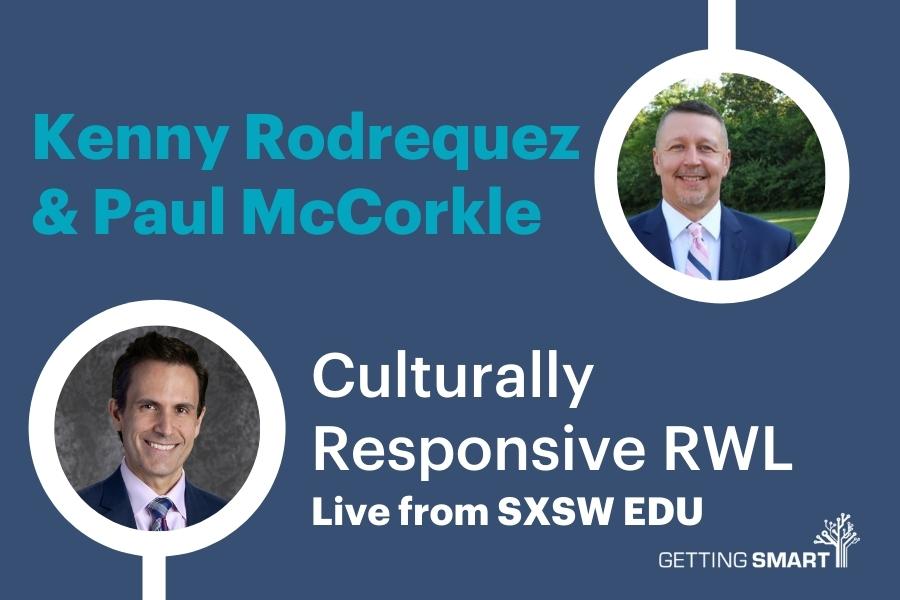
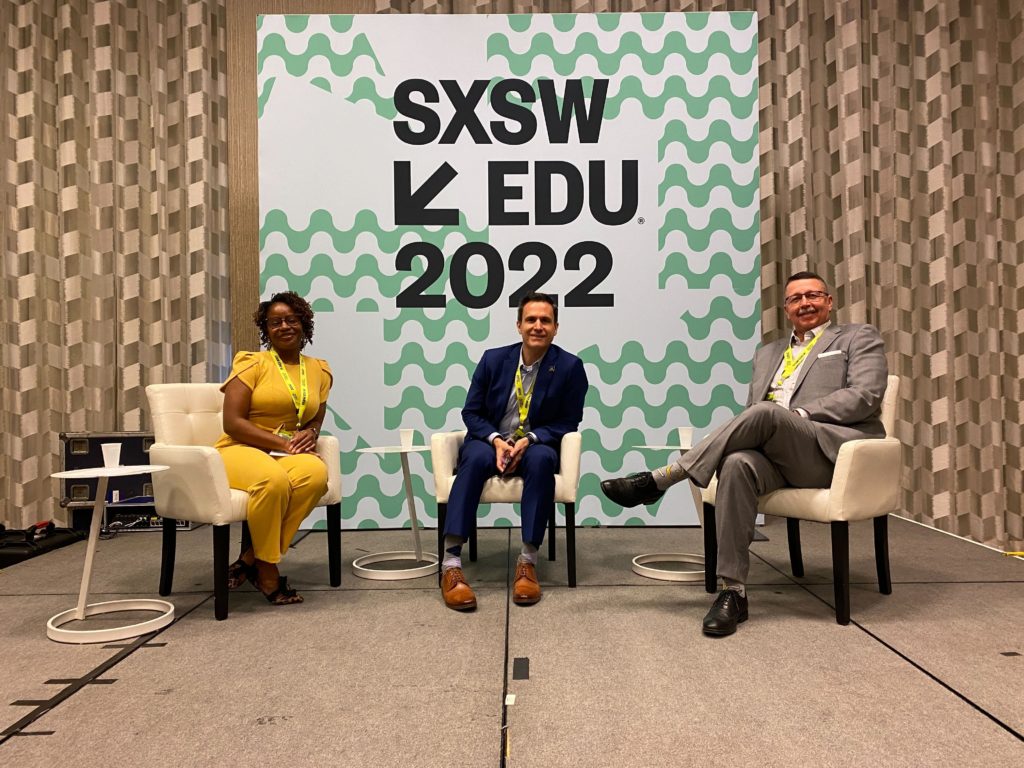
On this special episode of the Getting Smart Podcast, Shawnee Caruthers hosts a live conversation at SXSW EDU with Kenny Rodrequez, Superintendent of Grandview C-4 School District and Paul McCorkle, Associate Executive Director of Cornerstones of Care.
Listen in to hear them discuss essential skills, connecting to communities, economic mobility, real world learning and much more.
Links:
Transcript
This transcript has not been edited for spelling accuracy.
Hey there. Our team had a great week last week at South by Southwest EDU. This week, we wanted to share a few of our sessions with you through the Getting Smart podcast feed. Today, we’re bringing you a live podcast recording hosted by Shawnee Carruthers. The episode focused on culturally responsive real-world learning, and it ties closely to the work we’re supporting in Kansas City alongside the Kaufman Foundation.
We hope you enjoyed this episode. Hello, everyone. Thank you for attending the culturally responsive real-world learning podcast. We are so excited to see you all here today. I’m Rashawn, but I also go by Shawnee, Rashawn Shawnee Carruthers, and I am with Getting Smart. And today, I am joined by Kenny Rodriguez, who is the superintendent of Grand Mucie Forest School District in Grand View, Missouri,
which is a suburb of Kansas City, Missouri, and also joined by Paul McCoracle, who is the associate executive director at Cornerstone of Care. I’m going to allow them to introduce themselves, and then we’ll get started. Kenny, if you could tell us a little bit about yourself. So, Kenny Rodriguez, this is my sixth year as being superintendent.
We are about 15 miles south of the Kansas City Metro, so certainly one tier off of the urban core. My school district is about 4,000 kids, so relatively small. It’s about a medium-sized district in the state of Missouri, but we have a lot of different things happening in our school district, but we’re about 4,000 kids. It’s about 75 percent students for free and reduced lunch, about 70 percent students of color,
whether that be African-American or biracial. We have about 12 percent of our students now that are Hispanic or Latino, so certainly a growing population of Hispanic and certainly multi-language families. Definitely a melting pot, so to speak, of a lot of different schools and a lot of different groups, but one high school town, a phenomenal community, but we’re kind of sandwiched in between a lot of different tiers.
Being one tier off, you have a whole other county about a mile and a half south of us, the state line of Kansas. We butt up against it, so literally you go across one street, and you are then in Kansas on the far end of one of ours, and then we have another school district that is just to the north of us,
so it’s an interesting little area there, but a nice size district, and certainly a lot of wonderful kiddos and families. And, Paul, can you share about Cornerstones of Care? My name is Paul McCorkle. I am starting halfway through my third year, school year,
as the Executive Director of Education for Cornerstones. Cornerstones is a nonprofit, family-centered social. I always get confused exactly what we do, because most of the organization is based around child advocacy, foster care, and family support. I run the education side, so it’s a bunch of teachers working with a whole bunch of social workers.
But my education side of it, we run two therapeutic schools. I’m also responsible for education of roughly between 40 to 60 kids that live residentially, and that’s part of the tie that we have with Grandview, and that Grandview functions as our LEA for that campus. So one of my therapeutic schools is inside of Grandview’s LEA.
My other one is inside of the Kansas City Public School District as an LEA. Other part of my education team is BIST, Behavioral Intervention Support, and we actually support school districts from Colorado all the way to Illinois and Nebraska down to Southern Missouri. And we just recently had a school district from California reach out to us, so we’ll be doing that. And also inside of my group, we run a pretty extensive career tech ed that we’ll get more into.
The kids that come to my schools are students, all IEP-based students. We are the end of the continuum. We are the most restrictive environment they have before they go into homebound, and it is purely based on behavior. So students are coming to me kind of as that last resort to be able to stay in school,
and I run a K through 12 program. So I’ve got littles all the way up through the top end that we work through that. Yeah, thank you. As part of the work that we do in Kansas City, we work with a foundation, the Kauffman Foundation around real world learning,
and real world learning in Kansas City is a by state initiative where schools from both sides of the state line in both Missouri and Kansas have an opportunity to really engage with some authentic work experiences or internship experiences or college credit, et cetera. Through a survey of lots of stakeholders, it was determined as most of you all know that graduating with a high school diploma is no longer enough. They need something a little bit more to be prepared.
So as part of the real world learning initiative, students now have the opportunity to earn what we deem as market value assets. And those vary from work experiences, which are like internships or working with clients directly in client connected projects, or if they earn at least nine hours of college credit, or if they earn an industry recognized credential, or have an opportunity to engage in an entrepreneurial experience. We all deem these as valuable.
And so the goal is for all students in the Kansas City regional area to gain at least one of those market value assets before they graduate by 2030. And as part of that, we’re able to work with 75 high schools across the Kansas City region and Grandview being one of them and their industry partners, which is what Paul is. And so today’s conversation will be centered around not only what is real world learning, but how do we create culturally responsive real world learning?
Because at the core of real world learning is all about equity. And we say we want equity, but if we’re not intentional about it, then it doesn’t really matter. Because in the Kansas City area, as well as I’m sure school districts all across the United States, students are transient. And their success should not be based on what their zip code is. And so real world learning was implemented as a way for all students to have equitable experiences, regardless of if they lived in the urban core,
if they lived in the suburbs, if they lived in a rural community because of these market value assets. And so as part of that work, working with Kenny and Paul, they meant really good at providing these opportunities for students. So Kenny, what is a real world learning experience that you’ve had as a young person? And what did you learn or what did it make you aware of? I think certainly it was never discussed or talked about in that regard.
When I was in school, certainly I’m a first generation college student and there was no conversation about anything that had to do beyond high school, at least with me. So when I was in high school, I was a music person. So I loved band, was always been a music passionate, ultimately ended up being a music educator for a few years. But when I was in high school, I was able to work directly with the staff there at my high school and was able to do things after school, which realistically when I look back on it, could have very easily turned into and been an internship because I was able to work with them beyond the school day.
I did things after school with other groups. I was able to go down and work with younger students and be able to help them and do lessons and things like that. Where at the time it was just me again doing more of the stuff that I love to do. So it’s like what else do you need me to do? Like I’m here like all the time.
So I would love to be a part of that. So it’s just me having a passion, being able to continue working through that passion. And so that ultimately continued to impact me and one of the reasons why I became an educator. Yeah, that’s great. Paul, what about you?
Sort of similarly, not a lot of conversation and I too am a first gen college kid. Everybody in my family was very blue collar grandfather worked on the Ford assembly line. Uncle was a contractor yada yada yada. So mine was actually in reverse of when you are one of the boys, your job is in the summer you’re going to go work construction.
And so I found out I really didn’t like doing that. Like it’s hot and they made me carry all the really heavy stuff. And so in that it was almost that reverse. I had the experience because of family opportunity. And then my summer after my senior year before I was going to college,
which I chose a college because that’s where my best friend went, honestly. I got involved in a summer camp. And so I was responsible for a whole bunch of little people and I kept them alive all summer. It was pretty impressive for an 18 year old. But I realized this is something I really like doing.
I like working with little people and thus went on to have an elementary degree and my first teaching job was kindergarten. So it was kind of that experience, but I got it through my family. Yeah, it seems like for each of you for your real world learning experience, it’s kind of by half instance.
There wasn’t anything intentional about it. And unfortunately it seems like students are still kind of getting to it by accident. So as we think about real world learning, Kenny, how does that increase equity for students? How does that increase the economic mobility for students? Well, for us it’s about access.
I want my students to see themselves being successful beyond high school. And so first of all, when you go down to elementary, because this work cannot start when they step foot in high school, it has to start lower than that. And for students to be able to see themselves being successful in some other field. In elementary, it’s still a lot of I want to be a doctor, I want to be a lawyer,
I want to be a policeman, I want to be a fire, you know, whatever that may be. I want them to see themselves being able to be successful at something different. So it’s opening their eyes to what’s possible for them. Let them see themselves in other people. So some of that is working with other community partners so that they see people that represent their group
and see themselves being successful, whether that be a female, whether that be, you know, LGBTQ, whether that could be race, just something where they can see themselves being successful. So once you start opening those pathways, I have students now that, you know, in elementary school are talking about being project managers, like, what does that even mean? Well, now they see themselves and see a lot of this stuff happening.
So for me, it’s opening their eyes and being able to provide that access. Because I want students, when they graduate from us, to have a path. I don’t care what that path is, whether it’s college or whether it’s a career. But I want them to have a path and that we’ve defined that, that they’ve maybe done some of the things that are like, well, I know I don’t want to do that.
But I want them to be able to explore that and experience that with us. So that way, when they leave us, they are prepared for what life is going to be after high school. Yeah. And Paul, you mentioned that as part of your community. You’re kind of the end of the line before it goes kind of to the next level. So how do you go about increasing that equity and access for your students and their economic mobility?
So many of the students that I work with, whether they’re in our school, they’re in residential or they’re in foster, we actually have some transition housing as well. So effectively, we’re talking about homeless youth. These are really underserved populations of every group you can think of. That’s the group that’s landing in either one of my schools or one of our programs.
So we work diligently on teaching all of them the skills they need to be successful. Now we do it based in our career tech ed in our different programming. And one I shared with Kenny earlier, I got an email from one of my principals and told me that this kid came up. She graduated last year and she was in our construction trades. And our construction trades does just that, but we’re not on profit.
So how do we fund it? Our kids make things and we sell them. We sell them at pop ups. We do the cool Saturday morning things and we catch people and we sell them cutting boards and yada, yada, yada. She wouldn’t talk to people.
And so we worked at facilitating her ability to have those job ready skills. She didn’t go into construction. That’s not where she went, but she came up to school and said, I’m fully employed. I’ve been employed. I have an apartment.
I have my own car. I’m making it. That’s what we’re looking for. I’m looking to take that incredibly marginalized kid and say, I’m going to teach you those skills so that you can make it. Because when they look at their surrounding, what the community they’re coming from or the family they’re coming from, they don’t have that safety net.
So that’s what I’m working towards. Yeah, rural learning truly creates an opportunity for students to change the trajectory, not just for themselves, but for everyone that comes behind them. For the for their whole family. And here at South by Southwest, we’re here obviously for these great sessions, but also for networking opportunities. And students don’t often have the opportunities for those network opportunities because we talk about it’s about who you know, but most importantly, it’s about who knows you.
So why is it important for students to build that social capital and professional networks while in high school? Can I start with you? Well, again, just because that’s the way that the world works. So everybody here is still doing all those things. So if we’re not teaching them those skills while they’re in while they’re in our schools, then we’re not preparing them for what the world really is going to be like.
And so we need to we need to make sure that they understand that so developing those opportunities. We have students that will do a client project so they get to go pitch their idea and they get feedback from the client and it’s not always necessarily fantastic feedback. So how do they take that? How do they understand that? We had a couple different groups that were pitching an idea and their idea wasn’t selected and somebody else’s was.
So they had to take that feedback of how did that work and you know, not just collapse in a shell and say, well, I’m never trying this again. But what did you learn from that? So let’s take that information. We learn from failure. We have our entire lives and yet we still think let’s protect our kids and make sure that they don’t fail.
No, they need to fail to learn, but they need to do it in an environment where we can help grow them and understand why did you fail? So what did you learn from that? Let’s take that opportunity and make sure that you take that into the next piece. So if they don’t have those experiences, then we’re setting them up for even further failure when they leave us. We need to make sure that they understand what that looks like because those opportunities are what’s going to make sure that they’re successful when they move forward.
So part of what Kenny was representing, Paul, was essentially essential skills. How do you make those really visible for students so that they don’t feel like failures, but instead there’s some really key components like collaboration and problem solving. How do you make that clear for them that this is what you learned and this is now how you pivot? So kids in a therapeutic day school are not collaborative. They don’t want to work with anybody and they have absolutely no problem telling you with the most colorful language what they think about the situation.
I’m from that world and I’m going to work real hard of not using any of that language myself. I’m just going to throw that out there. So when they come into our career tech ad, we talk very specifically about we are intentional to have a job you have to explore. We’re not going to talk to X, Y and Z. We’re not going to grade, you know, kind of talk about we’re going to say you are late and you’re not going to get paid for that time.
If you’re in our advanced internship program, so you go through our intro and you go into our advanced internship, we pay our kids. They do work. We pay our kids. We also partner with other nonprofits in Kansas City that they have funding. They pay the kids. So we are constantly teaching them all of my people and that is the one thing that we constantly talk about is not necessarily what they’re doing in landscape management.
But it is how is the student, how’s the kid learning those skills we identified this particular kid is not great at X. How are we helping the kid do that? And what are they doing? And how are we getting them through that? Trust me, every kid knows when it’s payday.
They do. And we have a process in which they get paid and we tie that into it. Hey, you don’t like it when we don’t get that checked to you in a timely manner. How do you think your boss is going to feel if you’re not on time? If you aren’t prepared, if you don’t complete your work and we are giving them that opportunity to be successful and fail with support.
What we’re being very intentional about that training situation. Yeah, absolutely. And I just want to remind everyone if you have any questions, please submit them through the South by Southwest app. Just click on this session and click on engage and we will get to those who are in the question and answer session. Paul, how do you make a workplace culturally responsive?
What does it mean to be culturally responsive? When I think culturally responsive, I think about working with kids from where they’re from. And if a workplace was going to say, I want to be culturally responsive, I think that’s the first step is identifying the fact that you have to work intentionally at it. I work with kids from every background and my organization just in the entity that it is works to be inclusive of all groups and identify and recognize and honor. That’s what we do.
And if I’m an engineering firm, and that’s just not the way they think, but you have a leader that says, I want to be, that’s the first step, and then reaching out to organizations that are doing it. That can help you lead through. We are on our own journey. I’m going to steal something somebody else said, we’re on our own journey. We’re not there.
I don’t think you’ll ever be there. I’m going to be better. And I’ve lived in this world. I was a city kid. I grew up, but I had a conversation the other day when they looked at me and I said, there are things I will never know.
I will never know what it means to be a man of color. Never will. I can study and I will support and I have some amazing kids and men that work for me that are, but I’m going to always intentionally work towards that. What about for schools, Kenny? What does it mean to be culturally responsive?
I think, you know, very similar. But I mean, for us, it’s really being able to build relationships with, you know, individuals that are different than your own. We know nationally we have most of our teaching staff is white. Same with with us. I got 70% of my students that are of color and I have 70% of my teachers that are white.
It doesn’t mean that we can’t build great relationships with kids. We just have to understand what that means and what that looks like and then have to be ready that sometimes it’s not pretty. It’s not always perfect. It’s going to be a little bit messy and it’s going to be a little bit ugly at times. Their lives at times are a little bit ugly and messy.
So we have to make sure that we help them navigate through that. One of our core goals in my district, it’s a board goal and one of my personal ones for the last six years since we’ve been superintendent is cultural competency in my school district. So we do PD twice a year with every one of our staff members. And so we do modules, but I want every one of my staff members to understand that because whether it’s the first moment that a student walks on the bus, that that’s the first experience that they’re going to have with somebody that could build that positive relationship with them and understand what that might mean and what they may be coming into,
what they may have done that gone through the night before and the problems that they had maybe on a Monday and what they may have gone through over a weekend. Food service workers are custodians. Everybody in my district will go through those particular pieces because they can all build positive relationships. It takes all of us. It’s not just the classroom teacher.
It’s every single person. So I think making sure that you have that environment that students feel welcomed, that they feel valued and that their backgrounds and their past and the things that they bring with them every single day when they walk in the classroom and they walk into the schools are valued and that people understand that and they’re building that relationship with them in spite sometimes of some of the messiness that may be going on. So we’re just going to have a keep it real moment for a second. When you’re saying that Kenny, that’s great.
And lots of school districts go through the PDs of the cultural competencies and whatnot. How do you know that it’s working or how do you know that they’re just not checking it off the list? Because I know we’ve all gone through PDs just because it was required, but it didn’t really shift the behavior. How do you know that it’s working? So I’ll say a couple of different things because this is something I think about constantly.
I was in a 40,000 district in Tulsa where I was the director and we did the check of the box. We did a great PD. It was phenomenal. We had amazing conversations. And then a year later, there was nothing left.
We didn’t do anything else to continue that. So the first thing that I said whenever I wanted to do this was this was going to be an ongoing thing. This can’t be something that we do for a year or two and then stop. So it is a constant thing. Brand new teachers coming in.
I do a module with them. We do this continuously. So that’s one piece. Yeah, that’s nice. That’s pretty.
But does it really change the mentalities? Sometimes yes, sometimes no. There are still challenges. I would say, you know, quantitatively, I think I do surveys with students and I’m starting to see that shift happening with the data there. Qualitatively, I have conversations where people come up to me.
And go, man, somebody said something the other day and I think five years ago, I never would have said something back. But now I just felt like I needed to have that conversation of, hey, can you explain to me what you meant by that? Because you said this and it just, I don’t know, it just kind of hit me the wrong way. And they’re having that dialogue back. And that’s an uncomfortable conversation to have to have.
This is not easy to be able to do. But I also, every single year, and I’ll say it again this year and I always tell my principals when I’m going to do it. But I tell my teachings, hey, staff, this is what we’re going to keep doing. These are the emphasis that we’re going to put on everything that we do in this district. If that’s not for you, then please find your bliss.
I want you to be happy wherever that may be. And I know right now when we’re talking about staff shortages, that’s not the smartest thing to say. But gosh, I would rather have a substitute that cares about kids and being in there that really believes that all means all than somebody else that tells me that they believe all means all. But then it’s going to do something completely different when they walk in the classroom. If I didn’t think it would make a weird sound, I would do a mic drop at that moment.
But I’m not going to. Paul, how do you, I guess how do you respond to that? Because yesterday when we were talking, we were talking about creating brave spaces. How do you help to create those brave spaces for the students that you serve? And how do you use culturally responsive real-world learning to do that and to keep students engaged?
Once again, the kids that I’m dealing with are those marginalized kids. They function differently. They are street-wise and they can tell if you’re lying a mile away. Right? So when we talk professional development, when we talk as a team, whether I’m working with my principals or our career tech ed, we have to be authentic.
We have to be the person who actually is for our kids. I function with a much smaller group of kids, but it is the microgroup of the hardest kids to get. And yet the ones that we need to save the most. And if we’re not authentic about it, if we don’t bring to the table what is important to that kid, then we will never move the needle for that kid. Many of these kids have been in the system and you pick the system, they’ve been in it, whether it’s the foster system, whether it’s juvenile justice, whether it’s thrown out of multiple schools, they’ve gone through it.
They’ve heard adults say things to them to check the box and they will also be the first ones to call you out. It is humbling to see a 14-year-old know an adult is just blowing smoke. The kids also know I’m the principal’s boss. That’s the way they look at me. I’m on campus.
Mr. McCrackle, we need to talk. Principal’s just like, and I’m like, all right, what does every kid want to complain about? Food, right? Okay, and this is something Kenny and I just talked about yesterday because he got an email from a middle schooler requesting something. And we both said, that’s excellent.
We have empowered our kids to know that they have to walk a process. They have to walk a process and they have to know how to walk through that and do it in a way that gets them what they want. Like I said, my kids usually use more colorful language. But in that process, as adults, we have to approach it. Where does the kid come from?
What is important to the kid? Where does he come from? Because the kids that come to my school, where Kenny has a regular school district, I contract with 32 different school districts across greater Kansas City and then way out. I have kids that ride an hour and a half to go to my school from very rural.
So their experiences are radically different than kids that usually live within a geographic area. So we bring a pretty diverse group of kids together. And we have to be authentic. If we’re not, we lose it quick. So Paul, you were referencing kind of meeting kids where they are.
How do you get kids to truly see that they’re a part of their community? So whether they’re a grocery store or at a park, so many times when people see kids who maybe don’t look like them, they are sometimes fearful and don’t create sometimes the most welcoming atmosphere. So how do you either use rural language or rural learning or creating brave spaces, etc.
to help kids connect to their communities in a stronger way? Our career tech, our activities that we do are out in the community. I mentioned the pop-ups. Our kids staff the pop-ups. I have a couple students that, oh my gosh, I mean, ice to Eskimos sort of selling ability
because nothing is better than to have this young man talk about how this is going to help provide. He never throws in there. Oh, and by the way, I get paid. He never throws that part in, right? It’s just funding for our program.
And later we laugh. We put them in the situations. We talk about, like I said, we have to be very intentional. We talk about this is what you do. This is how you work it.
We have culinary. So our kids go through a culinary program. They work and intern in professional kitchens. So we have to teach them, hey, this is what you do. This is how you act.
This is the expectation. You’re going to get yelled at. You’re going to get mad. It’s going to be hot. You’re going to be tired.
What do you do? And guess what? They all fail at some point. All of them. And we are there to pick them up and start it again.
Our hope is that when they leave us, we’ve done it enough that they have that skill ingrained. And so we put them in this situation. We go out there. My littles go on field trips. I’ve got a class of first through third graders.
And if you think first through third graders that can’t maintain in a regular school and they get sent to my school, we go on field trips. Because how else are you going to go to the important places that these kids either one don’t experience because they are from a marginalized group? And how else are we going to learn something that’s important to them? They want to go somewhere? They want to do something?
Then let’s do it. That’s how I can teach them. Kenny, how do you build relationships with businesses or intermediaries like with Paul to increase student access to culturally relevant opportunities? You got to be out there. You got to go have those conversations.
And sometimes those are awkward conversations at times as well. Especially if a business has not had a positive experience with your school district for one reason or another. But you especially now it’s a different conversation because they’re struggling for workforce. So we’re talking to them about, hey, why don’t you help us shape what’s happening here? Why don’t you help us come to the table and be a partner?
It’s going to all of the chambers of commerce. And I actually have three different chambers of commerce that I’m actually a part of that I can go and talk to and get businesses a part of. But it’s also just going and talking to businesses. It’s seeing that new business come open and going there and building the relationships with them. These are incredibly difficult jobs, but a lot of it is again comes down to just building relationships with individuals and then getting your kids a part of that conversation too.
What are we missing? What are the experiences that you’re looking for? Again, we tend to forget student voice. We talk about it a lot, but how do we really authentically gain student input in these conversations? And what are you missing?
What are the experiences that you would like? And then let’s go find that experience, that business, that career set to make sure that you get that experience while you’re here with us. What do you say to the educators out here that say, I’ve tried to connect with businesses, but they won’t call me back or nothing is really coming from it? Like how do you help them? I think it depends on where you are.
What I would say is we have a little swath, like I said. So sometimes the people south of us don’t really want to talk to us and sometimes the people north of us don’t really want to talk to us. One of the creative things that we’re working through in the Kansas City area is I’m a one high school town. So I’m 4,000 kids. For some people that seems huge and for some people that seems incredibly small.
There are two other school districts within a very small geographic area. One is about 2,200 kids and one is about 6,000. So they are both one high school town as well. So what we have done is we have started partnering together and the three superintendents getting together and saying, hey, what partnerships do you have? What partnerships do you have?
And let’s start having this conversation so that maybe there’s not 15 people asking but that we can unify our requests. The other thing is just knowing what to ask. Sometimes when you go into businesses you’re like, hey, do you want to partner with us? Great. What does that look like?
Well, we don’t really know. But can you can talk to our kid? What is the specific ask? Hey, I would love for you to come in and talk to our students about your business, what you mean to the community. I may have a couple of those bulleted things and then set up that opportunity for some of your students.
Maybe it’s internships or maybe you’re not even to that point yet. But what is the specific ask? Because that’s the number one way to derail some of this is when you go in to talk to somebody and you don’t really know what to ask yet. You don’t really have anything. If you’re like, I really want to work together.
That can work sometimes and be awkward. But most businesses want to know specifically what the request is. So when we don’t really invest in building those business relationships and when we don’t really use culturally responsive learning in order to help kids build connections for our community, sometimes it feels as if community institutions or schools aren’t held accountable for the success of their young people. Kenny, do you think schools and community institutions should be held accountable for the success of the young people?
And if so, in what ways? Well, yes. I mean, there’s no way to say that. I mean, they have to be. Our number one job is to educate kids.
If we’re not doing that, then we are not doing our jobs. But what I’d say, it takes everybody. It’s a partnership. So I tell our parents all the time, partner with us and to the best of your ability. Some of our parents don’t know what that means.
So, hey, we will talk to you and we will help you if you don’t have the skills needed, but just partner with us. Come to the table and have that conversation and we can work through that. Businesses, you play a role in that too. Community members, I have an aging population in areas of my school district. So they don’t have kids.
They may have never had kids in our school district, but they definitely don’t have any kids there now. But I want them to know what we’re doing. I want them to be still a part of it. They’re still a part of that community. So they still play a role in the success of our students and our school district.
We are the number one employer in terms of employees in our area. So they should want that. We know that it helps property values. I mean, selfishly, we try to give them all those things of, hey, this is going to help you in any number of different ways. But number one, don’t you want to see the next generation be successful in taking over this country?
So help and partner with us. So, yes, I think the community at large has to play a role in that. And all of us are held accountable in that regard. Anything to add to that, Paul? One of the real challenges in education when you have something like that is how are you measuring success?
You know, earlier, I said my measure of success kind of looks different than Kenny’s measure of success. And I think they’re both accurate definitions. So that’s always going to be something, a nuance that has to be spoken to. What is it that you’re looking for? That doesn’t mean that you’re watering down success or that you’re not accepting the same level of success.
In our, we’ve developed what we call workforce development program. So I’ve got a range of things kids can do. We even support kids that want to go to college. We’ll run the gambit. So we really do have to think, and all my kids have IEPs and I’m historically a special ed teacher.
So I think this way about individually, how am I looking at this and I’m hoping this kid achieve what this kid wants? What does that look like and how can I do it? And how can we be accountable ourselves and how can I assist school districts in doing that? Something that kind of came out of COVID is our behavior intervention support team who works very closely with all of Kenny’s schools. They developed some parent training.
So if you think about the way a school usually runs and what the structures are and what your culture is and how you kind of run your classroom from a teacher standpoint. We started to work with and do some trainings with parents to give them the same language, not just, hey, here’s the bullet points of what we do in school. But hey, this is the pedagogy behind this. Didn’t use the word. But how many people in here who have children learned how to be parents other than from your own parents?
And what if that didn’t work well? You know, did you really read all the books? I think I read one. What to expect when we were expecting and once I was done with that, I didn’t read any more books. But I read the whole thing.
I was scared. I didn’t make it through all of that one. I was really scared. So we started working with parents to give them more skill sets so that parents could partner with so that we could change what that definition of success is and continue moving that forward. I function kind of in a micro in our own education, but then I get to function in a much larger way with many school districts.
So it really is kind of that symbiosis. Kenny talks about who he works with and it’s very regional once again. We’re intentional about who we partner with. We look for companies that are owned by women are owned by minorities that are we intentionally seek them out. And it is amazing as soon as I do or my CTE guy does and says, we’d love to have an internship with you because you do amazing things.
They will look at you and go, yes, because we too are providing workforce. We too are then creating an opportunity for kids of color for kids of marginalized groups to see business owners to see people that look like them being successful and learning how to do that. It is interesting that you talk about the different definitions of success and how to get there. And I think that’s what I think is really important. I think that’s what I think is really important.
I think that’s what I think is really important. I think that’s what I think is really important. I think that’s what I think is really important. I think that’s what I think is really important. I think that’s what I think is really important.
I think that’s what I think is really important. I think that’s what I think is really important. I think that’s what I think is really important. I think that’s what I think is really important. I think that’s what I think is really important.
I think that’s what I think is really important. I think that’s what I think is really important. I think that’s what I think is really important. I think that’s what I think is really important. I think that’s whether we really are traveling
and getting into our campus from now on or whatever. I think that’s the problem that is most important for students and for our golden age students. I would encourage you to, if you are asked to start a career as an Idea Consumer
customer nonstop, it’s a big question, so say you have a consumer story that gets a lot of questions about them in your 회, go out, they start to see that value a little bit more than they do even with us.
So I think as they continue to get those particular confidence and again going back younger, I mean to have, I’ve had second and third grade classrooms do debates and debate back and forth and so that itself is an understanding of having a topic and it doesn’t matter what the topic is. For them it was video game time but having video game time be your topic but looking,
searching something, being able to have that conversation and debate back and forth and have an argument of why you need to be able to do something. Those are skills, those conversational type skills and again I call them essential skills as well but those are what the companies want right now. When I talk to people about what you’re looking for for high school graduates or people that
you employ, very seldom do they say a degree, very seldom do they say that they’re saying I want people that can actually have conversations that can disseminate information that can work together in teams that can actually have these particular skill sets that none of them are going to be on standardized tests, none of them are going to be on any of the credits and things like that that you see on a diploma but it’s going to be things and experiences
that they have while they’re in our schools. Paul, when Kenny’s talking about those successes and those essential skills, I’m sure that you probably deal with students especially black boys who are experienced like vacant self-esteem, like it’s just not there. How do you help them to overcome it so that they can even begin to work on an essential
skill? It goes back to building a relationship. As I mentioned, very quick to assess who you are and are you authentic. I have ever since I started teaching, I grew up in Kansas City, taught urban school kids and kids are very honest and very quick to figure out that you’re there for them or you’re
not. So the first thing is building that relationship so that they know day in, day out, going to be there for you. And it’s not necessarily me. It is one of our staff.
It is somebody that they work with that they feel confident and able to start that movement. Once we have that relationship started and we can identify somewhere that they’re interested in, then we start giving them opportunity to be successful. And that’s exactly it. We just had a fundraiser and it’s based around our career tech head and they highlighted,
get a little emotional here, highlighted one young man and he happened to be working the table and he can sell to anything. His mom was there. This was $175 a plate. We’re a nonprofit.
We need money. And it was sold out. And once again, that population was not the diverse population that we serve. And they do this video about Tay. And Tay is a junior, will be senior.
Tay has created relationships with the owners of Bar-K, which is a company in Kansas City that runs dog parks. I didn’t know you could make money doing that. They make money doing that. They built, we built their tables and did some installs in Kansas City.
They then contracted with us. Not me, I didn’t do it. I don’t like construction with the team. And Tay went with the team to St. Louis and did the install. Bar-K is about to expand to Oklahoma City and Denver.
He’s involved in that. He also does these pop-ups. And so they do this video and they talk about how he made that move and I’m sitting with his mom. She starts crying. And I’m looking at her.
I’m like, he’s doing a great job. And she just kept saying, I’m so proud of him. Later on in my day when I thought back, I thought, how many times has this woman been able to say that about her son and he is honestly doing it? No school at once, he’s in my school. He has multiple problems that he works through.
I know when he’s not at school, I say it on the attendance level. But that’s what we have to do. And it’s not quick. It’s not easy because he had to know we cared, then we had to let him be successful, and then we had to keep doing it. And he has job offers when he graduates high school.
That is a great recipe. Show him you care, give him space to do it, and then let them keep doing it. That’s great. Paul, how can we get those sort of professional learning opportunities for schools? Like how can we help educators understand that recipe so that they can support creating culturally responsive opportunities for students?
We have to be creative. I come from public ed. I come from public ed. This position came open. But I’ve always worked with this population, but usually in a regular school district.
And I was interested and I jumped at it. And we have some flexibility that normally a school district doesn’t have. Kenny and I were having this conversation. My CTE director and his team are not certified teachers. So my kids don’t earn credit per se through that program because it’s usually afternoon.
After they come back from Grandview school, if they live with us, my high school kids do some during the day, but they’re supervised by somebody else. But we still have the shop teacher run and shop. So we have to be creative. We have to find those people that can help create that opportunity. And teachers, though we sometimes teachers like to say, I’m very collaborative.
Teachers don’t like to be collaborative. They want to run their classroom. They really want to close the door and run their classroom. But when you find that group of people that are willing to step out of that, who are willing to go out into the community and say, I’ve got this group of 15 African American teenagers who I’m going to teach to use what looks like a blow torch. Yeah, go with me here, folks.
It’s a visual and painting. Because I walked around the corner and this is what they were doing to scar wood because it pulls the pores out of the wood and it looks way cool. I’ve painted a picture of the kids that I work with. I mean, flame, this is going to look really good on a podcast. I’m doing this with my hand.
Flame, this bit, shooting out one kid flaming a couple of boys stand around in my head. I’m just waiting for someone to catch fire and run across the field. That’s me, right? We are giving them that opportunity. But it is a flexibility that school districts oftentimes don’t quite have or they have to think about changing that paradigm of what that looks like.
I’ve worked with great CTE folks in school districts. Ours gets to look different because of what we need to do and who we partner with. Kenny, what advice would you give to an education leader or business owner who’s looking to get started in creating more access, more equitable opportunities or pathways for their kids? I think you would first of all look in your community because I think you’d be surprised sometimes at the things that you already have available. So I mentioned before, know what your ask is, but start small.
We’ve been doing this now for five or six years and we’re not even close to where we want to be. But when I talk about the things that we’re doing, I know that we’re a lot further along than a lot of individuals. Again, our goal is that every single one of my students is going to have a path and that they have market value assets when they graduate. That number is like 15% right now. That is unacceptable for us.
Just period is unacceptable. But that doesn’t mean that the students that are graduating are not prepared for those pieces. So life after high school. But start small, understand what you have and build on the things that within your school district, within your individual school that you already have. What are those values that you have?
What are those things that you already have available to you and leverage those because those are the relationships that you’re going to be able to really rely on the most? Kidding you mentioned about life after high school, what do you wish you would have known after you graduated in high school based on kind of what you know now as an adult? Same for you, Paul. By Bitcoin. I just wanted to say it before he did.
Apple’s going to be big. This guy that you’re seeing on TV, he knows something. Again, I was lucky. I’ve had a passion all of my life since I was five years old. And I knew that that passion would lead to something I had no idea.
Truthfully, my passion was music. It wasn’t necessarily education or teaching or any of those things. Thankfully, I had a divorced family, but I had at least two parents that loved me and supported me no matter what. Again, not all of our families have any of those particular things. So I think what I wish I would have known is that it is going to be okay, that you are going to fail multiple times, but it’s going to be okay.
Keep going. Again, I want our kids to know that it’s going to be okay. They’re going to be able to keep going. I still have students reach out to me and I tell them when they graduate. I still have kids reach out to me to need help or advice or something.
I’ve helped with college applications. I’ve helped with job applications and those kind of things. So I think I would have liked to have known just that it’s going to be okay, that life is going to continue to change. You may not be in the exact same position of what you think you’re going to, but that doesn’t mean that you’re not going to be successful and you’re not going to still find your bliss. I happened upon it, so I’m very thankful of that particular piece.
I would love for somebody who have had to have that conversation with me and line out how all the different opportunities that would have been available to me when I graduated. And Paul besides buying Bitcoin and color TVs are here to stay. What would you… That hurt. Yeah, that hurt a little.
She got right there. I would have loved to have had the opportunity to explore what I really wanted to do. I knew what I didn’t want to do, right? I didn’t want to work construction. I didn’t want to go that route and I was the first one going to college.
Kind of the same thing. I meandered for a long time through college and I would have loved to have had some opportunity for some direction. Not someone to pick for me or to do something like that, but to have had the opportunity to kind of explore, hey, this is something you can do. I didn’t know. I mean, I honestly didn’t.
And I wasn’t joking when I said I went to a university because that’s where my high school best friend went. He went on a college visit, asked if I wanted to go. I said, sure, I filled out the application. I got accepted. I like school.
I did like school. Many people who go into education, we enjoy being there. I mean, you don’t choose a job that you don’t want to do, but I didn’t realize that that’s kind of how I was going to keep going. So for me, that, you know, a little bit of direction, I would have loved to have had that. All right.
And just one last question before we close out here. One of the perks of being in Austin or in Texas is some really good tacos. I have some amazing steak tacos for breakfast because you can eat steak tacos for breakfast in Texas. Kenny and then Paul, what would you put on your dream taco? Oh, gosh.
Paul, you go first. If you got this. Okay, go. Okay. Where’d we go to dinner last night?
Yes. Hop Daddy. Hop Daddy. And so我們 would say they have this fries that have kind of a honey hot sage. On folks, like on the fries, we’re from Kansas City.
We like barbecue, right? So if I’m creating a love tacos, that’s all of it. So it was like a pulled pork taco. Hmm. And you go, divider or something along that line.
with that sauce from Hop Daddy last night, I’d be good. Nice, Kenny? Tortilla’s gotta be fresh. There’s a piece to that. I don’t like hot just for the sake of hot,
but I love chilies, I love any kind of hatch, I love any of that stuff that gives it that spice, but I love steak tacos. I mean, I love steak, but pork, I think I could do any of that would be great.
Doesn’t need much of anything else, it doesn’t need really salsa, it just needs some of the natural flavors and stuff and a little bit of a pico and stuff, it’s amazing. Well, y’all aren’t tacos, but this has been a dream.
So thank you, I love the simplicity of the conversation we’ve had, just like your tacos, it’s just like education, keep it simple, keep it foundational, provide awesome opportunities for students and make sure that students can be seen
in every piece of the work that they’re doing in high school. So just wanted to thank both of you. Do we have questions? Let me see, I don’t. Hold on, we’re not done yet.
Yes, sorry. Did anybody write any questions? Are there any questions? If you can ask it and then I’ll repeat it, that way it can be heard.
So we do something similar, but our district has come back and asked us to submit the metrics that we would like to be used in order to evaluate the effectiveness of our program. My question for you guys is, what are you guys using?
I need to come up with this, and this would probably be too, but not only the second largest district in the country, it would be interesting, but, you know, and I don’t have any. Yeah, so the question is, and I’ll just repeat it
for the purposes of the recording, about the metrics that are being used in the districts or in the work that you all are doing to gauge this work. Yeah, so for the entire KC Metro, I think one of our metrics, again,
that we decided to align was in the market value assets. So how many of our students are going to have these opportunities, whether that be college credits that they receive while they’re in high school through a dual credit opportunity,
whether it be an internship, you know, the client-client-ed projects, and so really trying to see how many of these opportunities do all of our students have while they’re in school with us. And so that’s one of our metrics there,
but, you know, truthfully, it’s also, none of us have mentioned standardized tests once while we’ve been up here, that’s, you know, purposely trying to avoid those kind of things, but we also still live in that world.
We’re still gonna have to live in those particular, you know, world around that, so we still have to find the balance of when do we find time? When do we find time to do these things? So, again, that’s why for us,
trying to do a little bit younger in that regard, but I think this increases graduation rate. We’re using attendance because we’re making it more viable for students and making them understand that this is really valuable for them.
They want to be a part of it because it’s more real. I’ve had kids that go out there that go into a job and they’re like, that’s real, that’s like the real world, and they come back to school, like, well, that’s just school. Like, they don’t see a connection
to what we’re doing in the real world. So this work is going to make them a higher attendance rate. It’s gonna make graduation rates higher. It’s gonna, so those are all different metrics that we’re still using to show value
in this particular regard. I just, I wonder, because I’m also in an alternative edge setting. Oh, yeah. I’ve also been thinking along the lines of wellness data
and looking at how the child is performing or whether they have access or you’re using the access they have to well-being, the impact that that’s having on a new degree of entrepreneurship on the team. It’s okay to admit that it’s not there
because I’m not very specific. Yeah, so I’m gonna repeat the question, Paul, just for the purpose of, in an alternative edge setting, when you’re thinking about the wellness data, what’s out there?
Is there any data out there or anything that you all are using? So we use a couple different metrics, a couple different assessments. I mean, of course, we take the ACEs on our kids
and they win, right? They get all the points. But there are also a couple mental health metrics that we use. And I’m not one of our clinical managers,
so I can’t pull it right off the top of my head. I’ll gladly give you my email. And so we do that metric. When they come into the program, then we usually do a yearly metric as we go
and we look at progression in actual mental health. So we’re looking at that and then that tied with their success in school. I can’t speak to a direct correlation, but as Tay, who I talked about before, became successful,
he started attending and his scores on his mental health assessment started to improve. So I have a clinical team at both schools, so we have a very intentional clinical piece working with our students in the mental health setting.
So it is something that we also normalize, definitely not something that we spoke about here, but in our setting and in my world, it is very normalized. It is not something that our kids just don’t do. So it is part of the assessment
and part of what we do to walk through. It’s not something that’s going to prevent you from graduating or anything else like that, but we definitely have that metric that we look at. We survey our kids too.
So when we survey our kids of, do they have one adult they trust within a building? I mean, questions like that that we measure over time of, is that increasing? Do they feel safe in our schools?
I mean, all those particular kinds of metrics and do they have somebody that they talk to while they’re at school, whether that be an adult or whether that be another student? So those are certainly some of the social-emotional pieces
that we do and truthfully, part of our partnership, the way that this actually started was for us trying to increase social-emotional supports in our district. And so I knew that I couldn’t, I could go out and hire another social worker,
but that’s not really going to get the impact that I need. So I partnered with a behavioral and supports with Cornerstones of Care to come in and provide some of those family supports for our families and our students through external partnerships.
But we do measure those things as well in terms of every year, but part of that is also surveys with our students. Are there any additional questions? Okay, well, again, thank you all for being here and talking about culturally responsive.
Thank you for everyone for attending. Thanks for tuning in to the Getting Smart podcast today. We want this podcast to be actionable and insightful and a great way to learn about what’s next in learning. In order to stay on the cutting edge,
we need people in the community to be able to help us out. And we want to help you learn about the future and the future of the community. At the cutting edge, we need people in the field
to tell us what they’re hearing, what they’re wanting, and what they’re needing to learn more about. Got a topic or a guest in mind? Send your recommendations to me, mason at gettingsmart.com. And if you like what you’re hearing,
don’t forget to leave a review in Apple podcasts or subscribe wherever you listen. Feel free to share the podcast on social media using the hashtag GSPodcasts. Thanks so much.
Wind Aah-Ah music Daniel Reuter



0 Comments
Leave a Comment
Your email address will not be published. All fields are required.