

Kaya Henderson on Reconstruction and Identity Affirming Curriculum
Key Points
-
Representation is essential for all students.
-
Teachers are actually reconstructors themselves.
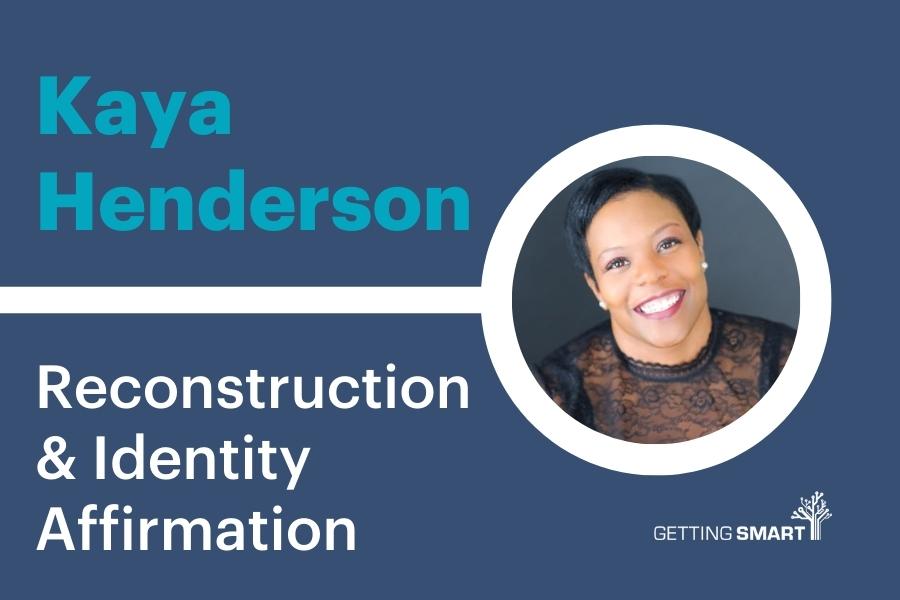
On this episode of the Getting Smart Podcast, Tom Vander Ark is joined by the phenomenal Kaya Henderson. Kaya is the CEO of Reconstruction, an edtech company that delivers k-12 courses that situates Black people, culture, and contributions in an authentic, identity-affirming way. Kaya is a career educator, starting as a middle school Spanish teacher in the South Bronx with Teach for America.
Kaya has been a leader in DC for 20+ years, first with TFA, then TNTP and then a decade at DCPS. She co-hosts the popular podcast Pod Save the People, with DeRay McKesson.
Let’s listen in as they discuss representation, hosting a podcast and the importance of culturally responsive pedagogy.
[Change happens] from the grass tops to grassroots. It takes an entire ecosystem. It takes a city. It takes the politicians. It takes the deep, deep engagement from students and families and then of course it takes amazing educators to to do something very, very different.
Kaya Henderson
Links:
Transcript
This transcript has not been edited for spelling accuracy.
Kaya, what does it mean to be unapologetically black? Being unapologetically black means being incredibly proud of our history and our culture in the face of a society that tells us we ought not be. We send our young African American people messages about education not being important to us, our vote not being important around what we are and aren’t able to do.
And in fact, when I look at our history and I look at our culture, I think about black people being innovators, entrepreneurs, thriving in the face of innumerable odds. And when you teach young people that history, right, they see themselves differently in school and in life. And that’s what we’re trying to inspire at Reconstruction.
We are trying to teach our young people that we come from a proud legacy, not just over in Africa, but here in the United States of America. We’re called Reconstruction because we hearken back to a time of incredible prosperity and independence and entrepreneurship and innovation in the black community right after emancipation. And so we have people who, when they first hear about what we do at Reconstruction, they
say, oh, Kaya, isn’t that divisive? You’re teaching black history and black culture. And I think I’ve taken a page from one, I’m drawing on the traditions of the African-American culture where we’ve been teaching ourselves through citizenship schools and freedom schools and all kinds of literary salons, you know, all through history.
But I’m also drawing examples from our friends in the Jewish community who are unapologetic about teaching their children their history and culture, or our Chinese friends who are unapologetic about teaching their children their history and their culture. We want to unapologetically teach African-American kids so that they are strong in who they are and they can then engage with other strong people.
I’m Tom Van Der Rook and you’re listening to the Getting Smart podcast and today we’re joined by the phenomenal Kaya Henderson. When I say Kaya, you say Henderson because Kaya is probably the most recognized first name in American education. Kaya is the CEO of Reconstruction, a very cool ed tech company that delivers K-12 courses
that situate black people culture and contributions in authentic and identity affirming ways. Kaya started as a Spanish teacher in the South Bronx. But what I want to start by talking to you about Kaya is the 20 years, the two decades that you put in leading the work in Washington, D.C., first for TFA and then TNTP and then a decade at DCPS.
So thank you. Thank you. It’s been a long time. You know, I’ve said a lot of times it takes a decade to do important work as a leader and you put in two decades starting at the ground floor and then putting in a long stint
as the chancellor and so many of us just appreciate your sustained leadership in the nation’s capital, Kaya. Thank you, Tom. I, you know, I love Washington, D.C. It is not, it’s not where I’m from, but it is home for me.
I have spent the better part of two decades and maybe a couple of additional years. This is my 30th year in education and much of it has been here in the district. And I think I’ve had the privilege of working from a lot of different vantage points, whether it was the executive director of Teach for America, D.C., where I felt like I was helping to supply human capital to district public schools to founding at Action, D.C., which
was sort of a political action committee that helped elect different types of school board members to the school board to serving as deputy chancellor and then chancellor of DCPS, where I had a front row view and a high level of accountability for helping to turn around what was the lowest performing urban school district in the country. When I think about what we have been able to accomplish in Washington, D.C., I’m incredibly
proud that as a city, we prioritize education from the grass tops to grass roots. It takes an entire ecosystem. It takes a city. It takes the politicians. It takes the resources.
It takes will. It takes cooperation from other agencies. It takes the deep, deep engagement of students and families. Then, of course, it takes amazing educators to do something very, very different. I think what we did in Washington, D.C., was defy the odds.
We were a dying education ecosystem. We went from being the lowest performing urban school district in the country when we took over in 2007 to the fastest improving urban school district in the country in 2016 when I left. It’s almost six years later and we’re still the fastest improving.
When you add to that the advances that have been made in the charter sector, the tremendous work that we as a city did around early childhood education, around supporting schools with health care services, both mental health and physical health, it really is an interesting story. People want to tell the DCPS story or they want to tell the charter story.
This was a story about a whole city that decided enough was enough and it was going to do something different for its kids. It is a great story of sustained and community-connected leadership. I’m glad that you gave a shout out to the … You put together an incredible team, but it really was a city that rose up from the mayor’s office, the NGOs in town.
There are a couple of philanthropies that deeply supported your work and invested where you needed it. It is a great story. It was at the behest, at the demand of students and families who were tired of being underserved. Someone once said to me, you’re never going to change DCPS until parents and students
are rioting in the streets the way they do in the suburbs when things are wrong. We were at that point where families were rioting in the streets and we had to regain their trust to deliver something very different. They held our hands with us and we did it together. This isn’t a story about a heroic superintendent or a heroic mayor or a heroic set of principals
or teachers. This is about real community partnership and co-creation. Let’s fast forward to 2019 when America’s best known system leader has coffee with America’s best known education academic, Dr. Roland Friar. What were you guys cooking up?
Roland and I had done some pretty cool work together in DC public schools, setting up incentives for students to improve their homework and their grades and their attendance and that had worked really well. It was a crazy idea paying students. I believed in it and Roland believed in it and we were able to get it done at DCPS.
Roland called me out of the blue and said, hey, I want to do something really important for black people. I said, well, I have an idea that I’ve been working on, but I haven’t had the time to really do anything with it. I was calling it the national black curriculum, deeply inspired by Hebrew school and Chinese
school. I thought, what are all of the things that African American students need to know and what books do they need to have read before they graduate high school? What are the things that are going to ensure that they have a strong identity? As the teacher friend in my friend group, lots of my friends would call me and say, what
books should our kids read to have a strong sense of history and culture? I thought, what if we formalize this and put this together? Literally just gave it out to people so that they could support their young people’s identity and cultural development. Roland said, that’s a great idea.
Let’s put it online so that kids anywhere could have access to it. We started noodling. We literally started, I met him at a tea shop outside of Fenway Park on my way to a baseball game. After that, we just met once a month and started noodling about what this could look like.
We had a fortuitous conversation with a guy who I thought was a friend of Roland’s who just thought this would be a cool idea. I didn’t know that he was one of the most legendary venture capitalists out of Silicon Valley. He said, I think this is an amazing idea.
I’m going to give you some money to get started. Let’s go. The next thing I know, I was quitting my job at Teach for All where I was working with communities all over the world to come back and do this very important thing in my own country and my own community.
That is reconstruction. She launched really with curriculum in mind. Just a reminder for everybody, this was fall of 2019. This is May of 2020 is when we actually started the company. May of 2020 is also when the George Floyd murder happened.
At the time, we had two big questions. One was, would kids get online and take classes? Are people going to want to learn about black history? Between the global pandemic and the George Floyd moment, those questions were answered for us.
Kaya, was the original assumption that you would be more of a traditional curriculum company delivering to schools? Were you thinking of directing to students or both? What was the idea? We thought the idea was that this would be direct to families.
That families would choose this for their young people. That was not a proven idea in 2019 when you guys started to have this conversation. American families, there wasn’t a real strong tradition like there is in Asia of buying supplemental services. It has changed in the last two years.
It has changed. I’m still not at the level that we see in some other countries. But I think what we also believed was that some of the community institutions that undergird the African-American community from churches to some of our civic organizations to local after-school programs and organizations like Jack and Jill or the Boys and Girls Clubs,
that those would be places that we would be able to reach young people also. The deal was just not in school. The reason is because so many of our young people have traumatic experiences in school. They have negative experiences in school. We wanted reconstruction to be a place of belonging, a place of motivation and positivity.
It’s a cool clubhouse kind of place where you and your friends can hang out and learn some cool stuff that you are not learning in school. Our idea was let’s not do this in school. Let’s do this wherever kids are outside of school. You know how this stuff goes.
Whatever you intend is not what ends up being the case. I reached out to a superintendent friend of mine and I said, hey, listen, what’s the best way to reach a bunch of parents in this particular city who would be interested in this? The superintendent said, I’ll buy it for 5,000 kids. I said, wait, wait, hold it.
What the superintendent said is this can be supplemental to the work that we’re doing. We can use in our after-school programs. Landa, offer it in school or for out of school, after-school, summer? Out of school, after-school, summer? Most of our business has ironically been with schools and school districts, school networks,
charter management organizations. I think we are still deeply committed to and we have families who just sign up. You can do it anyway. We’re still deeply committed to empowering families, to choose this for their young people because we think that that is an important piece of the work that we’re doing.
I think we saw what happened during the pandemic when parents got a firsthand view of what really was and wasn’t happening in their kids’ classrooms and became galvanized and motivated to pull together a set of experiences that are more consistent with their values or more consistent with their priorities for their kids. Kaya, I’ve been cruising a bunch of the classes that you offer.
Let me just give people a sense of just a couple of the titles. Black innovators, black music, the continent, Africa. There’s classes on poetry, on cooking. There’s classes on leadership. Oh, there’s one on learning the experiences of the African diaspora that I love.
And then there’s college tours, particularly HBCU tours, which is a very cool idea. What else would you add to that? Yeah, I mean, what is beautiful about this, having been a superintendent where I was constrained around what I could teach and how much I could teach. This allows us to be completely and totally responsive to what students and parents are
asking for. There are academic classes that don’t… There are advanced placement courses on there. Yep, we have pre-AP classes that, you know, pre-AP classes in African history and geography. We have pre-AP English classes that look at African American literature.
We have a pre-AP calculus class that looks at entrepreneurship but teaches calculus principles. So we have hardcore academic classes. One of our exciting academic classes that we were just… That we’re super excited about, we developed in conjunction with the Folger Shakespeare
Library, it’s called Black Shakespeare. And it looks at five different Shakespearean plays through an African or an African American lens. And we were just awarded the American Shakespeare Association’s Civics Award for that curriculum, which we’re proud of.
We also have book clubs. We have cool cultural classes like cooking for the soul, spades. We teach spades and dominoes, coming soon, bidwist and tongue. These are the games that we play as a community. We teach stepping, which is the dancing that’s performed by African American sororities and
fraternities. But we trace the history of stepping back to South African gumshoe dancing. We teach Caribbean cooking courses and low country cooking courses and soul food 101, where literally kids are learning the history of these foods and the food ways that they’ve traveled.
And then they’re actually learning how to cook the dishes with chefs. We have whole families that are all in on our cooking classes. We shout out to our friends in Pittsburgh who did soul food summer camp, where families all over Pittsburgh came together to cook, which was super cool. And that’s, I think, another thing.
This is not just limited to kids, but we have families who are participating, whole communities that are participating together. And that rebuilding of community is as important to, I think, what we’re trying to do for young people as the hardcore classes. Kyle, let’s dive into the learner experience.
Are these synchronous or asynchronous? What’s the experience like? Yep, these are synchronous classes. So think sort of a cooler, socratic seminar where six to 10 young people are engaged virtually in a conversation where they’re learning with a tutor who we call a
Reconstructor leading the class. And they are interactive. Kids are creating things and presenting things. There are not at this point many technological bells and whistles. But our student satisfaction score has been a 4.8 out of five because kids say three
things. They say they love the content, it’s stuff that they’re not learning in school. They love their Reconstructor. And that’s really important for us to bring the right caring adults to be able to teach this. And then they love being in conversation with other kids. You know, so many times in the academic space, we have kids who are responding to a
teacher or what have you. These kids are talking to one another and mixing it up about the things that they’re learning. And that is inspiring to young people. I love that they’re synchronous, small groups. That’s beautiful. Where do your Reconstructors come from?
Our Reconstructors come from all over the United States. Many of them interesting, many of them are teachers, of course, who are rediscovering the joy of teaching. They say that they this allows them to do what they came to do, which they are not finding in their day to day jobs.
We also have a lot of young people, college students and recent college graduates who say, I wasn’t taught this, so I want to teach it so that I can learn it and so that I can be part of ensuring that the next generation doesn’t miss what I missed. And so it’s an interesting group of folks. Kaya, with the pushback that we’ve seen against the racial justice movement is so
disconcerting. It must just be wonderful and liberating for your Reconstructors to be unapologetically black and to try in really tough times just to share some black joy in who they are and what they love. We’ve created a very important space in this particular moment.
One of the one of the taglines that we use to recruit Reconstructors was you’ve protested now what it’s one thing to be angry and to dismantle. But in fact, we also have to build and contribute. We have to seize on the black joy that has helped us persist over generations. And so that’s what this space is.
I’m not debating people as to what should be taught or what not what should not be taught. I am not arguing about making people feel badly or what have you. This is a place of positivity. This is a place of excellence and whatnot. And we welcome anybody who is interested in learning this history and culture.
And so, you know, absolutely integral for African-American young people, but also a huge opportunity for non-African-American young people who want to learn black history and culture. We have a number of non-African-American students and families who are taking our courses and parents who are saying, I don’t want my kid to grow up not knowing the things that I didn’t know.
And so I want them to have a broader worldview and we welcome that. But this is also why we decided to do this outside of school. I knew before the culture war started that there would be some school board member who said teaching black history is not important and we shouldn’t do it. I also know the demands of schools.
We asked schools to teach a zillion different things in 180 days and six and a half hours. And there’s no way to fit it all in. And so I wanted to create a space outside where we could do what we wanted to do with kids, taking as much time as we possibly could. Any reflections on building a business versus leading a school system?
Has it been a personal growth opportunity for you? It has been. I have been a nonprofit or government employee my whole entire world, found myself unexpectedly thrust into the world of entrepreneurship. And it is fun in some respects.
It is incredibly hard. And I think every entrepreneur will tell you how hard it is. I think it’s particularly hard in the midst of the great, whether you call it the great resignation or the great reshuffling, this, you know, gestalt around what work is and what work should be where, you know, in startup world, you are grinding it out and you need
everybody to work as hard, as fast as possible. And we have big questions around working hard and working fast and what work life balance looks like and what people are willing to do. And so it has been a real challenge. But a challenge that we’re up for.
I mean, I think I also know for sure that people are drawn to this mission. People are drawn to this work. And so we’ve been really lucky to have some amazing people who are in this with us. You do. And you have some great investors and Kai, I think we’re at a time where it’s becoming a lot more
common where people are trying to do good to make a difference in the world and to build the sustainable business. And I appreciate that you’re that you’re doing both of those and that you’ve found a few people that are supporting your journey. It’s been interesting as we were out raising money to start reconstruction.
I had a number of people who said, why isn’t this just a nonprofit? You I’d give you money if this was a nonprofit. And I, you know, I reflected on that was in it was deeply disturbing to me because when other people have products that that are in demand, we sell them, right? And we create opportunities to create generational wealth to share equity in companies.
Right. These are the economic rewards that the African American community has largely been cut out from. And so I had people who this is what the capitalists, who this is what they do. This is how they do their work. Telling me, you know, go ask for philanthropy to pay for this stuff.
And, you know, that, I think, gave me more energy to show that there is demand for this. People will pay for it. And we could build a sustainable business model. Kaya is is also the co-host of a fantastic pod called Pod Save the People. On a on a weekly basis, they report the under reported news of the week.
Kaya, I can tell that you enjoy being a podcast host. I listen. I, you know, this is my real confession, Tom. I don’t listen to podcasts. I have started listening to podcasts.
But until I was asked to co-host, when I was asked to co-host the podcast by my good friend, Doremi Kessen, I said, I don’t even listen to podcasts. He’s like, I think you’d be great. Come on, just join us. It’s a conversation.
And so every week I get to have interesting political, cultural, societal conversations with three other incredibly smart people. I am the oldest person on the podcast, which is hilarious. Because these young people are teaching me some things that I just, I mean, they’re helping to broaden my worldview.
And it is almost like I forget that there’s a million people who listen to us every week until, you know, the podcast comes out on Tuesday morning. So Tuesday afternoon and Wednesdays, my Twitter or my email or my Instagram are bopping, right? I loved what you said, or I hated what you said.
And we are in this dynamic conversation with people. It is, it is thrilling. And now I’m listening to more podcasts and I’m consulting with a podcast company on stories and it’s a whole new world. I mean, you’re an old pro at this, but this is all new for me.
Well, you, you are, you’re a natural, you’re a star. It’s just, we’ve super enjoyed Pod Save the People. You bring humor and insight. So check it out if you haven’t listened. Kaya, what a, what a treat to reconnect.
Congrats on reconstruction. We love the mission and so great to see the progress that you’ve made in spite of a pandemic. Thanks for being with us. Thanks for having me, Tom.
I appreciate it. Kaya Henderson, former chancellor in DC and now the founder and CEO of reconstruction.us. Check it out. Uh, thanks again, uh, to our producer, Mason Pasha and the whole Getting Smart
team for making this possible. Keep innovating, keep learning, and we’ll see you next week. Thanks for tuning into the Getting Smart podcast today. We want this podcast to be actionable and insightful and a great way to learn about what’s next in learning.
In order to stay on the cutting edge, we need people in the field to tell us what they’re hearing, what they’re wanting and what they’re needing to learn more about. Got a topic or a guest in mind? Send your recommendations to me, Mason at GettingSmart.com. And if you like what you’re hearing, don’t forget to leave a review in Apple
podcasts or subscribe wherever you listen. Feel free to share the podcast on social media using the hashtag GS podcasts. Thanks so much.

0 Comments
Leave a Comment
Your email address will not be published. All fields are required.