

Justina Nixon-Saintil on Corporate Social Responsibility and the Rise of P-TECH
Key Takeaways
[:01] About Screencastify, the leading K-12 screen recording solution. [:39] About today’s episode with Justina Nixon-Saintil. [1:33] Tom welcomes Justina to the podcast! [1:57] Justina speaks about her upbringing and early education. [4:10] Justina’s experience as the only African-American to graduate in her engineering class. [5:06] Tom and Justina speak about how we have to do a better job of introducing young people to the STEM field. [6:30] Is Justina encouraged by the response of leading companies like IBM to really live into their corporate social responsibility? [9:15] IBM’s stance on AI. [10:33] Justina’s thoughts on inequities in America (especially for women and People of Color) and how it fits into her role at IBM. [13:35] How IBM has been a leader in moving towards skills-based hiring as a strategy to attack inequity. [16:29] About IBM’s leadership in digital credentials. [17:40] About P-TECH. [20:29] Tom and Justina give a shout-out to Dallas ISD for having a P-TECH as the campus. [21:17] What is Open P-TECH? [22:20] Applications of AI that Justina is most excited about. [24:25] How does Justina continue to learn? [25:52] Tom thanks Justina for joining the podcast! [26:02] Thanks to Getting Smart’s sponsor, Screencastify.Mentioned in This Episode
- Screencastify.com/GettingSmart
- Justina Nixon–Saintil’s LinkedIn
- P–TECH
- SkillsBuild
- IBM Credentials
- Open P–TECH
- Dallas ISD
Transcript
This transcript has not been edited for spelling accuracy.
This episode of the Getting Smart podcast is brought to you by ScreenCastify, a tool made by teachers, for teachers, that makes it easy to record, edit, and share videos of your computer screen. Educators created over 100 million videos with ScreenCastify in 2020 alone, and is likely that some of those videos were created in your district. Contact ScreenCastify for more information on why they’re the premier video solution for educators, and to get a custom usage data report on your district’s teachers who are already creating with ScreenCastify. Head to ScreenCastify.com slash Getting Smart or click the link in the show notes or the blog for this episode. Alright, let’s get to the show.
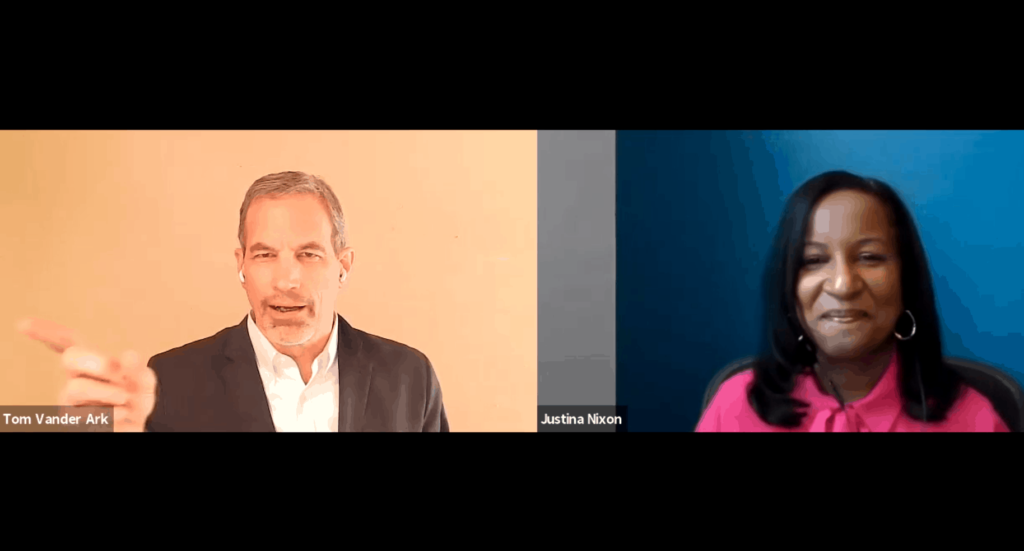
You’re listening to the Getting Smart podcast, where we unpack what is new and innovative in education. I’m your host Jessica, and today we’re sitting down with Justina Nixon-Saintiel, IBM Vice President and Global Head Corporate Social Responsibility. Justina drives strategic, socially responsible, programmatic investments that enable IBM’s technology and talent to address some of society’s biggest challenges worldwide. She also leads initiatives like P-Tech, Open P-Tech, and SkillsBuild, and uses multi-sector partnerships to help create more inclusive and innovative schools and workforces. Justina was also Verizon’s liaison to President Obama’s White House Office of Science and Technology, U.S. Departments of the Interior, and U.S. Department of Education.
Earlier in her career, she was an engineer for the U.S. Department of Energy. Let’s listen in as Tom and Justina talk about her unique trajectory from engineering to social responsibility, the future of IBM, and much more. Justina Nixon-Saintiel, welcome to the Getting Smart podcast. Thank you. I’m happy to be here. Hey, we’re thrilled to talk with you today about education because you have such an interesting background.
You’ve been a tech exec at a couple of the country’s largest technology firms. Like me, you’re an engineer and an MBA, you’re a mother of three. But I get the sense that you had a bit of a non-traditional approach to becoming a mechanical engineer at SUNY Buffalo. How did that happen? Yeah, no, that’s very interesting.
And I wouldn’t say I had a non-traditional approach. However, it was very challenging for me. I think obtaining my big practical engineering degree was one of the most challenging things I’ve done. And when I went to college was when I realized that a lot of my peers were stronger in a lot of subjects versus where I came from. So I can just give you a little bit of my background.
I’m an immigrant who came from Dominica, a very small island in the Caribbean. We settled in the South Bronx, and my family was very focused on getting a good education. So my mom, who was a teacher when we were in Dominica, when she came to the United States, she spent many years getting her teaching certificate in the United States. So education was a priority for us. And I was very interested, always curious as a child.
I would take a lot of different items apart at home. And I can tell you, my siblings did not always enjoy that. And they kept me away from taking apart our only TV in the house. So, Steve, were you the kid that took the vacuum cleaner apart and tried to put it back together? I didn’t do the vacuum cleaner, but I can tell you, I did a small radio that belonged to my older brother.
I took apart our typewriter, of course. You know, this was before we had computers. So I was a very curious kid. And in high school, I really excelled in math. And my older sister mentioned about engineering.
I never had exposure to engineers. I didn’t really fully understand what engineers did, but I applied to the School of Engineering at the University of Buffalo and was accepted. And it was very challenging to get through the coursework, especially when many of my peers were already advanced in physics and calculus and so many other subjects. But I was able to get through it and it was one of the best things that I ever did.
I imagine your classes were mostly white guys? Yes. And I have to tell you, Tom, I was not the person that was mainly embraced in some of those study groups. So it was a tough one for me because, number one, I was the only African American female who graduated with a mechanical engineer and degree in my year. So I did not have a lot of people around me who looked like me. There were not a lot of females either.
So to be able to get into the right groups or seek mentors to get the right help, it just took me a little bit, you know, more time to find the right resources. But I did have guidance counselors and people who helped and, you know, it helped me obtain, you know, internships and eventually a job. So I am thankful for those who stepped in. Christina, I just want to underscore that even for a good student like you that was strong in mathematics that you hadn’t imagined yourself as an engineer.
And it just strikes me that we have to do a much better job at introducing young people to possible futures, particularly in the STEM fields and do that much earlier, right? Oh, absolutely. You know, I grew up in an area where you did not see engineers, you did not meet with them. I mean, I was exposed to educators, of course, I was exposed to doctors during my annual visits, exposed to retail. But it was not something I was exposed to. And again, it was a long time ago.
I think now there’s so many more business partnerships with education, a lot of public private partnerships that enable students to get exposure to STEM. I mean, when you think about what IBM is doing in high schools, in colleges, you know, providing mentors, providing education in cybersecurity and AI and blockchain, you know, topics that a lot of under-resourced students would not have access to by providing those public private partnerships, more and more students today are getting the kind of exposure that I did not get, you know, over 40 years ago. So I think there is improvement, but there’s more that needs to be done. And just seeing it in a couple of minutes, we’re going to come back and talk about P-TECH, one of my favorite subjects, because it combines rigorous STEM high school, college credit and high tech work experiences.
So we have to find ways to create more access to those kind of high school learning opportunities. But first, I’d love to have you just reflect on the state of corporate social responsibility. You had an executive role at Verizon and you’ve now stepped into that role at IBM. And I know you can’t speak for the tech sector, but are you encouraged by the response of leading companies like IBM to really live into their corporate social responsibility? Oh, absolutely. One of the things that I’ve enjoyed at IBM in my last three months is that you see social purpose woven into the fabric of the company. So it’s not just something that you see within the CSR organization. You see it in research where there’s a focus on future of automation, future of healthcare, future of climate.
You see it in our university relations team where they’re working with academia to bring the right skills and education to universities. I was so impressed by the announcement we made with HBCUs where we are bringing them all quantum technologies and actually creating quantum centers at universities like Howard. So we are across the board a social purpose company. And I think just overall, especially today, there’s such an emphasis on CSR. Whether it’s clients who want to have access to your ESG data, environmental, social governance data around DNI, around what are you doing around climate protection. Before they actually ink deals with companies, they want to have that information to make a decision.
When you see potential employees making a decision as to what company they want to work for, they look for CSR information. They want to know what companies are doing for society. And in general, communities, especially black and brown communities, under-resourced communities, they’re looking for corporations to help them, to invest in them. So I think it’s always been of importance to companies like IBM, but the focus on it is even more so now more than ever, and the need for it has increased. So I am very impressed with the work that IBM has done and again how it’s warping throughout the company and really proud of our culture around it. IBM’s leadership in artificial intelligence makes your stance on corporate social responsibility more important than ever.
It’s this two sides to the sword. It’s one of the most powerful tools that human beings have ever built for good. And we’re beginning to understand that it can also incorporate if we’re not careful and transparent bias that disadvantages companies. So I really appreciate your leadership on CSR at IBM. Yeah, I mean, when you look at AI and the work that we’re doing there, and I think last year we made a statement around how we are sunsetting certain AI technologies that could lead to bias. What I love about IBM is that there’s an AI ethics board, and it is woven again through all the decisions that are made around our technologies, what we call tech for good.
So we make sure that we have principles of trust and transparency in everything that we do around AI. I appreciate that you made a strong statement around misuses of facial recognition that I think was a really important leadership role. So thanks for that. This is really a personal sort of policy question, Justina. I guess I’m increasingly worried about inequity in America. I was concerned about that in 2019 and then the pandemic accelerated so many trends, but particularly inequity.
And when we look at climate change, we look at the tech economy and then the pandemic that these are layers of factors that seem to be accelerating inequity in our society, particularly for women and for people of color. I guess how do you think about that and how does that fit into your role at IBM? Women continue to bear the brunt of duties at home. And when the pandemic hit, so many women had to exit the workforce because they had children at home who were learning, who could no longer go to daycare or go to grandma’s house, you know, grandpa’s house. And this is something that needs to be corrected.
I actually heard a statistic this morning and I wrote this down because I think it’s so important. The World Economic Forum said that the runway to gender parity has lengthened for women from 99 years to 135 years because of the pandemic. So there needs to be a real focus on how women re-enter the workforce, the flexibility that women sometimes need if they do not have a spouse or partner who can really help them at home and share the duties. And making sure they have the skills, the development, the mentorship they need to thrive in the workplace. And it’s not just a woman’s issue. You’re absolutely correct. It’s an issue around low income populations as well.
Black and brown communities that have also been left out of the workforce or have been hit really hard with the pandemic. So I definitely think that those are the types of communities that we want to focus on from a CSR perspective and whether it’s bringing our P-Tech program to the right schools, our skills build program where we empower and provide the skills needed for women and minorities and under-resourced populations to move into the workforce and get meaningful jobs. We have to make sure we have the right partnerships to enable these populations to be successful. But it means we have to be focused on this. It can just be a general practice. We have to be very targeted and intentional in working with women, in working with vulnerable populations to make this happen.
Our colleague Byron Auguste at Opportunities at Work thinks that skills-based hiring is one of the strategies that we can use to attack inequity. So many companies in sort of an unthinking legacy way just say every job requires a four-year degree. And increasingly those degrees don’t do a very good job of matching up with the skills of a particular job. And so I guess our sense, I think our shared sense is that skills-based hiring is part of the solution. And I know IBM has been a leader in both credentialing and moving towards skills-based hiring. Tell us more about that.
Yeah, absolutely. We have coined the term new-collar jobs for many years. And what we mean by that are jobs that do not require a four-year degree. In fact, 15% of IBM’s hires do not require a four-year degree. And the goal is that that number will increase over time. So you have jobs in data analytics or in cybersecurity where you can have an associate’s degree, you can have a certificate, and have the right technical skills, and also those professional skills to be successful, and have a meaningful job where you can support yourself and your family and a better life.
So we are very focused on skilling and making sure that adults have certificate programs, credential programs, so that they could move into a job without the burden of a college degree or debt from a college degree. Or they may not be able to attain that degree because of other commitments they have in their life. You can still be successful with a two-year associate’s degree or the right certificate program with the new-collar concept. So we are very proud of a platform that we launched globally just a couple of weeks ago called SkillsBuild. And it is a free digital platform that allows anyone to access and get the right skills so that they could be, they could move into a meaningful job. What I really like about SkillsBuild is more than just a platform, it’s really a program because we’re partnering with nonprofits on the ground that could reach those marginalized populations or reach women who have been left out of the tech workforce. So I do think it’s important that we don’t continue to focus on a four-year degree. Of course, it is a huge goal and it is a goal that many people should have. In fact, a lot of our P-Tech students attain a four-year degree, but the idea behind this is you should not have to to have a successful career.
Justina, IBM has been a leader in digital credentials for more than a decade. If our listeners just Google IBM digital credentials, they’ll find amazing resources, both learning resources and credentialing resources available. Anything else you’d like to add about that, your leadership in digital credentials? The only thing I would add is that digital credentials can really demonstrate your knowledge and skills and one more companies are accepting those credentials. So it’s really around consortiums of companies coming together and saying, these are the skills that we need. This credential will help support those skills and really making a concerted effort to hire the people that attain those credentials. And IBM has been a leader in that space working with industry partners all over the world to make that happen. So yes, absolutely. That is something that continues to be a focus of ours and we are leading the charge with the digital credential workplace.
Justina, about 20 years ago, a group launched the early college high school initiative that resulted in about 300 great high schools that combine high school and an associates degree. I think five or six years ago, IBM stepped in and really reinvigorated that movement and added high tech work experience to it and called that P-Tech. So I really appreciate IBM’s leadership there. What’s going on with P-Tech? Well, it was actually 10 years ago, not five years ago. So the P-Tech 10 year anniversary is this year and we’re looking forward to celebrating the impact we’ve had. Not just on the schools that started in the program in the US, but we’ve actually expanded the program to 28 countries and we have 240 schools in the program today, partnering with 200 community colleges and 600 industry partners.
So we are really, really proud of the scale of the program and the impact we’re having. But really this goes back to the fact that we strongly believe that a zip code should not determine your future. And we worked with the most under-resourced schools in the country to bring the workplace learning skills, the mentorship, making sure that they had free access to community college courses and providing them with the internships when they graduate. And we are really proud because we made a commitment last year that we were going to hire a thousand P-Tech graduates at IBM this year and we have almost completed that search for those P-Tech graduate students. So we’re going to have a thousand students roaming IBM virtually in really meaningful internships starting this summer. So we are really, really proud of that. That’s super exciting. I want to break this down for our listeners. So P-Tech graduates get a high school diploma, they get college credit up to an associate’s degree, they get high-tech work experience either at IBM or at another technology partner, and there’s often an employment opportunity. Is that right?
That’s correct. We’ve actually hired students who have gone through the P-Tech program and we work with many industry partners who have done the same. And what’s really important here is that that associate’s degree is completely free. So there’s no burden on our students to pay for college. We partner with state education departments, with the districts, and again with industry partners to make sure that entire pipeline to that associate’s degree is completely free for the student. Justina, I want to give a big shout out to Dallas ISD, the nation’s leader in both early college and P-Tech. Every one of their comprehensive high school either has an early college or a P-Tech at the campus. It’s just so exciting to see a big urban district like that. Make sure that every neighborhood in Dallas has access to this sort of education. Dallas is a rock star and actually we are going to create a case study around Dallas because it’s one of the best implementations that we’ve seen around P-Tech and it’s a model that should be replicated everywhere.
I want to quote for that. I’m a Dallas groupie. I love what they’ve done and I appreciate their P-Tech leadership. Justina, what’s open P-Tech? Yeah, so in response to COVID last year, we created a digital platform so that everyone can access the same types of content and curriculum that we bring into our P-Tech schools. So on open P-Tech, we have STEM content, we have teacher training, and we provide those soft skills to, you know, presentation skills, creative thinking skills, even mindfulness. So we provide a lot of different skills and exposure to STEM for students on open P-Tech. Again, freely available to everyone. In fact, one of the most, one of the courses that most students access is around cybersecurity, followed by blockchain and AI, but definitely a huge interest in cybersecurity.
Our goal is to reach around 500,000 students by the end of the year on that platform, and those students earn badges that they could use for employment or for their applications to college. So really excited about the growth of open P-Tech. Justina, you recently joined IBM, one of the world’s leaders in artificial intelligence. What applications of AI are you most excited about? Well, just because I’m in the education space, I’m really excited what we can do with AI for learning and development, and we already have it underpinning all of our digital platforms. But in addition to that, I’m excited about transportation and what is going to mean in that space. I think healthcare, manufacturing, retail, you name it.
But I really think AI is going to be a part of every industry, every job. What’s important, though, to understand is, I don’t think AI is going to replace anyone’s regular job, right? It augments it. It makes things more efficient. It helps us learn. It creates better and new processes. And I think what’s important is that young people need to understand what AI means for them. So I think as early as possible, they should understand that when they talk into a voice-activated product, that’s AI. When they’re on the Internet and they’re being targeted by ads, that’s AI.
When they use banking or any of the other products that they see their parents using, that’s AI. So I think the education about AI should start as early as possible. And then as you move up in education, once you start getting into the middle school, high school level and college, you really need to understand what are the skills that you need to be successful in a job that leverages AI. So whether it’s through OpenPetech or PTECH program or even SkillsBuild, we provide those skills and we also provide teacher training. So teachers can expose their students to AI and also create opportunities around it.
So I mean, as you know, IBM is the leader in this space. We have our Watson product that’s being used in so many industries. And I’m really excited about the opportunity to work with AI and bring it into our initiatives. Justina, how do you keep learning? You’re on a steep, you must be learning on multiple dimensions. How do you reflect on yourself as a successful learner? What works for you? That is such a great question because just the other day I was chatting with my husband and I said, unless I decide not to sleep,
I don’t know how I’m going to get my hands across all of the different technologies of IBM and understand how to use it in our work. But that’s a big priority for me. So the first thing I would say is I continue learning by surrounding myself with really smart people. And that is not difficult to do at a company like IBM. But I also, if I have 30 minutes or an hour in the week, I attend virtual conferences where they’re talking about ESG, where they’re talking about CSR and societal impact. And that’s one way I learn from experts and especially the people that are out there doing the work day in, day out.
But the best learning I’ve ever done is really just listening to the people around me, my peers, my team members, and really just, you know, really, really smart people. And, you know, before you know it, I will be completely well-versed in blockchain, quantum, and all of the other technologies that IBM offers. Justina Nixon-Taynqiel, she’s the global head of corporate social responsibility at IBM. Thanks for joining us on the Getting Smart podcast. All right. It was my pleasure. Thank you. Another thanks to our podcast sponsor ScreenCastify. To learn more about the power of video to engage learners, check out screencastify.com.
There’s a link in the show notes as well. For the Getting Smart podcast, this is Jessica, signing off.



0 Comments
Leave a Comment
Your email address will not be published. All fields are required.