

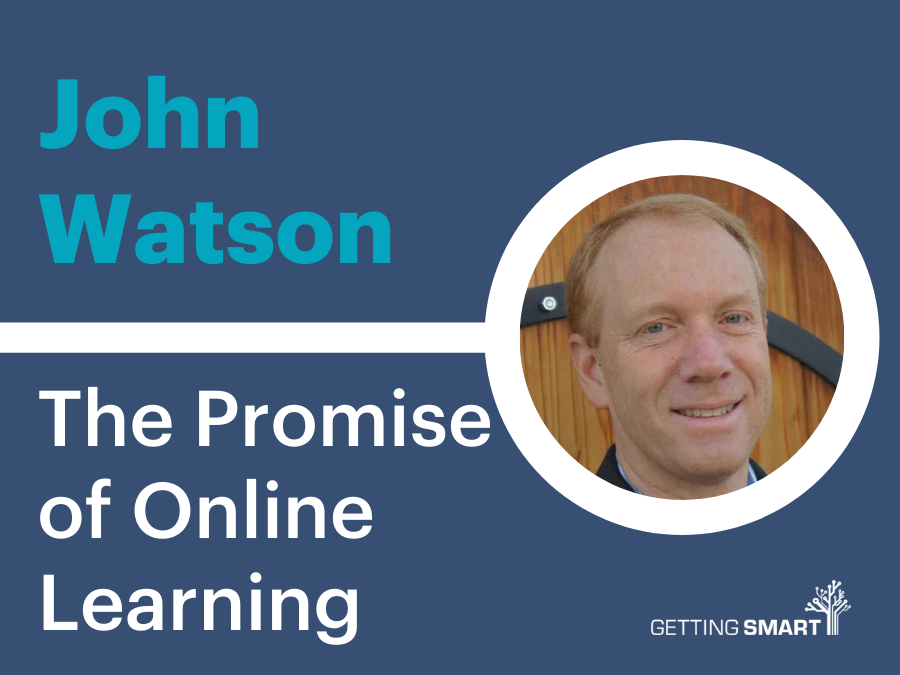
John Watson on the Promise of Online Learning
 “Online has been a niche for 25 years now — examples of really good online learning exist. We’ve seen the emergence of a lot of online hybrid schools.” John took a moment to call out the people at the recent DLAC conference who said “I didnt know this was going on!” One attendee even said “Coming to DLAC I thought I was diving into an olympic sized swimming pool, after being there for three days I realized it’s more like the Pacific Ocean. So much opportunity, so much to learn.”
“Im not interested in the next interesting technology. I’m interested in the next district state or system that catches up to use the technology.”
“Online has been a niche for 25 years now — examples of really good online learning exist. We’ve seen the emergence of a lot of online hybrid schools.” John took a moment to call out the people at the recent DLAC conference who said “I didnt know this was going on!” One attendee even said “Coming to DLAC I thought I was diving into an olympic sized swimming pool, after being there for three days I realized it’s more like the Pacific Ocean. So much opportunity, so much to learn.”
“Im not interested in the next interesting technology. I’m interested in the next district state or system that catches up to use the technology.”
Transcript
This transcript has not been edited for spelling accuracy.
This episode of the Getting Smart podcast is brought to you by Screencastify, a tool made by teachers, for teachers, that makes it easy to record, edit, and share videos of your computer screen. Educators created over 100 million videos with Screencastify in 2020 alone, and it’s likely that some of those videos were created in your district. Contact Screencastify for more information on why they’re the premier video solution for educators, and to get a custom usage data report on your district’s teachers who are already creating with Screencastify.
Head to Screencastify.com slash Getting Smart, or click the link in the show notes or the blog for this episode. All right, let’s get to the show. You’re listening to the Getting Smart podcast. I’m Tom Vanderek. I’m joined this week by John Watson, the founder of Evergreen Education Group.
John, as you may know, is the leading expert on online learning. He recently hosted the Digital Learning Annual Conference. John, welcome to the Getting Smart podcast. Thanks for having me on, Tom. How was your conference?
It was fantastic. It was… Was it in person? We had 500 people on site in Austin. We had 700 online for the folks who were on site in Austin.
I think for most of them, it was the first gathering anywhere close to that size since pre-pandemic. And so it was just a fantastic vibe. And I think a lot of that came through with the online portion as well. We were live streaming some sessions out of Austin, and it just felt great. Who comes to the conference?
We are focused, as in all of our work, on the broad range of K-12 digital learning. Most of our attendees are school and district leaders, state agency folks, nonprofit organizations, companies, researchers as well, I should mention. The full range within K-12 education. We have some private schools. We have public charter, private, as well as online blended hybrid mainstream, the full gamut of different school and district types.
It’s interesting, John, do you feel like in some respects the world came to you in the last two years? Online was a little bit sort of around the edges of traditional education, and suddenly everybody in the world was learning online. We’ve said that many times in the last 15 months. We were niche for a very long time, and then all of a sudden we weren’t. I’d love to just hear you talk about the status of online learning in America.
Maybe you could start just pre-pandemic. How many learners in K-12 were learning primarily online in America? Do you have a sense of that? It depends on how you define online. We do a number of counts around these issues.
There are probably around 400 to 500,000 students attending full-time online schools pre-pandemic. We count those primarily around the charter schools because there are some district schools that are a bit harder to count. And those are the schools in which students never attended a physical school. On top of that, there were millions of students who were taking one or two online courses while enrolled in a mainstream school. And then on top of that, there were untold millions of students probably getting close to all students who were using some form of digital tools and resources.
So as you know from your long history in this space, that’s been the evolution. If you go back 20 years or so, there were small numbers of students in the online courses and in online schools. Those numbers have increased steadily, perhaps somewhat slowly, but steadily. The real growth has been within the mainstream districts with those tools and resources as opposed to the online schools and fully online courses. What do you think the full-time online enrollment K-12 will be in the fall?
And will that be 50 or 100,000 up from pre-pandemic? Almost certainly, yes. We are right now gathering the data for what were the numbers during the pandemic. And the online schools saw very, very significant increases. Of course, some were flat, but some online schools and providers saw increases of 30, 50% or more, in some cases as much as doubling.
Now, of course, some of those students and families are going to be going back to their mainstream schools full-time. But we’ve heard from a lot of folks, students and parents, saying they didn’t know about that option pre-pandemic. Now they do, and they want to stick with it. John, I’m thinking the last time we saw each other, we went for a bike ride a couple years ago. And since then, video became a thing.
Was that a big and important addition to online education over the last two years? I think it’s a very significant change, and I think some framing of this is valuable. When you look at the distinction between what we’ve been calling emergency remote learning, right? That’s what districts who were on site had to do once the pandemic hit. They had to shift to emergency remote learning over a weekend or a week.
And that, of course, was very different than what you and I knew of pre-pandemic online learning, which tended to be asynchronous primarily with some limited use of video. Now it’s pretty clear that putting a student in front of a camera or listening to a live video lecture for, let’s say, six hours a day is clearly suboptimal. That’s not a great approach. A lot of mainstream districts learn that over time, right?
So we saw changes happening during the pandemic. The interesting thing as well is those online schools that had a long history that was a bit more asynchronous started incorporating more synchronous video into their courses and into the communication between their teachers and students. And I think that’s a very positive thing. One of the interesting things that we saw was the more experienced online schools and course providers
were using video in different ways, a little bit less for direct instruction and a little bit more to connect with students. Thinking about that social and emotional connection that happens between a teacher and students as well as between students, that’s clearly facilitated by real-time video. That’s the kind of usage of video that we saw by the experienced online schools during the course of the pandemic. There’s been a generally negative supposition about online learning and some of that
was expanded during the pandemic. But I want to note the really bad extremes of online learning that we saw ranging from all lousy asynchronous content done remotely, or as you described, all video trying to replicate a regular school day, but just videoing into a classroom. And both of those extremes of all bad async content and trying to replicate school as a Zoom classroom, both are things that we wouldn’t consider to be high-quality online learning, right?
Absolutely correct. Even pre-pandemic, we often said, look, online isn’t a magic bullet. It’s not like you could say, hey, we’re online and you’ve magically got a great product, a great course, a great school, a great outcome. Instead, it needs to be well-planned, well-thought-out, well- implemented, assessed, evaluated, adjusted, etc. We knew that. And in fact, when we’ve seen new online schools or new online or hybrid, we should talk about that as well,
there’s some distinctions between hybrid and online. But when we’ve looked at the development of new online and hybrid schools over the years, experienced educators will often say, look, it took two or three years for me to get really comfortable in this new environment. And so we know that there’s good practice and there’s bad practice. We know that it takes a while for educators to get comfortable in that new environment. And when you go back and you think about, look,
there’s good practice and bad practice, it’s a lot like a brick-and-mortar school, right? Putting a school building out doesn’t mean that there’s going to be good instruction and good learning in it. And that’s the exact same situation within the online environment. Jen, maybe for our listeners, you could, who might not be familiar with online learning, what would you, how would you describe sort of best practice today? And maybe you could give us
a picture of what might a upper elementary learning experience look like and then give us a picture of what a, what a rich high school day might be. But from sort of what you’d consider best practice, I would you describe the learner experience today in a full-time online school? First, I’ll say there’s a lot of different practices that vary by grade level. And so that’s, that’s important to understand. Right. Second thing that’s really critical to understand is that
good online schools are building really strong relationships between adults and online students. Now oftentimes that’s between a teacher and the students or multiple teachers and, and students. It also often is a counselor, a mentor, a student champion, somebody like that. These students talk about that a lot, the connection that they have with a caring adult, whether that’s a teacher or somebody in another role. At the high school level, what we’ll see is that students will tend to have
more flexibility. They’re in a bit more control. There’s more student agency about what are they, what courses are they choosing to take? How are they spending their time? They may be in a bit more of a situation where once they are taking control of their education, they’re reaching out to their teacher a bit more than the teacher having to consistently reach out to the student. The student is working a bit more self-paced and a bit more of a flexible schedule. A lot of these students
will talk about how that flexibility allows them to pursue another interest, whether it’s a career related, a job, an internship, a sport, theater, dance, etc. We hear these stories from students. We also hear from students who may have had mental health or physical health issues for whom the flexibility is so critically valuable. Pre-pandemic, I think there was this sense, as you mentioned earlier, that this was a small number of students. But if you’re familiar with
some of the concepts of the end of average, for instance, in fact, when you think about students who have individual interests, students who have different pursuits, students who may have different personal issues that they have to address, that’s a lot of students, right? And so the idea that this should just be niche, I think that that may be relegated to a pre-pandemic view, and I think that would be a great thing. Now, when you think of the other extreme of student ages, what does
this mean for, let’s say, a second grader? Well, if you’re talking about a second grader in a fully online school, you’re talking about a student who will probably be using some video to connect with teachers, as well as having a learning coach, maybe a parent, maybe a relative, maybe some other caring adult who’s in the home with that student who is playing a very valuable support and instructional role. The other element with those youngest students is the online school is probably
sending that student and the caregiver a set of non-digital materials, physical books, books to read, workbooks, manipulative science labs, you know, things like that, as well as the teachers are more likely to say, let’s say it’s a science class of some sort, or they’re thinking about science, they may say, go outside and see what you see and come back and tell us about it, you know, if you’re talking about clouds or rain, weather, etc., they’re incorporating a lot of offline experiences into the
online school environment. It’s so critical to think this way because I don’t know of any good online schools that have kids in front of computers for six hours a day. John, are you seeing more project-based learning being incorporated into models and if not, why not? Yes, there is more. I don’t know that it is accelerating as much as project-based learning proponents might like to see. It feels to me like in pre-pandemic,
there were two areas that a lot of educators were talking about. Project-based learning was one, and this is unrelated, but it was just another area that it seemed to be coming up a lot, was SEL, social-emotional learning. Well, during the pandemic, SEL became front and center for every student in the country, as well as just about every teacher and probably most adults as well, and so again, even though there’s not necessarily a reason to think those are substitutes for each
other in any way, it does feel like a lot of schools, districts, and individual teachers as they were thinking about, okay, where do we need to focus perhaps complementing or in addition to the academic content, sometimes really going front and center, and that was really social-emotional learning in the last 15 months during the pandemic in particular. I think it’s going to be a good thing if our system continues to focus on the social-emotional needs of students and teachers.
I think we’re going to see more use of project-based learning in different situations as well. John, we saw innovation frequently called pods, but nano-schools, these very small groups of students often forming around an online resource or an online school. Was there a lot of conversation about pods at the conference, and is this a structure we’re likely to see more of going forward? I think the jury’s still out. There’s no question that pods
were able to support students and families during the pandemic. When we think about what’s going to come out of the pandemic in education and continue going forward, I think there’s reasons to think pods might continue, and there’s actually really good reasons to think pods might not continue as well. I do think there are equity issues around pods. I think it’s far easier to envision a pod when you’re talking about upper-income parents, for instance, who have more flexibility
around their work. Perhaps there’s a non-working parent who’s able to support a pod compared to the wider range of families and whether they’re able to support their kids in that way. Phrases the question of will either schools themselves or NGOs, social organizations, churches, etc. might they be able to provide pods in some form or fashion also? I think it’s a really interesting idea. I think the different ways that different community groups, whether
existing formal community groups or informal groups of families, can support students in their education in different ways. I think those are great conversations to be having going forward, but I think it’s way too early to know what pods are going to look like. Our friend, Kelly Smith, who started Prenda in Arizona saw extraordinary growth. I think he’s over 400 of these nano schools or pods on the Prenda platform. I like Prenda because I appreciate the
way Kelly sort of reimagined the learning day between these skill sprints and projects and collaborative activities. Do you think we’ll see models like Prenda expanding across the country? I think that’s the key question actually. Are we going to see replicable models like that, that the people who are interested in pods can tap into? Because what we were seeing in the early days of the pandemic with these pods sprouting up in different places was essentially
so many of these groups had to figure it out for themselves. They were all one-offs every time and that’s a pretty big challenge. I think the question going forward is will organizations like Prenda and others be able to provide a replicable low enough cost, high enough quality approach to the pods? Then I think the other related issue is what’s the exact relationship between the pod provider or pod supporter with the school as well. As you know,
you think about all these different flavors of school, whether it’s a mainstream school, mainstream district, charter school, private school, independent study. I think you’re going to see different elements of what you might call the mainstream system either more adaptable towards supporting pods or less adaptable to supporting pods. I also think we’re going to see differences by state. We’ve already seen that and we’re seeing it right now. Unfortunately, we’re seeing some
really bad policies related to online learning coming out of some states and I think some of that’s going to impact how we think about pods as well as how we think about some other innovations as well. We are already seeing some states and some districts closing down or restricting online and virtual learning. Can I assume you think that’s a really bad idea? It’s a terrible idea and I feel like it is based on this really, really fundamental
misconception and that misconception is the conflating of emergency remote learning, as I mentioned earlier, with online learning. It’s also conflating the idea that during the pandemic in a lot of situations 100% of students had to shift to emergency remote learning, but as you know, online learning was never meant for everybody. You and I for a long time have been advocates around online learning as much as anybody else, but I have never said I don’t think
you’ve ever said that it should be for every student. When you look at places like New York and New Jersey and there’s other states as well that have said every kid needs to be back in a physical school, I just want to look at those folks and say have you talked to some of the students who had a great experience being online? Have you talked with some of the parents who have said this was the best thing that’s happened to my child? Why would you take that away? It doesn’t
make sense to me at all. It seems like a horrible idea and one that ignores many of the lessons of the pandemic. I’d like you would love to see every family and every learner have access to high quality online learning as a choice and would love to see every secondary student have access to course choice where they on a course by course basis have a high quality online option. So heartbreaking to see cities like New York
squelch that option for families and hope we see some reversal of that happening with family pushback. I fully support the idea that every student in this country should have the opportunity to go back to a full-time on-site school in the fall. There’s no question about that of course that would change if there’s a new surge of the pandemic but I don’t think that’s going to happen so let’s leave that aside. Every student should have a full-time on-site option
but to me there’s no question that every student should have online and hybrid and blended options as well and saying that every student should have an on-site option does not equate to you take away the online option. Those are two different things. It should be about options for all students and all families. John we’ve talked about some negative examples of districts and states doing some really dumb things to restrict online and virtual learning but do you see some
states taking positive steps to take some of the lessons from pandemic education forward and increase access to quality online learning? At the state level unfortunately right now it’s mostly a defensive action to make sure that they don’t pass poor laws and implement poor new policies. At the same time though what we’re seeing that gives me a lot of optimism is the number of districts that are creating online and hybrid schools and programs for the first time and so
the reason to be optimistic is that we’ve got all these students who have now had a remote learning experience. Some weren’t great but a lot were really good and now we see districts responding to that and I’m optimistic that this groundswell of it’s probably like 10 times as many students and families who have had a really good experience with online learning than had ever experienced online learning pre-pandemic. Eventually I hope that’s going to make its way up through
the system and result in better access, more options and other really positive policies. John as you look forward to the future what are you excited about when you think about full and part-time online learning? What are the developments that you’re jazzed about? It’s really a summary of some of the things that we’re talking about in the sense that as you said at the very start of this conversation online has been a niche for approaching 25 years now right?
We know now that the examples exist examples of really good online learning exist over the last five or seven years or so we’ve seen the emergence of a lot of hybrid schools that we’re doing a really good job of combining online and on-site and we’re seeing them in interesting places. Massachusetts for instance isn’t known as a hotbed of online learning activity but I shared a platform with two founders of a school called the MAP Academy in Massachusetts who had created a hybrid school.
We’re going to see a lot more of that going forward and it’s exciting. We saw this in Austin and at D-Vac online this mix of the really experienced folks like you and the folks that you work with and all these people who are new and one of the things that’s so exciting is the number of people who join us in any sense look around and say I didn’t know this was going on. I didn’t know that this was all out here. Somebody in response to our conference wrote he said coming to D-Vac
I thought I was diving into an Olympic-sized swimming pool and I was going to see all this amazing stuff. After being there for three days I realized it’s actually like the Pacific Ocean. There is just endless opportunity and there’s so much to learn and we’re seeing those positive impacts and those positive developments for teachers and families and students and that to me is what’s exciting. Online has been a niche. It’s growing now. There’s more and more opportunity.
In the past there’s rarely been a combination of large scale and positive impact. There are exceptions. There are some very good schools and programs that have achieved both but they’ve tended to be outliers. When you look at some of the most prominent examples they often tend to be pretty small. I think what we’re seeing now is this next stage of evolution around digital where you see that combination of positive impact on student opportunities and outcomes and scale so
it’s reaching a large number of students. In the past there’s been a few of those. In the future I think we’re going to see a lot of those. John I want to riff on a couple of the things that you said. We’ve had the good fortune to work coast to coast with different communities launching new micro schools that really take the best of onsite resources taking advantage of community assets and incorporating blended and online learning in a very small setting. It might be 30, 40, 50
students but really strong relationships and access to a world of opportunity and so it’s been really exciting to see people inspired by a new sense of what’s possible creating these new school formats and we’re excited about some elementary schools as well as a lot of new high schools being formed and it sounds like there was some enthusiasm for that at the conference. Undoubtedly the ways that technology can be used creatively I think are becoming
more and more clear. You’ve been thinking about these issues for a long time and very thoughtfully around issues like the idea that technology moves much more quickly than human systems right? You’ve talked about this and I think what we’re seeing now is the human systems catching up to the technology. I get asked all the time what’s the next interesting technology? My answer is I’m not interested in the next quote-unquote interesting technology. I’m interested in the next
district, school, state or other organization that catches up to being able to use existing technologies in a much broader and impactful way. We’ve been talking to John Watson, Evergreen Education Group. John’s the world’s leading expert on online learning. John has been great to catch up. Congratulations on a great conference. I’m sure it was great to be in person with a lot of folks that you have been online with for two years. It was great to have
them in person. It was great to have the online folks as well be able to share what we were doing in Austin and I appreciate the opportunity to chat with you, Tom. We appreciate your insights on what we think is going to continue to be an accelerating trend that’s online learning. Thanks for listening. Keep learning and keep innovating. Another thanks to our podcast sponsor Screencastify. To learn more about the power of video to
engage learners, check out screencastify.com slash Getting Smart. There’s a link in the show notes as well. For the Getting Smart podcast, this is Jessica signing off.
0 Comments
Leave a Comment
Your email address will not be published. All fields are required.