

Fernande Raine on The Power of Participation and Our Civic Future
Key Points
-
Civics education should evolve from fact-based instruction to fostering active participation, pluralism, and critical thinking.
-
Schools must create opportunities for students to connect with their communities through meaningful projects, ensuring they feel seen and valued.
Shownotes





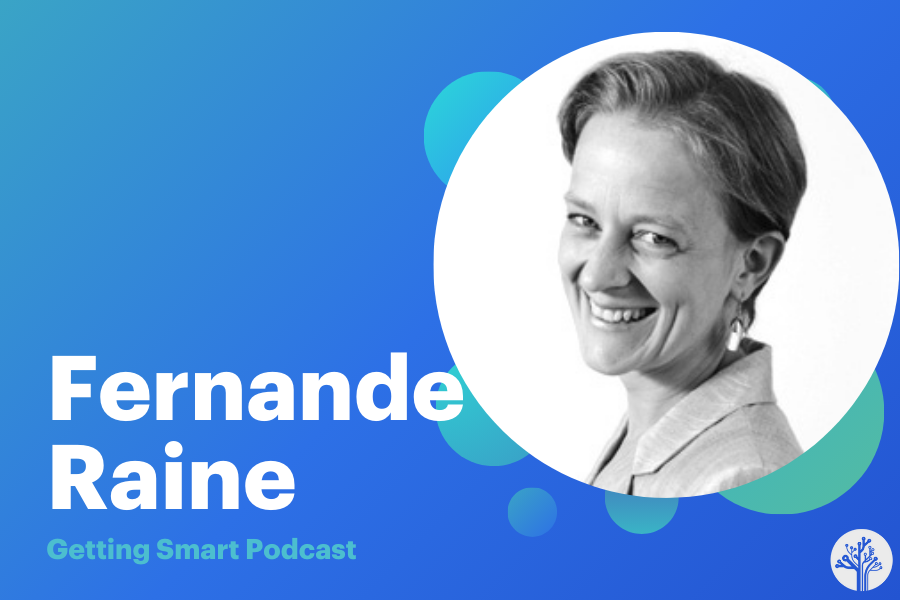
In this episode of the Getting Smart Podcast, Nate McClennen sits down with Fernande Raine, founder of the History CoLab, to explore the critical role of civics and humanities in shaping the future of education and empowering young people. They discuss the intersection of crises—disconnection, democracy challenges, and AI disruption—and how these challenges demand a reinvention of civic education. The conversation highlights the “18 by 18” framework, which outlines 18 key learning journeys for students to complete by age 18, and the importance of designing education to foster participation, connection, and purpose. Dive into this insightful discussion to learn how fostering civic engagement and leveraging the humanities can equip students to thrive as active, purpose-driven citizens in an evolving world.
Outline
- (00:00) The State of Civics Education
- (09:25) Understanding the Three Crises
- (14:26) Historical Context of American Civics
- (19:08) Building Multi-Perspectivity in Learning
- (23:44) Purpose and Potential in Youth Development
The State of Civics Education
Nate McClennen: Welcome, everybody. You’re listening to the Getting Smart podcast, and I am Nate McClennen. I’m excited today because we’re talking about the super important purpose of public education, which is about how we reestablish the idea of participation in civic engagement in schools. We’ve been focused on workplace skills for a long time, really thinking about pathways to careers.
And it makes sense because they’re an economic driver, but we’ve been less focused on citizenship and civic engagement as an intentional part of schooling. Yet, I think we all would agree that we need this more than ever. So, how do we best prepare young people to participate and give them the power to participate through their K-12 experiences?
That’s the whole thought and premise behind our podcast for today, and I’m super excited to have a repeat guest, Fernande Raine, who’s the founder of the History Co:Lab. The Co:Lab is a design and innovation lab for civics and humanities. So, Fernande thinks about this every single day. Fernande, welcome. Excited to have you here.
Fernande Raine: I am so excited to be here, Nate.
Nate McClennen: Awesome. So, we’re going to start today with a really easy question. What are you most excited about in your work right now?
Fernande Raine: Well, Nate, it’s an easy question and yet one that’s going to be hard to answer briefly because there’s so much I’m excited about right now. Partially because, you know, when the going gets tough and the world gets complicated, people who do history and the humanities—that’s our jam, right? When the world gets really rough and the path forward looks fuzzy, historians and people who think about what it takes to be human, what it takes to get us out of this mess, how we can move forward, where we get hope, and what are some good ideas—that’s exactly what we do.
So, for me, the moment we’re in is a sort of boom time for the world of humanities, particularly with the curveball of AI, right? Everyone’s like, “Wait a minute, we need to think about what it is to be really human.” And I’m like, “Yep, that’s exactly what we’ve been talking about for a long time.” The need to focus on the humanities, history, philosophy, and ideas—on the kind of learning that helps us thrive as human beings in connection with other people—is becoming a hot topic, which it hasn’t been for a very long time.
So, I’m feeling like we’re at the beginning of a wave where the stuff I care about most is becoming the thing people are asking for with the most urgency.
Nate McClennen: I love that. I think you had your first mic drop of the podcast today, which was “boom time for humanities.” It makes me think about how we’ve been in these places before. The context changes, the technology changes, but we’ve had challenges and opportunities before. Historians are the people recording this and hopefully helping us learn from history. So, I, too, am super excited. It’s a unique opportunity.
I think this conversation is about the power of participation. It emerged because we had written this book—Tom, Emily Liebtag, and I—called The Power of Place, which was about how to help young people understand their places so they can make an impact on them. You, of course, have been focused on civics, civic engagement, history, and humanities for much of your career. When we came together, we said, “Okay, we need to figure out how to write a book on the power of participation.” This discussion is not a culmination but a stepping stone along the way in that conversation.
The other thing that happened, I think you told me it was about 10 days ago, is that you released something from History Co:Lab and a number of other partners—this 18 by 18 or 18 squared grid. It’s colorful, and we’ll put it in the show notes. Talk to us about that so our listeners can get some context on what you all have been thinking about production-wise.
Fernande Raine: Yeah, well, this came from a wonderful partnership we have and the merger that happened last year between History Co:Lab and IHR Games. Actually, let me edit that. The 18 by 18 grew out of the partnership we formed with IHR Games, which turned into the merger between us and them last year. This merger brought together an organization focused on what it takes for young people to step into their roles as makers of history and the future—History Co:Lab—and IHR Games, an organization focused on what we need to know about adolescent development and the teen brain to help them thrive.
When you put those two things together and work together for a year, you realize that the kinds of experiences young people want and need to grow into adulthood are very similar. We had been working for several years with you all in Kansas City, implementing and testing real-world humanities projects with teachers. From those experiences, we saw recurring projects and experiences that kept coming up. At the same time, there’s a world of learning science and teen-centered development research thinking about foundational building blocks of learning. This includes work by Karen Pittman, Pam Cantor, and Brooke Stafford-Brizard, who have thought about what young people need to find an on-ramp into learning, particularly civic agency.
When you put those two things together, they map onto each other. We found this set of 18 learning journeys that a young person could and should complete by the time they’re 18, so they can grow into their full human and civic selves. Is it the ultimate 18? Of course not. But these 18 will get you a good way down the road.
It’s the 18 learning journeys that a young person could and should complete by the time they’re 18 so that they can grow into being their full human and civic self. The fun part about these, when we looked at them with a historian’s lens—looking at Greek traditions of educational design, indigenous traditions of how people approach education, and different cultural traditions around guiding young people from childhood through adolescence into adulthood—is that there are patterns that reemerge all the time.
For example, if you’re growing a young person into adulthood, you want to make sure they understand their relationship with their elders. This could be through an intergenerational experience, like an oral history or some version of a deeper connection with someone from a different generation. This helps them understand where they’re coming from, learn resilience, and hear the stories of how people navigate through life.
Another example is a classic project-based learning experience of doing a local history project. If you design that and say, “I am a curator of my community’s story; I am a historian of my community’s story,” that’s a very different sort of invitation. It’s not just about doing a project to check a box for school; it’s about stepping into a role as a storyteller for your community.
Nate McClennen: I love that you’re combining this idea of the science of learning—which should inform everything we do in schools and teaching and learning—with civic engagement. The idea of doing civic engagement experiences, like you articulated in 18 by 18, matches the science of learning and development. There’s this nice integration, and of course, project-based learning (PBL) is a way to do that as well. Great. I’m super excited about what you’ve produced. Again, we’ll put that in the show notes for our listeners.
Let’s talk about the opportunity. You’ve already talked a little bit about how you thrive on these times when there are challenges, and historians and humanities folks can lean in and say, “Yep, we’re ready for this. We’ve done this before.” It is a challenge in the age of AI because we’re encountering some things we haven’t seen before, but we’ve certainly encountered technology before.
You and I, along with Mason and Tom, have talked a little bit about this intersection of crises. Let’s talk about that. I’m going to just say that we have this disconnection crisis, this democracy crisis, and this future of work and AI disruption crisis. All three of these things are intersecting in a way that says, “This is the time to really think about how to teach young people how to participate.” What are your thoughts on these three crises—the disconnection, democracy, and future of work/AI? Are they all combining at the same time? Is this a unique feature? Has this happened before in some ways? What’s your thought on those?
Fernande Raine: I think those three crises, Nate, are connected but not necessarily causal of one another. You can’t say one is necessarily determining the other, but there’s definitely a confluence of these crises at the same time—not to mention the climate crisis and the sense of limitations of our planetary boundaries.
The exciting part to me, when I look at those crises, is that the answer for all of them is the same. The solution to all three crises, even if they’re not caused by the same thing, is the same solution. If you design learning for human connection, for engagement in your community, and for taking responsibility for the needs of your community, you are solving for the disconnection crisis. You are solving for the democracy crisis because you are helping people reconnect with why it even matters to create a system that recognizes the freedom and individuality of others.
The only reason you need to care about democracy is if you have a hunger for freedom—if you have a desire to be free, creative, and an individual who has the capacity to make and do things. That drives democracy because if you want it for yourself, that’s when you can start seeing, “Wait a minute, how do I make sure someone else has that too? How can we design that so we all can be creating, even though we’re different? How can we negotiate in that space?”
I think the disconnection crisis and the democracy crisis are connected by that thread. Then, to the AI crisis, it’s again the same thing. When AI shows up and has a whole set of things it can do that humans used to think they were unique at, all of a sudden we’re back to the things that make us specifically human. Tom pointed this out so beautifully recently in one of his pieces where he said the things that make us uniquely human are to curate, to connect, and to create.
Nate McClennen: Yes.
Fernande Raine: The curation of information, ideas, and spaces—what matters, what we need, what we want, what’s relevant for us in this space today—and then creating something new and imagining what’s possible or what we haven’t even dreamt up yet.
So, if those are the three crises, the answer to all of them is the same: inviting young people to create, to matter, to find their voice, and to step up. To your point of participation, it’s about stepping in and stepping up and having adults see them in their magnificence. My colleague Susan Rivers always puts it much more beautifully than I ever can: recognizing teens in their individual magnificence and creating spaces where they can see how much they matter and how much they are able to create a new reality today—bringing their powers in today, not just tomorrow.
Nate McClennen: That’s beautifully stated. I love this idea of connection—it really resonates with me. That podcast you referred to talked about how we teach young people to curate because knowledge is now infinitely accessible. It’s about how you curate the things you’re seeing, how you connect with others to do something with that, and how you create something new. These three C’s are really important.
Understanding the Three Crises
Nate McClennen: I think the other thing that this brings up for me is this idea that we have this tension in our country—maybe it’s in all modern nations—between individuality and the common good. The power of participation is around the common good side of things. And yet, there’s a lot of focus, like the future of work, on family-sustaining wages. It’s often about performance and personalized learning, which is really a goal of trying to help every learner have a personalized experience. That also is an individual thing. So, we have this tension between individuality and the common good, and I think that matters as we start to think about these crises and how we’re trying to help young people participate.
Fernande Raine: I think that’s where the ability to connect students in these learning experiences with their community becomes so important. All of these experiences in the 18 by 18 framework, and in all the real-world learning that you all have been a part of in Kansas City, make sure that young people’s learning is connected to community spaces, people, and needs. This ensures they’re growing into an understanding not just of what job they can get, but of what the community is asking for and needing that they can create.
Crafting for the commons is always going to require a high degree of creative and entrepreneurial capacity, as well as the ability to connect with others and tap into the resources already in the community. This is so much more complicated than saying, “I’m going to be an aerospace engineer and go sign up for this one job training program and this one company.” That’s amazing and much more straightforward than finding a role for the common good because the common good doesn’t pay directly. There’s no clear set of jobs that is always defined.
Nate McClennen: Yeah. And, you know, I think that even if someone goes into a very specific field—whether it’s the medical field or aerospace engineering—where there’s a long and narrow runway, these are all good and important things. But having young people understand how to participate at the secondary level and even in higher education is critical. No matter what their career is, they still have to do that on their own time, right? They have to learn how to vote, how to be part of their community, how to communicate with people who are different from them, how to work with their neighbors, and how to collaborate to move an idea forward. These things may be totally unrelated to their occupation or job, but they’re part of being a citizen and a community member. So, I think that no matter what someone’s career outcome is—which is important—they still need these skills to participate.
Let’s pivot now to standard civics education. We’ve been doing it for a long time. One of the original goals of the U.S. education system was to prepare students for civic engagement. It feels like that is included in all states for sure—it’s in the standards and things like that, typically in a social studies set. But it doesn’t feel like it’s an emphasis. It’s not really assessed that often. It feels rudimentary and often fact-based. What’s your thought on the state of civics education? What’s working, and what’s not working?
Shorts Content
Historical Context of American Civics
Fernande Raine: Nate, that is a huge question, and it’s one that I’m completely obsessed with. So, we could sit here until tomorrow talking about it.
I think the state of civics education in the U.S. has grown out of the history of why it mattered and the role it played in this country. Democracy here was never seen as fragile—something that needed to be defended or worked on particularly. You just needed to know the role you needed to play so you could do your job of showing up at the voting booth. Civics has usually been about getting people to vote. It’s not about figuring out how to not make democracy die, which is what civics education is in Europe, or about building democracy after a dictatorship, which is what it is in Eastern Europe.
Here, democracy has been seen as a given. Civics education has been about knowing the procedures—how to vote, how the government works—not about why democracy matters or how to ensure it thrives. This approach has been procedural and straightforward, partially because we were building a nation out of many ethnicities, religions, and backgrounds. We wanted to keep all that out of the classroom. Why discuss all this difference if we want to be crafting one out of many? It played a really important political purpose to have America be America. We are America because if you sign up for these ideals, that’s it.
But there’s a part of that approach that isn’t built from within, which is a commitment to the idea of democracy as a pluralistic process of finding shared ground over difference. That’s where we now have to pick up. We need to think about how to build civic education that truly allows people to develop pluralistic ideas, opinions, and mindsets, and then talk about them in a classroom. At the same time, we need to craft a shared identity of who we are together, especially after the division we’ve seen over the past decade. That division came from suppressing difference and complexity. When you suppress difference, people get frustrated and feel unheard, and that can blow up.
So, I feel like we have a lot of work to do in wiring ourselves to embrace complexity, celebrate difference, and respect one another, while still finding the common ground in an embrace of democracy as a place where we have different ideas.
Nate McClennen: Yeah, there’s something really fascinating there, Fernande. My sense of civics education is that we’ve done a lot of work to say, “All right, what are the three branches of government? How do you vote? What does the voting system look like?” So, from a fact-based perspective, there’s some percentage of students who understand that. Actually, I don’t think it’s that many because we don’t teach it in a way that’s really sticky for young people. But presumably, that’s in the standards and things like that.
What we haven’t prepared people for is this idea of how to create common ground over difference. How do you negotiate when you have two very different ideas? The idea you mentioned—embracing complexity—is so important. It’s messy. You can understand the three branches of government and how voting works in a representative democracy, but if you don’t talk about complexity and the difficult things, we’re not helping young people become adults who can participate effectively.
Fernande Raine: Yeah, and it’s fascinating to see, by the way, on that note, in Europe, we work closely with a network of organizations that focus on history and civics education. In a system that was built after the 1990s—after the end of the Cold War and the collapse of the Soviet Union—there was a focus on how to do civics education in Eastern Europe after the fall of the Soviet Union.
The thing they went hard on, or focused on centrally, was this idea of multi-perspectivity. It’s not even a word in our vocabulary, but multi-perspectivity is the thing. For example, if you’re in former Yugoslavia and you’re in a classroom where different people have had their parents fighting each other—often killing other family members in a war that just passed—and you’re sitting in the same classroom, how do you approach a contested history topic with different perspectives in a classroom that is still full of that conflict and trauma?
That’s normal to them. They’re like, “This is what we do all the time.” It’s multi-perspectivity, contested histories, different monuments—it’s just what you do. It’s fascinating to see how we look at that now and think, “Really? That’s a thing? Multi-perspectivity? Contested histories? Cool. That’s so neat.” I love being able to partner with that community because there’s a lot we can learn from working together across the pond.
Nate McClennen: And it’s based on the histories and the lived experiences of those individual nations and nation-states.
Building Multi-Perspectivity in Learning
Nate McClennen: Okay, so we’ve talked about these three crises—disconnection, democracy, and the future of work and AI. We’ve talked about the existing state of civics education—what it is and what it could be. When we were brainstorming, we came up with these core principles, and I just want to walk through them quickly and then unpack them a little bit for our listeners as we work through this podcast.
- Participation is learning of skills and knowledge. We talked about that—learning skills and knowledge to be able to participate.
- Participation is an expression of genius. Every young person has a unique strength and insight that they can offer.
- Participation as contribution. We’ve talked a lot about that—how, as an individual citizen, I can contribute at some level to my neighborhood, community, nation, region, or state.
- Participation as co-creation and community fabric weaving. Learning does not happen in isolation. We do it with others. This ties into the common good versus personalization.
- Participation as an expression of voice and needs. You’ve talked about this a lot—this agency piece—making sure young people have a strong sense of agency so their voice is heard, they feel like they belong, and they’re not othered in this process.
- Participation as navigation in an increasingly challenging media landscape. You and I have discussed this, and I’ve discussed it with others on the podcast, like Mason and Tom. Navigating the media world is going to get harder and harder. Ultimately, the only source of truth we know someone has been able to deliver is when we see them face-to-face in the real world. Even this, at some point, will become difficult to discern as truth or not.
I just laid out these six principles or core ideas for participation, which we think can ground civics education and civic literacy in the modern world. What are your thoughts on those? Do they ring true to you? What jumps out as more challenging or less challenging around these six?
Fernande Raine: I love these. I love carrying them around with me as we do our work in different communities and think about which of these have been neglected and which are so important to elevate.
Of the ones you mentioned, one that comes back again and again as underrepresented in most environments is the second one: the expression of genius and the recognition of every young person’s potential. There’s a disconnect between what teachers believe and what adults believe in classrooms about whether every young person actually has potential to learn, and what we say we think. If you ask someone, “Do you think every kid can learn?” they’ll say, “Oh yeah, sure.” But the reality in a classroom is often, “Well, that kid can’t,” or “This kid can’t.”
To say that we believe every young person has something to contribute and has a gift to give to their community that they can unfold—that’s a radical premise. It’s absolutely not realized in classrooms today, but it’s beautiful. There’s a wonderful new article by Daniel Kinn from More in Common and the Beacon Project. They published it two weeks ago, and it’s about potential as a mindset and ideology—a philosophical principle that unites Americans across party differences. Most Americans, when you dig into what they truly believe, believe that all people have potential and should be given the opportunity to contribute to the common good.
If that’s the case—if this is something that unites us and we truly believe it—then it’s something we should double down on in our learning spaces. How do we make sure every young person feels that adults recognize their potential and help them grow? That’s definitely not the case today. If you ask teens today, “Do you feel like adults recognize your potential?” the answer is often no. So, that’s the first one I think is essential.
The other one that I think is really central—and it’s possibly fresh in my mind because I was just at a beautiful convening hosted by Tony Burrows and his team from Cornell and Purpose Commons—is this effort that digs into the research around the importance of purpose for young people. What does it mean to have a purpose, and how do we separate the idea of purpose from career?
Your career can shift—you can get fired, lose a job, or have your job made irrelevant by AI—but you can still have a core purpose. For example, “I am a creator,” “I am a storyteller,” or “I am a friend.” Your purpose might have a religious component or be tied to something else that gives meaning to your life. That purpose can be connected to your career, but it doesn’t have to be constantly connected to it. Anchoring young people in their purpose, particularly in the later years of adolescence, is so important.
This isn’t something you’re going to do with a middle schooler. Don’t try to talk about purpose with someone who’s 13. Their purpose is to get by, not get bullied, and not be miserable at school. But when they’re 18, 19, 20, or 21—during that transition out of the home and into either the workforce or college—that’s when their minds are opening up to this idea of purpose. It’s informed by the people they meet, the relationships they have, and the experiences they encounter.
That feedback loop of having experiences and emotions that give you an indication of what you care about is so important. Feelings are an indicator of what you care about. Supporting young people in surfacing their true values and what they care about is essential. My colleague Susan Rivers writes about this in the paper we just co-authored on civic thriving. It’s about the deep learning science behind activating young people’s emotional groundedness in their own beliefs, values, and their value to the community.
Connected to that is the principle of contribution—the idea of co-creation and making things. When you’re making something, that’s when you feel like you have a purpose. Whether you’re making a game, a beautiful space, a concert, or an event, if you’re doing something in collaboration with others in your community, that’s when you start hearing that voice in your head saying, “Wait a minute. I didn’t know I could do this.”
This is what I love about the humanities projects we’ve been doing in Kansas City with teachers. They have nothing to do with civics—civics is not on the project. But when young people are creating art for the Truman Library or creating art about the Pearl Harbor incident, they’re not doing it as a civics project. Yet, in the process of making art to reflect on, for example, the experiences of a Pearl Harbor survivor, they’re engaging deeply.
This past year, a marvelous group of teens created art reflecting the experiences of a Pearl Harbor survivor who shared her story with them. She talked about her lifelong dedication to stopping another nuclear war or attack. These teens had a deep, immersive experience with this elderly woman and then made art expressing their desire for peace and what it means to them. That artwork was displayed at City Hall in Lee’s Summit.
The sense of, “Oh my gosh, my art, my expression, my story, my connection to the idea of a vision of a world in peace matters to my community,” is transformative. When those young people talk about their growth in that project, that’s civics on steroids. That’s everything you want to see—young people feeling they have a voice, that they matter, and that they belong. They see themselves as someone who can contribute to their community.
Unpacking our understanding of civics to include these lightbulb moments in a young person’s brain—those moments of, “Oh my gosh, I have a voice. I matter. I belong. I can contribute to my community”—is what makes civics education so exciting. It broadens our lens on what civics actually is.
Nate McClennen: Right, right. Yeah, that makes total sense. I love that you amplified those ideas—the genius, the co-creation, and the voice and needs of young people. I would add that the principle we’ve probably spent the most time on as a community in education is learning skills and knowledge. I would argue that you can give agency to young people, but they still need skills and knowledge. Otherwise, you have purpose and excitement, but you don’t have the tools to do anything with it.
We have to have self-efficacy to feel motivated to do something. We have to feel purposeful, like we belong. All those things come together, and these six core principles make that happen.
Purpose and Potential in Youth Development
Nate McClennen: Fernande, we’re going to wrap up here. You and I could probably talk for hours on this, and I know we have in the past. What’s the big takeaway message for our listeners, whether or not they’re directly involved in civics education? What’s your succinct, “This is what you should do next” kind of thing?
Fernande Raine: I think the number one takeaway is to love a teen. Find a young person—it doesn’t have to be your kid. We are each other’s village in helping young people discover their agency, belonging, and purpose. It usually isn’t the parent who can step into that role because the last person a teen wants to take advice from is their parent.
Adults—whether you’re a teacher, a museum educator, or a friend of someone with a teen—can be that person. Even in a 15-minute conversation, you can open a kid’s mind, make them feel heard, and challenge them to step up. That’s the key takeaway: enabling young people to develop their civic selves and full humanity starts with every adult realizing they’re there, waiting for an invitation to come to the table and step up. If you say, “I need you to know this stuff so you can be valuable to me in this meeting,” they will do it. They will read whatever you give them if you let them have that role.
Nate McClennen: I love it. “I think you can do it.” That’s great. Let me just double-click on the idea that we are our own village. We have the people and resources around us. We just need to empower those, give them the skills and knowledge, and give them the agency to do the good work to make communities better and the world a better place.
A couple of things that stuck out to me—and mostly these are just nuggets of things you said, which were beautiful gems—include the idea of how we design for human connection. How do we think about curation, connection, and creation? You also mentioned that we don’t allow for multi-perspectivity, and how that could become a more important component of civics education.
Another idea that resonated with me is the concept of potential—that every young person has potential. And finally, finding shared ground over difference. I think we really struggle with that as a society.
My last addition for listeners would be to practice these principles ourselves as adults. We should think about our own power of participation. What are we modeling? What are we demonstrating for our own children, if we have them, or for students in our classrooms? It doesn’t need to be anything radical. It just means saying, “Hey, I am living in a community, connecting with people, and contributing in some way because of the unique skills and knowledge I have.”
Fernande Raine: Thank you, Nate. It was such a pleasure.
Guest Bio
Fernande Raine
Fernande Raine is a social entrepreneur and the Founder and CEO of The History Co:Lab. She is led by a lifelong conviction that history can be fuel for a new, inclusive, democratic culture.
She obtained her History PhD from Yale, and early in her career worked as a consultant with McKinsey and Innosight. She ran the Human Rights Center at Harvard’s Kennedy School, and launched and led the “Measurement in Human Rights” project.
During her 15 years as an entrepreneur with Ashoka, she launched five programs (including Western Europe programs) and co-led the research effort into systems change leadership. As part of Got History’s change strategy, she incubated the National Youth Council for Real History Education and the (teen-led, award-winning) UnTextbooked Podcast.
Links



0 Comments
Leave a Comment
Your email address will not be published. All fields are required.