

Dr. Valerie Truesdale, Dr. David Miyashiro and Dr. Kelly Niccolls on Next Generation School Leaders
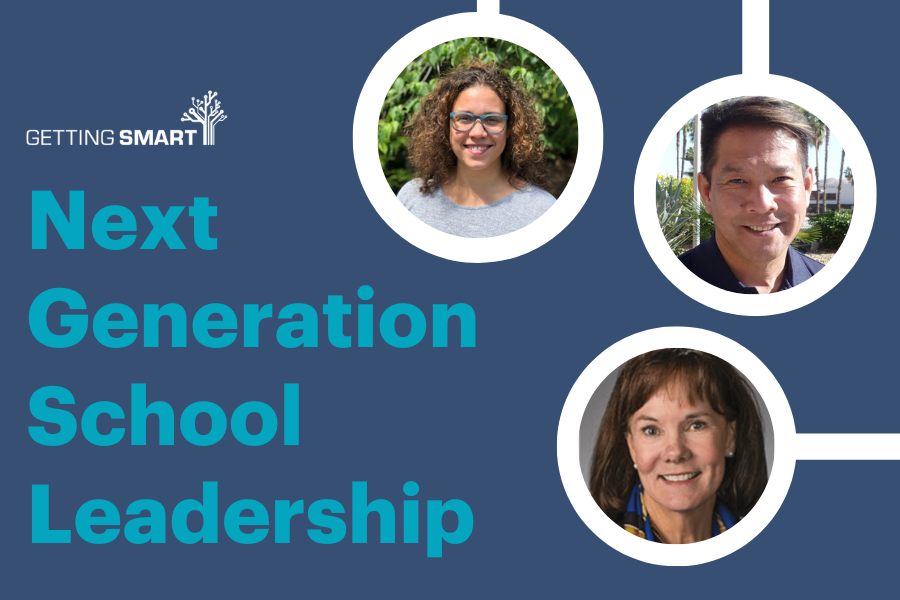
On this episode of the Getting Smart Podcast, Tom Vander Ark is joined by Dr. Valerie Truesdale, the Assistant Executive Director of AASA, the Superintendents Association; and Dr. David Miyashiro, Superintendent of Cajon Valley Unified School District and Dr. Kelly Niccolls Teaching and Learning Asst. Director, Secondary at Cheney School District to discuss next generation school system leadership.
Together they cover: What skills are required today? Who is the next generation of school leaders? What matters to them?
I’m hopeful for the rebuilding of what can be and for the doors that open for folks with skill sets that otherwise have been ignored or devalued. These skills are what we need now for these new times.
Kelly Niccolls
Links:
- AASA
- Cajon Valley Unified School District
- Cheney School District
- Previous town hall with David Myashiro
- Previous podcast with Valerie Truesdale
- Decolonizing Education by Kelly Niccolls
There’s common language that can unify based on shared goals and values that are beyond democrat or republican, beyond liberal conservative, really about happiness wellbeing and gainful employment and financial freedom for every person. Those things are not controversial.
David Miyashiro
Transcript
This transcript has not been edited for spelling accuracy.
Valerie, is there a leadership shortage in America? I think there is an abundance of talent in our school leaders in America, but there are certainly a large number of people leaving the profession, which is going to create a shortage at all levels. Leaders in the classroom, leaders at the school level, leaders at the district level.
The Bureau of Labor Statistics has told us that nearly 48% of schools and districts have reported having difficulty finding enough full-time teachers. Principles according to the National Association of Secondary School Principles have reported in their survey that 42% of principals want to leave their position. At AASA, the Superintendent’s Association, we are certainly seeing a very large number
of superintendents retiring and leaving their roles this year. This has been a very tough two years on school leaders. That it has. You’re listening to the Getting Smart Podcast. I’m Tom Vanderick and joined today by Dr. Valerie Truesdale.
Valerie, after an extraordinary career as a system leader, has joined the Superintendent’s Association AASA and just brought extraordinary leadership support to America’s superintendent. Valerie, we so appreciate your leadership at AASA and you joining us today. Also with us is an extraordinary school superintendent, David Miyashiro from Cajon Valley Union School District in East San Diego County.
David, welcome. Great to be amongst friends again. Thanks, Tom. What’s the mission of Cajon Valley? Happy kids engage in healthy relationships on a path to gain full employment.
David has just created a beautiful mission for Cajon Valley learners and is doing some of the most important work in the United States leading that system. Next year will be your 10th year. Is that right, David? I’m 10.
That’s right. Also joining us is Dr. Kelly Nichols. Kelly and I have had the chance to work together in several capacities. Kelly, recently, when did you wrap up your EDD, Kelly, in 2021? Yeah, 21.
Kelly worked with me at Getting Smart and has been a system leader in Eastern Washington the last few years. Kelly, in our conversation today, will give us the viewpoint of a new system leader. Valerie, I’d really appreciate your national view on this and it really has been extraordinarily difficult to your period of time.
Looks like we’ve seen something like record turnover. Is that fair, Valerie? We don’t have hard data on the turnover so far, but what we’re seeing as a trend is a significantly higher level of turnover in school and system leaders than we’ve seen before.
David, you’ve heard me say many times that being a school superintendent is both on many days both the best job in the world and the hardest job in the world almost simultaneously. Has it gotten harder the last few years, David? I don’t think so. I think if it was easy, it wouldn’t be fun.
So the harder it gets, the more fun for me. So yeah, the last three years have been the most fun I’ve had in my career. Do you sense that there are this and I’d love all of you to reflect on this. Do you think there are today a new set of skill requirements or a different way of thinking about priority of skills for leading a district today?
I think just from my own experience with the superintendents in my circle and those that I’ve been interacting with the last 10 years, a lot of our profession I think is in the space of just trying to not get fired, meaning I’ll try to avoid controversy, I’ll avoid risk, and I’ll avoid conflict. And by doing so, I can stay in the job of superintendent for many years and have a nice
career. When things come up though, like the pandemic and there is uncertainty and there is a crisis, then the leader has to be able to operate in those realms where some of the next moves may not be popular. Some of the next moves may be scary or have risk or estimated risk.
And I think that most leaders in their schools of education or in their preparation programs weren’t prepared for that. And I think that coming out of the pandemic, we have to really think about through the lens of what are the skills and dispositions and qualities that leaders must have to navigate risk, conflict, and controversy as everything has been hyper politicized in this environment.
Valerie, how do you think about the new skill priorities for system leaders? I think it’s been fascinating to see that as the pandemic unfolded, how amazingly flexible our school system leaders were as they pivoted to being able to feed the children remotely, teach the children remotely, keep kids safe, and keep folks employed, bus drivers and others when they weren’t transporting kids.
How did they redefine? And so I’ve been very, very proud of my colleagues around the country, but it is not something you have trained for is to have that degree of change thrown at you where they became trackers of who has been infected by whom and wellness experts. We’re seeing right now that the need for leaders to be ultra sensitive to the social emotional
wellness of the adults and the students in the schools is an unusual and for themselves as well because their lives have been turned upside down for two years. So as things begin to settle back in and folks become more resilient, that I think those skills of flexibility, resilience, stamina, and thoughtful care of their staff and their students even more so than has ever been needed before are emerging as essential skills.
David, I’ve seen you lead bravely with strong community support. It feels like community building is a new priority and not one that we teach in superintendent and licensure programs. Is that fair? Did you learn that on the job?
How did you build your community building chops in the last 10 years? One of the first tasks the board gave me when I started this job was to get out into the community and get to know the other leaders in the community. So getting to know the city manager, the chair of the Economic Development Council, the president of the chamber, the police chief, those are things that I was directed to do and had benefited
all of us because we started to have a collaboration with all the different other entities that served our community. We also had frequent parent engagement and staff engagement, but looking back on them, they were not very authentic and not very transparent. When we went into the pandemic and we began weekly Zoom meetings with all of our school
parent associations and had them tell us what they were experiencing through the pandemic and how we were not meeting their needs and how their children were suffering and how they were having to decide whether to go to work or to quit their job and were in desperation was the first time we actually had authentic, meaningful input from our parents. That’s something I think that will be part of our system moving forward.
We also did the same with our employee groups and had our associations tell us what they were feeling and experiencing and we recorded these calls and we posted them online so that everyone could see them. I think that that was what allowed us to open. It was what allowed us to do a lot of really courageous things because it was the needs and wants of our families and community that drove it. I would say I learned a lot of that on the job and was humbled by
those that were willing to give feedback. Valerie, I talked to our friend Mark Benini last week and recalled that he had been mayor of his town before he became superintendent a decade ago. I think being mayor is a pretty good preparation for becoming a superintendent. That really develops your civic chops. Valerie, how do you see people developing these community building skills? I think one of the things that has been brought to the surface even more glaringly
during the pandemic has been that parents and we had glimpses into students’ homes and they had glimpses into the teaching act and they have begun to blur some of the boundaries of where things are and what Dr. David Miyashiro is describing is an increase in the level of transparency of understanding that this is a partnership, the home, the first teacher of children, the school house, the community. It has to all be aligned in order to prepare students for their futures, not our past.
Kelly, how do you think about the skills that system leaders need today? Well, I think they are different from what I would say the standard skills were in place before and this is why I’m really excited about this time. I think those of us who are creative and problem-solving enthusiasts, not trying to necessarily play it safe and as you know, there was definitely some elements where people felt more vulnerable and exposed in ways that they
never had been before, particularly in positions of power like a superintendency. Valerie, I really appreciate you talking about the need of symmetry and synergy across all elements of a school system. We are a microcosm and intersectional and I think there was this facade that people showed up to a building and that’s where learning happened and it happened within a place of closed decision making and that those decisions were made by people
specific status or hierarchy or resources and all of that fell to the wind and was exposed on a screen where we’ve all been in all of this together and now you can’t hide from it anymore or try to put a structure on it or send them off to a building. It’s been sad because there’s been a lot of heart break in these times but I think this type of reckoning is necessary for us to really achieve the outcomes we say we want for our communities and for our kids and for us to really execute school
and learning and community building in the way that we say we want to and I’m, you know, it’s sad to see some turnover and it’s sad to see people really be shifted in ways that are painful right and have resulted in gaps in our classrooms and in our leadership positions but I’m hopeful for the rebuilding of what can be and the doors that open for folks with skill sets that otherwise have been ignored or devalued because those are what we need now for these new times.
Kelly, you’ve had such an interesting and diverse background. Do you feel like between your school coaching and consulting and system leadership and your the degree programs that you’ve been part of do you feel like you’ve pieced together a set of skills in community building that’ll be useful? Which parts of those backgrounds do you think are sort of most relevant to the challenge going forward? Well I definitely think my schooling experience like I always go back to Kelly in the
classroom and the schools that I was raised in and the community that I was that raised me and I think I’m very privileged and David you spoke to this about some some preparation programs are really ill-equipped to prepare leaders for the future. I’ve been part of some incredible programs that have been equity-centered anti-racist organizations very creative oriented design thinking just all the things that we need and so I’m grateful for that and I’ve also and I currently
work in very traditional contexts and so it’s that that tension of what we know can be and and how we get to that from where we are so it’s a journey but I think that you know always going back to the heart of me as a student and being a learner and knowing that kids and their families and respecting that experience and knowing how very different our experiences are and that all of them are valid you know the ecosystem right this interdependency has been far influential and my ability to travel
the country and work in very different places and contexts because at the end of the day all we care about are the same things right we care about the hearts and souls of our young people and what that means and and how we care for them can shift but we can always get to that core and that’s something that I’m really grateful for having that kind of context and experience with. David your your district is super diverse and and I just love how you and your team are culturally relevant equity
focused in everything that you do. I assume that that you think everybody needs those skills today is that is that fair? It’s critical to the job today isn’t it of leading any school system in America? I think so we have we have the largest Middle Eastern refugee population in the country over 50 languages spoken in just a small 65 square mile radius and languages like Farsi and Pashto and in Arabic and Aramaic and and Spanish and the other the Asian cultures as well. The diversity
is our strength and the way that we achieve that is starting in kindergarten we have students start telling their TED talks not an 18 minute TED talk but a 30 second TED talk where they talk about who they are and so the journey begins with self-awareness telling my story and having each classmate hear and accept and welcome each story into the community of the classroom or the school or the district or community and so that curricular aspect has allowed us to really transform our
classrooms and schools into inclusive environments where every person tells their unique story and every story is embraced we value in our happy kids healthy relationships a sense of belonging and our hashtag is hashtag you belong cv and those things have really helped unify us in a very politically divisive time and I think that that’s a skill set that principals and superintendents school boards really need to learn is is is to find unifying language that when you have a red
circle and a blue circle there’s a space in between where there’s common language that can unify based on shared goals and values that are beyond democrat or republican beyond liberal conservative really about happiness well-being and gainful employment and financial freedom for every person those things are not controversial there are no buzzwords in there that would set any side off and I think that that those lessons on being in such a diverse area to find unifying language
that supports each person is is really critical in the grand scheme of things as well Valerie the superintendent’s association launched this wonderful initiative called learning 2025 and that plan for the future really embraced an anti-marginalization effort it was a strong plank that suggested that every every system leader had an important role to play but I was struck that that and I had the good opportunity to be one of the commissioners on that on that
effort but I was struck that one of the most eloquent voices for anti-racist and inclusive education was run off by a school board in the middle of that commission and so these skills of leading for inclusive education are not yet widely appreciated Valera how do you think about how what does this mean for the profession so you lifted up a few moments ago Tom the importance of a different type of skill set and David addressed this a bit when he really is describing a growth
mindset finding the common ground wherever it is the genesis for the national commission on learner centered equity focused future driven education was finding common ground and putting the student back in the center of the conversation in our country and not politics and not woes such as a pandemic but beyond that because we will move past this our students still have to be focused on their future and I think that the whole the community’s willingness to come
together and find common ground will define them as a community of promise or a community as Kelly said of very traditional ways that need to be evolving we’ve always known that learning children learn everywhere all the time and that has been underscored by this pandemic because they have they’ve learned learned in churches and community centers and the schoolhouse and at home and in the playground wherever it is we need to embrace that thinking that all of our children are learning
all of the time and that we need to put children back to the focus of the center in our country and I think that that’s going to be difficult for some communities to embrace who have perhaps not had a really wide lens you know if you if you think about this in a car a windshield is a very wide thing and a rear view mirror is a really small thing and that’s in proportion by design so we ought to think about leading with that proportionality of looking forward Kelly I’m
thinking back to 25 years ago when I became a school superintendent 25 years ago is a lot easier for a young white guy to get hired leading a school system feels like we’ve made a little bit of progress for for women of color but does it feel like that to you what what what as as you think about the the leadership opportunity for young women of color yeah well I’ll say that I Valerie you talk about the the where communities are at and we talked a little bit about this earlier
too in the sense of people need to be ready we you know school boards hire superintendents search firms you know our our folks who have been in the system a long time and and find their way to kind of welcome at least my experience here in Washington to welcome in the the new generations but that’s a legacy model right and so you you find people who look like you and share your values and know your context and and that you can get along with and
have dinner with right and and contrast and then a crazy lady like me shows up right and and I would say I have the skill sets you need to get you future forward but if I’m in a place of decision-making and I’m happy where I am or trying to go back to what was then that’s a misalignment and so I think I think there’s definitely progress and I think in more progressive places where we have more representation on school boards and and in places where there
I would say for a lack of better term like more sophisticated search firms and processes you know women of color show up and show out right and and just also different folks who don’t fit that traditional school leadership district leadership model right we were able to shine and we’re asked questions that allow you to tell us to tell you our story in ways in which you can hear it and think well that’s the kind of you know capacity that we need to to rear our young
people right to build our community and take us ahead but I would argue over archingly the systems are still very much set up where I can’t do that and so and people like me cannot do that but I’m hopeful right and and you know working really hard every day to disrupt some of those components and and I think what’s also been wonderful is for those of us who have been able to enter the space we’ve done good work in ways where it allows some people to take more
leaps of faith right or contrast something that would be otherwise unknown in their community because they’ve seen it work elsewhere in places like theirs. Valerie I spent the weekend with a superintendent whose board just flipped as a result of an organized campaign and now the board chair wears a gun t-shirt and espouses racist things in in board meetings things that we’d kick a seventh grader out of school for
and it just makes you cry. So Tom I think it it doesn’t make me cry it makes me angry because I used to tell my community and I told my board members it went all the years that I was a superintendent our children are watching you are tangible demonstration of the democratic process of civic leadership and if you’re acting like a very petulant seventh grader on television and speaking ugly to one another
our children are watching you and they’re imprinting you and they will copy you. We we have to be bold in saying it is not okay for people to not treat each other with dignity and make them feel as if they don’t belong there has to be a reckoning of leaders from all walks of life community leaders political leaders business leaders philanthropy the nice thing about the national commission that you were so kind to serve on Tom is that it was a mix of top leaders in
philanthropy business and education coming together to say if you were to fundamentally improve redesign to Kelly’s point design thinking redesign American education to be more learner centered equity focused and future driven what would need to change and those areas of redesign are being embraced by a number of superintendents and I would submit I I get on a tear with any of my colleagues who are retiring and I say run for office run for an office it doesn’t matter what
office stand up and be counted we need people who believe in children and their futures leading I was I’ve been thinking of our friend Don Haddad and Saint Brain Colorado that community has been so intentional about developing cultivating school board leaders elected leadership for that community that are that put kids first and put community first I guess the lesson there is that as community leaders we really have to pay more attention
to cultivating elected leadership that put kids in community first is that is that fair that’s fair David I’m I’m struck by the real the bravery that that you continued to show in your leadership and that your opening comments that suggest we need to encourage our fellow education leaders to to be bold and to be brave and to put kids in community first is is that fair I think that that that’s the job and I think that what you described with the the school
board member that was just reelect or just elected and displaying behaviors that maybe would be unbecoming of a school board member I think that’s going to be more common than not and so for for people going into this professions are this leadership role saying you know I want to be superintendent but I don’t want to deal with with those bad politics or those ideologies that’s that’s not realistic and so when we hired getting smart back in 2017 to help us
build open a high school the first thing that we did was with your team is we hired the San Diego improv company and they came in and they trained all of our administrators and and teacher leaders on improv and improv is a place where no matter what somebody says your job is to take that offer and try to make them look good as hard as that may be and so if someone says it’s raining in here you don’t say no it’s not you have to say yeah it’s a good thing that someone so brought umbrellas
right and then somebody else picks it up and and the the superintendent or principal has to navigate conversations in a politically tense arena to find a way to deliver a show that meets the needs of the people that are there to view it or or to serve the kids in the community that are there for their education and that political savvy that ability to use improv yes and and be able to keep a conversation going with people who have very strong beliefs one way or the other is a skill
set that I think that is important and I think that should be a requirement in terms of of knowing you have that skill before you even apply for the job and something that I think Valerie alluded to is the idea of search and placement I think or maybe Kelly because I think that search firms that place and hire superintendents have been guilty of malpractice for the latter three decades I’ve experienced it I’ve seen it I think we all see it and if organizations like AASA
were to take on that role of assisting districts in running searches and placing then I think we’d see a lot more equity a lot more of the right fit and a lot more of those leaders that really are equipped to do the job finding that right match in a school district with a hope that there’s longevity there search firms they don’t have any any stake in the game in terms of longevity of superintendents they they get the contract they get the money they place a superintendent and
then they’re gone and maybe we should create a Yelp system of rating superintendent firms that you know they’re on their ethics on their longevity on because we’ve seen a lot of bad practice out there and I think that that can change a lot if we can reform superintendent search and placement Valerie I don’t want to discourage perspective superintendents like like Dr. Nichols I think it’s important that’s this juncture to reiterate that this really is the best job in
the world that a school superintendent more than any person in any community can help a community shape how it thinks about its kids and its future you really can change the arc of history in a in a community as a school superintendent it’s the good work right it is the good work I believe that we are put educators are put on this earth to create conditions in which children can thrive and no one has more influence over creating those conditions we don’t teach the children
directly as the superintendent in most communities but we create those conditions you know the research from the Wallace Foundation has found very definitively the principles are second to teachers in improving student achievement so the superintendent’s role in finding recruiting developing appointing and supporting nurturing principles is critical to have a strong robust pipeline we know that our profession is 74 percent female in our education profession but yet 74 percent of all of our
superintendents are male and only six percent of our superintendents are people of color and two percent are latino so you put that together and you realize we have a long way to go to making sure that everyone feels that they can be a leader that they belong and that they are part of bringing opportunity for children at higher levels than they’ve ever had before because we can do that do you have anything for aspiring administrators what would you like them to to think about pay attention to
so one of the things that we find it for an aspiring superintendent academies and a asa has four aspiring a superintendent academies one for female leaders one for latino leaders one that’s our national program and one that is primarily virtual and always has been that you get prepared you go into it with eyes wide open and understand that the match which is what Kelly and David have both said the match with a board is the relationship that is critical it has to be a good fit it’s not
just because i like this location or that compensation package or this community it’s the board the relationship of those my smallest was five and my largest was 12 members that’s a large relate large number of relationships and you’re very close because you are creating for that entire community the future for children thank you David closing thoughts advice for aspiring administrators my advice would be to subscribe to ceo networks and and follow leaders in business doing creative
and fun things along my path i learned from herb keller her and how he built southwest into a a customer focused environment where the employee was the first customer or from starbucks leadership how they’re not in the coffee business selling to people they’re in the people business selling to coffee i learned from las loba at google how people operations really is people operations and they do value their employees so that the employees can value the work in the customer
and i don’t think that that’s common but i think that that’s helped me not just excel in this role but enjoy my job i have a lot of fun creating a corporate culture in a district is fun you know loving on your employees is fun uh focusing on happy kids and healthy relationships and watching them develop their career development and vocational identity is fun and so it is you’re right tom this is the most fun and impactful job and you can actually enjoy doing it gellie what
advice do you have for aspiring leaders oh i i think um i think to find the joy something i really appreciate about our conversation is that this work is fun um to be relentless in pursuing what’s best for our communities and for our young people to find each other stay connected there are great organizations and it’s not all education organizations and it’s not just what’s in your local realm of control but really seeking the opportunity to engage with others and learn
from others and to keep on fighting right like it’s it’s it’s a good time this is a fun time so how do we how do we stay with that type of energy and persist so that our young people can have more to look forward to the fight is productive right yeah yeah it’s about leaning into um these issues kelly we always appreciate that you you learn out loud and um and lead with values and um we we deeply appreciate that not everyone will appreciate that the the lesson
from valerian um on finding fit um finding a place where you can lead in the way that uh you need to lead to put kids in community first uh it’s really important yeah well and it’s it’s good to know that maybe where you are or when people don’t like what you have right now there are people out there who do want what you have right and to continue to find that good fit and find that community because great things can happen where you where you belong yeah and the
lesson from uh kawan valley that david has just cultivated a beautiful sense of community that feels really sustainable um and so i i love that about his leadership he’s created something that is uh is is going to outlast him because he’s been so committed to community building absolutely i’m so excited for that work uh you’ve been you’ve been listening to uh some of america’s best system leaders david miashiro uh valerie troustail from a a essay and dr killie nickles from
cheney school district uh thanks for joining us this week keep learning and keep innovating for equity thanks for tuning in to the getting smart podcast today we want this podcast to be actionable and insightful and a great way to learn about what’s next in learning in order to stay on the cutting edge we need people in the field to tell us what they’re hearing what they’re wanting and what they’re needing to learn more about got a topic or a guest in mind
send your recommendations to me mason at gettingsmart.com and if you like what you’re hearing don’t forget to leave a review in apple podcasts or subscribe wherever you listen feel free to share the podcast on social media using the hashtag gspodcast thanks so much you




0 Comments
Leave a Comment
Your email address will not be published. All fields are required.