

Dr. Luvelle Brown, Dr. Pamela Cantor and Dr. Valerie Truesdale on the New Vision For Student-Centered Equity-Focused Education


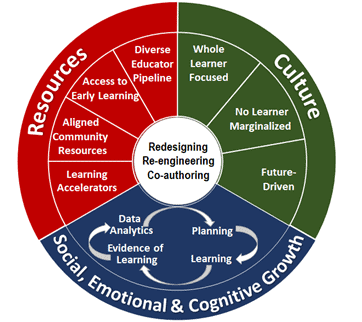 Dr. Luvelle Brown pushed throughout the meetings to have DEI language reflected throughout the doc: “It’s not a one-off, not an addition — it’s embedded deep into the fabric of what we’re doing.” He learned from his parents about how to “call people in rather than calling them out — welcoming folks, inviting folks and supporting folks on their journey.” This was an effective and powerful way to get everyone rallied around a common purpose, rather than isolating. One key takeaway was “no learner marginalized.” This commitment came about through thoughtful discourse and helped to formulate one of our favorite elements of the report — co-authorship. The AASA agenda will be shaped in the years to come by a commitment to inviting learners into the design process in order to better personalize learning and equip young people with the skills and supports needed to thrive. “[This approach] empowers learners to become co-authors as they develop agency. Teachers evolve too, advancing student voice and agency. Teachers are engaged as co-leaders in the redesign of the school system.” Dr. Pamela Cantor added, “The single most important word in human development is “co”, the entire development of us as human beings is relational. What I know will get released is the energy that comes out of kids when they feel like they own.” When reflecting on the experience of being a part of the commission, Dr. Brown said, “Things really slowed down for me. I can see things more clearly than I have before. As an abolitionist educator, you will never see the fruits of our labor. I hope I’ve inspired someone to take my place when I’m gone. It may take us til 2025-35.” Dr. Cantor added, “The idea that I would be part of a group of people with different backgrounds/experiences to share this point that we can drive young people, from wherever they begin, to their greatest potential…” Lastly, Valerie Truesdale said, “To have been able to channel the brilliance of each of these educators into a set of recommendations. This is legacy work, when we’re said and done, we will know that this work made a difference.” Links:
 - Learning 2025 Report
- Twitter: Dr. Luvelle Brown
- Twitter: Dr. Pamela Cantor
- Twitter: Valerie Truesdale
- Science of Learning and Development Alliance
- Ithaca City School District
- Turnaround for Children Toolbox
- AASA
To find out more about sponsoring or advertising on GettingSmart.com, please email [email protected]
Transcript
This transcript has not been edited for spelling accuracy.
You are listening to the Getting Smart podcast where we unpack what is new and innovative in education. I’m your host Jessica and today we’re joined by three esteemed guests to discuss the new AASA report issued by the Learning 2025 Commission, which makes a commitment and a recommendation for whole child design.
Joining us today is Dr. LaVelle Brown, who is currently serving as the superintendent of the Ithaca City School District in Ithaca, New York. We’re also joined by Dr. Pamela Cantor, founder of Turnaround for Children and currently a governing partner of the Science of Learning and Development Alliance. Lastly, we’re joined by Valerie Truesdale, deputy director of AASA, the School Superintendent’s
Association. Let’s listen in as Tom talks with these guests about the findings in the new report and why a commitment to whole child design is more important now than ever. Dr. Valerie Truesdale from AASA, welcome to the Getting Smart podcast. Thank you.
It’s so great to be here. Valerie, it’s great to see you again and we’re joined today by two extraordinary guests that I had the pleasure of serving with on the Learning 2025 Commission, Dr. Pamela Cantor. Good morning, Pamela.
Good morning, Tom. Thanks for having me. And Dr. LaVelle Brown, the Ithaca Superintendent, LaVelle, welcomes the podcast. Good morning. Thank you.
Valerie, you and your colleagues, Bill Daggett and Mort and Dan, gathered this extraordinary group of people this spring in a commission. I’d love to have you tell us the origin story. What was it and why did you organize this group? Sure.
Thank you, Tom. You know, this past year, we noticed that the pandemic has laid bare the growth in equities, in access and opportunity for children in our country. And we as the AASA Superintendent’s Association decided to tackle this challenge. Our Executive Director, Dan Dominic, joined together with Bill Daggett of Successful Practices
Network to seat a national commission on student-centered equity-focused education. They believed that we needed to address this challenge, these challenges of inequities with intentionality and a great deal of urgency. So seated a commission that called for change of designing schools by 2025. We had 27 commissioners representing everything from CEOs of business, foundations, nonprofits,
and of course, amazing superintendents of public schools in our country. And these folks all came together to examine the question of if you were to redesign American education to be more student-centered, equity-focused and future-driven, what would be the key components included in that redesign and it resulted in 11 major key elements that were brought forth over a six-month period.
The report went live in April and the conclusion of the report. And what we are doing right now is it is out on our websites and very actively trying to find exemplary school systems who are embracing the components of redesign advanced by this auspicious commission. Valerie, let’s just start by pointing people to that report.
They could find it at aasa.org. They could find it at aasa.org. It’s under a category called aasacentral.org. Just last night, the landing page went live on May the 4th to recruit districts to be considered as demonstration sites for epitomizing these 11 components.
Yeah, it was a really great process. Bill and his team called each of us and we did detailed interviews and then we did lots of round-robin discussions and then breakout groups and it was a super thoughtful process. Dr. Brown, did you know everybody on that commission when we got started? Yes, fortunately because of the great connections and networked at aasacus established, I had
connections with everyone on the AR group. I got to know folks a bit better, but yeah, I did know everyone, which is amazing. There were some people that were new to me and I was just what a great group of American education leaders, superintendents and advocates. It was just a super thoughtful group.
Dr. Cantor, it was great to have you participate. I’m curious as the founder of turnaround and really a leader in helping America understand what science tells us about learning and development, did you find the group open to and interested in what what science can tell us about learning and development? You know, it was a remarkable experience for me in part because in contrast to Lavelle,
you were really the only person, Tom, that I knew going into the experience on the commission. And so I found the people participating in it incredibly open and I’ll give you one concrete example of that and that is their adoption of a whole learner approach. As my interview with Bill Daggett and Valerie at the start allowed me to talk about a piece of work that’s about to be launched called the essential guiding principles for whole
child design. I was able to explain what it’s derived from, do a mini tutorial on the science of learning and development and lo and behold, watch the excitement seeing how this integrated approach builds on the work of many others, but includes a lot of new knowledge and new thinking. In short, I found them incredibly open to it.
It’s so interesting, Pam, that during the pandemic and really in the last year and a half, we’ve we’ve seen school districts around the country in fact around the world sort of quickly moved to social emotional learning and knowing sort of instinctively that they needed to pay more attention to to relationships, to well being, but you can really I think you really help the commission put that into the broader context of whole child development.
What are some of the dimensions of a really comprehensive whole child approach? Yeah, you know, this point is key that you’re making because in many ways, the the key to what we are calling a whole learner approach is that it integrates a number of elements, but it says that human development is the umbrella and within human development, you have a focus on the importance of relationships, building a culture of safety and belonging, rich, engaging,
productive learning experiences that are relevant to the kids, developing skills and mindsets and providing those integrated supports. Now you could look at this and say, well, this isn’t rocket science. We knew all these things were important, but we actually have relatively few examples of doing all of them together in an integrated way.
That’s the opportunity that I think ASA is kicking off. Yeah, that’s exciting. Dr. Brown, what what did you tell Degget and his colleagues up front that your your priorities were for the commission? Frankly and honestly, to be around people like Dr. Cantor and Valery Trusdale, so having an opportunity to be in a space with them that many, that many times would make me a better person and a leader
and so I wanted to be a part of this for that reason primarily and then I wanted to make sure that we embedded conversations in language around equity and inclusion and diversity throughout the document and I think we see that it’s embedded. It’s not a one-off. It’s not an addition. It is embedded deeply into the fabric of what we’re proposing.
Dr. Brown, I just want to compliment you on the thoughtful and persistent way that you contributed to the commission. I think the way I experienced it was that the commission quickly embraced Dr. Cantor’s contributions around whole child, but it really took some persistence for you to help the commission more fully embrace the racial reckoning that this country is going through.
Is that, did you experience it that way? Of course. I’ve been reared by my parents to call people in versus calling them out. So that persistent approach to this conversation and in welcoming folks, inviting folks, and then supporting folks on their journey has been what I’ve been trained to do. And so I’ll give that credit to my parents and it was uncomfortable.
And you cannot have conversations about equity and inclusion and diversity and anti-racism and be comfortable. So AI experienced it is not unlike any other opportunity or a situation when I am engaging in this dialogue. It was uncomfortable, LaValle, in a productive way. I think it was illustrative of the challenge that America is really going through.
But I just, I loved your thoughtful, persistent approach and the way that you invited us in to that dialogue to say, let’s be sure that we’re being thoughtful about how we’re representing the path forward. So thank you for that. Valerie, how did you respond to that dialogue about race and inequity?
It was amazingly powerful to watch the growth of these 27 commissioners as they really wrestled with key topics. And as an example to Dr. Cantor’s point, the group adopted the commitment to whole learner as a foundational commitment, not just to the whole child, but to the whole learner, understanding that not only are we learning, our students learning, but our teachers and leaders
are learning if we’re going to have an intentional relations-based culture, which has been unusual. And Dr. Brown was the one that was so amazing in helping to really call people in. And one of the foundational principles that came from the commission was no learner marginalized. The anti-marginalization commitment came about by thoughtful discourse and understanding if we want to have all children be honored and be whole learner focused, then we have to say no child
should be marginalized and that we have to be future driven. And that future driven focus, really Dr. Vander Art came from you and a few others that were saying, but what about their jobs for tomorrow? What about their futures, not our futures? So those three fundamental components are essential for a systemic redesign. Dr. Cantor, what do you think it means that the America’s superintendents have really embraced
whole child learning? It feels like an important threshold. One of the things that I was most struck by was how much this integrated concept resonated with things that their experience told them needed to be the next step, needed to be the future of our work that really has transformational goals for kids. And I think the learning agenda that Valerie is talking about, because without the adults as part of that learning agenda,
then it doesn’t go to the place that Dr. Brown wanted us to reach. And I think that was accomplished, not just looking at it from a child’s perspective, but also looking at the who do we as adults have to be in order to make this real for kids. In order to fix the deep inequities in our school systems, we need to build with a new blueprint, a blueprint that’s focused on how children really learn and develop. The team at turnaround for
children has created the toolbox, a new online hub created by educators for educators that is backed in science, research and passion. With this tool, you’ll be able to create a supportive environment, cultivate developmental relationships and build students knowledge, skills and mindsets, all of which is centered around a whole child purpose. Together, we can design our schools to be places where all students can thrive. Visit turnaround us.org slash toolbox to get started.
Dr. Brown, we’re coming out of what was probably the most difficult year and a half of your professional career. Does this report sort of make more complicated and challenging the path forward or does it make more clear the work we have to do? How do you think about these recommendations? Both and, and I often embrace both and thinking. It makes things much more complicated and challenging. Yes, we’re having a conversation at scale in every part of this
country with every school leader in this country about equity and inclusion. That’s never happened before. And now the resistance and the pushback and the uncomfortable conversations we were having among some of the best leaders in the world when it comes to education is going to happen now across our country. So yeah, I’m excited and I’m inspired by it, but I’m also bracing for even more challenges. What we’ve seen this last year is just a tip of the iceberg. We’re going to see a whole lot more
going forward if we truly are committed to implementing the things that we put on on paper. Valerie, there’s one phrase that I’m really excited about in the report and it’s co-authoring. This, this really important idea that the next generation of personalized learning is about walking alongside young people and increasingly as they get older, giving them voice and choice in their own personal learning pathway. And to me, for the superintendents to embrace
not only anti-marginalization and whole child, but this idea of helping young people co-construct their learning journey. I think it’s a really profound recommendation. Are you struck in the same way? I agree. When I saw the words out of the subcommittee come forward to say that an organizational system, an educational system that re-engineers instruction to empower the learners to become proactive co-authors in their personalized learning journeys as they develop agency and
metacognition and executive functioning skills and that teachers evolve to engage in advancing student voice and agency as they develop students as co-authors and that they also, the teachers are engaged as co-leaders in the redesign of the school system and that the system leaders advance students and teachers as co-authors in their journey. I found that to be significantly stride, a huge significant stride forward in our discussion about the needs to build
thoughtful students who are going to be ready for the next pandemic whenever it comes, because we may have gone for hundreds of years without one, but I’ll be willing to bet that the young learners today who are creating responses to this pandemic are going to, they’re going to out-science all of us, aren’t they, and they go forward because of this. They will. Dr. Canty, this reminds me of the building blocks for learning that you and Turnaround have been advancing and how they progressed
student agency as an important outcome. I wanted to build on something Valerie just said in the question that you just asked. The single most important word in the human development literature is the phrase co. Co is the word that defines human development and here’s what I mean by that. What we now know is that context drives the development of the brain, that the entire development of us as human beings is relational. It has a great deal to do with what happens to us
in relation to the environments, experiences and relationships in our lives. That experience is what harnesses the agency of kids. So I was thrilled with the word co-authoring because what I know is going to get unleashed is the energy that comes out of kids when they feel they own, the process when they feel they own the result. I was thrilled about that phrase co-authoring. Dr. Brown, back to you for some thoughts on next steps, either for Ithaca or for New York State.
How do we begin to put into practice some of these recommendations? Well, opportunities like today. I found myself as a fan right now and I’m forgetting that I’m a panelist. I’m hearing from some of the leaders who are part of the process via podcasts, via webinars, via in-person experiences. Have folks who are leading the writing of this document go out now and share their learnings and some of their passions will be a key next step. Also, I’m excited
about the demonstration districts. There’s some amazing things happening all over the country. So more we can do through our networks to support and promote the demonstration districts and where it’s happening on the ground is going to be important. And I also want us not to check a box and to keep innovating. Just think about where we are today with our mindsets and our skill sets. Compared to what we were last year. Who knows what we’ll be in 2022, in 2023. So I know the
report has 2025 as an end game, but we may, I see this report as being flexible and iterative and that we may change it along the way as we learn and grow together. Valerie, what’s up with 2025? I remember in the conversation, I think I even told you, these are great recommendations, but holy cow, there’s a lot of work to do between now and 2025. You’re absolutely right, Tom. And there was a great deal of discussion about that as a former
high school principal and superintendent for many years. I could tell you 2025 is tomorrow. We’re ready to do. So the original conversations with commissioners, however, said if we say 2030, people won’t get off energized, ready to go to do something about it now. And if we miss this moment in time of coming out of this pandemic, if we don’t seize this moment for redesign and reconciliation of looking at ourselves, we’ve known these gross inequities persist for years.
And we have not addressed them with urgency to kick up the urgency a bit 2025. It does mean, as Dr. Brown said, that’s only the beginning. The iterative process will go forward and it’ll take years. One of the ways that we hope to chart progress is that Malbert Smith, one of the commissioners, has offered to help us build a dashboard so that we can measure cognitive growth and a growth model that can look at how are kids progressing, the whole learner in this process
as we move forward past 2025. I Valerie, Dr. Brown mentioned the idea of demonstration districts Tell us about that concept. I’d like to explore what happens in the next year or two as a result of this report. What we’re going to be doing at AASA is the commissioners emphasized that practice should drive policy and currently policy is driving practice. So if we were to flip that concept, then let’s go find places where we are focusing in on the whole learner, where children, there is an
anti-marginalization commitment and school districts that are forward driven. They’re not just school districts, it could be a whole community. There was also a relief among the commissioners that it is the whole community must join together. There’s museums, there’s libraries, there’s community centers, there’s all sorts of individuals who need to be part of the ecosystem around an education. And we want to go seek those places. So with those foundational principles,
there might be school systems that are focused on, and I’ll use as an example, Dr. Tammy Campbell in Federal Way, Washington has really focused on a 360 equity plan, part of which is redesigning all of the human resource systems. One of the recommendations of the commission is that we have a diverse talent pipeline to serve our children. So if we were to highlight some of these superintendents around the country and their school systems, we can show this is where it is
happening. This is what it looks like to stand up the recommendations of this commission, and that we will be helping school districts move along that continuum because it’s a continuum. Nobody, if anybody had already had all of the components in one place, we’d know about it, and we’d all be visiting them. But finding those folks and moving them along the continuum will be the work of AASA Leadership Network over the next several years. The report’s also going to frame up your next
convening, isn’t that right? It is. The National Conference on Education will be the conference on Student-Centered Equity-Focused Education in February of 2022 in Nashville, Tennessee, and we hope to bring our commissioners back during that meeting and also to showcase some of our demonstration districts where folks are really standing up this commitment to the various aspects. We call them learning accelerators in the report. What are those things that will
accelerate the learning of children and fast forward the redesign that ensures no child is marginalized and that we are learning as we grow to make sure every child is embraced and honored? After what has been a really difficult year and a half, maybe several years, I found participating on this committee quite invigorating and it just made me hopeful about America to participate with so many thoughtful leaders. And I guess I’d love to give each of you space. If you feel the commission
in some way left you with a sense of hope or optimism, I’d love to know what that is. Dr. Brown, what gives you hope about the path forward? Some things really slowed down for me and I can see things more clearly now than I ever have before. And I’m, you know, harkening back to what my elders have taught me. They said as an abolitionist educator, which is what I think I am and my parents were as well, you will never see the fruits of your labor. You will always be dreaming
about what’s possible in this industry, but you will never see it. And, you know, even as we put these recommendations on paper, wow, they’re bold, they’re courageous, I most likely won’t see them happen in our schools, but what I do hope and this is what I was always taught is that I’ve hoped I’ve inspired someone to take my place when I’m gone. So if the work of this commission is to put on paper our vision for public education, which is bold, and it may take us to 2025, it may take
us to 2035, I also know that I’m hopefully, hopefully retiring in somewhere near Valhalla, if you want to be somewhere hanging out in 10 or 15 years, but I hope that I’ve inspired someone without words and I work to take our places when we’re gone. I really appreciate your contributions to the commission. Dr. Canter, what gives you a sense of optimism? So I was asked a question recently in an interview and the question was, what is the hill you would die on?
And the way that I answered the question was that this idea that children are malleable to the experiences in their lives and that there is no ceiling on the potential that they’re capable of. This idea is something that I’ve known for years since med school days, that it is biologically, psychologically, and genetically true, that we are malleable as human beings to growth because of the context that we’re exposed to. So the idea that I would be part of a group of
people who come from very different backgrounds than mine, very different experiences than mine, and would end up sharing something that is grounded in this point, that we can create settings across this country that can drive the growth of children no matter where they begin to their fullest potential, that’s what I found in this commission and what I’m thrilled to continue participating in. Thank you Pam. And Valerie, how do you leave this inspired for the path forward?
You know what was fascinating to me was to see as a co-facilitator, the commissioners examine everything about the ecosystem and to come out with recommendations that start with early learning for all and expand all the way to paths for youth, post-secondary, and everything in between that focuses on taking care of our whole learners along the way to have been able to channel the brilliance of these 27 individuals, each of whom is a thought leader extraordinaire
in his or her area, and to focus them into channel that brilliance into this set of recommendations, which is really truly a how-to, how can we move forward with a deep commitment when Dr. Cantor speaks of the hill to die on. I’ve always been the kind of educator that believes in every single child and every single child can be stretched and every single child can be pushed to the next higher level, and this commission embraced that. There were no excuses, there was no woe is me, there was a focus
on forward thinking, future driven, and it was it was out, it was just a huge educational experience to learn and grow from these great folks. And I will say, I’ve said many times to Dan Dominic and Mort Sherman, this is legacy work. This is the work Dr. Brown that yes, when we’re said and done, we will know that this made a difference. Valerie, to you and Mort and Dan, we really appreciate your leadership at AASA. It’s just
great to see you guys out leading the way. This was a great process, it’s a great report. We’d love to have everybody take a look at AASA.org and read the Learning 2025 and National Commission on Student-Centered Equity-Focused Education. Val, thanks for being with us today. Dr. Cantor, Dr. Brown, thanks for being on the commission. We really appreciate you joining us today. Thanks so much, Tom. Thank you all.
A huge thanks to Valerie, Dr. Cantor, and Dr. Brown for joining us on this week’s episode. This report is an urgent and necessary move in the direction of whole learner education, and we are excited to watch these changes unfold over the coming years. All right, that’s it for this week, listeners. Thanks again for listening to the Getting Smart podcast, and until next week, this is Jessica signing off.


0 Comments
Leave a Comment
Your email address will not be published. All fields are required.