


Dr. Fernande Raine On Using History and Museums to Incubate Changemakers
Stay in-the-know with innovations in learning by signing up for the weekly Smart Update.
Transcript
This transcript has not been edited for spelling accuracy.
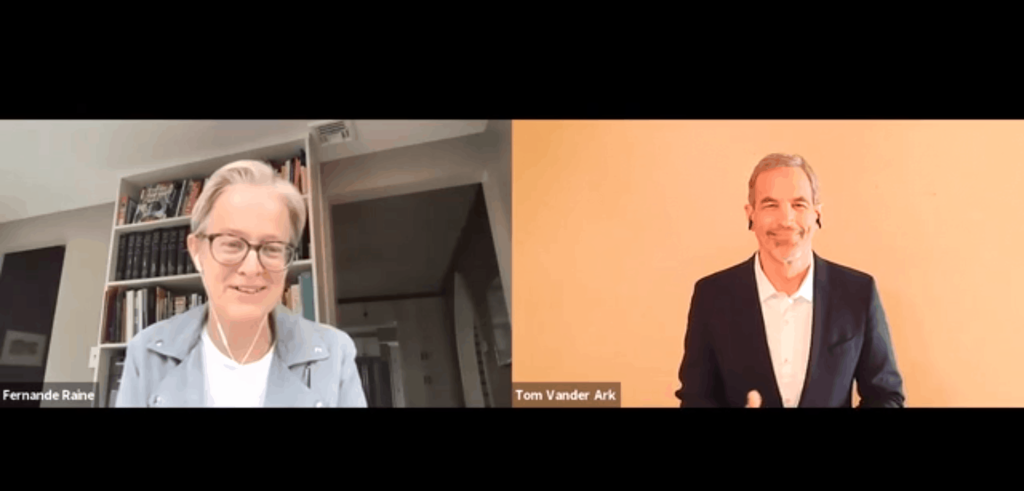
You are listening to the Getting Smart podcast where we unpack what is new and innovative in education. I’m your host Jessica and today Tom is sitting down with Fernanda Rain, a social entrepreneur who works towards reimagining how we talk about, teach, and use history as well as bringing civics education to the forefront.
Let’s listen in as Fernanda and Tom talk about new approaches to history, democracy, and changemaking. Dr. Fernanda Rain, welcome to the Getting Smart podcast. Thank you so much, Tom. It’s such an honor to be here.
Fernanda, you wrote that history is not just a narrative about the past. It has the power to give us agency, empathy, context, and community so that we can improve our systems for the future. What a beautiful and interesting sentiment. Where and how did that insight originate?
I traced that back to my time in high school. I went to high school in Germany in the late 1980s and early 90s and just sort of before and after the Berlin Wall fell. That was a time when the world was really transitioning from one state of being into the other, from a system that was very much shaped by the aftermath of the Second World
War to a phase in which it seemed like the promise of democracy and the universal spread of these principles of freedom and equality and justice were, that was sort of an inexorable march forward. That’s where we were headed. But the teachers and all the adults around me at that time were very, very clear about
the fact that that journey toward the nirvana of democracy was only going to work if we understood the history that created the operating system that we had to deal with at the time. This was very much shaped by teachers who had grown up as children, either of people who had fought in the Second World War or who themselves had been engaged in the war as very, very young soldiers.
This was a country still very much shaped by that experience. So learning history was at that time about understanding some very, very important things. First of all, that democracy is fragile. If you don’t take care, it will go away. There was this constant message of we have messed it up before, despite having all these
great thinkers and great democratic ideals and great leaders, but we, as you can see by the story of the rise of Nazism and of the Holocaust, we also brought it to the very nator, right, to the lowest level of what human beings can do. We did the same thing. So don’t ever forget that.
Also this sense of being always a country in transition with a narrative of community. The Wall fell, sure. Two pieces of Germany came together and we had to figure out who are we? What does it mean to be German? What is German?
And how do we avoid a national unity conversation without hearkening back to the last crowd that talked about Germany as a nation that didn’t go so well, right? So how do we navigate the process of making peace with this context of this concept of community at this time and why history is so very, very important to do it well? And around this theme of agency, learning 21st or 20th century German history, you really
understand that the actions of individuals matter, whether it’s people who came up with crazy ideas that then hurt a lot of people or individuals who tried to assassinate that person or tried to rectify the course of history. What you do matters. That was sort of the thread that our teachers kept bringing up again and again in that history
teaching. And it made a huge difference. I guess bottom line was sort of history is the, I guess the key to figuring out how you’re going to get to a better place because it is the operating system of the world we’re in, right?
And if you want to install new software and say we’re going to put in democracy software into the system, you can’t just code in new software and update your phone if you don’t understand what the operating system is that it currently has. So I guess history is that for me, right? It’s always that inspiration to think about where we can go, but also an understanding
of where you’re coming from. So what led to your Yale dissertation on Soviet foreign policy in Iran? Not a topic I think about every day, I will admit, but that was a missing puzzle piece in a picture I was trying to put together at a certain time, right? So initially I had gone to grad school thinking I was going to solve the problem of why democracy
didn’t work so well in Russia. I thought I was going to figure out what religion and the difference between the Eastern Church and the Western Church had to do with how people developed a sense of a rule of law. And my professor at the time looked at me and he said, you know, it’s going to take you 30 years of working in dusty archives across the former Soviet Union, reading handwritten
documents in old church Slavonic. You sure you want to do that? They’re also great other topics. I was like, maybe I should find another topic. And there were phenomenal professors, some of the greatest diplomatic historians of our
time, Paul Kennedy, John Gattis and others were at Yale at the time. And just made studying international affairs fascinating, right? The connection between what was happening at the diplomatic level and what’s happening on the ground just was so exciting. And in looking at the end of the Second World War, in the beginning of the Cold War, there
was this moment of the crisis in Iran in 1945-46 when the allies had all occupied Iran during the war to block the access to Iranian oil and to the trade routes to block them from Hitler. And so at the end of the war, the Soviets didn’t want to leave Iran. And I asked, well, what was Stalin up to?
What did he want? Do we know what he was thinking? And the answer from the professors and the books was like, I have no idea. We don’t know. But the archives are opening.
And so at that moment in 1997, the Soviet archives had just opened to crack, right? And the sense was maybe you can find the answer in these archives. That’s going to be in Moscow. It’ll be great fun. This is an adventure.
And I’d been to Russia. I spoke Russian. I loved Russia. I thought this would be really exciting. And so I got to have the adventure of going on this quest for the Holy Grail of the documents
that would tell the whole story of what Stalin was up to. And thankfully, I found them. But that’s a story for another time. But it was exactly what I had hoped for, an adventure that ended in finding fantastic documents to fill in a gap in history.
Sounds like it was a useful deep dive. But we’re all glad that you didn’t stay there, that you have gone on to help us as a society rethink history. You’ve had a couple of interesting intersections with Ashoka during your career. Ashoka is the famous nonprofit that in many ways really pioneered the concept of social
entrepreneurship around the world. I’d love to have you explain the ways in which you now connect history and social entrepreneurship, at least in part because of the times that you’ve spent with Ashoka. Absolutely. So Ashoka, when I first encountered it for me was not even something I recognized.
I came from a history PhD and was working at McKinsey and someone said, you need to meet this guy, Bill Drayton, because he’s really, really interesting and he does really interesting work in reimagining what the future could look like. And I met Bill Drayton at an event in New York City. And what I found in him was this excitement about a historic moment that we were living
in, in which there was this opportunity to complete the last mile of democracy. Because there was this sense of, oh my gosh, we are living at a time where change is happening so rapidly. And we’re seeing the effects of man-made problems, man-made change, man-made impact on the environment, man-made impact on other people’s systems that aren’t sustainable.
So rapid change, not always positive impact of human beings on the world. And at the same time, we have two other threads that are going on. One is that we finally reached a point where we actually recognized the universal equality of human dignity, which is in all of human history totally new. And we have the radically new opportunity that every human being has access to all the information
they could need to solve problems. Also radically new. And you put that together, and that brings you into this moment of like the moment to complete this idea of democracy in which everyone can be a changemaker. Everyone can participate.
Everyone can take responsibility is now. Never was possible before. And so I met him in this silly fundraiser, right, in New York City. It’s just an event. And we’re having this long conversation.
He says, we need this in Europe. You know Europe. We’re very state driven, not particularly innovative in this sort of social sector space. We need this kind of energy of an everyone to change maker future in Europe. You’re the right person to create it.
Will you launch a show in Europe with me? We need someone now, like not tomorrow, but like now, now, now I need to know, are you in now? And I had in my hand a tenure track teaching job at a university in New York City that I thought was going to be my dream job, right?
Life long teaching history again. I thought this is going to be fantastic. And so Bill Drayton gives me this opportunity says, you need to make history, forget teaching history, you got to make it. And of course I came home and I told my husband who had just moved to New York with me.
I said, I’m sorry, you have to go back to Germany. I met Bill and I have to go now. He’s like, who’s Bill Drayton? What is this? This is crazy.
You can’t do that. I said, no, the moment in history is right now. We have to do this right now. So that’s sort of the initiation of my story with Ashoka. And it’s awfully fun to see what has happened with social entrepreneurship in Europe.
I got very lucky with finding incredible people in the years that I was there. And Ashoka Europe is one of the strongest parts of the institution, hundreds of fellows across all the different countries. And I look at it and I see that horizon of the future that we sort of envisioned at that bar a long time ago, 20 years ago happening.
That’s kind of exciting. So I guess that’s one part. The other piece of it is that in the work at Ashoka, you get very trained to look at how people think about systems. So how, when you’re trying to see whether someone is a social entrepreneur or not, who
is sort of worthy of the Ashoka Fellowship label, it’s not about a business plan. You’re not asking the person who is being interviewed. And I did many, many, many of these fellowship interviews selecting Ashoka Fellows. It’s not about whether they have a fantastic plan and have it all figured out of how to get from point A to point B.
The question you’re looking for is, does this person really understand the historic moment in their problem area? Like where are they coming from? What’s the past? What’s the system?
How does the system look? How do they analyze the system to find a lever that would work? And do they have that dogged commitment and passion and flexibility of path of an entrepreneur? Because anyone who comes in with a business plan and says, I have a plan for the next five years, it’s not a good entrepreneur.
Because you have no idea when you’re creating something that actually is going to be powerful, what is going to look like three years from now? And if you do, you’re not a good, there’s no, that’s not how entrepreneurship works, right? Anyone who gives you a three-year business plan, I wouldn’t trust their entrepreneurial qualities for a minute.
And so that ability to connect an understanding of how change happens as this, sort of how change happens with an understanding of the past, that’s sort of what social entrepreneurship always meant at Ashoka and informed how then obviously I approached the creation of God History when I did create it. So it’s all informed by the sort of systems thinking approach that Ashoka always instilled
us with as members of that team finding and selecting Ashoka Fellows. A couple of years ago, you started a nonprofit called God History. Tell us about the origin story and mission of this organization. Well, the origin story was November, whatever it was, the dark day in 2016 of the election in the United States that politics aside was I found a very dark day for democracy because
the demagogue was elected to the highest office of one of the world’s the world’s oldest democracy. And no matter what your politics are, you could never argue that this was anything but a demagogue. He’s someone who did not make rational arguments and use logic and facts, but someone who riled up people in a way that was very scary to me.
And as someone who hadn’t done their high school training here, my first thought, knowing that I was sort of inoculated with the ultra vaccine against demagoguery in German history class, I was like, I knew what is going on? What how come our collective immune system against demagoguery is broken down in this country? What happened? How are we teaching history here that this could that this is even possible?
It made no sense to me, particularly knowing that there are amazing institutions that exist in the United States that are fighting that kind of board, that kind of thinking, right? Facing histories around the corner from my old house in Brooklyn and teaching tolerance, name, name five, six different organizations around the country that create fantastic curricular content.
So I thought, what what what is wrong with the system that it’s not reaching students that in the system, young people are not getting that kind of mission focus or principal focus, history, education. So I obviously first went to talk to Margot Strom, the founder of Facing History and learned all about how she had created that,
why she had created that, the backstory behind that. And then asked her whether she thought there was a need for a re-energizing of the movement aspect of this, right? How do we build a movement to understand, to spread the understanding that
we need a new approach to history? That was one part. The second part was interviewing teachers and students around the country. I wanted to know what’s wrong in the system today with the sort of supply chain of good history, if you so will, right?
It’s sort of a business problem. We have a supply chain challenge. Whether drugs are getting to a patient or a great content is not getting to a student. It’s a classic supply chain issue. And so in the supply chain issue,
what I realized is that we have all sorts of barriers in the system that prevent good stuff from getting to where it should be. We have the textbook industry making sure that certain narratives and certain stories and formats of education are
perpetuated or that they are sold. There are there’s a big company called the College Board, right? That perpetuates the AP system and the whole model of textbook teaching that is focused on maximizing the amount of content. It’s good content, right?
But there’s a huge there’s an economic factor to this whole thing. We have financial pressure on school districts to do certain things. That’s one piece of it. You also have so that’s sort of a the dominance of old narratives is in large part driven by the textbook industry.
Then you have no incentives or any metrics that would incentivize using the good stuff. Right? Like if you use facing history and your kids are all empathetic, fantastic citizens, change makers and, you know, community love agents,
no one cares if you don’t get your scores up in the LA and math and your kids don’t do well on the AP test and your kids don’t do good SAT have good SAT averages and they don’t get into good schools, your toast. So who cares whether we actually do it? So the incentive system was off.
There are. Also barriers to teachers being able to do the kind of learning that’s fun. Like taking a textbook and just reading it in the classroom is pretty easy. If you have 40 kids with all sorts of issues, easy sounds pretty great. Right? To do project based learning that’s
individualized, that allows kids to do things in their community, that allows kids to do things that are really exciting for them individually. To ask a teacher to do that with 40 kids, three different classes, 120 kids, three different topic areas is beyond impossible. There is no way a teacher in the current time can do that.
And then the lack of an understanding that history is actually about helping young people develop a citizens, right? The whole assumption of why we teach history seemed off. So like, OK, those things all seem a little bit off. We need to change the system.
We need to change the incentive system. Right? We need to change what’s measured in the system. We need to think about learning science and argue for the fact that there are certain learning outcomes that we need. We need to measure those as a system and say we actually want to be measuring
resilience, grit, community, whatever they are. Like there are a million, you know, the 150 frameworks that exist on different civic qualities or democratic capacities. Doesn’t matter what they are, we should just value them and then track whether we’re getting there and place an emphasis on that.
And then the learning signs of how do you get there, right? That you need a textbook isn’t going to get you a deep learning insight on, oh, my gosh, the Holocaust should never happen again. Right? Or oh, my gosh, democracy is fragile. Oh, my gosh, migration is a story of human, you know,
it’s the story of human movement throughout time. It always happens. It’s a great challenge that we always have as human beings. Those things are not going to connect to by reading it in a textbook. You need to have the experience.
You need to have this kind of interaction. And that only happens if you have an ecosystem that is ready to provide that kind of stuff, right? So the the different pieces that we have been looking at is exactly this. How do you connect an ecosystem of players that will jointly ensure,
A, that the goal of learning is the right one? We want young people to be prepared as citizens for the future, for now, for tomorrow, for, you know, they should be prepared by their history teaching to deal with the challenges of today. If you create an ecosystem of people aligned
toward that, all sorts of stuff can happen, right? You can create opportunities that you wouldn’t even have thought existed just by saying, let’s agree on the same goal. Do you have something? Yeah, I have something. OK, let’s put make stone soup and and have that happen.
And the final pieces that you have a very interesting phenomenon that young people want the kind of history that the most forward thinking, futuristic, innovative history, history, educators and civic educators want to give them, right? The demand on the young people’s side for information that will help them
be kind to other people, be supportive of other people, build a strong community, create justice and equality, create a sustainable model of economics. All that stuff is there. They want to know this stuff. So why don’t we ally with them and increase their agency and their power
and their voice in making change happen? Because they’re great, right? Gen Z, they’re empowered, they’re vocal. They have all sorts of tools at their disposal. So I guess the last part of the got history model was let’s leverage the power
of young people as allies in creating change in the system. Hey, listeners, we’ll get right back to Tom, but first wanted to tell you about a new Getting Smart report about what’s next in learning. Over the last few months, the Getting Smart team has been working on identifying 20 invention opportunities and learning and development and have pulled all of that
together into a report that was made possible by the Walton Family Foundation and the Bill and Melinda Gates Foundation. These opportunities have the possibility to completely shift what we talk about when we talk about schooling. Check out our recommendations, insights, and more at the link in the show notes or
at GettingSmart.com slash invention opportunity. All right, let’s get back to the show. Fernanda, I love a couple of your quotes about your approach to history. You say that we should be teaching history in a way that can heal and create a democracy. I love that idea.
And I also found this really provocative that history education can advance well-being for individuals, communities, and for society, even the planet. I want to ask you to reflect on that. And I’m hearing in my ear a critic, a philanthropic investor said to me a few years ago, Tom, all this project based on learning.
It creates Swiss cheese learning where kids get some of these new strengths. They build agency and empathy and and critical thinking, but they they’re missing sort of half of the canon. So is that a trade off we should be willing to make that they they don’t fully memorize the critical dates for Western civilization while they’re becoming change makers?
Those are two big questions. I’ll take the one on the sort of future orientation. How do we think about teaching history first? And then we’ll I’ll get to the second piece. And the Swiss cheese challenge on the down stuck in the cheese metaphor.
And I have to sort of mentally move away from it. I think if you look at the way the world is today, right? If you look at the world around us with all its fantastic beauty and opportunity, there are a couple of. Core threads and patterns and challenges that we face as a global community that
need to be addressed, right? It’s obviously climate change. It’s it’s these issues of completing these questions of equality and inclusion and justice and access to these different rights for all. It is the question of an accelerated rate of human migration, right?
The challenge that we have to the old nation state model and the challenge we have of defining communities that are multi ethnic, that are very diverse. The challenge of reimagining the sort of origin myths and narratives that formed our communities in the past that just need updating and the chat like that sort of updating of narratives, understanding the fragility of democracy, migration,
climate change, completing these questions around the journey toward equality and human dignity, those things are pretty big. If you look, however, at how history education is structured, right? For the most part, it isn’t about achieving those goals.
It isn’t helping. It’s not set out to help us achieve those goals right now. It’s about how do we ensure that our students are prepared to be citizens of our nation still is how it’s defined, right? When we address educating for American democracy, it is educating for American
democracy and not thinking about educating as a global citizen, which is just telling right of where we stand. So I think the if we want to advance a world in which regardless of whether you were born in a country or you’re a migrant, you feel safe, you feel a sense of belonging, you feel included and can thrive.
If we want that world, we need to create an understanding in our communities that history bids us to create that kind of community, right? That we can, that this is the a community in which migrants are not welcome, is a historic creation, but we can uncreate it. We have had societies that do not operate that way.
We have had societies that do. It is a choice we can choose to not be exclusive and disempowering for people that move here, right? So I think thinking about all of these big challenges and how we teach history as a way to allow us to advance the kinds of practices and mindsets that promote well-being, that sort of is for me what history should be
about, right? You should. I mean, you can teach history through the lens again, back to the social entrepreneurship lens as a history of all the things that have changed and have advanced, right?
All the things that have how far we’ve come and how how many things we have today in terms of mindsets and systems that allow us to do things we never could do. That is so exciting and frees you from the sense of, well, it’s always been that way, which is hugely predominant, right? Well, it’s always been that way. Guys will be guys, right?
Boys will be boys. They’re always going to act that way. You’re like, not really, right? Not really. And most things are like that. Well, these schools have always been unfair or schools have always been really
for the elite or schools. But nothing was the same in ancient Greece, right? Ancient Greeks did not have a cell phone. They did not have rights. They couldn’t vote. Like, what are we talking about?
No, you can’t. So the people love to use historical analogies to explain why things are the way they are and why they should be the way they are. And that’s just the wrong setup for how we use history. History could always tell us that that’s why it can be changed now. And that, for me, is the exciting, exciting part of teaching history.
You were saying, how do we deal with the Swiss cheese problem? Well, I think. It’s a little bit like the question of fiber in your food, right? Like, how much do we really love salad? Right? Or how much do we really love these like kale and things like that?
There are certain things that kind of keep your keep your body functioning and keep you able to to to to be I don’t know, mobile and functional as a living organism. Not always the most exciting, but sort of useful for me. A kind of architecture of chronology is that and whether it’s an app that you have
that you keep referring to that makes you just that you keep coming back to to understand where is this again and how does this fit in, but that you understand that it matters how things are sequenced and where things happened in time. That is a baseline understanding of time matters, sequencing matters, which facts you put into that timeline.
There’s some I would argue we have to reevaluate all the time, which ones belong into that canon and which don’t. But there’s n number and it shouldn’t be n times a million. The key piece is that we understand that there is chronology, that there’s a place for you to find a timeline where you can put things in and there’s certain key
things that you just cannot leave out like the Second World War, the Holocaust, 1989, the fall of the Berlin Wall, things that shape the world in which you live and shape our understanding of why we have certain norms of equality and dignity and why we care as a community about certain things. Those sort of milestones are really important, but which Civil War battle
happened on what day and when? I don’t know any of that and I don’t care. I don’t even remember Second War battles and I studied it in. I did a whole degree in Second World War history. I don’t care.
Like I really it’s it’s not relevant to my understanding of the universe. So I think there’s sort of the the fiber question, but then the fuel comes from your carbs, your fuel is what you get excited about and everyone has a different form of that. Some people like French fries, some people like whatever, rice. But I don’t care what car, but you need carbs to fuel yourself.
So find whatever it is that you get that fuels you. What do you get angry about or what do you get excited about? What do you have hope for and then dig in and get as much of that as you possibly can so that you can get excited about engaging in this world around you? And that really doesn’t matter what it is.
So I think for me, it’s a little bit that nutritional out analogy helps since you started with the cheese. It’s less of a yeah, less of a Swiss cheese than a fiber versus. I appreciate the analogy, Fernando, one of the things that has brought us together is that interest in
place-based education in a way formal and informal learning can more fully embrace a learner’s place. And in particular, you’ve done some really great thinking about how museums can play a more fulsome role in helping a community learn together and describe your view on how museums and other community assets could be more active
in the learning of young people. Again, I’ll start with a historical analogy. The interest in this came a little bit from history because I was starting to research a book that I never wrote and probably never will write about a brief history of it was called a brief history of giving it
S H asterix T of how do we think about actually caring about the world around us and how is philanthropy changed in engagement and social engagement? And in that context, I read a book about the history of museums. Fantastic book called Buying Respectability and the whole history of the creation of museums and libraries in the 19th century in the United States and how they were
looking at historical examples in Europe. And there was this hope of creating these incubators of civic imagination and sites of learning for a democracy. This was the promise that was attached to this. Initially, they were monarchical, very royally driven royal libraries in Europe.
This is how the models that they were looking at were kings creating these centers to increase their own standing. And in the US, it was democratized and they said, you know what? This should be for everyone and super democratically oriented. Like arguments about whether you could even charge an entrance fee and that this
should be the people’s library and the people’s museum and how it is looking. Of course, it would be glamorous and you’d have all the names of the fancy people that funded it on the wall. But the access should be universal so that people could see, oh, my gosh, humanity is incredible.
I want to be a part of engaging with this learning. That’s what it was for. And then fast forward to the God history work. I was thinking how are museums that have this promise and have this capacity to be these sort of incubators of civic imagination engaged in the day to day
education process? And what I realized is that they also had been sucked into the paradigm of you need to convey maximal content. So teachers would go to museums saying, oh, my gosh, I have to teach the Second World War or I have to teach whatever the Cold War.
What do you have on social studies, curricular requirements, whatever the number code is, Second World War, that makes it a little bit more interesting than what I have in my textbook? Like, how do you make this content more interesting? But that educators were not seeing museums as incubators of civic imagination or as
incubators of discussion and discourse or as experiential engaging learning opportunities. And I thought, gosh, that’s too bad. Because there’s amazing examples of museums that do this really, really well. But that’s not the mindset of how teachers see museums. Like content providers and sort of edutainment.
Right. I get to go as a teacher. Someone does something cool. My kids are excited or not. And then but I’ve had the day to do something else, which is great. But that I felt was sort of both selling short what museums can do and
robbing kids of the opportunity. If you connect the dots to the learning science we were talking about before to have experiences that blow their mind, which museums can do. If you’re at the EJI down in the South or if you’re at the Holocaust Museum in Washington, D.C. or in a simulation at one of the presidential libraries,
those kind of experiential learning opportunities, kids, don’t forget them ever, they just it sticks with them. You experience something that blows your mind and that kind of deep learning is completely magical and should be part of how kids learn. Right. Whether it’s in a museum or through movies or whatever.
But that kind of learning science based experience. Of key ideas and key principles through museums seems like a great opportunity. And museums are so trusted, everyone loves museums, like even in a state that
politically might have challenges at the district level, using curriculum, let’s say, from teaching talents or from the ADL. If their local museum does an exhibit on red lining and talks about systemic racism, no one is going to challenge what they say because it’s the local museum. We know the local we love that museum.
They’re great and they are great because they’re also able to put it into the local context of how we see this issue here. And that is is I find total magic because you have museum educators that have the capacity to generate learning experiences and learning materials. With such ease and to fill a market need for the teachers that just want great
experiences that I feel like this is the opportunity that we’ve been trying to explore is to connect that intent and then to show how much co-creation can happen. Because the museum educators want to do what’s good for the kids. And if teachers can frame what it is that they want, that is good for the kids in a different way, then all of a sudden you start co-creating things that really are amazing.
And obviously a lot of this is replicating fantastic things that already have been done across the museum universe. Every day I learn about another museum somewhere that has some phenomenal project for teens that is just blows your mind and you think, gosh, this is amazing. Why isn’t this done everywhere?
Why doesn’t every kid this doesn’t cost that much money? Most of them are. This doesn’t even cost so much money. So how can we do things that are like that that aren’t yet another as much as I love ed tech? And I know you love ed tech and I know there’s a lot of investment that goes on in ed tech.
This is an ed tech. This is like your local museum educator who’s awesome doing something super low tech, super locally. But that can be can create also a human connection of a young person with with a mentor.
And frankly, one of the things that we’re really focused on is ensuring that the museum educators see the young people differently than they did before. Right. It’s also about a mindset shift on the adult side. Museum educators and teachers have been trained and conditioned to see young
people as empty vessels that they are responsible for filling with stuff. And instead of having that as your paradigm, if you say this young person is potential and an identity and a human being with values and dreams and hopes and desires and capacities, how can you help this young person find what they need so they can thrive as an artist, as a musician, as a businessman, as whatever they want to be.
But whoever it is that they have inside, that sort of spark of the divine, right? What’s your job as an educator? It’s to find that little spark and let it grow. And obviously that’s a tall order, but it’s a very different engagement mindset. If you welcome in a young person into your space to say, I’m excited to know what you think.
I’m excited to know what you find interesting. That’s not like, oh, my gosh, let me tell you why Thomas Jefferson is amazing and why it’s so exciting because no one really cares. Like I’ve been to so many of these tours at historical sites, you have these fantastic park rangers or museum educators.
They’re awesome. I love those stories too. They’re great. Chance is that the young person who’s walking in the door finds that story great too. It’s about as high as that my kids find my story of what I did at work today exciting. Like zero, right?
Or maybe not zero, maybe one percent, but your chances aren’t that high that in a random sampling of young people, they’re going to find your story about this guy exciting, just like you probably don’t find the story of what they were looking at on TikTok last night. Interesting. You don’t. They do. Right. So that sort of interest disconnect.
We can bridge that with a different framing of the questions of what, you know, what are you excited about? What are you passionate about? How can I help you nourish that interest and that curiosity here? We’re talking to Dr. Fernanda Rain, the founder of Got History.
Where can people find more about Got History online, Fernanda? Our website, which is going to be redone soon, but still is in its slightly basic form, is at www.got-history.org with the additional links to our sub projects, our youth projects and our collaborative projects are on there as well. Thank you, Tom.
Lots of great resources there for both museums and school staff to reimagine history. Fernanda, one more question. You have this beautiful, synthetic view of history and civics education. I’m curious how you keep learning and what your last year of learning has looked like.
I keep learning because I keep reading and talking to people. So my day is spent usually with engaging with really interesting people. That’s the beautiful thing about being an entrepreneur. You can select that you spend your time to create a new tomorrow by finding people
that you admire and want to learn from and thinking about how you can get to that school together. So I learned a lot by talking to other people. And then I I I love reading and I’m a sort of grad student reader, like read fast and read, read a lot. Are biographies, are biographies an important part of your reading? Biographies, interestingly enough, not so much.
Unless they are like I’m currently in the middle of a back to back biography of Luther and Erasmus, written by a journalist who’s looking at what the two of them, how the two of them shaped the development of the Western mind. Right. And this the fatal discord between these two characters, that’s the name of the book, is it’s fascinating to me and just the power of ideas and the power of these two
battling characters and individuals and their hopes and their desires and what they were doing to transform how Europeans approached religion and how they approached Europe and war and solid civic engagement, but community organizing. That is that kind of thing is so exciting to me that I was at a couple of pages. I have to close the book because I get so excited that there’s so many new ideas that I can’t even take it anymore.
But the last year has been particularly I mean, COVID has had its its its awful toll. But it did create a lot of space to read and they’re just amazing thinkers out there also in the space of reimagining history that are starting to come out of the woodwork, usually from the journalism space more than from the historical field.
You read print, audio books, print, print, print. I’m a I’m a I mark up your books or not. I do, I do all the time with exclamation points and here, here and yes. And I can. They’re they’re a mess when you give them away.
I get the ones that I love, I don’t give away and the ones I don’t love, I don’t mark up. So it’s sort of, you know, the ones that aren’t that exciting to me. If my brain is triggered and the book is good enough for me to write into it, it stays in my shelf much to the chagrin of my, my, my, my, my familial roommates that see growing piles of books everywhere.
But thankfully, there are also duds that you can then just give away without the markup or donate to the local library. Fernanda, thanks for your leadership and history and civics education. We deeply appreciate your commitment to healing and recreating this democracy. Thanks for joining us on the Getting Smart Podcast.
Thank you so much, Tom. It’s been such a pleasure. Thank you. Thanks so much to Fernanda for joining us today. We appreciate her passion for making the world a better place and for working to make sure that learners turn into informed and effective citizens.
For more information on reimagining how we teach history, check out Episode 272, Ada Palmer on learning from the past and the future. We’ll be sure to put a link in the show notes. That’s it for today, listeners. Thanks again for tuning in for the Getting Smart Podcast.
This is Jessica signing off.



0 Comments
Leave a Comment
Your email address will not be published. All fields are required.