


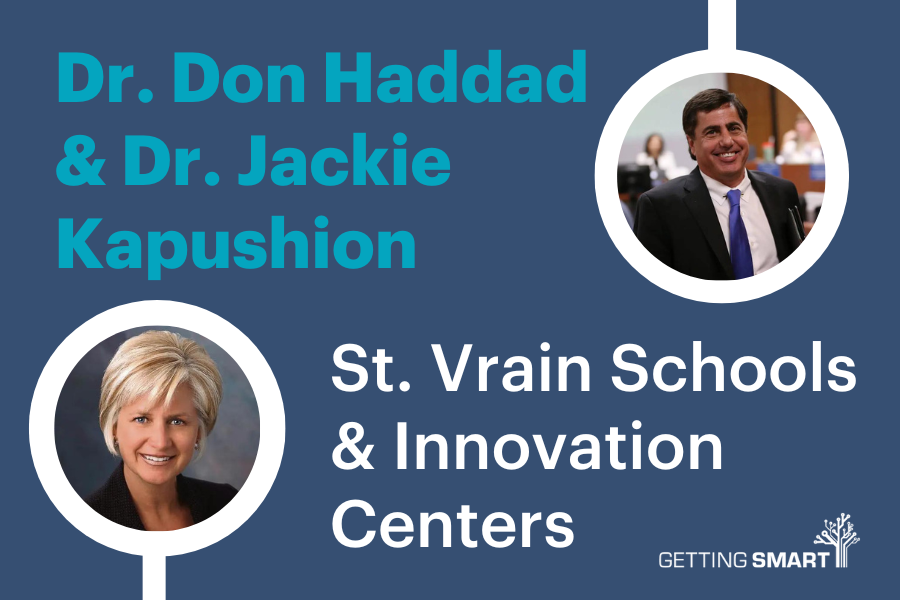
Dr. Don Haddad and Dr. Jackie Kapushion on St. Vrain Schools and Innovation Centers
Key Points
-
Public education is critical to public health, well-being, safety and even national security.
-
Superintendents have to be willing to learn with and alongside other districts.
This episode of the Getting Smart Podcast is a part of our New Pathways campaign. In partnership with American Student Assistance® (ASA), the Bill & Melinda Gates Foundation, Stand Together and the Walton Foundation, the New Pathways campaign will question education’s status quo and propose new methods of giving students a chance to experience success in what’s next.
On this episode of the Getting Smart Podcast, Tom Vander Ark is joined by Dr. Don Haddad, the Superintendent at St. Vrain Valley Schools and Dr. Jackie Kapushion, the Deputy Superintendent.
Together, they discuss the various pathways initiatives of St. Vrain Valley Schools, the role of a superintendent and how to scale innovation.
From Next-Gen Career Prep at St. Vrain Innovation Center
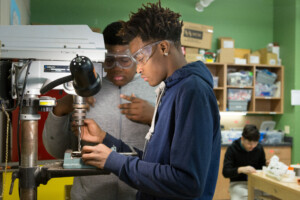
From launching a drone fleet to fighting cybercrime, from robotics to biotechnology, from engineering to entrepreneurship, the Innovation Center (@ICSVVSD) serves more than thousands of high school students in the St Vrain Valley School District (@SVVSD).
Thirty miles north of Denver, the Innovation Center serves students, PK-14, from all 60 schools in Longmont and surrounding communities. In its second year of operation, the $20 million career center offers 50,000 square foot of specialized learning programs prioritized by local, national, and global business and corporate partners.
Students take one or more classes at the Innovation Center and retain enrollment at their home high school. Buses run all day to extend access and options for St. Vrain students.
[Education is] an opportunity maker, a dream maker, an equalizer. It gives everybody the opportunity to advance and succeed in whatever way they choose […] I really believe that in my core. Not just theoretically, but personally. It’s what caused me to be able to do the things that I dreamed about.
Dr. Don Haddad
Links:
- Don Haddad LinkedIn
- St. Vrain Valley Schools
- Jackie Kapushion Twitter
- Jackie Kapushion LinkedIn
- P-Teach
- P-Tech
- Career Elevation and Technology Center
- Bill Ritter Getting Smart Podcast
- Next-Gen Career Prep at St. Vrain Innovation Center
Transcript
This transcript has not been edited for spelling accuracy.
This episode of the Getty Smart podcast is part of our new Pathways campaign. What is something you used to think that you’ve changed your mind about? It’s time for us to do that with all things learning. Previous Getty Smart campaigns have laid the groundwork of networks, place, purpose, and innovation. Our latest effort, the new Pathways campaign, will serve as a catalyst for an unbundling education
to allow for new learning models that are sustained by supporting guidance and embedded in scalable systems. In partnership with ASA, the Bill and Melinda Gates Foundation, Stand Together and the Walton Foundation, the new Pathways campaign will question education status quo and propose new methods of giving students a chance to experience success in what’s next. Find out more at www.gettysmart.com.
Backslash, New Pathways. Getty Smart Don, how do you think about the mission of the St. Brain Schools? I think about it both from the perspective of the St. Brain Valley Schools, but even beyond that I think about the mission of public education in general.
We have a quote here that kind of drives a lot of our work. It’s by Mark Twain. It says, out of the public school grows the greatness of a nation. And we truly believe in that. You know, if you look statistically, 90% of the children in America, ages kindergarten through 12th grade, are enrolled in a public school.
So it stands to reason that 90% of our population is either going to be educated in a public school, is being educated in a public school, or has been educated. And so there’s a significant correlation between what happens in the public school system and how well our nation fares overall. And we always talk about two really important institutions,
one being the institution of parenting, and two, the institution of public education and the combination of those two things. I believe, and we believe, we’ll have the greatest impact on our local communities, on our state, on our nation, and ultimately on our world. And so for us, our mission is to educate our children in such a way
that they not only develop the knowledge and the skills that are identified as important within the content and standards, but beyond that, we also know that our children are going to be entering the workforce and they’re going to be driving our economy and our economic vitality as a nation. So we see that as a large part of our mission to ensure a viable and vibrant workforce pipeline. We believe that public education is critical to public health, well-being, safety,
and ultimately our national security. And so we’re educating children to understand their role in maintaining and advancing those types of things. We also know that public education has a significant influence on the values of our homes and the values of our businesses and our corporations, and they’re helping them understand their role in having a vibrant business community
and the quality of the service industry. Everywhere you go, 90% chance you’re going to be interacting with somebody in the service industry who is educated in a public school system, and so we want them to understand that. And that workforce pipeline that leads to our nation’s success and ultimately our democracy, we believe that only a well-educated population can ensure making the right decisions
or at least thoughtful decisions, decisions that are based on knowledge and information in order to ensure our democracy. And so for us, public education is huge, and we believe that it’s a huge determining factor in the well-being of our country. Don, that’s why I love to pull up your website for St. Frain Valley Schools
and you proudly proclaim we are the future of America. And for all those reasons, our economic future, our civic future, the future of our communities, that’s the mission of public education, right? That’s right, yeah, absolutely. We want to raise good people with good skills and good leadership.
I’m Tom Van Der Rik and you’re listening to the Getting Smart podcast. I have the pleasure to be joined by the superintendent, deputy superintendent of the St. Frain Valley Schools in Longmont, Colorado. Dr. Don Haddad is the superintendent. Don, is this your 15th year?
Yeah, 15th year is a superintendent, 38th year overall. That’s an incredible track record. You have this super talented team and you guys have stuck together for more than a decade. I think that’s important lesson number one, that doing hard work takes a talented team with shared commitment sustained over time.
And you guys are one of the best examples of that in the country. We’re joined by, I think, Jackie as your better half. Dr. Jackie Kapushan is the deputy superintendent. And Jackie, you’ve been there for more than a decade, right? No, I’ve actually been here about eight years.
So I came on board in 2015 and was really, really thrilled to join such an innovative team. And Tom, I was getting advice from Jackie long before she came here. I would call her on the phone and say, what do you think about this? Because she’s just a brilliant educator. Donna, in my frequent visits to St. Frain, I guess I’ve detected a real commitment to growing here.
And the commitments are growing your own. It’s a growing teacher talent, turning talented students into teachers, growing teacher talent, growing leadership talent, growing community leadership. Has that been an important theme of just developing talent in that Longmont area? Absolutely.
We have a large district with a lot of students. We have parents that are heavily involved. We have our business community and business leaders who are heavily involved. We have our civic organizations. We have our elected officials.
We have our media outlets. We have our educators, our teachers, and our staff. And I believe that this is a shared leadership effort because only when you can bring people together, lots of minds, lots of thought processes, lots of opinions, diverse opinions, can you reach the pinnacle?
Can you really get to that next level and hire when you’re doing it together as a team with everybody pulling and pushing for public education and everybody rallying around our students? And so we have avoided a top-down hierarchical model. We are very collaborative, very much in sync as a team, and we have lots of involvement and we cultivate that with our students, with our teachers,
with our staff, with all those groups that I talked to you about. And that is absolutely one of our greatest strengths that we are all engaged, we’re all in in public education here in St. Brain. Tom, I would also say that one thing that Don does incredibly well in terms of developing talent is he hires it when it’s available and he understands that at some point we’re going to need that talent.
So if we look out into the landscape or if we have people who have an incredibly talented skill set apply to St. Brain, Don will often bring those people on board, whether we had a position posted or not, because he understands what we’re going to need in the future and has a vision for how to plug people in and to use those strengths to advance our mission. And Don, I think you’ve been intentional about supporting community leadership for more than a decade.
Do you have some kind of a community leadership development program that helps build and form supporters of public education in the community? We do. You know, I served on the board of directors for a number of chambers of commerce, and one of the programs that I ran throughout the city of Longmont was leadership long-month through the Longmont Chamber. And that model worked very, very well. I’ve been doing that for over a decade. We implemented something similar in St. Brain called Leadership St. Brain.
And Leadership St. Brain involves about 150 to 200, primarily parents that are representing each of our 60 schools, and we will meet for a period of six months and we’ll meet in different schools and we will address and talk about school finance and curriculum and instruction and transportation and safety and athletics and activities and legislative initiatives and give them an entire experience understanding in-depth the ins and outs of public education and how public education impacts the rest of our lives and the quality of our lives.
And many of those folks that have gone through this program are now and have been on our board of education. And it also serves us well because once they understand the dynamics of public education at a very deep level, they’re able to be advocates out in the community and they’ll write editorials and they’ll run for other city council boards or things like that, but they’re actively involved. And that’s just really important because obviously, you know, parent leadership is critical. We have their children in our schools and so they need to share in that leadership
and they want to and we want them to. Don, I don’t know if I ever told you this, but I was in the Leadership Denver class of 1990 with Bill Ritter, who went on to be your governor and it was really that Leadership Denver experience that where I understood the calling to become a public school superintendent. And so it was that sort of a community leadership program that was really important to me and why I brought that same kind of a program to the district that I led.
So I really appreciate your commitment to building community and particularly community leadership. It’s really been key to your success. You know, and Tom, the thing that people understand about schools is that they all went to one. And so oftentimes they feel that that’s synonymous with understanding all you need to know about schools, but when they begin to understand that we are the largest employer with nearly 6,000 employees,
that we are a business because we have nutrition services and operations and maintenance and human resources and IT technology and education, they begin to see it in a different way. And that’s really important in order to advance and sustain our success. Jackie, you’re one of the larger districts in Colorado. I’m curious how you think about the organization of the district.
How do you think about your relationship with your schools? Are you sort of a top-down district where the leadership team makes most of the decisions? Or is it a bit of a hybrid? How would you describe your relationship with your schools and with your teachers? Yeah, that’s a great question.
You know, we are the seventh largest district in Colorado. We have a great relationship with our schools and our teachers. You know, I think one important thing and a question that many school districts often grapple with is, what does that loose-tight fit look like? And I think we’ve struck a great balance, partly because our team centrally believes that we exist to work for our schools
and not the other way around. We know that in our classrooms is where the magic happens, and we really believe that our role is to reduce the barriers that allow for teachers and students to connect well around great programs and to help advance students. And so I think we’ve done a great job.
You know, we’re tight around the things that involve school safety, equitable distribution of resources, you know, offering great facilities and learning spaces. We have a tight communication and feedback loop in St. Verane so that everyone gets the same information when it’s relevant to their role or to their, you know, to their responsibilities. But we’re also, we also give schools agency where once they’ve met those really strong foundational skills with students
that they have the options and the opportunities to add additional programming, to add clubs and activities and traditions and celebrations that really highlight the uniqueness of those schools and really work towards celebrating students and taking them to the next level. And so I just think we’ve had, you know, we’ve struck that balance incredibly well in St. Verane. I think our teachers and our principals feel very supported around the things that they don’t actually want to have on their plates. And I think they feel a lot of license to be creative in other spaces where they want to try some new things.
So I think that’s a great balance in terms of our teachers. You know, what I will tell you, Tom, is that in St. Verane we revere our teachers. We hold them in very high esteem. Don and I meet regularly with our teacher association reps and our association leadership. Again, we are listening for those challenges that we can help solve and to reduce those frustrations to again remove barriers.
We celebrate our teachers if you follow us on Twitter. Or on Facebook, like Dr. Haddad is boasting about St. Verane teachers every other day. Every day because we truly love our teachers and we just have the greatest respect for the profession. And so, you know, we just, we continue to have that relationship and, you know, keep our teachers close and let them know that we’re here to support them. Don, I really, I love so many of the career pathways that you have created in St. Verane.
And so I want to ask you a similar question about how you spot those emerging career pathways, how you develop business partnerships around them, how they then get located as a school. Does that often start at the district office or does that leadership for pathway formation sometimes started the school? How does that happen? And then how do you make sure that you have equitably distributed pathways across the district so that all kids have sort of an equitable shot at opportunity? What’s your pathway strategy? Well, one of the first things that we support is students being able to select which school they’d like to attend.
And we don’t create waiting lists for them. We say that these are the programs. Every school is going to offer a great public education, a great high quality public school education. And on top of that, you’re going to have options. So about 12 years ago, 13 years ago, we started our focus school initiative where we’ve implemented different types of focus schools across the K through 12 system. One of them is in international baccalaureate, another one is in leadership, another one is in medical and biosciences, another one is in energy, another one is in STEM, another one is in performing arts, another one is in aerospace and engineering.
Then we have P-TECH programs that offer cybersecurity associates degrees. We have the medical and biosciences associate degree. We also have the computer information systems associate degree and we have the new one that’s coming online, our business associates degree. And so you have all of these different programs in addition to all of the traditional programs that you would find with advanced placement, international baccalaureate. Then we also have a very, very robust advanced manufacturing program where kids can pursue certifications in machining and welding and optics and electronics in automotive technology.
And you look at the paramedics and nursing and all of these culinary arts programs that offer lots of choices, printing trades and things along those lines. We also have a pathway that can lead to the military. So you look at the two-year associate degree or community college approach, you look at the four-year pathways that kids can select to go to anywhere they want to in the United States and beyond. Then we have those other options around certifications, all of which guarantee a student a great education regardless of which school they go to. And the key around choice is that people aren’t choosing to get away from something.
They’re choosing to get into something that they’re passionate about. And that’s really, really important. So coupled with our very high and rigorous graduation requirements, we have these other options that are all pathways. And I serve on the Colorado Business Roundtable Board of Directors and I’ve served on a host of different economic development councils. And so we understand very clearly along with our close to 200 partnerships with business and corporations what those critical pathways and career opportunities.
So for example, we were driven to open up a cybersecurity pathway in our P-Tech program because we know that that’s big and aerospace and aeronautics is big. And so we’re really in tune with the careers that are out there and creating options and opportunities for our students to do that. And Jackie leads a lot of that effort and can also probably respond to some of the work she’s done. Jackie, a couple more questions on that. How do you keep those pathways dynamic? I imagine almost all those pathways have a community partner.
So say more about that. And then what does a K-8 program look like that helps young people imagine possible futures to make good high school choices? Either one of those. Yeah, we work as Don said so closely with our business community that in terms of keeping our pathways dynamic, it is looking out in the broader landscape, understanding what the future is going to hold in terms of career pathways. And then back mapping and aligning that to some of the work that we do in St. Frayn.
You know, it’s one of the reasons that St. Frayn took on such a strong STEM approach over a decade ago because the landscape really called for that. It basically informed us that 87% of the jobs would require some kind of STEM skill set. Regardless of the career pathway that you were choosing that you would need to have a strong basis in technology, in science, you would need to have design thinking as a foundation for the way that you problem solve and work in project teams. And so that decision over a decade ago to really build a strong STEM base is what has prepared us to take on really any pathway. Now that we might we might consider we have looked across all of the major career options that are in in the literature out there and in the US, and we serve and have pathways in every single one of them.
So health care and the medical prelaw, the one area that we identified that we don’t have a pathway yet and it potentially will be our next pathway is construction management. And that’s big in Colorado right now we are a growing state, and there’s lots of opportunity in that space. So it is that external scan, and it’s the work we do with our business partners that kind of help us to think about what’s next. In terms of helping students with options, we have a high school options catalog that’s very descriptive very robust that we put out to all of our families. We often spend two to three months having open houses and tours so that families and we don’t have those on the same night we have them on multiple nights because we essentially are are entering into that season.
Where families are going to be able to make those choices and they spend November, December and January visiting our schools, talking to our administrators and our teachers and looking at what each school has to offer. The one thing I really like about the way that St. Vrain approaches workforce pathways is that even if you choose a high school and your interest changes, there are other opportunities. So our career elevations and technology center offers standalone courses that students can participate in. Our innovation center offers project teams real real work based experience in project teams after school hours. So students, they really have lots of options. They’re never pigeonholed into one to one option.
You know, right now we’re starting our agile learning classes where they are online and students from any high school can participate in an online course if it isn’t currently offered at their own high school. So what we’ve tried to do is just be really flexible in the way we do high school. We try to expand options beyond the school day and into weekends and opportunities into the weekends and use technology to also expand options for students. Jackie, when I was there a couple weeks ago, I learned about P-Teach, a really cool pathway for future teachers. Tell me about that. Yeah, we love our P-Teach program. It’s again where St. Vrain was a little bit ahead of the curve now that the rest of our country is talking about the teacher shortage.
We were poised about four years ago to start a P-Teach program, which is a pathway to teaching. We tap our high school students who are interested in going into the teaching profession. We pull them in quickly and start giving them some experiences in our classrooms with students, with children, and they’re able to kind of test those waters to see if it remains in interest. And if it does, we partner with the University of Colorado at Denver to offer them their first classes paid for by St. Vrain, their first foundational education classes. And they complete those and go, they enter into college with almost a year under their belt in their teaching credentials. And then they continue on with the University of Colorado at Denver to finish their teaching degree, but during that time they continue to work back in our classrooms in paid positions.
So they might be a paraeducator during that time. They might come back and work for summer school and take a small group of kids under a master teacher and teach a summer school class. Or in their fourth year, their final year of college, they’ll come back into a full year residency with some pay and some benefits. And then we hire them back into our classrooms. Many of those students are first generation college going students. So we help build some diversity in our teaching pool. And most importantly, we bring students back who are invested in this community back to teach in our schools. That is such a great program. Everybody needs a P-Teach program.
Don, Jackie mentioned the Innovation Center. This is one of my favorite education facilities in America. What is it, what happens there? When was it built and what’s next for the Innovation Center? You know, a number of years ago we had applied for Race to the Top and we were fortunate. We were one of 16 school districts across the United States to win a grant from Race to the Top for $16.8 million. And we had prior to that started a mini Innovation Center where we renovated one of our areas in the Career Development Center. It’s about 6,000 square feet to begin with. But when we got that Race to the Top, we had put in the plan for this Innovation Center and that was part of the overall application. But when we won that, we began to build it out and then in 2016 we went for a bond and that bond included $20 million to build the current Innovation Center which is now 50,000 plus square feet.
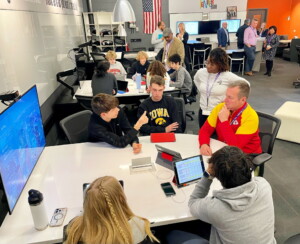
And within the Innovation Center, it acts as a center that reaches out to all of our schools. So there’s innovation that happens there but it’s innovation that supports what’s happening in all of our other schools so it’s not isolated. And you will find things like robotics. We have 200 robotics teams in our 60 schools and we actually won the World Championships this past year in the large division and the small division in Texas. So we have underwater robotics and traditional robotics. We have aviation and drone technology. We have virtual reality. We have augmented reality. We have artificial intelligence that you will see. We have cybersecurity that goes on in there.
We have all types of things where kids are advancing their ability to innovate. And we built a system in our school district that we refer to as Foundation Innovation. So the Foundation is this strong, rigorous, academic experience for students that will qualify them to apply and get into just about any college and university in the country. But then layered on top of that foundation are the various innovative experiences that our students can have. And so it’s a beautiful facility. So it’s also symbolic of St. Brain and we do about 150 to 200 tours every year.
It’s slowed during the pandemic for sure but it’s kicked back up. And we are now in the middle of a capital campaign where we are going to double the size of it. So it will go from 50,000 to about 100,000 square feet. And the new space will actually house an airplane because part of what we do is we are creating opportunities for kids to get their pilot’s license. And they build planes and so that will be part of the new build-on facility.
We have a lot of mentors from people like at IBM, at Apple. We had the first Apple certification program in the country for high schoolers where our students actually get paid to work on fixing the iPads and doing real work. Those types of things. It’s an incredible facility. Incredible facility. And again, I always highlight the fact that it branches out so it’s not just a singular location.
There’s innovation happening across our entire system. One of the next steps for the Innovation Center in the build-out is a futures center. So we would like to offer, because we have so many rich business partnerships, we would like to offer every high school student an internship as part of their high school experience with our business partners. So we’ll be building out a futures center where we’ll have some additional counselors in that center and they will connect high school students with businesses that connect their interests and allow them to experience an internship before they graduate from high school.
I love that. I’m going to learn more about that when I’m there in a few weeks. There’s two things that I super appreciate about you guys. One is that you’re just great advocates for St. Vrain kids, teachers and schools, but more broadly for public education in Colorado. And two is the way that you’re learning with other districts that you’re helping other people get better and learn with you and learn from you.
So, Don, I want you to speak to the former. Why are you so darn positive? You’re just such a great advocate for St. Vrain kids and teachers, but more broadly, you really spend a lot of time advocating for public education in Colorado. What’s behind that? Well, you know, you start out by being a product of public education and some of the people who had the greatest influence in my life or public educators and many of whom I have stayed in touch with my entire life.
I just see public education as being that opportunity maker, that dream maker. It’s an equalizer. It gives everybody the opportunity to advance and succeed in whatever way they choose. And I really believe that in my core, not just theoretically, but personally, because it’s what caused me to be able to do the things that I dreamed about. And so I think that people can talk about things from, you know, either a negative perspective or a neutral perspective or a positive perspective.
And for me, mindset is a lot. You know, I grew up as an athlete and, you know, I just don’t have a lot of patience for thinking about everything we can’t do, but rather thinking about all the things we can do. And then strategizing and working hard to achieve those things. And we are working together with a number of groups. One of them is the Colorado Education Initiative, and we actually have opened up a national training center, which you’re aware of.
And so we’re actually trying to advance some of the ways in which we communicate and some of the strategies that we implement and some of the creative and innovative things that we’re doing and broaden that and expand that throughout not only Colorado, but across the nation. Because, you know, we were at this event today at Metro State, four star general was speaking and talked about the future of our country and how it’s, you know, nothing is certain. And that we have a lot of competition, both economically, militarily, and it’s important that we stay focused, that we stay disciplined, and that we stay hungry as a nation. And public education is the catalyst for a great continued future in this country. It’s that important. And I want to make sure that we don’t reduce the conversations, the ideological warfare around events and things that may have occurred, but rather stay focused on this institution, so that we can ensure the next generation is ready to keep America in that great place as a leader in our world.
And I just believe that in my core. And so it’s it’s easy to talk about it that way. Jackie, a couple weeks ago I had the chance to watch you and Don, you know, sharing with districts from around the mountain west. Why, why is it important for you to help other districts innovate. Yeah, I, I, I share Don’s enthusiasm for wanting public education to succeed. You know, we just, we are just a district and a team that believes that we have a responsibility to the to the 90% to the 50.3 million children in this country, who depend on our institution to help lead them into the future. And so it is a mission that we that we are fully bought into. It’s a responsibility that we take seriously. And we aren’t in it just for ourselves and Saint Brain. We want to see public education succeed in this state. And in all states across the nation, we want to be an institution that people look up to we want our teachers to be proud that they’ve gone into the teaching profession, and to understand the honor and the responsibility that that profession holds.
And so we do everything we can to help them understand that deep sense of purpose to keep them motivated and inspired around that purpose and to, to really understand what their impact is on this on this community and really the state and our nation. And so, I’ll tell you one thing that it really just accentuates the exponential impact of public education. I started teaching and coaching when I was 23 I was coaching wrestling at the time. And I had a lot of young men that were on my wrestling team that have since grown up, had their own families reside in Saint Brain, and I am now passing out diplomas to their children. And so you, you really begin to see that back then at 23 while I was working to influence this young man. I didn’t really think about the fact that I would actually be influencing his child, who then will be influencing another generation. And so, and then I think about, well, that’s what happened to me. There were coaches and teachers influenced me. So that’s public education. It, it really does influence lives in a major way. So it’s exciting work.
We’ve been talking to Dr. Don Hedat and Deputy Superintendent Jackie Capuchin from the Saint Brain Valley Schools. You guys are the future of America. We do appreciate your, your local leadership, but we appreciate how you’re, you’re leading public education across the state and across the country. Thanks for being with us today. Well, Tom, the respect is mutual. I, I follow you and I read all about the things that you’re working on and you have had a major influence on our work and the work of many others. So thank you. Yeah, and thank you Tom for bringing people together who want to do great work in this space. We appreciate your leadership as well. Well, just keep letting me bring people to visit. We’ll see in a couple of weeks with another bus full of eager learners.
That sounds great. Thank you. Thanks a lot. You’ve been listening to the Getting Smart podcast. I want to thank my producer, Mason Pasha and the whole Getting Smart team, including a Saint Brain Valley teacher that we hired Marissa Wicklin. She’s, she’s wicked talented like the rest of the Saint Brain Valley teachers. Until next week, keep learning, keep leading and keep innovating for equity. Thanks for tuning into the Getting Smart podcast today. We want this podcast to be actionable and insightful and a great way to learn about what’s next in learning. In order to stay on the cutting edge, we need people in the field to tell us what they’re hearing, what they’re wanting and what they’re needing to learn more about.
Got a topic or a guest in mind? Send your recommendations to me, Mason at GettingSmart.com. And if you like what you’re hearing, don’t forget to leave a review in Apple podcasts or subscribe wherever you listen. Feel free to share the podcast on social media using the hashtag GS Podcasts. Thanks so much.
0 Comments
Leave a Comment
Your email address will not be published. All fields are required.