

Christine Ricci and Leo Morton on Connecting Schools and Industry
Key Points
-
Learners must get comfortable with uncertainty in order to thrive in a future forward workplace.
-
Learners must find ways to use skills acquired, learn every day and live with a sense of purpose.
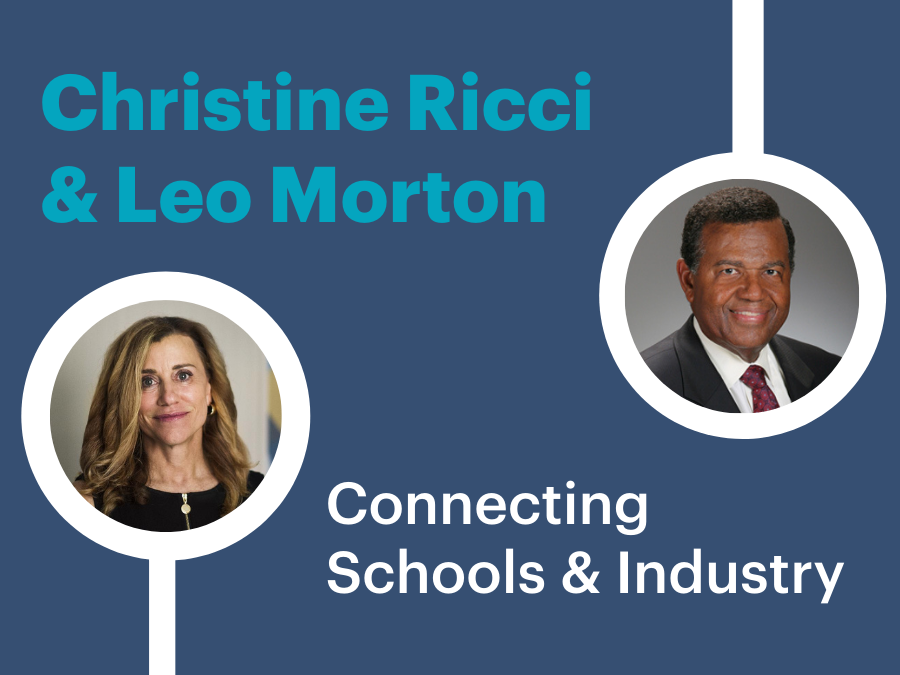
On this episode of the Getting Smart Podcast Tom Vander Ark is joined by Christine Ricci and Leo Morton, two business leaders from Kansas City who recently met with Tom at a Kauffman Foundation sponsored real world learning event.
For the last five years, Christine served as CEO of Phone Medic, also known as UbreakIfix, an electronics repair chain. She has had twenty years of executive leadership in healthcare and tech with companies like HCA, Cerner, Sprint and more.
Leo Morton is a private equity investor and President of DeBruce Companies, a family office managing a diverse investment portfolio. He started his career as an AT&T engineer, and has had numerous executive roles in manufacturing and energy. He also served as the Chancellor of University of Missouri Kansas City for nearly a decade.
Let’s listen in as they talk about connecting school to industry, where entrepreneurship comes from, how to have better school and business partnerships and much more.
Soft Skills are not only gifts you can transfer from job to job, but they are things you can use in everyday life.
Christine Ricci
Transcript
This transcript has not been edited for spelling accuracy.
Hey there! Before we get to the conversation, we wanted to tell you about the Getting Smart Smart Update. Do you love hearing about new innovations in learning? Every week we send out a newsletter blast to thousands of leaders in the field that highlights what we’re thinking about, what we’re excited about, and of course, the most
innovative things in education. If you’re not on the list yet, then we’d love to have you. Sign up for the newsletter at www.gettingsmart.com. Alright, let’s jump in. You’re listening to the Getting Smart Podcast.
I’m Tom Van Der Rook, and today I’m joined by two amazing business leaders, Christine Ricci and Leo Morton. They’re both from Kansas City, and I recently had the pleasure of chatting with them at a Kaufman Foundation-sponsored real-world learning conference. For the last five years, Christine has served as CEO of PhoneMedic.
You may know it as you break-eye fix electronics repair network. Christine is also launching a new venture back in HealthTech, and we’ll talk about that a little later. She’s got 20 years of executive leadership in healthcare and technology with a bunch of great companies in Kansas City, including HCA, Cerner, and Sprint.
Hi, Christine. Hi. Great to have you here. Leo Morton is a legend in Kansas City. He’s a private equity investor and president of the De Bruyse Companies, a private family
office that manages a diverse investment portfolio. Leo started as an engineer at AT&T and served in a number of executive roles in both manufacturing and engineering. In between, he spent almost a decade as the chancellor of the University of Missouri, Kansas City.
Leo, it’s a real pleasure to have you on the Getting Smart podcast. It’s great to be with you again. Leo, you started as an engineer. Maybe you could talk about your transition from engineering to administration. What interested you?
What propelled you from an engineering role into an executive role? Well, I had played a number of executive roles in the corporate world, and I thought I was retiring in about 2008 and was asked if I would serve as the interim chancellor at UMKC for about six months while they searched for a new chancellor. After about four months, they asked me to stay.
I did, and it turned into nine years of assignment there. I think the transition was probably sparked by the fact that I spent a lot of time volunteering for a number of organizations around Kansas City. In fact, I was chairman of the board of trustees for the University of Missouri, Kansas City, serving in the third term of what was supposed to be one term.
I was very familiar with the university, and they were familiar with me, so it just worked. Leo, is it harder running a big energy company or a university? I would say the difference is usually its governance. At a large corporation, you have a board of directors appointed by the, that represent the shareholders who appoint the CEO, and from the CEO on down, it’s an issue of command
and control. The CEO says we’re going in this direction and that’s the way it works. But at the university, it’s something called shared governance. In that case, what it typically means is that everyone wants to participate in the decision, but if there’s a prison term at the end, you’re kind of on your own.
There’s a limit to the sharing. I would say that at the university, you will find some of the most committed people I’ve ever worked with in my life. They care about what they’re doing. They care about the students, and they make us all better.
Leo, I know the whole Kansas City region really appreciates your leadership at UMKC. Christine, in our research, I found out that you’re a volleyball star. I didn’t know about that, but what skills, mindsets do you think you learned as a D1 athlete that have been valuable to this day? Yeah.
So volleyball was really my ticket out of Chicago. So grew up in a, my mother raised us, grew up with a total of six kids, and really to go on to college, sports was the way to do that. So it taught me perseverance. It taught me resiliency.
It taught me the value of athletics and athletics as a means to really learn those values and virtues that help make you successful later in life and really in the business world. And I didn’t realize it, definitely didn’t realize it at the time, but as I continued to progress, I’m really reflected back on coaches and mentors and the softer skills that I learned from the discipline of sports.
So you became a nurse and then you did an MBA and you made your way to the executive ranks. I think it was in healthcare first, right? Right, right. With HCA and Rick Scott at the time when he was part of HCA.
So Christine, I wonder if you could reflect, we’re going to talk today about real world learning, the big initiative in Kansas City, but I’d love to have you both reflect on your sense now of what young people need to know and be able to do. When you think about your last five years of running a network of retail outlets, you think about the sort of unit managers that you’re trying to hire and cultivate.
What skills were most important to you? I would have to say it was the softer skills. We could teach the harder skills. So we could teach anybody to fix an iPhone, a Samsung, a computer. So the trade part of it was the easy part.
The softer skills such as deescalating a customer, communication with teammates, how to confront challenges and work through those challenges versus seeing a challenge and running away from the challenge. So it was more of those softer skills that were the things that we looked for, but even more so what we coached to.
If we could get an individual that was coachable, that we could teach how to communicate, that we could teach how to see a challenge as an opportunity and to build that critical thinking that’s really where we tried to build the talent base, but also the gift we tried to give back to individuals that came into our organization knowing that those are not only gifts that you can transfer from job to job, but they’re also things that you use in everyday
life. Christine, were you hiring people with degrees as well as people without degrees in your last executive role? Yeah, most of our employees did not have degrees. I would say at least probably 95% did not have degrees.
And do you think your organization got better during the five years you were there at identifying critical skills and hiring for those skills? Definitely. Initially when we started, we thought it was all about the hard skills. And to a certain extent it was, but when we looked at what’s truly going to grow the business,
but also what’s truly going to make a difference with those that we served for the customers, it was about the experience and the experience was really about how they were managed, that you could actively listen. You could solve their problem and then educate them after the fact. So they walked away with not just a fixed phone, but a trusted partner.
All right, we’re going to come back and talk about entrepreneurship in a minute, but I want to get Leo in here. Leo, maybe you could give folks a sense of the scope of the kinds of businesses that are in the DeBruce portfolio. It’s a pretty broad portfolio, right?
Exactly. It ranges from biotech. We have a clinical trial with a cancer drug. We have a school and group homes for people with autism. We have a startup that is producing a diagnostic for COVID and for foodborne pathogens.
We have another company that is developing an alternative energy solution, another company that has a technology that is revolutionizing sports and bringing technology to that. So the portfolio is quite broad. I may have mentioned to you before that when I first joined, I mentioned to Paul, you know, Paul, if we could have this portfolio a little more narrow, I can figure out when to say
no quicker or when to say maybe quicker. But now after looking at it, I really like the fact that we’re fairly agnostic. We know a good deal when we see it. I’ve worked in maybe seven different industries. So I’ve been blessed to have a very broad background, so I don’t get lost in a lot of
things but can really tell in my advanced years what a good business looks like. This is a hard question given all the different kinds of businesses that you have. But maybe across your portfolio, you could give us a sense of the skills that are becoming more important, particularly for younger people in your companies. Right.
I would agree with everything that Christine said. One way I would put it is, you know, young people need to have a good tool belt. That tool belt needs to have all of the educational skills that one brings to the table. But the future has so many surprises in it. You have to be pretty agile in order to address the changes.
Find ways to use those skills you’ve acquired. Learn every day. Live with a sense of purpose and be purpose driven. You’ll find that more opportunities come your way. I had no way of planning.
I couldn’t have dreamed about the kinds of things that I’ve been fortunate enough to be a part of. But it’s all because you have to be flexible. You have to give it your all wherever you go. But I just have to reinforce the things that Christine mentioned about the kinds of fundamental
skills one has to have and always develop. I happen to be 76 years old right now. But I’m kind of embarrassed about what I didn’t know yesterday. You know, because you’re learning all the time. And there’s a I think young people today are facing lots of uncertainties in terms of how
things might evolve. But that’s also exciting. You just need to be flexible and make sure you have the fundamentals in order to address the opportunities that arise. Thank you, Leo.
I want to riff on this a little bit more. Both of you have worked in really large organizations, but you’ve migrated to a point of entrepreneurship. Christine, you now have this really interesting role where you build businesses to sell and you’re getting ready to step into a new role and you’re moving back to healthcare. But you’ve really developed an entrepreneurial mindset where you have trained yourself to
think about what doesn’t exist but could be possible. I’m wondering how you think you developed that entrepreneurial mindset and maybe what we could do to help kids keep or create that in themselves. I think the entrepreneurial mindset I think goes back to a lot of problem solving. And so if I think about my earlier childhood, a lot of what I had to do was problem solving.
And so it wasn’t the straight math problem or the anatomy problem. Those were all good and foundational. But it was really the complexity of how things worked together. And so really having a passion, and a passion is a big part of it, really having a passion for solving problems, I think gives you a good foundation going into large businesses
because in large businesses, whether it was CERN or HCA or Sprint, getting thrown into complex issues or at problems was fun and enjoyable. And therefore you’re always striving to solve, solve, solve, solve. Take that over into the entrepreneurial world once you understand the basics of accounting, marketing, sales, operations, those type of things that you learned from the large businesses
in the entrepreneurial world. As long as you still have that passion for solving problems and you’re able to do it, there are so many entrepreneurial opportunities out there. If the passion doesn’t exist for that, though, it’s not necessarily a path you would want to go down or you would want to align with somebody that has that passion because I feel
like so much of entrepreneurism is solving problems and solving complex problems. Leo, it’s interesting that you’ve worked in big businesses and run a university. You wouldn’t think of those as having a real entrepreneurial mindset, but you spend all day every day working in an entrepreneurial way these days. How do you think you’re able to keep that fresh and develop it late in your career?
Well, I believe I owe it all to my roots. My father was an entrepreneur. About 12 years old, 64 years ago, I started working with my father in Morton’s upholstery company in Birmingham, Alabama. It was in that shop where I learned almost everything that I know about business today.
He took me out on a sale. We kind of won a job to a posterer’s chair. We brought it back to the shop. I upholstered the chair. We took it back.
The lady paid and I was paid. So immediately I knew how the economy worked. I had to stay with me. As I may have mentioned, I might have a master’s degree in business from MIT, but the best business school I ever attended was Morton’s upholstery.
So it’s in my DNA. But one of the things I also learned working there was that’s not what I wanted to do. I understand what it takes to be an entrepreneur, but I knew that that was not the kind of thing I wanted to focus on trying to make payroll every week. So you’re right.
My brother and I are both engineers. I worked for Bell Labs, AT&T, General Motors, Rust Engineering, AT&T, all the rest. But I’m now in a position where I can take everything that I’ve learned from all of those assignments and really help the entrepreneurs who really, in many cases, it’s not that you have to help them redesign the product.
It’s all about how to manage the myriad of issues that they are confronted with every day. And I really enjoy it. I’ve had the opportunity to be of help to them. So what brought us together was the real-world learning initiative in Kansas City.
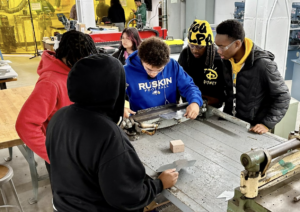
I think the three of us are big fans of that effort. There’s 75 high schools and 31 systems that are implementing real-world learning, and that includes client-connected projects, work experiences like internships, but it also includes entrepreneurial experiences. Really the biggest effort in America trying to encourage entrepreneurship.
Christine, do you want to talk about any one of those internships, client projects, entrepreneurial experiences? Which of those do you feel strongly about? Yeah. So I can hit on two fronts.
One would be, as far as working with school systems and students, oftentimes when they would come into our organization and do internships or spend a semester with us, they were typically going down a specific route such as technology, but we knew what their growth plan was, working hand-in-hand with their school system and their teachers. We knew what those developmental areas were, and that’s where we focused our coaching,
our mentorship, and their experiences. And really did a lot of real-time coaching. We put them in situations that were uncomfortable situations, and that’s what it was all about, like being comfortable, getting comfortable being uncomfortable, but also we would let them fail.
Fail in a safe way, but really leverage it as an opportunity to coach, mentor, and give them real-world experiences. So they were in a trusted environment. They were in a protected environment, but we allowed them to get uncomfortable and to really get that real-world hands-on experience.
And oftentimes what they came in like, they’re very different when they left, and they were excited and they were passionate. And who knows what their journey was going to be, but now they had a journey. And really it was rewarding for the students, the teachers, but everybody that helped to grow and groom that individual.
Leo, why do you think real-world learning is important in Kansas City? Well, I think it’s important everywhere because I’ve had it myself, and I owe a lot to it, and probably comes from several things. One, I have a deep appreciation for how I ended up where I am today. Secondly, I think I mentioned to you that I had a, my oldest daughter was in high school,
and I asked her what she wanted to do, and she said she wanted to be an entertainment lawyer. So I thought I was doing her a favor. I had her spend the day with a lawyer friend of mine, and she came home and said, well, I’m not doing that.
Well, she saw herself. She’s a very outgoing person, so she saw a person sitting at a desk with piles of paper. She did not see herself doing that. So that experience turned her in a different direction, and she’s doing great now. But the other one was after being at a university, I know that out of, well, we had a population
of maybe 16,000 students, and probably 35% of them actually knew what they wanted to do. One of the things I wanted to do was put internships on steroids at the university, because I wanted those students to have those experience, to understand what the work experience was like, not just the title of the job, but what is the work experience?
What is the work experience for an engineer, for a teacher, for anyone? And is that the kind of work experience you will enjoy and accelerate in? So to me, having, if you’ve been there and done that and you enjoyed it, you’re more likely to understand the importance of the education, the relationship that you have with the classes and the work that you intend to do, and the outcome will just be superior.
Leo, like you, I was talking to the folks at the Coffin Foundation today, and they said at the beginning of this initiative, in many of the school districts only, 20 or 30% of young people were getting real world learning, and there’s internships, client projects, college credit opportunities, much less an entrepreneurial experience. So this is really an equity initiative to get every kid those kinds of experiences.
I think you and I both think that’s an important part of this story, right? Absolutely, because I would tell you, I participated with Bell Laboratories when I worked there and recruiting talent for AT&T and Bell Laboratories. But I’ll tell you this, in today’s world, I think most companies realize that they cannot sit on the sideline and wait to see what comes out of the universities and the high schools
and trade schools and the like. They have to get more involved. And that means putting together, it’s sort of try them before you buy them, right? It’s how do you give them the kind of experience that they learn from, but also it’s a benefit to the corporation as well.
They get a chance to learn how they need to fashion the environment in the company so that they will be more attractive to these young folks coming out. I feel like it’s also a mindset, though, that if when you’re young and coming in school, if you can learn the value of real world learning and experience and appreciate the coaching and the mentorship and you set yourself up for that for every stage of your career, like
you are going to accelerate so much more. And if I think about Leo, Leo is still doing real world learning. He still has his entourage of students that he is teaching about what the real world is and they are learning and prospering from his knowledge and his experiences. So it starts in the school system, but if you can appreciate it and build upon it, it
doesn’t end. Christine, you’ve had a chance to work in tech and healthcare and retail. What kind of advice could you offer to schools that want a stronger partnership with business? I think it’s simple in that just reach out and have the conversation. Oftentimes, the businesses, they are really supportive of the school systems and they do
want to support students coming in and learning. So for school systems, I would say just reach out and have the conversation with those businesses that align with what you’re looking for. And then the second thing I would say is just figure out how to make it easy for the business. Some of the school systems that I was approached by, it was really, really complex and so a
lot of time was wasted and we really didn’t accomplish much. But for other school systems that came in, we figured out pretty quickly it was a match and then they basically said, who do I need to work with, we’ll make it happen. And it was very, very, it was simple, it was fast and within a week or two weeks, we could make things happen.
Leah, what advice would you give to school and system leaders on partnering? Well, to me, it’s all about the objective. The objective is to give the student a real world learning experience that has value. And I think, and as I pointed out before, it’s also about value to the employer as well, because there’s a little enlightened self-interest here you have to invest in order to benefit
long term. But I would say it is difficult. One, the thing that I learned at the university was that even at the university, you had to prepare the student before so that they understood how to dress, how to act, what’s the right way to perform at the environment.
You have to provide support for the student while the student is there. They will run into issues in the assignment and you have to be prepared to support them there. And then there’s after. And on the corporate side, many corporations, unlike Christie’s, I mean, they’re willing
to volunteer, but they don’t know how to design a good experience for the student. And it’s not in many cases in the past that wasn’t necessarily a winning. It wasn’t a project that the company really felt was important. And it wasn’t making copies, but in some cases, it wasn’t much better. And so working with the company to design that good experience, making sure the company
benefits from that experience is also a part of the total value proposition. Both of you are such treasured business leaders in Kansas City. We really appreciate your contribution to the business community and your many contributions to the education community, particularly your leadership on world learning. I just want to say Christine and Leo, thanks so much for joining us today.
Well, thank you. It was a great honor to be asked and you’re doing great work here. Thank you. You’ve been listening to the Getting Smart Podcast. I’m Tom Vanderark.
Keep learning, keep innovating for equity. Thanks for tuning in to the Getting Smart Podcast today. We want this podcast to be actionable and insightful and a great way to learn about what’s next in learning. In order to stay on the cutting edge, we need people in the field to tell us what they’re
hearing, what they’re wanting, and what they’re needing to learn more about. Got a topic or a guest in mind? Send your recommendations to me, Mason at GettingSmart.com.



0 Comments
Leave a Comment
Your email address will not be published. All fields are required.