


Catching Up: Can AI Help Students Connect With People?

In this wide-ranging episode of the Getting Smart Podcast, co-hosts Nate McClennen and Mason Pashia discuss some of the most pressing questions in education today. They unpack Arizona’s latest ESA fiscal report, examining who is actually using education savings accounts, what they are spending the money on, and what the accountability gaps reveal about the broader school choice landscape.
They then break down the mechanics and limitations of PISA, the global assessment that generates alarming headlines every cycle, including a live attempt at a sample science question that exposes just how disorienting high-stakes standardized testing can feel, even for adults. The conversation also touches on the reintroduction of the NEED Act, which would establish a DARPA-like R&D center within the Institute of Education Sciences, and the persistent challenge of collecting reliable data on microschools.
The episode’s deepest insights emerge in two interconnected deep dives. Drawing on a recent Christensen Institute report by Julia Freeland Fisher and Anna Arsenault, Mason explores how pro-social design in edtech tools, such as asking students to name a witness for their extracurriculars or map a spark-based professional connection, can quietly build social capital in learners who need it most.
The hosts then turn to the student motivation crisis, grounding the conversation in the four engagement modes from Rebecca Winthrop and Jenny Anderson’s book ‘The Disengaged Teen.’ With fewer than 10 percent of students operating as high-agency, high-engagement explorers, and AI making it easier than ever to become a passive passenger, Nate and Mason wrestle with whether this is fundamentally a supply problem, a demand problem, or both, and what it would take to scale the boutique models that are already getting it right.
Transcript
Introduction
Nate McClennen: All right. What are you gonna talk about today? What do you have to share with us?
Mason Pashia: We’ve got a bunch of good topics today. One, we’re talking about a report on ESA usage in the state of Arizona: who’s it serving, and what are they doing with it.
And then we also look at a new report out of the Christensen Institute on pro social technology. Lots of really interesting findings, and some advice for edtech providers and credentialing. What about you?
Nate McClennen: Well, I’m definitely gonna share a quick thing on microschool research and the elusiveness of good quality microschool research. We’re gonna do a deep dive into PISA scores, and we’re gonna subject you to one of the PISA science questions and see how you do.
Then we’re gonna talk about engagement and AI, and do a quick shout out to some public boarding schools in the United States. Super rare that they exist, and there’s a new one emerging in Alabama that we think is pretty awesome.
And I know we’re gonna do music at the end. I know you’re pretty excited about that music, which I haven’t heard yet. But what’s one word to describe how you felt when you created that song for our end of show?
Mason Pashia: Elated.
Nate McClennen: Okay. Listeners, if you too wanna be elated, stay tuned for this entire podcast. Don’t just skip to the end. Listen to the whole thing.
Mason Pashia: Don’t go anywhere. Amazing. All right. So I think this week we may actually have shorter openers, too. I think this is the first week we did any form of catching up.
The NEED Act: A DARPA for Education
Mason Pashia: So one thing I’m just excited about: there’s an act called the New Essential Education Discoveries Act, which was essentially reintroduced. It had been kind of on the docket before, but it was reintroduced this year. This is an act to try to establish a National Center for Advanced Development in Education within the Institute of Education Sciences.
So this is essentially doing something we’ve written a lot about in the past, and that various voices at Getting Smart have advocated for: a DARPA like model for R&D in education. And this bill is essentially saying, “Hey, we really need to establish this.”
So it’s a fun thing to watch. It’s always great when something we’ve been talking about rises to the national spotlight, and I think from here we’ll see what happens. It is endorsed by people on both sides of the aisle, so it’s bipartisan, which is exciting.
Nate McClennen: Bipartisan? That’s a miracle.
Mason Pashia: That’s great, and a miracle, true. So yeah, the NEED Act. Keep an eye out, and we’re rooting for you.
Nate McClennen: Yeah, no, I appreciate that R&D call-out. I think it is much needed, and given the amount of investment that goes into DARPA, I would love even a tenth of that going to education, right? ‘Cause it’s a lot lower than that right now, I’m sure.
I’m all for it, and let’s see if our politicians can pull off some sort of bipartisan bill. That would be amazing. Or act.
Why Microschool Research Is So Hard to Trust
Nate McClennen: For my end, you probably saw this, but The 74 just had a write-up on a new study coming out on microschools. We’ve been following microschools for a while, and in the microschool project that we all worked on, we tried to collect a standard set of data, and it turned out to be fairly variable.
We were partnering with RAND on that, and then they did a larger study and really found it was difficult. A lot of people choose microschools because they don’t want that bigger testing regime, and there’s also a reluctance to release data and a lot of variability between schools, so it’s hard to compare similar demographics, et cetera.
The 74 article was about a new study that came out of the University of Texas, and the headline was about microschools performing well. But I think the caveat is that it was a very small sample of microschools that was self selected, meaning the schools said, “Hey, we wanna opt in and report our data.” So I’m not sure the data means a whole lot.
I think the biggest takeaway for both of these studies is that unless the microschools are embedded in the public sector, where they’re required to do some sort of accountability, I don’t think we’re gonna get any real, strong landscape level data, because of the small sizes and the privatization of this. So, probably an obvious conclusion, but just another affirmation for me on that.
Mason Pashia: Maybe we should start calling those micro studies, when you don’t get enough participation to really make it a sweeping claim.
Nate McClennen: Yes, micro studies. Okay, that sounds good.
What Arizona’s ESA Spending Reveals
Mason Pashia: Yeah. On the subject of accountability, I always click on these fiscal year reports from different states on their ESA reporting. I just think it’s fascinating to see how this approach is being leveraged.
This one is from Q3 of the fiscal year for Arizona, and it looks at who’s using ESAs and what they’re using them for. I’m just gonna throw some numbers at you. We’ll put a link in the show notes if you wanna explore more, because the charts are many and the numbers are big.
There were 102,981 students who received an ESA in Q3, so that’s a sizable number of kids. The largest cohort is in third grade, which is maybe interesting; that’s closest to 10,000 students. You definitely see more students in the earlier years, and the second you hit middle school, the number of people claiming ESAs goes down, so it’s closer to 6,000 starting in eighth grade, and by 11th grade it’s, like, 3,000 kids getting it.
About three quarters of the scholarships are between $7,000 and $9,000. I think that is not a surprising number. That seems like kind of the average amount of money per kid in a lot of states. That varies state to state, but it is a dynamic number based on need and a couple of other criteria. Overall, this amounted to $1.1 billion in funds distributed to these 100,000 kids, so serious money being distributed and claimed in the Arizona marketplace.
Mason Pashia: I pulled a few charts, and I’ll put those in the show notes as well. Essentially, they did a breakdown of quarterly spend for all of the different things people are using these ESAs on, and this is really where the accountability piece comes in. I’m just curious about how this is being used.
And this is just for the quarter. The $1.1 billion number I shared earlier was for the year; this is for the quarter. The top line item, for approved items by expense category, is supplemental material, which is already kind of the vaguest of the claims. It feels like the broadest bucket.
As we’re thinking about accountability and what goes into supplemental material, I just found myself thinking that is actually not the most helpful line item. There’s a bunch of stuff like curriculum and computer hardware and tuition that feels more mapped to something I understand. But supplemental material feels like there’s a lot of room for interpretation.
Mason Pashia: If you go to the next chart in the show notes, there’s another category. This is basically more approved expenses, and this is really on tuition, textbooks, or fees at a qualified school. So over $100 million was spent on tuition, textbooks, or fees. $30 million in tutoring.
I think this is interesting for two reasons. One, it is a better way to check if something is accountable compared to that last study, right? This gives you pretty good numbers for how people are choosing to use the money.
And I think it’s a really interesting study in demand, in terms of where people really need this money to go and what they’re paying for. So I think these are always worth looking at as documents, and I’m sure in two years’ time we’ll have a really useful pool across states to learn from. But Arizona’s been doing it a little longer, so they’re a little more mature. But anything…
Nate McClennen: No, it’s super interesting. I’m trying to decipher the difference. It looks like ClassWallet, obviously, is a vendor that helps move this money. It reimburses the parents, and they’re managing partners with the state.
It looks like there’s a massive amount of spending on supplemental material, the materials and supplies type things, nine million dollars. What’s interesting to me, and I’m trying to figure out the difference between these two tables, is that tuition, textbooks, or fees at a qualified school is 547 items at 23 total, and that compared to the next thing down, and it might just be how ClassWallet is being used, that there are other ways to get reimbursed, because it seems like what we’re seeing across the country is that most of it’s being used for tuition, which is what we’re seeing here in this $115 million. So do you have a sense whether the two tables are different because of the vendor they’re using?
Mason Pashia: I think it’s the vendor’s breakdown, yeah. I couldn’t tell if the reporting was maybe supported by ClassWallet in some way, so they got a special call-out. Which is possible.
But ultimately I think we’re seeing trends that align. We are going to have players like ClassWallet show up who are offering a marketplace of options, and we are going to have line items that look like supplemental materials, and it will behoove us as a sector to continue to click into those things further and say, “What is actually going on here?” Because the numbers maybe don’t lie, but they also tell partial truths depending on how zoomed in you are.
Nate McClennen: And I think the other big question is, where is that money coming from? I think different states have adopted different policies, where some states are saying there’s a carve out from other parts of the budget to do this, so it’s supplemental, and some states are carving it directly out of the ed budget. When you start carving out of the ed budget, that has real, significant consequences, obviously, for the existing public school districts.
So, yeah, interesting, and at least there’s some accountability here. You have some data about what’s happening, and it’s worth paying attention to. It would be interesting if there were another level of data on how satisfied people were with what they got, whatever the case may be. Some sort of quality rating on these things would be really interesting, and whether or not they’ll do that, I don’t know.
Mason Pashia: Yeah, I agree. Totally agree.
Deep Dive: What PISA Actually Measures
Nate McClennen: We truly made a short set of openers, which is really good. That’s the first time we’ve been successful at that. So let’s go into the deep dives. We’ve got three of them today. We’re gonna talk about PISA scores, we’re gonna talk about engagement, and then I think the last one was…
Mason Pashia: Pro-social technology.
Nate McClennen: Technology. Right. Exactly. So we’re gonna start with PISA, which most people probably think is boring, and I was fascinated by how headlines are based off whatever the actual results were. So I wanna break down PISA for our listeners in a way that at least made sense to me.
Mason Pashia: All right.
Nate McClennen: So let’s start with the headline, right? The headline is “US Reading Scores Plummet on Global Exam.” I think this was the New York Times. Yeah, New York Times.
So the first thing we have to remember is that it’s talking about reading scores, it’s talking about plummeting, and then it says “global exam.” So I was like, “All right, well, I know PISA is actually a very interesting exam in how it’s administered.”
Here’s how it breaks down, which is fascinating to me: only 760,000 students take the exam. It’s all focused on 15 year olds only, so generally sophomores or so. 760,000 students representing 91 different countries across the world, right?
So in the US, this headline, “US reading scores plummet,” is based on 4,625 students in 144 schools that represent the larger group of 3.5 million students that exist in the United States. So it’s only about 5,000 students we’re talking about.
Now, statistically, it makes sense. Statisticians would say this is a representative sample. And how they select these, because as we know, every state administers exams every year, so this is different from that. This is a test that’s administered outside of that.
They start with all public high schools and private high schools in the United States. That’s their initial pool, and they can get that from the feds. Then they randomly select a set of those schools, so in this case, 144 schools out of that much larger group. Within each school, they select 40 to 60 15 year olds to actually take the test. They’re randomly selected to get statistically representative samples.
So now we have 40 to 60 students in 144 schools representing this headline. It’s significant, but when the education world talks about PISA, we say, “Oh, it’s this global exam,” and actually it’s a small subset, statistically significant, that’s taking it. And probably the only way you could get 91 countries to do something is to do it this way.
When you actually do the test, it’s a two hour test, and it’s testing reading, math, and science, but each student is only assigned two of those. You’re paired with science and reading, or reading and math, et cetera. You don’t take all three, and it takes two hours to do it, so one hour each.
Some of the results from this last year: the headline you can infer is that mathematics and science were similar to 2022. There was no statistical difference. They dropped a little bit, but statistically it wasn’t different. But there was definitely a big drop in reading from 2022 to 2025 for these high school students. And there are all sorts of conjectures about why.
The other thing that’s interesting to me is that because they’re assessing private schools as well, private school scores are significantly higher than public school scores. But when you adjust for socioeconomic status, public schools are scoring higher than the private school students. SES. So just something to think about. What do we know? I mean, private schools generally have a wealthier demographic.
A couple of things overall, globally: US students placed 13th globally in science, 13th globally in reading, and 27th globally in math. So this is the bigger picture of what’s happening overall when we compare. China leads in math. Singapore, Japan, Taiwan, all in math. Singapore and China also lead heavily in reading and science.
So the overall result is that literacy scores continue to be a challenge, thus the idea of science of reading and all the initiatives in the United States to address and work on that. And certainly if you care about national rankings and what that means in the long run, that also would be of concern.
So, okay, any questions? That was your instruction on what a PISA is before we jump into an actual question. Any questions on how that works, or thoughts?
Mason Pashia: I don’t have questions on how it works. I appreciate the randomized control kind of approach to this. My larger wonderings, and this is maybe jumping ahead or not fair, is that reading is just such a narrow definition of what that skill is.
I’m thinking about, if we consider reading as a thing that a lot of people in America used to be good at, I’m not sure America would be where it is with a misinformation climate, right? Or China, which is apparently really good at reading, but also has a culture where you can’t really question authority or be a critical thinker.
I hate always being this “Yeah, but is that even the right measure?” person, but that’s what it makes me think of: reading is not literacy. Literacy is this much larger pool of… Yeah. And so I look at this and think, “I’m not sure this tells me much,” even though technically it might.
The other thing I would say is timing. I’m sure this is in the article, but I haven’t read it: those 15 year olds who took this were 10 during the pandemic, which is a really key age for reading. So there’s this question of whether it’s a problem of current practices, or actually a continued trickle down from this one huge event in the lives of all of us, but especially these kids.
Nate McClennen: Yeah. Well, I think you’re absolutely right to push back on whether this is the right measure of success. We have to avoid alarmism in this, and we have to pay attention if there are students who struggle with reading, which we know there are. But just because a nation is good at reading doesn’t mean they have all the critical literacies needed to be a productive citizen or an adult in the world.
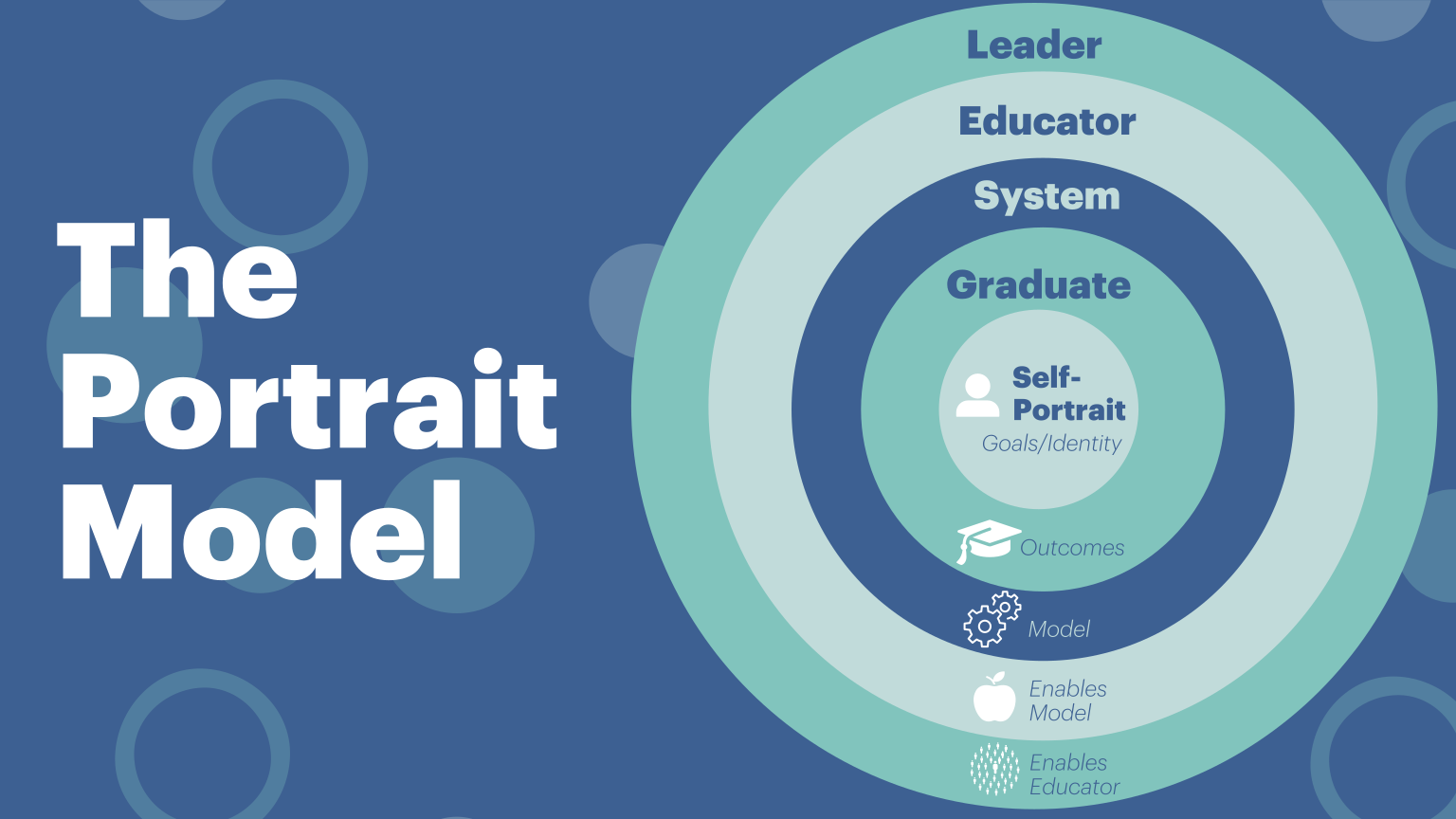
I would add to your argument this idea of all of our work on Portrait of a Graduate, and our collective work on how we’re developing these durable skills that are also additive to whatever content knowledge you need, right? Measuring those has proven elusive. There’s more and more effort in this regard, with some AI efforts and some other big organizations thinking about how to evaluate these. But we know they’re important.
We know that a nation that can’t read at all is gonna really struggle. We also know that reading is not the sole measure, and I think we, collectively in the world, have struggled to find the battery, or the set of metrics, that really represents the foundations to allow students to thrive, right? ‘Cause that’s ultimately what we want: students, learners, thriving when they graduate and move on to the adult world.
Mason Pashia: What do you wish was the takeaway from a finding like this, and what do you think will be the takeaway at the larger level? Like, whoever is looking at the PISA findings and making decisions based on it.
Nate McClennen: Yeah, I think the takeaway will be people hammering on, “For those kids who are underperforming in reading, they need way more direct instruction time in reading,” right? And that often tends to be students in more marginalized communities, lower socioeconomic status, et cetera. So those students may be getting more and more attention at a higher intensity in reading, but that may take away from some of these other experiences that are developing more durable skills that may, in the long run, also be beneficial to them.
I think we have to find the balance of making sure that core content, like students need to learn how to read, they need to learn how to be mathematically proficient, and they actually need to know science to understand how the world works. But a drill and kill approach to do well on a test, we all know collectively, is not gonna work. The drive will be to do that, though, because the metric, whatever we’re measuring, is gonna be what we teach to and try to target.
So what I wish is that people say, “Oh, okay, this is a challenge. How are we addressing the challenge holistically, and how are we making sure we take the larger view?” It’s not just that students could read, like you said; it’s that students become adults in the world who thrive. And what does that mean, and what are the skills, mindsets, competencies, and content knowledge they need to do that? That’s a much broader basket of goods than simply a set of scores on a set of tests.
Taking a Sample PISA Science Question
Nate McClennen: So hold on, I’m gonna share a screen. Okay. So what we’re seeing right now, why don’t you describe what you’re seeing? This is from the 2015 PISA, so this is part of the science assessment. Just describe to our listeners what you’re seeing.
Mason Pashia: Yeah, I’m seeing a one question kind of screen. It’s called “Running in Hot Weather,” and it’s your typical problem statement with a little visual of water loss and dehydration versus body temperature, on a spectrum to heatstroke.
So I’m going to be assessing something. I can read the question aloud if you would like.
Nate McClennen: No, I think it’s just “Running in Hot Weather.” You’re giving some context, you have a graph. So that’s the introduction. I’m gonna click you to the next screen. Okay. So what is this one telling you to do?
Mason Pashia: I hate this. Okay. It’s so bad. On the left hand side there’s more text information.
On the right side is a really clumsy, four tier visual of a person approaching meters, some sliders we can mess with, and then a table at the bottom. So you can adjust air temperature, air humidity, and then you can say yes or no to drinking water, which is kind of a funny mechanic.
Nate McClennen: Okay, so this is the second part of the introduction, making sure you understand the controls. Okay, so now I think I have to press run here. Good. So that means I have demonstrated for you that you know how to use the controls. That’s what this second part is.
Mason Pashia: Good for you.
Nate McClennen: Okay, so third, and we won’t do this full thing. Let’s just walk through this particular question, and then we’ll call it quits. Just read it out loud, and then tell me.
Mason Pashia: Yep. So I’m basically running a simulation. A runner runs for one hour on a hot, dry day. Air temperature 40 degrees Celsius, air humidity of 20%. The runner does not drink any water. What health danger does the runner encounter by running under these conditions?
Okay, so basically it’s a hot day, 40 degrees Celsius. I’m an American, but even I know that’s high. And then the air humidity is not terribly high. But the health danger of running… I mean, in general, if you’re running, you’re gonna have a heat stroke.
Nate McClennen: But before…
Mason Pashia: Okay. So…
Nate McClennen: You have these… So what do you want me to do with the control panel here?
Mason Pashia: Well, wait, don’t I need to select things below first?
Nate McClennen: Oh, that’s a good question.
Mason Pashia: Okay, so in the question flow, it says, “The health danger that the runner encounters is,” and there’s a dropdown. If you click that button, what happens?
Nate McClennen: Okay. So tell me what to do.
Mason Pashia: Oh, I can’t see that. What does it say?
Nate McClennen: “…or heat stroke.”
Mason Pashia: Okay. And then this is shown by the blank of the runner after a one-hour run. This is so confusingly worded.
Nate McClennen: That’s gonna be sweat volume, water loss, and body temperature.
Mason Pashia: Whoa.
Nate McClennen: So I think the idea here is that you take the air temperature and move it to 40 degrees Celsius. Can you see it moving?
Mason Pashia: Yeah.
Nate McClennen: And then you take air humidity and you leave it at 20, and then you run, and then it gives you a set of data, and then you respond to that.
Mason Pashia: I see. So there’s a critical interpretation layer. You don’t technically have to know what any of this means. You’re just looking at a chart and saying these numbers have this relationship.
Did that first slide tell you what the conversion of Celsius to Fahrenheit is? I know this is a global test, but that sets American kids on their back foot.
Nate McClennen: Yeah, no, I don’t think it said much about that. So anyway, I’ll stop. I wanted you to experience the granularity of these particular tests and what it looks like when you’re actually on the ground.
And imagine a 15-year-old who’s interpreting this, and, like you said, you don’t actually have to know anything about science. Just like a lot of science standardized assessments, it’s much more about numbers and graphs and things like that.
That’s also true for the ACT. The ACT had a science assessment, and that’s the same kind of thing. It was graphs and things, and you had to interpret them. So, Mason, how was doing that assessment?
Mason Pashia: I felt terrible. I haven’t looked at one of these in such a long time. I guess I’m young enough that I was doing a lot of MAP testing and some of the computer tests, so it was familiar. I would’ve been out of high school by the time the 2015 PISA was administered.
But it’s such… The question doesn’t tell you anything about what headspace you should be in as you go through this six slide question. So every slide is a new layer of panic, because you don’t actually know what’s coming, and you’re gonna have to go back to the first slide to catch back up.
There’s a little devilish sleight of hand going on where they never tell you what you need, and then they just kind of… It’s a really bad experience, and it’s also one of the least pretty things I’ve ever seen, just from an aesthetics question. It is bad to spend time with.
Nate McClennen: And what’s interesting is that PISA is actually known as one of the higher quality tests in terms of testing critical thinking, because of the nature of the global, 91 countries, et cetera, compared to, say, some state assessments. So anyway…
Mason Pashia: I appreciated that part.
Nate McClennen: And some of them are multiple choice. This one happens to be more interactive. But I wanted to test and see what happens when we do something like this on a podcast, and also just for you to tell me how that felt.
Mason Pashia: No, I appreciated that the question it was asking was, “How do you think?” That is ultimately the question it asks, and I think that is the right question to ask. I just think UX does matter, and also the learner would just be like, “Why am I doing this? What is going on?”
Nate McClennen: Right, right. And do they care, and all these kinds of questions.
Mason Pashia: Of course not.
Nate McClennen: All right, so we’re gonna leave standardized testing. Hopefully that gives everybody an understanding. Maybe listeners are super bored by the PISA explanation, but it shows up all the time, and people talk about it, and I find that people just don’t know what it is. So there you go. That’s why we did it.
Mason Pashia: I can’t remember if we talked about this last year, but I had friends who were in a fantasy football league, and the loser of the league had to get a 30 on the ACT. That was the punishment. So they had to pay to take the ACT as an adult and get a 30 or above.
Nate McClennen: That sounds…
Mason Pashia: Terrible. And so I encourage any of you, as we’re getting back into football season, if you’re looking for a good punishment, figure out how to make someone take a standardized test as an adult, ’cause it’s terrible.
Nate McClennen: Hey, let’s go back to our favorite topic, AI, and your next topic.
Mason Pashia: Great.
Deep Dive: Pro-Social AI and the Power of Witnesses
Mason Pashia: Yeah, I mean, AI, super interesting in the world these days. My personal feelings on AI have been on a crazy boomerang in the last week. I don’t know if you’ve had a similar experience, but all the pump fakes and all the pauses…
There was a very fortuitous ending of Hard Fork this week, the podcast, that I think in many ways inspired this one. It started roughly four years ago with AI coming on the scene, and then it ended this week with all the pioneer founders saying, “Please, someone stop us.”
So it’s this crazy… Hard Fork just documented the four-year runaway train of AI. But anyway…
Nate McClennen: One of the guys’ partners, I think, is…
Mason Pashia: Fiancé is at Anthropic. Yeah. They’re starting a new show over at NPR called Machine Gods. They’re gonna keep doing the work, but it’s just a super weird time to be thinking about this topic.
So I’m focusing on pro social possibilities, a recent report out of the Christensen Institute by Julia Freeland Fisher and Anna Arsenault. It’s a really interesting little report. I’m gonna talk about a few of the things that stood out to me, and then I just kind of wanna talk about this topic.
We’ve talked about pro social things a little bit in the past, but I do think it’s actually a pretty useful framing, especially in the context of how you would design edtech.
A couple of the ones that stood out to me: Christensen and others helped run this pilot with some preexisting AI tools, with these little sample sizes of varying degrees. Some of them were really small, like five people participated in the pilot, and others were larger, more like 500 plus kids. It was basically: how do outcomes change if we make these tools pro social by design?
Anybody who knows Christensen or Julia Freeland Fisher knows that, in particular, they talk a lot about social capital and who you know, and the network effects. A lot of that is the core pro social layer, or the focus of these tools to begin with.
So there’s a tool called ESAI, and something that really stuck out to me about this one is that it’s essentially an AI tool that helps you with college admissions, and it asks you who could vouch for you across your extracurriculars. If you list an extracurricular, it says, “Name someone in your world who could vouch for this,” and then you do a little write up about it.
I think it’s useful in two ways to add that pro social, backgrounded in the real world experience. One, it makes people do the active work of network mapping, right? You start to think about who saw me do it, who cares enough about me to go to bat on this. And it also makes you think, “Did I actually do a good enough job that someone would vouch?” It does make you ask that question, which I think matters.
But it really struck me, as we’re having all these conversations around credentialing, that this is such a useful layer to add to credentialing, this evidence layer of who would vouch for me. Because we talk all the time about issuers, but we don’t talk all the time about witnesses, and I think that’s a really useful pro social nudge when you’re making a credential or listing an experience, to start to build that webbing.
So I thought that was really cool. One little fact from that pilot was that only 4% of the people selected their peers. A lot of people selected family, and a lot of people selected counselors and teachers, but they did not view their peers as viable witnesses.
Nate McClennen: Interesting.
Mason Pashia: And I found that really interesting. I’m curious, Nate, how do you feel about what a viable witness is for an extracurricular? If you’re a soccer player on a team in high school, could one of your teammates vouch?
Nate McClennen: Yeah, I mean, I would probably say the coach is gonna be a more viable witness than a peer, although maybe that’s my adult bias, right? If you’re on a sports team or in a band or in a dramatic performance, you are in it, and you have a sense of the quality of your peers.
I think there’s a question of what witnessing means, right? How do you create quality witnessing? If I just see someone score a goal and I say, “Yeah, I can vouch that they scored a goal,” that’s pretty black and white. But if I’m saying, “Hey, they’re a hard worker on the field, and I can vouch for their persistence and resilience,” if that was some competency someone was evaluating, what does that mean?
How do you allow witnesses to become good evaluators? Or really, they’re not evaluating; good witnesses. That’s what it brings up for me.
Mason Pashia: Yeah, and I think there’s a spectrum of earnestness, right? It actually takes a level of earnestness to go to a peer and say, “Hey man, I really care about this thing. Will you vouch for me?”
And then there’s the other side of that, which is gaming the system, right? Where it’s all these people being like, “Oh yeah, they did that, they did that.” I think that’s what all the employers assume would go on. That’s why all these things are invalid, because it’s like, “Everyone lies on their resume.” It’s that impulse. But I actually…
Nate McClennen: Right. As a layer, I think that would work, right? That’s what I think it is: a layer that’s increasing social behavior, in addition to the other things, a video documenting it, maybe a supervisor blurb, or whatever the case may be. I think it’s a set of layers, and this is a really important layer to add on.
Mason Pashia: I agree. And the next couple of examples circle this, so I’m gonna keep moving through them. One is called Via Cella, which is essentially… you reach out to folks, and it starts to constellate who you know, and it’s all based off a spark.
You express that you have a spark in something, and then it starts to make a map of other professionals who have that same spark, and then you can reach out to them along that spark. Honestly, personally, I got in touch with Getting Smart because Tom and I both liked poetry. That was our spark. I was interested in education, too, but there was a way that I got in touch on a spark, and it worked, and I’ve been here for a while now. So there’s some proof in the pudding on that one.
But the interesting finding on this was that only 2% of the students reached out after making a spark-based connection.
Nate McClennen: Mm.
Mason Pashia: I think we all assume that if you build the infrastructure of connection, connection will happen, and I don’t think that’s true. I don’t know exactly what the agentic muscle is to reach out. Same thing as a cold call.
It’s hard, and if we’re gonna put all this effort into building these tools, I think we have to be doing that other work too, of getting people comfortable with cold outreach, getting people comfortable with failure. I think we talk about that a lot with entrepreneurship ed.
That’s fundamentally what it should be doing: if you ask for something and they say no, you go ask someone else. That’s not the end, and you did not fail. So, I don’t know, I found that stat really interesting.
Nate McClennen: Ah. Well, I wonder, is that a sign of our times, because students are less social than they have been in the past? Or is it that, you know, for 20 year olds, it’s hard to speak to adults? That’s not an easy thing to do. It takes practice, takes confidence, takes…
Mason Pashia: Takes practice. But I don’t know when it ends, ’cause my wife and I are super different on this topic. I will send an email to anyone with any question, and she is a little more hesitant.
Even calling a restaurant to make a reservation, I’m like, “Yeah, just give me the phone.” And she’s like, “I gotta be in the right headspace and the right zone to do it.”
Nate McClennen: It’s variable by person, I guess.
Mason Pashia: I think it’s variable by person, yeah. Also, my wife is wonderful and so good at so many other things that I’m bad at. So another one of these is Overgrad. It is an alumni outreach tool, and the cool thing about this is that students were much more inclined to reach out to people if the person was an alum and the counselor made the handoff, which is what this tool facilitates. I think that’s really interesting.
This is also another feather in the hat of every single college needing to pretty much just be an alumni outreach tool. The fact that it is hard for me to get in touch with alumni from my university, I think, means my university failed. That needs to be what you’re really selling in higher ed: you get access to warm handoffs in perpetuity from this university.
Nate McClennen: Some universities are very, very good at it. They actually spend a lot of time and money to build those networks, for sure.
Mason Pashia: Yes. So I think that one’s interesting. And then the last one ties back into some of the credentialing stuff. There’s a tool called Climb Together, which is essentially career interview practice.
You’re practicing interviewing for your career, and what the pilot was testing was doing it with a machine versus doing it with a peer. But as I was listening to it, I was thinking it’d be so cool if a tool like this is what actually builds your learner wallet. If, just through practicing for job interviews, you started building a resume based on the stories you were telling and things like that, so you didn’t have to sit down and say, “What have I done?” But it was just all conversational.
Gobekli built a learner wallet that had a similar conversational flow, but it didn’t quite feel natural yet because it was early. But I think tricking people into volunteering this kind of information in a way that serves them is really useful.
There was a game that launched in 2012 called EyeWire, which was basically a game for people to select shapes and follow patterns with their eyes. And essentially what it did is map all these neuron pathways in the brain for researchers at Princeton, through people playing this game.
So it’s harvesting information, but in a really beneficial way. All these tools have these really interesting layers for other uses, like what to do with the data, and it served the learner twice, essentially. The first time because you’re practicing job interviews, the second time because you’re building a resume while you do it. Which I made up. I don’t think they’re doing that right now. But I think it’s cool. So anyway, thoughts on any of those things?
Nate McClennen: I think it’s interesting. A couple of things I appreciated about this: one is that the idea of using AI tools to foster pro social behavior is really smart, and it’s gonna be an important thing. ‘Cause we know… I just saw Meta came out, I think it was yesterday, with their pendant, which is gonna be the pendant version of… It’s like 95% of your iPhone, but in a small little pendant that sits around your neck, and you can change the emoji that shows up on your pendant, or whatever the face is on your pendant. And I unfortunately think we are gonna get more and more there. So this idea of creating pro social things that actually use AI is really smart.
Nate McClennen: I think it’s interesting. A couple of things I appreciated about this: one is that the idea of using AI tools to foster pro-social behavior is really smart, and it’s gonna be an important thing. ‘Cause we know… I just saw Meta came out, I think it was yesterday, with their pendant, which is gonna be the pendant version of… It’s like 95% of your iPhone, but in a small little pendant that sits around your neck, and you can change the emoji that shows up on your pendant, or whatever the face is on your pendant. And I unfortunately think we are gonna get more and more there. So this idea of creating pro-social things that actually use AI is really smart.
I also think the other thing that’s notable from here is that when we test things that we think are a good idea, sometimes they are a complete flop. Like, only 2% reached out after making a spark based connection, right? So the power of small pilots is really, really important.
And I do like the warm handoff thing. I think there’s a combination of lessons learned here that should drive tech to make sure that, hey, if increasing social capital is a critical factor in long term student thriving, which I think you and I both believe, and social capital actually has biases, with socioeconomic status and things like that, how do we develop and increase social capital using AI tools that already exist? That is interesting to me. It’s like a secondary effect. You’re using college and career counseling software, but at the same time you’re building your social capital network. Or you’re using a career interview practice, and you’re building your social capital. That is helpful.
I also think the other thing that’s notable from here is that when we test things that we think are a good idea, sometimes they are a complete flop. Like, only 2% reached out after making a spark-based connection, right? So the power of small pilots is really, really important.
And I do like the warm handoff thing. I think there’s a combination of lessons learned here that should drive tech to make sure that, hey, if increasing social capital is a critical factor in long-term student thriving, which I think you and I both believe, and social capital actually has biases, with socioeconomic status and things like that, how do we develop and increase social capital using AI tools that already exist? That is interesting to me. It’s like a secondary effect. You’re using college and career counseling software, but at the same time you’re building your social capital network. Or you’re using a career interview practice, and you’re building your social capital. That is helpful.
It does make me think: are there any apps that are directly building your social capital? And of course, a social network like Facebook, or let’s take LinkedIn. LinkedIn is building social capital in some ways, but it’s a very, very light touch rather than, you know, a real touch. But it can be useful. I’m a big believer that every high schooler, seniors especially, should build a LinkedIn account, right? In lieu of them having digital wallets, this is a loose version of that. So, interesting.
Mason Pashia: It’s really interesting. It makes me have a lot of questions about… I mean, this is not the first inherently antisocial technology, right? Every technology exists on a level of social to not. A car is kind of an antisocial technology, but it gets you to a place where you can be social sometimes.
Or if you take a car versus a train, very different levels of social possibility, but that does not mean you’re going to talk to people on the train, and it does not mean you’re not talking to a friend when you’re in your car. I think this is really doing something similar.
Last note on pro social: there’s an app called MySky that I was made aware of recently from an org called New_ Public, and this is essentially a shell of Bluesky. I think it’s got something like 60,000 users on it right now. But the algorithm is fully visible and adaptable, so you can adjust the weights of how many things you wanna see that you don’t already have a connection to. How do you wanna measure engagement? Is it likes? Is it the number of people who read it for longer? So it’s a fully exposed algorithm, which is really cool, and I think it’s a really interesting way of building a pro social device where people can actually adjust how social they want to be in that world and how they want social to be defined for them. Is it connecting with new people? Is it connecting with old people? Is it connecting with the things they always know they’re curious about, or finding new curiosities? So I don’t know. I’ll put a link in the show notes, but it’s a cool little program, and I’m glad someone’s messing around with it.
Last note on pro-social: there’s an app called MySky that I was made aware of recently from an org called New_ Public, and this is essentially a shell of Bluesky. I think it’s got something like 60,000 users on it right now. But the algorithm is fully visible and adaptable, so you can adjust the weights of how many things you wanna see that you don’t already have a connection to. How do you wanna measure engagement? Is it likes? Is it the number of people who read it for longer? So it’s a fully exposed algorithm, which is really cool, and I think it’s a really interesting way of building a pro-social device where people can actually adjust how social they want to be in that world and how they want social to be defined for them. Is it connecting with new people? Is it connecting with old people? Is it connecting with the things they always know they’re curious about, or finding new curiosities? So I don’t know. I’ll put a link in the show notes, but it’s a cool little program, and I’m glad someone’s messing around with it.
Nate McClennen: Agency, self sovereignty, being in control. You know, I’m not a huge Instagram user, but it does drive me crazy that the default is a general feed, and you have to click twice to get it to show only those you’re following. The reality is I wanna be able to select that always. I could care less about all the other feed stuff. I wanna see who I follow. I have to press two buttons to do that, because obviously the algorithm wants me to go see other things and get sucked into whatever rabbit hole you get sucked into when the algorithm feeds you. So it is interesting, and is that pro social? I think that’s pro control, and maybe pro social, ’cause you’re choosing how to control who you see and who you connect with, I guess, rather than being told who you might want to see or connect with. I don’t know.
Nate McClennen: Agency, self-sovereignty, being in control. You know, I’m not a huge Instagram user, but it does drive me crazy that the default is a general feed, and you have to click twice to get it to show only those you’re following. The reality is I wanna be able to select that always. I could care less about all the other feed stuff. I wanna see who I follow. I have to press two buttons to do that, because obviously the algorithm wants me to go see other things and get sucked into whatever rabbit hole you get sucked into when the algorithm feeds you. So it is interesting, and is that pro-social? I think that’s pro-control, and maybe pro-social, ’cause you’re choosing how to control who you see and who you connect with, I guess, rather than being told who you might want to see or connect with. I don’t know.
Mason Pashia: Yeah. At least agentic is something.
Nate McClennen: For sure.
Deep Dive: Motivation, Engagement, and AI
Nate McClennen: All right, let’s finish off with one last deep dive. Oh gosh, we’ve been going for a long time, but let’s just jump into this. This is our age old challenge. Greg Toppo was writing in The 74, and his headline was, “Schools Have a Motivation Problem. AI Is Making It Impossible to Ignore.”
The article basically alludes to the things we’ve talked about: that motivation has always been a challenge, especially the older a student gets in the K 12 sector. And as AI has emerged, learners are finding ways to become even less motivated, because they can subvert the system, and they don’t have to do the work ’cause AI will do the work for them.
So I wanted to riff a little bit on a couple of things. That article was talking about the school in Tennessee that did the forensics investigation that’s been all over the news, the…
Mason Pashia: Oh, yeah. Elizabethton.
Nate McClennen: Elizabethton, yeah, which we know and does amazing work, and we appreciate the work they’re doing. They’ve gotten a lot of PR for doing this particular project, and I think it turned into a Netflix show or…
Mason Pashia: Yeah. The Prime show, yeah.
Nate McClennen: But it did make me go back to… we did a pod with Rebecca Winthrop and Jenny Anderson about their book on teenage engagement, The Disengaged Teen, and it made me go back and think about engagement again. I wanna share: they talk about their four modes of engagement, and on one axis, the vertical axis, is agency, and the bottom axis is engagement.
The percent of students who are highly agentic, so they have a lot of choice, and highly engaged, they call those explorers. And that percent is very, very low. Less than 10% of students report being in that mode. Whereas the passengers, those who are low agency and low motivation, are about 44%, and the others fill out the rest. So the vast majority of students are feeling neither agentic nor engaged, and when you put both of those together, you create this explorer mode, but very few students are like that.
So the fundamental question is: what does it take to create 90% of students feeling that they have agency and engagement? And I just keep going back to this idea of motivation theory, which is: you need autonomy, so you have some control. You need competence, so you feel like you can do something. You need human connection, you need to feel like you belong, and you need purpose.
Those four things feel more and more important, and yet they’re so dang hard to figure out and to get people to, as shown by the survey done in The Disengaged Teen. And AI is just gonna make it easier and easier to become a passenger, to use their words. We’ve talked about this a lot.
I don’t know that we have an easy solution, except that we do know there’s an amazing set of teachers out there who do this really, really well, and the question is how to replicate them and help them become leaders. And there are districts and systems that are also trying to do this well.
So it’s almost like we know what we need to do, but to do it at scale is really, really difficult, given the systems people are operating in. So that’s my riff on engagement, and certainly AI is only gonna make it harder, but I think this has to be one of our primary goals, to allow students to get to thriving.
Mason Pashia: Yeah. Authentic, relevant learning, where you don’t have to look at a PISA chart and say, “Why am I here?”
Nate McClennen: Yeah. And in K 5, where you have higher engagement, real world learning looks different. It might be going outside, it might be talking to community members, or it might just be that in your classroom you have a little more choice and a little more engagement around the things you’re working on, even while everybody’s still covering the same standards and the same competencies. That, to me, stays static, and that’s the fixed piece. But the learning experience itself is the one that needs to be adjusted and modified.
Mason Pashia: Yeah. Maybe more like play based learning, or inquiry, something that LEGO’s kind of working on. I feel like all those have really nice play and place and real world aspects that have these levels of relevance and creativity and explorer behaviors that I think are really exciting and important. So yeah, I agree. Engagement is the key.
Is It a Supply Problem or a Demand Problem?
Nate McClennen: So I’m gonna push one more time on you here, ’cause you’re a big fan of talking about supply and demand in the education sector. Is this a supply issue or a demand issue?
We know what the data’s showing: we have disengaged students. The vast majority of students don’t have engagement and agency in that upper explorer quadrant. And AI’s only gonna make it harder to have explorers. Do we need more supply? Do we need more demand? Or is it equal in both?
Mason Pashia: It feels to me like there’s a mismatch. The supply may exist; we have a lot of educators who are doing this. I still think the outcomes from that are really hard for the system to recognize and then communicate. So it’s kind of whatever bridges the supply to demand.
It’s the question we talked about before: a high-agency CBE school, really cool, not a line to go there. A STEM school with a high graduation and college attendance rate, really long queue to go there. It’s the failure to communicate outcomes at the end, like, “Where did this get all of our kids?” I think that matters.
Sure, we could always take increasing great teachers; the more good teachers, the better the world. That is a real equation.
Nate McClennen: No.
Mason Pashia: But I do think there’s this thing where school is so familiar to parents as a thing that is kind of bad and kind of hard. And if kids say, “It was boring,” I think the refrain is, “Yep, that’s how it goes.”
And so that might be where the demand side problem comes in. But that doesn’t change unless the supply side changes, and it might just be the 20 year problem. It might just be the kids of these kids…
I was just… this was gonna be my shout-out for one of the schools, but we just recorded a podcast that may not be out by the time this comes out, with the folks at The Met. We talked with Andrew Frishman, who is at Big Picture Learning now but was one of the early advisors at The Met School in Providence, Rhode Island.
And they’ve started a new podcast called The Advisory, which is Andrew checking in with all of his advisees from 20 years ago. It’s a cool study in outcomes, and a lot of those kids have enrolled their kids at The Met. So from a demand side, the kids who had that experience are like, “Oh, this is the way to learn. This is awesome. I see me in you, and this will work for you.”
But without that experience, I just don’t know if you can even fuel it. So that’s my really messy answer, but it’s both. I mean, it just fundamentally…
Nate McClennen: …so important, I think. This is landscape-wide, so for everyone listening, we need to be thinking about both of these things. If we want to do better by all students, we need to increase the supply of models that are increasing the number of opportunities for students to be explorers, in their words, right? So this idea of higher agency, higher engagement.
In order to do that, we need to think about supply: the competency-based education models, higher levels of PBL. But fundamentally, it’s the learning experience. There are a lot of ways to do this, but it has to be working toward: do students have more control? It’s back to motivation theory. They have more control, they see more relevance, they feel like they belong, et cetera. They feel like it’s purposeful.
On the supply side, I also think, as we’re now working in larger systems, there’s always gonna be a large set of boutique schools and settings that are able to do this really well. And I think The Met is one of the few examples that not only did it well in a boutique setting, originally at The Met, but then expanded to become this Big Picture Learning network, right? The Met was the original BPL school. So now it has formed this very loose network. It’s not a tight network. It’s a loose network under some very standard principles, or a set number of design principles.
But that’s rare. They often sit in boutique schools where they’re able to thrive but are often hard to scale in larger systems, districts, and divisions. And I think that on the supply side is a little bit of the holy grail right now. It’s not that we don’t know how to do it. It’s how do we do it in larger systems, to replicate all these boutique models at scale so that all students can access them?
And then the demand side, gosh, that’s really interesting what you said, and I agree. If your vision of school is that it is boring, it is hard, you don’t like the teachers, whatever the case may be, from a demand perspective you’re probably gonna accept it if your child’s experiencing the same thing, maybe because that’s what we expect of school.
It’s easier for me to imagine shifting the supply side, maybe ’cause that’s what we’re in, in this system level work. It’s really to understand this demand side, where, like you said, how do parents start to see this here? That’s where I struggle.
Mason Pashia: Well, and I think it’s happening in real time, right? Fundamentally, if there’s a time to take a risk on an education, it’s probably now, because they don’t guarantee anything. College doesn’t guarantee a job. High school doesn’t guarantee college. It doesn’t guarantee a great job.
So I think parents, and we’re seeing this in all these non-traditional learning environments, are getting that fractured-outcomes message, and they’re like, “Who cares? This is what I’m used to, but that doesn’t mean it has to be right. Let’s try something else.” And there are gonna be a lot of people, unfortunately, who fall through a crack because of that.
At the same time, there are gonna be people who find their way, and as a sector, this is why R&D is so important: we have to learn the lessons in real time, or else there are just gonna be more people left kind of in the lurch, so to speak. But I think the messaging is changing. I think supply is ultimately probably the thing that raises all boats. We need public systems, and yeah.
Nate McClennen: Yeah, and if the supply increased so much in these newer and more interesting models, then it really becomes the ocean you swim in, right? That’s what we want in the long run, and that way the choices become obvious. It’s like I’m choosing between this good school and this good school and this good school, or this micro and this micro and this micro within a larger school; they’re all good.
And so few parents have that choice right now to say, “Wow, I have a bunch of choices, and they’re all incredible.” That just doesn’t happen. That’s a very, very rare scenario. So, all right.
Nate McClennen: Yeah, and if the supply increased so much in these newer and more interesting models, then it really becomes the ocean you swim in, right? That’s what we want in the long run, and that way the choices become obvious. It’s like I’m choosing between this good school and this good school and this good school, or this micro and this micro and this micro within a larger school; they’re all good.
And so few parents have that choice right now to say, “Wow, I have a bunch of choices, and they’re all incredible.” That just doesn’t happen. That’s a very, very rare scenario. So, all right.
Mason Pashia: I hear you.
Shout Outs: The Met and a New Public Boarding School in Alabama
Nate McClennen: We’ve been going for a long time today. I’ll throw in my quick shout-out. I know you talked about The Met, one of our favorite schools for sure. They’ve done some amazing things to help promote BPL and just launch a new idea, and I’m looking forward to Andrew Frishman’s new podcast.
I had a great conversation with some folks down in Alabama who are the founding leads of the Alabama School of Healthcare Sciences, and we’ll probably do some more on this at some point. I might write about it, but it is a public boarding school that has just launched. It’s the fourth public boarding school in Alabama, so there are actually three others that have been started and funded by the state government.
They are public schools, open enrollment, or application based, but there’s no tuition. There are probably 15 to 20 other public boarding schools in the United States, so it is a super rare thing.
This one in particular is gonna be located in Demopolis, which is southwest of Birmingham by about two hours. It’s a pretty rural spot, but with a lot of healthcare needs in terms of talent, and they’re building a new campus right next to the regional hospital. This boarding school is gonna be hyper focused on the health sciences, and it’s gonna be deeply integrated into the hospital next door to help address this severe shortage of healthcare workers.
Mason Pashia: Cool.
Nate McClennen: Pretty awesome. So stay tuned. We’ll talk more about it. It is a labor of love to run a boarding school, and they are feeling it, and they’re excited as well.
They move into their new campus in year two. They’re on the University of West Alabama campus right now. But we’ll put the website into the show notes so people can take a look.
Mason Pashia: Amazing.
Human Expression: Bikes and a Dementia Village
Nate McClennen: All right, let’s finish off with some human expression. What do you got for me?
Mason Pashia: Love it. All right, so there’s a lot of construction in my neighborhood right now. The other day I was riding a bike to do some errands, and I kept getting stuck at this one intersection where I’d have to wait at multiple lights on my bike.
The other people on bikes would come and join me, and we would just chat as we waited at these lights, and then on the way back I bumped into one of them again at the same light, so now we know each other well in the neighborhood.
And I was like, bikes are such a solitary act, but they are kind of a third space. They get rid of walls if you are willing to chat. I think this goes back to pro-social technology. Maybe a bike is a pro-social technology. I just really appreciated it, and it surprised me, so go humans. How about you?
Nate McClennen: That’s just making me think about all these third spaces. Anyway, I’ll think of some other ones. So I have a family member who’s struggling with dementia, and I’ve talked about this, and about getting good care, but it’s also just challenging to see, when someone’s brain doesn’t function, how their world suddenly changes, and the world around them suddenly changes, with a lot of intense caregiving and spaces that are constrained and locked down.
So I was thinking about who is doing this differently in the world. And I came across what’s called The Dementia Village. It’s in the Netherlands and opened in 2009. It’s called Hogeweyk.
I don’t know anything about this area of study, but when you look at the website, it’s about how you create functional spaces that are close to real life for folks who are struggling with dementia, with an actual village and actual places they can go, and with all the appropriate care, not these really restricted and confined spaces.
Still safe, good care, but also just normalizing this idea that sometimes brains fail. I guess for me it is an interesting way to think about human compassion as our elders move on in the world, and some of them lose the ability to think the way they did as grown adults.
Mason Pashia: Yeah. It’s a beautiful share. I’m looking forward to checking that out. We’re going through something similar over here, so thanks for sharing the resource.
Nate McClennen: Yeah. And you know what? We’re almost at 60 minutes, which then makes us a long form podcast or something like that. So I think we broke the record today.
Mason Pashia: I think we did, yeah.
Nate McClennen: It was great to catch up. Could you finish us off with some music?
Closing Song
Mason Pashia: I would be so happy to. Okay. All right. I think this has to be the right one. I’m gonna share my audio. Boop. And then tell me if you can hear this.
Nate McClennen: Oh, I can hear it.
Mason Pashia: Hi, Pat.
[AI generated song plays. The hosts react over it: “This part is so funny.” “Incredible.”]
Changed its parts. The old brass compass spins too fast. The doors swing wide, the shadows pass. I lace my boots, I lift my chin. The world keeps moving, I’m stepping in. Lesson one more try. I can learn why. Catching up, catching up, to a world that won’t stand still. Catching up, catching up, with a steady hand.
Nate McClennen: Oh my gosh, that might be the best one yet. First of all, Broadway, right? It’s a…
Mason Pashia: For sure. Yeah.
Nate McClennen: Actually, at first it felt like a news broadcast, like the original, like, dun, dun, dun…
Mason Pashia: Oh, yeah.
Nate McClennen: And then it went into the Broadway singing. I just wanna catch up.
Mason Pashia: I mean, absolutely. The instructions I gave it were a Broadway musical, a hero going from zero to hero…
Nate McClennen: Oh.
Mason Pashia: …a montage, because I was thinking of the Hercules one, with the little faun, when he’s training him.
Nate McClennen: That’s awesome.
Mason Pashia: It is so funny. That one run…
Nate McClennen: Catching…
Mason Pashia: Yeah, yeah, that last run is so funny. Only a machine has lungs like that.
Nate McClennen: Well done. We’re getting closer and closer to an album, I think. So thanks.
Mason Pashia: Oh my gosh. I really… Wow. Yeah. All proceeds…
Nate McClennen: All right.
Mason Pashia: I think they’d probably have to go to Suno.
Nate McClennen: Probably have to go to Suno and all those AI robots that are doing this work. So, well, great talk. Lots of good stuff. And I hope, listeners, you enjoyed it, and please send us questions and share our podcast with others.
Mason Pashia: Yep. Love it. Thanks, Nate. Good to see you.
Links

Nate McClennen



0 Comments
Leave a Comment
Your email address will not be published. All fields are required.