

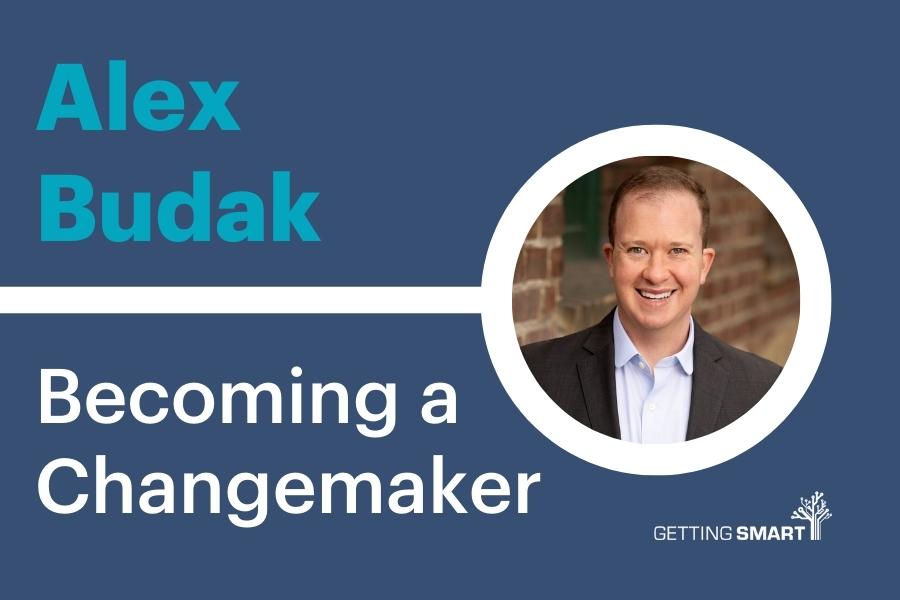
Alex Budak on Becoming a Changemaker
Key Points
-
You can bolster changemaking tendencies by encouraging young people to not just take the world as it is.
-
Changemaking is a journey, it’s not a destination.
This episode of the Getting Smart Podcast is supported by LME Global’s Learning Blueprint. Find out more at lme.global/smart.
On this episode of the Getting Smart Podcast Tom Vander Ark is joined by Alex Budak, a UC Berkeley Haas faculty member and now the author of a new book called Becoming a Changemaker: An Actionable, Inclusive Guide to Leading Positive Change at Any Level.
A changemaker is a person who leads positive change from wherever they are.
Alex Budak
This world has never been more ready for you.
Alex Budak
Links:
- Alex Budak LinkedIn
- Alex Budak Website
- Becoming a Changemaker (Amazon)
- Difference Making
- Bryan Stevenson
- Changemaker Index
- Sam McCracken
- N7 Shoe
- Dr. Nadine Burke Harris
- ACEs
Transcript
This transcript has not been edited for spelling accuracy.
Imagine a teaching staff that was fundamentally on the same page about what works and what doesn’t work in the classroom. What would this mean for engagement, efficacy, agency, and turnover? Thirty-plus years of science of learning research has delivered this foundation. Unfortunately, much of it has not made its way to teachers.
Until now. A new program called the Learning Blueprint, developed by neuroscientist and former podcast guest Dr. Jared Cooney Horvath, has proven effective at helping schools understand and embed key science of learning principles into everyday practice. It won’t replace any teaching systems that you may currently use, but it will make them
work better. You can learn more by visiting lme.global.smart. That’s lme.global.smart. Alex, what is inclusive changemaking? When I think about the different identities that we all have, so many of them are inherently
exclusive. You’re either an educator or you’re not. You’re an entrepreneur or you’re not. You’re an artist or you’re not. I think there’s an opportunity to think about an identity that unites all of us.
That’s where I think changemaking comes in. I, of course, come from a background. Before I got into classroom, I’m a social entrepreneur. I love social entrepreneurs. We see the world in such a unique way.
But I also recognize that not all of us can, nor should be, social entrepreneurs. As I’ve worked throughout my career, I’ve realized that there are so many ways that each of us can lead positive change. We don’t need to be defined by our specific identity, by our specific career or occupation. Instead, I’ve found this term, which I think is really resonating, which is the idea of
being a changemaker. Different organizations, different folks may have their own way of defining it. I simply say a changemaker is someone who leads positive change from wherever they are. It’s inherently broad. It’s a radically inclusive invitation to all of us to lead positive change.
So there’s space there for the 18-year-old freshman who’s just figuring out the world and knows they want to make a difference, but they don’t know exactly how to the person who’s the seasoned executive, the principal, the faculty member that have dedicated their lives to leading change. But maybe in ways we don’t normally think of when it comes to traditional paths of change.
I’m really passionate about widening the aperture to say that each and every one of us can be a changemaker and that we can all lead positive change from wherever we are. You’re listening to the Getting Smart podcast. I’m Tom Van Der Rook and today I’m joined by Alex Boudic. He’s a lecturer at UC Berkeley and he has a beautiful new book out called Becoming a
Changemaker, an actionable, inclusive guide to leading positive change at any level. Alex, it’s really great to have you on the podcast. Tom, thanks for having me. I love that definition, Alex. It’s really simple and provocative, leading positive change from wherever you are.
I wish I had written this book before we wrote Difference Making because we were looking for a short description and I think you captured it beautifully, leading positive change from wherever you are. You’re implying that anyone can and should be a changemaker, right? That’s right and I’m inspired by the words of Brian Stephenson.
He’s, of course, the founder of the Equal Justice Initiative and he says that faculty were often trying to complicate the world for folks. I like simplifying. I like keeping it simple so that all of us can remember that definition. The fundamental, the belief, the beating heart behind all that I do is this belief that each
and every one of us can be changemakers, that there’s space and indeed the world is showing us there’s an opportunity for all of us to become changemakers right now. You learned a good deal about this changemaking framework at Ashoka and there’s this global Ashoka alumni crew that is just extraordinary. A group of world changers, is that where you really built your changemaking muscle?
As I look back, the red thread throughout my whole career has been changemaking. That first spark, of course, happened at Ashoka. I was just a lowly intern at Ashoka but my then-girlfriend, now-wife, actually worked at Ashoka so I got to know some people on the Ashoka staff who were wonderful and also those incredible Ashoka fellows.
They are world changers, people that just see society in a very different way and take action at a deep systemic level. That’s where I got that first spark of changemaking perhaps and then have built it through different means throughout the rest of my career. How did you talk the high school folks into letting your creative changemaker course?
It’s crazy, isn’t it? As I look back, I still am a bit wonderfully surprised that I get to teach this class. I just simply remember the moment. I went in to speak with a guy named Jay Stalsky. He’s the one that was overseeing basically all the curriculum, all the faculty at Haas.
He’d always been a mentor to me. I went in to ask him for some advice on a more traditional career transition. I think he could tell that my heart wasn’t really in it. I’ll always remember what he said. He said, Alex, what do you really want to do?
In that moment, it just became so clear to me. What I really want to do is teach. Then I started mumbling off a little bit, figuring, saying, excuse us, well, most faculty are older than me or they have a PhD. Instead, to my complete shock, he said, okay, what do you want to teach?
In that moment, I said, I want to teach becoming a changemaker. He said, okay, great. Show me a syllabus and we’ll go from there. I literally leapt out of my seat. I shook his hand.
I left his office and then immediately pulled out my phone and googled how to create a syllabus because I had no idea how to actually create a syllabus. Then that started the process of a one-year process of creating a syllabus, getting approvals. Then January 2019 was my first day in the classroom. I imagine this is a popular class on campus.
Yeah. It’s been really a bit emotionally overwhelming to actually to see the response that I’ve received because I have this firm belief that each and every one of us can be changemakers. To see the demand among students when they have so many classes at Berkeley from which to choose, but that each of them see something in themselves, even if it’s just in the name
of becoming a changemaker, that it feels aspirational to them. It’s something they feel called to do. That feels really meaningful to me and that really reinforces the opportunity that we have to help these students become changemakers. Alex, your book is full of tips and tools and techniques, but the first third of it is
really around mindset. You argue that it starts with a changemaker’s mindset. What is that and why is that important? Yeah. Going back to the idea of radically inclusive changemaking, I’ve done some research which
is called the Changemaker Index, looking at what are some of the common traits that all changemakers have and how do they develop them over time? What I’ve seen in that is that there’s some common patterns that no matter if you are an engineer or a professor or an artist, there’s certain traits we have. Certain ways of seeing ourselves and the world around us that all changemakers share.
I start my class and I start my book in the same way, talking about that mindset, the way of seeing ourselves and the world around us. You’ll explore things like being able to question the status quo. That takes different forms depending on where you’re working. If you’re in a startup or if you’re in a traditional corporation, how you question the status quo
may change, but at its core, a changemaker has to become comfortable with questioning it. I try to give some tools and some ideas based in social science, based in social psychology about how we can get more effective at questioning those status quills. Alex, when I was reading the first couple of chapters, I loved all the stories that
you gave, but I kept wondering, what might this look like in elementary school? Do you have a sense of how an elementary school teacher or leader could invite a changemaking mindset in younger kids? I love that. I think about it quite a bit, actually.
As we speak, I have a 20-month-old at home, my first. I’m thinking a lot about changemaking at a young age. I thought you might ask me on toddlers, but I can do five-year-olds. Five-year-olds, I think there’s a couple of things that we can start doing. Of course, we shouldn’t expect five-year-olds to be launching social ventures and so on.
I think there’s a couple of things we can start teaching, which are directly related to the changemaker mindset. The first is teaching empathy. Teaching ways of putting ourselves in the shoes of others. At a five-year-old, you can’t expect a ton out of it, but you can’t expect they can
start understanding feelings. You can start seeing how others might be perceiving the world when other students or other colleagues might be scared, excited, and so on. They did amazing work serving on the board of an organization called Peppi Pals. They’re based in Stockholm, and they use media to teach children emotional intelligence,
starting at young as age three. No words at all. It’s all micro expressions. Through some studies at Uppsala University, they found that even kids as young as two or three can start recognizing these micro expressions.
That to me says empathy is absolutely learnable. The second thing is to give children a sense of agency. If you were to ask my toddler, I think he already has a pretty good sense of agency, maybe too much more than his mom and dad might like sometimes, but in terms of teaching that to five-year-olds, giving them the sense that you aren’t just there to take the world as
it is, but you have a chance to help shape it a little bit. Now, when you do it, it can’t just be all about yourself. That’s where empathy comes in, to see what would be better for all of us, for your friend. But I think if we can start teaching a bit of agency and empathy, that could start unlocking some of those key changemaker mindset traits that would serve all of us well from a young age.
Alex, I started my day yesterday talking with a group of scholars about how to measure citizenship, the knowledge, the skills, and especially the dispositions, the actions of engaged citizenship. And then I read your first chapter, which includes a changemaker index. And it looks like a beautiful way that a high school or a collegiate program could help learners really gauge their growth in the changemaking skills and dispositions.
Was that what you had in mind with that? That’s exactly my hope, is that some might say the changemaking or difference making can feel a little bit fluffy and fair enough, but I want to make sure that it’s grounded in real research, real science, and to also give people a sense of where they are. As I write in the book, changemaking is a journey. It’s not a destination.
It’s not like you ever sort of wipe your hands clean and go, okay, cool, I’m done becoming a changemaker. I’m there. No, we’re constantly working on it. And so I think it could be helpful to give people a sense of a snapshot in time. Where are you right now? And then give you something to work towards. If people are interested, they can even start taking the changemaker index themselves, changemakerbook.com slash index. And it’ll give you a sense of
what is your greatest changemaker strength right now? And then perhaps you can retake it again in a few months after reading the book and then see how you’ve developed, which I think is really motivating to folks as well to know that it’s a skill, it’s a mindset, it’s a process that’s learnable, and we can make progress on it. Alex at Getting Smart, we really value learner agency. We’ve come to believe that that might be the most important disposition that we help develop.
And I thought a lot about that in chapter two on questioning the status quo. The one thing about learner agency is that you value it until it actually develops around you. And then young people start questioning the status quo. But I love that as an important part of the changemaker mindset of not taking for granted what’s around you, but teaching those questioning skills. That’s an important part of the changemaker mindset, right? It absolutely is. And alongside
that, as a teacher, as an educator, you have to have the humility to let people question things around you. And so I actually love that. One of the things that I always encourage my students to do is on every single assignment that they have, they can propose an alternate means of proving the same learning to me that they want. So for instance, instead of writing a final paper, I give them the option if they want to, they can write a children’s fairy tale, a children’s fairy tale about what
changemaking means. And I like that because it gives them a little bit more agency, a little bit more creativity. And even though it sounds like it’s more fun, honestly, I think it’s harder. It’s harder because you have to simplify things. You have to put it into understandable terms to build a story, to build a narrative around it. And it’s more fun. It’s questioning the status quo, but I think it also generates greater learning. And when students tend to choose that assignment or
question the status quo with other assignments, they usually have greater buy-in, which I love to see as an educator. Alex, I don’t think you used this term paradox, but I felt the paradox of being a changemaker because it does require this sense of agency, the confidence of knowing how and where to act on the world. But it also requires a sense of humility. You talk a lot about this in chapter three, confidence without attitude, right, of being able to take action with a sense
of humility. I appreciate that. Is that a bit of a paradox, confidence with humility? There’s a bunch of these sort of dichotomies that we have to handle as a changemaker, confidence without attitude being one of them. There’s also the idea of you kind of need to be impatient to feel like you’re going to make change, but also you have to be patient because change takes time. So there’s a number of these things that what we want to do is be somewhere
in between. We want to be both and. So the question here is, how can I just be confident, just be humble, or be somewhere in between where I’m like a little bit confident and a little bit humble? No, I want to create changemakers, create leaders who are both at the same time. So I tell this story of an amazing changemaker, Gwen Yu Wang. She’s the founder of an organization called Tribalus. It’s a tool that teaches organizations, groups, companies, empathy, emotional intelligence.
So from all outside measures, she was absolutely thriving. The organization based in Malaysia was absolutely taking off. Things seemed really good. But inside she felt like she just wasn’t the right leader to be the CEO of this company. And it’s not an easy thing to do because you, of course, have to have a lot of confidence to say, Hey, I’ve got an idea. I’m going to put it out into the world. I’m going to be the CEO. But then she also had a lot of confidence and a lot
of humility to say at that point that, you know what, I’m not the right person to continue leading this. What we need right now is more of an operator, someone better out of process. She found herself more of an idea person, a product person. And so she had the confidence to step back, the humility to say that there’s another person that I think could be better leading this team right now, in this case, her co-founder. And so over a number of really
difficult conversations that she recounted to me, she decided to take a step back. She stepped down from the CEO role into a kind of a chief product role. And in doing so, I think she embodies this idea of confidence without attitude. She was both confident and humble at the same time. And in doing so really served both her team and the users of her product really well. I love the section on changemaker mindset ended with a chapter on lifelong learning. You called
students always and you stressed these values of empathy, curiosity, adaptability, flexibility. Being a changemaker means you’re always a learner, right? You’ve got to be. Yes. You’ve mentioned a couple of these titles. These are grounded in what we call the defining leadership principles at the Haas School of Business. And so I sort of grounded them in that. And one of them is students always. And I love the idea, again, going back
to my role as an educator, as a faculty member, is that I’m teaching changemaking. We’re sort of at the cutting edge of this field. And I’m constantly learning from my students as well. I don’t go in expecting that I have all of the answers. I consider that I’ve had a really good class when I learn something new about changemaking from one of my students or from a conversation that we have. And so there’s, of course, the traditional power dynamics in a classroom of
professor and students. But I think if all of us show up with this idea of always wanting to learn, and none of us ever being truly an expert, but always having that curiosity, it serves all of us well in all of our changemaker endeavors. Alex, the second part of your book argues that we need a different kind of leadership, a different style of leadership for changemaking. How is it different than the way we’ve historically
thought about leadership? I spent a lot of time reading a lot of leadership books. And I think what we see is that a lot of the models are based on a world that’s rapidly disappearing. Now, a lot of leadership books will say things kind of from the command and control approach of, I’m the CEO, I come up with a vision by myself, and then I have a team that executes on it. Now, you can debate whether that was ever an effective leadership strategy, but that certainly was the common
strategy one would learn if you’re doing an MBA in years past. But if we look at all the trends shaping the world today, that approach no longer works from flatter hierarchies, more globally dispersed organizations, people working from home, working remotely, people that aren’t in the same office. Those traditional models no longer work. At the same time, the rise of the internet and other collaborative technologies mean that the way you get things done has also
totally changed. So we need to raise up approaches to leadership that value collaboration, working through and with others. We need to raise up the idea of network-based leadership, where it’s not up to any one of us to do everything. To get rid of this concept, we sometimes call hero-pronorship and said, saying, what’s the role I could play to move us collectively forward? As you mentioned in your previous question, it takes a bit of humility to say, look, it isn’t all about me.
But if we start thinking about what can we do as a team and how can I help to galvanize that, it’s a different approach to leadership. But I think it’s one that really fits our world today. Alex, the third section of your book is on action. And early in that section in chapter 9, you introduced this formula. It’s mindset plus leadership times action equals impact. Maybe you could talk us through that formula. Yeah. And of course, I joke in the book that I hope that
none of my grad school professors that taught me econometrics are ever reading this. We say, would say, Alex, he should not be teaching any math in his book. So this is the one and only equation in the book. But exactly what you said. So your impact as a change maker is equal to your mindset plus your leadership. So what we’ve talked about so far, it’s your ability to question the status quo, to be empathetic, plus your leadership skills. How can you galvanize others towards a
shared vision? How can you influence without authority? That’s the sum right there. And then you multiply that by your action. And so it doesn’t take a mathematician or even someone with my math skills to know that if you multiply a number by zero, the result is zero. Even a really big number, even 1 million by zero is still zero. And so that reminds us that it’s not changed thinking, it’s changed making. That if you just sit on having your mindset, just sit on this leadership,
but you never take action, you can never have impact. So your action then is a multiplier force that allows you to catalyze the impact in the world. Alex, I’d love to try to spend a few minutes imagining with you what a high school and what a collegiate program of change making might look like. I think most of the examples that you and I know of change making is added. It might be an after school program or it might be like your class, one class added to a traditional
curriculum. But if we really took this idea seriously and said, our job is to equip change makers, what might a high school course of study, what might a high school experience actually look like? It’s so fun and so important to be reimagining because if we think about what are the skills people need when they leave high school, of course you have to know math, you have to know English, you have to know social sciences, but it’s a lot of these change maker skills, which will
define someone’s success. So I think I would start by saying, how can we integrate this into everything that we do? I often like teaching in my class about different lenses that we may use when we think about impact. So I teach about how to use a diversity, equity inclusion lens, maybe a lens of the sustainable development goals. And so we sort of overlay these on everything that we do. I think there’s an opportunity to similarly use a change maker lens. So not just
how students work as individual contributors, but perhaps almost everything is done as a group, because when you’re in the quote real world, you’re very rarely working on something completely by yourself. But often I find that students graduate from a school like Berkeley and they’re ready to do solo multiple choice tests, but not necessarily to work on a team to solve a coding problem. So I think there’s a lot more collaboration that we could be doing and then so much more
experiential learning. The big believer in, again, what Brian Stevenson says, of getting closer to rather than further from the issues we want to solve. And so losing some empathy, getting out of the classroom, applying things, doing our own learning, just as an example in my class, we talk a lot about failure. And so failure is of course easy to intellectualize to say, okay, if I’m going to lead change, I’ve got to learn to fail. But it’s a very different thing when you’re forced to
actually go do it. So after we spend a couple of hours talking about failure, giving research and some case studies, then I simply flash two words on a screen, go fail. My students look at me and they I think at first think I’m kidding. But then they realize, no, this guy is serious. The next slide pops up and I say, okay, you have 15 minutes, you have to go leave the classroom and you have to go ask for something and get rejected. And you can’t come back until you’ve gotten rejected. And at
the front of the classroom, I start seeing them respond somatically, I see them starting to sweat a little bit turning red to giggle nervously. But go, okay, clock is ticking. And of course, when I teach, I’m a big believer in creating psychological safety. So I want everyone to feel totally safe, but just a little uncomfortable, just a little outside of their comfort zone. So I say, of course, you’re feeling scared, I’ll stick around to the front of the room, I’ll help you, I’ll coach you,
I’ll mentor you on this. But really, you’ve got to go out, you’ve got to ask for something. So students leave the classroom, and they are like nervously shuffling out. But then 10 minutes later, they come back and the energy level is just off the charts. They are so excited when they come back, because they’ve gone out and they’ve failed and they’ve learned an important lesson about failure. By doing it themselves, you actually learn something you couldn’t possibly learn
by studying great change makers, or by intellectualizing what social science says about failure. You’ve got to do it yourself. And so I would hope that we could invent that type of learning into curricula around the country. Alex, this is a change what question, what obligation do we have as educators, maybe secondary and post secondary educators, to introduce young people to the challenges that they’ll inherit in the world, so that they begin to understand the nature
of the needs in the world, so that they can think about how and where they want to express their own contribution, their own change making. So do you have a sense of how we could, I call it the earth owners manual, how could we introduce young people to the world and the needs in the world, and a sense of a priority about those needs so that they can begin to imagine their future contributions? Yeah, I love that question. I think I would answer it on two levels.
And so the first is that students today are pretty smart. They’ve got a pretty good sense about the problems facing us, whether that’s racial justice, climate justice, mental health. I think they’ve got a pretty good sense. And so one of my jobs as an educator is to see them where they are. So I often tell them, if you feel upset at the world that you’re inheriting, you have every right to feel upset. You’re inheriting a number of problems, a number of problems that are not of your making.
You have every right to feel upset, but don’t lose your hope. You cannot take away the hope that you feel. You have to believe that a better world is possible and that you can be part of that. So I think let’s trust them that they have a sense of what those problems are. And part of our job is to shift their mindset from sort of this something done to me to like, you have every reason to be upset, but still take action nonetheless, have that agency. But then the second thing is to
encourage them to take a broad based curiosity approach to their education. Because I look back on my own education at UCLA, I just let my curiosity guide me. I ended up doing a double major and a minor mostly because I found so many things imminently fascinating. There are so many classes that I wanted to take. And it wasn’t immediately clear in that moment how a class on, let’s say, the geography of Brazil would pay off as a future changemaker. But I’m so glad that I took classes
like that because those interconnections that ways of thinking, the rigorous analysis, or just being having your mind open to different ways of thinking, different tools are so valuable. So I think I would encourage them to stay hopeful despite the problems and then to lean into curiosity, to explore a number of different disciplines. Do you find frameworks like the UN Sustainable Development Goals, is that a useful summary of needs in the world? I really like it. I use it
in my classes mostly as a way to help anchor people that have never really thought about it before. So if you kind of want to have an impact, you kind of want to make change and you just don’t know where to get started, I find a lot of my students can feel kind of paralyzed by the scale of challenges. They’ve thought about it, but just having a framework where they can go, okay, look, I can go through this, okay, gender inequality that really resonates with me,
let me go a little bit deeper into that. That can be almost like a sense of, like a permission slip to them to be like, okay, this is something worth solving. They know it inherently, and it gives them a chance to move forward. I like to broaden beyond that. I don’t think it’s completely comprehensive, but I think it’s a great place to start, especially for someone that just wants to make an impact and needs a little bit of a little guidance along the way.
I love that. Alex, as we close, I want to point folks to other useful resources. You also started a site called StartSomeGood.com. What is that and what could people find there? That was the beginning of my journey as a social entrepreneur. So I co-founded this site called StartSomeGood.com, which is based on the belief that there are changemakers all around the world, but just too many barriers getting in the way. And so we focused on financial capital. We said,
no one knows better what a community needs than the community itself. So instead of someone sitting in a room approving a bunch of grants, let’s make the funding for social ventures community-based. So it’s a crowdfunding site for social impact all around the world. We don’t ask what type of form are you. We just say, what’s the good you want to start and how can we help you? How about a tip and a shout out? Sort of a tip for an aspiring changemaker, like where to start,
and maybe you can add if there’s one or two people that have inspired you on this journey. We’d love to have you share those resources too. I love that. So here’s the first tip, and it sounds a bit meta, but give yourself permission. So many of us are waiting for someone else to say, okay, Tom, you can go be a changemaker. No one’s ever going to give you that permission, besides maybe me in the book. Give yourself that
permission. That’s the first thing that unlocks it. The world needs you to be a changemaker. You can be a changemaker. So my tip is right now in this moment, give yourself that permission. Then in terms of changemakers who inspire me, I mean, so many, I’m so fortunate to spend my day surrounded by wonderful changemakers, but I guess two that come to mind who really inspire me. So one is Dr. Nadine Burke Harris. She’s the first ever surgeon general of the state of California,
and she has had her impact as a medical doctor, as a social entrepreneur, and then she’s raised up this idea of something called ACEs, adverse childhood experiences. Based on this research, she’s then made it her life’s mission to embed this concept of ACEs, the belief being that the more the children experience an adverse childhood experience, the worse off many of their health outcomes later on will be. And so she’s integrated that into all kinds of systems,
including now as surgeon general of California, into our public health systems, partnerships with UCSF, education systems, and so on. So I think she’s amazing because she had an impact on individuals as a medical doctor. That’s a great way to be a changemaker, but then also scaled it throughout all kinds of systems in the public sector. The other changemaker whom I really love is Sam McCracken. He’s a general manager at Nike. He’s a member of the Sioux tribe, and he created
something called the N7 shoe line. So I love about his stories. He combined both his own lived experience as a member of the Sioux tribe, growing up as a child in a community that often lacked access to sport and recreational facilities, but also understood how Nike worked. So he made this pitch that brought together his two worlds. He said, what about if we create this N7 shoe line, which is based on my own experience for my community, but also grounded in what I know
about Nike. Nike has what they call their 11 maxims, sort of their 11 ways of doing business, of seeing the world. And he grounded his pitch in all 11 of those. So he was super smart with how he leveraged the power of business with the power of his own lived experience in his community to create the shoe line, the proceeds of which go to the N7 fund and has raised to date about 7 million US dollars to support Native American indigenous youth. Those are great examples. We’ve been talking
to Alex Pudak. He teaches changemaking at Berkeley. He has a great new book, Becoming a Changemaker and Actionable Inclusive Guide to Leading Positive Change at Any Level. Alex, what a gift. Thanks for teaching the course. Thanks for turning it into a book. And thanks for being with us on the podcast. Tom has enjoyed talking to you. Thanks. Thanks to our changemaker, Mason Pasha, and the whole changemaking crew at Getting Smart for making this possible. Until next week,
keep leading, keep learning, and keep innovating for equity. Thanks for tuning into the Getting Smart podcast today. We want this podcast to be actionable, insightful, and a great way to learn about what’s next in learning. In order to stay on the cutting edge, we need people in the field to tell us what they’re hearing, what they’re wanting, and what they’re needing to learn more about. Got a topic or a guest in mind? Send your recommendations
to me, Mason at GettingSmart.com. And if you like what you’re hearing, don’t forget to leave a review and Apple podcasts or subscribe wherever you listen.



0 Comments
Leave a Comment
Your email address will not be published. All fields are required.