

100 Days of Conversation Project and The Importance of Community Agreements
- What’s a good life?
- What’s a community?
- How can we make our experience of school closer to a good life?
- Bridgemakers
- Choice–filled Lives Network
- Dr. Erin Raab | Choice–filled Lives Network
- “100 Days of Conversations” Project | Choice–filled Lives Network
- REENVISIONED
- Human Restoration Project
- Local Voices Network
- Youthprise
- High School for the Recording Arts (HSRA)
- Difference Making at the Heart of Learning: Students, Schools, and Communities Alive With Possibility,by Tom Vander Ark and Emily Liebtag
Stay in-the-know with innovations in learning by signing up for the weekly Smart Update.
Transcript
This transcript has not been edited for spelling accuracy.
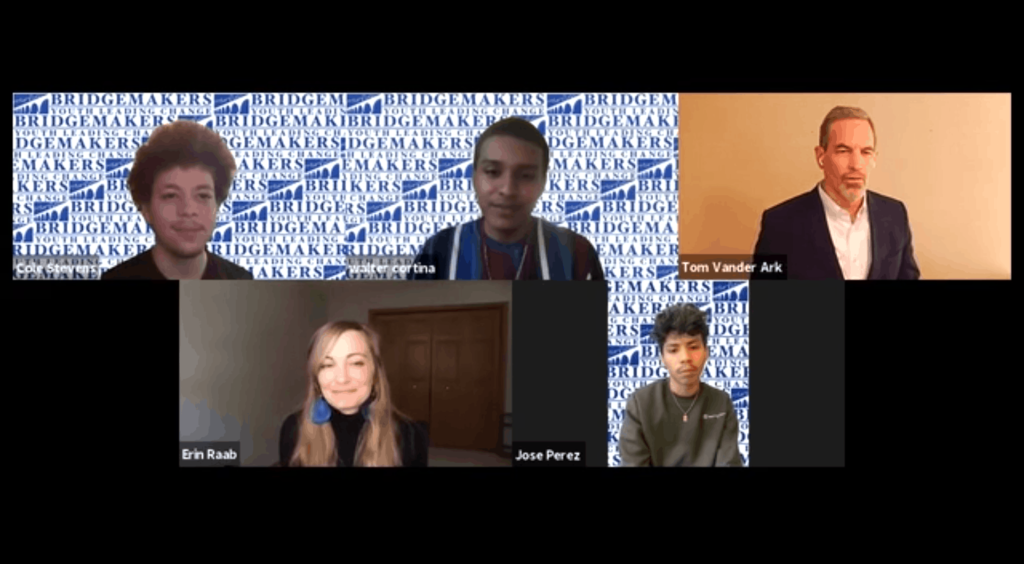
You are listening to the Getting Smart podcast where we unpack what is new and innovative in education. I’m your host Jessica and today Tom is joined by a group of young change makers and Dr. Aaron Robb, Chief Strategy and Impact Officer of the Choice-Filled Lives Network. Together they discuss the 100 Days of Conversation Project, a collaborative project organized to catalyze conversations in communities across the country on each of the first 100 days
of the new administration. Alongside Aaron, three young men are setting the stage for impactful and life-changing conversations in Minnesota. They are Cole Stevens, Walter Cortina and Jose Perez and together they run an organization called Bridge Makers. We love the energy and the urgency of this conversation as well as the continued emphasis on student voice. You will not want to miss this one. Let’s listen in.
Dr. Aaron Robb, welcome to the Getting Smart podcast. Thank you. It’s good to be here. It’s great to see you Aaron and I’m so glad that you’re accompanied by a set of conversation leaders, Cole Stevens, Walter Cortina and Jose Perez. Welcome guys. Thank you. Such a pleasure to be here. Thank you.
Aaron, you’ve been reimagining, re-envisioning education now for almost 20 years, right? I don’t know if that whole time I knew I was re-envisioning, but I’ve certainly been working in education for the last 20 years, yes. You really made that mission central to who you are and the work that you do. Maybe you could… How did you live into that mission?
Sure. That mission really came out of the first part of those 20 years where I was working first internationally and then here in the US as an educator and working with young people and watching how the system wasn’t working for them. Again and again, it was failing the kids that I cared about and I ended up going to Stanford to do my PhD because I thought somebody must have the answer. There must be some experts somewhere who know the answer to this
and they can just tell me the answer and I can go do it right out in the world. Largely what I found is that we’ve had a lot of people with a lot of very good answers in terms of curriculum, in terms of programs, in terms of theories and we largely weren’t using them in our schools. Then I thought, okay, well then if it’s not an issue of knowing the things, we need a new way of thinking about what even this system is for and then thinking about how
we translate what we know about humans and our communities into our practice of schools. Came out of a long journey, but I would say the last five years have been about re-envisioning. Erin, we’re here to talk about this really cool project that you’ve launched called The Hundred Days of Conversation. Where did this specific insight, the community conversations were key to unlocking potential? Where did that insight come from?
Yeah, it came out of originally, and this is maybe a little farther back than you might mean, but it came out of some of my dissertation work around systems change and understanding that to truly shift a system, you have to have a shared vision and that shared visions can’t actually come from the top down. Shared visions have to be co-created in community with the people who are living the experience day in and day out and that is what led to Re-envisioned,
which has a community revisioning process that is student-centered. Young people interview each other, adults in their lives, they learn how to qualitatively code, they come up with a vision, but then this moment of 2020, of this moment of multiple crises across our society, crises in our healthcare system, obviously in our social safety net, in our democracy, in our schooling system, led to this thinking of, is there opportunity here for not just returning
back to the old normal, but actually re-creating a new normal together that we return back to rather than just taking the old as the default and accepting that. I love that. And Dr. Aaron Rob, maybe you could tell us where you ran into these gentlemen and tell us about what you’re working on together. Yes, okay, so maybe very quickly I’ll say, I don’t know if you’re going to give 100 days of conversations what it is, but 100 days of conversations, the idea is to catalyze
conversations all across the country in small group conversations in communities between educators, young people, and families. So can people talking about not just what we would change about school, but what is a good life? What’s a thriving community? How do we think about the role of school in helping to create those and what are we going to do, what are we going to learn from this moment to make sure that our experience of school is getting closer to
these ideas we have about good lives and thriving communities. And as we’ve started working, so this is Re-Envision Ed, Human Restoration Project, and Local Voices Network are all partner organizations in this. And along the way we met bridge makers. I had the very good fortune of getting introduced to bridge makers through an organization here called Youth Prize in Minnesota. And these young men really run a very effective, very impactful youth organizing
organization that I’m going to let them actually say better. They’ll say much better than I can, what the mission is and what they work on. But one of the things they work on it turns out is reimagining education and making sure that youth voice is heard. And we had a few conversations and just immediately I knew, I hope they feel the same, I knew they were my heart people forever. And then we were just very vision aligned and they’ve become really the organization that is
running the Minnesota part of the larger national effort. So we’d love to dive in and talk about that. So Walter, are you leading that effort? Yes, hi. Walter Cortina, an 18 year old student high school for recording arts and executive director of bridge makers. Bridge makers is a nonprofit focused on mentoring and supporting the leadership and voice of marginalized youth as they help break the cycles of poverty, miseducation and violence. As a young age, I knew
that I couldn’t change the whole world. So bridge makers, what we’re really trying to do is focus on the set amount of people who can then help change the world. And we’re helping to make new cycles that can just go on and on. And I do want to pass it off over to Cole Stevens to talk a little bit more about the achievements that we’ve had over the year and how we tie into the 100 days of conversation. Thank you very much, Walter. So yeah, like Walter said,
really, this is all about making sure that any decision that’s made about young people, any policy, any system, anything that we’re going to have to interact with on a day to day basis, we’re going to be there to talk about how we want it to go down. No decisions going to be made about us without us. So for me personally, I kind of fit into this in a really funny way. Here in Minnesota, there is a law stating that if you are in high school, that’s it. Just that you’re in
high school, even though your employer is paying into the unemployment insurance system for your work, you can’t get those benefits at all. So that’s just going to subsidize other workers’ benefits. And so I came face to face with this in early May or late April, really. Lost my job, right? And I’ve been working to support my family ever since I was 14. My dad had just graduated a treatment facility. I’m helping him get out of debt, paying these bills, getting stuff done.
And I lost my job. And I’m in this situation where rent is laid, there ain’t no food in the fridge. And I had already requested unemployment benefits about a month ago. And I didn’t get anything until then. One day I did get the benefits, use that to pay down those bills. And then I got a letter about a week later, they’re like, about that. Actually, we just figured out you’re in high school, you’re going to have to give us all of that money back. So,
you know, understandably, I was pretty unhappy. And originally I was just looking for a lawyer, dude. I didn’t know what to do. But I got in contact with Walter Cortina and John Bacall, the incredible coach at Bridgemakers and my mentor. And really, we started this effort then to say, you know what, this law was clearly not made with youth voices at the table. So we’re going to bring it to y’all now. And we tried to get it done in the legislature, couldn’t really agree on funding.
So we sued. With that lawsuit, we were able to get $70 million worth of benefits back to young people, hardworking young people supporting their families, $30 million of which has been claimed and we got more coming. So really, with this, you know, we realized, let’s not stop at that, right? What about education? You know, what about economic opportunity for us young people going in because the economy is about to change massively and schools are not preparing us
for this change. So, you know, however long, some 100 years ago, when this was really put together for the industrialized society, this new industrial age that we were growing into, you know, they were really, they were pumping out factory workers, right? They were teaching obedience. They were teaching consumerism. They were teaching dependence. And that’s not how it’s going to work coming up. That’s just not the way the economy is going to go. We need independent thinkers. We need innovators.
And so basically, we were just like, let’s reimagine education. Let’s get youth voice in the legislature. Let’s get them on the individual school level. Let’s get them to these super intendents. Let’s talk about this. And that is when we were able to meet through Marcus Pope, the vice president at Youth Prize and our awesome, awesome partner in the unemployment insurance lawsuit. Shout out to Youth Prize. They’ve been awesome. They introduced us to Erin and
it was like she said, it was like kindred spirits. Like it just clicked like that. And you know, they really had this incredible kind of like technology and this awesome idea put together. And we were like, okay, you guys got this kind of structure. We got the young people. Let’s boom, let’s connect it. Let’s do this. And Jose, how did you connect with Bridgemakers? Of course, yes. So for Bridgemakers, the way I connected with is actually I got to meet Walter
Cortana at a high school for recording arts, actually showing him around and for showing him around our facility and really just trying to show him and let him know all the benefits that were really there for people of Black or Indigenous or people of color. Dr. Erin Robb from out in that relationship, then before Bridgemakers was established and just a product of those benefits and of great mentorships and of his hard work, he created Bridgemakers. And while that was all
happening, I was on my own journey creating my artistry to activism, just getting to really learn myself as an individual from high school for recording arts and just really getting back to connection with Walter and John McCall. And ultimately, we agreed that what I stand for and what Bridgemakers stands for is completely aligned. And it was very obvious that during the team, we weren’t too sure, like Walter said earlier, it was a little weird situation. We didn’t know
exactly where I could fit in, but we were just very necessary that we get hands on with the groundwork. So for example, just getting to be in the segue of meeting Erin and facilitating these conversations and really reconnecting groups of students. And this is really a multi-generational conversation that’s really impactful. And I’m just so grateful that I have been able to sit in these conversations to really reap the benefits of what a 100-day conversation is doing. And that’s
why Bridgemakers is so excited to continue the work because Professor Erin and Rob is just so incredible. And we really believe in her and anything she does. So we really know that not only will 100 days conversation will take off. Anything that we do together is definitely consolidated in greatness. Walter, I loved learning more about Cole’s story about changing employment law. But what are some of the other goals that Bridgemakers has?
Okay, so to my favorite part, in June, we’re looking to launch a fellowship program. Like I said, Bridgemakers want to focus on mentoring and supporting the voice and leadership of a certain amount of youth. And so we really want to work with that group of youth to then make their own projects within the community. So an example could be like Jose, as an ambassador, and he would be in charge of working with Erin in the community on 100-days conversation. We really want to
just blow the scale up more. How Cole mentioned him and I and a few groups of other young people started the Minnesota Young Champions team last fall. And that’s how we’re able to like sue the state and bring a lot of benefits to the community. So we really just want to just amplify those projects. And also we plan a host and a lot of community events for the moment of virtually. We just really like the sense of community. We really feel like a lot of people are disconnected.
And I feel like that’s what society aims to do. And so with Bridgemakers, we really just want to put our foot in a lot of the major systems. Like for example, we’re building a partnership with Children’s Hospital to work with families. And how Erin said it can’t happen from the top down. That’s why we’re starting with student voice because we want to go from down up. And I also just want to share that I’m so excited to this work because I myself,
like Cole, have been taking care of myself since 14. And the systems and a lot of, I guess, things that play into my day to day weren’t such in my favor. And I really wanted just to have a voice. And I do have to say that this is Bridgemaker. Walter, you’re at high school for the recording arts that, you know, in the Twin Cities, that’s kind of as good as it gets. Oh my God, yes. Shout out to Tony Simmons, the leader of High School for Recording Arts. The High School for
Recording Arts has given me the privilege to be able to do what I do. I myself am a very fortunate student because I get most of my work through my Bridgemakers work. I do the work that I already do. And then I turn it into like a validation credit. I show school like what I learned and why I learned it and like how it serves a purpose to my life. And so yeah, I really love the school. It’s brought a lot of connections, networks, freedom and thinking that I would never
think I would be around. And like you said, like that is the best that it could be. Hey Cole, are you also at high school for the recording arts? You know, I am not. I had a funny kind of high school experience. I started out at, you know, Southwest and in Southside Minneapolis. And I’ve been to two sort of just your typical big public high schools. And then I actually did have an experience with an alternative school.
And basically my experience at high school was sort of, well, let’s just say I wasn’t the best at paying attention. I didn’t like sitting still. And you know, I’ve always kind of had a, just I’ve loved to challenge authority, right? So they didn’t like me. To make it short, they didn’t like me at all. Right. And so the whole time I was thinking to myself, I was like, this is just arbitrary. Like why am I sitting here right now, regreting information? I can do it.
Do they really want me to, they want me to sit here, memorize and regurgitate more? I showed them, I could do that. I showed them I could do that in second, third, fourth grade. I already did this. Right. So this whole time I’m thinking to myself, and I graduated last year. So this is all still very fresh, you know? The whole time I’m thinking to myself, I’m like, why am I in this building? And I’m not out in the community right now. Why is it that the field trips are supplemental to the
book learning and the packets? And it’s not the other way around. And that’s driven a lot of my, that’s driven a lot of my passion for school is like learning through experience, full immersive experience. Cole, I’m, Cole, I just wrote a book called Difference Makers, where I argued that young people should have the opportunity to develop the sense of agency that you obviously have to
make a difference in the world. Where does that come from? Did it, it sounds like the high schools weren’t very central to developing that sense of agency that come from other people in your life. Did Bridgemakers contribute to that? Well, that’s an awesome question. Really a lot of it, a lot of it came out of necessity, you know? And a lot of it came out of sort of seeing, seeing where my parents were at. When I, when I grew up,
you know, my mom, I remember several times where she would work all day for like three weeks straight. And then like maybe she’d have a day break, you know, she’d have a Sunday off or something and get right back to it. Right? And my dad was doing the same thing. And my dad was, he wanted to be a freelancer. He wanted to be an artist. My mom is an incredible artist as well. And so I kind of was in this family. I was raising a family with a lot of love, not a lot of money and a lot of artistic
talent. And my parents wanted to just do what they wanted to do to create art and to bring that beauty to the world. But what they had to do was to just provide for me. And I’m so glad that they showed me that. So basically, for a very long time, I’ve had this just rampant like need to get to it, to be entrepreneurial, to get my money, and to buy my mom and my dad nice big houses. I mean, I’m really, I just always, always, always wanted to make sure that they, their investment in me came back
10, 20, 100 fold. And so that’s a lot. That’s a big part of my agency, right? And my like, kind of go getter attitude. But the other thing is just like, for myself too, like I was a young kid who was always questioning things. You know, if you told me something was the way it was, I would go why. And then, you know, you tell me why and I’d be like, okay, why again, I would just keep saying why until I got to the very bottom of it. That annoyed a lot of people, but it helped me a lot.
You know, it helped me a lot to, to gain independence. And so when I got into middle school, you know, I was, I was really more focused on sort of like relationships and like talking to people. I didn’t, you know, like I said, I had ADHD or something, I was just not good at standing still. And I just felt something was deeply, deeply, deeply wrong with, with this institution, this school. And I was like, because I loved learning. I got a laptop when I was about eight years old.
And I literally, it’s literally all my LinkedIn, my education is listed as the internet, because I love learning. And I’ve been learning and I’ve been checking my sources and going to different places and doing this my whole life. But in school, it would just be like, I just want to pull my head through that desk. So, you know, I think a lot of it was sort of what I didn’t have made me so, so, so, so passionate to make sure that others had it. Because I won’t put my kid in that institution,
not the way that it was for me. Aaron, I’d love to know more about the 100 days of conversation. Are the conversations that these gentlemen are holding in the Twin Cities, are they representative of what’s happening around the country? How are they different? What else is going on? So, 100 days of conversations works at three different levels. First of all, at the national level, for this first 100 days, which we are 50 days through the Biden administration’s first 100
days. And that’s what we’ve set it up on. So we’re halfway through. But for these first 100 days of the administration, we wanted to have communities talking. So at the national level, people are talking all across the country, we are gathering up those conversations, the transcriptions and the audio, and we’re going to be analyzing those for policy recommendations, for programmatic recommendations that will go back to the community of people who participated and then also get in
front of the new Secretary of Education. And for states that have a significant number of participants, they’ll also go to the state secretaries of education. So at the national level, this is what’s happening. At the state and local level, we have a couple of partners like Bridgemakers who really want to see, what does this mean for Minnesota, right? Or what does this mean for my district? And so what they’re doing is they are themselves catalyzing a number of conversations
and using it. We have a number of school districts who are using this as their family engagement or their youth engagement process heading into next year because they get the transcriptions and the audio as well and some help making sense of that at the end. So it’s great for local organizations in the sense that all they have to do is get people together and the rest is taken care of. And then at the individual level, we believe really strongly in the power of time
and space for deep reflection, for actually getting asked deeper questions, for asking young people deeper questions, not just like, how would you do lunch differently at your school? But really what matters to you? What matters to your community? And to have the power of also getting deeply listened to and listening deeply to others. So having to put your own hopes and aspirations and goals in conversation very literally with another and how that works at the local
level is basically a host signs up super easy. You just go to the website, you sign up, you get five to eight people together, intergenerational, so adults and young people. You sign up for a time on Calendly, you get sent a free Zoom link that will auto record the conversation. And there is an entire facilitation guide, start, finish, you can read verbatim. So basically it takes two hours all in from like organizing through to thank you notes to your participants at the
end. And it’s all taken care of in the sense that all a host has to do is show up with some people and then read the questions through. And that begets I think a very powerful experience. But I’ll let these guys talk about what the actual experience was like because they had one both being a participant and then also being a host. That’s all right. So Walter, tell us more about how this actually works. Did you get together
in person or were these virtual meetings who attended and what did you talk about? We have been doing it virtually. Bridgemakers has had its ambassadors, which is a group of youth leaders, I’m hosting their own conversation. But how it goes, you contact three to five people and there’s a set of question there. And we pretty much just hop on Zoom and we just run through the questions, give each person a few minutes to answer and then more towards the end we have
like an open conversation about like how the whole thing went. But I do have to say that it’s a very smooth but deep process. I’ve never really attended a questionnaire such as deep as 100 days on conversation. It goes from how is your life to like education to like purpose. And so I really I just love the process. Jose, what was your introduction to this sort of conversation like? Yeah, definitely. So I mean, for the first conversation we had was kind of a mini trial
between Aaron and I believe like three of us individuals. And it was definitely very much personal and intimate. So immediately when we stepped out of the conversation, we obviously put our heads together and said, yo, this is awesome. It’s really dope. How can we incorporate this more heavily before we even thought about partnering. So the next step we actually did amongst our ambassadors and even being amongst that conversation with our ambassador team,
you really get to get to know one another and get to really realize that how different education facilities could be ran even on the other side of the river. You really can see compare and contrast people’s differences and struggles and really see that there’s a lot of the same problems and a lot of the same issues being produced out of these out of out of high school education. Still a lot of questions unanswered and still a lot of uneasiness going into adulthood
and into this scary thing called college. So definitely it was just an amazing way to really get to know my team. It was really transformationally allowing me to open up my mind to see why one another acts the way we act or kind of learn the way we do because there’s definitely triggers and monumental moments amongst our educational career that makes us act the way we do. So definitely just seeing this around the close ones that I work with, it was very
uplifting and it empowered one another and I was really just seeing that that’s what made everyone so excited. That’s why everyone in our ambassador team is facilitating meetings and conversations, I should say, and everyone immediately after the conversation definitely feels the warm feeling of being heard and being able to speak your mind, being able to learn and to just have a more clear view of everything. Cole, I get the sense that you felt that way too of being seen and heard and
empowered in conversation. Is that fair? That’s exactly right. I actually would love to connect this to you. You did ask me too, did Bridgemakers help with kind of my agency and this connects directly to it because I had the agency, I had the drive, I had those opinions. Bridgemakers gave me the confidence through putting me through the ringer, through the experience, right? Gave me the confidence to speak my mind on that stuff. So what I love about these conversations is that
people say to me, oh, you’re well spoken or you’re well educated, you’re smart, but you’re so young, that’s so rare for your age. No, it isn’t. We’re all like this, but we have been neglected, we have been patronized, we have been ignored and these young people coming into these conversations, they are feeling that. They are feeling that heavily and the conversations that I’ve been had the pleasure to host and the one that I’ve had the pleasure to be a part of, this is a theme right
here is that these young people’s genius is being uncovered and they’re being given the confidence, give them the microphone and they get this boost of confidence and they get this like Jose said, this warm feeling and yeah, no, it’s really a beautiful thing. I mean, you can obviously see with me, give me the mic and I won’t shut up. So you can tell it works. It does, Walter. It’s a cool thing. I get the sense that there’s two important outcomes that
come from these conversations. One is that young people like Jose come away with a sense of empowerment and secondly, the adults that are part of those conversations leave with a new founder, specter, youth voice and a bunch of really good ideas that can make schools and communities better. That’s spot on. Yeah, absolutely. I think that adults leave the conversation just freaking glowing. You know what I mean? Because I think there’s a lot of adults who are so,
so like they really want the young people to stand up. They want to give them a platform, you know, like Aaron, like my mentor, John, like you, Tom. And so when they see young people excited and really, really just they got the hoods button. They just really want to get moving and they got all these ideas. I really think they leave just glowing. Aaron, I wonder how school administrators and system heads, are they typically sponsoring these conversations or they attend these conversations?
How are they often involved and what outcomes do you hope they get out of this? Yeah, that’s a great question. And maybe I’ll say one thing on the adult and young person outcomes in the sense that we really wanted these conversations to be intergenerational because we believe really strongly that there is a wisdom to being around for a while. Like there are experiences that people have had that are important and that there is a real renewal and a real possibility
with the new perspectives and the new voices and energy of young people. And so bringing those together, which just so rarely happens in our communities, was a really important part and not just have it be kind of within each generation, but really have these conversations happening intergenerationally. And I think absolutely what we’ve heard, I’ve heard from a few educators that they had to convince young people to show up, but then the next day all of them kind of independently
wrote and said, thanks so much. And now I want to host another one. And then to answer your question about the different partners and how different school leaders are getting involved, it’s really been very varied. So some people are just a classroom educator who cares a lot about getting young people’s voices heard. And so they’re going to host a conversation with young people in their classroom or in their school. Some of it is young people like these three here who are really
passionate about making sure that their communities are part of a larger conversation and that their community’s voices are heard. And some of them are more institutional. So we’re working with some entire school districts as I said before. So this is like superintendents, we have a couple superintendents who we’ve talked to who then pass it on usually to the to the family engagement department within the district and that and what’s great about this process that it’s all set up as
I said earlier that literally all you have to do is get people together and everything else is taken care of which especially in a time of pandemic is a really nice benefit. And so some of it’s been entire school systems. And then so actually, and we’ve had one or two rural communities that are doing it across not just across one school but across an entire rural community. So thinking about what this means across our whole town for this. So it’s really depended. But what’s nice is
that whether you’re doing one conversation or whether you’re doing multiple that it all contributes to this larger effort and that you have access to that that information afterwards you can be part of that meaning making as well. I love that. Walter, I get the sense that that being a conversation host like this has changed you and how you think about yourself and your path forward as well as your community. What’s next for you? It has as I mentioned the questions and the process
were very deep. I do just have to say what’s next following along with Bridgemakers is just what’s happening after the conversations because I’m having conversations themselves we feel won’t make the the greatest impact that it could have. Bridgemakers plans to work with schools within the Twin Cities to revitalize those. I was a part of a Changemakers team in like 2019 Adventure Academy, a school that my mentor started on John McCall. And there we started a
Changemakers team like I mentioned comprised of youth leaders and what we did was basically we spoke truth to the administration and we spoke truth to the teachers about what we wanted our education to be. Eventually we presented to the board of directors and that seemed to make a bit of change. So Bridgemakers kind of wants to work along the lines. We really want to form a student leadership team around that schools and we’ll revitalize them from the inside out.
We’re talking to Dr. Aaron Robb and Cole Stevens-Walter Cortina and Jose Perez from Bridgemakers in the Twin Cities. What an incredible story. Dr. Robb, what’s next for the 100 days of conversation? And now you have 50 more days of conversation. So first answer is probably making sense of those the next 50 days. And then what do you think is next? What would love to know what you’ve learned in this initiative and maybe some of the aspirations
for change that may come as a result of it? Absolutely. Well, first of all, we just are trying to get as many people to participate as possible. So for all of your listeners, we’re hoping that you will sign up to host even just one conversation or if this can be helpful for your school or your school district, we’d be happy to partner in a bigger process. So one, we’ve got 50 more days to get as many voices as possible heard and involved. And so I’m on full,
let’s make this happen and get as many people to have this experience that can be transformative as possible. And then you’re exactly right. We have to figure out how to make sense of that. We have to we’re going to have just hundreds and hundreds of hours of audio. And luckily, we’ve been partnering with the local voices network, as I said, and this is an MIT initiative that has an AI transcription software. And their whole mission is to catalyze more civil civic conversation,
basically. And so it’s really well aligned. But that platform is really allowing us to democratize the meaning making process, we’re going to be inviting participants back in to be able to access that platform and help make sense of these conversations with us. And that will feed into the policy and and programmatic recommendations. And that’s kind of the summer. But longer term, we’re thinking about this power of this process with bridge makers, as one of our partners, and
obviously, all of our organizing partners, Human Restoration Project, and Choice Build Lives Network. And thinking about, is there a power to this process, knowing that school, right, school reform is never done. The reimagining of school has to happen with every generation. I mean, these young people are here now in 10 years, it’s new young people, right? It’s it’s got it and there’s a new context. And so thinking that this is actually a lifelong and a really intergenerational process.
We’re wondering if this process in particular has some power for thinking about how do you bring people together in powerful ways to get them to be able to think transformatively about their their communities and their lives, and then and then move forward towards making that change. And so we’re seeing this first 100 days as really a pilot for a process of the initial catalyzing of ideas for change. It’s an exciting agenda.
Erin, I just I’ve loved the chance to get to meet Colin Walter and Jose. It’s obvious that the three of you felt heard and and appreciated. And I love how you’ve turned and you’re giving that gift to other young people and other people in the community that you’re you’re listening actively, that you’re paying a close attention and that you’re looking for ways to turn that into new agreements that make your community a better place. Cole thoughts on next steps for you,
where are you going to try to take your bridge makers experience? Really, it’s straight to the moon and I’ll elaborate on that. So I just want to say, you know, with all of this incredible brilliance and this youth voice and everything that’s coming of this, you know, there’s really a very there’s a reason behind it. And this is actually a direct response, kind of like for us, like 100 days of conversation is a national thing. It’s very necessary to start
having these democratic discussions in a time of incredible division right now, especially when you’ve got six companies, you know, owning and controlling 90% of what we’re reading and what we’re watching right now, we need democratization of the voices and the things that are being heard. So for us in Minnesota, though, this is a direct response to here, I’ll just I’ll just I’ll just I’ll just have to call the people out. The governor has had his do North education plan
put together to try to, you know, improve and better our schools after the COVID-19 pandemic. He had a roundtable discussion with, you know, distinguished people in the space, guess who wasn’t there? Students. So that’s okay, Mr. Governor, you didn’t have to ask us because we’re going to come and tell you the page amendment, which is about to well, it’s being pushed real hard in the legislature right now to the amendment to our constitution to give our students a civil
right to a quality education, all children, right? And this is awesome, except for the fact that this is measured against the standards set by the state, right? Well, the standards set by the state don’t work. They’re not helping us for this future economy and this future society that we’re coming to. So with this, we’re going to need a lot of follow up and young people’s voices are going to be in the middle of that follow up for sure. So on top of all that, there’s just always, always
these policies and these new systems and these new things that are coming into place that are directly affecting young people every day of their lives in school. They have to live with it and they’re not even asked how they feel about the decisions. So we don’t need to be asked. We’re just going to tell y’all legislature, we’re coming for you, governor, we’re coming for you, we’ll open arms and with open hearts, but we’re coming for you. We’re going to tell you how we feel
and we’re going to collaborate on this and get this done and we’re going to democratize our schools. So I really want, if I was just to get really, really big picture and really kind of radical, I really want young people to be able to vote on funding and organizational structure and management decisions within their schools, curriculum decisions and content decisions within their schools. I really want them to be at the forefront in every single thing about their
education. So they, I mean, we talk about how much we love democracy and of course we do, but then why is it that young people are fed something with no decision? They don’t get to make no decision about that. How is that a good prerequisite to going into a democratic society, not having a choice at all in your schooling? Why are people graduating without having understood how to connect with and talk to their legislators and their local representatives?
So it’s really, I want to democratize all of this. I want youth voice at the forefront. It’s going to be different for every community. So the way to fix this is to make sure that the youth in those communities get to vote on it, get to have a say and get to make it happen and get to control their experience. Okay, okay, I’ll shut up. I thank you for that. Thank you, Cole. No, I love it. I appreciate your leadership. Jose and Walter, I really appreciate your leadership as part of
Bridgemakers. Erin, wow, what a great example from the Twin Cities of conversations and youth leadership that’s been unlocked nationwide. Where can people find out more about 100 days of conversation? Yeah, we’ve made it really easy. You can just go to www.100, the number, daysofconversations.org. And you can follow us on Twitter, we’re on Facebook, we’re on Instagram. We have a separate young person social media team. Our entire social media team is made up of four young women who
are leading all of our social media efforts nationwide and they are doing an awesome job. It’s been really impressive for me not knowing much about social media, to be totally honest. And so you can check out what they’re doing and creating. And it’s at 100, again, the number, days con, so, like 100 days of conversations, obviously. And so you can find us on any of those, but you can sign up on 100daysofconversations.org. And I just want to stress that it’s super
easy. I think in this moment when everyone is feeling very overwhelmed and very isolated, this is a really easy way to reconnect with your own community and have it all just be set up for you. Literally three steps and you’re there. It’s great. So people can donate, they can host conversations, how else can they help? They can get the word out. So if you know some young people who might be interested in getting
involved and having their voices heard or organized or if you know some educators who are really into youth voice or community conversations, please spread the word. We found absolutely it is happening more through, I mean, maybe this is obvious, but through direct conversations, through us talking with other people and being connected with other people, right? So if you hear this and you’re inspired and you know somebody that this just resonates with, we’d love that. And we will
very soon have a map up of which states have already had conversations. And I think we’ve had almost half the states that had some conversations, but also hopefully go check it out and make sure that your state is represented and that your community is represented in this larger initiative. Great stuff. Dr. Aaron Robb from 100daysofconversation.org. Love to work and thank you for bringing these young leaders, Cole Stevens, Walter Cortina, Jose Perez, gentlemen. We appreciate your work,
your leadership. Look forward to supporting your leadership for years to come. Thanks for joining us on the Getting Smart podcast. It was a pleasure. Hey, thank you. Yes, thank you, Tom. Thank you, Tom. Thank you. Appreciate your time. A huge thanks to Aaron, Cole, Walter, and Jose for joining us on today’s episode. We found the conversation inspiring, actionable, and urgent. For more information on the 100 Days of Conversation project, check out the link in the show notes as well as on our blog.
This kind of work needs to be ongoing, so the community conversations won’t stop after the first 100 days. All right, that’s it for today, listeners. Before you go, remember to hit subscribe and please leave us a review if you haven’t already. For the Getting Smart podcast, this is Jessica, signing off.


0 Comments
Leave a Comment
Your email address will not be published. All fields are required.