

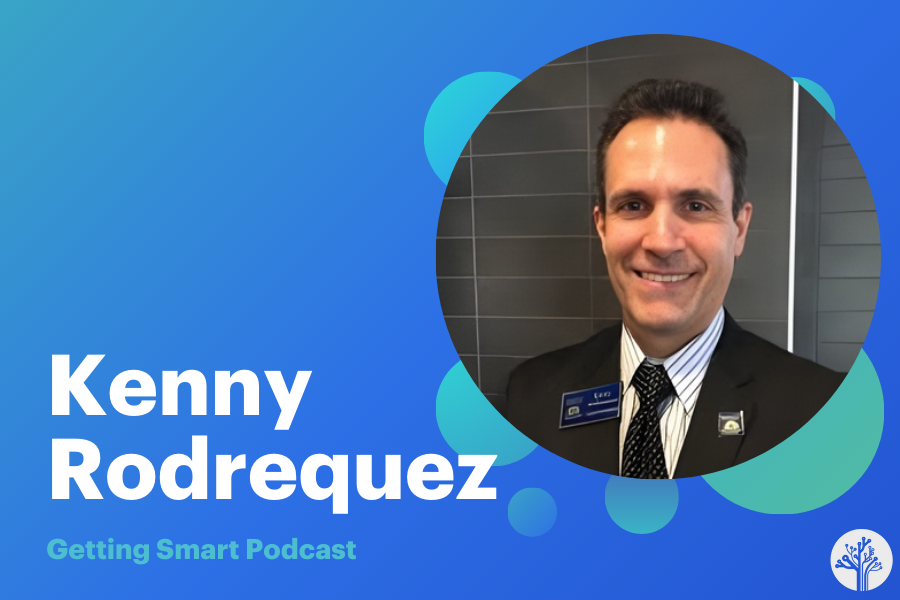
Dr. Kenny Rodrequez on Embracing Real World Learning
Key Points
-
Regional partnerships among districts create unique, shared learning opportunities for students, breaking down traditional barriers.
-
Grandview’s focus on pathways and real-world learning equips students with practical skills, aligning education with their passions and future success.
Shownotes





In this episode of the Getting Smart Podcast, Dr. Kenny Rodrequez, Superintendent of Grandview School District in Kansas City, shares how his district has embraced real-world learning and innovative pathways to drive student success. From his early work with Big Picture Learning in Tulsa to leading regional collaborations with neighboring districts, Dr. Rodrequez discusses the importance of breaking down barriers to provide shared opportunities for students. He highlights how Grandview integrates student passions into education through personalized learning pathways, partnerships, and hands-on experiences like Project Lead the Way. Tune in to hear how his leadership philosophy—focused on collaboration, creativity, and putting students first—has transformed education in his district and beyond.
Outline
- (00:00) Discovering Big Picture Learning in Tulsa
- (09:38) Building Pathways in Kansas City
- (14:18) Regional Collaboration Begins
- (19:52) Creating Shared Pathway Portfolios
- (23:59) Leadership Through Learning
- (28:00) Advice for Aspiring Superintendents
Discovering Big Picture Learning in Tulsa
Tom Vander Ark: I’m Tom Vander Ark. You’re listening to the Getting Smart podcast, and today we’re with Dr. Kenny Rodrequez, superintendent of Grandview School District in Missouri. Kenny, welcome.
Kenny Rodrequez: Thank you very much. Appreciate it.
Tom Vander Ark: You had an early career introduction to, I guess, what we would now both call real-world learning in Tulsa. What was your job in Tulsa, and how’d you connect with Big Picture Learning?
Kenny Rodrequez: Yeah. Well, I was initially an assistant principal and was moving into a principal role. At the time that we were in that structure, there was a major challenge and issue that was very public in terms of not meeting the needs of some of the special education students and the alternative network of schools.
So basically, the state was coming in and shutting almost everything down. And, as you know, sometimes those are the biggest opportunities for improvement and to truly be revolutionary. So they gave us kind of free rein—a group of other leaders that were extremely intelligent—and I was able to be a part of this group. We got to meet with community members, put together teams, and creatively look at, “Hey, this is an opportunity.” We made Big Picture Learning the core of all of it. Every one of the schools had in-school suspension teachers that were Big Picture-trained, all the network teachers, all of our administrators. We hired our own administrators and teachers, and these were individuals that were great at building relationships. But we were also looking at a network of schools that had both choice and, sometimes, not choice in terms of disciplinary reasons. Then, how are we making sure that the student still gets those opportunities? So we were still talking internships and sending kids out. We had an internship coordinator and worked through board policies that wouldn’t allow kids to be in teachers’ cars, but we needed them to have transportation.
We were really on the cusp of all of that, trying to do the best we could and truthfully set up a network of schools that was really helping students find their passion. And that’s what we started with—just asking, “What do you like?” “Well, I like skateboarding.” “Okay, well then let’s talk about mathematics and the mathematics of being on a skateboard. Then you’re going to design your paper on one of your topics. I don’t really care what you write about. Here’s the essay, here’s what you have to write, and here’s the structure. Just give me something that you really like to research and learn about.” Then every single student was doing their own individualized work that way. We all learned how to do it, we all learned the structures, we all learned those pieces, but then they got to individualize it. This was now, you know, 15 years ago, which was really crazy to think about, trying to do that in a structure that normally is not built that way.
Tom Vander Ark: Well, it’s so interesting, Kenny, because in most places, what was happening in that kind of turnaround situation was the opposite of real-world learning. You would double down on academic press and tutoring—the opposite of real-world learning. So it’s an interesting insight. Let’s remind people: the Big Picture model started in Providence in 1995. The big breakthrough was two days a week of “leaving to learn,” doing internships. So a big chunk of the week was spent usually in a community setting—a pretty radical high school model. How did you find that? Who discovered the model? Did it involve a field trip to visit some Big Picture schools?
Kenny Rodrequez: 100%. A leader at the time was in charge as assistant superintendent, and he was beginning to look at, and we actually found a couple of different models and we just kind of shared them. But Big Picture is what we gravitated towards. So absolutely, we went to Providence. We actually went on-site, and we saw it with our own eyes, talking to principals and asking those questions that sometimes you don’t like. “Okay, how does this really work? Like, how are you really going to be? How do you time it? How do you make sure that you’re bringing back that? How are you tying their work outside in the community to what’s happening in the school? Like, how are you really, logistically?” ‘Cause that’s what we get stuck into. We get stuck into all the reasons why it shouldn’t work, and then we just get beat down. It’s like, that’s never going to happen. So how are we doing attendance? How are we doing all these particular components? We just, we just found a way. And thankfully, we were given freedom from a superintendent that was a little bit more ahead of his time in terms of Keith Ballard. And so being able to have a little bit more flexibility from a leader.
One of the reasons why I really gravitated toward being a superintendent is like, I want to be that person that doesn’t stand in the way. I want to push. I want to confine, but at the same time, I don’t want to be that person that’s the reason why we’re not able to innovate and be able to push things forward that’s in the best interest of kids.
Tom Vander Ark: It is very cool that he helped create that space for you. It is really cool that you had what is sometimes a once-in-a-career opportunity to step back, rethink, and be involved in a new school formation initiative. How’d you make it from there to Missouri?
Kenny Rodrequez: Well, truthfully, as superintendents leave, as leadership teams leave, we had kind of established everything. We had kind of done everything that we were gonna do, and then a lot of the pieces and parts start to leave. And so as they start to leave, you start wondering, are we gonna still be able to do these things? But I was still looking for being able to push this forward. And Kansas City had an opportunity as a director of secondary schools, and they were kind of several years behind what Tulsa was doing. And so they needed something, and I just told them, this is what I’ve done. This is what I want to do. And I believed in the superintendent’s vision at the time to be able to really help. They were, you know, having trouble with their accreditation. They were having trouble with leadership. And so I was thankful to be able to come in and be able to help in whatever way I could for a couple of years. And then got the opportunity here at Grandview as assistant superintendent to continue moving forward.
Tom Vander Ark: KCPS. It’s been a challenging district for 30 years, hasn’t it? And you were there maybe right after people had started to leave the district, either moving into charter schools, which were booming, or families leaving for the suburbs, often the south suburbs of Center, Grandview, Hickman Mills. Right? So the district was really changing a lot in those years.
Kenny Rodrequez: A lot of pieces and parts, a lot of people moving. They reestablished a leadership team that had just been in place for maybe six to eight months, and they were really trying to move the district forward, back towards full accreditation and back towards really, again, meeting the needs of kids, showing that, “Hey, we have amazing teachers, we have amazing staff members, but we’re not getting the results that we should.” And in many ways, it was because of the system. The system itself had many superintendents over many years that each one had brought in their own system of, “This is how it’s gonna work,” and then I’m gone in two or three years. And so it’s the national model of we’re changing people every two to three years and changing systems. And so Steve Green was there for a longer period of time, which was amazing. And then obviously Mark Bedell after I had already left, coming in and again, establishing a longer tenure to finally put the district back going forward. But amazing people in that district.
Tom Vander Ark: So you left it, you went to Grandview as superintendent. Was that 12, 13 years ago?
Kenny Rodrequez: This is 12 years ago. I came as assistant superintendent for curriculum instruction, and then I took over as superintendent in 2016. So this is my 10th year as superintendent here.
Tom Vander Ark: Oh, that’s interesting. So 2016, that probably was the very beginning days of real-world learning in Kansas City. Wasn’t it 2016 that the community was having a regional dialogue about it, maybe doing a portrait of a graduate? And is that about the same time that you stepped into the superintendency?
Kenny Rodrequez: All around that same time. It seemed 2016 and 2018 was really the conversation in the community leading up into some work with Kauffman. Finally, into 2018 was when it’s finally starting to take shape for closer to what it is today. Obviously, it’s even evolved since then, but absolutely all those conversations were starting to happen at that time. And so it was a very easy conversation for me to be a part of since that was all the work that we had done previously.
Building Pathways in Kansas City
Tom Vander Ark: How did it align with the Grandview strategy and where you were? You had been an assistant superintendent anyway. How well aligned was it with what you were trying to do in Grandview, and how involved were you in the regional dialogue that led up to the formation of real-world learning?
Kenny Rodrequez: Yeah, when I came here, the only real piece they had was their version of pathways. They had the houses, which is the older kind of model. They just weren’t really as fleshed out as what they should be. They were just kind of there, but you really didn’t have a true design understanding of how this really progresses through. So even when I was an assistant principal in Tulsa, we had the magnet schools, and even as the magnet schools, we had outlined as a freshman, “Here’s every class you take, and here are your abilities.” But we had mapped it out from ninth through 12th grade. If I’m interested in being in instrumental music, what is my path, and how does this really play out to where by the time I’m a junior and a senior, here are the courses that I’m taking to make sure that I’m meeting this requirement. We didn’t have any of that mapped out.
So our number one thing that we did really well was Project Lead the Way. That was my foot in the door—being able to say, “Okay, we’re the first high school in the Kansas City area to implement Project Lead the Way. We feel like this is something we do really well.” That is, at its core, real-world learning. It’s practical. It’s putting you in a situation and having you problem-solve your way out of it. I thought, “I can deal with that. So why aren’t we doing it everywhere?” That was the very first thing—this is going to be mapped all the way down into elementary school. And it took us a few years to be able to do it, but we had to map that through.
Tom Vander Ark: This is a great reminder. I was just on the phone with Dave Dimmett from Project Lead the Way a few minutes ago. This reminded me, Kenny, that your adoption and really doing it K-12 also, I think, laid the groundwork for KC STEM Alliance, which became a regional Project Lead the Way hub. And then in some respects, that was one of the important precursors to real-world learning in Kansas City—this regional approach to adopting Project Lead the Way and high-quality learning experiences in pathways. Is that fair?
Kenny Rodrequez: Absolutely, 100%. And as we continue to expand all of that, I think they were finding more ways to weave them together, like, “Oh my gosh, there are so many more cross paths for us to be able to make these connections.” So rather than each one of these groups just having all of these separate kinds of things, it became, “How do we really work together because we’re all accomplishing the exact same type of thing, and we’re doing it just a little bit differently?”
Tom Vander Ark: So I want to remind some of our listeners who won’t know the framework for real-world learning. Around 2017, a regional conversation about a portrait of a graduate was going on. And right at the end, Susan Wally wrote a paper about what she called market value assets. She said, “What if we just agree on a set of powerful learning experiences for young people, and we all work towards more kids having more of those experiences?” It included internships, client projects, entrepreneurial experiences, industry-recognized credentials, and nine hours of college credit. So a goal of big, powerful experiences. Then Kauffman followed up with this super thoughtful framework of a small planning grant followed by an implementation grant.
So what did you do with that planning grant? Did you hire a real-world learning coordinator or…?
Kenny Rodrequez: So I did not want to hire anybody that I, later on, would potentially have to cut. I was always trying to look at sustainability. So my goal was to take any amount of money that we had and immediately infuse it into an area in a way that we could get the most forward progress to lead us into the future. So these were stipends, these were transportation pieces—anything that was a barrier at that time. And we needed people. I need people, but I need people that are with us to be bought in and sold on wanting to do this. Let me pay you extra for your time, but I need you to be the ones doing this. Because if I hire a coordinator that comes in and tries to run all this stuff, there’s still a disconnect. And then if all of a sudden something happens and I have to cut that person four years later, then the whole thing breaks apart. So I was just trying to be as sustainable as possible. We did it more by infusing it throughout our organization, buying pieces of the things that we needed, but really trying to lay as much foundational work as we could and then get us pushed as far forward as we could as quickly as possible.
Regional Collaboration Begins
Tom Vander Ark: It sounds like you had pathways work well underway, and so you were looking for ways to infuse pathways with these real-world learning experiences. When did the collaboration with the other southern districts—Center and Hickman Mills—the kind of three urban districts just south of the city, begin?
Kenny Rodrequez: It all happened around the exact same time. So in 2016, when I became superintendent, I had already developed a relationship with the superintendent in Center, and she had been hired the year before. She and I started having lunch and just building that relationship. Then a new superintendent was hired in Hickman Mills in 2017. So then we had the three of us who just happened to all be very collaborative at that particular time. We really started having this conversation around us looking at ourselves as a unit. My conversation with them was, “We are each one-high-school towns. What could we potentially do if we had three high schools and really looked at what each one of us does really well?”
What happened was, at the time, Center had a relationship with a regional hospital that was close to them, and I didn’t have that. That’s really what I was looking for—relationships that I didn’t have that were further away from my proximity. But they only had four kids. Hickman probably had five kids, and I probably had five kids. All of a sudden, that one organization had 14 students that they could really lock into. So it was an easier sell for us as three leaders and then with our groups. For the next year, we just started meeting and bringing the whole group together, trying to map out where we start and what we could do. Truthfully, the next meeting that we had was with Susan Wally.
We also knew, like, again, smart leaders do smart things, and knowing that we do not need to be the smartest people at this table, we needed someone smarter than us who also understood our three districts and could help us collaborate and keep us moving. Because we’d get busy, and then all of a sudden, six months would pass, and something wouldn’t happen. So we needed someone to hold us accountable as well as continue to move this work forward, and also someone who had all the relationships. We brought them to the table, and then it just kind of went. It went slowly because then, of course, we hit COVID. We were still meeting the needs and still doing some of these programs remotely. But over the course of the last three or four years, it’s been so exciting to see the growth of that program.
Tom Vander Ark: Kenny, it’s just such a cool story. I can’t think of another example where districts, with their own initiative, created this—I call it a pathway portfolio—where they decided to create complementary pathways based on the local assets with transported choice so that your kids really have access to pathways at all three high schools. It’s just such a cool example, and now it’s survived. There’s been turnover in the other districts, but that level of cooperation has survived turnover. And Kenny, it resulted in one of my favorite school visit pictures. I think it was four years ago. I was in your lower-level manufacturing shop. I think you were standing next to me, and there’s a kid from the neighboring high school. He’s wearing his mascot jersey, and he’s surrounded by students from your high school, but they’re all working together on this manufacturing project. I just thought that was so cool. It illustrated how kids who were competing after school on the football field were standing there working on a problem together in the shop. It just illustrates the cool opportunities that you’ve created for kids.
Kenny Rodrequez: We’re so territorial. As school districts, sometimes we’re so territorial. We want to be the masters of everything, and we don’t want to share at all. Especially in Kansas City, it’s kind of become a time where we ask, “How can we just get better? If it’s better for you, it’s going to be better for me.” We just don’t seem to care as much about that. That’s really where it started—getting rid of money. Again, just like I said before, sometimes we’ll come up with all the reasons why something won’t work before we even get to just have the conversation. We were just getting rid of all the barriers. Transportation is a barrier. What are we going to do about money? Well, we’re going to have to sign an MOU. The three leaders said, “Hey, we are going to let everything continue. It’s going to be fine. If you need to have something figured out, we will get in a room and figure this out.”
But that’s been the coolest thing. You’re right—the collaboration between them. Hickman Mills had a black box theater, and our students went there. Same thing—they’re all performing on the same stage. They did a performance, and I’ve got my students on stage doing one-acts and things like that. We’re over at Hickman Mills doing that. It wasn’t about where; it was about the experience for the kid. I think once we get to that point, it’s just so exciting to watch.
Creating Shared Pathway Portfolios
Tom Vander Ark: You know what I appreciate about your leadership is that it’s been just sustained excellence in Grandview and then in this larger ring of three districts working together. But you’ve also been an important leader regionally across the whole 40-school system collaboration that is real-world learning. I think that your leadership in those concentric rings was a part of why you were recognized by your colleagues as Superintendent of the Year in 2024. That must feel pretty cool to be recognized by your peers as the best superintendent.
Kenny Rodrequez: I mean, I don’t even know how to describe it, even to this day. I think it still makes me uncomfortable. You know, we’re just ingrained as leaders, and it’s not me. It is a system, and it is people, and it’s all these amazing individuals that you’re blessed to work with. So when you get a recognition like that, you absolutely are thankful, and you know it’s worth it, but you’re still a little uncomfortable with the recognition around that, knowing that all these other individuals and people that you put in place are the reason for the success. But yeah, it was very humbling, for sure.
Tom Vander Ark: Kenny, we should note that the Real-World Learning Initiative is the most collaborative reform effort in America. It is just very unusual that 40 school systems, particularly across two state lines, including four or five charter networks, are working together to ensure that all kids have access to powerful learning experiences. I think you mentioned COVID. I think that weekly call that we had during the pandemic only made that collaboration stronger. It’s just unusually collaborative, and I don’t know. I think your style and the longevity of your leadership in Grandview have played an important contributing role in making that a great collaborative initiative.
Kenny Rodrequez: It’s interesting when you’re a superintendent at 41, and you’re the young guy on the block, and then you blink an eye, and all of a sudden, you’ve been here for 10 years, and then you become one of the veterans. You start to take that role on a little bit, like, “Oh, that’s why that person was kind of that way.” But you take that role very seriously. I feel like the people that came before me set the foundational piece. But yeah, you know, the one thing I would say, as you mentioned COVID, is that we talk so much about all the negatives and all the bad things and all the ramifications, and rightfully so. But I don’t think we talk enough about some of the positive things that maybe came out of it. And I agree with you. I don’t know—I mean, it’s hard to know what the truth is—but I don’t know that we are where we are if that had not happened because of that and because of that opportunity to have those weekly conversations. That pushed us forward quicker than I think it probably could have. We had the time to stop, even though we were dealing with things on fire and chaos. But we were actually talking about what this is going to be like after and moving forward. I don’t know that we have that without that opportunity. So again, a lot of negatives came out of that, but I think we have to also kind of look at some of the positives that did as well.
Tom Vander Ark: Kenny, I appreciate that. You’re a learning leader. You’re always reading interesting books, and it seems to be part of the culture in Grandview, with a commitment to learning leadership. I saw on social media the other day that you were reading Unreasonable Hospitality, the Will Guidara book. What in the world does that have to do with leading a school district?
Leadership Through Learning
Kenny Rodrequez: You know, there are so many things. I mean, I don’t read nearly as much as you do, but when I read all these books, there are times that there are good books, but then they seem like we’ve recycled the same thing over and over again—we’re just saying it differently. I think anytime that you have an opportunity to look at something from a completely new vantage point, it’s valuable. This one has just hit me differently than most of the other ones. I finished reading it, and we’re taking our team through it right now. Yes, there are things that are not the same. Like, I know they’re going to have one experience at a restaurant one day, and they’re not going to see them for another month, and you’re going to see them every single day. So that parent that’s mad at you is going to come back mad at you tomorrow. But just like this last time, we were talking about the 95/5, and there’s a piece in this book where he talks about the 95% and he’s talking about it from a financial standpoint. These are the 95% things that we’re going to do, and we’re going to take 5% of our budget and just spend it without any regard. We’re going to focus on unreasonable hospitality, and we’re just going to blow it on something like an experience that they’re never going to forget. That’s 5% that we can just do.
So we took it from a leadership perspective: What’s your 95/5 in terms of your leadership? What is the 95% of things that are inside of your control and the 5% that are outside of your control? And do you usually spend more time on one or the other? They were putting things outside of their control, like emotions and frustrations and sometimes where parents live—things they can’t control. It was like, “How many times do you spend? It’s not 95/5. You’re spending 50% of your time on this, but then you’re spending 50% of the time on things you can’t control.” It was one of those times where my team put this together, and we were really talking through it and what it could be. There was silence. They were just mind-blown, like, “I am spending so much time focusing on things that I can’t control.” How much time would I get back just in my leadership and my thought process? So things like that, you sometimes have to make that connection. Yeah, we always have things outside of our control, but what can we control, and how do we focus more time on that? Yeah, we have influence sometimes on the things we can’t control, but you can’t control it. So it’s just interesting going through things like that. But it has been one of the coolest books in terms of just a very different way of looking at leadership. You have to find the parallels, but there are definitely parallels if you’re any kind of a thoughtful leader at all.
Tom Vander Ark: One of the unique things about the Real-World Learning Initiative is that I think it’s the only regional initiative in the country that has a shared focus on entrepreneurial experiences. What I really appreciate about Kauffman’s approach to entrepreneurship is that it’s about value-add, value creation, whether it’s in an enterprise or in a community setting. It’s about helping kids appreciate the importance of creating value for a community. So I’m glad you guys are reading it, but I also appreciate that you’re creating experiences for young people where they can come to understand the importance of hospitality and value creation in whatever setting they’re stepping into.
Kenny Rodrequez: You’ve got to give back to your community. I mean, we have a lot of students that come back and live in the same community, live in the same area, and are going to stay in Kansas City. So you’ve got to be a good human. How do we balance all those things with the time that we have and make sure we’re still taking care of people at the same time? It’s been fun. It’s a blast. It really is.
Tom Vander Ark: Hey, we were talking to Dr. Kenny Rodrequez. He is the superintendent of Grandview School District in metro Kansas City. On the way out, Kenny, a word of advice for people thinking about a superintendency?
Advice for Aspiring Superintendents
Tom Vander Ark: And then, if you care to add any words of gratitude?
Kenny Rodrequez: I’ll do all of those, and I’ll start with gratitude first. I’m not here without many of those people. I’m not here without Keith Ballard. I’m not here without Millard House. I’m not here without Kevin Burr. That was the Tulsa Public School leadership team, and that’s who invested in me and really pushed and challenged me. Certainly, Steve Green over in Kansas City gave me an opportunity to come up here and be in this area. I’m not here without those individuals really pushing me and challenging me and just giving me a shot.
I think anytime anybody asks me about being a superintendent, the two things that I normally tell them are: Don’t get into this job if you think you are—if you really love being an assistant superintendent, that may be what you want to do. Because being in this job, you don’t get to do all the three jobs or the other jobs. You are managing the people doing that and really pushing them as leaders to do it. But you should not be the one doing that. Your job is the board. Your job is the community. Your job is to make sure that you’re rallying around all those components and to remove barriers from your team to do their job. But you don’t get to do their jobs anymore.
And then I just tell people, don’t just rapid-fire apply. If you just want to get out, this is not the job to run into. You find jobs in communities and districts that you feel like your skill set is going to be a match for and that you could actually bring and push them forward because, “Hey, I like what you believe in as a district and as a community, and I want to be a part of that.” Because you will be in that community, and you will be living there and being a part of that with people who have been there their whole life. They’re going to know whether you are for real or not. So don’t fake it.
Tom Vander Ark: It’s a tough job, but it is the best job in the world because it’s the only place you can change the way a community thinks about itself and its kids.
We’ve been talking to Kenny Rodrequez, the superintendent in Grandview, just outside of Kansas City. Kenny, thanks for joining us. It was a blast catching up.
Kenny Rodrequez: Always appreciate it. Always love talking to you.
Tom Vander Ark: And thanks to our producer, Mason Pashia, and the whole Getting Smart team for making this possible. Until next week, keep learning, keep leading, keep innovating for equity.
Guest Bio
Kenny Rodrequez
Dr. Kenny Rodrequez is the Superintendent of Grandview School District in Kansas City, Missouri, where he has led transformative initiatives in real-world learning and regional collaboration. With over a decade of experience in education leadership, Dr. Rodrequez has championed pathways that connect student passions with practical, hands-on learning opportunities, including the successful implementation of Project Lead the Way. A staunch advocate for equity and innovation, he has played a key role in fostering collaboration among districts in the Kansas City area to create shared learning opportunities through initiatives like the Real-World Learning framework. Recognized as the 2024 Missouri Superintendent of the Year, Dr. Rodrequez is deeply committed to empowering students and communities through innovative educational practices.
Links


0 Comments
Leave a Comment
Your email address will not be published. All fields are required.