

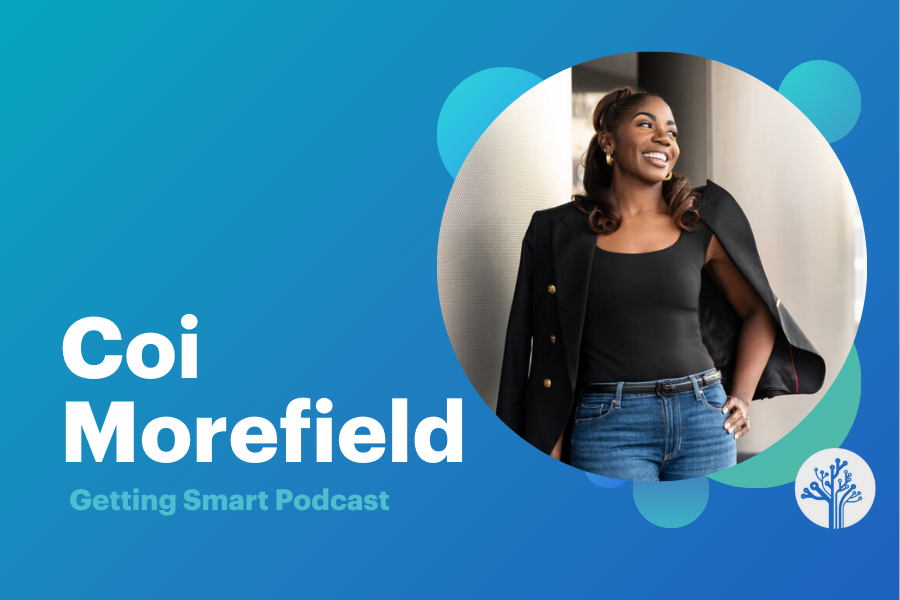
Coi Morefield on Microschool Masters and Updating Professional Development for a New Generation of Leaders
Key Points
-
Micro School Masters offers tailored professional development for micro school educators, emphasizing unique challenges like small student-teacher ratios and diverse roles.
-
Effective teacher training in micro schools can significantly reduce turnover costs, enhancing sustainability and growth potential for these innovative educational models.
Shownotes





Mark your calendars for SXSW EDU March 3-6, 2025 in Austin, Texas, and register now at sxswedu.com. Let’s work together to shape the future of education—one idea at a time.
In this episode of the Getting Smart podcast, hosts Jordan Luster and Victoria Andrews dive into the world of microschools with Coi Morefield, founder of the Lab School of Memphis. Morefield introduces Microschool Masters, a groundbreaking platform designed to address the unique challenges of microschool education by transforming teaching teams into exceptional educators and leaders. With a focus on adult learning, Morefield emphasizes the importance of mindset shifts and sustainable practices to retain educators and decrease costly turnover.
The conversation highlights how microschools, with their small, personalized settings, require a distinct approach to teacher training and professional development compared to traditional models. Morefield shares how her platform is akin to MasterClass, offering high-quality, digestible courses that not only cover essential educational strategies but also critical areas like compliance and governance. This episode is a must-listen for those interested in the future of education and the transformative potential of microschools.
Transcript
Jordan Luster: Good afternoon, everyone. You are listening to the Getting Smart podcast, and we’re so glad you’re here. I’m Jordan Luster, and today I’m joined by my esteemed colleague and partner in all things microschools, Victoria Andrews.
Victoria Andrews: Hey.
Jordan Luster: Together, we’ve been leading the charge on a lot of microschool work here at Getting Smart, and we are excited to bring you into an inspiring conversation about what’s next for this transformative movement.
Today, we are thrilled to be joined by the one and only Coi Morefield, the incredible founder of the Lab School of Memphis. Victoria, why don’t you share a little bit more about Coi and some of the amazing work she’s doing?
Victoria Andrews: Sure. Coi is from Chicago, but she has been in Memphis for a couple of years. During her time in Memphis, she became the founder of the Lab School of Memphis. She is also the entrepreneur-in-residence at the Beacon Center, a fellow of the Black Minds Matter McLeod Fellowship, a Yass Stop Prize Award winner, and a recipient of many educational grants.
Today, she’s here to talk with us about an exciting new offering she has for leaders in the microschooling space. I won’t go into too much detail because Coi is going to share all the details herself. So, Coi, we are so happy to have you with us today.
Coi Morefield: Thank you for having me. I’m thrilled to be here.
Victoria Andrews: We’re going to start off by asking: What is your vision for adult learning?
Coi Morefield: Okay. As you mentioned, I’m the founder of the Lab School of Memphis and now the founder of Microschool Masters. What we are doing at Microschool Masters is tackling one of the biggest challenges in this rapidly growing movement—how to develop and retain exceptional educators who can deliver on the unique promise of microschool education.
Victoria Andrews: Microschools in general have— and we’ve talked extensively about this— a history rooted in the efforts of enslaved populations who lacked access to formal learning environments. Those within these communities took the initiative to create learning opportunities for young people.
However, we often overlook what learning looks like for the adults in this space. How are they equipped to be their best selves so they can share their collective brilliance with the young people in their care? But you’re tackling that head-on. And if Coi does anything, she doesn’t do it small—she goes all in with gusto. Can you talk to us about how this came to be and how you’re hoping to share it?
Coi Morefield: Sure.
After seeing other founders—and experiencing it myself—struggle with teacher turnover costs upwards of $14,000 per replacement, I knew we needed a solution. Some even hit growth ceilings because they couldn’t effectively transfer their vision to their teaching team. That’s when I realized we, as in the Lab School of Memphis, along with my counterparts in this space, needed a system to help.
Our platform, Microschool Masters, helps founders transform their teaching teams into exceptional teachers and leaders who can deliver on the promise of microschooling—personalized and innovative education.
It fascinates me that the very things that make microschools so attractive—small class sizes, personalized instruction, and an average 8:1 student-teacher ratio—are also the reasons why traditional teacher training and professional development (PD) are inadequate for this model.
Supporting a teacher in an 8:1 environment is vastly different from supporting someone in a 25:1 or 30:1 setting. This fundamental misalignment with traditional PD is something we had to address.
Of course, research shows that structured teacher development programs can increase retention from 8% to 25%. So, it’s necessary, but we don’t want just any program. We need something customized—something that helps founders translate the fundamentals of the model and the mindset needed for microschools.
Victoria Andrews: Speaking of mindset shifts, what does that look like in practice when it comes to adult learning? How do we actually help shift the mindsets of adults so they can, in turn, do the same for the young people they serve?
Coi Morefield: That’s a great question.
This isn’t just a numbers problem—it’s not just about turnover. It’s also about training teachers for a completely different system. In microschools, we’re not just asking teachers to be content or grade-level experts, like in traditional environments.
We’re asking them to be entrepreneurial. To be curriculum designers. To be experts in communicating with parents. To be customer service representatives. To be brand ambassadors.
This level of personalization is unparalleled. That’s why we built Microschool Masters with a conversational approach—think MasterClass but for microschool teachers.
Our library is full of courses featuring experts, including myself and my peers, sharing stories, tools, strategies, and resources as if they were speaking with a colleague. These are digestible, audio-friendly, and designed to be accessible—whether you’re listening in the car or sitting at your desk.
But beyond mindset and instructional training, we also include crucial compliance-related courses—topics like abuse and neglect reporting, first aid, bloodborne pathogens, data privacy, and ethics. These aren’t federally mandated yet, but they’re best practices in both education and private industry.
If a founder is ever sued or faces an employee-related issue, being able to demonstrate that you’ve taken proactive steps in training your team is essential. It’s what keeps your business running.
Jordan Luster: I love that you mentioned compliance because that was literally my next question. There have been several surveys about governance, compliance, and business acumen that microschool leaders need—but aren’t traditionally taught.
The resource library sounds amazing. What other tools and features does Microschool Masters offer to support teachers and founders?
Coi Morefield: I have to say—when I compare it to MasterClass for microschool educators, I mean it. The sets are beautifully designed, and the production quality is high.
But beyond that, we provide workbooks, checklists, real resources, and even scripts. For example, in our Excellence in Service course, we provide scripted language for teachers to use in different scenarios.
Because microschooling has grown 300% since 2019, the biggest bottleneck will always be the founder. If all the institutional knowledge, language, and know-how live and die with one person, the movement isn’t sustainable. That’s why standardizing training is crucial.
Jordan Luster: We’re huge fans of codification—making sure all the knowledge doesn’t reside within one person. It’s about capitalizing on collective genius. If you’re planning to grow and scale, you don’t just want to clone Coi and put her everywhere—you want to build a system of best practices that can be shared, whether it’s in a Google Drive or another resource hub.
There’s so much power in codification. That way, the vision and dream can live beyond one person and continue serving the community and families.
Victoria, I know you probably had another question—I can already see it. Go ahead.
Victoria Andrews: I do. In this microschool sphere, there’s so much emphasis on collaboration and collectivism. What opportunities for networking and collaboration will Microschool Masters create? Will this establish more of a network for your teachers and founders?
Coi Morefield: Yes, I’m glad you asked that. When you referred to the teachers as students, I realized I should clarify something.
This is new in our space. Many people support founders in launching microschools—helping them get started, set up systems, and establish their schools.
But our end users aren’t the founders; they’re the teachers. The goal is to save time and money by preventing the sunk costs of turnover.
In terms of community, we’ve thought a lot about how to build it. We have traditional ways—like joining our LinkedIn group for resource-sharing and discussions. But we also offer opportunities for teachers and leaders to come together monthly or quarterly for Q&A sessions with our instructors. These will be available for purchase, but they’re a valuable perk for subscribers to Microschool Masters.
These Q&A sessions give educators direct access to experts, helping them solve real-time challenges they face in the classroom.
I consider it a privilege to serve in this space, to support and develop the teachers on my team at the Lab School of Memphis. One of my core values is ensuring that no one is overlooked. Building a strong educator community is part of that mission.
Another unique way we foster community is through our instructors. As I invite experts to share their knowledge, we make sure they are well-compensated for their expertise and intellectual property.
Too often, we hear about underpaid educators. But if we, as a platform, have the opportunity to engage experts, we must lead by example—honoring their knowledge, time, and professional journey with fair compensation.
This creates a deeper sense of community, not just among educators using our courses, but also among the experts sharing their knowledge. Many of us have been in this work for a while and have faced battle fatigue. Having a space where experienced educators can support one another is invaluable.
Jordan Luster: There’s so much to unpack here. But, Victoria, I’ll pass it to you because I know you have thoughts.
Victoria Andrews: It’s exciting to see that the same design principles you use in the Lab School of Memphis are now being applied to adult learning—not just for founders, but for the educators in microschools, too.
Too often, the best practices we apply to young learners are not the same ones we use for adult education. You’re changing that. You’re providing accessible, actionable professional development that meets educators where they are—whether they’re listening in their car or sitting down to dive into the resources.
I just want to applaud you. I’m really proud of you and excited to see what’s next. Many educators leave workshops overwhelmed by information, but it sounds like Microschool Masters is designed to mitigate that—offering responsive learning that evolves with the field.
If your courses rival MasterClass in production value, that’s incredible. Those ads pop up in my Instagram feed all the time!
Coi, as we wrap up, do you have any parting words for founders or anyone interested in learning more? And how can they contact you?
Coi Morefield: Yes! You can reach me on LinkedIn—just search my name, Coi Morefield. I’m also on Instagram—you’ll see my kids there with me, but I’m okay with that! You can also follow The Lab School of Memphis on Instagram.
Victoria Andrews: But your kids are cute, so it’s all good!
Coi Morefield: Thank you!
I also want to illuminate something from an operational standpoint for founders. I understand that not every founder is in a growth stage or adding team members yet. Some may feel they can’t justify the investment in professional development.
But I want to emphasize something we often overlook: the true cost of turnover.
Let’s break it down:
Imagine you’re paying a teacher $20 an hour. That’s pretty standard in the microschool world. You might think replacing them only costs a few job postings and training time.
But the actual cost of replacing a teacher is around $14,000—here’s why:
- Job postings, interviews, and background checks
- Paying other teachers to cover classes while you hire
- Productivity loss as the new teacher gets up to speed
A new teacher takes about three months to reach 60% productivity. That 40% gap during those months costs about $3,000 in lost productivity.
Multiply that a few times a year, and you’re looking at massive losses.
Having access to structured professional development—whether through Microschool Masters or another system—isn’t just about training. It’s about sustainability. Without it, I believe microschool growth nationwide will stall.
Jordan Luster: Victoria asked for parting words, and you just dropped several gems! That alone could be its own podcast episode.
As we close, I just want to thank you. Your servant leadership and dedication are empowering. I’m excited to see how your work will continue to uplift educators and microschools across the country.
For our listeners, please check out microschoolmasters.com. I can’t wait to see how this platform grows and supports educators.
Coi, thank you again for your time. We’ll be following your success closely!
Coi Morefield: Thank you so much! I appreciate you having me. You guys are amazing.
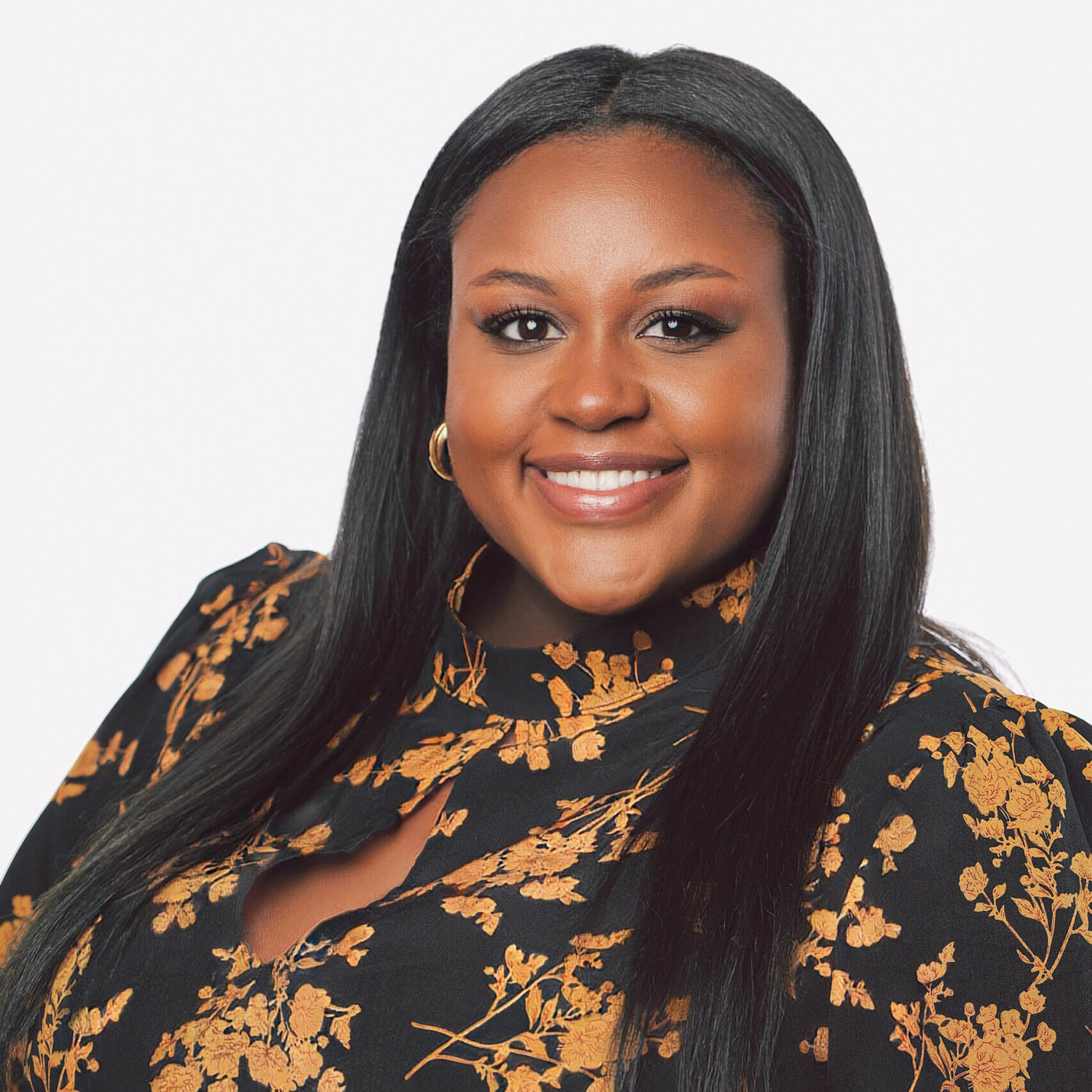
Coi Morefield
Coi Morefield brings visionary leadership and hands-on experience in pioneering learner-centered educational environments. Founder of The Lab School of Memphis, Coi has championed local, accessible, and innovative education for students and communities underserved by traditional school systems. Her work emphasizes microschools as transformative solutions, integrating competency-based learning and individualized academic support. Coi’s passion for educational freedom and practical expertise in launching and sustaining microschools align with her commitment to broadening educational options across Tennessee, offering scalable, community-driven alternatives in K-12 education.
Links
Victoria Andrews


0 Comments
Leave a Comment
Your email address will not be published. All fields are required.