


David McRaney on How Minds Change
Key Points
-
Individual-based approaches to learning don’t work. We are inherently social creatures.
-
Oftentimes truth is ambiguous, but we never realize it is ambiguous.
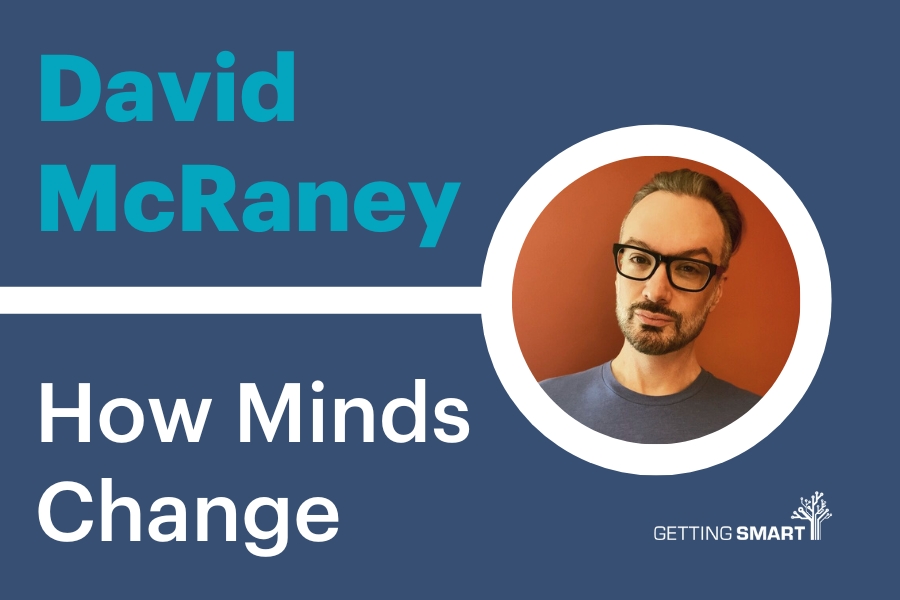
On this episode of the Getting Smart Podcast Tom Vander Ark is joined by David McRaney, author of the new book How Minds Change: The Surprising Science of Belief, Opinion, and Persuasion and the host of the You Are Not So Smart Podcast.
In this conversation, they touch on topics like social science, tribal truths, living in a post-truth society, the art of persuasion and much more.
Reasons ‘for’ become reasons ‘against’ when your motivation to find a reason changes.
David McRaney
Links:
- About You Are Not So Smart
- You Are Not So Smart Podcast
- How Minds Change
- How Minds Change Discussion Guide
- Clash by Caravan Palace
- James Burke
- Jay Van Bavel
- The dress debate
- SURFPAD
- Genetic Epistemology by Jean Piaget
Transcript
This transcript has not been edited for spelling accuracy.
David, what is deep canvassing? What is deep canvassing? That was one of the things that started this whole journey for me. I read an article in The New York Times about what they were up to. At that time, the big wedge issue, believe it or not, it’s hard to accept that this was
true just a few years ago, was same-sex marriage. People were arguing about same-sex marriage in the way they argue about things like gun control today or most recently would be the abortion debate. It was people on two very clear sides, foreign against arguing all day on the internet. There are as many news articles about the arguing as there were about the topic.
This article came along and said that these people in Los Angeles had devised a technique to go door to door, knock on people’s front doors, and within 20 minutes, flipped their opinion on a wedge issue. Specifically, it was same-sex marriage that they were having the most success with. It was in the early days of trying to figure out what kind of book is this going to be. That’s the thing. That’s really the thing. I emailed them and then called them and then
eventually flew out there. I went out there on four different occasions and on three of those occasions, I trained in the art and practice of deep canvassing and went door to door with them and did it and learned how to do it and spent weeks with them. It was great. Deep canvassing is a conversational technique. They would consider it conversational. It’s also, you could look at it as a persuasion technique, but it’s a way to engage with the
person who may disagree with you on this particular issue and get them to see things a little differently and possibly move them along the attitude scale, especially if you’re trying to canvas for a certain vote on a certain issue, to canvas in a way that persuades them to vote in the way you’d rather them vote. The way it came about was Prop 8 in California. When it went through, it was a vote to see if
whether or not California would make same-sex marriage legal. They failed in that regard. It was absolutely astonishing to the LGBT Center of Los Angeles and other LGBT centers in the state because it just seemed like such a state that it was progressive in that regard. Many people move there for that reason to live more openly. Dave Fleischer, who is the leader of something called the Leadership Lab, which is the political action wing of the LGBT Center of Los Angeles,
he said, what if we just went out to the regions where the polling shows we most likely lost and knock on people’s doors and ask them, how come you didn’t vote for this same-sex marriage thing? That’s what they did. They went door to door and they were astonished that people really wanted to talk about it. So many people wanted to talk about it at such length, they started recording their conversations and they eventually started recording them on video.
So they ended up with thousands of these videos. When I met with them, they had already gotten up to 17,000 videos. In the course of doing that, every once in a while in a conversation, someone would flip their opinion in the conversation. They thought, that’s fascinating. What if we tried to replicate that? They looked at the two or three videos that took place and they tried to A-B test everything inside them. Do this, if it works, keep it. If it doesn’t work, throw it away.
And through an iterative process, they zeroed in on this technique called deep canvassing. And now they have a very high success rate, a high enough success rate that people, social scientists, come to study them. Activist groups in every domain you can imagine come there. And the tool itself has been expanded to talk about issues about race and immigration and not just wedge issues, it was used in phone banks during the last political election. So it’s a very powerful
technique that I was astonished to learn through the course of writing this book, has, shares a lot of features with a lot of other rhetorical techniques that they were completely unaware of. And also there’s a lot of scientific foundations here that they were not aware of either. It was just through this A-B testing and lots of funding that they rediscovered some things and newly discovered others. It’s really fascinating. You’re listening to the Getting
Smart podcast and I’m Tom Vanderenken. Today I am joined by David McCraney. He’s the author of a great new book, How Minds Change, the Surprising Science of Belief, Opinion and Persuasion. David is also the host of a great podcast called You Are Not So Smart. Welcome to the Getting Smart podcast. It’s perfect. We should have met earlier. If not just for search engine optimization, we have shared interests and goals and values and the VIN diagram had to overlap at some
point. So I’m happy to be here. Who introduced you to Caravan Palace? YouTube. I don’t know. It was like a suggested video and it was, I love the song that I heard and then I got the album and the album version did not sound anything like it. And it turned out that the thing that was on YouTube was something from their demo tape days, from their demo tape days. And I emailed them. I finally got a hold of their manager and said, can I use your thing? And they were like, sure. I was
like, but can I use your YouTube thing? And they were like, I don’t know about that. So it took a little bit of wrangling, but I got a hold of it eventually. It is the craziest, catchiest, the most idiosyncratic podcast opening music. When I hear it, I know it’s McCrary. Thank you. I wanted one, I looked, I wanted a song that it would pause so I could say the name and the show in it and it had that perfect spot in it. But full disclosure, I reached out to the
Dust Brothers before that who did the Fight Club soundtrack because they also have a song that has a nice little pause in it, but they straight up were like, look, we couldn’t even use it for stuff that’s owned by Fox. Tell pictures, they will never give you rights to it. So I moved on. I love it. It’s awesome. You’re brave for using it. It’s crazy. I want, I want, I’m trying to figure out how to introduce you to the Getting Smart audience. I think of you as a public intellectual
that’s been learning out loud about why people do the things they do, particularly in groups. It feels to me like you’re knitting together knowledge at the forefront of social psychology. Is that, how do you think about what you do? Yeah, I mean, I think it’s changed over time. I’m rooted in social psychology, of course, but over time it’s evolved and changed and mutated. I, I mean, my official degree is journalism, but it’s all in psychology. I’m one of those rare people
that used both, used their, both their degrees. So yeah, I went to school to be a therapist and then switched it toward the end. It was like, no, I’d rather be a journalist. And then I went out in the world and did newspapers and television and things like that. And then some lawyer along the way, I wanted to write because I was no longer writing. I was editing and helping television personalities learn how to write for the web. So I started a blog about my central passion, which is
the psychology of reasoning and decision making and judgment. And that just took off. I eventually got a book deal and that led to wanting to sort of podcast and that led to just being this person who makes this stuff. So now in my bio, I say that I’m a science journalist and author who’s, who is fascinated with brains, minds and culture. But yeah, you’re right. I just, we were talking a bit earlier, like there are other contemporaries in this spot, this sort of new
space. I think we all remember like Carl Sagan and Attenborough. I also love James Burke and there’s a new sort of generation across several generations. Some of, I see a lot of new ones on TikTok too, very young people, people who make stuff, but also are very scientifically curious and to check their notes, do a lot of fact checking, show you their work, Hank Green, Joe Hanson and others. So that’s where I am. I don’t know if there’s a name for what we’re doing exactly,
but I’m happy to be doing it. I believe your work is so important because it is surfacing dated mental models. I think economics and education are both built on the rational man theory, the individual actor. And so education is the act of filling one’s head with knowledge. We shifted 10 years ago to thinking much more about skills, but it’s about filling your head with knowledge and giving your hands a new set of skills. But as an individual actor and we live in this
society driven by economics based on the rational individual and turns out both of those are fundamentally wrong that we are super social as you’re seeing your books and that it’s much more about the beliefs and attitudes and values that we hold as members of groups that dictate our behavior. Is that? Yeah, we’re a complex nuanced thing, but pedagogically, I hope I said that word correctly. I like that word. It’s odd that in learning domains there would be this mismatch
because Jean Piaget is so fundamental to my thinking and all this and that’s supposed to be the basis of pedagogy. The assimilation and accommodation model is so important. We can talk about that, but yeah, we’re a very complex nuanced entity. I like to think of it more like if we want to play around some metaphors and similes, the muscles of your arm did not evolve through natural selection to paintings or type letters to people, but they’re very good at doing that. Likewise,
the most many of the mechanisms, the cognitive mechanisms, the mental machinery of the brain that arises from the actual biological underpinnings of all that, it didn’t evolve through natural selection to engage in formal logic and certain kinds of propositional, purely rational probability type thinking that we are very good at doing, but we don’t innately fall along those. We don’t innately pursue that kind of thinking unless we’re in an environment that helps us frame it in that
way or we’re in a social environment that encourages that and vets it and gives us a pilot’s checklist to engage in that kind of thing. We’re very good at, we’ve invented all sorts of things like science and academia and law and medicine where when it’s working properly, we can really do incredible things in that rational, reasonable domain. Even in a place like that, there are plenty of halls of academia where people are doing some really irrational things. There are plenty of places
where doctors of medicine are engaging in behavior that they tend to regret. It’s just a function of, it’s one system that’s working on top of another. It’s a very complex neurological system that is capable of amazing feats of reason and rationality, but we’re not exactly innately set up to do that. We’re actually more concerned with what people think of us more than anything else. I could put it very succinctly. The sociologist Brooke
Harrington told me that the equals MC square of social science, it would be the fear of social death is greater than the fear of physical death. When that’s the proposition on the table, we will put our reputation in the lifeboat and let the ship go down with our body. That’s just how we work as a social primary. Yeah, I love that observation. I think if you’re a high school principal, you see that every day on the hallways that social death can be viewed to be even more significant
than physical death. Yet we haven’t really taken that insight to heart in the way we create learning organizations. Let’s come back to that. I’m wondering if the crocs and socks and the dress, the striped dress, I wonder if those were early signs whenever they came out five or six years ago that we see things differently. I know that was just one neurobiological version of that and that there are many other ways we see things differently. Did that help wake people up
to the fact that we view things in the world differently? I think so. There was a great gift for me because in my book, I wanted to be on the ground for every chapter. I didn’t want to be writing purely from the literature or purely just from interviews over the phone or whatever. I wanted it to be, I met these people. This is the information I’m getting from them and so on. It was in that particular chapter, I wanted to talk about learning. I wanted to talk about how
brains construct their models of reality and how they update and don’t update and resist. Then the researchers behind the dress came along and I met them at NYU and I was like, oh my god, this is exactly what I was looking for. In fact, Jay Van Bevel, a psychologist there at NYU told me, you need to talk to Pascal Walsh because his dress research is exactly what you really are. There are a couple of concepts in psychology that it helps illustrate for people
if they’ve never come across them and there are several concepts in philosophy. All the concepts in learning that if you haven’t academically come across them, it it revealed them to you. One is naive realism. Nive realism is the concept that you have a pretty good understanding of the world and very little of your perspective is biased, that it’s all fact-based. It’s very evidence-based. Therefore, if someone disagrees with you,
all you have to do is show them the facts and then they will interpret those facts as you do and therefore agree with you. That’s naive realism. It’s very close to something called the information deficit hypothesis, the idea that people who are wrong about things or have strange attitudes just give them more information and they’ll come around. That is not true. The 19th century rationalist philosophers, they thought that public education would get rid of
all superstitions. The founding fathers, they thought, hey, what if we had public libraries in every town? That’ll get rid of them. We thought this about social media 15 years ago, that it would just level us up. We’d all get smarter. Yeah. Even in the early days, like Timothy Leary and other of the early cyberpunks, they were like, as soon as we have everybody’s got internet, then all the world’s information will be available to everyone.
Even further than that, in their pockets maybe. That means no more misinformation, no more lies, no more superstitions, no that stuff. No more gatekeepers. You put power to the people as they put it. Of course, none of these thinkers have ever considered as something that’s very well understood in psychology, which is motivated reasoning. My favorite example of motivated reasoning is when somebody is falling in love with someone and you ask them, why do you like them?
What reasons do you have to fall in love with this person? They’ll say, the way they talk, the way they walk, the way they cut their food even. Then the music they’ve introduced me to, the television shows you watch. Then when they’re breaking up with that exact same person and you ask, why are you breaking up with them? Why don’t you like them? The way they talk, the way they walk, the way they cut their food, the dumb music they listen to, the shows they make me watch.
So reasons for become reasons against when their motivation to search for reasons change. And we always have motivations to search for that which will confirm our beliefs and that which will validate our attitudes and assure our values. So with the dress, as you were talking about, one of the things that helps illustrate all these principles in a very stark way, for anyone who doesn’t remember this, and I haven’t met anyone yet who has it, but some days
someone will, it was an image of a dress that went around on the internet, it went viral. For some people, it appeared black and blue. For some people, it appeared white and gold. But if you didn’t meet another person who saw it differently than you, you might never know that because the way it appeared just happens. It happens to you. It’s not a choice. It doesn’t seem like it could be any other color. It is that color. And then of course, thanks to the internet,
people started meeting other people who saw it completely differently. And the reaction, of course, was what’s wrong with you? This is what it looks like. There’s something wrong with you. But the other person thinks the same thing because they have no choice. And there’s no way to introspect and understand what processing led to your perceptual experience. But thanks to the research by Pascal Wallach and Michael Karlovich, we now know why people see it differently.
It’s called a bistable perceptual illusion, an intrapersonal bistable perceptual illusion. So you can think of the picture of the duck rabbit, where everyone can see that it could be interpreted in one of two different ways. They call this disambiguation in neuroscience and psychology. It’s an ambiguous image, and you can disambiguate it as a rabbit or as a duck. The dress happens to also be an ambiguous object, but in this case, it’s the lighting
conditions that are ambiguous. It’s clearly overexposed, but it’s unclear to each individual brain what’s the nature of the overexposure. And there’s something in neuroscience called subtracting the luminant, which we do all the time. Every time we’re around something overexposed, whether it’s an image or whether it’s in meat space, if it’s overexposed without our knowledge, a little bit of the exposure is subtracted so that we can see it more clearly. As I say in the book,
it’s a lie the brain tells you to help you see what ought to be the truth in this situation. And so to subtract the overexposure, you have to have some experience with overexposure to know what color where the overexposure was. So in this case, people who had spent more time, this is research done with more than 13,000 participants, lots of checks and balances, replicable in many different ways, and it stands that people who’ve spent more time around sunlight,
people who wake up earlier or work around windows, they tend to have had more experience with things overexposed by the sky. So things on the bluer side of the spectrum, they subtract the blue overexposure, they end up with white and gold dress. People who have spent more time away from sunlight around incandescent light, which is mostly in the yellow side of the spectrum, they subtract yellow assuming it’s overexposed, and that way they get a black and blue dress.
And what’s important here is your experiences in life lead you to develop these priors that in moments of uncertainty and ambiguity, you will lean on to disambiguate that which is ambiguous. And the very most important point is you never experienced ambiguity, you never experienced uncertainty, and it can feel like that is the truth. And it is, it is the truth of your perceptions. And in this case, you run up against this beautiful philosophical 2000-year-old idea of,
well, what if my perceptions are different from your perceptions than what is the truth of the matter? And in this case, the dress is one of those great things. They can finally solve that old dorm room question of, do you think we all see the same colors? No, we don’t. And sometimes, sometimes it creates this confusion. I love it because the Pasco Wallach and Kaliwicz, they took this further and created something called the surf pad. I love surf pad. They’re real
cheeky dudes. Surf pad means substantial uncertainty in the presence of ramified or forked prior assumptions will lead to substantial disagreement. It’s better understood, I think with illustration. Basically, you think of a line, and above the line are all the experiences that the other person has had. And that’s not only their perceptual experiences, like in the case of overexposed images, but all their received wisdom, all the times I’ve ever interacted with a dog or eaten
a sandwich, everything they’ve ever learned, everything they’ve ever learned was wrong and updated, all that stuff that’s happened to them, they bring that two moments of uncertainty. And what happens is the uncertainty is resolved. And what’s left behind is this raw experience, whether it’s purely mental or it’s perceptual. But you never know that you never felt the uncertainty, you never felt the ambiguity. And this is also what happens with another person.
And sometimes that resolution is so different that you end up saying, how could you possibly see this any differently than me? That makes no sense to me. And if you argue at that level, nothing great comes out of it. So the big lesson from it is, imagine if someone who saw the dress is white and gold, okay, met someone who saw it as black and blue, and the impulse was, you’re wrong, and I’m right. And I want to argue with you in that way. I want
to win a debate over the color of this dress. You’ll never get to whichever, which way you want to metaphorically look at it. You’ll never get to the deeper or higher truth of the matter. You’ll never get to all the stuff about overexposure and priors if you try to debate that. But if you said instead, I wonder why we see it differently. That’s curious. Now you could have a completely different kind of conversation that would explore how a person could see something differently.
And that’s the more valuable way of constructing disagreement. And that’s why the dress is in the book. That’s what it’s all about. The next chapter is on disequilibrium. And you talk more about assimilation and an accommodation. You mentioned those earlier, but you better explain what those are because they’re key to changing minds. Sometimes the question often comes along, you know, like, why are people so resistant to
changing their minds? And also, like, well, how do minds change at all? And assimilation, accommodation are great ways to make sense of that. Jean-Pierre Géh’s work, the principles of genetic epistemology, if this is something that you find fascinating, I feel that anyone in the world of teaching and learning should have this book as a foundational text. It’s just really important. He was trying to understand how knowledge is formed in the brain. And that’s
where all those experiments with the kids and the glasses came from, like, which was the way that I always think that when I go to a bar, they give me a tall drink, and I’m like, yeah, you’re trying to pee a Jamie. Like, I know how much is in there. If no one knows what I’m talking about, he would give kids a wide glass and then pour the wide glass into the tall glass and they would match at a certain age. Up to a certain age, kids seem to
think, oh, my God, you magically made me more stuff. And there’s a certain age in which you go, I know what you did. And he was trying to determine, like, the natural arc of how a brain understands things and when that tends to kick in. So that was part of this model, and assimilation, accommodation are central to it. So assimilation is when you are disambiguating, in the presence of something novel, or uncertain or ambiguous, you will disambiguate that by fitting
it into an existing model. So it can be interpreted as sort of confirmation of what you already understand. Accommodation, on the other hand, is acknowledging because there’s too many incongruencies or there’s too much threat to the incongruency. There’s just too many anomalies that there’s something must be incomplete or incorrect in the model, and you have to update the model so that the novel information is no longer an anomaly, but a new layer of understanding.
A great way to see this would be like a small child sees a dog for the first time, and they point at it, and you go, oh, yeah, look, dog. And that’s a new category for them. Dog, got it. And something along the lines of non-human walks on four legs, furry tail dog. Then later on, they see a horse, and they point at it, and they’ll say dog, or if they’re a little bit more advanced, the big dog. And when you say, no, no, no, that’s not a dog, that’s a horse.
This is the interplay of assimilation, accommodation. When they pointed at the horse and said dog, it’s an attempt to assimilate. This seems to fit into the categories I already possess. It’s non-human four legs, tail, furry. But when you say, no, that’s a horse, they must accommodate. They must create a new category in which both dogs and horses can fit. So they may not have a name for it yet, but something mentally takes place for its animal or creature or something
like that. And literally, it’s like expanding your mind. You have to have a new category to fit the other two categories within, and you start that nesting. So we’re doing this at all times, like in this conversation, all day long, we are assimilating some things, accommodating others, and you do that long enough, the models get so complex and robust that it’s a lot easier to assimilate than it is to accommodate. And since if there’s just a low level of threat,
a small amount of incongruity, you’ll be alert. You become alert when something doesn’t seem to fit, but you’ll err on the side of your priors as you evaluate. And it’s pretty easy to interpret almost everything as evidence that you’ve been right all along, evidence that the way you see the world still is the way to see it. It takes something pretty, I mean, I could imagine like if you open the door to your apartment or your house this afternoon, and you see a little marching
band of snakes going around on the floor, like your first thought isn’t, oh, I guess snakes can do that. It’s going to be something like, oh, is this a hallucination? Is this a trick? Is this a hologram? Like you try to make it fit before you step into that. Okay, I need to rethink how the world works. And those are the engines, assimilation versus accommodation and all brains resist, sure, but some things will motivate us to resist more than others. And as you have read in the book,
social concerns tend to be the things that generate the most resistance. And oddly, I think there are a lot of places where people feel that resistance, but it’s hard to acknowledge personally that the nature of the resistance is social. It doesn’t feel that way subjectively. Subjectively, it feels like something else. The next, well, chapter six is on the truth is tribal. That really,
I think that’s sort of the motto for the book, or at least it was one of the most important implications for me. And in chapter six, he said, it’s rational to resist facts when no one has a social safety net. So this goes back to the idea of the danger of social death being very real. If you don’t feel like you’re safe, like you belong, and you need the, you have a high need to conform. Is that why? Yeah. I mean, another way of looking at this is
we are social primates. But we’re not just social primates. We are ultra social primates. We have survived and natural selection got us to where we are today by having us think in group terms. We form and maintain groups, and we have so much innate behavior that drives that shame, embarrassment, fear of ostracism. Those things are there to help us stay in groups and stay good members of groups and be on the lookout for people who aren’t being good
members of groups. And a lot of what we think of as identity is really group identity. It’s the, that which identifies us as us and not them. And we, some people don’t like using the word tribal. Like I understand that there’s other terms for it in group bias, group affinity. I mean, even if you want to go to like partisanship, but we understand the idea, the concept is that we’re social animals and we are, we pursue belonging goals and are motivated by belonging
goals more than anything else when it comes to our innate propensities, both to behave and to assimilate and accommodate. And given a choice between being wrong or being a bad member of our group, we usually err on the side of, well, I would rather not starve in the woods and or have no chance at a mate or no chance at allies or face, you know, reality itself alone. So people tend to be persuaded and to persuade themselves to go with information that keeps them as stable
member of a group and in their reputation and their status are managed in a certain way. But all that happens so surreptitiously, it happens so innately that it can be very invisible and people can engage in behaviors like with like anti-masking and anti-vaxxing that seems like they’re pursuing some sort of rational end, but the motivation to even pursue information to suggest that this is a good idea goes all the way down to the processing chain to, well, I’m trying to be a
good member of my group. I don’t want to be identified as someone who should be shamed and it can be very difficult for people to accept that, but the research bears it out and that’s the idea in the book I talk about how that that’s what leads people into things like conspiratorial communities and cults and things like that. There’s all sorts of allures that bring people into one of those groups, but once you’re in the group, it’s the feeling that I want to stay in
this group and not be kicked out that really motivates people to think, act, and behave in certain ways. In a chapter on persuasion, you say that beliefs and attitudes form our values. I’d love to have you just define beliefs and attitudes and tell us why values are so important. Isn’t this, it’s really interesting that this is something that I was astonished to learn how recent some of this is. There are a couple of great books on this, the history of the language,
of science in general, but psychology in particular. Most of the terms we use in psychology are 20th century and forward terms and many cultures, the Greeks, the Romans, they didn’t have concepts like motivation or personality or behavior. They had different concepts, but I wouldn’t necessarily, they wouldn’t define them the way we define them, not even words like intelligence. In social psychology, in the earlier days, you could use the word belief, opinion, norm,
notion, attitude, even you could use all these terms interchangeably. They just were like stuff we think. It wasn’t until really until World War II and beyond that we started to need categories to describe these very specific mental states and mental concepts. Today, a belief would be considered information encoded into the brain that carries with it this subemotional tag of certainty or uncertainty. The more certain you feel, the more true it seems,
and the less certain, the more false, which allows us to hold beliefs and information in the mind that we know aren’t true. I can think about Harry Potter and be aware that it’s fiction, but there’s an interest. I believe that that is not true, which is a fantastic philosophical snaking its tail kind of thing. Attitude is an estimation of, it’s a positive or negative evaluation. It’s an evaluative concept. If I say peanut butter and chocolate chip ice cream,
you have a nice positive evaluation of that. That believes in a attitude that I could quantify somewhere around eight, nine, or 10. If I say medical waste in a bowl, you’re going to have a very negative attitude. That can apply to anything that you can conceive of. I can say Bill Clinton or I can say Shania Twain. You’re going to have attitudes about those things. Then you have all your beliefs and all your attitudes together about a certain
construct, and you can place it in a hierarchy of values, which is to say, where should my time, money, effort, and concern be most applied? Could I put that on a scale? We usually don’t articulate any of these things. They’re not necessarily very salient, but we feel them very strongly that we value this more than this, or certain concepts like truth or justice are more valuable than others. The great thing about all these constructs,
they all work together. They’re all ingredients that make the cake of our models of reality. They sometimes come into conflict that will have cognitive dissonance when that happens, and they feel we’ll need to resolve it. But when we meet other human beings or read their work or see the output of their creative processes, sometimes we’ll notice, oh wait, that’s maybe my belief is not the same as everybody else’s belief, nor is my attitude or value.
There’s a really interesting interplay when we come into contact with the fact that, I could see this differently. I could look at this differently. I could possibly update this, or I might resist that. David, I think we need a whole other podcast to talk about the education implications. I argued in a book called Difference Making at the Art of Learning that we ought to, as learning institutions, be committed to equipping young people to be
change makers, to be difference makers, to be solutionaries, to make the world better. And if you buy any of that, then your book would be required reading, because we would need to teach this technology of how groups act and why, and how, in chapter 10, you talk about social change, how social change happens and why. Do you think we need to introduce these concepts of what we’re learning in social psychology in high school and college, and where would it show up?
In a psychology class, does it change the way we think about history? What are the implications for what we teach and how we teach? The overall answer is, oh yeah, definitely. For sure. Yes, yes, yes. The more granular response is, it has to be part of everything. There are certain rhetorical truths and critical thinking truths that are essential to being a good student and a good teacher and a good administrator when it comes to putting information
into people’s minds and having that come out as understanding of anything. And the process by which we evaluate novel and ambiguous information or just learns, the way we actually take in unfamiliar information and incorporate it. It’s vital that we understand the process there now more than ever because we’ve gone through an incredible paradigm shift of what it means to send and receive information between human brains. This is much bigger than when we got
television. This is much bigger when we’ve got cable television and VCRs and CD-ROMs and VHS tapes. This many to many change that social media, the internet and smartphones have brought into our lives means that you engage with potential misinformation more than you ever have before. The people who trade misinformation have gotten really good at matching your attitudes and values so that you will just accept it and pass it along. The cognitive psychologist Tom Stafford told me
that you can think of it like this. Germs were always a problem for human beings in groups. But then we developed cities and became an absolute, possibly species-extinguishing existential problem. So to solve that, at the level of the city, they had to develop sanitation. And at the level of individuals, we had to develop best practices like washing your hands and boiling water. When it comes to trading information back and forth, misinformation and who to trust and
how to trust, how to vet and all those things, how to fact check. That was always a problem for human beings in groups. But then we got this, this massive information, chaotic epistemic mega load of change and how we interact with information. And now it’s an existential crisis for the human species. And we need to develop at the level of platforms and institutions the equivalent of sanitation. And then across a several generation spread, we’re going to have to develop the
equivalent when it comes to misinformation of washing our hands and boiling water. I would prefer if people learned that as they’re coming up through the first few years of being a person and going through all the different levels of school before you go out in the world, then I would throw them out there to the wolves of all this and learn it on the back end. And that’s how most people do. You can meet, I meet plenty of people in every generation, Gen Z and
Up, who are somewhat great at it and some are bad at it. And the results vary, but depending on what their experiences have been in these domains. So this brings up a big question, which is, I think the job of leading a learning organization, a school or a school district or a university is now different as a result. If you want to teach some of the things that we’ve just talked about, it would require a new set of agreements,
a new consensus about the goals and purpose of education. And that itself would take a lot of the strategies that we’ve been talking about, deep canvassing. And you end the book by talking about street epistemology and social change. But it strikes me that education leaders would need these tools to craft new agreements, to form sufficient consensus, to change what we teach and how we teach it. So this new knowledge feels like it needs to be woven into how we train
school administrators and civic leaders. I would agree with that. I remember, I, every once in a while, I go teach just for a couple of days at my alma mater. I teach interviewing and journalism. I jump into a journalism course and just lecture for a couple of days. Last time I did that, it was when you remember the boat that got stuck in the canal? I put that up on my slide. I said, how many people here know about this? And every, these are all people past 18,
you know, they’re getting their degrees. I said, how many people know about this? And they all raised their hands. And these are all people training to be journalists. And I said, where did you learn about this? And every single person said they learned it on social media, not a single person learned it from a news source. These are students in journalism. They did not learn it from the news. And they were varying. Then I was like, what do you know about this? And there were 30
different ways to look at it because they had, each one of them had learned it in 30 different ways. The skills required to make sense of new information and the skills required to have conversations about it are vital to the learning process. And they’re vital to teaching the learning, teaching and learning and taking the big things that have survived. If we’re going to talk about it, I went to a, I interviewed a, the spokesperson for the Flat Earthers live on stage in Sweden.
They have conferences. They have their own dating apps. That doesn’t seem like something that should happen if you’ve gone to high school. So there’s something afoot. And I think that we can, we totally are in a position to do something about it. Ron, don’t walk to your computer and get a copy of how minds change. The surprising science of belief, opinion and persuasion. You can learn more about David McCranny at urnotsosmart.com. I think once you, once you, once a caravan clash
becomes an earworm, you’re going to be hooked on his podcast. David, thanks so much for sort of learning out loud over the last five years. You’ve developed a huge following of people that are learning along with you about why we do what we do. And so many of us just deeply appreciate your contribution to making us better humans. So thank you. Thank you so much. This is the, I love getting on like your podcast is just, I’m so glad there are podcasts like yours out there.
I’m glad that we found each other. I want to find more places like this to preach the good wood. Yeah. And go to davidmcranney.com. If you’re interested in the book, I’ve got like a nice round table video with me and three or four different experts on these topics where you kind of hash it out. And there’s tons of other extra material there. If you just like, I want to look at this for a minute before I commit to a purchase, but yeah, it’s there. How minds change, David
McCranny. Thanks for being with us. And thanks to our producer Mason Pasha and the whole getting smart team for making this possible. See you next week. Till then, keep leading and learning and innovating for equity. Use, do some de-canvassing this week. See you next time. Thanks for tuning into the Getting Smart podcast today. We want this podcast to be actionable and insightful and a great way to learn about what’s next and learning.
In order to stay on the cutting edge, we need people in the field to tell us what they’re hearing, what they’re wanting and what they’re needing to learn more about. Got a topic or a guest in mind? Send your recommendations to me, Mason at gettingsmart.com. And if you like what you’re hearing, don’t forget to leave a review in Apple podcasts or subscribe wherever you listen. Feel free to share the podcast on social media using the hashtag GS podcasts. Thanks so much.





0 Comments
Leave a Comment
Your email address will not be published. All fields are required.