


Lisa L. Lewis on the Sleep-Deprived Teen
Key Points
-
Middle and high school should start no earlier than 8:30 a.m. This is just one factor in the life of the sleep deprived teen, but it is a policy issue.
-
California will become the first state with a start school later policy.
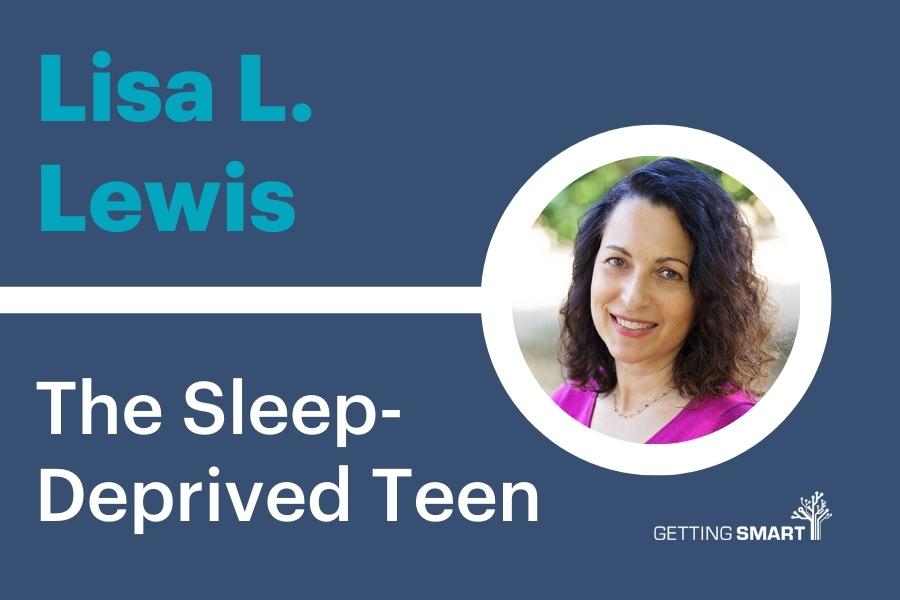
On this episode of the Getting Smart Podcast, Nate McClennen is joined by Lisa Lewis, a freelance journalist who focuses on the intersection of parenting, public health, and education and recent author of The Sleep-Deprived Teen: Why Our Teenagers Are So Tired, and How Parents and Schools Can Help Them Thrive.
Let’s listen in as they discuss the problem with the school schedule, research and science around sleep and getting work done at the policy level.
It’s not a badge of honor to get by on too little sleep.
Lisa L. Lewis
Links
- The Sleep-Deprived Teen: Why Our Teenagers Are So Tired, and How Parents and Schools Can Help Them Thrive
- Lisa L. Lewis
- Start School Later’
- Lisa Lewis Twitter
Transcript
This transcript has not been edited for spelling accuracy.
Hello, you’re listening to the Getting Smart podcast. I’m Nate McClennan, and today I am here with Lisa Lewis, who is a freelance journalist who focuses on the intersection of parenting, public health and education, and specifically thinking a lot about sleep. She’s the author of the book titled The Sleep-Deprived Teen, Why Are Teenagers Are So Tired and How Parents and Schools Can Help Them Thrive and Was Instrumental and Supporting an Effort in California to have
later school start times. So welcome, Lisa. Super excited to have you here. Thank you. Thank you so much for having me. So I am a parent of two teenagers, one 10th grader and one 12th grader. So this topic specifically is super interesting to me. I’m really interested in how the biology of sleep in adolescence and how technology has impacted it in learning sciences and equity. And you happen to be writing about all those things.
So I’m really excited for our conversation today. And I’d love to start us off with what inspired you to write about this topic as a journalist? What was the early inspiration for this? Yes. Well, I am a journalist. I’m also a parent. And so there have been plenty of times where those two roles have overlapped. And this is a perfect example. So my interest in this specific topic, teen sleep and why school should start later, really started back in 2015. That was when my
oldest, my son, was just entering high school. So that was the beginning of his freshman year. And at that point, our school started at 730 in the morning, which felt very early. I’m not a morning person. And it was really obvious he really wasn’t either because I was the one driving him to school every day. And I could see how hard it was for him to get up and get out the door and get to school every day and how tired he was at the end of the day. So I started looking into the
topic. I was trying to figure out why was it that our school started at 730 and was this the norm elsewhere? And what I quickly found out was that this was a topic much broader than our school or our community. And it was a topic that really was hitting a critical mass. The issue of teen sleep and the research literally had been going on for decades at this point. But at that point, 2015, literally the same month, August, the CDC had just come out with its report on school start
times, which was essentially a baseline report to talk about what time schools were starting around the country. And it was meant as a baseline because it came on the heels of a policy statement that had just come out the prior year, 2014, by the American Academy of Pediatrics. And they had made their official recommendation that middle and high schools should start no earlier than 830 in the morning because of the implications of school start times on teen sleep and the huge
health and well-being ramifications when teens are sleep deprived. Got it. Yeah, it seems like there was a lot happening where we were suddenly awakened to this issue. So I’m a scientist by training and so I love thinking about the science of this. So let’s take a step back a little bit and start with the data. What is it? Two parts of this question. So are teens getting enough sleep? That’s the first part of the question. The second
what’s happening in their brains? What are the impacts of not getting enough sleep that that’s indeed happening? Yes. So you are correct. Teens are not getting enough sleep. Teens, as a whole, really are sleep deprived. Again, just some data from… So I mentioned the CDC had done their school start time survey and what that showed was at that point only 18% of the schools around the country were starting at 830 or later. And when you look at also teens sleep, well 2019
we have data from the CDC again showing that only 22% of high schoolers are getting at least 8 hours of sleep. I think it’s not as widely understood that teens really do need 8 to 10 hours of sleep and 8 hours may sound like a good amount and it is for an adult but for a teen that’s the minimum that they should be getting and so many of them aren’t even meeting that. And so I definitely see that in the students that I’ve taught when I was working in schools.
Tired kids coming in regardless of start times. Start times helped for sure when we can make those later. So what have you learned about sort of the impacts of limited sleep or lower than expected or lower than needed sleep on these teenagers who are going through crazy transitions in their brains like the brains are growing really, really quickly in that period. So what did you learn that around this time? Oh my goodness. Well, so what you mentioned, I mean they are going through such
tremendous change. We see it just in terms of their physical development but in their brain too. It is a second most major phase of development for them. During adolescence there are two main processes going on. It’s when it comes to brain and it’s pruning and it’s remodeling. So pruning has to do with sort of the use it or lose it principle. There’s an excess of brain cells and those that are not being used are paired away so that the remaining ones can function more effectively.
The second process remodeling has to do with connectivity between those neurons. So and that doesn’t happen in all parts of the brain at the same time. So it actually sort of works its way from the back to the front which was sort of fascinating when I was reading up on this research. But what that means is that the part of the brain that is responsible for emotions and sensations seeking the limbic system is the part that revs up first but the prefrontal cortex
which is the executive function and you know the reasoning piece and judgment that is not coming online at the same time. So those two aren’t essentially that would be the breaking system and that’s not coming online at the same time. So you do have this fundamental mismatch but then when you layer in sleep deprivation well that just ups the ante even further because when we’re sleep deprived for all of us you know we have stronger emotions. It makes it harder just to cope with
the stressors we face on a daily basis but for teams that is even more intense because it heightens impulsive behavior for example which is already something that they are more prone to given the sequence of the brain development that I was just describing. And so I think what I’m hearing you saying is that we know from research that sort of the limbic system the emotional development is running the show as those adolescents brains are developing, prefrontal
comes second so logic reasoning when they are sleep deprived we’re seeing heightened emphasis on that emotional part. How does that connect with sort of mental health and well-being? So it’s one thing to be more reactive and more emotional it’s another thing to be really struggling with mental health. Did you see any connections between sleep deprivation and onset of mental health challenges or things like that that we know a lot of teenagers are experiencing?
There is absolutely a link and just to the first part that sleep deprivation actually does play a role in risky behaviors so we know that the less sleep teens get the more their risky behavior goes up and impulsive behavior goes up as well and unfortunately those do have implications when it comes to things like suicidality. But when we talk about mental health we know that our teens have already we’re struggling with mental health and and have faced even more mental health challenges
in these last couple of years. I mean the effects of the pandemic have been really really quite severe and you know the CDC just released data a couple months ago on that and it’s it’s really scary as a parent when you see that. So yes sleep does have a link to emotions and to mental well-being specifically when you don’t get enough sleep it’s linked with depression there’ve been many studies out there that show that teens who don’t get enough sleep
are more likely to report feeling depressed it increases anxiety. There’s also a condition called anodonia which is just the ability to experience pleasure so it means that you know when you’re sleep deprived it’s harder just to take joy from those little small moments in your day and that’s really a quality of life issue and then there’s the most severe which is when we look at suicidality and suicide risk and yes the absolutely the research shows the less sleep teens get the more
their suicide risk goes up. Yeah yeah it seems like it’s connected it’s really this ubiquitous thing that’s connected to so many other pieces. We didn’t we didn’t talk much about sort of the physical pieces but you have this the mental health pieces that are so profound. Let’s let’s think about I mean some of this will probably be pretty obvious to our listeners but I’m really curious as to sort of where you’re seeing so why are teenagers getting less sleep and clearly you
have talked you’ve put a lot of effort into start times for schools so school has to be one of those drivers which I’d love to hear you elaborate on but what else is getting in the way what are the big pieces out there? Yeah well so we know our teens overall are sleep deprived that so many of them are not getting as I mentioned even that minimum of eight hour sleep the most recent data only 22% of high schoolers were getting at least eight hours and that really does have profound
implications so I do mention the the time school starts because that really is a policy issue and that’s why groups like the American not just the American Academy of Pediatrics the American Medical Association American Psychological Association I mean the list goes on but they recognize that teen sleep deprivation is a public health issue and that starting schools at eight thirty or later has a real impact on that and the reason why is that teens are on a different
sleep schedule when they hit adolescence there is a circadian rhythm shift essentially their body clock shift to a later schedule and that’s because melatonin which is what primes us to feel sleepy is not released until later in the evening and it doesn’t subside until later in the morning so you know when your kid is six you know you can get them in bed at whatever time seven thirty at night but obviously a teen is not going to want to go to bed that early but they’re they’re
literally not sleepy you know if you put a teen in bed at nine o’clock they’re probably just in a lay there and stare at the ceiling they’re not feeling sleepy until about 11 o’clock at night and that has to do with the change of the circadian rhythm and their body clock’s just being on a different schedule so let’s say they’re not sleepy till about 11 even if they fall asleep exactly at 11 well if you do the math and they need eight to ten hours that’s why what time school
starts in the morning matters because that is what’s governing for most kids what time they have to get up so that is a very very major piece so so that’s that that if we can extend that time in the morning to adapt to the sort of circadian rhythms of typical teenagers that’s going to be so that’s that’s one piece that’s getting in the way start times for schools clearly the elephant that’s definitely not in the closet is technology so so tell me what you I mean it feels like there’s
there’s we’ve learned a lot about technology sometimes I think that we’re experimenting with this generation of both adults us and young people with exposing them to massive amounts of technology without really understanding of the implications yeah all sorts of great things but what did you learn about technology use and the impact of that on sleep technology absolutely I mean there are many factors that can play into how late
we and specifically our teens are going to bed again for them to get the eight to ten hours and I and I know I’ve already mentioned but the start times there’s one last piece I didn’t mention which is that when they wake too early it’s actually cutting into their REM sleep because that’s back loaded so more of it happens in the second half of the night so that’s actually pretty significant so again just recognizing how much that morning sleep is important but to your point
going back to okay so what about at night what can you do to help them get to bed at a reasonable hour there are many different pieces that I think that we as parents can address in our homes one of them absolutely is tech use so it was really interesting to me when I started delving into the research and talking to some of the experts on this I didn’t realize you know just as a user of technology and as a parent you know who considers herself fairly savvy on these things but I really
didn’t grasp just how much technology was designed to be deliberately immersive so the reason why you know it is so hard sometimes for us to extricate ourselves and for our teens to extricate themselves from media use or tech use is because it’s designed to be that way so you look at things like social media you know things like likes you know where where they get to see who who has you know hit that little button to like it that that plays into their their need for rewards and reinforcement
there’s also things like even if you’re streaming a television show and one episode ends and you know you’ll see a little countdown and five seconds later boom it just automatically loads the next one for you so all of these have been designed to keep us you know engaged as long as possible so so just to recognize that piece and there are also pieces where schools play a role in terms of technology so most students are doing homework on computers turning in assignments online and
what I found was I think it’s the default is 1159 for the turning time because I had asked that like well why is that I don’t think people automatically choose that well that is the default I believe and of course human nature being what it is if you know you have until 1159 to turn in an assignment that really does kind of tacitly encourage you to work on it later in the evening whereas if it had to be turned in earlier you know you’d have to hit the deadline you’re probably by necessity
going to start on it and turn it in earlier I had never thought about that you’re right by default most learning management systems on the teacher side will say when you say it’s due on this date it’s due on 1159 at 1159 on this date and no no teacher really thinks about that part because it’s like a smaller setting but that’s an interesting lever to pull we have schools and doing work on computers we have the technology itself we know the state the late start times how have you turned
that into a set of sort of recommendations I mean what are the key levers we can pull in this in this effort so I spent a lot of time trying to track down this information because as a parent you know I realized there really wasn’t information readily available in a book form and this is sort of you know me as a parent and as a writer I ended up basically writing the book I wish that I had had when my kid my oldest was starting my school you’re pouring some of this to take the science and
explain it in lay person’s terms you know what it why is sleep so important what what happens to teens the fact that there is this circadian rhythm shift all the various implications but then the last third of the book to talk about what is it that we as parents can do to help our teens get more sleep so I do as you would expect I do have a large section talking about school start times because that is something I was very very involved in here in California I started in my
local community and it snowballed from there because I wrote an article that ran in LA Times an op-ed on why schools should start later in the day one of our state senators read that he had a high schooler so the issue resonated with him he and he ended up introducing a bill on the topic I got sucked in and it was a two and a half year legislative journey that law goes into effect July 1st it is the first we are the first state in the nation California to enact
a law requiring later start times so for California specifically it’s eight thirty years later which I applaud like incredible incredible that that can happen and I love seeing that a small group of people or a single person can start something that’s really small and then make a difference right so just as a message to our audiences we always we talk about change making a lot and purposeful learning and this is about change making what you’re talking about
there so let’s pivot a little bit to that work in California it is not easy to get laws passed I know that and what were the big barriers were there people having counter arguments against this or was this an easy process that just happened to take a couple years to happen I’m just curious about the experience it was a two and a half year journey so it was an incredible learning experience for me because you know I’m a parent I’m a journalist I had not been involved certainly
to this level before the the objections are were really the same ones that have gotten raised in communities around the country that have talked about starting this they’re talked about changing their start times and I should mention hundreds of of districts around the country have already done this this is not something that you know it’s brand new but it’s been done on a patchwork basis up until now so I would say the three major objections that tend to come up just broadly
speaking are change itself because the idea of change is daunting sometimes and particularly when you look at schools which are in many cases what our schedules revolve around you know as parents we do plan around school schedules so there’s there’s that piece there’s transportation often that comes up and there’s sports however all three of those have been successfully addressed in every single community that has changed its start times so far which ranges from districts as small as
one high school to cities like Seattle so the other piece too which as a parent I’m sure you’re familiar with school start times do not mirror our schedules they were never designed to so they are not you know necessarily work friendly they are not necessarily family friendly when your kid is off all summer when your kid is off on winter break when your kid is off for teacher prep days you know that’s not something that a working adult typically has a schedule that mirrors that you know I can
remember when my when my kids were in elementary school the day the elementary school day ended at oh my goodness I can’t remember now it was 1 47 or 1 48 p.m. but it was imprinted in my brain because my schedule had to be planned around that and either parents had to come and pick their kids up or their kids went directly into after-school care but everything surrounds what time schools start and what time they end so those are issues that that you know you do have to address but they are
things that can be addressed and particularly keeping in mind why we’re doing it which is that sleep deprivation is a public health issue as is asbestos and lead paint so when you think of it like that then you realize making changes to logistics making changes to transportation yes it does require conversation it does require time but there’s a reason why we’re doing this right right right it is fascinating to to think about how little the school schedule models the
professional world that parents are experiencing as they’re employed and we all take it for granted but I do know you know there’s districts that have experimented with year-round there’s districts that have experimented with later start times as you insinuated so all of it is possible but you have to overcome you know obviously the fear of change is the fear of change like that’s that’s a human condition um transportation and sports is interesting I’ve seen some schools who do later
start times for teenagers but then they start running practices in the morning and so so you you have this this counter effect which is not effective either so I don’t know if you ran into that at all yeah well that would not be a best practice in fact one of the school districts I spoke with the superintendent in a small school district in Maine and when they implemented later start times they actually put rules in place so they barred before school practices and they set a
cap on how late practices could go in the evenings which again makes sense when you think about it our schools are not designed to be training athletes for you know professional career they are designed to be educating students and preparing them for you know the workforce and to be you know productive members of society it matters that they get enough sleep so they can be showing up to school because you know when they’re sleep deprived they the effect on attendance is something
that has been measured that goes up when school start times change tardies go down graduation rates go up and kids are actually awake in the classroom and able to learn and that’s really the whole point of them being there not to to you know score better in the game as someone who who had a high school athlete I mean my son did play sports but I think it’s also just let’s let’s keep it in perspective what is the whole point of them being in school yeah no for sure both of my
children are athletes as well and it is a learning experience that’s part of the bigger whole but it shouldn’t dominate the learning experience which it does occasionally in schools around the country so let’s let’s pivot a little bit you wrote in your book a little bit about different identities and sleep and some differences there and I’m really curious A what you found how did you go about thinking about this and what implications does it have for us as we think about sleep for us
collectively as educators parents etc those that are helping support children yeah children going on well I literally have an entire chapter I ended up calling not all teens sleep the same which you know makes sense teens are not one monolithic group and what I ended up doing was talking to various experts on some of these different areas really just because I think it’s important for us to understand some of these differences these aren’t necessarily things we can change but just
to be aware there are additional factors above and beyond everything we’ve already talked about that can affect teens sleep so one of them is sex and gender when you look at biological females in general and I’m just so I’m going to use the term girls but really what I’m referring to is biological females because this does have to do with biology so in general at puberty the risk of insomnia starts to rise for girls and in general they take longer to fall asleep than boys the
other key piece which any biological female is going to recognize that sleep can be affected by monthly menstrual pain so that’s something to be aware of you know that’s something that happens on a approximately monthly basis and yes it absolutely does affect sleep if you are somebody who experiences premenstrual syndrome if you have period pain and that’s something that is actually really common so up to 93% of teen girls say that they get cramps ranging from mild to severe I’ve spoken
with women who were able to tell me about what it was like when they were you know in school and they remember just being curled up and they couldn’t go to school because of the pain so you know this is actually a real thing and about half of us girls get their period by age 12 so just to give you a sense of the scope yeah so that’s one piece again we can’t change biology but just to be aware this is an issue so you know that’s yet another layer of things that are impacting sleep so if we
can try and impact the areas we can it helps our teens sexual and gender minority teens in general sleep worse and this is a really big deal there it was actually kind of surprising the oldest members of generation z are now adults which is kind of amazing to think about so this so there was a poll by gallops and it was adults and what they showed was more than 20% of the Gen Z respondents say that they identify as LGBTQ so that is the highest for all the groups but why that matters
is because in general sexual and gender minority teens and adults do sleep worse and often that’s because of discrimination that’s also something when you look at race and ethnic identity teens of color disproportionately likely to sleep poorly so and again a lot of that is rooted in discrimination and that’s everything from microaggressions on up and there’s the cumulative impact of that there’s also what they call the epigenetic factors which is sort of that that legacy the longer term
consequences that can be passed down through the generations and then there’s also socioeconomic status the impact of poverty and neighborhoods if you’re living in noisy conditions or crowded conditions or you don’t feel safe or you’re going to bed hungry all of that impacts your ability to get a good night’s sleep so so these are bigger issues that that unfortunately we can readily solve but just being aware of them I think is super important because these are above and beyond
the stresses our teens are already facing and so we may not be able to impact that but again we can take tangible steps to help them with the pieces we can help with having to do with their sleep right and we think a lot about that every young person in a school or every every learner in a school is known well right and when a young person in the school is known well it’s not only hey how can we help them encourage to get how we how do we help them get more sleep and encourage them to
do that with that with the purview that we have not being parents but being educators but also recognizing that each one of those individuals is a separate identity and is has different stressors different benefits whatever the case may be and when we recognize those pieces we then can help support them more even though there’s a societal piece here but every kid feels like they belong that might help them sleep better right like you’re making that interesting connection between
belonging and making sure that that we don’t have racism and discrimination and bullying all those kind of things in schools that cause young people to not sleep as well especially when they have a more marginalized identity so so I really appreciate you making that that connection and really emphasizing to our listeners that to remind ourselves over and over again that every individual is unique and and some have challenges that are way more challenging than others but all need more
sleep in the long run yes all teens as a whole are sleep deprived but many teens are in one or more of these categories yeah so recognizing that that they have these additional stressors and then those stressors which are eroding their sleep well that’s also eroding their emotional resiliency in turn to be able to deal with those stressors right right right right all right we’ve covered a lot of ground it’s been a fast 30 minutes Lisa so appreciate you you sharing all that you’ve
shared today um two last questions for you before I wrap it up number one organization or person that you like to amplify who’s inspired you or in this work that that others may want to look up and then what is your final takeaway message for our listeners so answer those two questions yes so you heard me mention before but I really would like to give a shout out to start school later it’s a national nonprofit as the name implies it’s all about advocacy for healthy school start times
it’s um it’s a group I reached out to I started my own local chapter back in 2015 when I first got involved in this issue and it’s a tremendous repository of knowledge and a tremendous resource because these changes of starting schools later have been made across the country and so all these issues like you’ve mentioned dealing with sports and you know the issue of change and transportation these have all been addressed and there are examples of how they’ve been successfully addressed so I
think that’s pretty key is that nobody has to go and reinvent the wheel um the final takeaway message that I would have I would say is just my my plea would be to make sleep a priority that I think being aware of how much sleep we all truly need it’s not a a badge of honor to get by on too little sleep which unfortunately is the way it’s often seen in society we don’t do anything better as a result of being sleep deprived so you know getting by because you have to is one thing but that’s a
far cry from setting ourselves and setting our teens up for success so really knowing they do need eight to ten hours really understanding that there are these implications for everything from their ability to learn to their mental health to drowsy driving etc and then doing what we can to make sleep a priority and to enable them however we can to try and get enough sleep I really appreciate that it is interesting you you bring that up is this idea that when we say or when teenagers say
or even sometimes I’ve seen it with adults in the workplace is oh I worked really late last night and there’s this sort of pat on the back like oh wow you’ve done that without the acknowledgement that this is a health issue that we’re dealing with so um to to wrap up what I learned today I learned a lot so but to summarize for our audience so a recognizing just like in zero to zero to five year olds the the teenage years there’s incredible brain development going on and this idea of pruning
and remodeling is so critical for long-term human development and then the second piece is this idea of when you don’t get enough sleep which you’ve asserted over and over again we students are not getting a teenagers are not getting enough sleep that we they are challenged with all sorts of things from emotional heightened emotions and depression to mental health physiological health etc so this is a real health challenge and you are really um asserting that we need to elevate that
and I appreciate that and then that there are some things that can be done and you’re a great example of of something can be done you you manage to help pull it off at the state level but there are examples all over the country of policy issues who later state later start times um what can we think about technology being where the addictive nature of it how do we limit teens use in their bedrooms at night so they can actually sleep um and then I really was interested in this idea of
schools and what can schools manage on their own learning management systems to help with the sleep issues so they’re not doing homework up till 11 59 at night thank you so much for your time today I hope everybody who’s listening uh have a has a a little bit of a different perspective on what we can do in this very fundamental issue that affects everything um that our teenagers experience so thanks so much Lisa thank you thank you for having me thanks for tuning into the getting smart podcast
today we want this podcast to be actionable insightful and a great way to learn about what’s next in learning in order to stay on the cutting edge we need people in the field to tell us what they’re hearing what they’re wanting and what they’re needing to learn more about got a topic or a guest in mind send your recommendations to me mason at gettingsmart.com and if you like what you’re hearing don’t forget to leave a review in apple podcasts or subscribe wherever you listen
feel free to share the podcast on social media using the hashtag gspodcasts thanks so much you





0 Comments
Leave a Comment
Your email address will not be published. All fields are required.