


Annie Murphy Paul on The Extended Mind
Key Points
-
The brain is dependent on setting, the body and social interaction to thrive and learn.
-
As we think about learner experience, the body and surroundings, we must remember that relationships matter
On this episode of the Getting Smart Podcast, Tom Vander Ark is joined by Annie Murphy Paul author of the new book The Extended Mind: The Power of Thinking Outside the Brain.
For the past decade, Annie has been a leading brain science writer on The Brilliant Blog.
Let’s listen in as Tom and Annie discuss the importance of the body in using the mind, how this can be better applied in schools and distributed cognition.
On Mindfulness
I do see mindfulness becoming a part of the curriculum at more and more schools.
Annie Murphy Paul
On Social Learning
We think of social life as being separate from academic life […] human beings are fundamentally social creatures, and we’re social all the time. The real trick is to harness our powerful social brains in the service of learning.
Annnie Murphy Paul
One-Two-One
One person who shaped Annie’s mental model
Two key insights for edleaders (in summary)
- As we think about learner experience, the body and surroundings, we must remember that relationships matter.
- As our understand of learning science continues to shift, we must reconsider learning goals and the purpose of learning/development.
One additional insight from Annie
- The metaphors we use to understand ourselves shape our thinking. Brain as computer and brain as muscle are limited.
Transcript
This transcript has not been edited for spelling accuracy.
Hey listeners, before we get to the conversation, I just wanted to tell you a bit about the services and solutions that Getting Smart offers. Did you know that we collaborate with and advocate for impact-oriented partners who are committed to accelerating the future of teaching, leading, and learning? Our strategic solutions are tailored to best support each partner in achieving their goals
and helping leaders know what to do next. Working with our vast network of resources and partners, we design and form strategic solutions that last. Whether your organization needs support with learning design and coaching, strategy, professional learning, media, communication and marketing, or are looking to build your next campaign,
we are here to help. If you’re interested in learning more about our services and working with our team, email Jessica at GettingSmart.com or visit GettingSmart.com slash whatwedo. Annie, what is the extended mind? Extended mind.
So, well, maybe I’ll tell a little story about how I came across the idea of the extended mind because it’s not mine. It’s an idea that I borrowed from two philosophers. So I had been researching and writing about the science of learning for a number of years and intending to write a book on that.
And I wasn’t finding a big idea that pulled together all the strands of research that I was finding so interesting until I read an article from a philosophy journal by Andy Clark and David Chalmers, two philosophers. And the first line of their article was, where does the mind stop and the rest of the world begin?
And I really liked that question. I thought it was interesting and provocative. And their answer was even more interesting because they said, you know, as thinking does not or the mind does not stop at the limits of the skull, as we might imagine, thinking and intelligence and the mind is actually spread, you know, throughout our body below
the neck, throughout our surroundings and throughout our network of relationships with other people. And that seemed to me to be a much more expansive and much more accurate description of how thinking works than imagining that it happens just up here. You’re listening to the Getting Smart podcast.
I’m Tom Vanderick and today I’m with any Murphy Paul, the author of a great new book called The Extended Mind, The Power of Thinking Outside the Brain. If I think back five years ago to the brilliant blog, I just had a super brain crush on you, like thousands of people did as the leading writer in brain science. You on a weekly basis were pumping out what we thought were super important insights.
So it was a bit of a left turn for a lot of us when you went off on this tangent. I was worried. I thought there was a lot of us waiting with baby breath for the book called Brilliant. I know, we thought you would unlock the secrets of the brain. And so what an interesting, interesting turn for you and us.
Yeah, it’s been quite a journey, right? Oh, it really has, because I did intend to write a book about the science of learning called Brilliant. And I tried to do that really hard for a number of years. And the problem for me was that I wanted to say something new and fresh about the science of learning. And I wanted, I do need as a writer that big idea that feels to me transformative of the way that we think about things and the way we see things.
And what I was finding in writing about the science of learning as interesting as it is was that what I had was a kind of collection of techniques, you know, and many of them are very effective, you know, spaced learning and retrieval practice and those kinds of things. But I was looking for something really, as I say, transformative. And I found it in the extended mind, which as you say, was kind of a left turn because I had been focusing on the brain and how it learns. And this idea is all about how the brain is not the be all end all of thinking and learning.
So it was it was a departure, I guess, from what I’d been I’d been thinking about and writing about. But ultimately, to me, it was the freshest and most exciting thing that I could put out there. Any like David McCrany, a couple of us thought this might be a little woo woo when we picked up our first copy, but it is. It’s such an important book. And I just love the the three sections and I want to walk through the three clusters of insights and and in each of those. I want to invite you to to to talk with learning leaders, whether they’re at home or in a leading a school or a learning organization.
And see if we can tease out some of the lessons and implications. I think my top level observation is that schools and other learning organizations are typically not very good at asking learners to stick with their bodies. And be conscious of their surrounding or their colleagues. And in fact, they may actually block all three of those right there. They may physically inhibit you by policy or practice to think with your body to think about and in surround and with your with your colleagues.
And so I want to dive into those. The first section is thinking with our bodies. You call that embodied cognition. Give us an overview of sort of why and how we think with our bodies. Sure, Tom, and I do really want to affirm your point that you made that conventionally or traditionally education has been very brain bound. It’s been very focused on on the brain on enhancing the abilities of the brain, but not necessarily not necessarily bringing in these other.
Extra neural, you know, outside the brain resources and one of the most powerful of those is the body. And in the book, I write about three particular ways that the body participates in the thinking process. And that is physical activity, gesture and interception, which is a kind of fancy word for the the internal sensations that we this flow of internal sensations that is always with us, but that we often don’t tune into. Maybe I’ll talk about that one first. I mean, interception is kind of another way of talking about gut feelings, the fact that there are insights and knowledge and wisdom that we have access to, but really only through the body.
Not through conscious cogitation. So and yet, as we’ve been saying about conventional schooling, being in tune with your internal signals and and sensations is not something that we traditionally encourage students to do or teach them how to do in in schools. And there are some simple ways to get kids to become more tuned to those internal sensations. For example, a mindfulness meditation practice known as the body scan, where you’re encouraged to pay curious, open minded, non judgmental attention to all those internal signals that are are arising within. And then it can also be a very useful practice to learn how to label those internal sensations to give a name to them.
And it’s it’s the more granular and those labels are and the greater the number of labels we can come up with the more effective that practice is for reducing anxiety for bringing down the level of physiological arousal. You know, I think traditional schooling has often, as we said, focus so much on the brain that it’s like we students are expected to quash or suppress those internal sensations when really they can be such a useful guide. And that that would be one major way that I think that schools could put the extended. Well, let me interrupt there and and see if you’re
as hopeful about the the introduction of mindfulness and practices that we’re seeing so broadly in part because of the pandemic, but I this may be a beneficial outcome of this this natural disaster that we’re living through of just more schools paying more attention to mindfulness and wellness. Do you do you see that as a as a related benefit. You’re right that there I do see mindfulness increasingly becoming a part of the curriculum at more and more schools and I do think that as long as that mindfulness is that part of that is oriented around the body and not just about you know, controlling or managing one’s thoughts. I think that could be a really positive silver lining of the pandemic. Yes. Any one one thing we don’t really historically teach in school is decision making.
We help learners make very good decisions, both about themselves or about their own learning and attempt Ferris podcast last week went into some detail of about the fact that it’s really important to sort of check in with your yourself and your body when you’re we’re thinking about making a decision so that you fully consider how you feel about about taking a next step. I assume you think that’s really important to becoming more in tune with how you’re feeling as a whole self when you’re considering personal next steps.
I do I do and I think it is important to remember that the body doesn’t always steer us right, you know, that our intuitions and our gut feelings are not always accurate, but they can give us more information than we have access to consciously. So I write in the book about the value of keeping an interoceptive journal, you know, noting as we were saying noticing labeling and actually recording those internal signals and writing a bit about how that relates to a decision that you’re making and then you can go back and check and see if your body was kind of steering you in the right direction. Any or do I have this right that you’re a bit of a cyclist you get out and ride with some frequency. I do I do an exercise and movement. What’s the connection to the mind.
I guess there’s a basic one just in terms of well being that exercise really can benefit brain function, but what what else is there. Yeah, there’s there’s so much actually I mean one thing is that human beings really did not evolve to stay still to the young of the species, especially and it actually absorbs it takes up a fair amount of cognitive bandwidth of mental resources to inhibit the the natural urge to want to move. So when students are expected to stay still, there’s a part of their brain that’s managing that activity that can then be used for their their academic work. So there’s a kind of activity permissive approach to to having kids in a classroom where it’s it’s not disruptive. It’s not, you know, it’s not kids
running around, but they’re able to move their bodies in more subtle ways that can free up that mental bandwidth that would otherwise be used to inhibit movement. Any I told you I’m spending a lot of time with my grandkids these days in my six year old granddaughter said Papa, I do math better standing up. I hope my teacher lets me stand up when we do math. So I just I love the fact that a six year old would have that that is that efficacy of understanding how in a particular domain. She thinks man creates best.
Right. And so how how to how to create more learning environments where we invite young people to be comfortable. I think that means a combination of high and low and hard and soft seating, but but it also has something to do with the spaces that we create right Absolutely. Yeah. And the way we allow kids just or encourage kids to spend their time, you know, I mean, there was a move. Unfortunately, in the last few decades away from recess and towards more seat time, you know, more sitting and learning, which is actually counterproductive because, you know, our ability to pay attention to pay attention to be vigilant is is limited and it’s refreshed when we get to, you know, engage in some physical activity and then return to the classroom which of course is exactly what recess is all about and so that’s kind of an old fashioned thing that I think we need to to remember the value of
that. Any of your the second section of your book is about thinking with our surroundings. You’ve called it situated cognition. I have to admit that this made me stand up and cheer because we wrote a book called the power of place and we just our whole team really believes deeply in the connection between place and identity development that introducing learners to their places in a full and profound way really can help shape who we become as as young people so I love this section of the book I love the fact that you you look at natural surroundings built surroundings and then sort of conceptual the life of ideas so let’s talk about natural and and built environments first.
Yeah, would you learn there. Yeah, yeah well you know I think we all have an intuition that not being in nature is good for us we have a pleasant feeling when we’re in nature and we may feel relaxed when we’re in nature. I was really interested to learn about sort of the mechanisms behind that that human beings evolved in nature in the outdoors. And so the kind of information that we encounter in nature is very easy for our brains to process it’s very effortless. We are attention is kind of effortlessly diverted here and there without the very hard edged kind of concentration that we have to bring to our academic work or workplace duties.
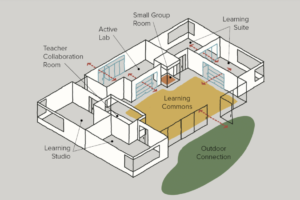
And so it’s really the fastest and easiest and most effective way to restore our attentional capacities which get drained very quickly you know in our in classrooms and in the office. What about built environments what what advice what lessons did you draw on how we ought to be creating spaces particularly learning spaces. Yeah, yeah. Well, and you know there I was very interested to learn about the research on how the objects and the cues that we see around us in a built setting prime certain identities and position us to think well. within certain identities like you know we all have many identities we may be students we may be workers we may be. Parents we may be siblings you know but when we’re in a school setting we want to have that identity of scholar or student foremost and so the things we see around us literally the material objects we see around us can prime.
That sort of orientation and so and in particular cues of identity you know cues of who we are what’s important to us what we value are important to have around us. And also cues of belonging cues that remind us that we’re part of a valued group and so I it’s my hope that every student when they’re seated in their classroom can look around and see cues of identity and cues of belonging reflected back at them. Any there seems to be some evidence that in learning environments that if, if you have the potential, at least periodically to connect with the world that might be looking out a window might be a vista where you can change the focus. Where you can see the the surround that there’s some benefit to that any thoughts on that. So, on having sort of a room with a view.
Room with the view right. It’s not just luxury that it there’s really some benefit to cognition and learning. Yes, yes, because we can’t always as much as we would like to we can’t always take a long walk in the woods when we need our attention restored but interestingly, research shows that micro restorative breaks that’s the word that psychologists use of looking out a window for as little as as 40 seconds can really refresh and reset our attentional capacities so it is important to to at the very least provide students with with scenes of green you know or to bring those motifs of nature even inside into the classroom with with plants and and greenery inside. Let’s jump to the third in the last section of the book it’s on thinking with our relationships distributed cognition this was really powerful section that talked about experts peers and groups.
How about experts first. How can and should experts provoke our learning and development. Yeah, and this was interesting to me too because our whole all of our systems of education and training and all of that are based on this model of experts teaching novices right but we don’t often grapple with the fact that experts are sometimes less than ideal teachers for novices, precisely by virtue of being experts you know they have all this knowledge that’s become so familiar and so practice that it’s become automatized and they actually are not even really aware of how they do what they do. So then when they go to explain or describe their expertise to novices they leave a lot of stuff out and that can leave novices feeling beginners feeling quite frustrated and confused. So there’s some strategies that I write about in that chapter that can help experts become more legible models for novices like breaking down their expertise into steps and even micro steps, or presenting their knowledge and in functional terms in other words this is how you use this information not just these broad level categories that makes sense to an expert but not so much to to the beginner.
Peers can be really important, both to create a sense of belonging, but also sustained relationships and, and I think more peer learning happens in productive environments than we may have known about in the past is that right. Yeah, yeah I think you know there’s there’s a bias I think that we bring to us to social activity we think of social life as being distinct from, and in some ways almost opposed to academic life like, okay kids you can you can chatter at lunchtime or recess but when we come into the classroom we’re serious and we’re, we’re not talking to our neighbors you know but human beings are fundamentally social creatures and we’re social all the time you know we don’t turn that off. So the real trick is to harness that are powerful social brains in the service of learning and there’s all kinds of cognitive activity that gets stimulated and activated by social activity that really remains dormant when we’re just thinking by ourselves. So I really think social activities like storytelling and debating and teaching other people as much as possible those should be incorporated into the classroom. And most schools are still focused on individual learning and individual grades and working in a group is often prohibited not not even right in encouraged right and I think you.
You did a beautiful. You got a beautiful section in here about the potential for collective intelligence of groups can be smarter than an individual contribution. I think a lot of workplaces are coming to that conclusion but we still don’t create learning environments that tap into collective intelligence do we. Oh no and you’re right you’re so right I mean how often do we work in teams you know in the workplace and yet we never learned how to do that as students and so and as a result I think a lot of students. You know you encounter a lot of resistance and a lot of reluctance to engaging in group work among students and I think in part that’s because our practices of thinking and learning are so individualistic that when we try to bring them into a group they just they just don’t work we
actually need to develop and practice entirely new protocols of thinking together and better to learn that in school you know because we’re going to need those skills for the rest of our lives. I mean, Martin Reeves recently wrote a book called the imagination machine which is really terrific he was on about a month ago. Martin talks about collective imagination, in a way that I think was was really attractive to me when I think about the work of education leaders for example of taking some of the principles that you’ve outlined in your book and bringing them into their environment and re-expressing learning goals and reimagining learning experiences you really have to you have to help a community re-imagine what’s possible so that for me it’s an interesting example of collective intelligence it’s collective imagination of helping a community imagine that things could be different and better.
It sounds like an application of this principle. And that’s beautiful I had not heard about that but I, I find myself wondering immediately how, how would you, how would one, how would a group create the conditions under which collaborative or collective imagining could happen. That’s, that’s really a lovely idea. We’ve been, Mason our producer just finished a smarts front with a group of people thinking about shared vision and our sense of helping a group come to a shared vision is really this act of collective imagination and I think it’s a great example of this collective intelligence that, that you called out and, again, we, we bar this in school instead of promoting it so the section I also want to just note the importance of advisors and a sustained
relationship with an adult mentor or advisor and how important that relationship can be to learning and development. Any thoughts on that? Yeah, well, what comes to mind there is, again, this idea of belonging, you know, I think human beings to go back to what we were saying earlier are so social are so focused on their place in a group and when we don’t feel that we belong, a big chunk of our minds gets devoted to, you know, how can I feel a sense of belonging or feeling hyper vigilant about threats and, you know, threats to one’s belonging and I think one of the most powerful ways to make someone to help someone feel a sense of belonging is that kind of bond with, with a teacher with an advisor and that’s a real welcome into the community that I think is so important.
Well, your, your book is such a great reminder for advisors to start by checking in with a person on how are you doing how are you feeling right and being conscious of the surround is it a place that is feel safe that creates a sense of belonging and then invites these peer relationships into learning experiences and just great advice for learning leaders. Thank you, Tom. Yeah, there’s really so much more than until learning and thinking than just the brain. There is you. It’s so fun to reconnect because you’ve been on such an interesting journey. We’re talking to any Murphy policies the author of the extended mind the power of thinking outside the brain. So if, if there’s another person or two that provoked your thinking and growth over the last two years who else would you give a shout out to that is helped you think differently and better about how humans develop.
Yes, well one name that I’ll mention is I’m sure familiar to your listeners and that is Dan willing him the cognitive scientist at UVA who wrote the wonderful book. Why don’t students like school and he has a new book coming out next year that I’m just so excited for but what Dan’s work really showed me was you know he says in in he writes in why don’t students like school he says the brain didn’t really evolve to think you know it evolved to activate, you know, remembered patterns of behavior doing abstract conceptual thinking is really hard for the, for the human brain and that really became part of the basis of what of my argument in the extended mind which is the brain is on its own is a quite limited and idiosyncratic kind of organ that’s bounded by its status as a biological organ as an evolved organ, and it needs help, you know it can’t do it all on its own. And we really don’t do ourselves any favors when we cut ourselves off or cut our students off from these external sources of intelligence of thinking power, and when we try to just sit there and do it all with our brain so it was really Dan’s work that helped me understand how quirky and idiosyncratic the brain is and how much it needs help if it’s going to do all that we ask it to do these days.
Alright let’s wrap with a couple questions we call this one to one. What’s, what’s one thing that’s next for you how are you going to extend this work. One thing that I really only got to touch on in this book is something I call extension inequality, and that’s the fact that once you start realizing that intelligence is not some kind of lump of stuff that’s inside the brain but is really this dynamic assemblage of stuff, you know the raw materials drawn from our environment. It just seems starts to seem so obvious that you know we’re, we’re evaluating and ranking and judging people based on on the notion that that it’s all inside their heads when really so much of what people are able to do depends on the access they have to resources outside their heads and so I would really like to do more with that idea of extension inequality and focusing people on the importance of having rich and accessible materials for thinking with rather than just believing that it all happens inside the head.
I love that. Here’s two insights that I cleaned from reading your book and tell me if you’d add a third one but the two that I cleaned were, I think now more than ever we have to reevaluate how we think about learning goals and how as communities we express our aspirations for learning and development and then closely related to that. We have to rethink the learner experience and be more conscious of, of as you put it body surrounding and and relationships. So, what would you add to that. I really am persuaded that the metaphors we use to understand ourselves and our thinking are really important and I see everywhere now these two metaphors that are so common. The brain as computer and the brain as muscle and both of those have their uses, but I think they’re limit they’re ultimately very limiting. And I propose another metaphor in my own book the brain is magpie which is the magpie is this bird that plex you know bits from its environment and weaves them into its nest and that to me was a more apt metaphor for how the brain works you know the brain is still, of course the brain is still central to thinking
but it doesn’t do it all in its own it’s really drawing from its environment and that to me could is a potentially transformative way of thinking about the brain. I love that. Any work and people go to learn more about you and your book. So I have a website it’s www.anniemurphypaul.com and I’m also really active on Twitter and I love to converse with people there my handle is at Annie Murphy Paul. If you go to any more if you Paul you will find some great Twitter streams where you’ve, you’ve doled out wisdom in series so any what a treat to reconnect. We’ve loved the extended mind the power of thinking outside the brain.
I think it’d be useful for parents. It’s a must for teachers and education leaders. Everybody ought to get a copy of it. Annie thanks for being with us. Thanks so much for having me on Tom is great talking with you. This podcast is made possible by our, the whole staff at getting smart especially our producer Mason Pasha. Keep learning and keep innovating for equity. See you next week. Thanks for tuning into the Getting Smart podcast today. We want this podcast to be actionable and insightful and a great way to learn about what’s next and learning.
In order to stay on the cutting edge we need people in the field to tell us what they’re hearing what they’re wanting and what they’re needing to learn more about. Got a topic or a guest in mind. Send your recommendations to me Mason at gettingsmart.com and if you like what you’re hearing. Don’t forget to leave a review in Apple podcasts or subscribe wherever you listen. Feel free to share the podcast on social media using the hashtag GS podcasts. Thanks so much.



0 Comments
Leave a Comment
Your email address will not be published. All fields are required.