


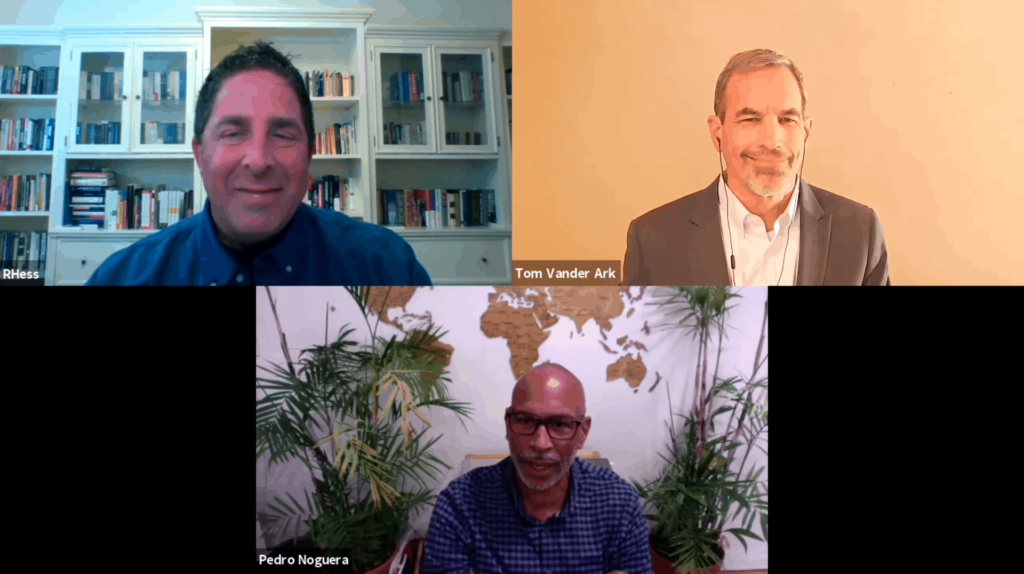
Dr. Pedro Noguera & Dr. Frederick Hess on Conversations About the Toughest Questions in K-12
More about A Search for Common Ground:
At a time of bitter national polarization, there is a critical need for leaders who can help us better communicate with one another. In A Search for Common Ground, Rick Hess and Pedro Noguera, who have often fallen on opposing sides of the ideological aisle over the past couple of decades, candidly talk through their differences on some of the toughest issues in K–12 education today―from school choice to testing to diversity to privatization. They offer a sharp, honest debate that digs deep into their disagreements, enabling them to find a surprising amount of common ground along the way. Written as a series of back-and-forth exchanges, this engaging book illustrates a model of responsible, civil debate between those with substantial, principled differences. It is also a powerful meditation on where 21st-century school improvement can and should go next. Book Features:- Modeling dialogue: Rick and Pedro provide a model for how to sort through complicated issues and find common ground in today’s atmosphere of distrust.
- Deliberate, sustained exchange: Rick and Pedro demonstrate how deliberate, sustained reflection allows them to respectfully flesh out differences and sharpen their own thoughts.
- Left and Right Politics: Rick (generally Right) and Pedro (generally Left) offer a window into where they do and don’t agree on education and point the way to principled cooperation.
- Readable and conversational: Rather than pushing a partisan agenda, Rick and Pedro have crafted a stimulating read for education newcomers and experts alike.
- Unique approach: While other books about the different sides of the education debates simply present paired essays, Rick and Pedro actually engage with each other to strive for a deeper understanding of their differences.
Links
- A Search for Common Ground: Conversations About the Toughest Questions in K-12.
- Twitter: Rick Hess
- Twitter: Pedro Noguera
- Getting Smart Services
- 100 Days of Conversation | Getting Smart Podcast
Stay in-the-know with innovations in learning by signing up for the weekly Smart Update.
Transcript
This transcript has not been edited for spelling accuracy.
Hey listeners, before we get to the conversation today, I just wanted to let you know about the services and solutions that Getting Smart offers. Did you know that we collaborate with and advocate for impact-oriented partners who are committed to accelerating the future of teaching, leading, and learning? Our strategic solutions are tailored to best support each partner in achieving their goals
and helping leaders know what to do next. Working with our vast network of resources and partners, we design informed strategic solutions that last. Whether your organization needs support with school design and coaching, communications and marketing, strategic design, organizational development, or are looking to build your
next campaign, we’re here to help. If you’re interested in learning more about our services and working with our team, email taylor at GettingSmart.com. We’d love to chat. We’re listening to the Getting Smart podcast, where we unpack what is new and innovative
in education. I’m your host, Jessica, and today, Tom is joined by Dr. Pedro Noguera and Dr. Frederick Hess, co-authors of the new book, A Search for Common Ground, Conversations About the Toughest Questions in K-12. Pedro Noguera is the Emory Stoops and Joyce King Stoops Dean of the Rozier School of
Education and a distinguished professor of education at the University of Southern California. Frederick Hess is a resident scholar and the director of education policy studies at the American Enterprise Institute, where he works on K-12 and higher education issues. He’s the author of Education Week’s popular blog, Rick Hess Straight Up, and a regular contributor to Forbes and The Hill.
He also serves as an executive editor of Education Next and the co-host of the Common Ground podcast. Let’s listen in as they discuss the importance of disagreement, relationship, and some of the biggest challenges in education. Dr. Pedro Noguera, welcome to the Getting Smart podcast.
Thanks, Tom. Great to be with you. Great to have you, and you’re joined by your co-author, Dr. Frederick Hess. Rick, great to see you again. Good to see you, Tom.
Congrats on a terrific new book. You guys just co-authored A Search for Common Ground, Conversations About the Toughest Questions in K-12. Love the book, love the topics, and love the format. It’s written as a series of letters to each other about a bunch of complicated thorny issues.
Whose idea was it to take this on? I had this notion. I think like all of us, I have been frustrated by the state of discourse, both in the nation, and especially in education. Lot of histrionics, lot of talking points, less and less energy invested in actually
trying to talk to people who don’t already agree with you and seeing why we’re on different pages. I reached a breaking point. I reached out to Pedro, probably Thanksgiving or Christmas 2019. I said, hey, I’ve got this notion of some kind of exercise, kind of modeling what it
looks like when people who disagree actually try to talk through their disagreements without compromising, but just talking through because I don’t think people see much of it. Pedro struck me as I have enormous respect for them. We know each other. We’ve known each other for a long time, but hadn’t actually had a chance to talk through
most of these issues with him at any point. It seemed like it might be the right exercise. Anyway, so I reached out to Pedro and didn’t quite know what I was inviting him into, but said, hey, you want to give this a shot. What was your take, Pedro?
I immediately said yes. I said yes, even though, as is often the case, I had a lot of other products. In fact, I was working on another book. I was trying to finish. But the idea of engaging in this dialogue, something that appealed to me because I think
like Rick, I was also frustrated at the way in which so many issues get dichotomized, like you’re either for or against, and a kind of unwillingness to see the complexity and the nuances of the issues, and also to listen. And so the opportunity to do that over an extended period, Rick, appealed to me. Rick, I guess I’m worried about the current state of affairs.
It feels like 10 years ago when we all got smartphones and social media, I think like people like Bill Gates, I was a bit of a tech optimist and thought that these things would help level us up to become collectively smarter and have, you know, in the sort of Wikipedia spirit of shared truth, at least have a base of facts on which to operate. And I’m afraid the opposite has actually happened, that we’ve sort of divulged into these information
gullies that are self-reinforced by a set of algorithms. And I think it’s made a stupor there and meaner and sort of narrower in our points of view over the last 10 years. Was some of that rationale for the book? Yeah, yeah.
And I think that’s, you know, one thing we talk a lot about in public discourse is what happened to us. And I don’t know. I mean, you know, we’ve all lived, you know, for a while now. I’m not sure that people I meet in 2021 are worse people than the people I knew in 1991,
but I think there are things in the world around us which are against our better angels. And I think these tech pieces are a big part of it. Yeah. Funny, because, you know, the technologies actually, it makes us smarter in some ways. Right.
Like I am much less likely to get lost driving today than I was 20 years ago. GPS turns out to be really good. GPS is a terrible tool for supporting human wisdom. And when we narrowcast, when we shouted each other, you know, facelessly over social media, what it does is it makes it really easy, I think, for our worst impulses to win out.
And the really weird thing is I don’t think this is actually true of most people, of most Americans. I think it’s true of 10 or 20 percent of us. And that 10 or 20 percent makes a lot of noise and drives everybody else to kind of hunker down.
And so I think part of the problem is how do we give the majority of folks who are all sitting here lamenting this together? How do we give them the tools and the confidence to take back some of these spaces from, you know, from the destructive, from the destructive? Pedro, we’re going to dive into a set of education issues.
But maybe before we do that, just your take on the time we’re living through what it means for young people to grow up with these information fractures. What’s your take on the context today? Yeah, I worry a lot about that. I think American democracy is seriously in trouble because if we can’t find ways to engage
in civil debate, if we can’t find ways to problem solve and address our common, the common threats to our future, we’re in trouble as a nation. And I think our politics really deserves this. And I say that about both parties. I think that they feed the polarization.
There are very few political figures I can think of that are real problem solvers. Although I do think, personally, I think Biden’s showing a much more mature example than we got with the last administration. But you know, I think a democracy in a society is diverse as ours. It really works if we can figure out how to figure things out.
And so that’s what Rick and I tried to model. And I don’t know if we had that ambitious aim in mind as we took this on. We really saw it as just an opportunity for us to think through a bunch of issues. But during the course of this book, so much happened. The pandemic happened.
The social movements related to police brutality, of course, the country took place. The attempted insurrection in Washington. So the polarization increased and it became clear to us as we were doing this, that this book also served another purpose of demonstrating that you can have civil discussion and disagree without billifying the people you disagree with.
Yeah, I love that idea. That’s a great segue to your first chapter on the purpose of schooling. This is certainly a fundamental issue on a topic like the purpose of schooling. Rick, I wonder, do you think you learned more about yourself in writing those essays? Richard, do you think you learned some things from Pedro about how you articulate an American
sense of what education is for? I think both. I think the reality is, look, all three of us have done this for a long time. So one of the things Pedro and I say sometimes is, look, it’s not like, I don’t think we changed each other’s minds in very many places.
We both read the same books. We both read the same studies. We just read through different eyes sometimes. But as we were thinking about these things and talking about them and exchanging, a lot of times Pedro would illuminate something that I just don’t spend a lot of time on that
doesn’t register with me the way it registers with him. He would phrase it in a way that would strike me differently. And when we do this a lot of times, when we do these conversations as part of talk radio or a panel somewhere, it’s all about quips and quick responses and trying to score points so there’s not much of that opportunity to actually listen, sleep on it, think it over,
and respond. So yeah, Pedro and I talked, I think our visions of what schools are for are not dissimilar. They’re both about giving every child a chance to fulfill their ambitions and succeed. It’s also about preparing children to be citizens of a free country. Both understand what were their rights and their obligations.
But as we talked about this, as Pedro shared a couple of bits of wisdom from his father, as we talked about the importance of discipline and whether fear ever has a useful role to play. Yeah, both Pedro raised things that I found really thoughtful and thought-provoking and that allowed me to take another bite at things where I sometimes probably am a little glib and go a little deeper.
And that’s part of the power of this is that it gave me an opportunity not to just push back or counterpunch, but to actually say, wait a minute, let me think about that because that really is a good point. Pedro, I think like you, I’m worried about a list of factors that appear to be driving inequality.
You talked about the pandemic, but it’s also the way racial tensions surfaced that are just symptoms of the 400 years of trying to create a common here in America, but also climate change and the rise of AI, all of those things appear to be accelerating inequity. And how do those factors influence you when you think about the purpose of schooling? They’re huge for me because education is one of the few institutions we have to hold us together
as a society and to plan for the future with intentionally, that is, it’s through our schools and through our universities that we prepare the next generation to assume roles as parents, voters, doctors, lawyers, professors, and we have to make sure, and if you read our dedication, I dedicated the book to the next generation because they’ve got to be better at solving problems than we were. We’re leaving them so much to figure out. And I think one of the things that
makes the book a bit different is that we didn’t just approach this as researchers. We approach this as parents, as former teachers ourselves, and as people who have worked with school leaders, district leaders around the country, because we know that when you’re in a position of having to make decisions, whether it be for your child or for many children, then ideology becomes a whole lot less useful. You’ve got to really figure out what makes sense,
what’s in the best interest of those we serve, and I think that level of pragmatism is important, particularly in education. Rick, the second chapter is about school choice and there were portions of your dialogue that were a bit predictable, but there were aspects that I thought were that surfaced really thoughtful dialogue. Pedro talked about school choices producing winners and losers, at least the way that it often unfolds organically without a real
system commitment to equity. And so I love the way that you came together around the idea of choices in and of themselves could be beneficial for kids and families, but there does have to be a context commitment to equitable choices. Is that fair, Rick? Yeah, I mean, I think, I’m one of probably the few people in education nowadays who worries when equity or equitable becomes the prefix on every conversation. Because I want schools to be more equitable,
I also want schools to be really good, and when those things are in tension, I think we need to wrestle with that tension. But sure, I think one of the points Pedro made is there are absolutely school choice arrangements in which some families are frozen out. They don’t know how the system works. They don’t have transportation. And when Pedro is like, Rick, how do you defend that? I’m like, I can’t. That’s a fair critique. If that’s what we’re calling
on the other hand, where I push back, and I think Pedro was equally kind of open to be, you know, to wrestle with it, is look, let’s be honest about how public school districts work today. There’s lots of districts where some parents know who to call on the school board. They know how to get the right teacher in the school. They have the means to buy their way into the right attendance zone. And so let’s not pretend that calling something a district entity
solves these same tensions. Right. Pedro, the school superintendent’s association just issued a report calling for learners to have more opportunity to co-construct their own individual learning journey. That idea suggests that choice might be moving from the idea of school choice to much more individual options. Do you buy that idea of individual learning journeys? Can we do that well and equitably at scale? What’s your take on that sort of
reframing of choices? I have concerns about it. I think to some degree you want to accommodate, you want to personalize, you want to tap into a student’s interest. But I know kids well enough to know there are some kids who don’t like math and won’t take math if they can opt out of it. And I think that, you know, education, we need to provide all kids with a well-rounded education, is what I believe. Now we can debate how much math you need or how much science you need or history.
I think that could vary by person. A lot of it depends on what age do kids start making these choices. And how do we make sure that we’re not narrowing their options because they don’t understand the implications later on for the decisions they made. I was asked when I was in college, because I studied sociology and history and they said, is there anything that you would have done differently if you chose it? I said, well, I would have studied abroad. I would have studied a foreign
language longer than I did and I would have taken a lot more statistics. But I, because I went to a school that gave you a lot of choice, I chose to do the things I liked rather than challenge myself in ways that could have benefited. So I think we got a strike of balance there. Rick, I want to ask you a question about school choice that connects back to the purpose of schooling. I think America called BS on higher education in 2019 and it only got worse in
2020 and there’s kind of an increasing focus on value in higher education. Value for a lot of people means getting a job and I think we’re seeing a lot of that move into high school. Do you agree with this increased focus on workforce prep and accelerated pathways into higher education? Those might be choices within a high school or they might be high schools that focus on like P-Tech high schools where you get a college degree and work experience all in
high school. Is this increasing focus on accelerated pathways a good thing? Well, look, I mean, I think it’s a good thing that we empower students, especially as they approach the age of majority and families to make the decisions that work for them. I don’t, you know, I grew up with lots of kids who hated school. The idea that the trick was to get them to go to borrow a lot of money to go to college to study stuff they didn’t want to study, get a credential which might make it easier to
get a job where the credential was irrelevant. Never made a lot of sense to me. So look, I mean, higher education all to be an avenue to let people gain skills that are going to help them. It shouldn’t be a protection racket. If you don’t want to go and buy that piece of paper, you should have lots of avenues to get you where you want to go with the skills that are going to get you there. That means high schools ought to offer this. It means non-traditional post-sec options.
It means we need apprenticeships. I mean, we need lots of options that work for students, that work for employers that, you know, are more fiscally responsible, that are better for what people need. But I think it’s a mistake in higher ed or K-12 to get a two green eyeshade about this, especially in K-12, because at the same time we’re having this conversation you just alluded to, we’re also talking about the importance of civics. We’re talking about the importance of
preparing students to be responsible citizens to make sure we don’t have January 6th at the capital ever again, as Pedro alluded to. And that obviously is a different kind of proposition. And so I think we need, you know, we need to be able to walk and chew gum as we wrestle with this stuff. I appreciate the chapter on civics education. You both are really strong advocates for more robust, more rich learning experiences in that regard. Pedro, on the testing and accountability front,
we knew that Rick would be an advocate for measures, but do you think you are able to lay out a case for a better system of measurements and accountability, kind of an accountability 2.0 in the book? I think that’s an area where we actually reach some agreement. Assessment is important, but assessment should be used to guide learning, not simply to rank kids or rank teachers or schools. And so I think we’re both skeptical about the way it’s been used, but not dismissive of the need for it.
You know, it’s interesting this last year, the SAT, many colleges waived the SAT and applications went up very high, particularly at elite schools around the country, which gave them a lot of challenges. Then how do you figure out who to admit? But apparently they figured it out, and we’ll see what, if any fallout, there is from it. And response, College Board and others are trying to come up with assessments that they hope will be more authentic with respect to making sure
we’re assessing what students actually learn, which I think is important. So, you know, the big problem with the way, you know, and I also have to admit something. As a researcher, I look at test scores. Tell me, do tell me something about how well kids are doing, how schools are doing, but as I also am suspicious of test scores, because I know they don’t tell us everything. I know just watching kids, sometimes you watch a child while they’re doing the test. Some kids are not taking the test that
seriously, especially if they know recesses right after, and they’re zipping through that test to go out and play. And so are we actually assessing their ability, or are we assessing their ability to take a test? And so I think moving towards a variety of ways to assess what kids have learned and what their needs are would make sense, being the interest of education. Tom, if I can hop in, because I think one thing I like about the testing question
is for me, it actually captures a lot of what I like about the book. You know, when you think about the testing debate over the last 20 years, it tends to be, you know, right, left, or test, don’t test. And, you know, I think one of the things, or Pedro, I agree, right, we agree that that’s a completely stupid way to frame the debate. Like, were we both thinking good teachers assess all the time about the 10,000 keystroke stuff, right? I mean, good teachers, from the
minute the bell rings, are in a million ways gauging what kids know, if they’re supposed to, it’s core to the job. But how we collect that, how we formalize it, how we share it with parents and policymakers, and how we, it ought to be a question of how do you do this usefully, not a question of whether you do it or don’t do it. Rick, this is a chapter where I guess I finished it feeling that both of you could have leaned
into innovation a little bit more strongly. This could be, you guys know that I’m a bit of a tech optimist, and I pretend to live in the future where things work better for teachers and kids. I have the sense that on many topics, particularly on measurement and accountability, that innovation has a chance to make irrelevant some of the old arguments about should we test or how do we test, and that there’s an opportunity to invent new measurement systems, new ways to aggregate the
data that we already have, and then better ways to support schools. Do you buy that in testing and accountability that there’s an innovation opportunity? Earlier in the conversation, you mentioned, we were hoping a decade ago that online networks, social networks would help us become, would bring out the best in us. And I feel a lot of my concerns about algorithms. I’m concerned about this. It’s possible. I really hope you’re right.
But I’m also very conscious of Campbell’s Law that when you measure things, you distort the behavior around them, find it very easy to imagine scenarios where trying to find ways to incorporate these measurements into routine behaviors winds up leading to problems that we don’t anticipate yet. So I hope you’re right. But I’m actually, I’m more skeptical, at least until I see it. I knew that.
Can I add, Jordan? Please, please, Pedro. I would say, we’re hosting a big EdTech conference at USC next week. So I think that it has a lot of potential. I want to just say, where would we be during the pandemic without it? If we didn’t have access to Zoom and to other forms of educational technology. So I think it’s an important tool,
but that’s the key. We have to see it as a tool, not as a panacea, not as something that can replace the human part of education. One of the things that concerns me is that we don’t vet the technologies out there very well. And districts are swarmed by vendors who are offering the latest Gizmo out there. And how do they know? How do they make informed decisions about what’s good, what would be helpful, and what’s not? So I’m concerned about that too. But I do think that EdTech can play an important role
in helping our field to innovate and improve. I should say, Tom, I’m more optimistic about tech for instruction than I am about kind of embedded assessment as making some of these problems go away. Like when we’re talking about helping educators do their work better, I’m more sold. So just to make that distinction. You have chapters on private capital and philanthropic capital. I appreciated those
dialogues, having spent time in both of those sectors. I guess my observation there is I think we’ve learned that the big steps forward in education are going to require public-private partnerships that often include private or philanthropic capital, as well as public capital and community agreements. And that your dialogue on both private capital and philanthropic capital illustrated that they can have a useful role, but only in the context of
new community agreements. Is that fair? Yeah, I guess the issue that, again, I don’t want to put words in Rick’s mouth. Where I come down on it is the issue of accountability and transparency. You know, look, I’ve benefited as a researcher from foundations and so it would be hypocritical to say that they are evil doers who are out to destroy the world. At the same time, I think there is, and you and I know each other from your time at Gates, and I was very cynical about the approach
the foundation took to the small schools. And not because I don’t think small schools can be helpful, but because I felt that there was a lot that they missed, you know, that just making a school small, it doesn’t make it better. And we learned that. But, you know, the foundation spent lots of money to help districts, you know, restructure, create small learning communities, but did not, at least that I’m aware, issue a really clear evaluation. What did we learn from
this? You know, why did it work in some places and not in others? Because that’s one of the things I think is missing. And Rick has written out with me about this elsewhere, you know, that reform, you know, we’ve been this churn of reform over the last, you know, 20 plus years. And a lot of places haven’t gotten better. They’ve been reformed and reformed and reformed. And we’re not asking why. What’s missing? And I think foundations could play a better role in extracting the lessons
from these experiments and reform, so that we don’t just churn more change, but we actually make clear improvement. Rick, a word on either philanthropic or private capital used? Yeah, both of those, we had really useful and constructive debates. You know, Pedro and I, I tend to think philanthropy, other things equal is a good thing. It’s democratizing, it empowers people left out. Pedro is concerned that it lets rich people weigh in on public
decisions and gives them. And, you know, we come at it differently, but I think we both made points that registered with each other. And it’s a heck of a lot better conversation from my mind when I read it now than most of what goes on about education to formers and who cares about the kids. And on the private capital stuff, you know, I thought we had a really, you know, Pedro had this wonderful analogy to being a kid in New York City. And, you know, what was so inspirational for him
about the New York subway was you’d see, you know, working folks and, you know, fancy Dan businessmen, you know, holding the straps together, and that this was a powerful vision of like, how we can be together, even when we’re going home to our different homes. And I find it compelling. I also said that, look, I buy that as a vision. You can’t build a New York subway in a Phoenix or a Houston or an LA. It just doesn’t work. It’s too sprawling, everything. So you need different
solutions in order to try to get everybody where they’re going to get going. And for me, for profits, the private sector in particular, as well as nonprofits, have a huge role to play in pioneering these things, figuring it out. And again, in the education debate, it’s usually somebody’s going to call it a privatizer, somebody’s going to call this. And what I really, what I hope, you know, listeners might, viewers might choose to take, if they take a look at it, is really
noticed the way that Pedro and I have different perspectives on this, but that we’re actually engaging in good faith. Pedro, I’d love to close with a couple thoughts on social-emotional learning. I wanted to end with this topic because you both agree that it’s really, it’s obvious and critical that it’s important that we learn how to manage ourselves and our time and our relationships. You both acknowledged that, appreciate it. Rick noted a concern that in some cases it can come off
as associated with a particular ideology. I think you both acknowledge that it’s a all the more reason that we need community dialogues about what’s really important for young people today. And so, Pedro, I guess can you talk about those community dialogues that help schools sort of update their learning goals and maybe you can reflect on what that has to do with this book, this sort of dialogue that you carried out in writing this book?
Yeah, I think that a growing number of people, educators and parents, realize that if we focus narrowly on achievement and don’t acknowledge the other needs kids bring, then we’re going to disturb lots and lots of kids. You know, during the pandemic and now we’re seeing a rise in mental health challenges amongst lots of kids and a lot of people, adults as well. And as schools reopen, if they don’t have the ability to address that, they’re going to be overwhelmed by the challenge.
So, to me, this is like a no-brainer, right, that we know the social needs of kids, if it’s hunger, if it’s health, they do impact a child’s development, they impact the ability to be focused on learning, but the same is true for their mental health needs. So, when we have that more holistic view and I think many parents see that readily, if you ask most parents, what do you wish for your children? Very few say, I want them to be as rich as possible, right? I want them to have the best
grades possible. If those kids are miserable and rich or depressed or unethical, I don’t think many parents would be happy with the state of their children. So, we do think about these things in a more integrated manner. And so, creating the space where we can talk about, well, how do we make that happen for more kids, I think is really important. Rick, how could a school leader or a system leader use this book? The book is a search for common ground. How could they read and use
this book? I guess in their own work and framing a dialogue with their community, what’s your take? That’s great. And I think it actually builds pretty nicely off of what Pedro was just talking about, say, with social and emotional learning, is, look, I mean, one problem is we talk a lot about stakeholders and getting buy-in when we do school for them. But honestly, I don’t know, I’ve taught in a number of schools of education over the last quarter century. I don’t actually see a lot of
efforts to engage diverse points of view. There tends to be a bunch of right answers. And, you know, like Pedro and I talk about in the book, it does, you know, we talk about courageous conversations, but there’s nothing courageous about speaking to a room full of people who agree with you. And we do a disservice to principals, to superintendents, to school board members, when what they hear is that there is a right answer and their job is to go
pound the table for that right answer in the community. Being an educational leader means you’re a leader of a community where lots of families are going to bring different experience at the table. They want a lot of the same things for schools, but they explain those things differently. They feel them differently. They see them differently in the needs of their kids. And so what you really want to be able to do as an educational leader, if you’re going to get these
stakeholders to share a vision, is you don’t just need to keep telling them what that vision should be. You need to be able to let them share with you how they hear you and engage in a conversation. And that’s hard because these are sensitive emotional issues. Those, you know, those people who are leading schools or systems, just like you and me and Pedro have been at this for a long time and have very strong points of view. And I think what we tried to show in the
book, what we tried to model and we came to this, I think, over time was what it looks like to just consciously hit pause. Say, you know what? I’m not backing one inch off of what I believe in. I have deep core principles, but other people have deep core principles. And if they’re not mine, let me try to understand why they’re different. And let me see where we’re actually disagreeing, where we’re just talking in different words, where we’re talking past each other. Because for me,
though we can have Pedro the last word, I’ll let him speak for himself. For me, we didn’t write this book trying to agree. We wrote this book trying to have honest conversations where we don’t understand. But I’ll tell you, I came away thinking we agreed on more than I would have assumed going in. And we came away, I think, more able to agree on things because we have more understanding for how each other’s thinking about it and where we’re coming from. And so for school,
system leaders, state leaders who are trying to actually navigate these waters, I think there’s enormous value in spending more time letting folks know, you know, listening, letting them know they’re being heard, engaging in that conversation, rather than just looking for the right way to message what you already want to tell them. Thanks, Pedro. Closing thoughts and particularly any tips for how school and system heads might use this book to have a richer dialogue with our
community? Yeah, my hope is that they would be encouraged to listen more, to not, to facilitate conversations between groups that may not, might be at odds, so that they can hopefully find some common ground. Because the fact is that we do have common interest as Americans that, that we often don’t, that often aren’t so obvious. Everybody wants to live in a safe community. Everybody wants a kid to get a good education. Everybody wants to live a good productive life to the degree
that we realize that we are interdependent. And let me bring this up, you know, we’re at a time, one of the threats we face in this country, we have a rising number of Americans who are aging, they are disproportionately white. Older white people will increasingly be dependent on younger, black, Latino, a more diverse population in their retirement. We are interdependent. The whole social security system doesn’t work unless those young people are working to support them. So
there should be invested in making sure those kids get educated well. So it’s our selfishness that is our greatest threat to our future. And I hope this book is a reminder that we are all in this together, and we need to figure out how to live together, work together. That’s a great thought to end on Dr. Pedro Noguera, Dr. Frederick Cassoff. There’s a great new book called The Search for Common Ground. Everybody ought to read it. It’s a great book for parents,
for education leaders, for civic leaders. Rick and Pedro, thanks so much for being on the Getting Smart Bud guest. A huge thanks to Rick and Pedro for joining us on today’s episode. We love their book and think that their approach to disagreement and discourse is essential for educators and ed leaders as we navigate complexity and the challenges of today. For more information on the importance of conversations, be sure to check out episode 319 about the 100 Days of Conversation
Project. All right, that’s it for today, listeners. Thanks so much for tuning in, and don’t forget to leave us a review before you go. For the Getting Smart podcast, this is Jessica, signing off.
0 Comments
Leave a Comment
Your email address will not be published. All fields are required.