


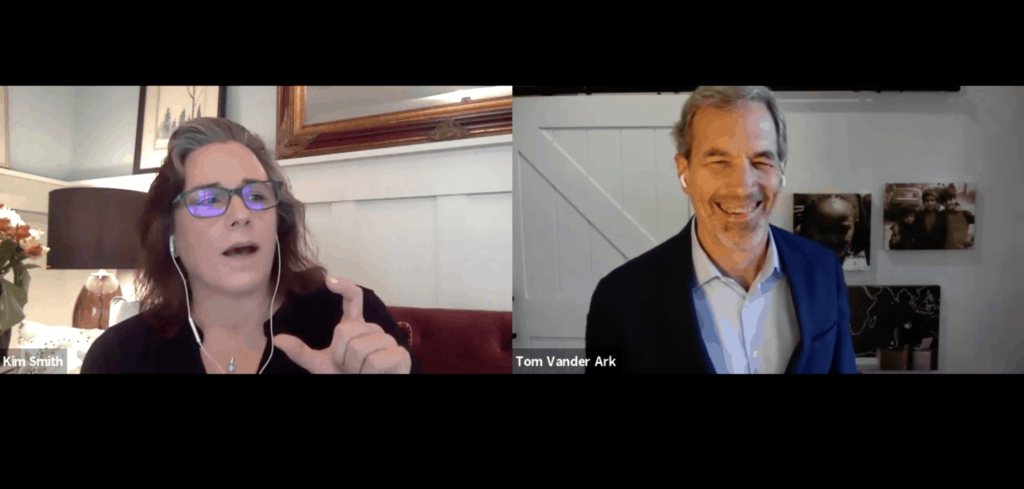
Kim Smith on Creating Schools, Companies and the Pahara Institute
- Be brave, take long term view
- Keep at it.
- Figure out the places where the workarounds may be a solution
- Pay attention to parent/family roles. Keep them centered.
- States have to find a way to collaborate to know what is going on for kids. Particularly for the sake of assessment.
- Budgets will be so constrained going forward — philanthropy and the Federal Government have to step in.
- The new secretary needs to be a bridging leader. We can’t have the pendulum swing too far.
- Kim Smith’s LinkedIn
- Stanford Graduate School of Business
- Teach for America
- Pahara Institute
- NewSchools Venture Fund
- Bellwether Education Partners
- John Doerr
- Getting Smart Podcast Ep. 212: “Teach for America: Helping All Kids Receive the Education They Deserve, with CEO Elisa Villaneuva Beard”
Transcript
This transcript has not been edited for spelling accuracy.
You’re listening to the Getting Smart podcast, where we unpack what is new and innovative in education. I’m your host Jessica, and on this week’s episode, Tom sits down with Kim Smith, founder of the Pahara Institute and co-founder of New School’s Venture Fund and Bellwether Education Partners.
Kim Smith is widely recognized as an innovative and entrepreneurial leader in education and was featured in Newsweek’s report on the women of the 21st century as the kind of woman who will shape America’s new century. On top of the previously mentioned successes, Kim was also a founding team member at Teach for America, created and led an AmeriCorps program for community-based leaders in education,
managed a business startup, and completed a brief stint in early online learning at Silicon Graphics. She has helped to incubate numerous education and social change organizations and has served on a range of boards. In this conversation, Tom and Kim discuss investment opportunities, Kim’s impressive
career in identifying and supporting innovations in education, and advice for this year. Kim Smith, welcome to Getting Smart Podcast. Glad to be here. What a treat to have you on. Kim, I would love to go way back to Columbia and would love to backstrand how you made
your way from Columbia to the Polyside major to TFA. Yeah, that’s a long time ago. I was finishing college and like a lot of soon-to-graduate college students had no idea what I wanted to do with my life. I had thought about the Peace Corps, I had thought about law school, and very serendipitously
ended up meeting Wendy Kopp. She was working to decide whether to start Teach for America. And I spent high school and college working with a consulting firm, a small consulting firm that did business education collaboration. And so she met with a woman I was working for, and I happened to be at that lunch and
heard what she was trying to do and thought, oh, that’s really cool. We should figure out a way to do that. And joined her right out of school and spent the first few months sleeping on couches because we didn’t have any money and eventually rolled into actually having Teach for America as a real entity.
That was quite a trip. So, Kim, a little bit of this is in your genes, right? Because we’re both your parents’ educators? Yeah, my dad was a professor of education administration at Columbia’s Teachers College for many, many years, few decades.
And my mother was a public school specializing elementary teacher. And so it’s true. I kind of, through osmosis, got the macro view from my dad and the micro view from my mom, which I actually think that combination was super important. I now know looking back across my career, most people do one or the other.
Most people either get the macro system change stuff or they really understand the learning between the teacher and the student. But it’s rare that people get to have a long-term view on both of those and how they fit together. But it’s interesting. For your parents, for them, education was really the road to a different future, right?
So they had experienced education as sort of unlocking new possibilities for them. Yeah, my parents met through 4-H camp in rural Tennessee. And my dad got a 4-H scholarship to Yale. He has a great story about that, which we can talk about another time. But yeah, I do think that education both through 4-H, so education for them was partly schooling,
but it was also out of school learning. And that scholarship and getting to a whole new geographical location and different possibilities was pretty powerful. Changed their lives for sure. How long were you with Wendy at TFA?
That’s a good question. Two years, I think, two and a half years. Okay. And then did you go straight to Stanford? No, I’m realizing there are some things I don’t have on my resume or LinkedIn that I
should probably add. I did TFA for a couple of years, and part of what I did was recruiting on the West Coast. I grew up on the East Coast. I really wanted to move to the West Coast. So I, in between, and I also wanted to figure out what of the experience we had at Teach
for America was because it was a startup and what was because it was a nonprofit. So I joined a little team doing a startup business, which happened to be a trade show in the wine industry. So it was as different as it possibly could be. All distributors are very different people from Teach for America teachers.
And I spent a couple of years doing that. It was sold. Then I actually left to create a program as the AmeriCorps program rolled out, Summer Service and AmeriCorps. And I created and ran an AmeriCorps program in the Bay Area that focused on community
embedded youth development programs who wanted to find a way to bring their former clients back into leadership positions. And so that was a great opportunity to think about youth development and learning outside of the school. So I should put that back in the, it’s an important piece, I guess.
No, it is. It is. And that probably answers part of that. The next question is really, what’s the origin story of New School’s venture fund? Is that something that you dreamed up while Stanford MBA?
Yeah. And it’s pretty, I’m thinking back now. I’m on sabbatical now, so I’m spending a little time reflecting on my career. And it’s notable to me that most of the times that I’ve helped create something innovative, it’s been a very collaborative effort.
And it’s been very serendipitous how it’s come together. I don’t sit off in a room by myself and come up with an idea and then just make it happen. In that case, I was at Stanford and I was running the entrepreneur club with a colleague friend. We wanted to have Jeff Bezos as a speaker for our event.
So I figured out how to work the network to get to John Doar to see if he could help us get Jeff Bezos. And he said, I can help you get him as a speaker. And by the way, I’m talking to Al Gore and I’m very interested in how can we use what I know in venture capital to help fix public schools?
Because I’m passionate about that. And so we kind of did a trade. He helped us get Jeff Bezos. And I did two independent study classes with him to sort of figure out, well, what would you build if you wanted to create an ecosystem for entrepreneurs in education?
And we created new schools. So I just heard our listeners, I have to underscore this is a crazy new idea because this is in the 90s. So there is nothing called an education venture fund. Those don’t exist for another 10 years.
This is before the Gates Foundation started, before sort of new money philanthropy came into the space. There wasn’t venture philanthropy. There wasn’t impact investing. There had been the new American schools, I think had turned America’s attention to the
potential for new schools, but charter schools were still a relatively new and small phenomenon. There’s just nothing about what you conceived that was familiar in 1999. And we got a lot of, I do remember early on, you may remember this time, early on the critique was education entrepreneur is an oxymoron. Do you remember that?
Right. Yeah, we got a lot of that criticism. And the second piece that was unusual was realizing we needed both for-profit and non-profit mechanisms to change the system. That kind of rubbed a lot of people the wrong way or just confuse them.
So I mean, you and I both in the 90s had that instinct that it was going to take public private partnerships and trying to put the right form of capital to work. I had just come out of the private sector to try to be a public school superintendent. You had this interesting hybrid background that allowed you to appreciate those insights. I’d love to dive into the sort of core insights that were baked into the New School Development
Fund. It seems to me it was that new schools formed particularly for underserved communities were a big idea that you could do that well, consistently well, and change life outcomes for kids that needed great schools more than anybody. And two, that forming them in networks could be a reliable scale strategy.
Is that right? Are there some of the insights that you’ve kept? Yeah, I think those are part of it. I think that new American schools really introduced the idea of a school level coherence and the idea you could support that at a larger scale.
It tended to be in districts and they tended to have trouble lasting. So I was looking at that thinking that’s what led to the networks idea. For a coherent school model to work and to be able to serve many, many kids because there’s so many kids we needed to serve, then you need to have aligned systems around them. We had all beaten our head against the brick wall of trying to align districts that way.
And that’s hard because districts have very diverse people who actually want very different models of schooling. And so that’s what led to the idea of charter management organizations once charters became a tool because then you could say that’s fine. We believed in a diverse portfolio of schools.
You may remember, Tom, we supported Hightakai and Aspire and our intention was to have many different kinds of schools and to say that’s fine. Have teachers elect to be in that environment, have students and families elect to be in that environment. You’ll reduce the friction if everyone wants to be there and it’s a model that they want
to learn in. And then you can align your professional development and all your supplies and supports to that model. So that’s the other reason we really pushed on charter management organizations is by that time I was watching the education management organizations like Edison get a lot of political
pushback. And so we wanted to have nonprofit versions to be able to really focus in on the social impact and social purpose. Not that we were against for profit, but it’s just a more complicated version. And so we spent a lot of time, we went out and recruited folks who had really terrific
single school sites to say, let’s figure out a way to build a CMO around you so you can serve just thousands more kids who are in need. I want to circle back to that, but in speaking of recruiting, you recruited this phenomenally talented team. I’d love to have you just reflect on how in the world you did that.
You got Jim Shelton and Chiba Mellick Shaw and Jen Caroline and so many talented people. Yeah. How did that happen? Well, I think, I mean, that’s a really good question. Partly luck and partly amazing people who are committed and have that sense of purpose want
a place that they can work together with other amazing people who share that purpose. So there was a moment in time piece of it. But the other piece was you just have to have like, we talked about this at another time, but I came to realize you need people, ideas and resources and that people part education is a public good and it’s a service business.
You can’t do anything without the people. And so we just thought about that place as a place to bring in amazing talent who would be with us for as long as made sense. But we were really explicit too about the idea that this should be an engine for great talent for the field.
So if you come in like James Wolcox was with us for a while and then decided he needed to go start something else and then eventually that inspire. Our whole point was the whole ecosystem needs to grow and we need to bring in phenomenal talent. So what can we as new schools do to create a learning environment that makes people excited? So you’re just constantly learning and it’s a great place to be.
And you know that we all are trying to do something bigger. So at the point when it’s time for you to go do something bigger, that’s great. So you’re not trapped. And I think that’s a great learning space for really talented entrepreneurs because they’re less likely to go someplace where they feel like they’re going to be sort of stuck there for,
you know, 20 years. It was a very trying to think of the right energy. There’s a lot of energy, do you know what I mean? In that space. There was tremendous energy.
So you assemble this amazing team around these core insights that new schools could change lives and that networks could scale impact. And in the 10 year period that we had a chance to do some work together, you guys created what I think is the most significant impact engine in America, where you had such an amazing hit rate that every, it seemed to me that,
that everything that you did was turning out impact at scale. I wonder if there’s any lessons learned there on how on earth you did that. That you were so successful at having such a high hit rate. I can’t think of another comparable impact engine of the last 20 years that had that track record. That’s so nice of you to say.
And you know, as we all do who work in this field, it’s just so hard to change this big, complex system. So I appreciate you saying that. I feel like there’s a couple of components. One is what you just said, just talent, really recognizing it is a human service business
and it’s really about the talent, both for our team, but also all the teams we worked with. I remember early on talking with John Doar and Brook Byers about the choice we had between two projects. And one had a really, really strong strategy and what we thought of as like a B team. And one had an A plus team and the strategy wasn’t quite right. And John said to me in Brook too, that in that case you pick the A plus team and you work with them on refining the strategy.
But that if you picked the one that had a great, great strategy on paper, but a B team, they said B players will always attract B players. And A plus folks will be learners and they’ll work with you and you’ll all figure out the right way to go. And I think that if I had to boil it down to one thing or two things, it would be the people and that those people were really committed to being learners. And that runs all the way from our founding donors through our team and into the teams we worked with.
And if you’re fundamentally committed to learning, then there’s no harm no foul in admitting if you’ve got something wrong or you’ve made a mistake. You’re constantly looking at how to improve things. And I think that ethos, I think that was behind why we managed to get a lot done because people were constantly learning. Maybe the third part is from the beginning, we never wanted to just be an investment or venture philanthropy entity on the resources side. We always had a learning network in mind that was bipartisan and that crossed silos because part of what we saw in the field was people just got into these really narrow silos.
And at the end of the day, to your point about networks and systems, education is like this really complicated linear equation with 20 variables. And philanthropists and operators tended to want to pick like one. It’s about reading curriculum or it’s about the length of the day. And you know what I mean? They would pick one thing teacher prep.
And you know, as a superintendent, it’s all those things and you have to factor all those things in. And yes, maybe two or three are your special sauce, but you can’t ignore any of the rest of them. And so I think having that wide bipartisan cross sector network was another piece of it because then everyone accelerated their learning. And that’s how we did the summit from the very first year to figure out a way to make the field smarter and to help all of us get better instead of just our portfolio. You’ve mentioned John Doar a couple of times.
I want to just give him a shout out and the fact that he he agreed to pay the bills to give you to cover your admin costs. And so when philanthropists like me showed up, everything that we added was going straight to creating great schools for kids. And I thought that was a terrific example of sort of brave early philanthropy, making it easier for other people to come in and support the kind of work that they that they wanted to. Your legacy there must have resulted in a thousand great schools, all of which are are still open and and growing is you got to be proud of that. Yeah, I’m proud that we were able to support so many amazing leaders and that embedded in all that work was this idea of sustainability and institutions that could serve young people for, you know, decades.
So I think that’s what we’re all trying to do is create organizations that have outsized impact and that last. All right, now I have to offer a public apology. I think it was about 2003. You started bugging me about starting an ed tech fund. You wanted to do an ed tech venture fund sort of an impact fund.
And I said, now just keep doing school. Keep doing schools. Yeah, you were right. And I was wrong. We should have supported that.
Your instincts were absolutely right. This is 15 years ago at the time there was about zero percent zero of R&D in education. Yeah. You know, Pearson, Houghton and McGraw were spending a little bit on R&D as the corporate giants in the space, but there were no education venture funds. The foundations weren’t spending any money on ed tech.
And I think you saw the big gap in the sector and understood that to continue innovating on school models that we needed tools for the kind of tools that kids deserve. So I totally appreciate your early leadership on the front. I’m sorry I didn’t support it. It was a great idea. It’s very cool that you had some early successes in that space and even, you know, went on to launch reach gaps.
And then you had the capital, which is a leading ed tech venture fund now. Jen and Wei launched reach. Yes, but it has its roots in new schools. In new schools. Yeah.
So I appreciate those early insights. It’s funny you mentioned that because I’ve been thinking about philanthropy recently and thinking about a couple of things. One, the argument we made at the time to use endowment capital for social purpose investments, as you said at the beginning, was really kind of unheard of then. And just really hard sell. And so I’m really happy to see a lot more of that activity happening now because the endowment capital is enormous and much of it is not going into social purpose work.
The other thing I was thinking about was back then I really I found this quote from Paul Gorin that said philanthropy is society’s passing gear, which I really loved because they don’t have the pressure for quick returns or even necessarily as high a return. They should have patience. They can take risk. They don’t have the pressure public sector money has. They can take a long view.
Yeah, they can take a long view. Yeah. And they can do risky things in a way the public sector can’t. Yeah. And so that I think was the spot we were trying to hit with that was to say to philanthropists, you should be taking risk earlier and bigger and holding on to it for longer.
Which at the time was not a successful thing. As you said, but I do think there are a lot of folks out there now who are seeing that more. And so the way I’m thinking back on that question is what is that next front that we need to ask philanthropy to move on to now, you know, given that they’ve caught up on that one. What’s around the corner for philanthropy now? Let me fast forward to Pahara in 2012.
You’ve been talking about the new Pahara. Let me fast forward to Pahara in 2012. You you founded another nonprofit. This one focused on talent. What was the core insight?
So I teach for America. We wanted to bring new people into the field who hadn’t been trained in what was impossible. Right. So they had this internal locus of control and realized we could do things differently. I didn’t say it at the time, but in retrospect, I realized that’s kind of an entrepreneur’s mentality.
So then at new schools, what I was doing is realizing many of them did have great ideas and wanted to strike out and we didn’t have an ecosystem to support them. So we supported them at new schools. By the time we got to Pahara, what I was realizing was a couple of things. One, the field itself was really narrowing. And you’ll you’ll know this to Tom, right?
The kinds of brands, the kinds of schools we were supporting. The field had really narrowed down to very much about efficiency, testing and accountability, which matters. But we had a breadth of different kinds of models. We had lost the wider, broader definition of student success was starting to get lost in that mix. So and and as I looked at the field, we weren’t diverse enough.
Leadership was not diverse enough. And I felt like parents and community were not centered enough in the work we were doing. And so and then the fourth thing was we had this leadership cadre of amazing people. As you said, the talent was amazing. And we were literally doing nothing to reinvest in them, nothing.
They were all starting to burn out. So what I wanted to do with Pahara was create a space that reinvested in those leaders, gave them a chance to step back and reflect what we know about adult learning. You have to pause the doing to reflect and to learn in that reflection to push them pretty hard on clarifying their values. In particular, we had a tool we used from Jim O’Toole and Keith Burwick called the executive’s compass,
which was the tension between community and efficiency and liberty and equality, but especially community and efficiency. I thought we’re at attention in our field. We can talk about that more if you want, but give them a private space to wrestle with those things. So they weren’t selling and they weren’t having to defend their work.
They were really open, create very diverse learning communities and push the field forward on more diverse leadership. Most of our Pahara Aspen cohorts are 50% leaders of color. Our next gen program is almost 100%. And to ask us to think about values, tensions when two good things are bumping into each other, not a good and a bad, but two different goods, and to find a third way solution.
So like with school closure, for instance, communities want ownership of the schools and the folks closing it or focusing on kids aren’t reading, both of those things matter. So you can just have a fight, you know, a dualistic fight and one side wins, but then the other side loses. So what’s the third way solution where you recognize the community needs ownership, maybe job retraining for a bunch of folks and the schools have to actually perform and kids need to read.
So these two things shouldn’t be at odds. So I wanted to create a space where leaders could wrestle with that and come out hopefully. My big goal, which I don’t know to what degree we did this, but I wanted hundreds of leaders who done an amazing job as entrepreneurs to be more ready for the generational change that was going to come. Because if you go back to Larry Cuban’s spiral staircase, right, the pendulum swings and it swings hard in education,
essentially from efficiency and tests and accountability back to community and relationships, right? And you know, and I know, and we all know, you need both of these. So I really wanted to create a leadership community who understood the nuanced question, how do we do both of these things well instead of allowing that pendulum to just keep swinging back and forth and do that in an environment that was much more diverse than we had had before. How many leaders have been part of the past eight years?
About 800. Little more than 800. That’s amazing. Yeah. Yeah.
I guess, Kim, I’ve observed the 100 power leaders that I’ve intersected with in the last couple of years. Really intense personal growth. Yeah. They’re much more reflective about who they are, what the work that they’re called to do, how they enter, you know, into community. Yeah.
And then secondly, this really interesting invisible web of the social network that you created between these cohorts is really strong and a lasting benefit, though, is created by the program. That’s, I think that’s one of the things I’m proudest of is both our team and our donors, honestly, because it was a very difficult thing to explain to donors. And so those folks who supported us really made an intuitive investment in the field. That, the way it plays back to me is two things. The single thing people say the most is, I’m grateful you made me a better leader, but you helped me be a better person, which is awesome.
And it was not us. It was the whole set of community members. But the second thing was trust. Like you’ve talked about this, but, you know, and your recent piece on like sort of collaborative truth or reality, defining reality. We had this one piece we used from Max DePri book called Leadership is an Art.
And he says, a leader’s first job is to define reality and his last is to say thank you and in between he’s a servant and a debtor. And I always love that quote. And we would have folks talk about it and they’d be like, define reality. And then they’d realize, oh, yeah, as you wrote in your piece, like you, you have to set the frame for people to engage on what is the reality we’re working in. And the feedback we get from folks is because they had the shared deep experiences, you said, they can start working with other Pajarans with a much higher level of trust, even if they weren’t in their cohort.
And part of that comes from just taking the time to build relationships. And you’ve said this in various places too. But it strikes me that we understand the need for relationships for kids and we’re working hard to do a better job of that. And it’s all parallel processing. The same is true for adults, right?
Adults need relationships and proximity to have empathy and they need those relationships to have trust. And if you have all those pieces, you can, and this is part of our theory of action, right? Then you can hopefully create better solutions because there’s just less noise in the way. There’s less garbage in the way, right? You must have mixed feelings as you have transitioned out of Pajarans.
What a gift to be able to spend eight years with 800 leaders, right? Yeah. A lot of heavy lifting, but a lot of beautiful relationships came out of that. Yeah, it’s an incredible gift. I feel incredibly fortunate to have had that opportunity.
And also, and you know this as an entrepreneur, and I’m also incredibly grateful to be able to hand that off to someone like Christy Dragon, who’s just such a phenomenal leader and understands all the things we just talked about and the nuance of it. I’m really excited about the next chapter. There’s a campus and development as well. So yeah, it’s bittersweet, but also the right time.
And what’s so great about what we just talked about in terms of relationships is they’ll last. So wherever, you know, wherever scene I’m sitting in, right? We’ll still get to work with those great people. Hey, let’s sprint to the finish with a couple words of advice. We’re in a world that’s in transition in a whole bunch of ways, but we’d love sort of top of mind advice for a couple of people.
Let’s start with philanthropy. You earlier talked about inviting them to be brave, to take a long view, to take more risk. Anything else you’d add there? I would encourage them to do a lot more investing, endowment side investing in social purpose education stuff, the long view stuff like assessments.
We have an opportunity, I think, to really reframe how we think about assessments and some other systems components. So yeah, I put a lot more capital to work. I know they have a lot of other fronts right now as well, but this is a disrupted moment by definition. So don’t be shy. What Kim’s talking about is foundations give away about 5% of their endowment every year,
but 95% of their assets sit there and are typically invested in the market, not in the causes that they care about. And most foundations could be much more thoughtful about how they invest their endowment, not just their funds. So I appreciate that. We have a paper on that subject that I’ll add to the show notes. What about advice for system heads, folks that are leading districts or networks?
They’ve had a super tough year. They have had an incredibly tough year. I don’t even know. I mean, with all humility, I don’t even know that I could offer them any advice other than to just say, keep at it and do figure out those places where it’s the whole necessity is the mother of invention.
So many of them have come up with these amazing workarounds. Please don’t let yourself fall back into the old ways just because that’s how everything was set up. Like you have gained insights in these workarounds for what’s needed around more tailoring to what students need, segmenting your kids in ways where they need different tools. Behanging attention to your parents.
I do feel like one thing systems leaders have had to do this year in a way that’s more than before, whether they’re charter or district, is really being attentive to the parents and family’s role, obviously, just because of the situation. Figure out a way to keep that attentiveness when you go back, right? Whatever the flavor will change, I’m sure, but keep them centered in the picture the way you have had to this year.
But more than anything else, I feel like we all just need to really appreciate how hard systems level leaders have been working to solve problems that were not just schooling. They had to do so many things before they could even get to academic instruction. So more than anything else, I would just say thank you because, oh my God, it’s amazing what they’ve been doing. Similar question for governors and chiefs.
If you’re a state leader right now, what could they be doing that would support families and learners? I feel like at the state level, I’m sort of obsessively thinking about assessments. And I’m watching folks do a knee jerk from super tightly ratcheted down to nothing. And I feel like that’s an area where the states have got to figure out a way to collaborate. This is a moment of disruption.
And we have to figure out a way quickly to move to a place where we know what’s going on for kids, even if it’s not back. Hopefully it’s not back to the old way. That’s a place where we could have a whole new consortium of states working on that together. The last consortium was kind of people were forced to come to the table and some good stuff happened, right?
But it was in the old mentality, I guess, right? Here’s an opportunity to really rethink how we do that and to maybe do some big investments collaboratively. But I also think the feds are going to have to step in. And this, again, is where philanthropy has to step in because budgets are going to be so constrained going forward. I feel like we’re in this suspended animation where we know budgets are going to get killed,
but they haven’t quite yet. And when they do, the philanthropy is going to have to step in to make some of these leaps forward possible. So a collaboration of governors and philanthropy saying, how do we reframe assessments and accountability 3.0 would be amazing. Any final words for the new Secretary of Education?
Gosh, I just hope the new Secretary of Education can figure out a way like we talked about before, to not have the pendulum swing super hard from one side to the other, but to really understand the need to be a bridging leader who can bring people together from accountability and assessment and instruction and relationships and community and pull all those parts together. It’s a tall order, but it’s an enormous opportunity that we haven’t really had before.
And I guess we haven’t talked about this at all. But one thing I would put out there for all of those groups to think about is the divide in this country is real. And we can’t afford to sit in our kind of comfortable media bubbles or silos and to think about whichever side you’re on. What do you do to be a bridger across the political divide and the ideological divide? I’ll add, Kim, that in your 30 years of impact that you have been the best example in America
of an entrepreneurial mindset in the education sector. And I think to the list that we just described, the philanthropist, the system heads, the state leaders having that entrepreneurial mindset when it comes to education is so important. And you’ve been such a great example of that. So thanks for joining us and thanks for 30 years of impact.
Thanks for all you’re doing. It’s been great and there’s so much more work to be done. So I look forward to keeping at it. Thanks, Kim. A big thanks to Kim for joining us this week.
We are grateful for her continued commitment to education and building an education ecosystem that works for learners. For more conversations on Teach for America, check out Episode 212 with Elisa Villanueva, CEO of Teach for America. We’ll be sure to put a link in the show notes. All right, that’s it for today, listeners. But before you go, as always, don’t forget to rate and review the podcast.
And thanks for tuning in. For the Getting Smart podcast, this is Jessica signing off.


0 Comments
Leave a Comment
Your email address will not be published. All fields are required.