


Running Your Own Race: Why Agency Begins in the Interior Life
Key Points
-
Young people need unstructured, screen-free time not just for rest, but for identity formation, confidence, and imagination. Quiet space supports agency before visible participation ever begins.
-
Parents and educators should create more opportunities for boredom, reflection, and offline experiences so teenagers can develop an internal sense of pace rather than constantly reacting to external attention and comparison.
Somewhere between here and our summer destination last year, something happened in the back seat of our car. My teenagers, phone-free for the duration of the drive, started talking. At first, it was random observations and inside jokes. Then it became something else.
It started with nothing important, then slowly moved toward the things that usually stay hidden beneath a busy week. I sat in the passenger seat, trying not to make it weird by noticing too much. But I noticed. I tried not to react. Nothing ends a good teenage conversation faster than a parent looking too interested.
What stood out wasn’t just the absence of phones, but the return of something screens often crowd out: unstructured mental space. Time with no agenda and nowhere else to be. The kind of time where a conversation can wander for an hour before it lands somewhere that matters.
I have been wondering if we have been misreading what young people are experiencing. We often talk about screen time in terms of quantity, but I wonder if the deeper loss is what constant consumption displaces. Boredom. Daydreaming. The chance to follow a thought a little farther.
At some point, the flood of information stops making us feel connected and starts making us feel crowded. When every quiet moment is filled, there is less room left to notice what keeps returning to your mind.
I am hardly immune to this myself. I spend a portion of my professional life thinking about learner agency and attention, and yet I still find myself reaching for my phone at a red light as if something urgent has happened in the last ten seconds. If I struggle to leave a little room for boredom, I can understand why my teenagers do too. Unlike me, they have never known a world without a feed waiting nearby.
There is a version of this that I see among teenagers, which I think of as the dance-floor problem. It describes the young people who stand around the edges of dances, not always because they are shy, but because they know someone could film them at any moment.
When I was sixteen, I danced with a level of confidence that was entirely unsupported by talent. Thankfully, the only evidence lived in the unreliable memories of my peers. But I think about what made that possible. It wasn’t just the absence of cameras. It was something interior, a willingness to be present without fear of judgment, to trust my instincts before I knew whether they were any good.
Today, everything feels potentially public and potentially permanent.
When life is shaped around what can be shared, you begin managing yourself for the sake of sharing. You stop doing things simply because they are fun, freeing, awkward, meaningful, or yours. A quiet caution settles in. Not quite fear, but the sense that everything might be watched, judged, or shared.
The real question isn’t just whether they are being watched. It’s whether they can still trust themselves when they are. I sometimes wonder how often young people are practicing someone else’s version of themselves before they have had a chance to discover their own.
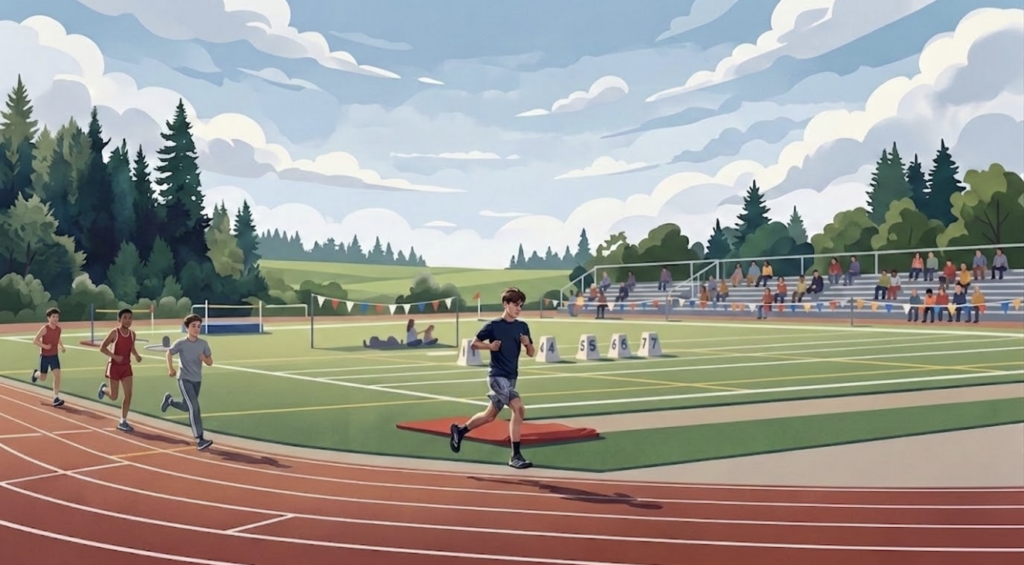
My son runs track and field, and for much of middle school, he ran the mile by following someone else’s pace. He would lock onto a faster runner and let that person determine the rhythm of the race. It worked well enough until recently, when something shifted.
He decided to run his own race.
He went out front early. He tracked his own splits. He stopped looking sideways and just ran his own pace. As a parent, there is a brief moment of panic when your child decides to lead from the front. I may have even held my breath for most of that first lap. There is nowhere to hide out there. But he stayed.
Afterward, I asked him what he thinks about when he runs well. He mentioned pace and strategy, but then he talked about other things too – music, life, random thoughts, the world around him. Not distractions, but presence.
He ran the best mile of his life that day.
What the dance floor and the starting line have in common: both ask you to stop outsourcing your sense of self to the people around you. Watching him, I realized how much of growing up is learning to hear your own pace in a world that is always trying to hand you one.
I see this in my own house more than I want to admit. The moment a conversation ends, there is a pull toward a screen. My own screen included. Sometimes I think the most endangered thing in our house isn’t attention, it’s idle time.
At the same time, we tell them to lead, innovate, contribute, and make a difference. I kept thinking that the things I most want for my own kids – that they contribute something meaningful and find the courage to be themselves – might depend on something quieter happening first.
I have spent much of my career thinking about agency and what helps young people see themselves as contributors rather than spectators. Lately, I find myself backing up a step. Before a student raises their hand, joins a team, takes a job, or starts a project, what is already forming underneath that decision?
I think it may begin in the interior life. Maybe it is in the space between conversations or on a long drive, when nobody feels the need to fill every silence. Watching my own son run, I kept wondering whether confidence comes after action or before it. I am not sure I have figured that out for myself, let alone for them. Maybe that’s why the quiet moments matter. If you never hear your own thoughts, it is hard to trust them when they finally arrive.
This summer, I am going to find more excuses for long drives. I am going to be a little less efficient about filling the quiet. I am going to try to leave room for wandering conversations and unfinished thoughts, which is harder than it sounds when you have a podcast queue and a phone in your pocket.
But I keep coming back to what I saw on the track, how he stopped looking sideways and just ran.
Maybe that is where it starts.



Nora
I am older. I remember taking long drives with my children - to a vacation spot, to NYC (my daughter) for a violin lesson. Those drives did not involve phones because they were not yet invented. On those drives, we talked about everything. They gave their opinions on school and lots of other topics. Now when I drive with my daughter and her two teenage children, there is very little conversation. Everyone is looking at their phones and, in many cases, they are wearing headphones. What a pity! We need connection through talk and sharing of ideas through conversation.
I hope banning phones in school has led to more conversation and greater understanding between people who might not look like us or had the same experiences as us.