


Lever 2 for Deeper PoG Implementation: Teaching the Skills Behind the Portrait
Key Points
-
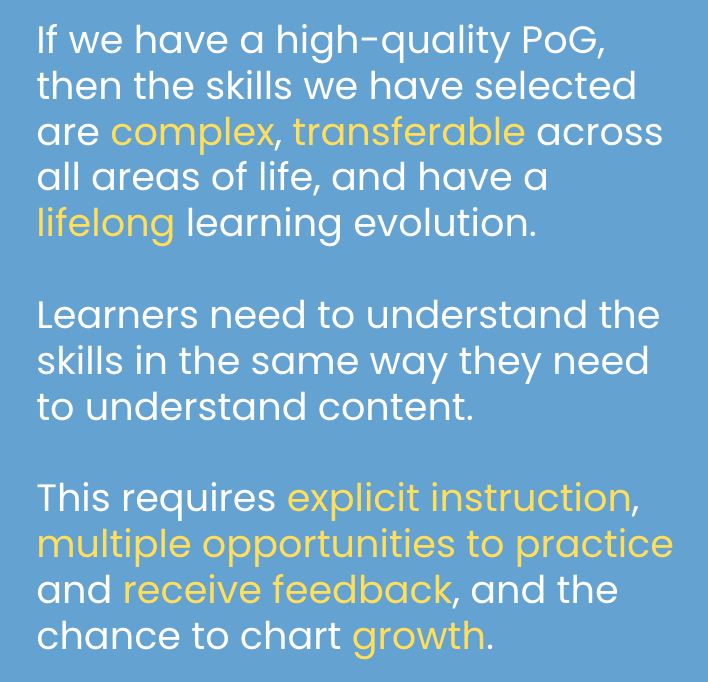
Treat PoG competencies like content. Plan explicit mini-lessons, models, and quality criteria—don’t assume students “pick up” collaboration, discourse, or communication.
-
Scale what works by embedding into existing systems by using shared instructional routines (e.g., talk moves, discourse structures) and curriculum crosswalks (e.g., StudySync) plus learning-walk data to identify bright spots and spread practice.
For many schools/districts who have built a Portrait of a Graduate (PoG), the language of the Portrait is likely up on the walls in PoG posters. For some, you might hear a teacher or a student referring to a PoG skill by name as it arises in the moment. And, as we discussed in the blog before this one about the power of reflection, some learning communities might be asking students and teachers to make connections between learning experiences and a PoG skill through reflective activities. And yet, when schools and districts introduce and begin to implement a PoG, it is really quite common for the system to skip over the need for high-quality instruction of the PoG skills to happen in concert with the existing content.
This is a very understandable pitfall of implementation. Most people who are teaching in classrooms across this country were trained in their own teacher preparation program to teach their content or their grade level. Very few of us were taught how to be teachers of PoG skills. So while we would not necessarily expect (nor condone) a teacher assessing content knowledge that had never been taught, it is fairly common for teachers to ask students to practice collaboration or self-directed learning or global perspective taking without ever delivering a lesson on these complex skills.
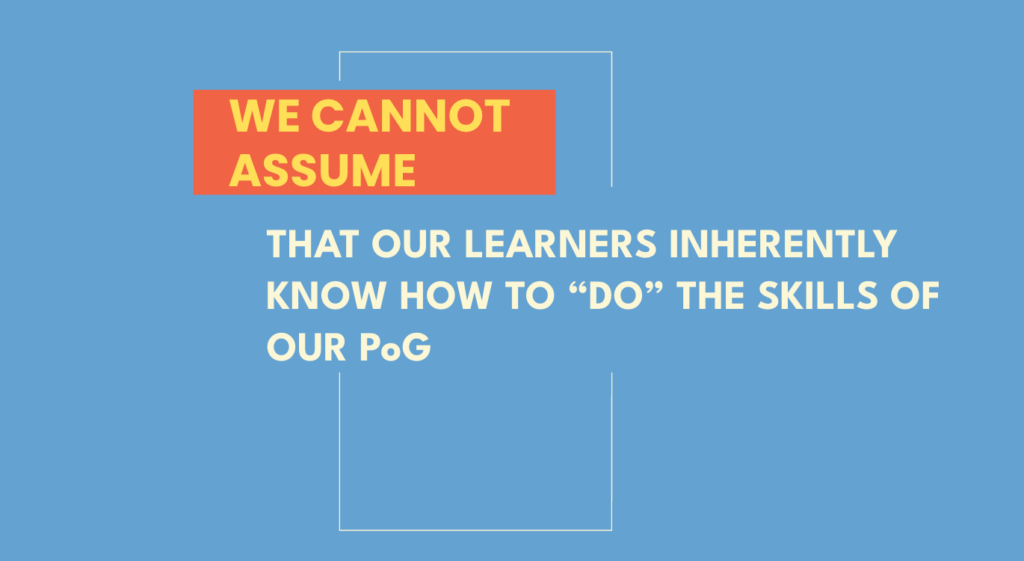
I think of the many times I asked my 10th-grade ELA students to get into groups to work on a collaborative task, and watched with despair (and often frustration) as one student would steamroll the rest of the group’s ideas, or three out of the four in the group would not complete the work they had committed to. As I learned more as a teacher, I started to set up more formal group role delegation processes, and student-created contracts of group agreements…but even as a veteran teacher, I missed the need for actual explicit instruction (mini-lessons, examples, etc.) on how to come to consensus as a group, how to identify individual strengths and areas of growth that had direct impact on their collaboration, how to navigate conflict, and so on… I was asking my students to engage in the very complex process of effective collaboration, holding them accountable for the work they needed to produce together and observing their process, all without breaking down the concept into smaller parts for them, and checking for their understanding. I would have never dreamed of doing this with my English content, but somehow did not apply that same level of practice with our PoG skills.
In working with folks across the country who are implementing their Portraits, I see this pattern repeated, and I think it can be a powerful contributing factor to a PoG feeling flat or forced or superficial. I say this humbly also, with full understanding of the pressures that plague all educators in terms of how much we are being asked to cram into every moment of a school day and academic year. Because of the overwhelming number of tests, accountability measures, and reporting metrics, teachers at all levels can feel like they are never getting through enough content, that there is always more to “cover”, and if something does not connect directly to an assessment, it cannot be a priority. And, while these pressures are real, I also know that when students and teachers are asked to perform something they have never been taught, we are not creating the conditions for successful learning nor implementation. (In Blog 6 – Parallel Pedagogy, we will be sharing more about the importance of engaging the adults in your system in their own learning journey.)
This makes it even more inspiring to see systems like Norwalk Public Schools creating structures and opportunities for the integration of PoG skill instruction into existing curriculum and instructional practices. There are so many ways to look for the natural intersections between what is already in place in classrooms, and moments to embed the PoG skills explicitly into teaching and learning. And though it takes time and intentional planning and effort, it is so powerful when everyone can see the PoG as an integral part of their work, rather than one more thing on a long list of boxes to be checked off.
The Norwalk Story: Using Explicit Instruction as a Way to Support PoG Implementation (Kimberly)
From the start of our Portrait of a Graduate work in Norwalk, we knew that vision alone would not change classroom practice. As we moved into the second half of the year focused on implementing the effective communicator competency, that belief continued to guide our approach. To make the Portrait of a Graduate visible in daily teaching and learning, we explored explicit instruction as a lever for implementation.
In Norwalk, we define effective communication as a student’s ability to actively engage with others, tailor their communication to different audiences and purposes, and clearly and persuasively articulate their ideas. Like academic content, these skills must be intentionally taught, practiced, and reinforced over time.
To better understand how the Portrait of a Graduate competencies are coming to life in classrooms, NPS conducts district learning walks three times per year. During these visits, members of the district leadership team and school leaders partner to observe classrooms using a common protocol and rubric aligned to the critical thinker and effective communicator competencies and The Framework for Teaching (FFT) by the Danielson Group. These learning walks help us understand how the Portrait of a Graduate competencies are reflected in daily teaching and learning practices. Observers are normed on the protocol in advance to help ensure consistency across schools and grade levels.
These learning walks allow us to monitor how the Portrait is reflected in daily teaching and learning practices. Look-fors include, but are not limited to, teachers planning for critical thinking, students engaging in critical thinking opportunities, and students participating in meaningful academic discourse.
Between October 2024 and January 2026, we saw steady progress in our PoG implementation. During this time frame, the percentage of classrooms in which teachers planned for critical thinking increased from 54 percent to 72 percent. Classrooms where teachers facilitated learning experiences that required critical thinking increased from 41 percent to 56 percent, and classrooms where students engaged in genuine discourse increased from 34 percent to 57 percent.
While these gains are encouraging, critical thinking and student discourse remain the most difficult indicators to move consistently across classrooms. This prompted us to more closely examine where progress was occurring and what instructional practices appeared to support it.
When we disaggregated our learning walk data to identify bright spots, a clear pattern emerged. Schools and subject areas that used a strong pedagogical framework or shared instructional routines to intentionally support critical thinking and effective communication consistently showed stronger evidence of both competencies. In contrast, classrooms that relied on isolated strategies or one-time practices demonstrated less consistent results.
One example emerged from elementary and middle school math classrooms using Building Thinking Classrooms (Liljedahl, 2020), a research-based instructional approach that intentionally shifts cognitive responsibility to students through structured problem-solving by making thinking visible and providing planned opportunities for discourse. Because the approach embeds expectations for student talk and reasoning, lessons using this pedagogical approach tended to create more consistent opportunities for students to both think critically and communicate their ideas.
Educators reinforced this during feedback cycles completed in spring 2025. When speaking about Building Thinking Classrooms (Liljedahl, 2020), one educator shared:
“I’ve had kids who barely wanted to speak at all at the beginning of the year. Once they realized this was going to be a routine for the rest of the year, they thought, okay, now I have to start talking.”
We observed similar patterns in schools that consistently adopted communication routines, such as talk moves. Talk moves are sentence stems and discussion routines that support students in listening, responding, and building on one another’s thinking. When these routines were explicitly taught and reinforced across grade levels, students became more engaged and confident communicators. As one elementary teacher shared:
“What really helped was having a common language across grade levels. K through 5 uses talk moves, so when students move to the next grade, they are seeing the same expectations. Over time, it becomes second nature.”
These findings prompted us to reflect on our own leadership development work. Early in the implementation, we introduced individual strategies to support critical thinking and discourse. While helpful, those strategies were often disconnected from the curriculum and used as isolated practices.
Over time, we realized that creating meaningful and sustainable change in teaching and learning would require embedding Portrait of a Graduate competencies within the shared instructional routines and curriculum structures teachers already use, rather than relying on isolated practices.
To address this, we developed a crosswalk between the Portrait of a Graduate and our middle school ELA curriculum, StudySync. We analyzed the structure of a StudySync unit and identified where Portrait of a Graduate competencies naturally align within the existing learning experiences. From there, we identified a small number of research-aligned strategies that support those competencies.
Rather than offering a long list of ideas, the strategies in the crosswalk were vetted by district leaders and informed by classroom observations from instructional coaches and school leaders. During professional learning sessions, educators engage with strategies in authentic ways and reflect on how they fit within the StudySync unit structure.
The crosswalk is also designed to evolve over time. Strategies are added based on coach recommendations, allowing the tool to highlight strong practices already occurring across the district while making clear the connections between StudySync, the Portrait of a Graduate, and the strategies that support both.
This work was recently launched with middle school grade-band teams, and feedback from educators has been strong. As a result, we are expanding this approach to both elementary and high school ELA curricula. The goal is to provide educators with a resource that illustrates how Portrait of a Graduate competencies connect to the curriculum they already teach and how intentional instructional strategies can support students in developing the competencies over time.
As Norwalk continues its Portrait of a Graduate journey, we have found that explicit instruction matters. When competencies are taught intentionally, aligned with the curriculum, and reinforced through consistent instructional routines, the Portrait moves from an aspirational vision to something students experience every day in classrooms.
If you are feeling like the explicit instruction of Pog skills is a lever you want to try in your classroom, PD session, school, or district, consider the following recommendations:
Curriculum and Skill Intersections
Whether you are working from a purchased or self-designed curriculum, spend some time looking for the natural and authentic places where a PoG skill is connected to a unit or sequence of learning (including adult professional development). The inclination for many teachers here is to find any and all skills that somehow relate to the learning, but try to avoid that temptation. Instead, identify the one (or maybe two) concrete parts of the skill (use the bullet point descriptors or I can…statements if you have them) that, if a student did not employ that skill, they would have a hard time being successful in the learning experience.
Example: your curriculum calls for a student-led discussion about climate change and your PoG skill of Collaboration is defined with “I can build on the ideas of others.”
Leverage Existing Instructional Routines
Many systems have some shared high-quality instructional routines and practices that often start in the K-5 realm and can be practiced all the way through 12th grade. If your curriculum calls for it, or you know your students are familiar with it, see if you can bring in an existing routine that will allow students to practice and demonstrate this intersection of curriculum content & PoG skill.
Example: your students have been engaging in Socratic Seminars across classes since 3rd grade. So you can use that structure for your student-led discussion where they must build off of each other’s ideas in order to explore climate change.
Mini-Lesson, Models and Quality Criteria
Without taking an enormous amount of time, see if you can design a 5-10 minute mini-lesson on the PoG skill component so that you are making it visible and explicit to everyone in the room. Using the exact language of the PoG is helpful to remind students and teachers that the PoG is integrated. Bring in a quick model so students can observe that skill being demonstrated, and even ask them to identify what makes it a quality demonstration, thereby creating a list of quality criteria toward which they can work.
Example: Play around with the “Yes, and…” improv activity where partners must tell a story together and only respond with “Yes, and…” as they tell the story. This necessitates building upon each other’s ideas. Do a quick debrief of what they did well in that game, and see if they can apply it to the Socratic Seminar.
Note: go back to the previous blog about Reflection to be sure you don’t miss an opportunity for your students to make meaning of this through some reflection as well!
Be sure to catch the next blog as we explore the value of students publicly demonstrating their learning and growth of your PoG skills.
Past Blogs in the Series

Abby Benedetto


0 Comments
Leave a Comment
Your email address will not be published. All fields are required.