

Christina Theokas on Whole Child Design and the Turnaround for Children Toolbox
- Christina Theokas
- Turnaround for Children Toolbox
- Well–Being Index | Turnaround for Children Toolbox
- Building Blocks for Learning | Turnaround for Children
- Getting Smart Podcast Ep. 217: “How Educators Can Positively Impact a Child’s Cognitive Development with Dr. Pamela Cantor”
Stay in-the-know with innovations in learning by signing up for the weekly Smart Update. This post includes mentions of a Getting Smart partner. For a full list of partners, affiliate organizations and all other disclosures, please see our Partner page.
Transcript
This transcript has not been edited for spelling accuracy.
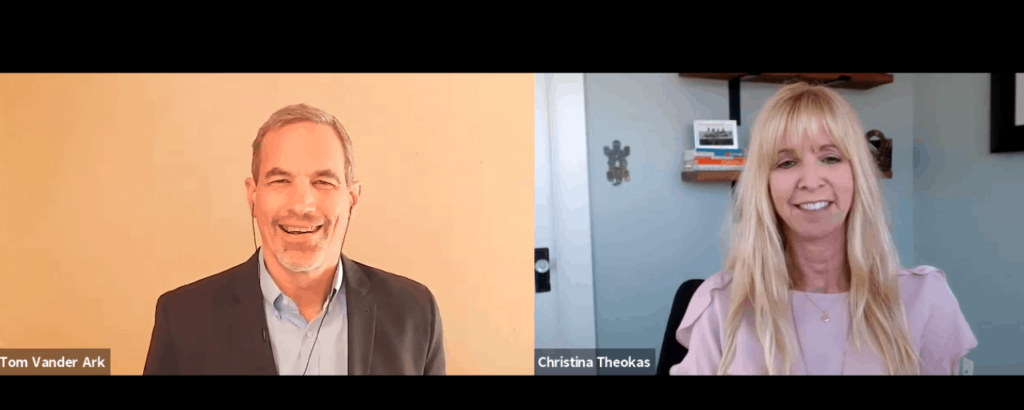
You are listening to the Getting Smart podcast where we unpack what is new and innovative in education. I’m your host Jessica and today Tom is talking with Dr. Christina Theochis, Chief of Applied Science at Turnaround for Children, about the whole child design movement and the new toolbox from Turnaround.
The Turnaround for Children toolbox is an online hub created by educators for educators and is backed in science, research, and passion. With this tool you’ll be able to create a supportive environment, cultivate developmental relationships, and build students’ knowledge, skills, and mindsets. Christina formerly was at the National Center for Urban School Transformation where she
studied the teaching practices, systems and structures, and leadership of high-performing urban schools and worked with educators to implement those strategies in their schools. She has studied and written about opportunity gaps for students of color and the low-income student experience. Let’s listen in as she speaks with Tom about why whole child education matters now more
than ever and how educators and leaders can get started with implementing these mindsets and approaches in their strategies. Christina Theochis, welcome to the Getting Smart podcast. Hi Tom, nice to see you, glad to be here. It’s great, we’ve talked quite a few times this spring and so it’s a treat to be able
to do it in public on the podcast. Christina has reminded that you went all the way through a PhD in psychology. I wonder from undergrad through your PhD if you remember discovering whole child literature, what was your introduction to this idea of whole child learning and development? Yeah, so my training is as a developmental psychologist.
So healthy whole child development has always been my passion and purpose. It was what I chose to do as an individual, but it’s through my journey in the education ecosystem from all of these different vantage points that has continued to push my thinking about what whole child development means, what whole child design means. I started my journey at an alternative school and it was an interesting place to start working
in a school because the therapeutic environment dominated the environment, but we were thinking about individual development along with disciplinary content at the same time. So that was normal for me to think about both of them simultaneously and how do we make the setting better for kids. And then as I moved away from that alternative setting and into other settings, I realized
this isn’t the case in other places that we often silo things and we think about academic development and we think about social emotional development and we ask kids to survive in the system. We don’t actually change the conditions to support their thriving and put them on a positive developmental trajectory.
So I’ve been lucky enough to do some program and curriculum development in school and out of school, work in the policy and advocacy space for a period of time, school leadership, learning network improvement communities. And it sort of flew through all of those different vantage points to think about like how can we improve the system for all kids and in particular, how can we do it for the kids
who’ve been marginalized and oppressed by the system for so long. So it’s exciting that I’ve been on that journey the whole time, although I didn’t call it that I call it that now. And instead of like all come together and I can see all these different pieces and I’m super excited about the potential that exists right now to integrate those pieces and really
get the ed system that we all really want to care about for kids. Christina, you have had this whole career view of whole child learning and development and I do, I appreciate how you described the way that you’ve been able to think about whole child development as an educator, as an advocate, an operator. Maybe let’s back up and just describe what is whole child learning and development?
What are the elements of that perspective? Yeah, so I think that the premises are certainly the way I come at it from it. I come at it from a developmental systems thinking approach. And that is where you want to marry the engaged, competent, active young person with a supportive and nurturing ecology and understanding that it’s the relationship between the child and
the environment around him that produces healthy development. And it’s our job as educators to create those conditions to support that development. And if you kind of take that perspective, it really caused you to think differently about schools. If you’re going to embed a whole child purpose in a system that wasn’t designed for, the system that was designed to sort and track kids and reward disciplinary content knowledge,
it really makes you start to think about things differently because then you’re thinking about each individual child. You’re not thinking about all kids and the average and sorting and tracking along these big benchmarks. And you start thinking about education differently. You start thinking about what would a nurturing context look like for kids? And it’s like, well, it’s personalized. It’s individualized for the needs and assets of
each kid in the system. And so you start sort of making different decisions about specific practices, particular structures, particular systems. And for me, very much so, thinking about whole child design, whole child development, we really have to sort of confront and look at the system that we have. We have to disrupt and dismantle those structural inequities that have been built into the system from the very beginning. So part of it is like facing that head on,
having direct and honest conversations about that and saying, okay, where are we going to start? How do we build a better system? How do we reimagine and redesign a different system that actually looks at each individual child and creating that supportive context around them? That will put them on that positive development trajectory that is unique for each student. And I think for me, like starting in a special ed setting or alternative setting,
that was the approach. And it’s like, a lot of my learning there can be applied to this now. And I think it’s that we, I found that you can actually do it. Oftentimes we think in education, oh, we can’t do that. It’s not possible to do that. But we actually have a model for how it can be done. And we just have to think about how we can bring that to scale to more kids, more classrooms, more schools. Christina, people around the world have, have chaired a pandemic this year. And
many educators concluded that they needed to pay attention to social emotional learning. That seemed to get a good deal of press this year. Is that really a subset of whole child education? Could you put that into, put SEL into the context of whole child learning and development? Yeah, I agree with you that the dual pandemics this year really are causing us to think about a hard reset. And how do we do school differently than we have before in the past? It really
exposed the vulnerabilities in the system and is suggesting something different. And when I think about social emotional learning or SEL as we’ve been calling it for years, I see that as we have momentum to build from there. Schools have been thinking about that for a while. And the reality is it’s always been the implicit curriculum in schools. But as we’ve evolved in ed reform, I think it’s got pushed to the side. But the idea is that we need to think about
holistically about kids. Like that’s what’s really positive about. It’s not just academic skills, it’s social skills, emotional skills, cognitive skills. And so we have a momentum of SEL. But how, how it has been is that it’s been two different things. There’s academic knowledge, content learning, and then there’s social emotional learning. But what we know from the science of learning and development is that learning is integrated. The academic part of your brain,
the cognitive part of your brain is not different than the social emotional part of your brain. And it’s really the relationships and experiences and emotions that you have that’s going to drive learning and development. So I think we have really good momentum with that and the pandemic real like resurface the idea of wellness and well-being and thinking more holistically about kids. And as difficult as this past year has been, I’m hoping that it’s a tipping point that we can
really do that hard reset and say, wait a minute, okay, we’ve been we’ve been doing some good things. But how do we do them differently to actually get the outcomes that we care about because we’re not getting to those outcomes that we care about for kids? Christina, you’re the Senior Vice President of Applied Research at Turnaround for Children. Turnaround is the I think of it as the leading source for what the sciences tell us about learning and development. So you’re really in
charge of integrating and incorporating. And I said science is plural because I think Turnaround uniquely looks across all of the related sciences to integrate what we can learn about learning and development. And you’ve recently tried to summarize all that you’ve learned in the last decade into a toolbox. Tell us about why the team at Turnaround decided to try to summarize the science of learning and
development into a toolbox for educators. Yeah, I think it’s one of the things I love about Turnaround is that we look at diverse sciences. We look at brain science, cognitive science, learning science, developmental science, and we look across them and say, what are the themes? What is the direction all of these things are pointing in? Are there some converging ideas that it’s important for all educators to know about? And if they have that knowledge and if they have applied resources
at tools, how can they innovate and design differently in their schools? And so the toolbox is meant to be sort of that online hub of those resources. I was mentioning I worked in a school for many, many years and I know when I was working in a school, I did not have time to stop and read all the research, all the literature, synthesize it in my head and say, okay, how do I apply this to my practice? And we really see that that’s our role and our responsibility and that’s our contribution
to the ecosystem. If we can kind of take that knowledge, how does it converge? And then how can we present that to educators in a simple, accessible, actionable way? Educators are eager to learn new things. They’re eager to improve their practice. They’re thinking about the holistic development of kids, but where do they start? And so the toolbox is meant to be a place where they can start and that there are multiple entry points into this. So for example, someone might be really
interested in the science and we have found that the science often causes that aha moment for people. They’re like, oh, I get it. I didn’t have that piece of information. Now that I know that, I’m going to do something different this way. Sometimes people just want to like explore that. So we try and make that we simplify all the science down into five core science practice principles for people to think about. If you can hold on to those five, it’ll it might help you to start doing things
differently. Some people might have a problem of practice that they’re that they’re faced with right now. And they’re like, I just haven’t had a really hard time connecting with my kids in this hybrid environment. I really want to build relationships. I want to build deeper relationships where I can really get to know my kids and what they’re experiencing. So they might go to the developmental relationships area and look for a tool. For example, how relationship reaches my classroom. So it gives
people all that science knowledge that we had, we turn it into like a document that says, here’s a relationship bridge environment. What are you doing? What are you not doing? Where might you want to improve in your practice? So it’s meant to be that like online hub of ideas and resources. And where we’ve done sort of that hard work of taking the science and turning it into applied resources. But we’re also really hoping it creates a community of people who are also sharing their ideas and
resources. We don’t believe that we have all the answers. We’re not suggesting a program. It’s a checklist. It’s really about like learning by doing diving in and creating that innovation. The contexts are different schools have different strengths and weaknesses. And how can how can we support that process by empowering people with some knowledge from the from the field, combined with the practice knowledge into these applied resources that folks can use on a daily basis.
One thing I love about the toolkit is that it is rich with tiered support resources that are quite like role specific to tell us a little bit about the tiered support components. Yeah, and that has really been one of our our focuses this year because of the unique context that we’re living in that we know that there is increased adverse experiences that kids are having with economic insecurity, housing insecurity, stress with the racial violence that’s happening
toward both Black folks and Asian American Pacific Islander folks. And the idea of like an integrated system of support is really important to embed into your system. So oftentimes the system has been and even where I worked when I first started, right, we were a separate school kids got kicked out of their home school to come to us to get the support they needed. But instead, we believe you integrate those those supports into the school environment, you create the conditions so all
kids can be successful there. And you tear how you meet the needs of kids based on their unique assets and their needs. And we really want people to focus on kids assets and the strengths that they’re bringing, as opposed to looking at just the problems that a kid is the worst problem that they have. And so you create the conditions around the student with the relationships with the environment. And then you can build in other supports. The blueprint I mentioned the five big
components, and then you can go one level deeper. And those are what we call core practices. And that and those are ways to kind of enter and think about rebuilding the system and tiered supports as one way to do that. And it has been something that has been really critical this year for folks. And I think the difference for us is really like having it be about assets for kids. And you start building your system that way. And so you start thinking about what can we do differently to
support the kids to help them be successful in the environment that we have. The toolbox also includes a well being index, which is a I think an amazing open resource for schools. Tell us about the index and how it’s used. Yeah, so we have a couple, we have a lot of reflection tools and a lot of like assessment tools to help you reflect on the different systems and practices in your school. And the well being index is a core measurement tool for us. And you can see it’s
really connected to the tiered support. So it’s saying, how can we look at individual kids holistically, quickly, and simply to understand how they’re doing. And again, it was something really important this year in the context that we were in. And so instead of thinking about the problems kids have, which is what we often measure in schools with the youth risk behavior system, or we do all these prevention programs to prevent bad things from happening to kids or kids making bad decisions.
But this is saying, how is each student doing? How are they feeling? How are they functioning? And it’s a quick, there’s an elementary version and a high school version. So the elementary version is a little bit shorter. It’s six items. And then the high school version is 12 items. But if we talk about that secondary version, it’s 12 really simply worded items that are all framed positively. And so kids can stop and reflect and think, okay, how am I doing? How have I been sleeping
well? How have I been getting along with other people? I’m feeling accepted for who I am right now. And then educators can get a really quick snapshot of each kid to see their strengths that they have, and then ways that they might be able to bolster the environment to what we were just talking about in those tiered systems of support for kids so that they can be successful and engaged in their everyday experiences at school. Christina, I think, is there an elementary version and a secondary
version? Yep. Yep. The elementary version is only six items. So both items, both versions, though, are holistic. And then they get at physical health, social health, emotional health, cognitive functioning. So both versions have that. It’s just a shorter, quicker version for the elementary kids as compared to the secondary kids. How often would you recommend that teachers use it? Yeah. So we’ve been working with educators. So we do that synthesis and translation of the
research knowledge, but we also, as we like to say, have one foot in practice, and we really want to work alongside educators to understand how can we make these applied resources and tools usable. So from the research, from the thinking about well-being and knowing that it’s variable, like as context change, kids’ well-being changes, and we want to be aware of that and in tune to that to know what we’re doing with the kids on each day. So our initial recommendation
is you do it once a week. And if you can do it in an advisory with a trusted adult, all the kids stop and think about it. And it’s quick. It takes kids less than five minutes to do, to go through and then teachers get the data on that profile of scores for each kid. But if they do it once a week, you’re checking in, you’re saying to kids, I care about you, I want to know how you’re doing. Is something different this week than last week? And the idea
is it really can start a conversation to say, okay, often as you try and solve problems for kids, but kids can solve problems themselves. Like we just have to invite them into it and raise up their voice and have them tell their stories. So this is another way of doing that. And if you do it weekly, kids are like, oh, they really mean it. They really do want to know. They didn’t just do this one time and forget about it. But this is something we do every week. And it’s a good point to stop and
reflect. Let’s talk about users for the toolbox. Is this for teachers or school leaders or policymakers or parents or a little bit of all of those? Yeah, so I appreciate the question. So the, I’d say like the first audience is educators. And that’s a really broad audience of people, though, from teachers to school leaders to school support staff. And the resources are really oriented for that action, as I had mentioned. So folks who are working in schools to pick up
something, to look at something, do something different with it, with their practice. As I said, it could be a problem of practice. It could be learning about the science. But there are a lot of educators too. They’re educators in out of school time settings, right? They’re not traditional educators, but they have a learning setting. They have kids there. So we also feel like they can use it as well to get those same ideas and resources to think about how they apply into their
setting. And then policymakers, parents, advocates, we think it’s a really good resource to introduce people to what is whole child design? What are the essential components of whole child design? How do you actually bring this about in a school in a new way? So we actually do build something different for kids. So we think it can be a really good resource and understanding for parents, policymakers in that way. But the tools and resources really are practical, action oriented
things that educators can do on a daily basis. I appreciate that, Ante, Christina, it’s a very practical toolbox. Every teacher that dives in will find things that are quite useful to use in class tomorrow. But I think particularly for school and system leaders, they’ll really appreciate the depth when you, the way you dive into tiered support, for example, really helps you think about how you architect a comprehensive system of support right down to
the roles and relationships between all the people that have responsibility for supporting kids. So multiple entry points for anyone that cares about the development of children, right? Absolutely. And as I said, we’re trying to make it be simple and accessible. So how I describe it is you can see the forest and the trees in the forest. So here’s whole child design. Here are the elements, here are the core practices. If you integrate those together,
then you can get to those outcomes that you care about. But you can see the whole and then you can say, okay, my entry point, the pathway for us in our school is this entry point, we’re going to really work on tiered supports. And I can actually really look at the system I have with this reflection tool and say, okay, we’re missing the mark here and here, we have a strength here. Here’s a tool that might help us to be able to do that. But there’s multiple entry points for folks into
whole child design. As I said, there’s no one answer, there’s no one solution, it’s not a one size fits all, but it’s really a visioning tool to really think about the schools that we want and creating the conditions in schools and how we would go about doing that. Christina, there’s a huge bibliography behind this body of work, right? It draws from science in a number of different realms. But I don’t think it’s, you’re viewing this as a
as a finished product, it’s more of a dynamic resource. How will this change over time, do you think? Yeah, we have an extensive science syllabus. People want to do go to all of those resources, although we’ve tried to synthesize it for folks into the toolbox. But we’ve just put the toolbox out and right now we’re in a period of like really looking for user feedback from people. Like, how does this sit for you? Is it simple and accessible? Like we thought, are these tools
actionable for you? Are there things that can be different? So we’re trying right now to build in like active feedback loops to really say, is this the right way to present the material? How could we do this better? We really value designing with folks and not telling folks what to do. So we have a foundational set of resources there that we want to get feedback on. And then over the next few months, we’re going to be filling in those foundational sets of materials. One of the tools
that I’m really excited about coming out soon is what we call our whole child inventory. And I’d mentioned we want to help folks see the forest and the trees. So this is a way of assessing your school’s alignment with these practices. So it’s a reflection tool for folks to use to say, okay, how are we aligned on these? Where are our strengths? Where are weaknesses? What could we do differently? So we’re going to be adding that soon. But we also have the core practices that I
mentioned that you can see in the blueprint. And we’re going to be adding, we have rubrics for each of those so people can see how do you progress along this? Because I think one of the things I’ve experienced in education is when you talk about things, we’re like, we’re doing that. And I’m like, you’re doing that, but you don’t have any outcomes that you really care about. So what, what could, how could you do it differently to actually get to those outcomes? So we have
rubrics for each of the core practices. And then we’ll have like a sample set of tools to get people started with those. And so we’ll be filling in all of those, all of those places over the next couple months. But we really wanted to get some feedback from folks like, is this useful to you? How can we make this even more useful to you? Christina, I want to put in a quick plug for the building blocks for learning. This is a product from turnaround that I think uniquely describes what learners should
know and be able to do these critical skills and dispositions, but in a developmental way. I think almost every other portrait of graduate looks just at exit skills. And your building blocks really do a beautiful job of starting with a foundation of attachment and belonging, the kinds of things that are incorporated into your, into your toolbox. So anything you want to add on the building blocks and why that’s such a critical asset?
Yeah, I really appreciate the plug. And this is like, this is about doing things differently, right? Graduate profiles have been really positive in the field, right? And to me, that that’s the center of the wheel. It’s like, what is our purpose? What is our vision for student success? And I think it’s really important. It’s a really important starting point for communities to talk about the outcomes they care about. It helps you to get on that pathway, right?
The building blocks is sort of like our tool to help people to think about a graduate profile, and then you start thinking about a little bit differently, because it’s a comprehensive student development framework. It’s not an outcome that we’re talking about. And then you can see the pieces and how they grow together in kids. And it’s a way of like understanding adversity and how adversity can influence kids and where they might have gaps on the bottom part of the pyramid,
even though they have strengths at the top part of the pyramid. And how do we build those in kids? And that’s the, how do you personalize experiences for kids? How do you build in those tiered supports to get to that? And that’s sort of like that slight difference to it, to when you’re starting to think about healthy whole child development. It’s not just an outcome and a destination, but it’s that process of how kids grow those skills, like in integrated ways over time.
I’ve thought a lot about student agency in the last few years, particularly during the pandemic. And your building blocks agency is one of those those peak capabilities. And your building blocks reminds me that we have to pay attention to the safety and belonging, the attachment to get all the way up to a full sense of agency. Yeah, it’s one of one of one of my favorites as well. And it sits at the top, but you can see the bottom ones and how they come together to get to
that point and how you can create like interlocking experiences for kids over time, like working on self management is a component of agency, self efficacy, belonging, connection to school, and they interlock together to help kids have that full sense of agency and goal setting as they look toward their future, but that there are foundational skills to build toward that so kids can really operationalize it. Christina, your group has been supporting a number of schools, districts and networks
you know how hard it is to really build an integrated supportive whole child system. What parting words of advice would you have for teachers and school leaders as they think about getting started on their whole child journey? Yeah, it is it’s hard, right? Like we’re asking people to embed a whole child purpose in a system that was not designed for it. So they’re very predictable and known barriers to implementation and they can dissuade us from doing it. I think what
I would say is that we just really believe and learn by doing and jumping in and getting started and doing it in a community of practice with other people. I think you know going back quite a few years you know, Richard Elmore talked about schools being like an egg crate that each person is isolated in their separate little nook, but if we jump in learn by doing and we do it together, I think we have such a better chance of getting to scale instead of some kids having really great
experiences in a school with a teacher, but that we actually are doing it together. We’re just so much more likely to get to the change that we really care about and doing it in a way that we know we don’t have to be perfect right now, but let’s try it. Let’s evaluate how we’re doing progress monitor along the way and then tweak and change to get better at it. Christina, you learned broadly across multiple sciences trying to integrate insights that are incorporated into things like the
toolbox. Can you give us a quick tip on how you stay focused and productive as a as an individual learner? Yeah, so it’s a great question. I think I’m going back to the building blocks. I think I’m really curious and I think many educators, most educators are. It’s why we go into where learners by nature and we want to help other people be excited and engaged about learning. So I think I’m sort of always picking up looking at new things, thinking about how does it relate to
what we already know and are doing and how do we do it better. So I really like the blueprint framework that there’s a foundation and there’s like a starting place to say, okay, here’s what we know now, but we’re going to be learning things about our efforts and how those are changing schools are going to influence what we do. There’s going to be new research. We’re learning even more about how the brain works that we want to like be aware of and then start knitting back into
into what we’re doing. And if we’re sort of continuously improving and we’re open to that feedback, then we’ll stay attuned to all those new things that we can be thinking about. We’ve been talking to Dr. Christina Theocas, the Senior Vice President at Turnaround for Children. Christina, if people want to learn more about the whole child toolbox, where would you send them? Yeah, they can go to our website at turnaroundforchildrenusa.org or they can go to the toolbox
website directly and jump in and get started and try something and tell us how it’s going. What was your experience like? How did you tweak it to make it even better than what we provided for you? Thanks for joining us on Getting Smart Podcast, Christina. Thanks, Tom. It was great talking to you. Thank you so much to Christina for joining us on this week’s episode. We’ve been excited to partner with her and the team at Turnaround for Children on some of the work surrounding the toolbox
and we can’t wait to see it used and shared by educators and ed leaders throughout the nation. For more information on the whole child movement and Turnaround for Children, be sure to check out episode 217 with Dr. Pamela Cantor. I’ve got it linked in the show notes and on the blog. All right, listeners, that’s it for today. Thanks for tuning in for the Getting Smart Podcast. This is Jessica signing off.
0 Comments
Leave a Comment
Your email address will not be published. All fields are required.