

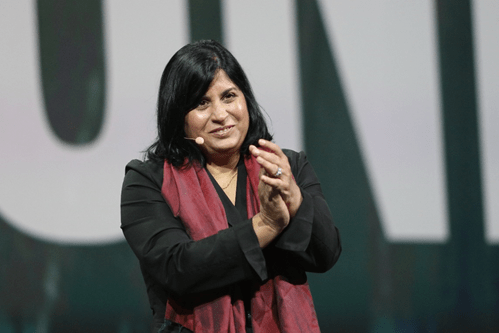
Maya Ajmera on Social Entrepreneurship and the State of Science
- Project-based learning
- See it, do it, feel it, experience it
- Science changing: more opportunity than ever for data sets and for doing real science at home
- “It’s not about testing, it’s about the problems we want to solve to make the world a better place.”
- “It’s not about what you want to be when you grow up, it’s what problem you want to solve.”
- Neuroscience
- Climate science
- Systems biology (Leroy Hood)
- Data science (bioinformatics)
- Neural networks/ML
- Synthetic Biology
- Maya Ajmera
- Society for Science & the Public
- Science News Magazine
- The Global Fund for Children (GFC)
- International Science and Engineering Fair
- Regeneron Pharmaceuticals
- Getting Smart Podcast Ep. 233: “Rebecca Parks on Learning and Exploring Through Nature and Science”
Transcript
This transcript has not been edited for spelling accuracy.
You’re listening to the Getting Smart podcast where we unpack what is new and innovative in education. I’m your host Jessica and on this week’s episode, Tom sits down with Maya Jamira, CEO of the Society for Science in the Public and publisher of Science News. Previously, Maya founded the Global Fund for Children, otherwise known as GFC, a nonprofit
organization that invests in innovative community-based organizations working with some of the world’s most vulnerable children and youth. She is also a celebrated children’s book author of more than 20 books. Recently, Maya was awarded the 2020 Public Service Award by the National Science Foundation. In this conversation, Tom and Maya discussed social entrepreneurship, why science matters
now more than ever, and her extraordinary journey through the world of science and impact. Let’s listen in. Maya, it’s rare to welcome to the Getting Smart podcast. Thank you so much for having me, Tom. Maya, I understand that you were a very young scientist.
What was it about duckweeds that entranced you as a 13-year-old scientist? I grew up, I’m the daughter of Indian immigrants. I grew up in Eastern North Carolina in Greenville, and I had this wonderful opportunity to work with a botanist, and he studied the growth of duckweeds. For me, what was important about it was that it could be thought of as a future source of
food. It was a high concentration of protein. I worked in a lab studying the growth of duckweeds under different circumstances, light, a kynotin, which was a growth hormone, and really learned the basics of scientific research. I would also say scientific integrity.
I had a thick notebook, and I would have to come in every day and count the duckweeds, and I had to count it five times, and I had to put the numbers in the laboratory book. We would change the experiments. For me, that became a way of thinking about questioning. If something didn’t work, it actually gave you an answer, Tom, that a lot of people say,
if something doesn’t work, it’s over. Actually it’s not. It actually tells you an answer that you can think about a new way of doing it or thinking about the problem. That’s when I got turned on to science.
I’m the daughter of my father being a physicist, my mother an entrepreneur. I grew up seeing NOVA on television. I grew up reading the magazine, I’m now the publisher of Science News in our household. It was all kind of ingrained. It’s been around for 100 years, isn’t it?
That’s right. Science News, we’re celebrating our centennial next year. It was founded by E.W. Scripps. We’ll come back and talk about that. Was that early science experience when were you an early student at the North Carolina
School of Science and Math? I was in the fourth class. I was one of the guinea pigs of Governor Jim Hunt. Governor Hunt had an enormous vision that he wanted to create the next generation of science, technology, engineering, and math leaders in the state.
He took a great leap of this energy and vision in the early 80s and said we’re going to create the first public residential boarding school for juniors and seniors who are talented in science and math. Not only that, we’re going to really think about diversity. We’re going to get kids from every single county, 100 counties across the state to come
to Durham at Watts Hospital. I was part of that experiment. Now when we look at the fact of how many of our alumni and the return on investment that has happened from that high school is quite extraordinary. The other piece on that, Tom, is that they’re now opening their second school in rural North
Carolina in Morganton. It’s going to be on data science and environmental science. We’re very excited. I’ve been a trustee of the school. I’m a big cheerleader.
Maya, that led to some research that you did as an upper classman on gut bacteria that ended up getting you recognized as one of the nation’s leading young scientists. That was a super important developmental experience, wasn’t it? Yeah. The School of Science and Math has a program called the Mentorship Program.
I knew that that’s something I wanted to do. I ended up working with a professor at the Department of Microbiology at Duke and did a project called the isolation and characterization of tetracycline resistant plasmid of an animal isolate streptococcus calis SF2 and entered it in the Westinghouse Science Talent Search. I founded online last night.
Oh, you did? Very cool. So I was able to enter that. Again, I was a science fair junkie from the age of 12 onwards and entered this competition. I was honored to be one of the top 300 young scientists.
Maya, can we both agree that every learner should have the opportunity to be part of a science fair at least every other year from grade 6 to 12? Absolutely. Project based for… They’re awesome, right?
Yes. And the opportunity just to go deep on something that is of interest to you for whatever reason to study it, to learn about it, to formulate an opinion on it and then to be able to express that publicly in writing and in oral presentation. What a super important opportunity.
Every student should have a chance to do that several times in secondary school. Well project based learning is absolutely critical to solving the world’s most intractable problems and science fair is a great way to defend your work, to present your work, to cross collaborate and also to win extraordinary awards and gets you on your road to college. And it’s an extraordinary opportunity and this country has been a great believer in science
fairs but also throughout the world. And the organization I work for, the Society for Science in the Public, helped found science fair in 1950. Is that right? That’s awesome.
Yeah. So we’ve been at the forefront of the whole science fair movement and building that throughout this country and around the world. I’m just going to add one more plug for science fairs. We’re in the spirit of time where the old college entrance exams are less important
than they used to be. There’s fewer colleges paying attention to them. More colleges and employers looking for young people that can really distinguish themselves, people that have a sense of curiosity, that spot opportunity that can express an opinion that can demonstrate self-directed learning.
So science fairs are a terrific way to really build a portfolio of evidence of who you are becoming and what your aspirations are that I think higher education really values today. So do science fair. Maya, at some, if you went to Bryn Mawr and you studied science, but at what point did you make the decision between basic science and public policy?
Tell us about that fork in the road. Sure. So I am one of those typical Asian kids that was going to become a doctor or get in my MD, PhD. I received a fellowship after college that allowed me to travel from Thailand to Pakistan
for a year. And I had wonderful professors who said, Maya, if you really want to understand people and understand their aspirations, get a backpack and start traveling for a year. And that’s what I did. Oh, great advice, right?
Right. Life changing advice. That’s right. It’s what I call in India, I had my moment of obligation where my parents are from. I was on a train platform and I saw, if you’ve ever been to India and you’ve been to a train
platform, they’re pretty chaotic places. They are. And among this chaos, I saw 50 kids sitting in a circle learning how to read and write. And there was a teacher teaching them with flashcards. And I was totally mesmerized.
These children are obviously quite destitute. And I asked her with my friend who spoke the native language of Aurya and I speak Hindi. I asked her what was going on. And she said, well, these children live on and around the train platform. They work, they live, they beg, they sleep, they eat, but they don’t go to school.
And a social entrepreneur decided she was going to bring the school to the children. And I said, that’s really cool. And I said, what is it cost to run one of those schools? And she said, at that time, it cost $500 a year to run one school with 40 kids to run two teachers and a hot meal every day.
And it was there that I had that moment of obligation of how do I help? And how come I don’t see more train platform schools all over India? And so I decided throughout my travels, I started seeing these homegrown community innovations take, you know, taking place. And I decided, you know, I need to go and learn more about this.
So I went to the program at Duke in the School of Public Policy and took courses in international development, economics and education and decided to put off the MD PhD to the horror of my parents and decided to found the Global Fund for Children when I was 24 years old. Wow. That was 28 years ago.
What an extraordinary institution that has been. This is really before the modern age of philanthropy, when this sort of thing has become more common. You are really a pioneer in identifying global impact opportunities, framing them up and then helping to fundraise for high impact philanthropy around the world. So I think a lot of the development that we’ve seen globally, at least in terms of
how it’s been supported by philanthropy, owes a lot to you and the Global Fund as a real pioneer. Thank you. You know, it was it was incredible. It still is an incredible journey because the institution lives on without me, which is a good thing. But I let it for 18 years.
We went, you know, we were searchers. We went out and searched for extraordinary grassroots, innovative leaders who were serving the most vulnerable children and youth in interesting and new ways and giving them small amounts of capital and making sure that these undervalued and undercapitalized organizations would be able to be robust and be able to be sustainable and scalable.
And we take great pride in the fact that the organization is invested nearly $50 million and over 800 NGOs and touched the lives of 11 million children thus far. But you know, Tom, after 18 years, I turned 37 years old and I had a very strong feeling that, you know, I could be with the Global Fund for the rest of my entire life. But I also felt that founders needed to move on from the things that they create.
And so I let my this baby go off to college and said, I have done what I needed to do. And I went on to the School for Advanced International Studies at Johns Hopkins and wrote a book and became a visiting scholar and started teaching. And I revel in the fact today, when I go by 14th and K Street, I say, Oh my God, I built that thing. That’s really cool.
I really will hand it to the extraordinary program officers that work at the Global Fund for Children who go out and search for these incredible organizations, but also the incredible grassroots leaders. I mean, our world, the way I thought about it then was we had to turn international development upside down on its head. That the big organizations was not what’s going to be happening in the 21st century. It was really the local institutions, the local organizations that were going to create change in their communities.
And I’m still a big believer in the world of science that I live in now, that the world, that the grassroots community is where you’re going to have to reach people. It’s not a top down approach. But that’s my theory of change. Yeah, I appreciate that, Maya.
You were you were also a pioneer in that regard. I think we’ve learned through a lot of failure in the last 20 years that doing improvement to people really doesn’t work. That you really have to do improvement work with people. And I think that spirit and that approach are things that you embodied at the Global Fund. So tell us about your entry at the science, the Society for Science and the Public.
Why and how and when did you take on your new role? So I was at again, I was at CICE. I was minding my own business teaching. I had I had a little baby girl in the meantime. That was one of the other reasons I needed a sabbatical.
And I got a call and they said, you know, Maya, the Society for Science and the Public is looking for its next CEO. And I laughed. I said, well, you know, I haven’t done science since college, right? They said, well, but you’re an alum of the Westinghouse Science Talent Search, which we founded. You did science fair.
You founded a nonprofit. We’re a nearly 100 year old institution and they’re looking for an entrepreneurial leader. Wow, you know, somebody who’s a founder coming into an organization that that’s old was really interesting to me. So I went in for an interview and didn’t think I had a shot. I was interviewed by eight elderly white gentlemen.
They were very kind to me, Nobel Prize winners, CEOs of major companies. And I didn’t think I had a chance. But lo and behold, they said, you know, you’re our person. We want you to come and lead this institution into the next century for the Society for Science and the Public. And I said, OK, I think what makes it really special for me
is that I’m an alum. I did science fairs. I entered Westinghouse Science Talent Search and I saw my dad read science news. And that became a cornerstone for me of how to be very passionate about this. But to also think about when I came in, I said very clearly that diversity, equity and inclusion was very, very important to me.
That we needed to make sure that every young person in this country could become a scientist or engineer. That’s what they wanted to be. And we needed to make sure that those opportunities were readily available to all young people. And so I went in with that mindset and we’ve actually now have a very major, robust equity program at the Society, including the work of our three major competitions and science news, which I’m publisher of.
Say a few more words about the equity agenda. In what ways do you try to ensure equitable participation in your program? So there are a couple of things. One thing that when I came on board, we started hearing from teachers is that the science content that they were working with was old. Textbooks were falling apart.
They didn’t know what to trust online. And that became really interesting for us to think about science news, science written for the layperson. But interesting. And we thought, how do we get science news into the classroom? And how do we create a learning guide where teachers can use it?
So we piloted a program in 2015 with 200 schools. And it went like wildfire, actually, Tom. Today, we’re in over 5,000 high schools working with nearly 20,000 STEM teachers, reaching about a third of high school students that are using science news in the classrooms and having evidence-based science journalism and discoveries in the classroom.
That, for us, is great. That’s just one of our programs of scale. We want to be in 10,000 high schools. And teachers have to apply for this, frankly, Tom. It’s not like we dump it into the high schools.
Teachers have to come and apply. So we’re really excited by that. Teachers matter. We have research teachers conferences. We have an advocate program, which is a mentorship program.
It’s called the official nudging program, where teachers create a posse of students that have done research, but they don’t compete, Tom. They don’t compete in the science fairs. They’re too intimidated. So these teachers create a posse of students and nudge them along that process.
And this, in the issue of equity and inclusion, has been incredible. We’ve had outside evaluation done on that project of where we’re seeing underserved kids from rural areas, kids of color that are competing, and are moving on and getting awards and going to college and thinking that they’re going to become an engineer or scientist when they grow up.
So these sorts of programs are really important. And we need to do more. I love that. I appreciate that you’re thinking hard about student motivation and inviting young people in instead of a competition that feels like it’s keeping them out.
Right. Right. Right. You took over a really well-known publication, perhaps the most well-known science publication at a time when it was super challenging to be a publisher.
Maybe a little backstory on the publishing business and how you’re rethinking the business model behind your enterprise to keep science for the public out in front. How are you doing that? So Tom, in 2014, I walked into an enterprise that had been deep in debt for about 10 years. It was like all magazines and newspapers that was just like this.
Your subscribership going down, advertising was going down. And my board had said very clearly, Maya, you have three options here. Shut it down, sell it, or make it sustainable. But we can’t keep the bleeding going. We can’t keep an enterprise going that’s bleeding about a million and a half to two
million a year. So this is where science news and high schools came in. Remember, I told you the 5,000 high schools? That’s become a cash cow for us because corporate sponsors, philanthropists, government entities want to be in the high schools and want to invest.
So they’ve been paying for that $500 a high school. And so that had turned us completely around. Then we did a whole big digital infrastructure change. That science news was not only going to be a paper magazine, it was going to be a highly sophisticated digital enterprise.
And we did a complete makeover on that as well. And then I had to change the business model, that it wasn’t only going to be subscribership and advertising. I had to look to philanthropy. I had to look to philanthropy.
And I had to look to our subscribership, that had been our subscribers for 50 years, 60 years some of our subscribers are around. And ask them for the first time, if you want science journalism to be around, a core to our democracy, I need your help. And lo and behold, our subscribers really listened and they became our individual donors.
And that having a mixture of different revenue sources has helped us become sustainable now. You can’t think of just subscribership and advertising as a way to make journalism work anymore. My brilliant answer to that, because it’s a high impact answer and a sustainability answer. So love that story.
But we as a society are facing a new challenge that in the last 10 years, with the rise of social media, we’ve seen what appears to be a disregard of science or a distrust of science maybe a loss of a shared sense of reality, a shared regard for science. How do you think we regain that? And what role is your organization trying to play?
So I’m going to be pretty blunt about something here. I truly believe that the individuals out there that are questioning science don’t believe it in it. I’ll just say the mask wearing being one very big example. I wonder what their science programs were like in high school or in grade school.
And this is where it becomes a huge problem is when the public school system science programs are disintegrating, then that knowledge disintegrates for our democracy, frankly. And that becomes a real problem. And for us, there’s a two pronged issue. For us, there’s a two pronged way of thinking about this.
One, we have to reach young people. So science news in high schools is one way of doing that. The other way is science news now. For example, all our COVID coverage is free. And we work with nearly 800 local news outlets to get that information quickly to the local news
outlets because they can’t afford to pay for it. And so what do we do in the meantime for the adult population? I think we have got to make sure that our journalism stays intact. It just has to. And science news is not the only group.
I am talking about our local newspapers. I am talking about our national newspapers. We have to stay intact if we’re going to fight against the misinformation out there. I loved your initial answer about the nature of science in high school. I’m afraid that some of this trust may have been the rise of testing in America and that
science went from doing science to memorizing science. I just think how different your experience was as a student and how engaging it was because you weren’t learning science, you were doing science. Let’s spend a few minutes talking about what science could look like in middle and high school.
You already said that it should be more project-based. But do you have any more examples of the kind of science learning that you’d like to see more of in this country? Absolutely. So I actually think that, so I’ve said project-based learning is absolutely critical.
Having to see it, do it, feel it, you know, experience it, right? It’s not about sitting back and being a passive learner when it comes to science. I also think science is changing so rapidly that you can actually use big data sets. You can actually be doing science at home now. You do not need to be in a research lab to be able to do really interesting science.
I also think that our research teachers in the high school realm, that is really starting to take a fire speed now of a different way of learning. And I think this has got to be, it’s not about testing. It’s about the problems we want to solve to make the world a better place. And one thing I always tell young people, Tom, is this, don’t think about who do you
want to be when you grow up. Think about what problem do I want to solve when I grow up. And when I talk to young people about that, they kind of go, huh. And always, it always comes down to something very personal, something in their community that they think they need to think about solving.
And I truly believe that we need to inspire this next generation about being the stewards of our world. And I don’t think we’ve done a very good job of that, frankly. I also will also just want to say, I really believe in this idea of, you can’t think of science in its narrow way anymore.
Like I’m going to go be a chemistry major or I really like biology. Think it out. You got to think about being a Ruthless Interdisciplinary when you grow up, right? You got to think that everything is interconnected. And that means that you’re going to have to take courses and a lot of different things.
And boy, that makes it fun. I really wish I could go back to college and take a bunch of… So many of the important innovations happen at the boundary of historical disciplines. So I think this is also why young people need to become comfortable working with diversity, diverse talent in every respect, right?
Diverse in personal background, maybe diverse in location, but also diverse in expertise, diverse in the cognitive makeup, right? People that just think differently and come from different backgrounds. It’s in those sorts of teams studying issues at the boundary where the most important breakthroughs are happening.
Tom, can I give you an image? So the Society for Science in the Public founded science fairs. We’ve been building them, but it culminates every year into the International Science and Engineering Fair where we bring 2,000 kids competing across 21 judging categories from 80 countries, regions, and territories.
It’s a kumbaya moment, frankly. But when you look at these kids all cross collaborating across different projects and talking to each other, that is what the future is about. And I frankly think science is a powerful tool for diplomacy. Science is a powerful tool for young people to think about the aspirations and inspirations
that they carry. I’m wondering now about entrepreneurship and the link to impact and what we could be doing to introduce more young scientists to impact models, but the opportunity to start companies, the opportunity to launch social enterprises, is there an interesting intersection there between science education and entrepreneurial mindset?
So we have 75,000 alumni at the Society who competed in our competitions and many of them go on to academia, the routes of research or industry, many of them have started companies. Let me give you one great example. When we were looking for our third sponsor of the Science Talent Search in its 75-year history, we had two, Westinghouse and Intel.
We went after, I basically told my board, it’s a great story, Tom. I said, I’m not putting out my tin cup and beg people to become the next sponsor. We’re going to have people apply to us. So we had 50 philanthropists and companies apply. And the company that won were two kids that were Westinghouse kids.
They competed at Westinghouse and they co-founded a major biotech company called Regeneron. They are on the forefront of the therapeutic. George Encopolis was one of the winners in 1976 and Leonard Scheffler is the CEO, Schleifer is the CEO and he was a mathematics kid. They gave us $100 million for this Science Talent Search.
Think about that. Think about two kids who grew up in New York City, George Encopolis, the son of Greek immigrants who went to the Broad School of Science and lunch life were going to forestels and doing these projects but having such an important that was so important to their trajectory and they built this incredible biotech company that’s now at the forefront of COVID-19.
But I will also tell you the chief scientific officer, Eli Lilly, Daniel Skrivonsky, he is also a Westinghouse Science Talent Search kid who’s on the forefront of therapeutics. So you know, I take great pride in the fact that we have 13 Nobel Prize winners. We have Oodles of MacArthur Prize winners. We have people that are on the forefront of starting new companies as we speak who are
very young. So I’m really excited by what the future holds but we have to do much more. We have to do much more. I’m wondering with advice to young people in mind, what areas of science are you most encouraged by?
You talked about interdisciplinarity but are there any areas of science that you think might be under investigated right now that hold real promise for the next 20 years? I think neuroscience is incredible. It’s fascinating right now. I also believe climate science, climate change, but that’s going to be looked at from a very
interdisciplinary perspective. I also think, you know, Leroy Hood’s work on systems biology with Leroy Hood is also a Westinghouse Science Talent Search kid like me. Is he right here in Washington? Yes.
He’s a systems biology group. Big data science, bioinformatics. And then of course the role of technology, right? Machine learning, neural networks. But with that I think of those as tools to solve the problems.
They aren’t in itself, you can look at it in its own bubble. So we see our young people using that as tools to solve a problem in plant science or in animal science or in translational medicine. So yeah, I think and science is changing at such a rapid pace. I don’t know if you’ve seen your old biology book lately when we were in school but I look
at it today and I’m like, dad, bag. And it changes year to year and that’s what I’m worried about with our public school system is how do you keep up with that rapid pace of change? Sounds like your advice is to scan broadly, find causes that you’re really interested in and then try to learn about them in an interdisciplinary way, maybe deepen the science
then as well as the data tools that would help you investigate the science. Is that close? And I also want to put a plug in for the humanities. In this day and age the humanities is absolutely vital, especially with the technology tools that we work with.
So I’m a big little bit of a student. To think critically and to be able to express yourself persuasively and concisely are super important. Why you recently won this really cool award from the National Science Award, they named you the 2020 public service recipient for inspiring generations of young people to be
science and technology leaders and innovators. That is really awesome. Congratulations. Thanks. I was shocked when I got it.
It’s really about the society’s work. It’s very little to do with me. Well, you’ve done amazing work there. It’s been great to see that organization reinvigorated. If we look ahead for Maya and the society, what do we see?
What’s next for you and the society? Well I want to be able to celebrate our 100th birthday next year. So I’m really excited about that. And for all the listeners, we’re going to be doing some really extraordinary digital celebrations.
There’s going to be a century of science microsite on science news. So go and look at our 90,000 articles and how they all connect to the different discoveries of today. Really cool stuff. What is in store for me?
I am still on that path of justice. And I don’t think that’s going to end, whether it was the Global Fund for Children, the Society for Science in the Public, or something else out there. Right now, we need to do more for our young people. And we need to make sure that every young person in this country can grow up to become
a scientist or engineer if that’s what they want to be. Maya Ajmir is the CEO of Society for Science in the Public. Where can people find you online? They can find us at www.societyforcients.org. They can find me on LinkedIn.
You can also find sciencenews.org. Yes, sciencenews.org. www.sciencenews.org. So please, we’re in different places. And if any teachers are listening to this, please reach out to us.
We would like to hear from you. We have quite a few resources. We also have a very wonderful, robust grant-making program where we support teachers, as well as STEM nonprofits throughout this country. We make grants to STEM social entrepreneurs up there.
So we really want to be supportive as possible to everyone who’s on this journey. That’s great. We deeply appreciate the work that you’re doing at the Society. And congratulations on the big NSF award. Maya, thanks for joining us.
Thank you so much, Tom. It’s been a pleasure. A big thanks to Maya for joining us on this week’s episode. We strongly believe in her commitment to keeping science at the forefront of progress and are humbled by her continued work to solve international challenges.
If you’d like to hear more about learning through science, check out episode 233, Rebecca Parks on Learning and Exploring through Nature and Science. We’ll put a link in the show notes. That’s it for today, listeners. But before you go, don’t forget to rate and review the podcast.
And as always, thanks for tuning in. For the Getting Smart podcast, this is Jessica signing off.



0 Comments
Leave a Comment
Your email address will not be published. All fields are required.