

Michael Horn on The Next Chapter

- Michael Horn on Choosing College (podcast)
- Abby Falik on the Benefits of Global Service (podcast)
Stay in-the-know with innovations in learning by signing up for the weekly Smart Update.
Transcript
This transcript has not been edited for spelling accuracy.
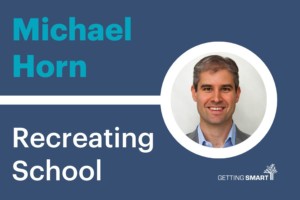
You are listening to the Getting Smart podcast, where we unpack what is new and innovative in education. I’m your host, Jessica, and today we’re bringing you an interview with our friend Michael Horn. Michael spent the last five years leading the higher education consulting practice at
Entangled Group. One of their early investments was Guild Education, a venture-backed startup leading the education as a benefit movement. In May, Entangled was acquired by Guild Education, and together they’ve launched Next Chapter, a new kind of out-placement service to help laid-off workers access the training and job
opportunities they really need. Let’s listen in as Michael talks to Tom about Guild in the Next Chapter. Michael Horn, welcome back to the Getting Smart podcast. Thanks for having me, Tom. It’s always good to be with you.
I’d say reassuring, actually, in these times to be with you. Michael, have you tried to explain what’s happening in America to your kids? My wife and I are talking a lot about how to have those conversations. We’ve started to broach it a little bit. There’s two levels of this, right?
With the COVID-19, and for those that don’t know, my kids are five and two-thirds years old, and I have twin daughters. On the pandemic, I would say they have a reasonable understanding of what’s going on, and we’ve talked about it, and it’s obviously interrupted their relationships with their grandparents, their schools, and so forth.
Major questions for what it means for us next year with them, frankly. More lately, with the anti-Black racism that has been sparked. We’re trying to figure out the right way to have the conversation, Tom. It’s clear to me from the research that you need to be explicit about race with kids. They notice it, and if you don’t fill that silence with context and the importance of
how to act, kids will fill that silence in their own heads, and so you need to be very intentional about it, I think. By the same token, we’re trying to be age-appropriate for five-year-olds. Some of the incidents around Central Park and getting appropriate books and things like that seem like better entry points, maybe, for our age children.
I guess the last thing I’d say is there’s a lot of Black Lives Matter signs and people talking about it popping up right now, and so we are certainly speaking about the importance of that message right now. We talked in the fall about your new book. It’s called Choosing College, How to Make Better Learning Decisions Throughout Your Life.
That came out in 2019, which meant you were writing it in 2017 and 2018. If you wanted to, what’s the two-minute, 2020 postlude? Yeah. You know, updated advice given the awful, bizarre circumstances that we’re in. What do you tell a high school junior or senior now as they think about their education
pathway? Well, I would say a major conclusion from the book was that a lot more students ought to be taking what we call gap years or what I’ve come to call discovery years, where they discover really who they are and how they want to contribute in the world, which your next book, obviously, squarely about this and how we should do a better job in K-12 on
this topic. But I would say that’s been reinforced, right? Because a lot of families now are opening their minds to the fact that if they can’t be on campus in the fall, they’re not sure they want to pay an exorbitant price. $30,000, $40,000, $50,000.
Right. For what’s been a really crappy online experience with schools that, let’s be honest, right? A lot of the schools we’re talking about in terms of the more residential experience, their specialty has never been teaching and learning. And so now you’re asking them to put what’s not a great teaching and learning experience
online in a distance to medium. It’s not a good recipe. And so we, a lot of families are obviously, and students are thinking about a gap year far more seriously than they otherwise would have. And I think that’s a moment where the book speaks to people to push them even farther
to say, how can you view this as not a year off, but a year on, a year to learn about who you are, a year to figure out how you can contribute. And honestly, especially given the spread of COVID-19 and relative risks where youth are less at risk in terms of getting very seriously ill, how can you be, use this as a crucible moment to really forge your character and leadership skills and be on the front
lines to help your communities and help senior citizens and give them the support in healthcare and socially that they need right now. And I think it’s a tremendous opportunity if people can reframe it as such. What’s our friend, Abby Felix, Global Citizen Year? I saw you podcasted with her recently.
What’s her response been? Yeah. So, you know, a lot of the curated gap year programs, they’re moving online. And Global Citizen Year has announced a partnership with the Minerva Project and their platform to basically create a sort of space, if you will, for people to have really important
leadership conversations in an incredibly active platform. So I think that there, I view the partnership as not just sort of moving something online, which I think a lot of the gap year programs are doing and should be doing. And there’s a lot of great ways to get experiences, valuable experiences and work experiences through Parker Dewey and Reipen and others online, right?
But what Global Citizen Year is doing is being super intentional about curating the space for reflection and curriculum, leadership curriculum in essence, so that what they’ve always provided a leadership opportunity and an opportunity to understand one’s purpose can be done really, really thoughtfully, I think. And in a way that they might find that they take aspects of this and actually it ports
over to whenever they’re back in person and sending people around the world, that they actually use this platform, I think, potentially, right, to continue to foster those opportunities for reflection and deep conversation. Thanks for that update. We appreciate your book, Choosing College.
And I think now more than ever, it’s time to be really intentional about your own learning decisions. So thanks for the update. Michael, you spent the last five years leading strategy for entangled solutions. Can you remind us of what that was?
Yeah, absolutely. So the entangled group was an education venture studio with a simple hypothesis, which is that the world had shifted from an industrial economy to, you know, insert your name here, knowledge economy, you know, fourth industrial wave, whatever you want to call it. And our education institutions simply had not kept up.
And so we needed an entity that could intentionally build and create the set of for-profit and not-for-profit education organizations that would help usher in an education ecosystem capable of supporting learners and institutions for this new world. And so we created companies, but we also had entangled solutions as part of that, which was a consulting firm to support institutions in their own transformation journey to better
support learners in this world. And yeah, you know, that’s what entangled was, obviously, and tremendously proud of the impact and a lot of what we created there. One of the firms that you were an early investor in is called Guild Education. And Guild, a couple of weeks ago, last month acquired entangled solutions.
Remind us of what Guild Education is. Yeah, absolutely. It’s probably one of the stranger events in education investing history where the investor gets inquired by the investee, if you will. But Guild Education was set up by Rachel Romer Carlson to effectively harness education
benefits in employers to help bring frontline employees into middle skills jobs. And so they’re in essence a platform that helps to unlock the education benefit dollars in Fortune 1000 companies and direct those and work with the employees themselves to be able to choose from a set of learning providers, higher education institutions in concert with their goals and then provide a heck of a lot of coaching and mentorship and support so
that those individuals really can find purpose in what they choose and in fact complete. It’s been exciting to see the growth of that company. I guess I think of them as the founder and chief spreader of the idea of education as a benefit, both of providing access to and encouraging big companies to provide a partial or even full subsidy for continued learning for their employees.
Is that fair characterization? Yeah, that’s exactly right. I think what a lot of people don’t realize is that companies have had these education benefits available to employees for a long time, but employees tended not to use them. And in many cases weren’t aware or employers weren’t as thoughtful about how they could
leverage them for their own strategic aims in terms of upskilling their workforce, helping with retention and so forth. And universities and employers, they struggle to talk to each other, very different languages because it’s not always clear how to work with each other. It’s complicated to use these dollars and figure out where you allocate them and direct
them and pay and so forth on a marketplace of providers. So Guild is really unlocked, I would argue, a benefit that’s been there, but in a much more intentional purposeful way so that it really produces a return on investment for both the employees and the employer. I’m going to celebrate the success of Rachel Romer Carlson.
It’s just super exciting to see a young female founder achieve such success. The idea of being an education warrior and creating access to quality education is sort of in Rachel’s DNA. Her dad, Chris, who heads up university partnerships for the company, Chris and I were on the board of Colorado Children’s Campaign together 30 years ago.
And I just love Chris and have appreciated the many ways in his career that he has tried to expand access to high quality secondary and post-secondary education. And of course, Rachel’s grandfather was Roy Romer. One of my first tasks as a board member at Colorado Children’s Campaign was to go visit Governor Romer and talk about improving access to quality schools for kids in Colorado.
Ryan and I continued to meet on a regular basis when he became the L.A. U.S.D. superintendent at the age of 71. So Rachel comes by it honestly. She has a family that’s just been in the fight for veterinary education for all kids for about 40 years.
Yeah, that’s exactly right. If I remember correctly also, you were at some of the meetings that became the inception of Western Governors University, which her grandfather, Roy, was. Right. No, I was on the founding board with Mike and Roy for Western Governors, which was really
an early effort to extend access and to try to infuse some innovation, particularly competency-based learning in the higher education. Yeah, and it’s, you know, it’s, I think it’s fair to say it’s probably one of the most successful stories of disruptive innovation in our sector in this country that you all seated there and continuing to grow extremely rapidly.
And, you know, Rachel and Gild has built an engine that is now, you know, literally tens of thousands of learners starting new classes each month and expanding access for 3 million working Americans at the moment through the programs that Gild has stood up with a variety of really important employers from Walmart to Disney to Chipotle, Five Guys, et cetera. You know, these are places serving large numbers of Americans who need to get more education
and be directed into pathways that will, you know, not just put them in next jobs, but honestly jobs that have real earning potential and pathways for upward mobility. Michael, part of this combination, this acquisition of Gild is the next chapter at Gild. There’s actually a platform called Next Chapter. Can you describe what that’s about?
Yeah, absolutely. So, you know, it entangled, we were building a company basically looking at the out placement or outskilling space, if you will, where companies historically when they shed employees, there’s a little bit of a, you know, maybe some resume training, maybe a counseling session or two, if you’re lucky, and a little bit of money, and then you’re sort of off your own trying
to find a new job, and maybe there’s some access to job boards. And entangled, we realized, you know, there should be a much more significant investment by employers in really supporting people that they know will not have a long-term future. And in many cases, it’s strategically so, like the employers bring people in for short-term temporary jobs that are maybe heavy in manual labor, and they don’t want them there forever.
That’s not good for their workforces. They want to help them move into other pathways. And so, we were starting to develop a solution to really help those individuals figure out, you know, what pathways were out there, and then provide them with education and training opportunities, and allow the employers to offer a much more robust package for those
people that they would be laying off or letting go. And Gild was incidentally coming to the same conclusion that this outskilling space was important in developing their own product and offering. And as we were working in parallel and then together, we realized it would be better done together fully.
And so, that was one of the bases for the acquisition, but ultimately resulted in the launch of NextChapter, which is this new type of out placement solution, to help employers reskill and then upscale their furloughed and laid off workers and connect them with new opportunities in other sectors. And I’d say, you know, we started building this before there was a recession and pandemic.
It really does feel like the perfect opportunity and need for millions of people right now across the country as they’ve seen their jobs disappear so, so rapidly and really needing to move into places that are at less risk of automation and the like. Michael, I just talked to Ryan Craig last week. I think of him as one of the most important post-secondary education investors in the
world. And Ryan just started a chief partners, a new private equity firm to invest in what he describes as intermediary organizations that do hiring and training. He claims that these firms will be able to take the guesswork out of career planning for individuals, be able to offer high quality learning opportunities often for your debt
free and then reduce friction for hiring employees. I’m curious, what’s your take on his new venture and how is that a different approach to the same set of problems that you’re working on? Yeah, you know, I think it’s going to be tremendously successful. I think it’s a tremendously important set of insights Ryan has had there around not just
reducing the education friction, but then the hiring friction allow, you know, the folks that he’s investing in, right, essentially give a temporary job to their students for some amount of time and then essentially allow employers to, in his words, try before you buy, right, and commit to bringing on an employee with all the cost that can entail if you’re, you know, if you make a bad hire, it’s a really smart way to reduce risk for employers.
And I think it makes a heck of a lot of sense. I think of it as the front end of this, right? It’s a really important way to do last mile training and bring people, connect them in intentional ways, make sure that you know that they’ll have a job and some security when they graduate and they won’t be in debt often pairs an income share agreement to finance
the arrangement. And so I think it’s tremendously smart. And it’s a piece of the puzzle in my mind. You know, I don’t think any of these things is a complete solution by itself. And I think there should be a plurality of options.
I’ve come to believe honestly in the last since choosing college, even more deeply, you know, that the liberal arts are an important piece of this as well, right? It’s not just going to be sort of very narrow job training that actually building the skills that a good liberal arts degree, much as the folks at Minerva are trying to build and so forth, or our friends at Northeastern, you know, Joseph Ayune, the president there talks about the
humanics, really developing this capacity for thinking critically, problem solving, collaborating and the like as enduring sets of skills. I think it’s tremendously important. So I don’t think it’s going to be any one of these solutions by itself. It’s really that what America has always been good at is having a set of or a mosaic, if
you will, of different solutions for different needs. And I think the thing about what Ryan’s creating that’ll be important is the learners before they jump into those programs, being super clear, is this the pathway in the on ramp, if you will, for me, because it really matches my strengths, my passions and so forth and making sure that there’s a good matching function, not just on the back end, but on the front
end to make sure that that we’re picking people who know what they’re getting into. Let me ask you a question about rural America. I was talking to some leaders from the Mountain West states yesterday, and it strikes us that post pandemic, there’s going to be a lot more remote work in tech America. How might rural states help more people skill up to participate in the technology economy
and maybe do it from their hometown? What kind of pathways do you see there for rural America? Yeah, I mean, in many ways, I think this is going to breathe a second chance of life into a lot of those towns that were dwindling and even potentially the colleges that were going to be shuttering alongside of those demographic challenges that many of these places were facing. I think it’s really a shot in the arm because all of a sudden cities don’t look quite as desirable as they did.
We know for a long time, students were flocking to schools that were in cities, right? That was where the jobs were. We saw a migration from Silicon Valley into San Francisco for the jobs, the activity, the connections. It was all about the city life. There was a real drain, obviously, in these rural and ex-urban areas and some communities that were really hurting, which I think explains some of our politics sometimes as well at the moment.
But I think the opportunity, though, is that some of this now may reverse, and it’s obviously a question of will that be durable? But I think for many it will be because they’re going to see that it’s way more possible to do remote work than they ever thought possible. In some ways, it’s way more efficient and productive, actually. That won’t be true everywhere, but I think in many cases it will be. So those states that I think are very intentional about creating partnerships, helping employers realize that there are great communities of potential employees for remote work opportunities and intentionally connecting and curating programs for them,
is an opportunity. And those maybe the colleges and universities in their hometown, oftentimes I’m not sure it will be. It’ll be online programs that do whatever vertical really, really well. And I’ve long thought that a missing opportunity for cities, towns, states in particular has been standing up what I’ve called renewable learning funds, essentially income share agreements, but that sort of replace scholarship funds, if you will. So they refresh themselves because as the individuals who get those scholarships succeed, then they put a portion of the income that they receive back into the scholarship fund, and so it’s a renewable learning fund as opposed to a traditional scholarship where you’re constantly begging for your next dollar.
And I think it’s something that towns and cities and foundations that are deeply invested in these communities could be very thoughtful about establishing similar to what San Diego has done, which you’re familiar with in the workforce partnership, to be super thoughtful about how do you create robust opportunities and pipeline for individuals living in these places. Yeah, that’s interesting. You know, Michael, we’ve talked about micro schools and I’m a big fan of Teton Science School and their national network of play schools. These are our world micro schools. You can think of a higher ed version of that, which could just be a almost an informal study group around a capability like edX or Udacity, where you’ve got three or four peers that are working together on a an inexpensive degree pathway, linked to a technology future. And so we may actually see a version of these higher ed micro schools or maybe cooperative learning pathways that could be quite productive. Yeah, I think that’s right. In the same way that it’s not the case that, you know, Amazon Bonobos and Warby Parker have totally, you know, as they’ve disrupted and that’s very true at the moment, you know, the brick and mortar retailers, right? They actually are, it’s not the case that all retail has gone online, they’re actually opening brick and mortar stores, not to have tons of
inventory, but to provide experience and connection, right, and community and so forth. I think the same thing is probably more so true in higher ed, which is the need for these cooperatives as you just frame them right and these opportunities to come together as a community in person where that makes sense. But with these low cost online programs really robust. And so it actually, it raises a really interesting question for how the sector will unfold because historically I felt like there’s going to be a few national brands like Western Governors, Southern New Hampshire, Arizona State, right, that that’s sort of large swaths of the country. And then you probably have very regional specific schools that do really, really well being hyper local and hyper attuned to the needs of that particular cluster, if you will, of economic activity. But it’s an interesting question if like Southern New Hampshire, just as use them as an example, continues to gain immense scale, the benefits of scaler that you can start to invest potentially in programs and clusters that maybe have the same job characteristics, if you will, right, but are distributed across geography, such that there’s an attractive market there. And then essentially partner with these on ground cooperatives of some sort to provide the community aspects that would be too small and too resource intensive for a place like an online institution to support.
But that could be deeply threatening, you know, to the real local institutions. So I’m not quite sure how this will play out, but I do see the benefits of scale accruing in more than just sort of a national play now, as it may allow the nonprofits in particular to invest in sort of these, I’ll call them niches, but they’re like, they’re niches that transcend geographic bounds, if that makes sense. It’s going to be interesting to watch I was thinking of ASU local in California. You can also think of ASU local in a, you know, in a vacant retail store in a, you know, in a small mountain town as well. So I think we’re going to see a lot of interesting formats and partnerships in the next few years. I’m curious if you’ve given any thought to entrepreneurship and what kind of advice you tell high school and college students about entrepreneurship. I think we’ve lost about 150,000 businesses in the last 90 days, and it looks to me like in a typical year we might have a 600,000 startups or so. Let’s, let’s guess that that’s only 400,000 this year, maybe 350,000.
Any thoughts on how we, and it turns out that entrepreneurship is quite important to economic recovery. So how might we encourage entrepreneurship and how does, how do you see that fitting in with any of the work that you’re thinking about at Guild now? Yeah, well, let me talk about it outside of Guild for a moment and then we can map it back. But the, you know, I, from my standpoint, high school student, part of the high school curriculum, and you’ve written about this aspect should have design thinking right at its core. And I would say entrepreneurship as well. I think that should be a piece of an experiential curriculum where students are getting the skills of what it means to generate an idea, understand demand through it. And I would argue a job to be done lens, but, and then really develop a solution and try to get it out in the wild. And those skill sets that you get from doing it, even if you don’t end up starting something will be tremendously valuable in whatever line of work or contribution you choose to make and really understanding how you pull together a set of activities, right, to create value for individuals in society and recognize I think the inherent nobleness, if you will, of entrepreneurship in terms of delivering value to people, employing people and so forth. And so I think it’s a tremendously important, I would argue, should be an important part of the curriculum in ways that it’s not people should be getting experience around it.
I go a step further, I think, and say, you know, it’s, it’s not just the high schoolers that need to be thankful about this, you know, Clay Christensen before he passed away. The last several years of his sort of research was deeply worried about what he called the capitalist dilemma that that in his mind, the venture capital firms, and other sources of finance in the economy, we’re so interested in short term return. And so in a way to mitigate risk that we actually were not investing in what he would call the market creating innovations. You know, true radical disruption that creates whole new markets because it’s easier to sell out, right, if you will, to be acquired by a Facebook. And so, but but the, you know, the real market creating innovations they don’t return capital necessarily in five to seven years those time horizons can be much longer in many cases, even in today’s modern economy with with the digital tools being what they are. And so I do think there’s another aspect of this is we need to be thoughtful about sources of capital and how we fund people historically who haven’t had access to capital but also with different time horizons that maybe expect the same ultimate return.
I’m not sure it’s realistic to ask investors to, you know, to be less return seeking but but over longer time horizons, I think would be tremendously important to galvanize that and not just have startups but startups that are going to become large enterprises that employ, you know, thousands of people is incredibly important. I get, you know, from the guild side of things, you know, guild is positioned to really work with those employers that have thousands and thousands of employer employees but I will say the skills of entrepreneurship are critical for those employers to, you know, to be able to succeed and thrive and so it’s not. It’s not the case that everyone needs to start something but I think those skillsets that underlie it are incredibly important to develop in intentional ways. Since you brought up Clay and his insight around investing in market creating innovations, I want, I’m writing a blog about this on the innovation challenges that exist in education or more broadly in human development. It feels like we’re stuck in the X prize folks think talk about as a broken market when there’s a blockage to progress and it feels like we have a number of those in education and and it’s in part a set of socio technical inventions that we need to create by that.
I mean a new set of tools and a new set of protocols for how to operate learning institutions or communities and I wonder as you think about your work at guild and your work in K 12. What are the two or three sort of invention challenges that you think need to be addressed in this decade. Yeah, well, you know, look, I think clear linkages of the return on investment, but that don’t just involve shrinking the denominator, right, but but actually can can rethink risk and understand the long time, you know, the long term opportunities that are created from taking deeper investments, whether that be in your human capital and workforce, or in creating new companies and products I think is tremendously important to the upskilling and employment, ultimately, of Americans you know there’s a lot of folks out there who think that there’s just going to be a jobless future and that we need universal basic income as as an answer and look universal basic income, I think could very well be a part of the picture. But I also think part of the hollowing out is just been this very short term spreadsheet minded view of, well there’s two ways to get my return up if I reduce the denominator of expenses right or time, then all of a sudden the same numerator looks even better in terms of an ROI calculation and being very intentional about viewing human capital.
And this is from the guild mindset, not as an expense but in fact as an asset, and really equivalent to research and development, your investments and learning and development, I think are an incredibly important keystone and unlocking a lot more investment that would spur the type of innovation that you’re there and what you’re talking about. And just to be, you know, super clear about it. I, that sort of, you know, if you start to realize that human capital in fact as an asset not an expense, the sorts of investments and understanding the DNA of jobs and what actually leads to successful employees and how would you assess that and then that would unlock alternative and innovative teaching and learning formats right a lot of the like we know that it’s very easy to talk in generalities about the skill sets that that good employees have in certain roles. We also know from our friend Bror Saksberg that a lot of the times the things we believe are important are in fact not as important as we as we think because of our own cognitive biases and as we get to be experts in a field. And so the investment in really breaking down the DNA of what makes for a good employee and understanding those skill sets in deeper ways that those investments just will not be made at scale. I don’t believe unless we can really have a much deeper understanding of what return on investment looks like. What about credentialing of learning? Is that is that critical? Yeah. And is there a downside to, you know, moving to credentialing every aspect of human capability?
Yeah, well, it’s the right question, Tom. You know, so look on the front end, I think we should be much more articulate about the skills that we have that goes deeper than just a degree which is a blanket statement of not much except that you had the persistence which is not unimportant right but the persistence to complete an experience. And therefore had some exposure, right, to the topics. And then for those institutions that are super selective that connotes another set of things but that’s actually that sort of thinking is what keeps a lot of marginalized communities out of jobs out of opportunity and so I think a lot of our belief is that if we can get more precise about what the skills are and how to measure them, you can unlock a lot of innovation and create more affordable pathways for a lot of Americans who’ve been locked out of jobs because of credential requirements to all of a sudden be able to have access to them. And then the second I’ll follow that with saying like I think this is far more possible in those fields that are highly technical in nature where the skills are more readily broken down and understood and that it’ll be a lot harder as you get into more say service oriented right for unstructured work. You know that could remain far more open ended. But if you talk to the folks in Minerva, you know, even they think you can even assess, you know, do that sort of assessment much more deeply and systematically than we do today as well. So I think it remains to be seen a little bit on what the balance is. I don’t think we should ever assume that the totality of human worth is is is possible to capture in a set of assessments and micro credentials. But I also think we can be much more articulate than we are today which would unlock a lot of human capital that we’re leaving on the sidelines right now.
On this invention front, I was thinking about our friend Julia Freeland Fisher this morning in her great book on who you know and her insights that I think have been so important and powerful about important developing all young people build social capital. I was thinking about it while I was running around this morning read Hoffman I listened to his commencement speech for 2020 and he ended it by talking about how important it is to leave high school and college with a social network with a set of connections that both provide insight and opportunity. I know it killed your more focused on learning and credentialing, but any thoughts on policies or tools that could help build this kind of social capital in more equitable ways. Yeah, you know I’ve been struck by Julia’s work that she’s starting to really invest in in terms of how do you measure the creation of social capital and under the notion that you know as as our friend Jeb Bush often says you know if you treasure what you can measure right. And so I’m I’m very interested to see how that all comes out and sort of not from just an absolute perspective but really a building perspective how do we help schools intentionally build social capital and there’s no incentives right now in the ecosystem for schools to really do that outside of if we were more to
significantly track outcomes at which point I think we would see very clearly that you have to build social capital as an input into those longer term outcomes right like we know that I think it’s something like 80% of jobs are not filled by by job board. You know, application blind applications right there they’re more often than not by someone you know that that unlocks opportunity. And so what that says is for people to get ahead in life and get into good jobs, good schools even like who you know is going to be tremendously important and you can’t discount that so I think the measurement work she’s doing is going to be important maybe not as a policy and its own right but so that schools can have a way of measuring and understanding and using that as a way toward ultimate opportunity for individuals, I think will be incredibly important. As a starting point, and I think the sort of deep longitudinal value measurements is incredibly important as well and I’ll tell you at Guild you know, look at an entangled we incubated a nonprofit called the Education Quality Outcome Standards Board, which created a set of
standards for measuring learning across learning outcomes completion satisfaction for graduates placement and essentially a value added salary metric. And we now with the separation, or rather the absorption of entangled into Guild that nonprofit is fully separated it’s got its own CEO now Kristen Sharp, and at Guild, you know we have a deep conviction that understanding the value that programs in part is incredibly important and a critical equation of that is not just the learning but it’s going to be the social capital formation. And so I think efforts to understand those trajectories and not just in a short term way but a long term way that really illustrates a pathway into life right is going to be incredibly important to elevate the importance of that work. Michael we didn’t have time today to talk about the really complicated task of reopening American K-12 schools.
Let’s do a quick plug for your podcast you’ve been doing some great podcasts with Diane Tabiner. What’s that called where can we find it? Yeah, thanks Tom. So it’s class disrupted you can find it obviously on wherever you listen to podcast iTunes etc but it’s also on the 74 the media site for education policy is we’ve partnered with them for distribution and it’s really just to give you the quick plug. It’s for you know for the first time a lot of parents across America or the lid has been lifted if you will on what schooling actually looks like and parents are asking a lot of critical questions and they’re confused in many cases about is this really what learning should look like in this day and age. And so we’re trying to take those questions as jumping off points both to answer them directly but also to provide a window into what schooling could be that looks a much more robust comprehensive and and from a growth mindset for each individual. So people these days can find you at guildeducation.com and on Twitter.
Yeah, you got it. Remains my most active platform for better or worse right Tom. Yeah, for better or worse. I turn out to hit the home button because I’m afraid of the what’s going to show up there. Michael Horne we appreciate your work. We’re looking forward to the next chapter both the platform and the story that comes with it.
We appreciate everything you’re doing to try to extend the opportunity to people in America and around the world. Create more learning experiences for more people. Yeah, huge thanks and huge thanks for continuing to shed light on the bright spots of innovation in the education world K 12 higher ed workforce etc. Because we need to hold those exemplars up to remember there is there is good news and opportunity out there. So thank you.
Thanks Michael. A big thanks to Michael for joining us on today’s episode. If you want to learn more from or about Michael, check out our podcast with him on his book Choosing College. We’ve got it linked in the show notes and on our blog for this week’s episode. That’s it for today listeners, but don’t forget to hit subscribe and leave us a review before you go. We’ll see you next week for a new episode for the getting smart podcast. This is Jessica signing off.




0 Comments
Leave a Comment
Your email address will not be published. All fields are required.