

Podcast: Ron Berger on Helping Students Become Leaders of their Own Learning


 Berger published a beautiful book called Leaders of Their Own Learning in 2014. It layed out eight practices that makes students the locus of learning. It reached the teachers of more than one million students. A sequel was recently released, The Leaders of Their Own Learning Companion. It is based on the same eight practices but includes more examples and tips. Berger piloted the new book with teachers, leaders, and coaches across the country, and used their input to make it as clear and useful as possible for a range of educators.
 For more, see:
- Why Career Exploration Must Be a K-12 Priority and One Way to Make It Happen
- Mastery Learning Objectives and Mastery Thresholds in the Classroom
- Build Support, Innovate, Repeat: Agile Public Education in Colorado
Stay in-the-know with innovations in learning by signing up for the weekly Smart Update.
This blog was originally published on Forbes.Transcript
This transcript has not been edited for spelling accuracy.
We’re listening to the Getting Smart podcast where we unpack what is new and innovative in education. I’m your host Jessica and today we’re talking with Ron Berger. But first let’s learn a little bit about him. Ron taught in a little town in western Massachusetts for 25 years.
First about everyone under the age of 50 in Schuetsbury was in Ron Berger’s class. The fact that his nurse, plumber, and accountant had all been in his class helped him understand the bigger picture. It made him ask himself, do they understand high quality work? Do they have courage?
Do they have quality values? And do they use critical thinking? Would I trust my life to that person? Berger went on to develop the Expeditionary Learning School Model, a project-based community connected approach focused on doing authentic quality work.
After growing a network of schools, EL Education launched an engaging line of highly effective open curriculum. Ron’s new book, The Leaders of Their Own Learning Companion, is a sequel to a popular 2014 book. It’s based on the same eight practices impact full of examples and tips to help teachers
implement more effectively. Let’s listen in as Ron talks with Tom. Ron Berger, welcome to the Getting Smart podcast. Thank you, Tom. It’s a pleasure to be here.
Hey, we’re big fans of your work, your writing, and your work at EL Education, so it’s really a treat to have you on the show. Why and how did you become a teacher in Schuetsbury, Massachusetts? It’s a great question. I taught for 25 years in the small rural town in Massachusetts, Schuetsbury, where I still
live. I’m not my own there. That’s like halfway between Albany and Boston, like as the crow flies, but you can’t actually get there. It looks remote.
That’s exactly right. It’s halfway between Albany and Boston. It’s up in the hills. It’s small town. When I got to the town, it was under a thousand people, no stores really.
It’s really a remarkable thing to be a teacher in a small town because having been there so long, almost everyone under the age of 50 in my town is a former student. That’s amazing. It gives me a real understanding of how much more than just test scores school matters in creating the kind of students and how we care.
How in the world did you get there? Why and how? I found that there was a small project-based school in this little town with a really small teaching staff, just four teachers in the early 70s. I realized this is a school that’s using no textbook and basing its learning as was a
new idea in the 60s connected to contributing to the local community. I was so excited by it that I got a job there as an aide and then as a full teacher. Over the next 25 years, pretty much taught everybody in town and ended up building a house in town. The advantage to that, Tom, is that my nurse is my former student and my plumber is my
former student and the volunteer fire department in town are my former students. My life is in the hands of my former students. That’s beautiful. I really understand the bigger picture of what education matters because if the first responders in my town show up at my house, I’m not going to worry about what their third
grade test scores are. I’m going to worry about, do they have an ethic of high quality work? Are they compassionate, responsible people? Do they have courage and kindness in them? I really care about the quality values and the critical thinking of my former students
because I trust my life with that. It reminds me what’s really important in education. It’s a much bigger picture than what we can easily measure. I love how you said that you discovered the schoolwork contributing to the community was the focus.
Two observations, one, I still see the evidence of that in your work today and two, that’s the subject of our next book. We’ve been writing a lot about contribution and how we’ve rediscovered its importance and why we think it should be central to education. We’ll talk more about that, but I do just want to underscore what a delightful discovery
that was for you and how central that seems to have remained in your own career and work. Absolutely so. I feel very fortunate. What was this about building a house? Were you a carpenter or are you a self-taught carpenter?
I was a rural public school teacher for 25 years and I probably don’t have to tell you that it wasn’t the highest paying job. My first full-time salary in town was $7,000 a year. For 25 years, I had a second job in evenings, weekends, vacation times in which I was working full-time as a carpenter in that job.
I built lots of houses, all residential, no commercial real carpentry, but I did a lot of residential carpentry for 25 years. I didn’t really have the money on a teacher’s salary to buy a house, but I had the money to buy land and get local lumber and stone. I built the house myself, actually, with my family.
My students did a lot of critique of the blueprints of my house. I brought the blueprints in and my students all year long gave me ideas for revising the blueprints and they came over during construction all the time. And 30 years later, they still stop by all the time to see how the house is. I also, in your writing, have noticed the idea of craftsmanship really come through.
I mentioned that a couple of times, but maybe you could say more about an appreciation for craftsmanship. Yeah. I mean, my vision in education is that once kids are done with school, they are measured for the rest of their lives by the quality of their work and the quality of their character,
like the kind of human being they are. But it doesn’t matter what life choice you make, the quality of your work is the determinant of how successful you are. And that’s all about work ethic and craftsmanship. And I think the rush of school, the pressure of schools to prepare kids for high stakes
tests makes it hard for teachers to focus on craftsmanship, but I think there’s nothing more important. Because when kids leave school with a deep ethic of craftsmanship, of everything they do they want to do it well, it doesn’t matter what job they go into, what life choice they make, that’s going to be the kind of person you want to have working with you.
Yeah. That’s a beautiful thought. It’s interesting. Welcome to the Malcolm Gladwell revisionist history podcast. The last two he’s been going off on the LSAT and he points out how ridiculous it is to
have a time test to get into law school because in the long run, the wind goes to the tortoise, the smart, thoughtful craftsman that really makes the best argument and it doesn’t have anything to do with the time pressure of a standardized test. Exactly. And it’s beyond standardized tests and it’s not the fault of teachers, but it’s kind
of the legacy of schools, the kind of schools we all attended. It’s even for teachers to be on a treadmill of requiring assignments turned in every day. And so that treadmill means that kids have to complete final draft work continually. Every day they’re completing work turning in, completing work turning in. And the quality of what kids turn in is usually way below the standards of what teachers would
hope for, but it’s hard for all of us as teachers to slow down and think we’re going to actually get off the treadmill and do something really well, like this mathematical work or this historical work, this work in history. We’re going to take the time to do a paper or a piece of research or a problem solving exercise really deeply and really well.
But it’s worth it if we can do that. If we can get off that rat race of turning in assignments quickly and focus more on fewer assignments, but ones done with real depth and craftsmanship, those are the ones that will be memorable for students and sort of shape their ethic for work. Ron, a friend of yours who told me about your appreciation for craftsmanship also said that
you had an appreciation for disco music. That also was fostered in the 70s. Was that lived on? I will tell you, I can’t believe that you know this. It’s my dark past.
It’s absolutely true. I was devoted to disco in the 70s and continued to teach disco for the next 25 years to students of all ages. Okay. In the back end of the 70s, I was even teaching adult classes.
But I will say in defense of disco, it was a very powerful, diverse movement for those who know it. Even people that are critical of the music should look into the fact that the early disco texts were places where black and white and brown, Latino, gay and straight, transgender, everybody was on the dance floor together.
The big disco sucks backlash movement of the 80s was really a white supremacist homophobic backlash to how integrated the world of disco was. You may hate the music. I love the music, but even for people that hate the music, if you go back into the history of disco, you find it was the very first time when sort of gay, straight, black, brown,
white people were all together in the same places, loving the same stuff. I mean, it was a really beautiful movement to me. My wife and I agree. We grew up in a disco, Donna Summer, and we raised our kids on earth, wind and fire and tower park.
I love it. I love it. I don’t think there are many people who will bond with me on this one. This might be a parting of ways, but I heard from the same source that you remain a real student of popular culture, that you may live in a small town, but things like People Magazine
really keep you in touch with the rest of the world. I’ll tell you, I spend my whole life going into schools all over America. I feel like I’ve got to stay up on popular culture. Otherwise, I have no idea what kids are talking about. I try to be current enough on popular culture so that when kids are talking about the people
there, they are instant messaging and posting on Instagram and following and stuff that at least I have some idea who’s current. At least know what they’re talking about. Exactly. I can be in conversations with teenagers and be not too clueless.
It’s absolutely true. When did you discover expeditionary learning? I was very fortunate, Tom, in that I did my graduate work at Harvard Graduate School of Education and then started collaborating after that with Howard Gardner and Steve Seidel of Project Zero there.
Right at the time that people at Harvard got the idea to apply to the New American Schools grant proposal for a new vision of schooling. It was a partnership between Harvard Graduate School of Education and outward bound USA, the wilderness organization that takes people in the wilderness, not to build wilderness skills but to build character through the wilderness.
I helped a bit with that original proposal 25 years ago to get funded a new vision of school that would be more adventurous, more character infused, more courageous, and more team oriented where every kid would work together to get to the top of the mountain. Although in this case the top of the mountain was getting every kid to college basically and success in life to contribute as citizens.
We started in 93. We started with 10 schools and we’re really fortunate. I worked part time while I was still teaching for 10 years with EL and I’ve been full time for 15 years. It used to be called expeditionary learning.
Now we shortened that to EL education. Now we work with about 160 schools, public schools as a partner and we work with big districts like Detroit and Memphis and Charlotte, Mecklenburg district around the country in New York City district. So we’ve really expanded to try to reach more people.
So I was a big fan of the EL model and when I was at Gates was able to provide some support for that early scaling and appreciate everything about that model. I would say you must have contributed to those early design principles then. I think some of the best, certainly the most beautifully written school design principles that anyone has put together.
Well, I’m so appreciative of Gates, of you personally and of everyone that was on your team because I was fortunate enough to collaborate with a bunch of districts around the country where we opened new small high schools with that Gates incentive funding for training staff that are still like the best urban high schools you can find. I mean, our high school in Springfield, Massachusetts has gotten every single graduate into college
for 10 consecutive years and 98% of kids are graduating on time and it’s not even a charter. It’s a public district, 700 kid high school in a city that’s getting every single student into college every year, 10 years in a row. The regular kids from the city, mostly black and brown kids from low income families and those kids are such stars.
I go to their graduation every year. I couldn’t be more proud of who they are and who they’re becoming and I so much appreciate the philanthropy that helped us get that seed to get those schools open. We have schools in New York City, the same kind of record in Portland, Maine and Denver. It’s been so great to be involved with that.
So around 2010 and 11, 2010 you started really focusing on your literacy curriculum and I think 2011 or so, New York adopted it and then seems like shortly thereafter, EL really pivoted as an organization to focus more on curriculum than developing a school network. I guess is that fair to say and if so why the shift? Is it really just a broader impact?
It’s a great question Tom. So I wouldn’t say we shifted instead but we shifted to add a whole another column of work for us toward the same end. So it is true. We still have our network of 160 public schools that we work closely with and we’re still
committed to the same whole school model. But people kept asking us couldn’t we scale more quickly? Couldn’t we reach more kids? And I don’t need to tell you or anyone that’s listening here but starting a great school, a great public school for low income kids is just hard.
Like there is no easy way to do it. No clever idea, no trick, no system that makes it great. It’s sweat and hard work and building relationships in the community and recruiting and retaining great staff members. Like there’s no shortcut to building a great school.
So when people said you have 150, couldn’t you do 300, couldn’t you do 500, couldn’t you do 3,000? We just felt like we can’t grow that quickly. We just can’t create quality things and crafted great schools at a fast rate. So we needed another entry point if we were going to scale our impact and help.
Everything we create is open source. All of our videos, all of our documents, all of our curricular resources are all open source. And so we worked on creating an open source literacy curriculum that would engage students in a different way. It would be more challenging, more engaging, more empowering than the typical stuff out
there. And we offered it open source. Originally that was for the state of New York but then it got downloaded more than 10 million times online. And so it’s really spread and it got the highest ratings from ed reports who is like the consumer
reports of curriculum. So a lot of districts have picked it up. So for us it’s been an entry point to reaching a lot more kids quickly. And we’re not reaching them with the whole model of EL education yet. But we’re reaching them with the core values of the model of empowering kids and empowering
teachers to do much more challenging and more meaningful work together. So for example, all the students in Detroit are using this curriculum. All the students in Wake County, North Carolina and Charlotte Mecklenburg County, North Carolina and Memphis, Tennessee, half the students in New York City. And so it’s a beginning place for us for teachers to change their practice from a stand and
deliver kind of practice where kids are sitting in their seats to getting kids engaged with the work discussing, debating, presenting their thinking, diving into harder things, being critical thinkers with each other. And our hope is that it’s an entry point for school change that has a different seed of starting.
Like we can reach more people quickly with that seed and we hope that they’ll want to follow that with more whole school transformation, more infusion of character education, more infusion of deep project based learning. But we hope it’s a different entry point to the same end. Around the same time, around 2011, I think you started a project with Harvard GSC called
Models of Excellence. What was behind that? Oh, this is my personal deepest passion. So I’ve been in education now and time for about 45 years and the entire time I have been collecting student work.
I’m just passionate about the fact that I think we underestimate the beautiful work that kids can do and the sophisticated, complex work that kids can do. So I’ve been trying to collect examples of the best things that kids can create. Interdisciplinary projects, mathematical projects, historical projects, scientific projects, great writing.
And I can’t tell you how many plastic bins I have of student work. My office is filled with them. My home is filled with them. Finally, 10 years ago, my colleague at Harvard, Steve Seidel, was willing to work with me to get a little bit of philanthropic investment so that we could scan all of that work and
create a website so we could offer it for free without me having to travel around the country with a giant suitcase to actually physically share it with people. So we now have hundreds and hundreds of pieces of exemplary student project work from all over the country and beyond, some international work as well, from pre-K to 12th grade housed online in the Models of Excellence website.
There’s a project collection and a writing collection. Everything that’s on there is open source and free. It’s all downloadable for teachers who want to look at models of what a great research paper, what a great field guide, what a great project. To transform a local community through active citizenship.
So there’s videos on there, there’s websites on there, and we welcome anyone in the country to send us work. There’s a submit work button on there. Not everything submitted gets uploaded. There’s a curation team at Harvard and an EL that reviews each piece.
But we are always looking to get more pieces of work that show what students can do in the world where they can make meaningful contributions, beautiful work. And it’s my baby. I love getting up for this website. It’s a great resource.
Thank you. Its Models of Excellence will include the link in the show notes. Ron, a quick reflection. Under what conditions do students do world-class work? It’s a great question.
So, I mean, I would start out by saying that the school culture has to be a place where kids feel like they’re respected, where they belong, where it’s a safe place to take risks and to dig deeply. Kids have to feel, kids from all backgrounds and cultures have to feel respected and honored. Like, this is a place I can dig in and be my best self and my true self.
Secondly, the work that kids do has to be meaningful. Like the work that kids do shouldn’t just be an exercise for their teacher, but it should be meaningful work that they think if we get this right, it’s going to make a difference beyond our classroom, beyond our school. We can create something of quality that will make an impact in the world.
Even if it’s just making people in the senior center feel more alive and valued and honored, it may be something with community impact or helping a preschool with something, but it has a purpose that contributes to the world. Next, I would say kids need professional models. You need to get outside experts who are authors, scientists, artists, legislators. You need people to come in.
And so the teacher is not the expert, but the actual professional experts helps shepherd student work toward adult quality, like real stuff. It’s a different use of experts. It’s not bringing in an expert to talk about my life as a scientist. It’s bringing in a scientist to say, we’re testing the water in every well in town. And we want to make sure that our data are accurate so that when we create individual reports for each
family and a report for the whole town, we need expert critique to make sure our protocols are right, our scientific method and experimental technique is right, so that we can make sure that the data we’re giving to the town is accurate. So the scientist becomes your guide and collaborator rather than just a guest presenter. So I think having that real genuine audience for your work that are going to care that you do something well and then having those local experts to critique your work through multiple drafts and multiple rehearsals to you, they get something that is truly world class.
It’s interesting that you started with culture because you, I guess I found in the dozens of places where I’ve seen teenagers do world class work, they’re clearly benefiting from feedback, often really tough feedback from real audiences. But because they’re in a safe, supportive environment, they can take and use that feedback to do better work. But you can’t really, you can’t get and use that kind of feedback unless you’re really in a safe space where you feel honored and where you belong. Yeah, exactly right. I mean, to do great work means taking the risk as a student of really putting your best effort on there, which makes you vulnerable.
I mean, you’re putting yourself out there, you need to get honest critique and it means you’re going to make mistakes. It means if you’re doing science, you’re going to be wrong. You’re going to go down wrong avenues. Some of your data are not going to be valid or they’re not going to be significant data. You may have to just throw away lots of what you’ve done if you’re writing or giving out, putting your heart out there in an essay you’ve written or doing historical research.
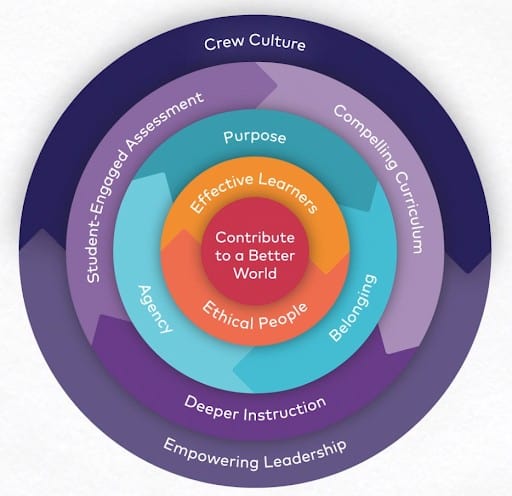
You may get a lot of pushback. You have to be in a setting where you feel like we can be honest with each other here about truly what’s working and what’s not working in our work. And that takes a safe culture for honest critique. Ron, I just rediscovered your character framework and I’m just so excited about how great it is. We’ll include it in the show notes, the picture of it, but it says we help students get smart to do good work.
So my question is why does your character framework put the idea of contributing to a better world at the center? It was controversial and we really believe in it. I feel and we feel, Tom, that there’s a virtuous side in students that when we tap into it, all of us in education, there’s an energy and a commitment there that there’s no other way to access. So I mean, you can talk to teenagers and say, if you really work hard in school, you’ll have a great career someday or someday you’ll get into a good college or someday. And many teenagers will respond to that and others will just think, I don’t think you know what I want in my life.
I don’t know what I want in my life. I don’t have those aspirations. I don’t need to get rich. I don’t need to follow your rules. Like if you try to tell a kid, this is for your own good. Many kids will sort of back off and feel like you’re not motivating me here because I don’t even know what I want in my life or what I want in my life is right now social. It’s not really academic.
And yet when you say to kids, you’re needed. Like we need you because these people in your community need your help. You’re tapping into a different side of kids. So if you say to kids, you have to do this assignment for a test, many of the kids won’t care deeply. They may go through the motions, but they won’t care.
Let’s say that test was on World War Two. If instead you said to those kids, we have a bunch of World War Two veterans in our city. And there’s not too many of them left because the age they are, many World War Two veterans are not with us. But the ones we have left are national treasures. Their stories have never been told.
No one’s ever interviewed these people. No one’s ever created a book or a podcast or a film about them. But you’re going to do it. Like you are the kids who are going to be the interviewers. We’re going to work with journalists to learn how to interview well.
We’re going to create a book to honor their lives. We’re going to create a video about their lives. And each one of you is going to be paired with a veteran who’s a hero, but nobody knows. It’s an unheralded hero. Like then you’re not asking kids to change themselves.
You’re asking them to step up to honor someone else. And I’ve never been in a situation where kids don’t rise to that occasion. Where they don’t feel like, I’m going to learn my stuff because I don’t want to dishonor this person. Like this is important. You’re trusting me with a contribution that matters.
And that kind of provocation invites kids, impels kids to step up and be their best selves. Yeah, I love how just outside of that inner circle where it talks about contribute to a better world. It talks about agency and belonging, that sense of identity. And I think we’ve discovered in our study of the future of work that this sense of agency cleared and well-formed identity is so important. It’s always been important, but it’s more important than ever.
So we just love the construction of your character framework for that reason. Yeah, and we try to define character as both being an effective learner, those things like grit and responsibility and perseverance and organization, important parts of character. But equally, they being an ethical person, parts of character, being respectful and compassionate and kind to other people, being fair and just and having integrity. Like I feel like character are the performance parts of who we are and the ethical parts of who we are. We need to tap into both of those in kids and all for the purpose of helping others, not for just their own.
Yeah, I guess the other thing that we like is we think most schools are characterized by routine and compliance and kids are headed for a world of novelty and complexity. So that’s part of our argument for extended challenges, extended community connected challenges for young people. It just keeps it real and it moves it away from simple worksheets with right and wrong answers to really complicated real life questions where the right answer is I don’t know, but here’s how we might approach this problem. Exactly right. I mean, just use a very specific example.
We were looking together, my staff and I yesterday, Tom, at an example of a school in Moscow, Idaho, where there was a trailer park there that was closed for reasons of bad health because the water system had gotten polluted. So they closed the trailer park and then all of the people in the trailer park didn’t have homes. And there wasn’t adequate housing for them to move into in this in this small town of Moscow, Idaho. The sixth graders in the police prairie school there took it on as a study of what can we do to support these families who now need to find housing? What are the policies?
What are the what’s the federal and local support? How can we take this on and make sure families get resettled in a way that’s humane and positive for them? These were 11 and 12 year old kids. They took on the legal parts of that, the historical parts of that, the civic parts of how do we get in front of the local officials and start working to get it, the mathematical parts of it. Like, that’s real hard work.
But, you know, I just was so impressed that they had the courage to have kids think, let’s take our learning and put it in service of something real for our community. That’s a great example. In 2014, you published a beautiful book called Learners of their leaders of their own learning with with Josie Bass. What was the impetus for that book? There are a number of practices, Tom, that we use in EL schools, none of which I’ll be honest, we invented.
They’re all practices we’ve borrowed from other people. And we’ve worked on refining them with our schools and those practices put kids at the locus of learning, really, in a way where kids are figuring out what is it I have to know, how close am I to getting there, and how do I know when I’m making progress toward those goals. Academic goals and character goals. And it includes kids presenting formally their learning in many settings to show this is what I’m doing. This is what I’m doing well. This is what I’m still working on. These are my goals in exhibitions of learning presentations of learning, student-led conferences, presentations to community.
And we compiled eight different of those practices of how to support students to take more ownership over their own growth academically and as scholars and people. And compiled all those into our book. And it’s actually the book that we’ve created that has reached the most people. I think it’s reached more than a million kids. And yet the practices in that book were challenging for people. So it’s been out for five years and for five years we’ve been getting the feedback that we love it in the field and we need more. Like these practices are hard and we’re struggling with them. So that sort of leads into the next question. You’re getting ready to publish a sequel, Leaders of Their Own Learning Companion. So why the companion? What would you try to do with the new book? And how is it going to help teachers?
Well, our hope with this, Tom, was that we’ve been in classrooms and districts that are using the original book, Leaders of Their Own Learning, to help them plan how they’re using learning targets and checking for understanding and how they’re doing student-led conferences and presentations of learning. And we’re seeing where their struggles are, where we didn’t explain things clearly enough, where we didn’t give enough examples. We’re hearing teachers and school leaders say, can’t you give us more examples of this? Can’t you give us more tips when this doesn’t go well? And so a couple years ago we started compiling all the best examples and all the major problems and created a sequel. The sequel has the exact same eight practices that the original book suggests for schools and districts to use. It doesn’t add anything new in the practices it suggests, but it gives lots of tips about how to implement those more effectively, what happens when things go wrong, here’s how we’ve seen schools handle that well. And we’ve tried to collect from across the country examples of schools that are really having success with them. So we can give many more examples, both in the book and in a companion online site for it. So people that are trying to do student-led conferences or trying to use learning targets well or presentations of learning or standard space grading well, there’s a lot more resource for them.
So really it’s just like an added resource for people trying those practices. That’s great. It sounds, it’s a super practical book. I’ve had a chance to look at it. It would be a great book for a teacher, a team of teachers to review together. A great book to use in a book study over the course of a couple months. Other ways you’d like to see people using the book? Yeah, I mean, I had the great fortune of in the last three years traveling every year to Alabama, where it’s being used across the state, the original book. And it’s been often taken on by a full district, where the district adopts the book and individual schools choose which parts of it they want to begin with so they can move at their own pace. And what I like about that is it’s not a mandated thing that schools feel like, oh, another thing we have to do, but rather this book has eight practices that really can supercharge student engagement and investment in their work.
Which one do we want to start with? And school faculties and leaders have chosen one or two to start with and work sometimes for a whole year just on that one practice. So I’ve been traveling through Alabama working with schools and districts who use it as a common read and use it respectfully with schools and teachers with some choice involved in how deeply do we want to get in? How do we make it our own? How do we make this practice fit our particular version of school where we are in our community? And I’m really delighted that the original book is as popular in red states as blue states. It’s not like seen as, oh, this is only for one kind of kid or one kind of state or one kind of school, because any of the practices can be used in any school to sort of start that journey toward more student ownership of work. Yeah, it’s another great contribution. It’s super practical. Teachers are, I think, are going to love the book. The book is the leaders of their own learning companion. Ron, where can people find you online? It’s great to ask. Our organizational website is eleducation.org. And I would also say that I hope people will come to our collection of great, beautiful student work, project work and writing, which is modelsofexcellence.eleducation.org.
Both to download and look at great student work, but also to submit work. If any of you out there listening feel like I have great student work in my kindergarten or in my 11th grade class. I have beautiful writing or great project, great science work. I hope that you’ll be willing to submit it to the open website to see that, so you could share it with people all over the world. Ron, we really appreciate your contribution to education. It’s really great to have you on the show. This is a great book. We’re going to encourage folks to check it out, check out EL Education and Models of Excellence. Ron, thanks for joining us. I thank you so much for having me on and to anyone who’s out there listening, thank you for your work in public education.
Absolutely. You’re the most important people in the country in my mind. Thanks, Ron. Thank you. Thanks to Ron for joining us on the podcast today. Like our team at Getting Smart, EL Education has been a great advocate for high quality project-based learning.
For more on provoking deeper learning, see episode 203 with Professor Jol Mehta. You can find a link to that in the show notes or on the blog. That’s it for today, listeners. Please make sure you’re subscribed to the podcast so you don’t miss out on any future episodes and go ahead and leave us a rating or a review while you’re at it. Thanks for tuning in for the Getting Smart podcast. This is Jessica, signing off.


0 Comments
Leave a Comment
Your email address will not be published. All fields are required.