


Wangchuk and Tashi Dendup on Bhutan’s National Shift to Place-Based Education
Key Points
-
Place-Based Education fosters a learner-centered approach by engaging students with real-world, community-rooted projects that enhance critical thinking and collaboration.
-
Bhutan’s national curriculum integrates Place-Based Education principles, promoting cultural preservation, environmental sustainability, and student agency.

Shownotes





In this episode of the Getting Smart Podcast, Nate McClennen engages with Wangchuk and Tashi Dendup to explore Bhutan’s innovative approach to learner-centered practices. Learn how Bhutan connects education with its community, culture, and environment to foster critical thinking, collaboration, and sustainability. Through a whole-school approach, Bhutan is not only enhancing student engagement but also aligning its education system with its Gross National Happiness philosophy. This conversation highlights impactful lessons on transforming education systems to prepare learners for the complexities of the 21st century.
Outline
- (00:00) Introduction to Place-Based Education
- (03:42) Welcome to Bhutan
- (06:34) Understanding Bhutan’s Context
- (11:37) Evolution of Education in Bhutan
- (17:45) Place-Based Education in Practice
- (21:37) Student and Teacher Impact
- (29:12) Lessons Learned and Key Takeaways
Introduction to Place-Based Education
Nate McClennen: You’re listening to the Getting Smart podcast, and I am Nate McClennen.
Today, we have some really special guests from the country of Bhutan, who have deeply immersed themselves in place-based education (PBE). I want to start by giving a little bit of context about what “place” means when we think about it. Place is about the ecology of the area, the culture of the place—meaning the human aspects—and the economy of the place as well.
All three of these elements interact in what we call the place triangle. We think about this triangle in terms of the past, present, and future. Originally, six core principles were developed through work I did at Teton Science Schools with Leslie Cook and several others in Jackson, Wyoming. We began to think deeply about how place-based education works in schools around the world.
The six principles focus on inquiry—making observations about what is, imagining what could be, and designing solutions. They emphasize putting the learner at the center, connecting local to global phenomena and vice versa, creating interdisciplinary experiences where different subject areas integrate, and using the community as a classroom. This approach makes learning more relevant and increases outcomes.
At Teton Science Schools, these principles have evolved to include community as a classroom, community impact, and integrating content with community—all centered around learner-centered practices. These ideas connect learning to local places to increase engagement, outcomes, relevance, and impact in local communities. When multiplied across schools worldwide, this approach helps young people understand their places and how to make a difference.
Today, we have a special episode on international education focused on Bhutan. My previous employer, Teton Science Schools, has been directly connected with Bhutan since 2008. Over the years, six delegations of Bhutanese educators have visited Teton Science Schools, and 10 delegations from Teton Science Schools have visited Bhutan. Thousands of Bhutanese educators have been trained in place-based education, with some participating in the Teton Science Schools graduate program. Approximately 40% of Bhutan’s curriculum has been revised to include place-based education.
This is an incredible example of a national movement to place learning at the center. Without further ado, I want to introduce my two fantastic guests today: Wangchuk, a curriculum developer at the Department of School Education in the Ministry of Education and Skills Development in Bhutan, and Mr. Tashi Dendup, the principal of Ma G Village School in Paro, Bhutan. Welcome to you both.
Wangchuk: Thank you, sir.
Tashi Dendup: Thank you, sir.
Nate McClennen: You’re in Wyoming today, doing some training, learning, and experiencing this place with Teton Science Schools. What’s been the most interesting thing you’ve seen or learned so far during your trip? Either of you can start.
Welcome to Bhutan
Wangchuk: Thank you so much, sir. It has been inspiring and deeply affirming. Returning to Teton Science Schools in Wyoming with a delegation of Bhutanese educators feels like reconnecting with shared educational visions.
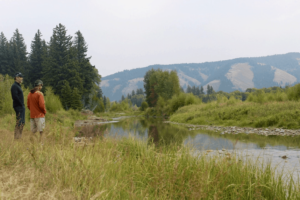
So far, the trip has been full of reflections—seeing place-based education principles in practice in different schools, visiting natural places, and hiking to significant locations like Yellowstone National Park. We’ve had discussions about place-based education with experts from Teton Science Schools. We feel very blessed to be here.
Nate McClennen: Fantastic. I love that shared vision. The powerful thing about our relationship with Bhutan and Teton Science Schools is that we’re all speaking the same language and committed to the same vision. Tashi, what about you? What’s been the highlight so far?
Tashi Dendup: First of all, let me thank you for having us here. I’m a little nervous because this is my first time doing a podcast or any kind of media interview.
Nate McClennen: No problem.
Tashi Dendup: Thank you. This is going to be a stepping stone in my life. Regarding the visit, it has been so nice. We are learning so many things—from school visits to exploring wonderful places like Yellowstone National Park, Jenny Lake, and Taggart Lake.
We’ve been doing place-based education activities, not just visiting places. We also had the opportunity to visit three place-based education schools. There’s so much more to place-based education than I had imagined back in Bhutan. I’m learning a lot every day, and I hope this trip will benefit my school immediately. If possible, I’ll share these ideas with neighboring schools too.
Nate McClennen: I love the willingness to share. Education improves when we all share what we’ve learned.
Let’s start with some context. I suspect most of our listeners don’t know much about Bhutan. It’s an amazing country, and I’ve been blessed to visit a few times. Wangchuk, can you briefly describe Bhutan—its economy, culture, ecology, and location?
Understanding Bhutan’s Context
Wangchuk: Thank you, sir. Bhutan is a natural place, rich in biodiversity. Our country is located between two giant nations: China in the north and India in the south.
Bhutan’s developmental philosophy is Gross National Happiness (GNH), which guides all activities, including education. GNH focuses on four main pillars: preservation and promotion of culture and traditions, conservation of the environment, sustainable socioeconomic development, and good governance.
Our Constitution mandates that at least 60% of Bhutan’s land must remain under forest cover. Currently, more than 70% of our land is forested. Ecologically, we are rich in flora, fauna, and biodiversity. Economically, we focus on producing green energy, primarily through hydropower.
Culturally, we emphasize preserving traditions. Visitors to Bhutan will see our culture and traditions everywhere. Community-wise, Bhutan is a small country with strong connections within its communities.
Nate McClennen: Tashi, do you know the general population of Bhutan and the number of teachers and students?
Tashi Dendup: Bhutan has about 700,000 people and over 8,000 teachers.
Nate McClennen: So, population-wise, Bhutan is only slightly larger than Wyoming, which has about 500,000 to 600,000 people. Tashi, can you tell us about your school? Where is it located? How big is it? Is it typical for Bhutan?
Tashi Dendup: My school is located in a remote area under Paro. It’s about 40 kilometers from the city, with six kilometers of rough road from the highway.
It’s a very small school with 24 students and four teachers, including me.
Nate McClennen: Four teachers and 24 students? That’s very small. There are a few small schools like that in the United States, but not many anymore.
Tashi Dendup: Yes, we visited one school—Kelly School.
Nate McClennen: Yes, Kelly School is probably similar. And Wangchuk, let’s pivot back to you. In terms of education, what has the history of education in Bhutan been like over the last 40 or 50 years? What’s changing now in education over the last decade with PBE and other initiatives? What are the bigger changes you’re seeing, given that you’ve been in education for a while?
Evolution of Education in Bhutan
Wangchuk: I started my career as a teacher in one of the high schools in central Bhutan, teaching science and chemistry. Based on my experiences and understanding, since I began working in the Ministry of Education in 2006, education in the country has been evolving.
When I started my career, the focus of education was heavily content-driven. Over time, many reforms and initiatives have taken place, including curriculum redesign, professional development, and international collaborations.
The model of education in Bhutan is gradually shifting from a content-driven approach to one that measures the holistic development of learners, guided by Gross National Happiness. Bhutan now emphasizes providing relevant and realistic education to all learners.
We are focusing more on promoting critical thinking, creativity, collaboration, and communication skills. The education system is shifting from a teacher-centered approach to a student-centered approach. There’s also a shift in assessment—from examination-based assessments to competency-based and performance-based assessments.
The role of teachers has changed as well. Previously, teachers primarily lectured in classrooms. Now, they are transitioning to being facilitators and guides. Similarly, the role of learners is shifting. In the past, learners were passive and dependent on teachers. Now, we see active learning strategies being implemented in many schools, leading to better engagement and improved learning outcomes.
Nate McClennen: That’s a big shift. Tashi, in your very small school, what does that look like? How does this play out with you and your three other teachers? Are you seeing these shifts where it’s more student-centered rather than teacher-centered? Are you focusing on skills, as Wangchuk described? What are some specific ways this looks on the ground?
Tashi Dendup: Sure, sir. We’re making a lot of effort to shift our teaching methods from traditional, lecture-based methods—where the teacher is seen as the sole source of knowledge—to methods that actively engage students in the learning process.
Our school is now a place-based pilot school, so we are using PBE as one of our primary teaching strategies. I see most of our teachers working hard to implement the skills and knowledge they’ve gained through training from the Ministry of Education and Teton Science Schools.
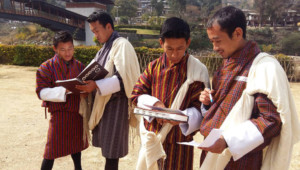
Most of my teachers now take students outside the classroom, connecting lessons to the place triangle you mentioned earlier—focusing on ecology, economy, and culture. Bhutan, and especially the location of my school, has a rich ecology and culture. Students learn about food items produced in the community, rituals, festivals, and other cultural aspects.
By teaching through place-based education, we can truly actualize curriculum standards. Over the past few years, our school has made significant progress in shifting from teacher-centered methods to student-centered learning.
Nate McClennen: That’s great. Those are good examples. I like the idea of connecting to curriculum standards while making learning more relevant and connected to local places.
Wangchuk, let’s take a broader view. How has place-based education played out nationally? Is it part of the curriculum, or is it a whole-school approach like Tashi described? What does it look like at the national level?
Place-Based Education in Practice
Wangchuk: We’ve seen a remarkable shift in the implementation of place-based education. At the moment, we are focusing on strengthening PBE as a whole-school approach.
Last year, we identified five schools to implement PBE as a whole-school approach, and we plan to identify three more schools this year. Nationally, our collaboration with Teton Science Schools has been very successful. Since 2008, there have been numerous exchange programs between Teton Science Schools and the Ministry of Education. Bhutanese professionals, teachers, and school leaders visit Teton Science Schools to learn and bring back practices to implement in Bhutan. Similarly, experts from Teton Science Schools visit Bhutan to train our teachers and principals.
At the national level, our first focus is implementing PBE as a whole-school approach. There’s a significant difference between implementing it as a whole-school approach versus allowing individuals to practice it based on their interests. We believe the whole-school approach brings greater impact.
Second, the impact of PBE extends beyond its principles and strategies. For example, our collaboration with Teton Science Schools has strengthened our curriculum with PBE principles. It has also enhanced teacher education programs in our teaching colleges, helping educators implement student-centered approaches in classrooms.
Additionally, we are collaborating with Teton Science Schools to conduct research on the impact of PBE in Bhutan. This research will help us understand how PBE influences the Bhutanese education system.
Overall, PBE is not just a theoretical concept in Bhutan. It is strengthening our national school curriculum, teacher training programs, and motivating teachers to adopt student-centered approaches in classrooms.
Nate McClennen: Just to confirm, Bhutan has a national curriculum, correct?
Wangchuk: Yes.
Nate McClennen: So, the curriculum starts at the ministry level, and every school in the country implements it?
Wangchuk: Yes.
Nate McClennen: That’s different from the United States, where every state implements its own curriculum, and local districts have even more control. Bhutan’s national curriculum allows you to roll out an idea like PBE to all schools in the country.
Tashi, let’s go back to the students. How are they reacting to these changes? Are they more engaged compared to when they were just sitting and receiving information?
Student and Teacher Impact
Tashi Dendup: I’ve observed that students’ excitement and interest in learning have increased significantly. When we tell them we’re going to learn something outside the classroom, their mood and energy levels change.
Outside the classroom, their interaction and participation levels are completely different. Inside the classroom, they tend to be more passive, listening to the teacher and showing less interest in activities. But outside, they are actively engaged.
Sometimes, when we try to skip a field trip due to time constraints, students insist on going. They say, “Sir, can we go for a field visit?” or “I think we should go for a field visit to learn more.” Their interest level is much higher with these strategies in place.
Nate McClennen: That’s interesting. When I visited classrooms in Bhutan, I noticed the same thing. Inside the classroom, students were quiet and passive, waiting for the teacher to tell them what to do. But outside, they were much more engaged.
Do you think this increased engagement translates into better learning?
Tashi Dendup: Yes, sir. When students are actively engaged, they develop other skills like writing and speaking. Hands-on experiences help them translate what they’ve learned into words or text.
Even during exams, if questions are based on their experiences, they can recall those moments and write about them, even if they don’t remember what they read in the textbook. These experiences stay with them for years and help them relate to their learning.
Nate McClennen: That’s a great point. There’s something I call “sticky learning,” where students remember things better when they’re engaged and connected to the world around them. Wangchuk, what about at the teacher level? You’re involved with many educators. Are they more engaged with these changes, or is it more difficult for them?
Wangchuk: Similar to other countries, whenever we try to implement new ideas and strategies, the shift in practice always takes time.
What I’ve observed is that teachers are keen to learn and interested in shifting from teacher-centered to student-centered approaches. They understand that traditional strategies are no longer relevant for 21st-century education.
If we want to solve 21st-century education challenges, we need strategies designed for the 21st century. Teachers in Bhutan understand this well.
One indicator of improvement is that when we visit schools and observe classes, we see many student-centered lessons taking place. Another indicator is that teachers are now planning interdisciplinary and inquiry-based lessons. These are signs that they are ready to shift—or are already shifting—from teacher-centered to student-centered approaches.
Additionally, due to PBE training, we’ve seen significant improvements in student engagement, which has contributed to better learning outcomes. Teachers now understand the importance of allowing students to discover information on their own. This enhances creativity, critical thinking, collaboration, communication, and problem-solving skills.
The goal is to build these personal disposition skills in students’ mindsets.
Nate McClennen: That’s exciting. It’s similar to what we’re seeing in the United States, where there’s a focus on skills like communication, collaboration, and problem-solving. It’s a big shift for teachers, especially if they weren’t taught that way themselves.
Let me ask both of you this: What lessons have you learned from this process? Tashi, as a principal of a very small school, what lessons have you learned? And Wangchuk, from a national perspective, what lessons might be helpful for our listeners as they try to push a place-based or student-centered initiative forward?
Lessons Learned and Key Takeaways
Tashi Dendup: Over the course of this trip, we’ve visited many schools and places, and each experience has been related to learning through place-based education.
Some of the key practices I want to take back include the innovative teaching strategies I’ve observed. One of the most important things I’ve seen is how students are thoroughly engaged in projects that address real-world problems.
For example, students here have a lot of voice and choice in their learning. Teachers treat students like friends, and students feel free to express themselves. This emotional connection fosters better learning.
In Bhutan, students are expected to respect teachers, which can sometimes hinder the learning process. I’ve learned that teachers should be as friendly as possible while maintaining high expectations.
Another strategy I’ve observed is how schools discipline students. For example, some schools select a “best student of the day,” and the current best student has the privilege of choosing the next one.
I’ve also learned about strategies like journaling and observation. Students are encouraged to observe nature, take notes, and reflect on what they see. One particularly interesting strategy is “sit spots,” where students go to the same spot in nature every week to observe changes over time. This helps them develop observation skills and creates a resource for future reference.
These are just a few of the enriching practices I plan to implement in my school.
Nate McClennen: I love what you said about voice and choice, as well as the idea that respect doesn’t mean being quiet all the time. Respect can coexist with student agency, where learners are at the center and have a voice in their education.
Wangchuk, what about you? What lessons have you learned from a national perspective?
Wangchuk: My visit to Teton Science Schools has been a blessing. As a curriculum developer, the lessons I’ve learned here help me enhance the quality of education in Bhutan.
One of the biggest lessons I’ve learned is the importance of implementing PBE as a whole-school approach. Transformation goes beyond lesson plans—it’s about school culture. A whole-school approach ensures that PBE principles are visible in leadership decisions, teaching practices, community partnerships, and the school environment.
When everyone is involved—principals, teachers, students, and parents—the school becomes a model of sustainability and community-rooted learning.
Another lesson I’ve learned is how much students love PBE. They take ownership of their work, and metacognition happens at every level. For example, when I visited Teton Valley Schools, I saw students confidently working on projects. They knew exactly what they were doing, why they were doing it, and when they would complete it.
This level of ownership leads to individualized and personalized learning. Outdoor activities, in particular, allow students to discover new things. I’ve noticed that students in these schools are confident and competent, with strong collaboration, communication, and problem-solving skills.
These lessons reinforce the importance of implementing PBE as a whole-school approach and focusing on student ownership and metacognitive skill development.
Nate McClennen: That’s great. I always evaluate schools by asking students what they’re learning, where they’ve been, and where they’re going. In schools that focus on place-based and student-centered approaches, students can answer these questions confidently.
Tashi and Wangchuk, it’s been wonderful hearing about Bhutan and your experiences at Teton Science Schools.
Here are some of the key takeaways I’ve learned today:
First, I’m thinking about how a nation can shape its education system. Bhutan’s four pillars—preservation of culture, conservation of the environment, sustainable socioeconomic development, and good governance—are deeply embedded in its education system. To achieve these goals, Bhutan is shifting from a content-first approach to a skills-first approach.
Second, the changes you’ve described—moving from teacher-centered to student-centered learning, from summative assessments to competency-based assessments, and from teachers as lecturers to teachers as facilitators—are significant. These shifts align with what we’re seeing in the United States as well.
Third, I’m struck by the impact of place-based education on both students and teachers. Students are more engaged, and their learning outcomes are improving. Teachers are seeing the value of teaching 21st-century skills like collaboration, communication, and problem-solving.
Finally, I loved the lessons you shared about whole-school approaches, student ownership, and metacognitive skill development. These are critical for creating confident and competent learners who are prepared for the complexities of the modern world.
Thank you, Wangchuk and Tashi, for sharing your insights. Enjoy the rest of your time in Wyoming, and we’ll be watching Bhutan’s progress closely. I hope to see you both in person sometime soon.
Wangchuk: Thank you so much, sir.
Tashi Dendup: Thank you, sir.
Guest Bio
Wangchuk
Wangchuk is a curriculum developer at the Department of School Education in the Ministry of Education and Skills Development in Bhutan
Tashi Dendup
Tashi Dendup is the principal of My Gakidh Village School, Talhogang, Toebisa, Punakha.
Links

0 Comments
Leave a Comment
Your email address will not be published. All fields are required.