


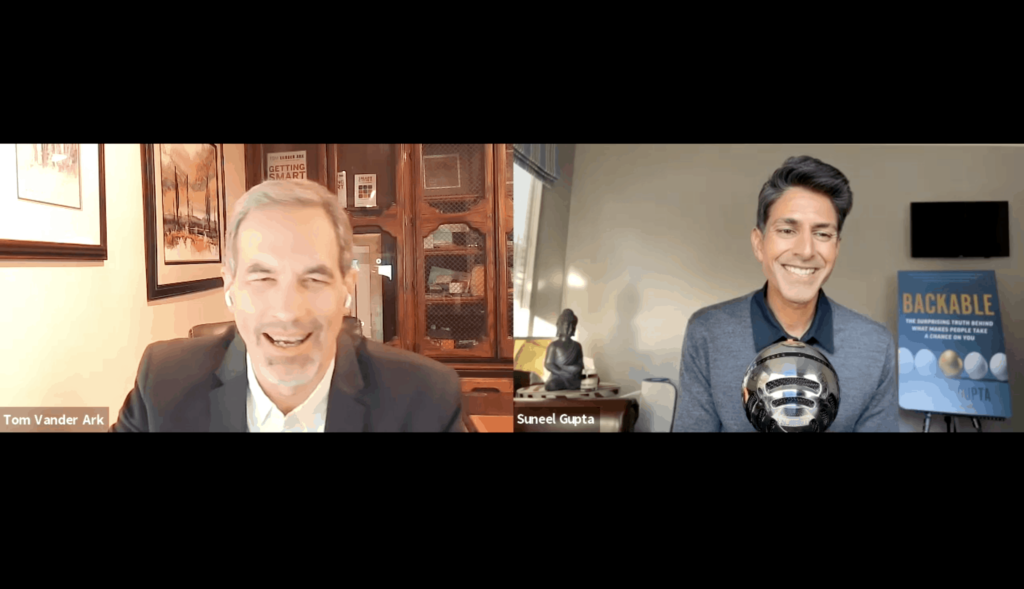
Suneel Gupta on BACKABLE: The Surprising Truth Behind What Makes People Take a Chance on You
- sustainable and equitable socio-economic development;
- environmental conservation;
- preservation and promotion of culture; and
- good governance.
- Suneel Gupta
- BACKABLE: The Surprising Truth Behind What Makes People Take a Chance on You, by Suneel Gupta with Carlye Adler
- Rise Labs, Inc.
- Gross National Happiness
- TED Talk “Do Schools Kill Creativity?” by Sir Ken Robinson
- Screencastify.com/GettingSmart
- Getting Smart Podcast Ep. 302: “Kim Smith on Creating Schools, Companies and the Pahara Institute”
This post is sponsored by Screencastify. If you’d like to learn more about our policies and practices regarding sponsored content, please email Jessica Slusser.
Transcript
This transcript has not been edited for spelling accuracy.
You’re listening to the Getting Smart podcast where we unpack what is new and innovative in education. I’m your host Jessica and today Tom sits down with author and entrepreneur Sunil Gupta to discuss his new book, Backable, the surprising truth behind what makes people take a chance on you.
Sunil Gupta is the co-founder of Rise and teaches innovation on faculty at Harvard University. During the seven steps inside his book, Sunil went from being the face of failure for the New York Times to being the new face of innovation for the New York Stock Exchange. His ideas have been backed by many venture firms and Sunil also serves as an emissary for gross national happiness between the United States and the Kingdom of Baton.
Let’s listen in as Tom and Sunil discuss failure, the ability to get people to believe in you and gross national happiness. Sunil Gupta, welcome to the Getting Smart podcast. It’s great to be here Tom. Thanks for having me.
Hey, it’s great to have you on. Congratulations on your book, Backable. It’s a terrific book. We look forward to diving in. But first, Sunil, you’ve had a wonderful, interesting career, even more varied than my own.
You’ve written a policy, public policy. You wrote for MTV. You led product for Mozilla and Groupon. You started a medical mobile app company and sold it. Then you jumped to the other side of the table and spent some time in venture.
You’ve been a visiting scholar at Harvard. Maybe my favorite is that with an appointment from Bhutan, you co-founded the Gross National Happiness Center in America. Really cool career. Well, thanks, Tom.
Yeah, no. It’s pretzel twisted. It’s scattered. But I’ve always considered myself to be a little more of an archeologist than an architect. I never had a blueprint and I never had a building to build.
I just went after things I really thought were interesting and stayed focused on them for as long as they kept my attention. You’ve had so many varied opportunities to make pitches to different audiences. We’re going to talk about that today. I’d love to spend a couple of minutes just talking about gross national happiness.
If anybody that listens to the business news every day, we really frequently talk about GDP. GDP is such a bad measure of social and even economic progress. Again, what interested you and better measures of societal progress? Yeah.
Tom, I think you and I come from similar backgrounds where we both come from different technical sort of worked in technical fields. For me, working in product development, metrics are very important. How do you actually measure what it is that you’re actually building? As somebody who also is very interested in public policy, I started to bring those two
patterns of thinking together as to how we measure ourselves is ultimately going to be a big indicator of what kind of policy. Put to bear. Bhutan was really interesting for me because while an imperfect country just like any other, the way they measure progress is based on what they call gross national happiness, where
economic growth is important, but it is one factor that rolls up to a whole much larger theme around the happiness of their people. I had a chance to visit the country and just became really enamored with this idea of a North Star around happiness. One of the things that was really interesting to me, and there were a couple, I could go
on about this for a long time, but I’ll tell you one thing that really stood out to me was when I had a chance to spend time with the researchers out there, people who are the ones who are collecting all of this data and computing this metric. One of the things that I asked them was when you go town to town and you talk to people, is there one question that you could ask that ultimately will give you a sense, a pretty
good indicator at least, of how happy somebody is? They said, yeah, as a matter of fact, there is. The question is, if you were in real trouble today, who could you call and know with 100% certainty, they would be there for you? They believe that having an answer to that question, having a clear answer to that question,
is a pretty good indicator of someone’s happiness, but there’s a twist. The twist is, who’s list are you on? Who can call you and know with 100% certainty, you are going to be there for them? Ultimately, it’s not a straight line. It’s a circle.
It’s a community. In some ways, it tells us, I think, what we already deep down already know, which is that we are social creatures and we thrive off of being part of communities. What was really interesting is, even as I wrote this book, Backable, I realized that every backable person tended to have a circle around them, a group of people that they had
kept for the long term in their lives and nurtured those relationships in order to become a better version of who they are. Well, we appreciate your advocacy for better measures of progress. You mentioned Backable, the surprising truth behind what makes people take a chance on you. It’s the best book that we’ve seen on pitching, on how to try to sell yourself and your ideas.
As I observed a minute ago, Sunil, you’ve had a chance to make a lot of pitches in a lot of different settings. I guess at a high level, what did you learn about the art of pitching? Yeah. Tom, I think you can come out of a book from one of two points of view.
I think either you come out of it from the point of view of having a solution or you come out of it from the point of view of having a problem. I certainly came at this book from the point of view of having a problem. While I had been pitching in these different areas, I wasn’t having much luck. I was certainly not the type of person who could walk into a room and get people to rally around me.
I think we all know that creativity and persuasion are two different skills. You can have a great idea and you could have a great brilliant product. You could be a great candidate for a job. Then you could still be dismissed. I felt like I was one of those people.
That all got me thinking about backable people, people who tend to have this mysterious equality where they’re able to walk into a room and we really want to take a chance on them. We really want to get behind them. The key is that oftentimes when they’re not the obvious choice or they don’t have a fully baked idea, we still feel compelled to want to bet on them.
I wanted to understand what is this equality? Then could it be learned? What I realized now through five years of researching this topic is that A, very much can be learned. The reason for that is because if you rewind the clock on nearly every backable person’s career, what you find is a very different version of them.
They’re actually not very backable. They learn how to become that way. But I also realized that being backable is not just for celebrities and it’s not just for CEOs. It’s really for all of us. Any type of change that we’re trying to create in our lives, in our careers, in our communities,
in our companies, we need other people to come along. That could be hiring managers, that could be partners, that could be clients, that could be even friends and family. There’s not a single situation where we’re not trying to rally other people to join us in what we believe. Well, I love how you observed that.
As you said, it’s not really about charisma or connections. It’s not about your resume. It’s very specifically about being able to persuade others to bet on you, to back you, to take a chance on you. Yeah, exactly.
It’s not always what we think it’s going to be that makes people take that chance. Again, a lot of times, these stories were not that person had the obvious choice, or they had the best resume or best pedigree. It was more like there was something emotional that happened inside the room. There was a moment that was created.
And as I started to unpack this, one of the things I thought I was going to find was I thought that backable people were going to have a certain style of communication. They were going to make use of eye contact and hand gestures and pacing. I realized that that really wasn’t the case. I mean, you certainly had some backable people who were much more Dale Carnegie-esque
and Toastmasters-esque. But I would say the majority that I studied were not. A lot of them were shy. A lot of them were introverted. They didn’t have the classic communication styles.
And a really good example, just a quick example of it, is if you go look up the number one most popular TED talk of all time, what you’ll find is a talk given by Sir Ken Robinson. And you might be surprised that it’s actually a very unted-like presentation. He sort of has one hand in his pocket.
He’s got a slouch. He sort of meanders on and off script. But it’s a brilliant talk. What I realized over time is that it’s not charisma that makes someone convincing. It’s conviction.
Backable people take the time to convince themselves first. And then they let that conviction shine through whatever style it is that feels most natural. Your book does this beautiful job of outlining seven lessons that you’ve learned. And I think that’s the first one, right? That you have to start with yourself.
If you’re not convinced that people will see that right away. Number two is super interesting. And I want you to unpack this for me. It’s put yourself in a story that makes your case memorable. Yeah.
Why? Why and how do you do that? Yeah, I think we do it through what we call in the book a central character, casting a central character. And I’ll tell you a quick story and then we’ll get into like how to actually do that.
So when I was pitching my company, my startup, which again was being rejected by every investor that I was pitching, what it was, it was a one-on-one health coaching startup. So what we did is we matched you with a personal nutrition coach right over your mobile phone. And one of the people that I was really interested in pitching was Tim Ferriss,
author and he invests in tech companies as well. And he had just written the four hour body. And I thought to myself, gosh, this would be the perfect investor. And so I ended up getting a chance to pitch him. I ended up getting a chance to pitch him.
And the way that that pitch sort of unfolded was I spent probably the first 50 to 70% of that pitch, really talking about the market, talking about how big it was. I talked about the climbing rates of obesity and hypertension and diabetes. And then finally at the end, I told a story. And the story that I told was about my father,
who in his 40s had a triple bypass surgery, an emergency triple bypass surgery. And I remember going to the hospital, I was maybe like nine years old, the University of Michigan hospital where your dad was and Tom. And I showed up and I realized that I saw a version of my father that seemed like it at age 25 years overnight.
And I remember leaving the hospital, they gave us a few pieces of paper. And one of the pieces of paper was lifestyle change. And it said things like eat broccoli, eat Brussels sprouts. I mean, we didn’t eat broccoli. We didn’t eat Brussels sprouts.
We ate Indian food. We’re an Indian family. And there was nothing on that sheet about chicken tikka masala. And so lucky for us, insurance helped pay for the time of a nutritionist who really helped customize our lifestyle and made it fit, made it something that would
actually stick. And I believe my father is still alive today because of that. And so I tell this story to Tim Ferriss and he’s like, what are you doing leaving that story to the very end of the pitch? He’s like, talk about that first.
Tell that story first. And the story that he told me was that when he was pitching the four hour work week, his first book, he was denied by 25 publishers in a row. He got a piece of advice that you were trying to write this book for a mass market. What if instead you wrote it for one person?
Just pick one person, right? And write it for them. What would happen? And what he found is his writing got so much sharper. The storytelling got so much better.
Publishers aided up and it became a mega bestseller. So when I took his advice and I flipped it and I started talking about my dad’s story first, my central character’s story first, then talk about the numbers, then talk about the market size and how many millions of people out there are living their own version of my father’s story.
It completely changed the way that investors were responding. That’s a great story and a great example. Number six is you can’t just wing it that you have to practice and you have to adjust based on feedback from practice. I guess you’ve learned that practice matters, right?
I learned that practice matters. In the book, what I call these exhibition matches, which are low stakes practice sessions before these high stakes moments. And what I found is that oftentimes we’ll see people in a room and we’re like, my gosh, that person’s really good.
Like they’re really naturally talented. What I found is that in most cases, that’s actually the product of lots and lots of behind the scenes practice. And that practice that those practice sessions, they actually don’t look very good. I’ve sat in on a bunch of them and they don’t look very good.
They’re actually pretty sloppy and there are a lot of mistakes. But I think that backable people tend to sort of have a mentality and that is that long-term success comes from short-term embarrassment. But if you’re going to embarrass yourself, you might as well embarrass yourself in these low stakes situations with friends, with family, with partners that aren’t the key one that
you’re trying to close. And so they set up these exhibition matches and they set up a lot of them. On average, backable people play about 21 exhibition matches before a key interview or a key presentation or a key pitch, 21 practice sessions. And I thought to myself, that seems like overkill.
Because my biggest worry was if you practice something 21 times, isn’t that going to make you sound not natural? Isn’t that going to make you sound robotic inside a room? What I found is that the opposite is true. When you have such a high level of mastery and comfort with your material, you’re no longer
attached to the script and you’re no longer running through it in your head when you’re in the room. Instead, what you can do is you can be fully tuned in to exactly what’s happening. With the people who are with you, you can be fully adaptive to their facial expressions, to their nonverbal cues.
And it’s one of the things to realize is that backable moments are very rarely created in these monologue situations. You don’t get in the room, recite your resume and leave. You don’t get in a room, give a pitch and then leave. What happens is that there’s a Q&A.
There’s a back and forth. And your ability to be very, very present in those moments. To be very, very adaptive in those moments tend to be what ends up leading to backing. And so it makes you more natural and not less. So, Neil, I’ve been sitting here thinking about the fact that most people start pitching
with no formal preparation. It’s very easy to go through high school and college. And never get any preparation for selling yourself or selling your company or selling a product or an idea. Do you have thoughts about where and how we could do a better job in high school and
college of making people more backable? It’s a really great question. We just launched the book a week ago. And what’s been probably the most inspiring pieces of feedback that I’ve gotten have been, hey, I’m giving this to my kid.
I’m giving this to my nine-year-old. And I want them to learn this right now because this is what I wish I had. And I do think we can do a better job. And I think what I’ve realized again is that it goes beyond teaching the surface-level techniques of the hand gestures and the eye contact.
It goes deeper than that. It goes into taking the time to believe in an idea. Taking the time, for example, just to spend time not only thinking about whether your idea fits the market, but whether your idea actually fits you. Is this something you want to do?
I remember when I was leaving, I spent years at a company called Groupon. And when I was leaving Groupon, my whole mindset was focused on e-commerce. And I knew I wanted to be an entrepreneur. So what I did is I listed all the ideas I had and I went to a mentor of mine. And I shared with her this list of ideas for companies.
And she looks at the list and then she looks at me and she says, which of these ideas really makes you come alive? And I looked back at the list and I realized none of them really did. None of them really made me come alive. Intellectually, I felt like they all had some market potential,
but none of them really made me tick. None of them really made me come alive. And that’s when I started to shift into healthcare because healthcare is what really made me come alive. And the story that she shared with me that I would share with any high school classroom
or grade school classroom is that when Martin Luther King was trying to decide whether or not to step into his leadership role, he went to go see a mentor. And he told his mentor, I think that this movement is going to be very, very good for the world. And Howard Thurman, his mentor said to him, don’t ask what the world needs. Ask what makes you come alive.
Because what the world needs is more people who have come alive. And so I think that we need to spend as much time thinking about whether something makes sense for the market or for the company or for a strategic career. We need to spend as much time thinking about whether it really makes sense for us. Does it really make us tick?
So, Neil, I think I’d like to encourage all the teachers and school leaders to make backable the textbook for junior English. I think if you just get rid of that English textbook, use backable as your junior textbook. You would be doing a great service to the next generation. You just think about what happens during your junior and senior year when you’re starting to make your
case, trying to figure out where you’re going to go to college and you’re trying to write that essay and you’re trying to land a work-based learning opportunity, maybe your first job, maybe an internship, all of those cases where you’re just beginning to be backable. And you’re almost doing it with no preparation. So I think backable would be a terrific junior English textbook.
What do you think of that idea? I love that idea. I love that idea. I could co-teach a class in a high school. I love that too.
No, it’s a terrific book. The point I want to make is that this is not just a book for people that are seeking venture capital. Almost everybody is involved every year in some way in making a pitch, making a pitch for themselves, for their company, for a cause that they care about.
And we think everybody could benefit by reading backable. I wanted to pop in and share a tool we’ve been hearing teachers rave about and have used and loved ourselves called Screencastify. This screen recording and video editing tool is designed to be easy to use for educators at any skill level and for students of any age.
Whether you’re brand new or a seasoned video creator, you’ll find that Screencastify is the most powerful yet most simple to use screen recording solution available. With over 100 million videos made in 2020, it’s likely that some of your district teams are already using Screencastify. Regardless of whether your learning is remote, hybrid, or in person,
asynchronous video is one of the most powerful tools a teacher and learner can have. Learn more about Screencastify and start recording today at Screencastify.com slash Getting Smart, or click the link in the show notes or this episode’s blog. One more question for you is that you’ve had this interesting career where you’ve had to keep learning. I wonder if you could share a tip with us about how you focus your learning and how you
learn productively. Sure, yeah. You’re making me think of a little game that I play with my daughter every morning. She’s in second grade and I ask her two questions. I ask her, what is the meaning of life? And she says, to find your gift.
And I say, well, then what is the purpose of life? And she says, to give it away. And it’s all based on this quote from Picasso, the meaning of life is to find your gift. The purpose of life is to give it away. And I think that backable is all about how do we give our gift away.
And I think that learning has so much to do with that because what we’re trying to do is we’re trying to go deeper and deeper into a craft. Like something that we feel like is our gift. And the way that I sort of think about this is that learning typically doesn’t come in big waves. What I have found learning comes through consistency, through sitting down and really
consistently applying yourself to something. And the lesson that I think has been sort of the biggest mindset shift for me has been when I stopped thinking about life like a to do list. And I started to think about life as a to learn list. Even with backable, this is my first book.
If my goal was that I wanted to write a best selling book, I don’t know, Tom, if I ever would have finished it because the pressure on that would have been so high. And it would have been about something other than sitting down and writing every day. But instead, I decided that I wanted to learn how to become a better writer. That was my goal.
I want to learn how to become a better writer. And it was with that to learn mindset, I was able to sit down and do the work consistently every day, every morning, I’d sit down and I’d write for at least an hour. And that’s how I got the book done. So I think shifting from this to do mindset to a to learn mindset, I think is the key.
We love that. We’ve been talking to Sunil Gupta. Congratulations on backable, the surprising truth behind what makes people take a chance on you. It’s a great book. Go get it.
Everybody can benefit from it. Sunil, thanks for being on the Getting Smart podcast. Thanks again for having me on, Tom. A big thanks to Sunil for joining us on this week’s episode. We love to highlight unconventional pathways and stories and think this conversation is great for
students, educators, and parents alike. For more information on building momentum and venture funding, check out episode 302, Kim Smith on creating schools, companies, and the Pahara Institute. We’ll be sure to put a link in the show notes and on the blog. All right, that’s it for today listeners.
But before you go, be sure to hit subscribe and leave us a review wherever you listen to your podcast. It really helps. For the Getting Smart podcast, this is Jessica signing off.




0 Comments
Leave a Comment
Your email address will not be published. All fields are required.