

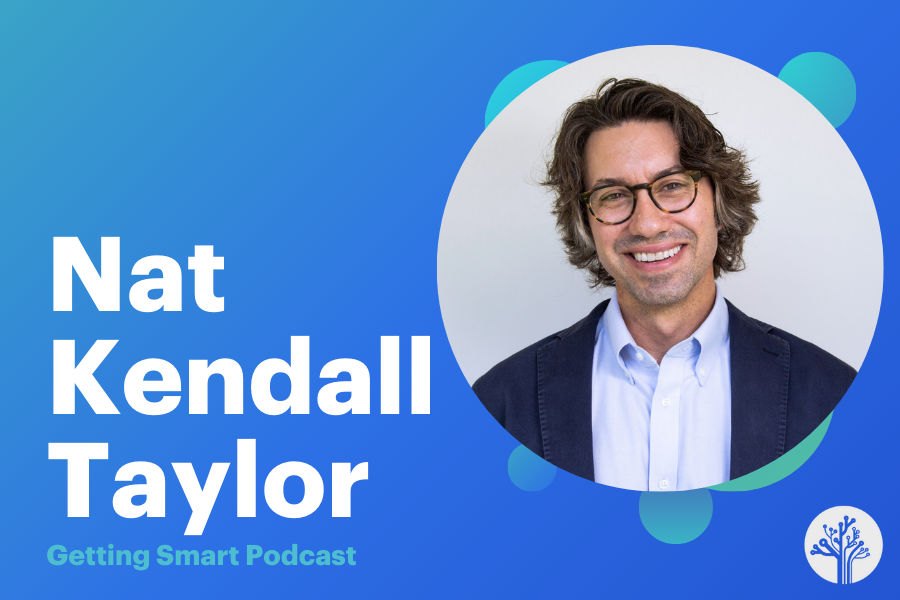
Nat Kendall-Taylor on The Power of Narrative
Key Points
-
A lack of cohesive and engaging narratives is a significant barrier to education reform. Prioritizing narrative development alongside policy or innovation is critical for achieving systemic change.
-
Constructive narratives must counteract mindsets like fatalism and hyper-individualism, fostering a collective vision for education improvement.
Shownotes





In the latest episode of the Getting Smart Podcast, Mason Pashia sits down with Nat Kendall-Taylor, CEO of Frameworks Institute, to explore the critical role of narrative in education reform. They discuss how framing and storytelling can combat fatalism, foster engagement, and create systemic change in education. Together, they dive into the challenges of building cohesive education narratives, the importance of youth-led movements, and the potential of shifting education’s focus from future preparation to fostering community and well-being in the present. Tune in to learn how innovative messaging can shape the future of learning and inspire action.
Outline
- (00:12) Introduction & Framework Institute
- (08:35) The Education Narrative Challenge
- (10:58) Understanding Cultural Mindsets
- (16:15) Narrative Strategy & Movements
- (36:33) Reimagining Education’s Purpose
- (44:21) Vision for Transformed Education
Introduction & Framework Institute
Mason Pashia: You are listening to the Getting Smart Podcast. I’m Mason Pashia. For listeners of the show, you know that I’m fascinated by narrative and community organizing, and when you put those things together, you get a movement—something that’s been severely lacking in the education sector. Needless to say, I was gripped by a piece that ran in The 74 last October by Molina Unfer and today’s guest, Nat Kendall-Taylor.
The piece ends: This is a lightly abridged version. Innovation doesn’t lack for ideas. It lacks the narrative infrastructure that makes them legible, trustworthy, and adaptable. The fix is straightforward: put narrative prototyping on the critical path. Fund it, time-box it, test it, ship it alongside the product or policy.
If we do this, school board nights will sound different—less rumor, more reasoning. Fewer “boogeymen,” more “show me how.” More time on what matters most: students learning well with adults they trust. I love that. So we’re gonna dig in a little bit today. Nat Kendall-Taylor is the CEO of the Frameworks Institute, and I’m thrilled to chat with them.
Nat, thanks for being here.
Nat Kendall-Taylor: Yeah. Thank you very much for having me, Mason. Looking forward to this discussion, and yeah, I think we’re both gonna have a lot to say here.
Mason Pashia: To get us on the right track, tell us a little bit about your work. So what is the Frameworks Institute, and what do you all do?
Nat Kendall-Taylor: Yeah. Frameworks is a nonprofit social science research communications think tank, which I realize is ironic given that I said that we do communications and it takes me all those words to describe what it is we do. But we’re basically a group of about 30 social scientists, communication and narrative strategists that do three things that are gonna sound pretty simple when I lay them out, but in practice are really kind of complex and hard to get our understandings and minds around.
So first of all, we’re really interested in the deep, what we call cultural mindsets—the deep understandings, the implicit patterns of reasoning, and propositions that people use to understand complex social issues. So Mason, you know this really well: when you engage someone in a conversation about education, you never get to have that conversation de novo, right? It’s not empty space. You are always having that conversation up against or in line with what cognitive linguist Deborah Tannen calls people’s priors—people’s kind of existing understandings. And we’re really committed empirically to understanding what those prior understandings are, what those implicit mindsets are on a given social issue, but also those that run across social issues and understanding the implications that those mindsets have for how people think about issues, how they feel, and ultimately what they are and are not willing to do as a result.
So when I say mindsets, just like a quick example to make that a little concrete: one that runs across our work that has been apparent on every single education-related project that we’ve ever done is the mindset of fatalism. That the world is too messed up, that things are too broken to do anything about, and therefore, like, why try? And fairly easy to see—and from the look on your face, Mason, this is not shocking news to you—that when people start to think fatalistically about a complex system like education, the result is disengagement and apathy, right? If it’s so broken that we can’t do anything about it, why try? And so that’s an example of a mindset that we found in our work that is highly unproductive in relation to goals, in relation to people who have goals that are kind of in line with changing systems, improving outcomes by changing the way that we do education.
So the second thing that we do is we study framing—the way in which the choices that we make in how we say what we have to say, the values that we use, the metaphors that we choose, the way that we explain things, the solutions that we put forward—how all of those choices, big and small, affect the way that people think, feel, and act as a result of hearing what it is we have to say. Again, this is not a shocker to someone who does a podcast and thinks about communications. The way that you set things up, the way that you prime conversations, the way that you ask questions—all of those decisions are consequential, right? They matter. They shape all of the cognition, decision-making, and action that follows.
I’ve been at Frameworks for almost 20 years. For about the first 10 years that I was here, that’s all that we did. And we wrote really nerdy 75-page research reports that I still think are awesome, but that nobody read. And that made not an ounce of difference. And so over the last 10 years, we’ve really committed to developing a practice of application that goes on the back end of that research. So partnering with organizations that are in a position to influence public discourse, that are attuned and attentive to the way that their choices of framing and narrative have effects. We’re figuring out how to take that research out of the lab, out of the social science lab, and into the real-world practical scenarios that superintendents, principals, teachers, and people who are thinking about education policy and practice—and a bunch of other issues—can use that work in a way that adds value and perspective and kind of allows them to advance goals with pace and power.
Mason Pashia: And just so you all know, you’ve done some really great work in the climate space, early childhood, and a ton of different sectors kind of across the world and also across the interest area. But it does feel like education and learning are somewhere, at least in your orbit—like you personally or your organization’s. What is your kind of specific connection to education, learning, development, and how did you find that beat, I guess, in this work?
Nat Kendall-Taylor: Yeah, I don’t know. It’s a really good question that doesn’t have a simple, easy answer. So there’s one answer: reframing education is the very first project that I worked on 20 years ago when I came to Frameworks. It was a project funded by the Nellie Mae Foundation and the Lumina Foundation, in which those two philanthropies were interested in better understanding how people deeply thought about education and how they could equip grantees with better ways of positioning calls for education reform—calls for systems and systemic change that landed more consistently and aligned with their goals in a more persistent and consistent way. So, I mean, one answer is I love it so much because, or I’m so interested in it because it’s the first thing I worked on at Frameworks.
The other answer is that I’ve been working even before Frameworks on issues kind of thinking about the way that culture shapes the way that we think about kids and families. Prior to Frameworks, I did research on pediatric epilepsy on the Swahili coast of Kenya and how people use cultural mindsets—kind of deep implicit understandings—in that case of epilepsy, of biomedicine, of traditional healing to make decisions about where to seek treatment for kids, whether to adhere or persist in that treatment, or whether to switch course. So, I’m super interested in the idea of kids and families, young people and families, and I guess education as a system that is pretty darn important in terms of the lives of kids and families. And one that we’ve found in our work is really—trying to say this in a way that doesn’t sound totally nerdy—is like really richly modeled, right?
So, everybody has some experience with education, the education system, and when you ask people to talk and think with you about education, you unearth a really deep and rich set of cultural mindsets that people are using to make sense of education information, to make decisions about education, to kind of orient and figure out how they feel about education and educational change and reform in particular. So, it’s like a super—from a nerdy theoretical perspective as a psychological anthropologist—education is a fascinating issue to study because it’s just such a good example of the way that people’s thinking and engagement with an issue is shaped by these really deep foundational mindsets about how the world works, about how kids work, how parents work, how communities work.
The Education Narrative Challenge
Mason Pashia: I was hoping it wasn’t gonna be. It’s super fascinating. So, taking you back a little bit to the project 20 years ago, what did you learn about building a narrative for education? That word is so many things to so many people, and it changes increasingly quickly, which makes it, I think, a little bit slippery by design. But what did you learn then that kind of informs how you’re moving now?
Nat Kendall-Taylor: Yeah. I mean, believe it or not, 20 years ago—believe it or not given today’s context and how frequently we hear that word narrative—20 years ago, people were not really talking about narrative. So, when I imagine 20 years ago—I’ll get to your question in a second—but when I imagine 20 years ago, trust me, back to 20 years ago, we at Frameworks had to do a lot of work kind of making the point that how you frame your communications matters. That the choices that you make in terms of values have a significant impact on the resulting understandings and actions that happen. And that’s just no longer the case—for better or worse. People are very attuned to the way in which rhetoric, the way in which narrative, the way in which story, and kind of more micro framing has these effects on the things that we care about.
So, in terms of the education work 20 years ago, we did kind of come up with a narrative, although I don’t think we always called it narrative, and we weren’t investigating it at the same level of grounding and depth in narrative theory as we work now. So, that’s kind of a caveat to the question. But what we learned really quickly is that there are a set of mindsets that exist on education that complicate people’s ability to think about the kinds of ideas that I would imagine people listening to this podcast are interested in advancing—that for education to be effective, it has to look and feel and be different than it is now. That requires some serious changes—kind of understandings of learning, understandings of current context and needs around learning. And what we found is that there were three mindsets in particular, which kind of impeded or blocked progress that people were trying to make.
One is kind of hyper-individualism, right? The fact that—or the sense, the idea, the story of the world through which success in education is the result of individual effort of a very small set of people, what we call the triad, right? So students, parents, and teachers. And so when you ask people what determines how well students do or why one student ends up doing well and another student doesn’t, it was all about effort, grit, motivation, gumption, drive, discipline—primarily of the student, and then this kind of second tier of parents and teachers. And obviously, if you’re someone, I imagine, who’s listening right now and is interested in educational systems, that understanding first of a ll leaves out a whole bunch of stuff that we know really matters. And it kind of misdiagnoses the problem in terms of a failure of will and effort rather than a failure of systems, structures, and the way things work.
So that was one mindset that we saw right away emerge. And I have to tell you, that hasn’t changed in 20 years. That’s still a really obstinate stumbling block in terms of people trying to make change and the ability for them to make that change.
The other one was—I talked about this before—fatalism, the pervasive deep sense that the education system is too messed up. The inability to imagine a future or an alternative education system, and therefore this immediate, rapid disengagement with calls to think about alternative models or to imagine what the future might look like. If you think it is a system, but systems are broken, opaque, and intractable, then for most people it’s like, what’s the point? That sounds like an invitation to exit this conversation very quickly.
Mason Pashia: Yeah.
Nat Kendall-Taylor: And then—
Mason Pashia: Yeah, and it’s kind of like a self-fulfilling prophecy. At a certain point, there’s a comfort in a despair spiral where you’re like, I knew it was gonna be bad, so I’m gonna click on the negative headline. I knew it was gonna be—and then you never even find, you would never encounter the narrative, even if it is built of this opposition.
Nat Kendall-Taylor: That’s right. And to be a little critical of people who are communicating about education, I don’t think we do ourselves a lot of favors all the time because we’re used to that fact that, you know, what sells, what gets engagement is stories of how bad things are. And then it kind of superpowers that cycle that you’re talking about. We then tend to tell stories about how messed up things are, about how inequitable systems are, about how things don’t work to produce, you know, to support the kind of learning that we need. And then we kind of stop there, and then we wonder why people are so fatalistic about the issues that we communicate about.
Mason Pashia: Yeah.
Understanding Cultural Mindsets
Nat Kendall-Taylor: And then I guess a third one that we found—and I should say at the beginning, these three mindsets that I’m talking about are not exclusive to education, which makes things in some ways both more depressing and is the root of a really interesting idea around narrative and social change—but the third one is zero-sum thinking, like the zero-sum mentality through which people understand particularly public resources. So if we’re doing things to improve this school over here, it by definition means that these kids over here are getting less, are getting left out. And so this kind of—if we look at education as a system and educational resources through that kind of zero-sum mentality, it’s really hard to get people to do anything different, especially to address stubborn inequities in the system and inequalities that it produces.
Mason Pashia: No, that all tracks. We’ve been doing a lot of writing about what it would look like to take some of the frames from kind of the abundance agenda and put it into education to get away from some of that. Like, if you can invest in this school, this school doesn’t have it. I think a lot of that is in conversation with the new changes to funding and the education system and the new optionality there. At risk of—I guess in order to maybe dodge being fatalistic ourselves about this topic—did the word education resonate with people? Is it too big, of a topic? And so when you’re doing other movements, it feels as if there are small things within education that are much more bite-sized that people actually either have momentum with. Right now, I look at the stuff with our mutual friend Jenny Anderson and Rebecca Winthrop with their disengaged teen and the anxious generation. That’s a movement that actually seems to be making some change.
I think we’re a few years out from seeing what the impact of that change is. But there are movements within this broader trajectory that are happening, and so I guess, how do you hold that as someone who’s working on narrative to do this polyphonic movement from a bunch of different places?
Nat Kendall-Taylor: It’s a great question. And I guess to—not sidestep, but take a step back—I think about framing, narrative, and movements. So if a movement is going to use framing and narrative to effect positive change, if it’s going to be a salubrious tool in their toolkit toward progress, it’s got to have two things, right? It’s got to have a narrative or a framing strategy. And what I mean by that is there has to be some kind of agreement, some kind of coherence around the ideas that we are trying to advance.
Mason Pashia: Yeah.
Nat Kendall-Taylor: That’s the—it’s like the content, right? The way that we’re talking about things in consistent ways. Now, there are lots of people who work in social movements, particularly two scholars, two sociologists a long time ago, Benford and Snow, who talk about the importance of that grounding, shared, coherent—well, they didn’t use the word narrative, but they kind of talked about frames and framing. But I think if you brought Benford and Snow into our current reality, they’d very much be using the word narrative, and they’d be heard as talking about narrative.
And so they talk about this kind of sequential set of questions that movements need to have a fairly singular set of answers to. So it’s like, what is this about? Why does it matter? What’s the problem? Who is responsible? What should be done? Those are the five questions they ask. And then I’d add a sixth question, which is: What’s possible if we do it right? And I think that increasingly is an absent feature of the way that people—we tend to partner with people who are really good on problem identification. They’re really good at attribution of responsibility. Then they start to fall down on those other questions around what can be done and, kind of most poignantly or most absently, what could happen if we did it.
So Benford and Snow talk about those first three questions as being diagnostic framing—they’re about the situation. And then the second two, and I’m adding one, three, as prognostic framing. So if a movement is going to use narrative and framing to drive change, it’s got to have a consistent way that it’s thinking about those five or six questions, right? So that’s step one. The second part of what movements need to use framing and narrative to effect is, to me, ironically—because it’s less about what we’ve traditionally done at Frameworks—I’m more interested in it, which is how you get those set of answers, the answers to those questions, out over time to either the right people or enough of the right people to actually shift thinking in meaningful and durable ways. And I think that’s—like when those words come out of my mouth, it sounds kind of relatively simple, like we need to figure out how we create surround sound and put it on repeat. In practice—
Mason Pashia: Attention is hard.
Nat Kendall-Taylor: Like, it’s super hard to figure out how to do that. Like, how do we take enough of a narrative, figure out who to get it to, how to get it to them, and most importantly, how to be persistent and consistent and have it on repeat enough times that it becomes kind of built into the way that people think about the issue.
Mason Pashia: One thing I want to just flag is I think this is all—the narrative strategy is very interesting, very compelling, and we live in a moment where, at least for the last eight-ish years, authenticity has kind of been king in a way that strategy hasn’t. I think we see that with our new administration in some ways where it’s like people just say things, and the strategy there is to be bombastic, to be unpredictable, to be surprising. And so there is—I think that is a strategy, but it’s easy to miss that it’s a strategy. And so there can be this kind of emergent randomness of authenticity that I think is core to a fun, a good movement a lot of the time, especially with the current tools that we have, which are largely first-person, POV kind of tools. So I mostly just want to add that, but then I think the piece that is really interesting about the repetition and the dissemination in education is: How do you make people feel ownership of that idea such that they can then use it? I think we just saw this—not again, in a political context—but with mania in New York. Like, everyone knew his things. It was like the freeze, the rents, the free buses. Like, there was quick language that was narrative that people could hold, see themselves in, and then say again in a way that felt authentic, not complicated, and it illustrates what’s possible to some degree. And so I think that’s the piece that we are really struggling with in education: to equip and let people feel ownership and complicit in it. So I’m curious if you’ve seen that.
Nat Kendall-Taylor: I’m going to turn this around on you in a second because I don’t know the answer, but I’ll say something while you think. And I’m not going to get political here, but folks on the right tend to not struggle with message discipline, right? There’s a set of ideas that have been consistently advanced across channels and over time that have shaped the context that we’re in right now, that have shaped how people think about government, education, health, immigration—all these issues that we’re working on now. For some reason—and I have some ideas, but I’m sure you do too—people who are working on the other side really struggle with that discipline, right? And it seems to be more characterized by competition around messages. Like, we each have our own thing, or there’s a separate part of our—there’s like this silo over there and this silo over there. There’s the executive function people, there’s the early literacy people, and they all have their own kind of story.
So, I’ve done a lot of work on criminal legal reform, for example, and when we started that work, there were like five times as many stories as subfields in the discipline. But it does seem like education suffers particularly from this. And again, I don’t want to sound overly critical, but this inability to get together around a coherent shared story that we’re going to share and tell over time.
Now, I don’t know—this is the part where I’m going to turn it to you—like, why? Why is that? Why is that particularly pronounced in education?
Mason Pashia: I mean, no clean answer either. My immediate responses are, I think one of them is not only do we have these different factions within education that are trying to advance their messages, but we also have a new word for critical thinking every two years. I think some of it is truly at the level of the signal and the linguistic, and it’s just like that. Everything is a silver bullet, so nothing is a silver bullet, and then it’s just everybody’s running in different directions. So, I think that’s a big one.
I think we have a fundamental mismatch at kind of the—I guess the mouth of education, when people become educators, which is that historically it has been a role for content experts, and content has come before people. And I think that education is fundamentally the act of growing people, not growing content. And so that could just be a capacity and training challenge.
And then I think the last one, which is maybe the most controversial—and I don’t want to put my foot in my mouth because I don’t think it’s 100% negative—but I think that largely education is exclusively responding to workforce, and I don’t really think that the people who are actually the stakeholders of education, which is the parents and the families and the students, have really any say in the design, at least to date. And we’re starting to see that shift a little bit through portraits of a graduate, through more intentional community visioning, but unless they feel fully complicit in the design and the direction of the systems—while also holding space for the fact that that might look different community to community, which makes it way harder—I don’t think that we can actually get something that is cohesive and on 360 surround sound like you’ve been describing.
Nat Kendall-Taylor: Yeah, that’s really interesting. I mean, those sound like great hypotheses, Mason. I think those are better than what I would’ve come up with. And it kind of takes me back a little bit to the way that you started off this conversation with the quote from the 74 article that Molina and I wrote.
Now, Molina’s very interested in this idea of education R&D—like, how do we develop new ideas that improve education, that address persistent problems? And so what I’m about to say is probably restricted to the subfield of education R&D. But the argument in that piece, which Molina and I have talked about for almost a decade now, is that education R&D tends to focus on the content and the idea that is innovative and leaves out the kind of narrative packaging that that idea needs in order to find a fertile place to land.
Mason Pashia: A hundred percent.
Shorts Content
Narrative Strategy & Movements
Nat Kendall-Taylor: That’s like the core of the argument. I will say it’s her idea, not mine. I helped in developing it a little bit, but I think it’s a fascinating idea, and I just wonder how much that generalizes to education more generally. I think I know enough about education R&D to believe that that very much is an apt characterization of education R&D. So the question is, is part of the answer to the question that I threw back on you that education maybe hasn’t focused enough on framing, communications, and narrative? I think that’s interesting to think about. Again, I don’t—as you said—I don’t know if that’s true. I don’t want to put my foot in my mouth, but—
Mason Pashia: I mean, there—I wonder how much of this is also like a “I did it, so you should have to do it too” mentality of just, like you said, everybody has an education story. It’s kind of like a fight-through-the-pain mentality to just—yeah, high school’s boring, but at the other end, life starts, and that’s great. Which is really toxic and problematic for a lot of the change we’re trying to make.
But I think to what you’re speaking of, I’m just going to give the tangible example that most resonates with me as an outsider looking in. So, in the climate movement, which is something that I’ve been passionate about for a long time, the earliest messages that I was getting were essentially fear-mongering, like the planet’s gonna essentially explode—not like actually, but—and that was the feeling, which eventually transitioned to conserve water because you should, like a disciplinary kind of feeling from the narrative.
And then I think what really started to take hold was when the R&D intersection hit with this emotional tug, and then they basically were like, actually, electrification is just better. Cars are quieter. Everything is cleaner. The air is nicer to breathe. There was a flip somewhere in there where it was basically like, not only is this possible, but this is what it feels like to be there. That really, I think, struck a chord with folks, and that felt like when we started to make a lot of R&D investment at the federal level. That felt like when we started to see some of these products become more household names, and suddenly everybody had a heat pump, and suddenly everybody was interested in solar and then electric vehicles, which have been complicated for a number of reasons. But that to me is like an example of a narrative journey that I think can bring different people in at different stages, but ultimately you have to have a vision of what’s possible. You can’t just do the Jimmy Carter thing of saying, don’t turn on your heat, just wear a sweater. That won’t work. You can’t take things away from people once they have them in a way that works at a societal level. And so it’s—I think this “what is possible” is fundamentally what Getting Smart is about, is trying to show what’s possible, and I think really key to whatever comes next for education.
Nat Kendall-Taylor: I couldn’t agree more. And that’s like when I was looking back over my Benford and Snow notes last night in prep for this podcast. I looked at the five questions that they had—this kind of diagnostic and prognostic framing—and it seemed like there was this really important missing sixth question, which is exactly what you’re saying, which is: What is the future state that would result if we made changes?
So, it’s not just about what changes should we make, but it’s like, what’s possible? What looks different if we make those changes? And I think that a narrative without that—and it probably shouldn’t just be at the end—is missing. It’s missing the force that a narrative has in its kind of orienting function.
Mason Pashia: It’s like somebody reading their leaf blower manual instead of a novel. There’s no feeling in it. There’s no reason to be there.
Nat Kendall-Taylor: I can’t stop thinking about that from the perspective of, like, why is that so missing or anemic in the way that we hear about education? And in our research, we did find that one obstacle was—and you and I have talked about this before, based on before this podcast—one of the obstacles is that the education system, I think people have a harder time imagining a dramatically different alternative education system as compared to an alternative, I don’t know, housing system. I have no idea. In part because it’s like the one system that everybody has had some experience with, right? And the number of times that people disengage from conversations in which they were invited to think about alternatives in the future by invoking, like, “back in my day” or, you know, “I went through that,” or this constant kind of incredibly powerful tethering of thinking to the existing education system just seems so powerful in education in a way that feels and seems different than how we think about and can imagine other public systems.
Mason Pashia: I mean, yeah. We talked about this briefly, and I’ve mentioned this in the show before, but I don’t even think that that is an oral tradition within families. I think that is the entire media landscape tradition of education. Like, you can’t—you cannot find a science fiction depiction of education that is radically different from the one that we’re in. The only ones that you can find are actually kind of this almost un-innovation where it’s, oh, it’s people in like a tribal community learning from their elders on the land. Like, there’s a place where you can get to where it’s like that is education done super differently without a bell, without a course structure, without a recess.
The ability for us to roll out an education system with such uniformity and then have that stick permanently in the minds of some of the most creative people in the world—whether that be people writing Harry Potter and everybody has courses and everybody has tests and everybody is a wizard, but they also are still complicit in an education system—to The Jetsons, where the only thing that’s different about school is it’s floating and they drop them off in a flying car. It is breathtaking to me that we have not come up with a world that we want to be in, in that space. And that’s not to knock—like, there are schools across the country that are doing this work right now, but it’s really hard to share the story when you’re living it.
Nat Kendall-Taylor: When you’re living it, and as you just said really beautifully, when you’re living it and when you’re inundated and fed such a steady and heavy diet of the kind of canonical, nostalgic way of depicting education. It’s like not only does it comport with experience, our personal experience, but that is the sole feature of the information environment that we are embedded in.
Mason Pashia: Well, and I think we have this other—this just came to mind right now, but it is really interesting to me to think about how the success—oftentimes the success stories of school are the people who didn’t need it. It’s like the success is actually dropping out and building a successful business. The success is you went to music school and you quit halfway through your first semester and became a world-known artist. The triumph of education is to not need the system, which is—
Nat Kendall-Taylor: Hmm. That’s fascinating.
Mason Pashia: —really hard. There’s also an economic mobility approach in education that is also a success story in some ways. But I think the one that our culture most celebrates in kind of the spotlight is the alternative, which is shirking the system. And I’m wondering how—we’re at a time when, within six months to a year, everyone’s going to have a pretty darn good tutor in their pocket. And they already have it, but I think that it’ll get more adoption and use. Like, a no-schooling movement might happen before a good-schooling movement. And then what does a society do? That is a really interesting bifurcation of kind of what the role of learning is.
Reimagining Education’s Purpose
Nat Kendall-Taylor: That’s fascinating. That compulsion, that way in which we are drawn to these hero stories, which include, you know, inevitably, “I didn’t need education,” or “I dropped out,” or “I succeeded despite.” Think about how many times “despite” happens in those narratives—despite this, that, or the other, right? Despite dropping out, despite this.
Mason Pashia: It’s so interesting. So, I guess one question more profoundly on the subject of narrative—and you might not have an answer to this, so if not, we can cut this section—but I was talking with Kim Smith a few months ago. I don’t know if you know Kim, but she started New School Venture Fund and is running an organization called Learner Studio now and has been thinking about something similar to this for a really long time.
And so we were talking about the narrative of education, and she was saying that seat belts as a movement were a really interesting analog because—and she was citing kind of the research around the different prototypes of a person in a car crashing, and that was too scary. People didn’t want to familiarize that much. Then a mannequin, then something else. And the final thing was an egg breaking in a seat, which became sort of like the hallmark of the seatbelt campaign—like, you wanted this to not happen, essentially, which is the broken egg. And that is something that viewers or whoever could identify with and not feel threatened by enough to act on it.
Do you have any thoughts within the education world? What is our egg? What is the thing that your own kids are probably too close to the source to have it be something that could ever be unified? They’re going to be too dynamic, too personal. That’s really wonderful. But I’m curious if anything comes to mind for you on that.
Nat Kendall-Taylor: That’s such a good question. What’s our egg? I mean, it’s interesting to think about why, like you were saying, the movement from person crashing to dummy crashing to egg crashing—like, why egg was the sweet spot and why person crashing, dummy crashing was too close to home, too real, too emotional for people to engage with.
I guess the thing that I go to—there’s a very famous behavioral economist named Daniel Kahneman who wrote Thinking, Fast and Slow. So again, I don’t—this isn’t an answer to your question, but it’s where my mind goes, which is these kind of two systems, right? The book is about System 1 and System 2. System 1 is this fast and effortless system—basically, I know or feel this story, and therefore I’m disengaging. System 2 is this kind of more suspended, effortful—it requires a break from your System 1 thinking to happen, for you to engage in deep, considerate System 2 thinking.
And I think there’s a lot of System 1 and System 2 stuff going on in education. You can tell a lot of stories that engage that System 1 that actually don’t get people to pause and really consider what’s going on in any meaningful way—certainly not meaningful enough that they would change any way that they think. And so part of the way that we think about messengers—like, part of the reason that I’m interested in youth-led movements is I think we have a better chance of engaging some of that System 2 thinking.
So back to seat belts, crash test dummies, and eggs—I wonder if there’s part of that that’s about the person crashing, which is kind of like immediately read as, I know what they’re trying to do, and I’m disengaging from it. And the egg works in part because it’s almost because of its novelty, right? Like, it suspends thinking for long enough that you’re actually considering what’s going on, rather than immediately telling yourself that you know the story, you write it off, and you’re not open to new information.
So this is one of the things—there’s a whole line of framing research on messengers. It’s called messenger effects, right? So what makes for a good messenger? And it’s all the things you would think about, like credibility, legitimacy, values alignment, identity alignment—all of which I think are super interesting to think about in terms of education and the education movement. But one of the features that consistently comes up is novelty.
Mason Pashia: Hmm.
Nat Kendall-Taylor: Right? So it’s easy to dismiss something when it’s the same old person banging the same old drum, and you basically tell yourself at a subconscious, implicit level, I know what this is about. I know what’s going on, and I’ve moved on. This idea of novelty is something that I’m really drawn to in thinking about messengers. Obviously, the rest of that stuff matters. Like, you tend to be more persuaded and more open to someone who shares some level of identity alignment with you or some level of values alignment or still, if you can imagine it, someone who you think is credible and legitimate to talk about the issue that we’re thinking about.
But I think this idea of novelty is super interesting, and it also kind of makes me think about this obvious thing—that it may turn out that advocates may not be the best messengers on advocacy.
Mason Pashia: Totally.
Nat Kendall-Taylor: Which sounds—I don’t know. Yeah. So I don’t know. We got from—we traveled a long distance there from crash test dummies to eggs to youth-led movements and novelty.
Mason Pashia: No, we did, but I think that they’re all super connected. I mean, something I think a lot about is what seems to be the prevailing narratives within the education system that I hear that are critiques of the education system. They’re often making it analogous to either the incarceration system, which I think is apt, and also I don’t think that’s a compelling enough message because I don’t think enough people are dubious of the incarceration systems to have that change minds on education. And two is the factory model, which is an idea that I think is maybe not used in the best way for it to be effective. But I do wonder, like, if you ran a marketing campaign around education that was instead of an egg—this is me just spitballing on an idea for the first time, so not a good, not necessarily refined idea—but if you were to do that with, say, a bunch of machine parts in a classroom instead of students.
The whole thing is them basically going through an education system, going through college, and all of them eventually become the same machine part. And then it ends with the protagonist machine part just not being picked, so it just goes into a landfill. Like, I wonder how much closer that actually gets to what is the core fear of the education system, which is essentially, yeah, it is shaping people, it’s doing its thing, it’s kind of homogenizing them a little bit through some of our systems and the way that we have it set up. But then the real issue is that it’s a failed promise now. Like, it doesn’t actually deliver you to anything permanently without kind of countervailing or emergent forces alongside it.
Maybe there’s something in that factory-destination-overlooked kind of narrative that works. But I think the novelty is key. And I don’t think that picking another human-centered system is going to necessarily convey our message in the same way.
Nat Kendall-Taylor: Yeah, that’s really interesting. I do think that there’s a narrative underlying the machine idea that you just threw out there, which seems pretty compelling to me, which is this kind of purpose-fit kind of narrative. Like, you are doing something that is ill-fit for the need. But I think really important—and you mentioned this before—the need has to be something other than workforce development or workforce preparation, which is the end of that story every time we tell it.
So, I think it’d be really interesting to think about how you tell stories about preparation fit that is broader or includes things other than or doesn’t include workforce preparation. What are we—what is education for? And how is the way that we’re doing it currently not aligned with that purpose? Again, where the purpose is not always infinitely forever workforce preparation.
Mason Pashia: It makes me think of that—do you remember, what is time? It was within the last two years—they had that Apple ad where they compressed all of the stuff into one iPad. Do you remember this?
Nat Kendall-Taylor: Yeah, yeah.
Mason Pashia: It was like instruments and paint cans and all this stuff, basically saying you could do all this creativity in this one thing. And the clapback was just like, you’re destroying all of these things. Like, you are getting rid of everything to make this thing. And then some creative person reversed it, and they put a different song on it and had it going from the iPad and the thing unveiling everything. And everyone was like, this is a perfect ad.
And it feels like that is kind of the thing we’re doing where it’s like we are—what we’re saying education does is it makes the iPad, when really what we need to be saying it’s doing is it’s making this canopy of diversity and creativity.
Nat Kendall-Taylor: I think that’s so smart. I think that’s great. I think you should work in advertising. I think you’ve got at least three good ideas that have come out of this call alone, Mason. Take them to the bank.
Vision for Transformed Education
Mason Pashia: Haha, I want to bring us to a bit of a landing place here with kind of the last question, where we can just keep brainstorming together. But if I were to ask you specifically what your vision for a transformed education system is fundamentally, could you describe the feelings that it would invoke? Something that you think would be resonant to both a parent and maybe a school board member and, eventually, hopefully, district administration. Like, what is the carrying emotion that we really need to start trying to convey in this conversation?
Nat Kendall-Taylor: Yeah, that’s a good question and a really hard one. And I love that you’ve kind of framed it in terms of feelings, which I’m not very good at, but I’ll try here. I don’t know—it’s—I’m going to do what I said we shouldn’t do, which is kind of start with a critique. But I think it’s—the emotion that I get from most of the education content and narratives that I consume as a quasi-real person when it comes to this stuff, like not an insider, is—it’s all like future prep. It’s all ROI. It’s all instrumental. It’s all transactional. It’s, what do we do now so that—and I’ve got, you know, I’ve got three kids that are in the education system—and it’s, what do we do now so that they become good, viable, productive, whatever things later?
Mason Pashia: Right.
Nat Kendall-Taylor: And I guess—I don’t know. I think that’s emotionally dead. What draws me, what I’m interested in, is this idea that education—yes, education is important in preparing young people for the rest of their lives, for sure. And I don’t know, education shapes kids and families right now. Like, what about current, right here, right now, well-being, mental health—all these things that, like, I’m living right now with my three kids, my two high schoolers and my one middle schooler.
So yes, education plays this—you know, we have to think about it summatively, right? In terms of what it produces. But I think there’s a whole bunch of emotions bound up in the more formative way of thinking about it. So what is—what’s education doing? What are the effects of education now for kids who are in it and families who are also in it? And I think there’s a whole bunch of emotions, and for some reason, that feels less instrumental. It feels less transactional than this, like, ROI—a dollar here saves 10 later, or whatever the new PACINIAN calculation is, right? It’s getting out of this transactional way of thinking about education.
Nat Kendall-Taylor: And I wonder if that’s like, in some way, part of the problem—that we’re not given practice thinking about how education matters here and now for those who are living it and in it. I don’t know.
Mason Pashia: I think that’s good. I think “here and now” is great. I think that would be a huge shift in the system. I would maybe add two things to it that are both kind of building on the “here and now.” I think one of them is that education is fundamentally an act of community-making in the moment. I think that community—or I don’t know what emotion is with it, I guess belonging might be an emotion or a sense—but I think that that has to be emphasized in whatever it is, because the most successful educational systems facilitate that. It’s every student, every kid has somebody in the building who cares about them getting somewhere and being right now, and that’s really important.
And then I think just two is, what if the core outcome of education was more curiosity? If it was just that—like, learning begets learning, begets learning, asking questions. I think in this moment, doubting sources—like, there’s a critical thinking to that. But I really wonder what that would look like to have the act of education fundamentally being an open-mindedness. I just really wonder how that would fundamentally change the entirety of the curriculum and the school day.
Nat Kendall-Taylor: I think entirely—the answer is entirely. Yeah. And I love, Mason, I love that first answer, the kind of community cohesion feature or function of effective education. And I will just say, like, having done research with people who don’t work in education and kind of mapping mindsets over time, that is just not a very dominant way that people have of thinking about education. And I’m not saying it’s people’s fault, right? I’m saying, like, think about how often or infrequently you hear those kinds of messages as you’re a person, you know, moving through the world, exposed to ideas and frames and narratives about education. It’s like that is not a strong signal that people are receiving. And that is exactly what I’m thinking about in terms of, like, when I say the right here, right now—like, education is doing things right here, right now. And to me, that just feels qualitatively different.
Mason Pashia: This has been super fun, Nat. Let me recap a little bit for our listeners.
So, one, I think really consider the narrative early in the process is probably one of the most important things. Whether that means you’re a district leader trying to communicate with your whole system, whether that means you’re a principal, whether that means you’re an educator trying to convey a lesson to the students—how you frame it matters. To get buy-in, complicity, and to have them continue to do this over and over again, the repetition of a movement is key.
Two, with that repetition of a movement, it’s important that you give your people something to hold onto such that they can do it again. I think it’s almost like a train-the-trainer model. If you are a leader, how can you make everyone else in your community an educational leader? What are the tools you’re giving them to become that for themselves and their communities? Because this has to scale and get buy-in and be inclusive of everybody to the best of its ability.
And then lastly, I think just really thinking about getting outside of education to think about education. You can learn so much from other movements. Personally—and we didn’t get a ton of time to talk about this today—but I think Nat and I are both bullish on this idea of youth-led movements. And what would it look like for students to start this conversation rather than the school leaders? I would just—we need to invite more people in, learn from youth climate movements, learn from other movements across the world, learn from social justice movements. All these different movements have done so much to unify around a vision and move forward together, and that is really what we need right now in education.
So that’s my quick recap. Nat, anything you would add in for our listeners?
Nat Kendall-Taylor: No, I love it. I mean, if we had another conversation, we could talk just about youth-led movements, which I’m incredibly, as you said, bullish about. And I think that kind of ideas from outside of the usual suspects is where we need to be spending a lot of our time.
Mason Pashia: Well, let’s go find a couple of youth leaders, and we can bring them together for a panel or something this year.
Nat Kendall-Taylor: Let’s do it. I’m there.
Mason Pashia: Awesome. Well, everybody, check out Frameworks Institute, and you can see a bunch of cool resources, reports, and keep up with what they’re up to. And thanks, as always, for listening.
Guest Bio
Nat Kendall-Taylor
Nat Kendall-Taylor, PhD, is chief executive officer at the FrameWorks Institute, a research think tank in Washington, DC. Nat is a psychological anthropologist and leads a multi-disciplinary team in conducting research on public understanding and framing of social issues. He is a senior fellow at the Center on the Developing Child at Harvard University, a visiting professor at the Child Study Center at Yale School of Medicine, and a Senior Advisor at the Stanford Center on Early Childhood.
Links


0 Comments
Leave a Comment
Your email address will not be published. All fields are required.