

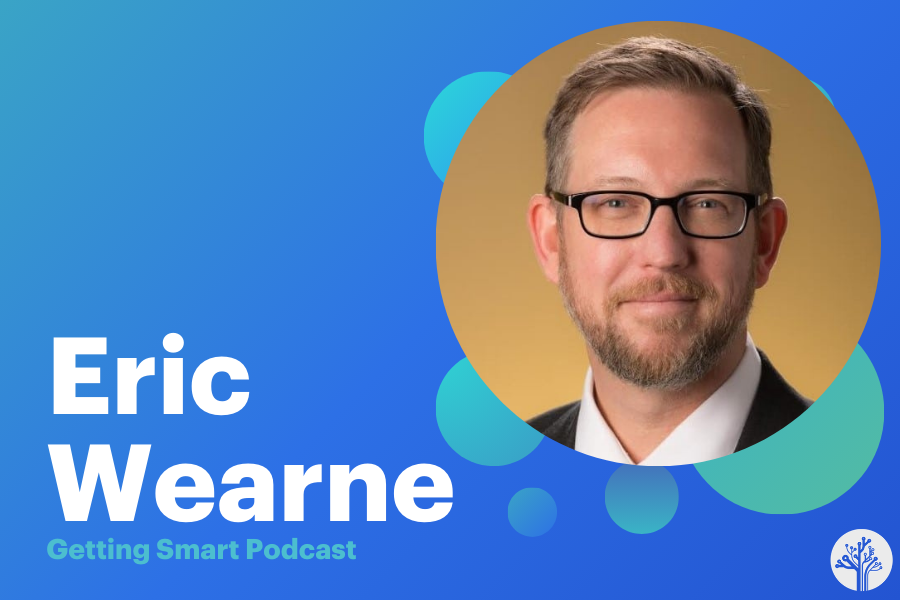
Eric Wearne on Hybrid Learning and the Future of Micro School
Key Points
-
Hybrid models change the operating system of school—especially time, staffing, and facilities—often enabling smaller communities, faster feedback loops with families, and different teacher hiring profiles.
-
Access can be designed, not assumed. Schools and communities are experimenting with support structures on “home days” to address caregiver and equity constraints.
Shownotes





In this episode of the Getting Smart Podcast, Victoria Andrews sits down with Eric Wearne of Kennesaw State University and the National Hybrid Schools Project to explore what research is revealing about hybrid models (often 2–3 days on campus and 2–3 days at home), including facilities and regulatory challenges, who teaches in these settings, and why learner-centered culture matters. They also dig into trust, access, and equity—highlighting creative solutions like support-day staffing and community partnerships—plus how expanded options could reduce conflict and better match learners to environments where they can thrive.
Outline
- (00:00) Introduction
- (03:45) National Hybrid Schools Project
- (08:07) Facilities and Teacher Hiring
- (14:33) Learner-Centered Design
- (18:34) Addressing Access and Equity
- (24:04) Finding and Choosing Schools
Introduction
Victoria Andrews: Hi, I’m Victoria Andrews, and you’re listening to the Getting Smart podcast. Today I have Eric Wearne with me out of the Atlanta area—specifically Kennesaw State University—and the amazing work that he’s doing with hybrid learning as well as micro-schooling. We’re super excited to have you, and we’re going to have a great conversation about innovation in education. We’re going to kick it off by answering a question: How does a former high school English teacher land himself in the economics department of a major university talking about hybrid learning?
Eric Wearne: Yeah. So it’s great to see you, Victoria. It’s a long and winding road, right? So just to give you a quick backstory, a quick origin story: I started out right out of college as a high school English teacher. I taught English and debate for several years at a very conventional, you know, 3,000-something-student school out here near Atlanta.
I went to graduate school, and out of graduate school I started working for the governor’s office doing education policy work here for a few more years. And then after that I landed in a teacher education program as a faculty member, still in Atlanta. And I had always been kind of interested in school choice. You know, I’d been doing school choice work all through graduate school.
But then I really came into this whole hybrid school world as a parent. So my wife and I had started having kids. We had, at the time, two kids, and they were doing fine, right? The school was perfectly good. There’s nothing wrong with it, but we found ourselves being really busy all the time, right?
So we had—every day was sort of like, surprise the kids when they had to wake them up to go to school. They go to school all day, they come home, they do some homework, go to practice, fight a little bit, have dinner, do some more homework, and go to bed—and start all over the next day.
So we thought that was not sustainable, and we ended up having more kids, which it would not have been for us. And so we kind of hovered around this really weird-looking school that only met two days a week. Way back in 2010, we hovered around it for about a year, and then we decided to kind of take the plunge and we sent our kids there. Our oldest one especially was in fourth grade at the time and absolutely hated it at first.
But then after about a semester he said, “You know, I would never switch back,” and he didn’t. He finished that. All of our kids have finished out there.
But back then, you know, I would tell people we sent our kids to a school that only meets two days a week, and the rest of the days they’re homeschooled.
Victoria Andrews: Mm-hmm.
Eric Wearne: And they would say something like, “Well, yeah, that’s interesting, right? I know somebody who does something like that.”
Victoria Andrews: Mm-hmm.
Eric Wearne: But then, as someone who is doing work in education policy, I realized no one’s really writing about this stuff. So I did a couple surveys—paper after paper—things kind of all snowballed. And then in the spring of 2020, I had moved over to Kennesaw State to join the economics department to do education policy work there and start up this National Hybrid Schools Project because the whole field was getting more popular.
And then in March of 2020, what happened? We closed every school in the country, and everybody got really interested in this stuff. So it was very providential timing, right, how I ended up here?
Victoria Andrews: Yes—like live-action research at its finest. All of a sudden everybody goes from, you know, a blip on people’s radar—unless you’re in the virtual learning space too—to everybody just grasping for information.
And so your work at the National Hybrid Schools Project—you guys, you said you do a lot of research, a lot of policy structuring. Can you share a little bit more about that, and then about the convening offerings you allow for people that are in that space too?
National Hybrid Schools Project
Eric Wearne: Yeah, sure. So we basically do three things. At the National Hybrid Schools Project, we do academic research, which is really important. We’re a university research center, and these schools are very under-researched, in part because, you know, the scale of them is kind of new.
Victoria Andrews: Mm-hmm.
Eric Wearne: And also, they’re just kind of hard to research, right? It’s like doing homeschool research of any kind is difficult because you have to find the people, right?
But these schools manifest in all kinds of ways, right? This model of two or three days on and two or three days off can be a collection of homeschoolers; it can be considered a private school. There are some charter school versions. Even some public school—like full-time conventional public schools—do this kind of thing. So it’s tricky, and there’s a lot of stuff to learn about it, right? Who’s doing it? Where is it happening? How does it work?
So we do a lot of academic research on that. We do policy work—mostly not in the sense of we don’t do lobbying or anything like that—but there are a lot of new questions that come up that have practical implications, right? Especially now, right? Forget about 2019—2026 is… there’s a lot of stuff going on.
So what does it mean to be a school? How does your state define you as a school?
Victoria Andrews: Mm-hmm.
Eric Wearne: The teaching pool is very different than, you know, a conventional public school—the kind of person that they’re looking for. You know, there are new bills that offer funding—what are the rules around that? How does that play out with schools? So we do a lot of writing and talking with people about how that is shaking out in real life.
And then the third thing we do is convenings. So we’re about to host our fifth annual national conference here in Atlanta, where we get a few hundred people every year to talk about how things are going in the hybrid and micro-school world. So it’s mostly founders or potential founders, but anyone who’s interested is welcome.
And I think there’s a lot of value in this. Certainly the first couple of years, we would have people come to this conference and they would say, “You know, I’ve had my head down, tunnel vision, running this school for 10 years, and I had no idea there was a school just like mine one county over,” because I was so focused.
So the convenings are great to have people come out and just talk about how this stuff is playing out. We also do kind of more regional convenings too. So the Atlanta one is the big one. But we started going to places around the country—especially places where they’re not known for being hotbeds of school choice, right? So, to Philadelphia, right? We’ve been to—we’re going to Los Angeles soon. And the idea there is, you know, these schools often don’t have huge travel budgets. Maybe they can’t come to Atlanta, but they’re willing to come to somewhere more local, and there’s a lot of value in that.
First of all, just meeting more people who are doing this kind of thing, but also kind of surfacing local issues, right? Like these things operationally play out differently in California than they do in D.C. or Florida or someplace else.
Victoria Andrews: Very much so, and I appreciate your approach to that regional mindset because the policies—like there are federal ones that impact the whole education landscape—but then, like you said, the challenges of California and what’s happening there across the state is vastly different than what’s happening in Georgia, which is different than Philly.
I’m from Texas, so even what’s about to happen in rollout in Texas is different. Meeting the community where they are and their needs is—I just appreciate that level of intentionality by you and your team.
But it’s also—if anybody is familiar with the mindset of most homeschool or micro-school learners or hybrid learning—that’s essential: not just building for the sake of building or a cupcake passion project, but what does the community actually need? So that is amazing. Kudos to you and your team, because that’s a bit of an effort for you guys to, you know, take the show on the road, for lack of a better word.
Eric Wearne: Yeah. It’s fun, though. It’s fun, though.
Victoria Andrews: I believe it. I believe it.
So let’s talk a little bit more about some of those levers that you’re exploring—maybe it’s through some of the work that’s being done through the research that you guys are doing. There’s a lot of—for our listeners that may not be aware of challenges of hybrid learning and micro-school learning—what are some of the key learnings or levers that are being pulled in order for those learning ecosystems to be successful?
Facilities and Teacher Hiring
Eric Wearne: Yeah. Well, there are several tricky things, right? If your listeners have any experience with charter schools, you’ll remember that buildings were a big problem, right?
So with hybrid schools, they tend to be small—maybe not so micro as, you know, a 10-kid micro-school, although some of them are; a lot of them are. But it can be easier to find space in some ways because you need less of it. But it can be harder because, especially now, the regulators are kind of looking, right?
So they’re trying to find: Are you up to snuff in terms of bathrooms and square footage and all these kinds of things, right? So we’ve done some work on just finding out what kind of buildings people are using for these things. It turns out that they move a lot—like anybody who’s a founder who’s listening knows this, right? It’s not normal for a school to stay in one place for the course of its whole life.
And you just have a different kind of expectation for what—you’re not going to have a swimming pool, probably, right? And a football stadium and things like this. So it’s a different kind of thing with buildings.
I mentioned teachers too. So we’ve done some surveys of who teaches and the kinds of people that these school leaders are trying to hire. So we found a couple things. One is, it confirms something that a friend of mine, Sebastian Garrin, who runs a hybrid school in St. Louis, told me, which is: the pool of teachers is just kind of different, right?
Not necessarily looking for someone who is going to college and they’re going to be a teacher for the rest of their life, right? It might be a teacher, but a lot of times what we’re going to find as a person teaching in this school is either someone who did just graduate but is not quite ready to stand on their own two feet yet, and maybe they’re living at home and teaching, you know, 10 hours or 20 hours at the hybrid school.
Maybe you get someone who was a teacher but now has had kids and they want to dial back their schedule a little bit. So they come to school to teach on the days that their young kids are in school.
We get maybe a lot more retired people, right, who don’t want a full-time job and all the work that comes with that. And they’ll get people with just weird—or flexible, I’ll say flexible—jobs, right?
So, like in my own school, we’ve got a guy who teaches who runs a pharmacy, but he comes in a couple of hours a week to teach middle school math because his job allows him to do that, right?
So that’s kind of who they get oftentimes as teachers, because the jobs are more part-time most of the time.We also find, on the other side—on the hiring side—some of my colleagues and I have a recent paper where we asked: Who are you more likely to hire as a teacher in one of these schools?
The key thing that we find is they’re interested in people who have college degrees, which maybe will reassure people, right? But they don’t care so much about education degrees as much as degrees in the field that they’re going to be teaching in.
Victoria Andrews: And that has so many implications when you talk about teacher prep programs—and I know that you mentioned that some of the work that you guys have done as well—so it’s like, that’s totally flipping on its head a lot of…
I know I’m sure you probably went through a similar program that I went through. I had a whole semester of student teaching in a public institution, and I was there from August to December, which was interesting when I graduated to try to find an education job in December, because back then nobody’s hiring a new teacher, no less.
But what are some implications do you think that has for teacher prep programs, knowing that? Because I can imagine what we’re seeing in that space is going to end up trickling to other—like you said—charter schools, maybe even traditional schools. So, what are some ways that teacher prep programs can be a little bit more responsive to the changing pool?
Eric Wearne: I think it would be a good—so I mentioned I was a faculty member in a teacher prep program for a long time prior to this big explosion in these schools, but they were still around.
So I think there’s value in the conventional teacher prep programs giving their candidates some experience with what the landscape looks like, right?
But from the other side, the schools themselves are not necessarily looking for people who have logged, you know, X number of hours observing a teacher in a conventional school. What they’re looking for is someone who is a good fit for whatever they’re trying to do in terms of curriculum and pedagogy.
Victoria Andrews: And that, I think, corresponds with being agile—just, we know that with AI and the increase of the gig economy, which is basically what you’re sharing, that level of flexibility. It’s not just like, “Hey, this is our ideal candidate,” because it’s also, you know, what’s needed at that time.
If a hybrid school is doing something connected to woodworking or more play space that’s more outside, then it’s like, hey, that person that has X amount of time and whatever comes might not be a good fit. Or even, like you mentioned, that scheduling—that flexibility—whether it’s because of having to take… being a caregiver for older generations or even a younger generation.
So just being a more agile teacher is going to be super crucial, is what I’m hearing, based upon what you’re already noticing and some of the things that you’re working on.
Eric Wearne: Yeah. Well, so agility is—so the gig economy is one way to put it. But I think it also kind of works in another way too, in that these schools are kind of creating more tight-knit small communities, right?
So the gig economy kind of implies that you’re kind of in and out, right? And you’re actually, in some ways, the opposite of that, right? Because you’re all in on whatever this pedagogy is, whether it’s some kind of Charlotte Mason work, or outdoor stuff, or art, or robotics, or classical education, or whatever it is, right? That kind of draws—even if you’re maybe there less—it kind of draws you together as a group more.
Victoria Andrews: Thank you for clarifying that too. And yeah, when I was mentioning less—yeah, not just like, “I’m doing this class this one time in the semester,” but there are more shared commonalities there.
Eric Wearne: A part of something, right.
Victoria Andrews: Exactly. A smaller group.
For our listeners that they know here at Getting Smart, we’re super fans of learner-centered ecosystems and programs. Can you share a little bit about how you distinguish between the designs of being truly learner-centered and those that kind of optimize for convenience that we kind of see in different-level environments, regardless of if they’re hybrid or even traditional?
Learner-Centered Design
Eric Wearne: Yeah. Well, there’s a big continuum in how these hybrid schools operate, right? So if you think of micro-schools kind of innovating on the dimension of size, the hybrid schools are innovating on time—on their use of time. Right? So in some schools—well, in most schools—what’ll happen is you’ll go, say you go to school on Monday. On Tuesday, you’ll have some kind of online lesson, right? Most of the time that’s asynchronous. It’s just kind of a list of things to go through during the day, right?
Some schools are very scripted about that, right? So they’ll give you a very detailed list of what you need to work on on the home days so you’re ready the next time you come back to your physical school, right?
Eric Wearne: Others are more wide open, and they’ll say, “Well, you know, this week we’re working on bugs, so on the day that you’re home, do something about bugs.”
Victoria Andrews: Yeah.
Eric Wearne: And everything in between. So I think that’s kind of where the learner-centered aspect comes from: the culture of the school, right? So some of them are hybrid—they’re still kind of closer to being a structured school—and others kind of let go a little more.
Victoria Andrews: And are you seeing—what are some of the learnings, not just based upon some of your research, that is happening from both those founders as well as those families that they’re in service to with that structure that they’re opting into and fully committing to?
Eric Wearne: Yeah. Well, I’ll tell you a couple things. For myself personally, I mentioned just not feeling like I’m in the rat race, right? I have a slower pace of life now, which is great.
Eric Wearne: But there’s other stuff too, right? We—there’s some research, and I’d like to get more into this at some point in my life—if you think about how I’ve described this, right? You go to school a couple of days a week and you’re home a couple of days a week; you’re kind of managing your business on the days that you’re home. That sounds a lot like college, right?
Eric Wearne: What if you started that when you were, like, in kindergarten? You learned how to regulate your time and take care of your responsibilities before you got to college, right?
So I think there’s some evidence that says the kids who graduate from schools like this are a little more prepared to self-regulate when they get out, right? So that’s one thing that we’ve learned.
Another one is that we are going to start looking into soon is kind of the mental health aspect, right?
Eric Wearne: So there’s some value in just being in a smaller institution, right?
Victoria Andrews: Yeah.
Eric Wearne: But I know—I mentioned I’ve interviewed people like this—real students who will say, “I was really stressed out going to my five-day school. When I went to the hybrid school, it really saved me,” because I could take a day every other day, right?
Like, I would go to school and it would be stressful, but then I would go home the next day and decompress and do my work. I’d be okay.
So I think there’s more to kind of pull out there in terms of how these small schools are able to help kids with the stress of school, right? We know that their mental health deteriorates every August, and there’s a reason for that.
Victoria Andrews: Yes.
Eric Wearne: Right. But we can help with that.
Victoria Andrews: Yes, and I’m glad you brought that up—just that mental health aspect. Just like you said, that self-regulation, being in small environments—we’ve seen even components of this in more traditional learning environments by just having, whether it’s academies or pathways or whatever it’s called, just knowing that there’s a small group of even a hundred people that kind of know you, as opposed to—I’m from Texas—so comprehensive big schools, you know?
But also, for our listeners that might be hearing this and say, “All right, Eric, I’m on board. I hear you. Value the mental health aspect, the flexibility of the staffing model. But what about if I’m a caregiver and I hear my kid is going to be home, or I need to have some kind of family structure that supports two to three days at home?”
Like some people might say, “Well, you know, where’s the equity in that, and how do I balance against that?” So what are some encouraging words or some insight that you might be able to share for people that are sitting at that crux of like, “I want this, but…”
Addressing Access and Equity
Eric Wearne: Yeah. Well, I’ll say a couple things, right? And those are real concerns, right? That’s a real thing.
So the easiest one I’ll say is: the tuition tends to be lower at these schools because they’re part-time, right? So that helps a little bit.
But the time aspect is important, and the caregiver aspect is important too. So if they’re older, maybe they’re okay to be home alone while mom or dad or both have to be at work all day long on Tuesday and Thursday, or whatever the days are.
So that’s a real thing for younger kids who can’t have that.
I’ve heard some schools experimenting with this kind of thing, right? So, for example, because of the intersection of their homeschool law and their independent school law and their charter law on the West Coast, there are a lot of instances of charter school versions of these things, right?
Eric Wearne: So they may have hybrid programs where they meet a couple of days a week, but maybe on the off days you can be home if you can. But if you can’t, the school will have kind of a smaller crew there to kind of guide you through— not teach you like a normal class, but you’ve got your work, and they’re there to kind of help you through it until you can get picked up from school or your parents are home to go back.
So that’s one way people are kind of thinking about it.
Another way that I’ve heard is a group of churches who came together in a rural area who said, “You know, none of us are big enough to host one of these things. We’re a big geographic area. What we’ll do is maybe on Tuesday and Thursday we’ll have classes at the biggest of our five churches, right? That’ll be the class days.”
And then on the other days, the kids can either stay home or they can come to one of these other four churches, and we’ll have some volunteers there to kind of take care of them and watch over them and help them—like the charter school would.
So people are creative, right? But that is a real concern for people who need support, right?
Victoria Andrews: Yeah. And it just reinforces that, like you said, that shared community. Like, if we’re both caregivers—whatever end of the spectrum of caregiving that is—but I know that, hey, you’ve got a young person, I’ve got a young person. We can be flexible.
And just hearing the innovative approaches that people are taking to make sure that their young people have the same opportunities and that choice—where it’s not just, “I’m going to default to this,” even though it may not be best for not just the young person in my family, but even for us as a family too.
Eric Wearne: Right, right.
Victoria Andrews: I would love to hear more about those different specific schools too. If you could—well, we can grab them and just drop them in the show notes afterwards too.
Eric Wearne: Yeah. Yeah. I mean, there are interesting things all over the place, right? There’s even—so there’s a public school district in Tennessee, in a rural part of Tennessee, who said, “You know, we are in a place—we just have this huge homeschooling population,” right?
If the average is, you know, 5%-ish around the country, they were closer to 20. And so they’re like, “What do we do to bring these people in?” And the public school system started a hybrid program—
Victoria Andrews: Mm-hmm.
Eric Wearne: —where they would do the same kind of thing where the kids could come on those school days, and then they could either stay home or get support.
So there’s a million different answers for how you could handle that kind of thing.
Victoria Andrews: And just the example of that private and public partnership—I just feel like with different teacher shortages across the country, we’re going to see more institutions that may not have played nice historically working together because—and I believe this in many situations—there are more commonalities of ways to address problems than there are, you know, enemies against that problem.
And what I also heard when you were talking was just this level of trust that families have to have for those hybrid programs. It seems to be a little bit different than maybe your more traditional learning ecosystems. So what specific designs or redesigns do you think that other institutions can learn from these, like building in those specific grounds of trust?
Eric Wearne: Yeah. Well, I think part of it is you just have to find a place that you’re comfortable with, right? So that’s part of it.
In the public school hybrid that I mentioned from Tennessee, people were skeptical at first, right? But then this whole field really is kind of like word of mouth in a lot of ways.
You know, before COVID you would hear, “Yeah, I’ve heard of one of these kinds of schools. Maybe my neighbor goes to one of them.” But over time, what you start to see is, “Yeah, my neighbor’s kid goes to one of these, and he seems to be turning out okay,” right? Or, “My niece went to one of these, and she’s not too weird,” right? Like, she’s doing fine.
So I think a lot of it is just kind of finding your place, because the beauty of it is it’s not trying to solve for every single problem in one institution, right? You’re solving it in smaller places all over the place, right?
So instead of one building having to fix every kid’s issue, you know, other ones are more easy to start up and kind of help individual needs.
Victoria Andrews: And how do people move beyond the word of mouth, like you said? What are some ways that we’re seeing across the landscape for caregivers and parents looking into alternative or just other options when it comes to education for their young people?
Finding and Choosing Schools
Eric Wearne: Yeah. There are some websites that are coming up. There are some networks that are starting to come online since COVID. So groups like Prenda and KaiPod and all these kinds of things—and Primer and all these things—didn’t exist five years ago, even.
Victoria Andrews: Really?
Eric Wearne: Yeah. And so that helps word of mouth spread faster, right?
Eric Wearne: And then I think a lot of it, honestly, is—it literally is still word of mouth, just because there are more people, right? There are more kids on your street who have done something different, and you see, well, maybe I won’t do that thing, but I could do this other interesting thing that I like more.
So I think it’s spreading, although, you know, we still are in the very early stages. I was hanging out with a group of my friends from college in the fall who live all over the place, and we were just talking about how things were going. And I was telling them about my work with hybrid schools and micro-schools, and they were all parents but not really aware of the landscape, right?
So I think the market still has a long runway before it’s really—you know, maybe you don’t see it that way. I don’t see it that way sometimes because I’m in it all the time.
Victoria Andrews: Exactly.
Eric Wearne: But the market is bigger than what we’ve reached so far.
Victoria Andrews: It’s so funny you mention that. I have a group of friends—girlfriends—and they’re educators in various aspects: some private institutions, some public institutions. And I’ll bring this up, and I remember one of the parents was mentioning like, “Hey, I might send my kid to school three days a week.”
And mind you, we’re all educators, and their brains were—I mean, particles were everywhere because they were just blown away.
Victoria Andrews: They’re like, “Well, what you gonna do the other days? And what is—” And I was like, “Actually, guys, it’s okay. This is another option.”
So with that, Eric, who do you think has the biggest lever in making known the other options and the ways that people can be engaged in learning? Is it policymakers? Is it more families? Or is it school founders? Of course, we don’t all want all the power to lie in one person’s hands, but who do you think could help really accelerate all of the different offerings that are out there?
Eric Wearne: Yeah, it’s a tricky question because the policymakers are always—you know, their hearts are often in the right place, but they’re always going to be behind, right?
Victoria Andrews: Yes.
Eric Wearne: Because there’s a million things. They’re all edge cases, right? Everything’s gray. Every area—every school—is an edge case in one way or another. So you can’t really solve for all of them. So I don’t think they’re the answer.
I think the best move for policymakers, just generically, is to not break things, right? So that’s, I think, the best way for them.
But who has the best lever? I mean, it really is a matter of kind of your desires in your social circle and the kinds of things that you like, because the schools that pop up are so different, right?
So a lot of times it’s church communities.
Victoria Andrews: Mm-hmm.
Eric Wearne: Also, you know, by tech groups, right? Like kids who are into robotics. Arts, right? And these things are started by, you know, like arts studios sometimes, right? Or by churches, or by just a person who says, “You know, I’ve taught for a long time. I think I’ve got this figured out, and I could do it for a small number of kids.”
Victoria Andrews: So the—
Eric Wearne: —levers are all over the place. It’s more about your desire for what you want out of life for your kids, right? Like, how do you choose anything else, right? How do you choose where you shop and what movies you watch and what you do for religion—all these kinds of things, right? School’s kind of the same thing.
But we’re so used to like, “All right, who’s going to tell us what I get to pick from?” Right? Nobody gets to tell you—just pick, right? You just do it, right?
Victoria Andrews: And I think there’s a thing as decision fatigue. It’s very real. It’s like, “I don’t know.” And if you give a menu—
Hold on. I’m going to repeat all of that. Okay.
Eric Wearne: Good.
Victoria Andrews: I love my hotspot too, so that’s like—
Eric Wearne: Oh, okay.
Victoria Andrews: Yes. The television—it’s—
Eric Wearne: It’s mostly fine. It’s mostly fine, but then you get glitchy once.
Victoria Andrews: Yeah, exactly.
Yes, like families do want—decision fatigue is very real. Like, they want a menu of options, and they want even kind of like a concierge of sorts to say like, “Hey, this is the benefit of this, and this is the benefit of that.” And the default setting is like, “I just want somebody to tell me where to go or what to do.”
And so I think even for parents, that identity shift is like, “Hey, I’ve got—I’m one of four, and everybody can’t go to the same space or same learning. Everybody needs something different.”
And some families are more accustomed to that, whether because they have an elite athlete or because they have a young person that has intellectual learning disabilities. And so they become accustomed to like, “Let’s choose based upon what’s going on.”
But for, I think, the greater swath of families, that’s not been the case. And so learning that, “Hey, I do have more options than just what’s around the corner,” or just choosing a random virtual school because I did a Google search on virtual learning.
Eric Wearne: Right, right.
Victoria Andrews: Like, I have to put in a little bit more work, and I’m going to have to learn my young person, and I’m going to have to learn about this possible institution that I’m going to trust with one of my most prized possessions, which is the education of my children.
Eric Wearne: Yeah. Well, that gets to what I was going to say, which is that it also feels like a really high-stakes decision, right? Because it is, right?
But think about that for a minute, right? The way we normally get what we want out of, say, a big conventional school is you turn over the school board. But that takes a minute, right? That takes a minute, and your kid doesn’t stop aging while you work on that, right?
Victoria Andrews: Exactly.
Eric Wearne: So that’s kind of an argument in favor of popping up new schools a lot more quickly, having them be more responsive. And then think about that: in a hybrid school especially, the parents are closer to the classroom than almost any other kind of school other than full-time homeschooling. So the feedback is much faster.
That is closer to the school.
Victoria Andrews: Yeah. Eric, you’ve given me so many different things to think about and consider.
For our listeners that are school leaders, parents, policymakers: I would say 10 years from now—the way that the world is moving at such a rapid pace—three to five years from now, what would you hope a listener would say hybrid school or even an alternative learning structure has helped them rethink about education?
Eric Wearne: Yeah. Well, I’ll say a couple things. I’ll say first: you know, if these continue to expand, one of my hopes is that we’ll say, “You know what? We used to fight all the time about what books we were going to read in school and what school was going to look like. But now we don’t fight so much anymore because we just go pick.”
Victoria Andrews: Mm-hmm.
Eric Wearne: And then we see each other, you know, at the football game, and we’re good because we’re not fighting all day long, right? So that temperature has turned down a little bit.
And in the meantime, I’m not so stressed because I found a place that—I’m not fighting with the school all the time because I’m part of a smaller community that kind of reflects what I want out of life and what I want my kids to get out of life. And my kid’s not so stressed out because they love it too.
Victoria Andrews: Those are—like, who doesn’t want those wishes for their young person and their families, just to live a more community-centered, human-centered existence, especially right now.
Thank you so much for this conversation. You’ve given us so much to think about. If you are in the Atlanta space in April, what are those dates again?
Eric Wearne: April 23rd–25th, 2026.
Victoria Andrews: Please stop by and join the National Hybrid School Learning Conference. It’s going to be amazing workshops, and you might find some other like-minded individuals.
Thank you for this conversation. Thank you for just really challenging and pushing our thinking. And we hope you guys join us for another conversation soon. Thanks.
Eric Wearne: Thank you.
Guest Bio
Eric Wearne
Eric Wearne is a Visiting Associate Professor with the Education Economics Center at Kennesaw State University. He was previously Provost at Holy Spirit College, Associate Professor of Education at Georgia Gwinnett College, and Deputy Director of the Governor’s Office of Student Achievement in Atlanta.
Dr. Wearne’s research work focuses on education policy, school choice, and the history of American education.
Links

0 Comments
Leave a Comment
Your email address will not be published. All fields are required.