


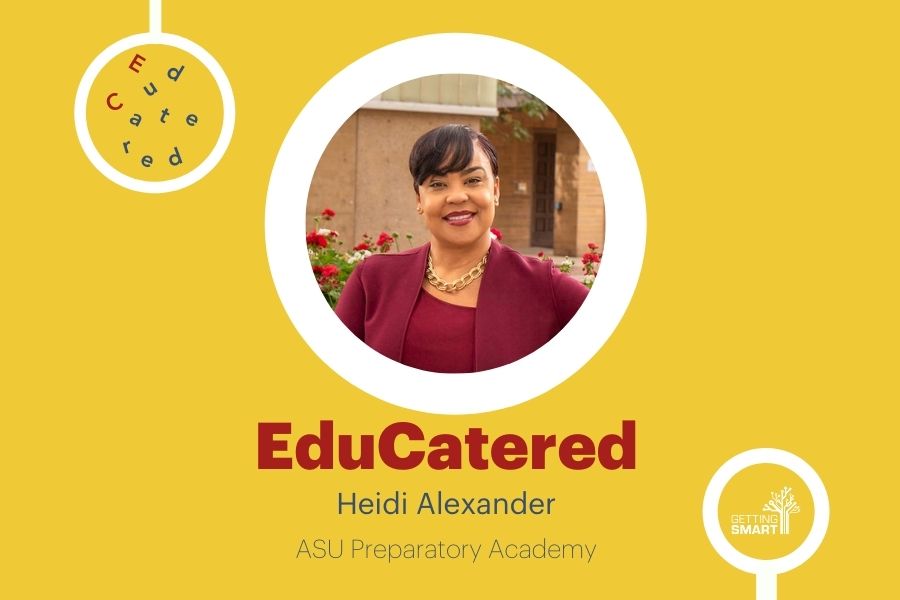
EduCatered: Heidi Alexander
Key Points
-
Model as a leader how you create relationships. Walk across the street and meet with the community.
-
It’s essential that students feel embraced and included and that they know how to include others.
Thank you to BetterHelp for sponsoring this episode. Speak with an affordable, licensed therapist at your convenience and save 10% on your first month at BetterHelp.com/GettingSmart.
On this episode of EduCatered we’re joined by Heidi Alexander, Founding Principal at ASU Preparatory Academy – Pilgrim Rest Elementary.
We love getting to work alongside ASU Prep in a number of ways and are always blown away by their incredible innovations and most of all… their incredible people. Heidi is one of those amazing individuals. Alongside her team, she keeps ASU Prep Academy at the center of their community.
Let’s listen in as they talk about food, belonging and how to best communicate with families.
On Student-Centered
I want the children to see themselves right in the curriculum, on the walls, all over their learning environment and I also want them to see others unlike them.
On Leadership
You have to lead with honor and respect for the community. I’m not on top or in front or above — I’m among.
This post includes mentions of a Getting Smart partner. For a full list of partners, affiliate organizations and all other disclosures, please see our Partner page.
Transcript
This transcript has not been edited for spelling accuracy.
This episode of Educator is sponsored by BetterHelp. The last few years have taken a toll on everyone, and lately, Teacher Burnout specifically has been making headlines. Teachers, we’re talking to you.
If you’re feeling overwhelmed, depressed, stressed, or anxious, BetterHelp is here to help. This service, used by over 2 million people, offers licensed therapists that are accessible, affordable, and highly personalized to fit your needs,
lifestyle, and schedule. Special offer to educator listeners, you can get 10% off your first month at betterhelp.com slash gettingsmart. That’s better, H-E-L-P dot com slash gettingsmart.
Thanks again to BetterHelp for sponsoring this episode. Hey, come on in. Welcome to Educator, a podcast that’s catered to educators. I’m your host, Shani, and gettingsmart, food, education, and innovation
are at the heart of our recipe. This podcast mixes it all together to get to know teachers that are doing the work and making a difference. We start with the appetizer.
What makes these educators unique? Then to the main course, stories and experiences that have helped to shape their practice. Finally, dessert, some tips for what you can do next, creating a future of learning that works for everyone.
Let’s dig in. Hey, it’s Shani. Today, I’m thrilled to be joined by Heidi Alexander, founding principal at ASU Preparatory Academy. We love getting to work alongside ASU in a number of ways
and are always blown away by their incredible innovations and most of all, they’re incredible people. Heidi is one of those amazing individuals. Alongside her team, she keeps ASU Preparatory Academy at the center of their community.
Heidi, thank you so much for being here today. Thank you, Shani. It’s an honor to make this my first podcast and to talk with you today. Yeah, well, we’re so glad that you chose us
for your very first podcast, and we’re excited to hear about all the great things that you’ve been up to. One of the most, we’ll call it one of our most favorite things, that we like to talk about and getting smart.
Besides education, of course, it’s food. We love food. We have some certified cooks on staff. But Heidi, if you were to contribute a recipe to a cookbook, what would it be?
Boy, it’d have to be between my lentil soup or my fried chicken and sweet potato honeywaffles. So let’s go with the fried chicken and sweet potato honeywaffle. I’m a little bit like Emeril, so about a bing, about a bang. Not too many measurements,
but I just used the good old Bisquick, right? Waffle mix, but what you want to do is add about a third of it. You can cheat if you want to and use Princella sweet potatoes and that syrup. Now, y’all know what I’m talking about.
You’ve seen this in the store. You’ve seen this in your mama’s kitchen. And if not, you need to see it. These are the prepared sweet potatoes and maybe put about a third into the waffle mix
and cook the waffles. Now, the honey part comes in when you just make a honey butter, right? Nothing fancy, just your butter. And you kind of mix that in with some raw organic honey. And that’s what you really glaze your waffles with.
And my family loves this, and I only cook it once a year. And that’s Christmas morning. And then as far as fried chicken, I go simple, right? I don’t use a fancy batter. I make sure my wings are clean, burn off those feathers
if they are any. Got to make sure. Now, if your mama didn’t tell you, I’m telling you now. And then, yeah, I put that fresh raw chicken into a little Ziploc bag that has some all-purpose white flour.
I did say white. It could be non-bleached. I have evolved with a little bit of lorry seasoning salt and some pepper. Make sure your oil is at 350, everybody. I learned that the hard way with some raw chicken over the years.
So you want to make sure your temperature for frying it. And they’re in there about 15, maybe 20 minutes. Make sure it’s GBD, baby. Put it right on top of that waffle. It’s time to eat.
Oh, my God, speaking of, it’s time to eat. That sounds yummy. And now I just want to go make that. Thank you for that very timely and tasty sounding recipe. And in the recipe, you talked about keeping it simple,
keeping it sweet, kind of honoring some of your traditions with the fried chicken and some other pieces. What is your diversity? What is kind of the mix that is Heidi? So that’s funny.
You’re probably saying lentil soup and then fried chicken. That’s probably a representative of my ethnic ethnicity. I identify and I am an African American woman, first and foremost. That’s at the front of my identity. But that’s supported by a multicultural piece, right?
I come from a family where my grandmother was Danish. She spoke German to me. My mother was born in Germany to my grandmother and grandfather, who was a white curly haired Dane at the end of World War Two, who met this handsome chocolate, tall,
Mississippian from the United States. And then, man, there’s a part of my ethnicity. So anywhere in family time, I could have broccoli, toffin and goulash and lentil soup. And over the weekend, I’d be over at Papa’s house.
And, you know, he loved his fried chicken and Pepsi. That’s what I have to say. Well, no, that’s really wonderful. You come from just a very diverse background, which I’m sure probably influenced your desire,
maybe to go into education, just kind of to help a whole lot of different kids. So why education? Well, that’s a big question showing. And I think the longer I’m in education, the more I’m clear of that. Why, right?
When I first started out, it was just a natural inclination, right? Loved English, started out as a high school English teacher. And as I moved into leadership, I understood that that purpose was much more broad and more personally driven. And my house, my mother didn’t talk about college or education.
She didn’t have the time. She was a single mom dealing with undiagnosed and treated mental illness, raising two babies in New York. But I knew education was important, even though she said never said a word about it, right? And in the midst of our poverty, she tried to pursue her education
by going to college after her second job, which was driving taxi. And then she’d leave her first job, pick me and my little brother up. I was responsible for watching him in the front of the taxi. And then after that job, because I sure was tired, so I know she was. We went to Adelphi University and she attempted to finish her degree.
And I said, as a kid, this school thing must be important because I’m tired. Why are we here after all of that? Mom needs to rest. And I think that just embedded in me that education is worth fighting for. So you you talked about just kind of the SEL component of, you know,
that your mom was dealing with. How does that influence your work with SEL today and students? I think I’m definitely sensitive. It’s at the core, right, of my conversations with teachers and staff as an educational leader and continual teacher and learner.
I’m concerned and pay attention to the mental health of my teachers, my staff and students. And we walk in that conversation with kindness and respect and empathy and also making sure that information is available and opportunities are available for everyone to truly share.
How are you doing today? Right. Yeah, sometimes it’s just that simple little question that’s so so key. And you talked about education being worth fighting for. And another thing that’s worth fighting for is making sure that kids feel
like they belong and fostering that sense of belonging. So how does that contribute to your practice? Oh, that’s huge, especially in building ASU prep pilgrim rest. I want the children to see themselves, right, in the curriculum, on the walls, all over their learning environment.
And I also want them to see others unlike them and that we openly recognize and talk about those differences and the beauty of what they see in that inclusive environment so that, you know, once once my babies leave me and they move on to higher heights and post-secondary education, they’ve personally embraced and felt included.
And they know how to include others, right? So that also means in conversations and in staff development, right? That is not just about race and ethnicity inclusiveness. It’s about socioeconomic inclusiveness. It’s about family composition, inclusiveness.
Some of my life I was raised by a foster family who were Jamaican. They were Caribbean. So if my teacher read a book about a mom and a dad, that wasn’t my home life at the time, I had a different family as opposed to parents. And also my mother was disabled.
She had polio, always had four inches shorter of a leg. And to me, I never knew that was a disability in addition to her mental health disability. That was just mom. She walked with a wobble. It was a nothing deal. Yeah. And I want our kids exposed and us to be intentional
about our environments, that all of that’s included. So in your environment at Pilgrims Rest, you will be serving lots of different kids as well. What who will you be serving in your community? And can you just tell us a little bit about Pilgrims Rest?
Yeah, Pilgrims Rest is nestled in a beautiful historic area called East Lake Park. It’s traditionally African American. It’s historical because Dr. King spoke at a church right across the street down the road from our school. Pilgrims Rest itself is a prominent African American church
that welcomes all races and ethnicities. But it’s known to support the African American diaspora here in Arizona. And I say diaspora because everyone’s spread apart. But in this community where our school is in Pilgrims Rest is
everyone can come together and fill that strength and support. And we want our students and families to fill that as well at our school. And right now we’re looking at about 85 percent of our school community is African American or Black and 15 percent are of mixed race. Whether and that mixed race is with Black and another race.
Black and Latin Nets, Black and White, etc. Yeah. So how do you lead this kind of diverse group of students and teachers and community leaders and historical kind of purveyors, I guess. How do you lead? You have to lead with honor and respect
for the community, the assets of the community and make sure you bring that into conversations, the program and everything that you do. You also lead alongside people. I think you started our podcast with that when you said that.
I thought that was interesting, right? I’m not on top or in front or above. I’m among and our community, they’re leaders. And it’s my job to identify the strengths of every stakeholder and bring that into everything that a issue prep pilgrimage is and can be.
And just keeping side of the small goals, right? That make up that larger goal, which is an excellence, right? And education for all of our students. Now, when we talk about equity, we always talk about like who’s not in the room, really recognizing it.
And you’ve been very intentional about ensuring that all voices are in the room, that all people are represented from your community. And when you don’t have someone, you keep searching and using your network until you find it. Why is that so important for you to be so intentional
about having your community truly represented in your work? I’ve definitely felt voiceless in my pursuit of education and while being educated from K-12 experience and especially in post-secondary. Also being the only black woman, African-American in the room sometimes and at decision-making tables.
I know how that feels and I know how important it is. And I also know how challenging it is. And how much there’s an absence of intention to include voices. So I think that’s behind my fight for everyone and making sure and checking myself and my own biases, right?
That, okay, African-American voices are at this conversation and planning session, but who else am I missing that may be unlike me, right? And that at times can be an unnatural reaction and action that we all, especially in education, have to make sure we’re checking ourselves and are ensuring. When there’s an absence of voices, we are presenting an incomplete model
for children to be educated in. Yeah, well, speaking of this model and you’re new to creating Pilgrim Rest, and I’m sure you’ve had lots of aha moments over these last months during this process. What is something that you’ve changed your mind about recently? That’s a good question.
I would say two things. It’s okay and be unafraid to be unapologetic for the voices that haven’t been heard as much. And I’m talking specifically about African-American voices. And by being unapologetic, I heard from someone that I really respect that to uplift one group does not diminish or squash another, right?
And that gives me strength and whereas before, I would be a little more shy, believe it or not, of speaking up for people of color and specifically African-Americans because of that, right? And then two, rethinking the relationship that in the past, I thought church and state had to be separate. I’m in a public school setting, won’t be any praying up in here. Oh my goodness, is that a picture of Jesus at the, you know, last supper and we have to separate and,
oh no, the pastors, they can’t have a say in what we do in our public schools. But I have learned better. It is because of the lack of separation of church and state that ASU Prep Pilgrim Rest is thriving right now and its enrollment, that it will thrive, that it will provide rock-round services, connections, that the public school sector just doesn’t have with the community.
And if we haven’t learned anything about these last few years, about the importance of SEL, the importance of engaging the community meaningfully, that in my point can only be done by embracing faith-based and community organizations, inviting them in instead of pushing them out. Yeah, and you’ve done a really, really great job at that. ASU are thinking and rethinking, what is something that you wish more educators would rethink?
How we communicate with families and that it may not look the way you think communication should happen between families and teachers or families in schools and being open to making sure we’re meeting families where they’re at. And that may mean I need to text you as a teacher. Healthy boundaries are great. I don’t want my staff and teachers burnt out, but by any means necessary, communication needs to happen. So let’s make it happen and let go of some old paradigms.
How do you do that? How do you let go of those old paradigms when you’re, I mean, you’re right. Some people are just used to doing things the way they’ve always done it, but we also need to use more personalized approaches with our families based on their needs. So how do you do that? You have to push. You have to push and be unafraid to say,
have you connected with this family and be willing to not accept I’ve emailed them or examples of one-way communication? You have to be willing to say, let me go with you on your prep. Let’s get in my car. We’re going to go over to, you know, the Smith family house, the Alexandria’s or the Venezuelans. You have to also model that, right? And share with your staff how you as a leader create those relationships, right? I want them to see me walking across the street to Little Valeria’s house because I know Dithi and Grandpa are across the street,
but I can’t get ahold of them to get this piece of paperwork and I’m going to walk across that street because I can and that’s the best way to reach our families. Absolutely. Knowing your community, knowing where you live and knowing those voices in your community. Who is one voice or two voices in your community that you will recommend educators check out? I would love for our educators to check out one in general, just elders. I’m learning more and more of the value of the stories and the wisdom of elders.
And I learned that from Mr. C right here in Arizona, former educator, and he was educated at Booker T. Washington High School, the segregated high school in Arizona. It’s celebrated now not because it was segregated, but because of the strength, because of the identities of students that are during the halls, the intentionality of hiring HBCU grads with master’s degrees. Today we call them highly qualified. And the intention of students starting their day with singing, we shall overcome. When he shared all those pieces with me, it helped me to build some blocks of our current school, which is we will start with affirmations.
We will sing lift every voice. We will work hard to hire staff and teachers who look like our children from HBCUs who can love up on all the children and make sure that they thrive. So check out an elder today. It’s amazing. Yeah, absolutely. And how do you think the elders will help to contribute to your daily environment once school opens? That’s still a work in progress, but they will definitely visit. I have a list, you know, and invitations ready for readers. I really would love the elders to talk with staff. I think it builds the story of place and time for folks who may not be from downtown Phoenix, and that includes me.
Right. So, yeah, making sure we have lunch and learns. Coffee with the principal and an elder available for our families and parents, right, who are still learning how to be parents, right? That’s not easy. So those are some of the ways we’re excited about. Well, we’re excited about you, Heidi. We’re excited about Peele and Rest. We’re excited about the work that you’re doing within your community and how you’re really being very intentional about knowing the kids and the people and the elders that are in the community. And we’re excited about what you’re serving because you’re giving real purpose to that community and the children are truly going to benefit from it.
So thank you so much for taking the time to talk to us today and sharing your thoughts. We truly appreciate you. Thank you, Shawnee. Can’t wait to hear how your waffles turned out. Absolutely. Thanks for tuning in today. We hope you found this conversation inspiring, illuminating and actionable. We love getting to talk with our wide range of guests about what makes us unique, alike and connected.
Know someone who will make a great guest on the podcast? Email Mason at gettingsmart.com and don’t forget to subscribe wherever you get your podcasts. It really helps to get more people around the table. Bon Appetit!





0 Comments
Leave a Comment
Your email address will not be published. All fields are required.